The Difference Between Efficient And Effective

effective-efficient.png

Friday, 6.04pm

Sheffield, U.K.

If you can’t describe what you are doing as a process, you don’t know what you’re doing. – W. Edwards Deming

Anything you do can be represented as a process. You take something that’s in one form, an input, and transform it into something else, an output. It’s easy to visualise this with real-world examples such as transforming rubber into tyres but it also applies to more abstract concepts such as transforming data into insight. You can think of a process as representative of real things – that machine, that conveyor, that material – or as representing mental models – ways of seeing the world.

There are two things that are important for a process. Objectives tell you what you’re trying to achieve with your process. Resources are what you have available to operate your process. The distinction between inputs and resources is because inputs are transformed into outputs and move on while resources stay or are exhausted in the transformation process, such as the use of energy.

And this brings us to the difference between an effective process and an efficient process. You might think that these must be the same thing, but the diagram above is a nice model of the difference between the two, which I first saw in in this webinar by Andrew Wright.

An effective process is one where the output meets the objectives that have been set. In other words, if the objective is to make a box you make a box and not a vase. An efficient process, on the other hand, is one that makes the best use of resources. You minimise the amount of time, effort and cost that goes into making that box. This is a simple and clear way to understand the difference. There’s no use efficiently doing the wrong thing. Doing the wrong thing better does not make it right.

What we should do is make sure that we clearly understand what the objective is and then go about achieving it in the most efficient way possible. If we do that, we will be effective.

Cheers,

Karthik Suresh

How To Think About Different Kinds Of Systems

types-of-systems.png

Thursday, 6.44pm

Sheffield, U.K.

The way to build a complex system that works is to build it from very simple systems that work. – Kevin Kelly

One of the amazing things about the Internet is that things that were lost are finding a new lease of life. The Open Library, for example, will introduce you to books that you won’t find in your library or on Amazon. And YouTube lets you see things like this lecture from Russell Ackoff which gives you a logical proof for the existence of God.

Then replaces one God with another.

One of the things he talks about is the concept of systems. Many people argue about this, especially on social media so it’s useful to reflect on Ackoff’s definitions of systems.

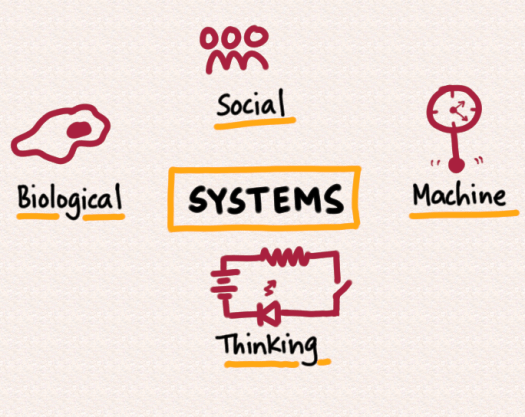
First there are machine systems, things like planes, trains and automobiles. These are mechanical and operate in known ways, what they will do is entirely predictable. A clock will tell the time, now and in the future, in the same way. In fact people thought of the universe as a machine for a long time and if there is a machine there must be a maker, therefore there is a God.

Then we have biological systems, of varying levels of complexity – amoebas to animals. These differ from machines in that their behaviour is not always predictable, they have a purpose, which in many cases is to survive and reproduce.

As creatures get more complex and get bigger brains, you get social systems that emerge from interactions and behaviour. Humans have very complex social systems, which include things like financial systems and healthcare systems, but we shouldn’t forget that bees have social systems as well.

Then Russell pointed out that we’ve been creating a new kind of system, Early machines did things, but then we added the ability for sensing and feedback and started making machines that responded to their environments. I don’t understand this concept entirely but heard the term “Thinking” machines. I think this refers to the ability for a machine to sense its environment and change its behaviour – imagine your automatic vacuum cleaner or a self-driving car. These are doing things that look like thinking, observing and changing behaviour after working out what to do.

Leave the last type of system for a bit, it probably needs more time to really understand. The mistake we make is that we confuse the way to think about one system with a way to think about the others. Machines are great for what they do. If you want to make things efficiently using machines you need to think in one kind of way. The same way, however, will not be useful if you think about social systems. For example, in Western societies, there are few people and so they use lots of machines. In poorer countries there are lots of people and using machines would put them out of work. Someone who believes that it’s more efficient to use a machine to make a road may not notice that it’s not efficient to put people into poverty at the same time.

We also make the mistake of thinking about biological systems as applicable to everything else. We see nature “red in tooth and claw” and imagine that competition is the way things are – we must compete in order to survive. But a social system is about more than that – it can be about cooperation and care rather than control and power.

But if we want to get better at living with the world we have we have to get better at thinking. We need more thinking machines, ones that tell us how the world is warming and how we can be more efficient in the way we use resources. Too many of us are still caught up in machine thinking or biological thinking. What we need to do is get better at Systems Thinking.

Cheers,

Karthik Suresh

What Does A Learning System Look Like For The 21st Century?

learning-system.png

Wednesday, 8.33pm

Sheffield, U.K.

Research is formalized curiosity. It is poking and prying with a purpose. – Zora Neale Hurston

What do you think knowledge is these days? Is it about a fixed thing that you get and keep? Or is it more complicated than that? In a world where what we know seems to keep changing, perhaps it’s us that change and find new things to know?

I think knowledge was once seen as fixed, as revealed, as a thing that was found and passed on. We now know that there are many problems with that kind of thinking, but we’ve not fully worked out what the replacement is. Some people find refuge in fixed thinking, because at least that provides stability rather than being tossed along as the world becomes ever more confusing. But we can make a start at trying to deal with this new knowledge world by thinking about how we learn instead.

Learning starts with selection – and people in charge know this. If you read the paper you’ll know that a certain large economy is making sure its textbooks say what the rulers want them to say. Learning can be a dangerous thing and you don’t want your children selecting what they learn from for themselves.

That’s perhaps not entirely fair because all governments do this, selecting a curriculum that serves what they want to say. So, more accurately, when you are old enough to think for yourself you have a choice – stick with what you’ve been told or go out into the world and select what you want to learn yourself.

But how do you know if what you’ve selected works? The problem with knowledge is that it’s sometimes hard to prove. If you do something and get it wrong, perhaps you did the wrong thing? And if you get it right, perhaps you were lucky? All you can do is try it out and see what happens.

But what matters is not the result but your views on what happened. You have to learn to reflect on what happened and think about what went well, what didn’t, why something might have gone wrong and what you could have done differently. Reflection allows you to think about what you decided to do, what happened, and how you explain, to yourself, what went on.

Then, with the benefit of reflection you can refine your process and carry on, selecting, trying, reflecting and refining – trying to be the best you can be at whatever you’re trying to do. And you measure this not by results, but by how you feel about what you’ve done.

Cheers,

Karthik Suresh

Do You Have A Good Product?

product-definition.png

Monday, 5.31pm

Sheffield, U.K.

Anyone can dream up great ideas, but an idea is nothing until it’s realized, be it as a website, a physical product, an app, or a user interface. – Jens Martin Skibsted

I had an email recently asking if I wanted to join a copywriting course. I read through the full email, because it was a good example of long-form copy. The kind of thing that you see being done well and done poorly all around the place. And somewhere in there was a comment, a point made by someone about having “a good product”.

This caught my eye for a simple reason – we really need to remember to check if what we’re selling is worth selling in the first place. Every YouTube advert you see appears at first glance to be a scam. Not all of them, actually, just the ones with a photogenic person promising to change your life if you join their course. You can spot the good ones because they talk about their product. You can spot the bad ones because they talk.

I’ve been watching teaching videos recently and noticed that teachers like to start with definitions. I never liked this as a student, it seemed mechanical and boring and I was instantly switched off. I’m starting to think differently about them because what happens in real life is that we all have different perspectives on the same thing, we see the world differently. A definition is a way to start from the same place, with a form of words that tries, not always successfully, to capture what we mean. Definitions are like axioms, they are statements that need to be accepted in order to develop successive logical statements. And, like axioms, you don’t try and prove them but accept they are true as long as they don’t lead to a nonsensical result.

I thought I’d start by looking for a definition of a product. Glen Urban and John Hauser, in their book “Design and marketing of new products”, talk about what success looks like for a new product. It’s something that has a set of benefits that address user needs. You can list out what it does – with a functional specification – and it’s something that can be given to someone else – it’s realized in some way.

So let’s look at a few products and see how they conform to this definition. A car, for example, is pretty easy to map to it. What about an online course in copywriting? Well, that could map to the definition as well. What about your idea for a new business? Do you understand what users need, what they are looking for? Can you articulate how your product will make their lives better? Can you list what your product actually contains or has or does? And what does the user actually get in exchange for their money – is it a thing or an experience or knowledge?

I suppose if I created a graphic to help cover this it would be a four-box matrix looking at user needs, product benefits, product specs and deliverables. Something like this.

product-assessment.png

The next time I come across an idea for a product I’ll try this out and see if it helps. What I’m hoping is that if this helps you create a good product, then the copywriting bit will be a whole lot easier.

Cheers,

Karthik Suresh

What Would It Be Like Going Back To School Now?

presenting-to-kids.png

Friday, 9.45pm

Sheffield, U.K.

Youth is wasted on the young. – George Bernard Shaw

I’ve been thinking about teaching quite a lot the last few days. It’s not because I want to be a teacher – I’m not sure I have what it takes to do that – but because I’m always interested in how to learn better. And it’s well known that the best way to learn anything is to teach it.

Teaching has come a long way since I was a child. In those days it came down to textbooks and chalkboards, taking notes and memorising stuff. I found school hard and didn’t really understand much. The first breakthrough I had was when someone taught me how to use flashcards and I realised I could write down everything in a text book, memorise it all, and do well on the test. This worked for all the important years in school and I left school with decent marks and very little real learning.

That pattern continued into university, where I learned how to capture information and memorise what I needed for the exams, again ending with a First and no useful knowledge.

Any real, useful learning has been messing around with computers, doing hands on work fixing things and trying to solve problems on the job. That makes you think, figure things out, go look for answers. You find information because it’s useful, because there is a point to doing so. You do it because when you know what you need to know you can make a difference, actually make something happen.

Teaching has come a long way since then and I think teachers, some of them anyway, try and help you get an education. And we can see some of this in action. For example, I recently came across the work of Jay Hall. You should have a look at his YouTube channel and two minute videos. They will blow you away. Jay mentions that his mother was an art teacher and perhaps that’s why his lessons are works of art in themselves – models of what you could do if you put some thought and effort into what you did.

One of the things about Jay’s work is that his material is designed to actually teach others, so it’s simple, clear and concise. I’ve been wondering for a while about the value of sketchnotes – especially ones that look great but hard to read.

There’s something here that I need to understand and articulate and a number of the words that matter seem to start with a “P”. Performance, product, process, practice. What are you trying to do when you work on something – is it to show off how good you are? Is it to create something that you can give someone else? Or is it a process you work through, or perhaps it’s a practice to make you better every day.

I think that if we really want to get better at what we do every day, we need to stop looking around the corporate world for models and start looking more into what happens in schools. Teachers have to engage and persuade a very tough audience. I worked out that I can hold my seven year old’s attention for around 15 to 20 seconds and that’s the time I have to get him hooked. We spend too long saying too little, while still expecting people to get it. If you want to communicate better, perhaps watch the way teachers do it, the way Jay does it on his channel. Because he makes it look easy and that should tell you a little bit about just how hard it is to do that well.

Cheers,

Karthik Suresh

Is There A Difference Between Mindset And Strategy?

mindset-strategy.png

Tuesday, 8.12pm

Sheffield, U.K.

When there’s a setback, someone with a fixed mindset will start thinking, ‘Maybe I don’t have what it takes?’ They may get defensive and give up. A hallmark of a successful person is that they persist in the face of obstacle, and often, these obstacles are blessings in disguise. – Carol S. Dweck

I was listening to a podcast on my walk to pick up the morning paper and had just started a new one where the presenter talked about how her focus was on mindset and her interviewee’s focus was on strategies that resulted in success.

I thought this was an interesting way to look at the two elements – particularly the idea that you might be able to work on one independently of the other. After all, surely you need both to be able to do anything well? That seems fairly obvious, doesn’t it? There’s a thinking job and a doing job and it is better if you use both parts of you, if possible.

That said, I suspect my approach to the mindset part is not what many people teach. The approach we come across most is the idea that if you focus on something and want it badly enough the universe will sort things out for you. These ideas are seductive – they promise results while you sit on the couch, because all you have to do is think yourself rich or thin or successful.

On the other hand we have advice to work hard, to put the hours in, to push yourself as much as you can. I don’t know if that leads to success either. It sometimes leads to making the wrong choices. Whenever I think of this Scott Adam’s words come to mind who says managing your creativity will make you happy and rich. Managing your time will make you tired.

If I were to look at the ideas of mindset and strategy once again and apply it to myself, knowing what I now know about the ideas and fads I’ve tried in the past, I think I would try and make things simpler. Mindset is about understanding what you want for yourself and for others. The amount of money you have is an outcome of the choices you make, as is how you spend your time. For example do you want to be famous, do you want to help others, or do you want to help yourself? Perhaps you want all three – to be well known, to make a positive contribution and feel like you’re doing something fulfilling. Perhaps looking at it another way, mindset is really the set of your mind. Maybe the way we should look at it is as intersecting circles and somewhere in the intersection is what you’re meant to do with yourself.

If I did that for myself I might come up with reading and writing as two things I like to do. I also think I might like teaching – I did it a long time back in a different context but it’s never gone anywhere since then. So I might start with a set of mind that looks something like this.

set-of-mind.png

There’s a weakness for me, because while I read and write, I don’t teach. But then there will be other considerations, including making a living and whether I really want to teach in a system of some kind or whether I want to do something else – and what that might then mean in terms of what teaching actually is.

Which brings us to strategy – the decisions you have to make about how to actually do something. I’m starting to see strategy differently, from viewing it as a plan or idea or approach to a much more tangible set of things you are going to do. It’s another set and the way that intersects will show you a bit more about yourself. Again, if I do that for myself it probably looks like this.

strategy-set.png

I might start with my professional experience and skillset. That took up the first twelve or so years. Then I started this blog after doing an MBA, and now, four years later, I’m trying to get more engaged in research and reflective learning, which may in turn help me with that teaching bit that I identified in the previous section.

The point, I suppose, is that perhaps as one gets older you stop looking for the shortcuts and try instead to enjoy the journey. Putting some work into knowing what you want and having a strategy to get there seems like a better idea than hoping and wishing that something amazing will happen.

Cheers,

Karthik Suresh

How To Become More Efficient

efficient.png

Monday, 7.40pm

Sheffield, U.K.

The first rule of any technology used in a business is that automation applied to an efficient operation will magnify the efficiency. The second is that automation applied to an inefficient operation will magnify the inefficiency. – Bill Gates

I have been thinking and watching material about efficiency recently and wondering about what’s changed over the last ten years or so in how efficiently I do things. If you think about efficiency as defined technically, in terms of useful work as a portion of the total energy used, are we better off or worse off? Or is it just different?

For example, I started reading the paper again a few weeks ago. Reading 24 pages of the FT is actually a bit of an investment, taking what seems like a couple of hours. That’s a couple of hours when I’m not looking at my phone for news or using a computer. And I feel better informed for it. I’m up to date on what’s happening with Greensill and Archegos. I’m aware of what’s happening in Tigray and how solid state batteries are developing. Yes, I’m paying for a physical paper but I’m remembering more than I ever did when I looked at stuff on screen.

When it comes to efficiency three points come to mind. The first is that we all do far more than we need to do. We do things on devices because clever people design them to be addictive. We do more than we need to at work because we don’t ask whether something is worth doing or not. And we stick to routines and habits that don’t really help us that much any more. The best way to become more efficient is to stop doing things that aren’t worth doing. For me that includes using the phone for most things. I’m not sure that active engagement on social media is a necessary condition for existence. On the other hand, reading and learning are worth still doing.

The next rule about efficiency is to stop repeating yourself. This is something that you are familiar with if you have done programming. Don’t write two lines that do the same thing – use a loop instead. Technology should help us be more effective rather than make life harder for us. Linda Barry, an amazingly creative cartoonist, decided to write her books with a fine brush because her computer made it too easy to delete her words. I’d recommend using the editor ed, which makes it quite hard to delete a line once you’ve got it down instead, forcing you to keep writing like you might with a typewriter. More generally, however, you should use technology to do the things you don’t want to do again and again. Unfortunately, most software tries to make it easy for you to do easy things and, in the process, makes it impossible to do anything complicated. The solution is to get better at using computers.

The third point on my list has to do with deciding what to do. I first thought about this in terms of choosing to do the highest value activity you can do. But what does that mean? Do you optimize for money – doing what earns you the most? Or do you do what makes you happy? Do you think about short-term returns – which perhaps include money or long-term outcomes – which might mean having more time? Do you optimize for joy? I’m a little uncomfortable with words like happiness and joy that set quite a high barrier for some of the things you might have to do – like designing an effective pension portfolio strategy. I settled for suggesting that we optimize for satisfaction – are you content with how you’ve spent your time? Should you have done something else instead or was this the right thing to do right now?

The place to start with any change, however, is always with deciding what to stop doing. If you are under pressure to deliver to a deadline, don’t work harder or add resources. The first strategy will make you tired and lead to mistakes, requiring more time to fix them. The second will take time away from doing to teaching and integrating new people, leaving even less time to do the work. The best thing to do is reduce scope – do less, but make sure that what you deliver is what’s needed most.

If you want to be more efficient, then start by asking yourself what you can stop doing tomorrow.

Cheers,

Karthik Suresh

How To Write A Blog Post

blog-post-planning.png

Sunday, 9.17pm

Sheffield, U.K.

A lazy man works twice as hard. My mother told that to me, and now I say it to my kids. If you’re writing an essay, keep it in the lines and in the margins so you don’t have to do it over. – Gary Oldman

If you’ve read the introduction to this blog you’ll know that it’s a place where I practice writing. After 1,026 posts and 752,867 words I still feel like there’s much much more to learn about what good writing looks like. But what have I learned so far, and what will I do in the future as I keep writing?

When you start learning anything there’s a long period when you’re learning specific skills. It takes time before you can do all the things you need to do well together – until you get to the point where the outcome is any good. For example, I know that my kids can tell me a story. If you watch them writing, however, the effort of forming letters interferes with their ability to form the story. It’s easier for them to type a story than hand write it, and it’s even easier to tell the story. Of course, it’s going to take some time before their stories are good, because they need to get to grips with the various stages, from the build-up to the resolution.

It’s the same for us at every age and stage, whenever we’re learning something new. Just because you know the alphabet and can form words into a sentence, it doesn’t mean you can write well. As Larry McEnerney from the University of Chigago says, quite brutally, all the way through our school years teachers read our work and said it was good. But they only read our work in the first place because they were paid to do so. In the real world people have a choice – they can choose to read what you write or find someone else’s work that is better.

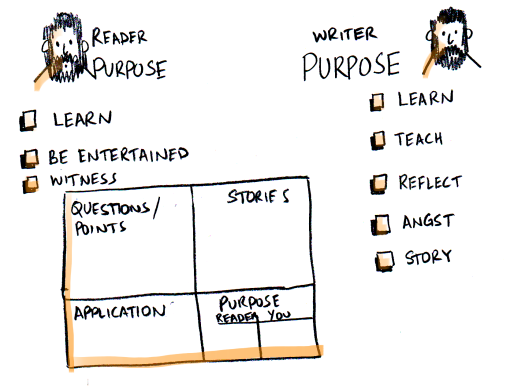
So that’s the first thing I’m getting to grips with. In the last four years I’ve just written, let the words come out. But I never really asked myself what the purpose was of my writing? When I think about the kinds of purpose that seem appropriate answers to that question, I think that perhaps it was to learn about something or to teach it. Quite often it’s a little angsty, worrying away at a thought. I’ve started reading a physical paper again recently and I’m starting to see why journalists think of their article as a story – it’s a narrative after all. And then there’s what I’m doing with this post, which is reflecting on what I do as a writer.

Just thinking about your own writing is quite exhausting – so what about a reader? What do you want them to get out of your piece? I started by thinking about it as a reader either learning something – finding something new and useful in your piece or being entertained – enjoying reading your material. But then a lecturer I recently met said something about bearing witness. When someone writes a blog, where there is no payment or obligation, perhaps they do it because then there is a thing in the world that they’ve made, and all they look for is for the world to bear witness – to be there to have a look if they choose to do so.

Now, in my own approach I haven’t really thought about purpose at all. All I’ve done in the last four years is try and exercise my writing muscles. And two things have happened. The first is that I think my voice has become more natural, moving away from the stilted, scripted sound that often accompanies one’s early attempts at writing. You step away from wanting to talk to millions to having a conversation with one person – you, the person reading this. The second is realising that advice that panders to Google or that breaks the rules of writing conventions are a bad idea. Long stuff that’s padded with rubbish is bad. And writing one sentence at a time rather than a paragraph makes it exponentially harder to edit your work later.

Given all that, I wondered if it might be useful to come up with a framework for writing, a template or rubric that might help think through what’s needed. I had a first pass at that in the image that starts this post, thinking about questions you’re trying to answer, the stories you might tell, and the way in which you might help the reader apply any suggestions or insights you might have. Then, I also thought about the purpose point and whether it was worth thinking about what you wanted and what you hoped the reader would get.

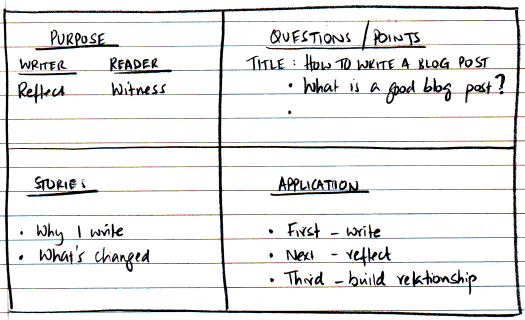
Then, I tried using that template to plan this post, and you can see this in the image below.

blog-post-application.png

I have always had difficulty following recipes and you will probably notice that I haven’t really followed the points I made in the template in this post. But, putting that aside, what makes a good blog post? I think it’s perhaps one you’ve enjoyed writing. A bonus is if a reader enjoys reading it. If it’s hard work for the both of you, then why bother.

This is a reflective piece, an attempt to look at my practice and ask questions that might help me improve. If I were to suggest improvements to someone else’s writing – there is a three step process that could be applied. The first thing is that if you want to do anything, you have to start doing it. If you want to write, write. If you want to make YouTube videos, make them. It’s very hard to get better at something if you don’t do it. Then, once you’ve done something take the time to read it again. What do you think? What do you like about it? What would you improve if you got a chance to do it again? And then finally, you start thinking about your reader – do you think they’ve found what you’ve done useful or interesting? Are they learning something or being entertained? You’ve heard that line about people buy from people. That used to be a face-to-face thing but now it’s includes your online presence. You can build a connection with people through your creations that you would never have met otherwise.

So what’s the takeaway here? If you want to write a good blog post do three things – first write a lot, next, read what you’ve written and make it better next time, and three, try and be useful to others.

Cheers,

Karthik Suresh

How Do We Balance Theory And Practice?

principles-skills.png

Saturday, 7.35pm

Sheffield, U.K.

In theory there is no difference between theory and practice. In practice there is. – Yogi Berra

When we start getting better at something, anything, we also start looking around at others and making judgments about whether they’re doing it in the “right” way. This seems to happen with much of human activity. I’ve seen it with swimming, with dancing, and in many areas of business.

It’s takes some effort to stop doing this, particularly if you’re convinced that the way you do something is right – and if you don’t really understand how someone else does something. Take Agile, for example. I’ve listened to an academic rail against Agile – saying that in every instance he’s reviewed the method has been a failure. A listener in the audience stood up and said that those projects weren’t following Agile, they were against everything Agile stood for. This, of course, creates a insoluble problem. If you are a true Agile believer, then if it works, it’s Agile and if it’s doesn’t, it’s not.

The challenge, of course, is how to get across what you mean. If we’re trying to explain something we tend to start with principles. Principles tend to be grounded in something, they tend to apply in certain contexts or more generally across contexts, and they can be useful or beneficial, having utility. A belief in God, for example, will meet these criteria, as will a belief in gravity. The grounds themselves might range from “because he said so” to “try it for yourself and see.”

This can sometimes confuse us. I remember reading a semiotics textbook a long time ago which seemed to come down to “he said this” and “she said that” and I didn’t see how you could trust any of that. As an engineer and science trained individual, where was the evidence that any of these things that were said were true – other than the belief of the writers? Of course, this was before I learned that there was more to life than physical reality and that there is a whole area of living that happens entirely in the mind. But I digress.

Principles can seem theoretic and esoteric and pointless, and some people point to skills as the things that matter. Skills seem to have important elements of their own. There is often a barrier to entry, a training period for example. If you have a skill, you can do something with it, you can contribute in some way by often creating something. And if you’re good, you achieve mastery and are recognised as a master of your skill.

Now, the narrower your focus the easier it is to say if something is useful or not. For example, if you are a joiner and you make nice wardrobes – then success looks like a happy customer. And a nice wardrobe. But what if you’re a teacher? Is success effective delivery of content or is it high test scores from your students? Do you define success based on what you do or on what the results are? After all, you only have control over your process, over what you do. Are you responsible for what happens after that?

I suppose that if the results are not as good as they could be, then you do need to think about it. Is what you’re doing good in an objective sense – do you take the time to review what you’ve done and assess it using a consistent framework? You always have excuses for why something didn’t work or why it’s not performing the way you hoped but if you’re not monitoring yourself and taking corrective action then what else do you expect? All that is, of course, hard and boring work. And you don’t need to do it unless you really want to.

I suppose this is what teachers learn how to do so that they can help their students learn. I might spend some time exploring that in the next few posts.

Cheers,

Karthik Suresh

Learning How To Study Again

study-skills.png

Friday, 9.55pm

Sheffield, U.K.

As engineers, we were going to be in a position to change the world – not just study it. – Henry Petroski

I should, in theory, be starting a programme of research soon and I’m wondering how to use this blog to help me with the next six or so years of study that I’m going to have to do.

A memory of study skills from a few decades ago came back to me recently. You might have heard of the SQ3R method. It stands for survey, question, read, write, revise. The idea behind this approach is to stop doing the thing we all think we have to do when dealing with learning material. We think we have to start at the beginning and then go through methodically until the end.

The SQ3R method says that a better thing to do is first skim through the chapter or paper you’re trying to read. Look at the headlines, the first sentences – get a feel for what is going on. Then turn to the end and look at the questions that have been posed. Or, if there aren’t any questions put down a few that come to mind. Then it’s time to read the whole thing, then go through it again, this time making notes. And then, perhaps after some time, go back and revise your notes.

I used this approach quite a bit through my first degree – less during my second. In the first, I took notes so that I could remember things and write them down in exams. For the second I didn’t have time – but it didn’t matter as much because I was more interested in the subjects. So I read widely, and some of that stuck. And I made sketchnotes – and that helped to remember the big ideas. And I did make concept maps that helped me memorise big chunks of content that were likely to be needed in exams.

So, I did a lot of surveying – lots of skimming and looking and flicking through material. And I did drawing – visual approaches to capturing information so that I focused on the important bits rather than trying to memorise lines of text.

What I’ve learned after all of this, however, is that all my studies so far have been about seeing what is already out there. The material exists and I’m trying to remember it so that I can write it down for a paper or exam. That’s not the same as understanding it.

That requires a deeper level of engagement with the subject. I’ve done some of that with this blog – taking a particular idea or concept and turning it into a model, or creating a visual and then having a look at what I think about that idea using this medium of text and a monologue. Thinking, some people say, is simply talking to yourself.

That’s ok – I might think (write) about an idea, and part way through get bored and move on to something else and fail to actually reach a conclusion or wrap it all up with a neat takeaway. That’s fine – it’s a way of engaging with the material. But it’s not particularly critical.

And critical thinking is what I need to develop a bit more. I need to take an idea or a lesson or a paper and break it down – understand the pieces that are there and express them in my own words. Or better yet, teach them. And that’s going to take work because now I have to do the SQ part – survey and question the material. Then I have to read and take notes and then go back and pull out ideas and concepts from those notes and try and make sense of them, questioning and comparing and relating the ideas to other ones. I need to be more rigorous about my approach to learning.

And then I need to try and teach them, putting them back together in a way that each part is an understandable chunk while making sure that the parts fit together to make a sensible whole. Which is pretty much the essence of systems thinking and the area of research that I’m interested in pursuing.

I understand that there are 30 or so approaches, a number of authors and lots of disagreement over what works and what doesn’t and if it matters at all.

I’m not sure how it will all work out but I think I’m going to try and experiment with reading and note taking in the next few posts – seeing how I could use this writing time to pull out ideas from a chapter and make enough sense of them to be able to teach them to some extent.

We’ll see how that goes…

Cheers,

Karthik Suresh