Using Facilitated Modelling To Think About Marketing

causal-model.png

Business analytics or predictive modelling is a $100 billion industry, and $41 billion is spent on outsourced business analytics every year. I think that’s about twice the size of the movie industry – it’s really big. – Anthony Goldbloom

You’re probably familiar with the idea of facilitation – the art of getting people to talk about a situation of interest or concern to them. What’s less common is the idea of using a model to help with facilitation.

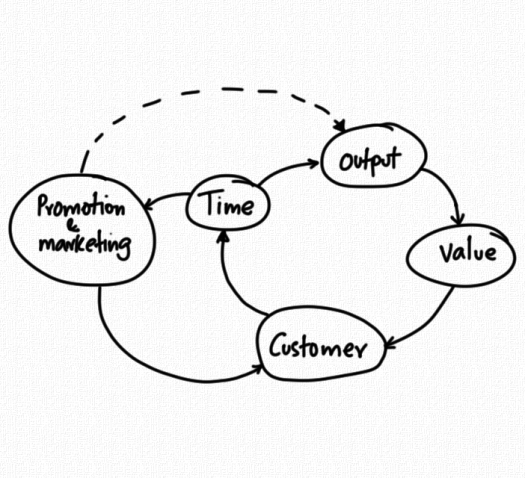
A model is a representation – some kind of thing that can be used to hold important ideas and talk about what’s going on without relying on remembering what people say. A model is different from a list of bullet points because it has elements and relationships – nodes and links. The picture above is an example of a causal loop model, something I’ve been trying to understand recently.

Causal loop models show cause and effect flows – plausible streams of activity that could explain what’s going on. They are simplifications that help us focus on important points and create a story, a narrative that explains what’s going on.

For example, if you run a business you can spend your time creating outputs that customers value. If they value what you do they will buy more time from you. That’s a positive loop – as you do more and better work you’ll get more customers.

If you spend time promoting and marketing yourself you’ll attract prospects some of whom will turn into customers. So that’s another positive loop.

The problem with spending your time marketing, however, is that it takes time and so you have less time to focus on output that customers find valuable. Spending all your time on marketing can end up reducing what you do, pulling down value for customers and causing them to spend less with you by going elsewhere.

This is a very simple causal loop that captures some of the considerations you need to look at when you’re coming up with a marketing strategy. You could assume that there is a limitless pool of customers out there and so losing some is ok as long as your promotion strategy brings in new ones. Or you could decide that your time is best spent creating your product and pay for promotion and marketing, either through advertising or by investing in a partner that does marketing for you.

Causal loops can be used to think through all kinds of issues – they’re the foundation of some of Peter Senge’s work on The Fifth Discipline about Systems Thinking. They are a subset of a wider group of graph models that show relationships between elements and help you deal with complexity.

Familiarity with facilitated modelling can help you deal with problems that are significant concerns to people and organisations – from business analytics to climate change. Al Gore, in a recent TED talk, described the sustainability revolution as all of the industrial revolution’s potential plus digital transformation.

The challenge practitioners face is that they have to be experts in facilitation and experts in the modelling process. This can be hard. Some modelling can be done in groups with people while other modelling needs to be done in the studio and then the results from the model shared and discussed with others.

This may be a topic that’s a little too niche for most people. But it’s a useful skill that could do with more attention. I might try and spend some time exploring the space in a few posts.

Cheers,

Karthik Suresh
What Is Good Work?

There is a remarkable amount of good television around these days. The huge investments that companies are making in streaming services seems to have led to smart, witty writing and engaging storylines that deal with important themes. As one of the characters in the series “Superstore” says, “We’re living in a golden age of TV.”

In the series “Space Force” the leading character, a four star general played by Steve Carell, talks about how “there are no small jobs.” What it says is that for the force to function what janitors do matters and what rocket scientists do matters – all these jobs need to be done to get things done.

That idea, that all jobs matter, has depth to it. Some people look at developing countries and thing that they need technology. They don’t. What they need are jobs, they need work that pays enough to live and school their children and change their fortunes over generations. Few people become rich in one lifetime. If they work at it, however, their grandchildren may have a very different life to the one they started off with.

Take the problem of dealing with insurgencies. We often think that the answer is to send in troops, to win a battle. You rarely hear about other approaches. I came across a story that described how troops in a region of India operated a program where people who surrendered their weapons were helped to set up businesses. They exchanged their guns and became business owners instead, starting things like small manufacturing firms. I don’t know if the story is true without spending some time verifying it – it’s social media after all – but the general principle is interesting. And one assumes it’s been tried in other places but perhaps successfully integrating rebels into an economy is not really news and so we don’t hear about it.

The idea that jobs matter is well understood in government. So you get targets to create more jobs – but what is the right kind of job? What is the right sort of work to do?

This is a hard question to answer because at one extreme any work is good when someone has little to offer other than labour. People around the world struggle to get an education for one reason or another, and that shouldn’t exclude them from being able to do meaningful work – or at least to get meaning out of work. Sometimes it’s may be wiser to forego a return to give people a chance.

Once you get beyond the struggle to survive, however, things don’t get much better. There appears to be a widening gap between the capability of the systems we have and the ability of people to produce using those systems. Cal Newport’s book A world without email suggests that we increasingly spend our time in a hyperactive hive mind allocating so much of our time to communicating that there is none left to do deep work. Doing work takes time – time when you need to get to your workspace and spend uninterrupted time on a project.

Another issue some face is that as they rise in their organisations they start doing less and managing more. A friend of mine who always has the perfect phrase to hand says, “first you’re paid for being the resource. Then at some point you start getting paid for allocating resource.” That second point, when you point to the work and get others to do it, is a disquieting time. There are people who are now better than you at doing things that you once did. I cope with it by having projects that still engage the technical and creative sides of me – this weekend was spent trying to program arduinos and figure out if the principles of junkbot robots can be used to design data collection devices.

One of the things I like about Action Research is this recognition of the interplay between theory and practice – between thinking and doing. Thinking deeply helps improve your practice and reflecting and learning from practice helps develop better theories.

Good work is the kind of work that helps you do both.

Cheers,

Karthik Suresh

How To Manage Diversity In Thinking

Saturday, 10.56pm

Sheffield, U.K.

I’m reading Matthew Syed’s The Power of Diverse Thinking and you will not be surprised to learn that the basic thesis is that people with different perspectives may make for better decision making.

Syed describes how a team that’s made up of very similar people often have a great time working together. If you like having a drink with mates and enjoy a regular round of golf and all the people around you like doing the same sorts of things work life can be fun – you get deals done in the pub and on the course.

This togetherness, this camaraderie, this homogeneity is great if you’re part of the in crowd but it makes it harder for others who are not. This often means that people who don’t fit in learn to fit in – they learn to talk and act in ways that will be accepted by dominant group. After all, conformity is rewarded while being seen as different is often a career-limiting strategy.

For example, I have little, no, actually no interest in sports. I like playing them, but not in watching others. But many interactions in the business world start with a conversation about sports, one that I find hard to participate in – and so I usually don’t. I have tried to take an interest, but it is just so boring.

People who don’t fit in find it hard to get ahead. Sometimes they find it impossible to get started at all. Imagine you’re forced to move to a new country and you encounter a different language, a different culture, a different religion. Do you hold on to what you had where you came from, or do you change to be more like the new place in which you find yourself. Some people can’t do it at all, their children are the ones that are the natives in the new world.

Now, of course, there are arguments on many sides. If you want to join a company, a country, you should be willing to accept the values of the place you’re trying to join. But too much consensus, too much of the same kind of thinking has historically resulted in people making very bad decisions.

Syed argues that diversity in thinking is good but you would need to be a special kind of person to get the balance right. First you have to make an effort to get people in a group that are very different from each other. Then, you have to have a conversation where you may have very different points of view and make sure that it leads to consensus rather than argument. Maybe the only way to get started is by having targets and quotas, no more male only panels, for example. A truer reflection of society in politics and the media. Making sure everyone has a voice.

That kind of thinking needs a mature, grown up society, a liberal one – one that is increasingly rare in a world where it’s much easier to be parochial, tribal and nationalist. It needs rules of procedure and engagement that are seen to be fair to all.

It shouldn’t really be this hard to do.

Cheers,

Karthik Suresh

When Are Thinking Tools Useful?

Thinking is hard work. We can only hold a certain number of ideas in working memory at one time. Any large, complex problem will have multiple, interrelated, and conflicting elements that have to be worked through. Some people can do this in their heads. The likelihood is that they will do it badly.

This is because we’re prone to bias. We cling to ideas that we think of first. Things that are recent, memorable or vivid seem more likely to happen again. As a result we’re often surprised when things turn out differently than we expected.

Formal thinking tools are a way to avoid these biases. We take notes, create models and carry out analysis so that we really understand what’s going on and, more importantly, avoid fooling ourselves.

Using tools brings its own risks. We can get so involved in models that we can forget they are simplifications of reality, not a model of reality. A model should be used to help you think rather than replace thinking.

But what is a thinking tool anyway? We’re surrounded by them – every textbook will show a model of one kind of another. Models show entities and relationships. A map is a model – a simplified representation of key geographical elements in relation to each other. A 2×2 matrix is a model, as is a spreadsheet with a budget.

Some things look like models but are not entirely quite. A list of questions, for example, is not a model unless there is some underlying connective logic that is visible to the questioner.

One of the challenges that we face is that some models are simplified to the point where they are plausible but not necessarily usable. For example, it’s often said that you can’t manage what you can’t measure. And you’re also told that not all that matters can be measured, and not all that can be measured matters. So which is it – is measuring something good or bad?

More often than not it turns out to be bad. Take waiting times or sales targets. They’re both very hard to hit and so managers end up gaming the system, managing the numbers rather than managing the business.

But really, what makes one thinking tool better than another? Why do some things work for some people and not others? Some people are motivated by targets while others hate them.

There is a sort of Godelian incompleteness to all this. Godel showed that within any system of logic there are things that cannot be proved using the tools within the system. In other words you have to take some things on faith, and treat them as axioms, a principle that is seen as true without proof.

The unhelpful, to some, conclusion is that the utility of any tool depends on you and how you feel when you use it. If target setting and goal-seeking work for you then great. It not, there are plenty of other methods that might suit you better.

Cheers,

Karthik Suresh

p.s. Posted from a Pi400

How Do Diagrams Help Us Think Better?

graph-theory.png

Monday, 7.03pm

Sheffield, U.K.

If I’m interviewing someone I need to know everything about them – I do these massive spider diagrams. Everything under different categories, and certain questions in other categories. – Cat Deeley

I’ve been thinking about how we use visual techniques to make sense of information. This is a rather wide topic and spans early work done sixty or so thousand years ago by an unknown Neanderthal on a wall to modern digital concepts. Why are diagrams so powerful and how have they changed over time?

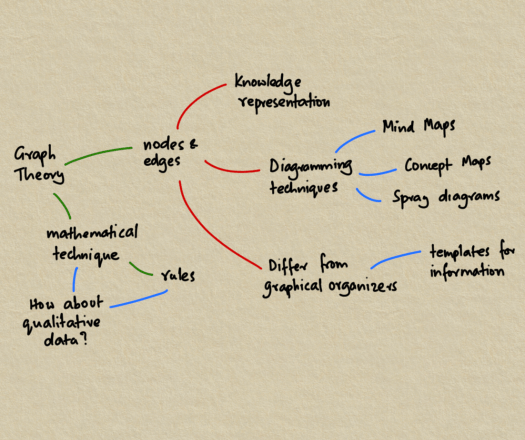
Let’s use a visual technique to explore this question in a satisfyingly recursive way. Graph Theory is a mathematical technique that resulted from the study of a puzzle. The prolific mathematician Leonhard Euler was working on a puzzle that involved the now Russian village of Königsberg – a place with seven bridges connecting two islands to the mainland. People wondered whether it was possible to find a walking route that would cross each bridge exactly once. Euler proved that such a route existed and invented graph theory along the way.

Graphs are hugely useful – circuit diagrams and chemical compound models are essentially graphs. But nodes and edges can do more than represent mathematical elements. They can also be used as a form of knowledge representation as you can see in the picture above.

For example, diagramming techniques including Tony Buzan’s Mind Maps, Novak and Gowin’s Concept Maps and the Open University’s Spray Diagrams can all be used to represent data and the connections between data. These are not templates that are filled with information like graphical organizers but rather containers for information and relationships that help us navigate from idea to idea.

And that’s interesting because so much of what makes the modern world work is the ability to share and connect ideas. It’s the basis of the world-wide web and websites like Wikipedia. If we want to make sense of the world it might be a good idea to see if these kinds of tools can help.

Over the next few posts I might follow the trail of some of these ideas and see what’s out there about how scientists and writers have used drawing in their work.

Cheers,

Karthik Suresh

Notes From Yuval Noah Harari’s “21 Lessons for the 21st Century”

suffering.png

Sunday 8.01pm

Sheffield, U.K.

There is no end to education. It is not that you read a book, pass an examination, and finish with education. The whole of life, from the moment you are born to the moment you die, is a process of learning. – Jiddu Krishnamurti

I’ve finished reading Yuval Noah Harari’s 21 Lessons for the 21st Century. Here’s a summary of the main points for me. They are mostly questions.

  1. It’s hard to think clearly in our increasingly complicated world.
  2. We need a new story for humanity. Fascism lost. Communism depends on the workers – who are these now? Liberalism limps on but its promises ring hollow.
  3. An age of smart machines will not need workers. What will humans do?
  4. Will those that control the algorithms have wealth and power? Will the rest of us be irrelevant? Obsolete?
  5. Who owns your data? Do they know you better than you know yourself?
  6. What is going to happen to online and offline communities?
  7. We are increasingly connected as part of a global civilization.
  8. Nationalism cannot resolve problems of nuclear war, ecological collapse, information technology and AI or bioengineering.
  9. Religion won’t either.
  10. Immigration is a deal. Resolving cultural conflicts is a challenge.
  11. We should not let terrorism win.
  12. Waging war is no longer a profitable exercise. Wealth is in minds, not in treasure or oil fields.
  13. You have to realize that you are less important than you might think.
  14. God’s existence or not is not that important.
  15. Secular values: truth, compassion, equality, freedom, courage and responsibility are perhaps what we need now.
  16. We don’t know that much any more, acknowledging our ignorance is important to examine big issues.
  17. Is there justice in the world? Have we failed?
  18. ‘A lie once told remains a lie, but a lie told a thousand times becomes the truth.’ Humans have always been suckered by liars seeking power.
  19. Stories and science fiction in particular help us understand our world.
  20. Learn how to learn – your education is your defence.
  21. We think and believe and live by stories. Stories make us feel better. But they are fictions. The only real thing is suffering.
  22. Watch yourself. Know who you are. Learn about your mind.

When I list the questions and statements like this, they’re not actually that easy to follow. Read the book, it’s worth ploughing through, but if you have to just take two takeaways from it, it’s these.

First, watch and read more science fiction and fantasy. They can be surprisingly insightful.

Second, if you’re looking for a way to contribute to the world, work to alleviate suffering. That’s the most real thing you can do.

Cheers,

Karthik Suresh

How To Understand The Ways In Which We Can Think About The World

critical-realism.png

Wednesday, 9.56pm

Sheffield, U.K.

Life is not a problem to be solved, but a reality to be experienced. – Soren Kierkegaard

I need to understand the basics of scientific thinking so it’s useful to start at the beginning. What do we know and how do we know it?

A theory is an explanation you have about something in the world – why something works the way it does.

For example, one particular theory says that the reason we have day and night is because we live on a flat world and the sun goes around the Earth. Day is when we can see the sun and night is when it’s below us.

This theory makes sense on the basis of the data you have – the empirical evidence. Empirical means the stuff you can see and try for yourself – not stuff that’s just made up. And if you look around it’s clear that the world is flat and day follows night so this theory explains what you see.

But the theory we’ve put forward doesn’t explain everything – it doesn’t explain why ships out at sea seem to slowly vanish below the horizon, their masts being the last to go. It doesn’t explain the behaviour of the stars. And eventually the theory is found wanting and we get a new one – the Earth is round, someone says. That explains everything we see and makes sense.

This dance, theory as an explanation and the evidence of your eyes as support, is the basis of the scientific approach. It’s a very powerful way of thinking and has achieved more than all the other ways that came before it.

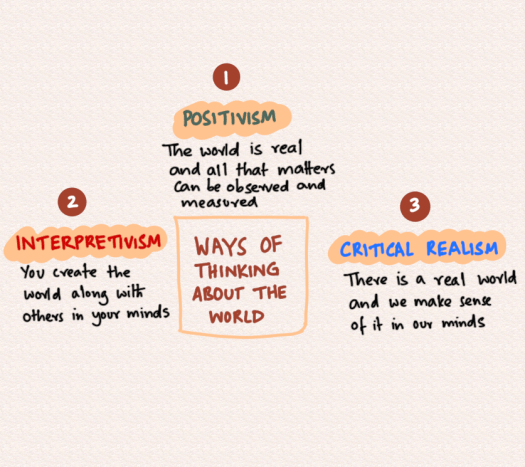
So that’s theory and empirical work – but there’s also this idea of “meta-theory”, something that sits outside these. Meta-theory has to do with us and the nature of our relationship with the world – who are we in relation to the world around us. And there are two main meta-theories and one that’s come along more recently that looks interesting.

The 800-pound gorilla in the room is positivism. Positivism says there is a real world out there – trees and comets and giraffes – the objective world. This world can be studied and measured and you can come up with cause and effect explanations of why things are the way they are. That’s all that matters. Anything that’s just in your mind can be ignored.

In reaction to this interpretivism says that what’s in your mind matters. In fact, your mind might be all there is. It might not, of course, but how can you tell? Reality is something you construct in your mind – you see a rock but do you really see it or is it something your brain conjures up based on light signals hitting your eyes. Is the rock out there really brown or is your brain making things up. What you’re seeing might be what’s there but how can you tell?

Both these meta-theories have problems and advocates and critics. Critical Realism, developed by Roy Bhasker in the 1970s, takes a middle way. It accepts that there is a reality out there, and there are things and there are flows of information and communication. But it also says that the way in which we make sense of what’s going on in our minds. And when it comes to social situations in particular we have to understand that people are different, they are the only creatures that can exist in reality and at the same time think about their place in reality – so that means what’s in their minds matters.

It turns out that all these meta-theories are nice ideas but doing them in practice is harder. Positivism is the easiest when it comes to the hard sciences. It works great there but it’s much less helpful when it comes to social situations. Interpretivism recognises that what’s in the mind is important but can struggle when it comes to making things happen. Critical Realism is perhaps a middle ground, a way of taking reality at face value and working on improving the way you think about it.

The takeaway is that we think in the ways we think but we don’t always ask why we think that way. Your thinking preferences are influenced by the way you’ve been taught and the culture you grew up in. It might be a good idea to check out what other approaches are being used out there.

Cheers,

Karthik Suresh

References

Hoddy, E.T. (2019)r. Critical realism in empirical research: employing techniques from grounded theory methodology. /International Journal of Social Research Methodology. 22:1, pp 111-124

Why Watching TV May Be Good For Us In The 21st Century

western-philosophy.png

Tuesday, 9.46pm

Sheffield, U.K.

There will be no end to the troubles of states, or of humanity itself, till philosophers become kings in this world, or till those we now call kings and rulers really and truly become philosophers, and political power and philosophy thus come into the same hands. – Plato

I haven’t written much in the last few weeks – a result of first getting Covid and then going on holiday – but that gave me some time to watch more TV and I came across a series on Netflix called “The Good Place.”

Before I get into that I was also reading Yuval Noah Hariri’s book, 21 Lessons for the 21st Century, and found it tough going after around 50 pages as it delved into the increasing danger posed by algorithms that learn everything about you and your world.

The Good Place is a comedy series. So far so good. It’s also about philosophy. At this point, someone probably says “Oh.” when they mean “Why?” – the kind of reaction we once got when we said to a friend that we were watching the series “Borgen” – a Danish political drama series in Danish. It just doesn’t sound that exciting – but it draws you in.

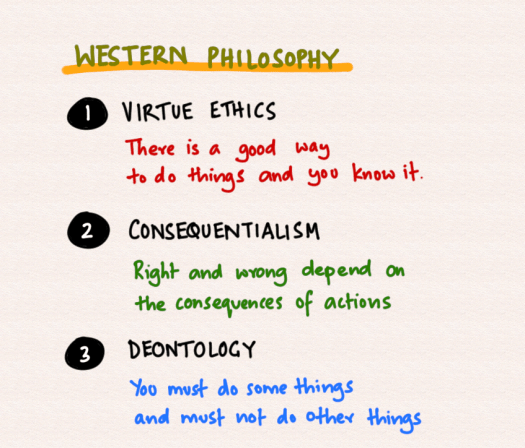
The Good Place, then, drew me into the world of philosophical thought and introduced ideas such as the three main strands of Western philosophical thought, as shown in the image above. And the big question is how should you live your life?

One answer is to look to virtue ethics – the idea that there is a “good” way to live. The ancients, for example thought you should show temperance, justice, courage and practical wisdom.

Another way to look at the world is through the lens of consequentialism. Whether an action is right or wrong depends on its consequences. Utilitarianism is a type of consequentialism that says you should make decisions that maximise your pleasure or happiness.

The third approach is deontological ethics which says there are rules – something things are right and some things are wrong and there is never a reason to break these rules. Lying is wrong, for example. Period.

I am almost certainly misrepresenting these ideas but the big idea – that there are three main ways of thinking and they’re called what they are comes from watching The Good Place and the snippets of philosophy that are woven into the story. The Oxford Companion to Philosophy which I have on my desk right now is a harder read and each of these ideas require more study to really understand them. However I might never have come across them in the first place had I not decided to watch a random TV programme that uses these ideas to set up conflict and drama with a group of characters.

When I finished the series I returned to Harari’s book and suddenly that made more sense. The point at which I had stopped had to do with algorithms and decision making and the argument Harari goes on to make is that we will increasingly ask algorithms to make decisions for us and the kinds of decisions they make will depend on the philosophical position we take.

Take for example the self-driving car issue. If you are in your car and you are suddenly in a situation where there are people in the road in front of you should the car swerve to avoid them but kill you in the process or drive into them and keep you alive? The answer will differ based on whether you are a consequentialist or a deontologist. Perhaps you believe there is an absolute rule – you shall not kill, it is your car and you should be prepared to die rather than kill another. Or does it depend on the consequences – maybe you’re a pillar of the community and the person in the road is a convicted murderer who has escaped prison. What if the person is a child with a life ahead of her or an old person with not long to live? How do you get the car to make these choices without knowing what your philosophy is?

Now the rest of Harari’s book is much more accessible and more TV and movies help. You can understand the section on terrorism much better if you watch RoboCop. If you are a power threatened by a smaller, weaker group and you have the ability to deploy killer robots to control their cities would you? Later on Harari points to the value of media using examples like The Matrix to make his points.

If you have an engineering or STEM background it’s possible that many of these questions have never occurred to you but once you see that they exist you also notice that modern media and films ask them all the time. So you have feminism and gender identity in stories of young professionals and their jobs and racial tensions in any show that has fantasy involved. Harari points out that most of us don’t read scientific papers to get our knowledge – we get our values and ideas from what we watch and that’s why it’s so important that what we watch is good – because that’s what we use to learn about how to live a good life these days.

Cheers,

Karthik Suresh

How To Manage Innovation In Your Organization

innovation-policy.png

Monday, 7.53pm

Sheffield, U.K.

Exploration is the engine that drives innovation. Innovation drives economic growth. So let’s all go exploring. – Edith Widder

I’ve been looking for definitions of innovation on the basis that you need to know what it is before you can figure out if you’re doing it but it’s rather hard to find a general definition. The thing is that innovation happens in many places – you can be innovative in the way you bring up your kids, innovative in the way you manage your team and innovative in the way you model crystalline structure.

While looking for information on innovation I stumbled on Hemphill’s 2003 paper on innovation governance that sets out a useful framework to think about managing innovation. It’s within the context of national policy but I think it could well apply at the level of an organization or even a family.

Innovation is the most important driver of modern industrial economies – you’re constantly being marketed the newest and the best, and the only reason you will buy something is because it’s better than what you have now. A huge amount of time and investment goes into creating the products and services that you use.

But you can’t allow the creation and sale of any old product so there are rules in place. And the oldest of these rules is the “precautionary principle”, which essentially comes down to do no harm. You have to show that your product or service is safe, that it doesn’t harm people. That means your car’s brakes need to work and your medicines need to have acceptable side effects. If you’re not sure that there’s a problem then you have to take action to minimise the risk.

This principle works and keeps us safe but it also acts as a deterrent to innovation, increasing the costs of bringing something new to the market. So another approach to innovation governance is “responsible innovation”, which is about encouraging the development of products that are good for society. The most visible aspect of this approach is the grants governments provide for socially beneficial product development. These incentivise everything from the deployment of digital infrastructure and skills to clean energy technology.

An alternative approach to innovation is to get the blockers out of the way – to encourage “permissionless innovation”. This means letting people get on with developing new products and services and only stepping in when you can see that harm is being caused. There are benefits to this approach because it reduces the cost of innovation but it also creates a risk that the innovators go too far. An example of this might be the financial sector which creates complex products that are supposed to make it easier for people to access funding but that also introduce unpredictable systemic risks that regularly threaten to destroy the fabric of society. It hasn’t happened yet, though, so it must be ok.

The last method of innovation governance is to require that you think about the impact any new policy is going to have on innovation. An argument against work from home, for example, is that people can’t innovate unless they’re together in one place. If that assumption is not true – if your best people can innovate from anywhere – then they’ll move to companies that let them work the way that’s best for them. You have to be certain that your policy is really about encouraging innovation and not a disguised way of getting people back into the office where you can keep an eye on them. Another example in business is giving people time to work on the business rather than just in the business – they can’t make things better if they’re busy firefighting every working minute.

Hemphill’s argument is that the precautionary principle is restrictive. It gets in the way and can stop ideas from getting traction. And it’s possible that powerful interests can use it to keep things the way they want, in the way that best suits them.

A good way to balance innovation and public safety is by combining permissionless innovation with responsible innovation. This removes barriers to innovation but makes it clear that innovation should be for the good of all. Encourage innovation that helps people.

In a nutshell, get out of the way and let innovative people get on with doing what is good for society.

Cheers,

Karthik Suresh

References

Hemphill, T.A., 2020, “The innovation governance dilemma: Alternatives to the precautionary principle”, Technology in society.

What Does A Consultant Do?

helping-process.png

It is literally true that you can succeed best and quickest by helping others to succeed. – Napoleon Hill

Edgar Schein made a number of contributions in the organizational development field, looking at career models, organizational culture and consultancy. In his paper on process consultation (Schein, 1990) he introduces the idea of “helping” and how you can think about this in your own context.

Helping others is a fundamental part of being human, whether it’s as a parent or a friend, a teacher or a manager – in addition to professional helping roles such as being a consultant or a therapist. The link between consultancy and therapy is interesting because there are many common features of the literature in both camps. For example, the idea that reality is a social construction, something that is created by an individual or group in a bid to make sense of what they perceive, is common to both. This means that the biggest thing we can do to make things better in our lives or organisations is to learn how to think more clearly about the problematic situations that we find ourselves in.

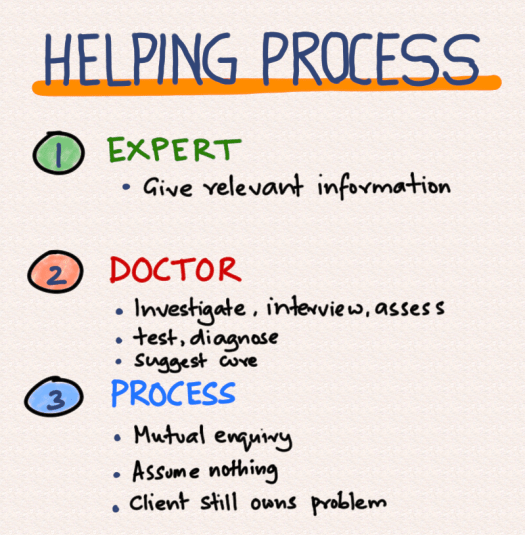
Schein talks about three types of helping – expert, doctor and process – and each of these ask you to do different things.

Most of us are familiar with the expert mode of helping. If you have a problem, say with a CRM system, you know who the expert is and can get in touch with them to help solve your problem. An expert knows what to do in their area of expertise and can come in and sort things out.

The doctor mode of helping is a little different – here you have someone who knows quite a lot and can come in, ask some questions, look at what’s happening, run some tests and come up with a diagnosis of the problem and suggest a cure. For example, you might call in a technical expert if you’ve got glitches in your network with random outages. That’s something that needs to be diagnosed.

The last kind of helping is process mode helping your client understand what’s going on in their situation and what they could do about it. This is a process of enquiry, a curiosity led process where asking questions and exploring is the way you understand what’s going on. The main difference is that client still owns the problem and they decide what to do next.

Schein argues that none of these helping processes are better than any other – instead what’s important is knowing which mode you should shift into and when.

When you first enter a problematic situation you should always start with a process mindset. Don’t make assumptions about what’s going on. Ask questions, understand why the client is looking at this situation now, is there really a problem, do you see why they are asking for help?

As you understand more about the situation the client is in then you can move into the other modes. That’s when you can play doctor, asking for symptoms, running tests and coming up with a diagnosis – and making possible suggestions for a cure.

If you end up talking about an area where you have relevant expertise and know what’s the right thing to do then you can say so. This is your expert opinion at work and you should speak up.

Why should you start with process consulting rather than diving straight into providing your expertise or diagnosing the problem? That’s because there are a number of assumptions that underpin the two other approaches. With an expert approach you assume that the client knows what the problem is and knows the kind of expertise needed to sort it out. With the doctor approach you assume that the client knows they have a problem, that they can recognize the symptoms and know what kind of doctor is needed.

It’s fair to expect that clarity in a number of situations, but in many cases we don’t have a deep understanding of what’s going on. We have to start by understanding what the problem really is before we can get on with the job of solving it. What we need to do is work with the client to make sure that they see what the problem is, they recognize that they own the problem and they’re committed to making things better.

Only then can we expect things to change for the better.

Cheers,

Karthik Suresh

References

Schein, E.H, 1990. “A general philosophy of helping: Process consultation”, Sloan Management Review, pp 57-64