The Route To Becoming Good At Something

competence-matrix.png

As a general rule, when your child, or anyone in the work force, doesn’t know what he/she wants to do, they should instead always be developing skills and competencies that will qualify them for the jobs that companies are most looking to fill and increase their hireability. – Mark Goulston

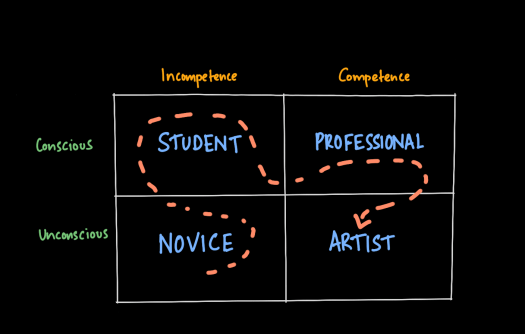
I came across Martin Broadwell’s (1969) i consciousness-competence framework again recently while reading about teaching. The image above is based on this four stage model and is a good one to keep in mind.

It’s hard to appreciate a state of mind where you don’t know that you don’t know something. It’s more obvious to others than it is to you. For example, if you listen to someone reminiscing about the good old days when everyone had a job and things worked and how everything has gone wrong now – you can pretty much guarantee that the problem is not that things have gone wrong but that the world has changed and the person complaining has not kept up – the world they knew has been replaced and no one told them that was happening.

This is a trap we fall into all the time. Most of us have an area of competence – but for some of us we start to think that because we are competent in one area we must also be good at other things. And that’s not the case. It’s very easy to step outside your circle of competence and not realize that you’ve got it all wrong.

The only solution is to recognise that you’re a novice at this and start to learn. At that point you know that you don’t know something and you start to look for resources, for opportunities to learn and develop your skills. This is when you become a student – someone who is seeking knowledge to get better at something.

After a period of learning and practice you know that you can do something well – you’re consciously competent. I’ve called this stage being professional, because that’s really the point at which people hire you. They don’t hire you to learn on their time, they hire you to get the job done – which is what a professional does.

Then there’s a stage beyond that, one that some people call mastery. It’s talked about as unconscious competence – where you do something without really being able to tell how you do it. How do you read that room, see the way in which minds are flowing, how do you ask the right question, carry out the right analysis, look for the right clue? You can’t explain why you feel something is right or wrong but you know it is.

This is perhaps most obvious in physical skills – the unconscious competence that comes with playing an instrument or shooting the perfect 3-pointer – but it’s visible in trades and business as well. But I prefer the term artistry to mastery, because in many cases it’s not about being good without being able to tell how – but being so good that you can break all the rules the professionals live by. That’s what great artists do – they know the form and go beyond it.

Cheers,

Karthik Suresh

Starting Something Again After A While

practice-your-lines.png

Tuesday, 8.04pm

Sheffield, U.K.

Good, better, best. Never let it rest. ‘Til your good is better and your better is best. – St. Jerome

I haven’t written for nine days and that’s quite a long stretch to go without putting out a post. When I do that – stop for a while – I’m never quite sure what it’s going to take to get started again. What will it look like, will I still be able to write, have the ideas gone away, never to reappear?

The good news is that you can always get started even if you question everything you do. I still wonder what this blog is for, why do I spend time on it? I don’t write long pieces that are designed for a search engine and the short pieces I do write are streams of consciousness that follow trails of thought. Today, for example, I looked at other people’s work and wondered about mine – what made it different, how could I do it better, and was there value in it?

The reason I’m asking such questions is because I’m designing a programme of research that looks at the “art of thinking” – the way in which we use tools to help us make sense of things, solve problems, learn new things and innovate. In a world where machines seem to do everything where is the space for human thinking and creativity?

One of the things that I do, as you can see from the blog, is draw simple pictures to explore ideas. We can all draw but we’re afraid to draw bad stuff, make the kinds of lines we made as children. That’s not “serious” work and we don’t do that kind of stuff any more.

Can you learn to draw again? Yes, you can, but you have to put in the time to practice. And that starts with simple things like doing drills. When you use a drawing tablet, for example, it takes some time to train your brain to connect what your hands are doing with what your eyes are seeing. With a pencil on paper feedback is immediate – you apply pressure and see a mark appear under the point. With digital tools you move your hand in one place and a mark is made on the screen. Your brain needs to be trained to connect the two events – the pressure of your fingers on the page and the sight of the pixels being stained on the screen. It can take a few months to get comfortable doing this, doing drills like in the picture above.

Is it reasonable to expect that people should try and gain such a skill? No. What people need are keyboard skills, the ability to create spreadsheets and documents. The ability to work in an office. That’s what’s needed. Except – if you can draw your ideas then you will create better spreadsheets and better documents. You don’t need to do that digitally but if you’re able to create an influence diagram that identifies what you’re trying to understand and then models all the factors that influence the outcome you’ll create a better spreadsheet model. Being able to draw an idea is going to help you structure a better document. John McPhee, the New Yorker writer, always starts his writing with a diagram in mind. Developing the skills to show your thinking visually makes the products of your thinking better.

Or that’s my theory anyway.

The challenge is that it’s hard to prove. Any kind of structured thinking is better than random decision making, isn’t it? Does it matter that you draw things down or is it enough just to make a list. Is there a “right” way to do things or is what matters “your way?” The answer should be that you need to do what works for you. So should we worry about testing effectiveness or should we collect ways of doing things and let people decide for themselves?

I don’t know the answer – hence the research programme.

Cheers,

Karthik Suresh

What Is The Reason Someone Should Invest In Your Business?

startup-reasons.png

Sunday, 7.19pm

Sheffield, U.K.

Nobody climbs mountains for scientific reasons. Science is used to raise money for the expeditions, but you really climb for the hell of it. – Edmund Hillary

I was talking to a friend the other day about being able to describe a business model in a single sentence, perhaps a single word, and started throwing out suggestions. I came up with money, momentum and mission. He suggested missing. And this is a good start.

A good reason to start something is because there is a clear route to payback. If you provide a product or service that has strong market demand, if you sell something people want at a profit then you’re going to bring in money and that makes sense. Many good, profitable businesses are ones that you don’t hear about in the papers – they’re the trench diggers, the utility businesses, the construction companies that get on and do the day-to-day work that keeps economies running and people fed and watered. These are the kinds of businesses that Warren Buffett dreams of buying – ones that have a competitive advantage and a long-term market.

The second reason to do something is because you’re on a roll, because you’ve got the timing right, because you have momentum. If you’re in a particular space and the stars are aligned then you can get on and build your business because you have the wind at your back. I wrote about a TED talk in my last post where the speaker decided to teach children how to draw during the pandemic and ended up with 10,000 children joining her first lesson. If you’ve spotted an opportunity and have luck on your side then you should go for it.

The third reason to do something is because you have a mission – a story that drives you and a desire to make things better. We all know people like this – some of them start social enterprises, others cooperatives or non-profits while others create purpose-driven for-profit firms. What matters is your story and how it resonates with others.

The fourth reason is to because you’ve found a gap in the market – because something is missing and you think you can fill that need. You can often only see the gap because you’ve spent a long time in that space and know what the problems are that people face and the kind of solutions that they need.

Those four Ms seem to cover quite a large number of cases.

Can you think of any more?

Cheers,

Karthik Suresh

Going Deep Or Going Quick – How To Decide?

learning-to-see.png

Saturday, 8.51pm

Sheffield, U.K.

What is art but a way of seeing? – Saul Bellow

I watched Wendy MacNaughton’s TED talk about paying attention and it reminded me of a challenge we face all the time in situations. Should we go deep into something or should we quickly sort things out? How do we tell which one to do?

MacNaughton writes a visual column for the New Yorker and she started her talk with an exercise that I’ve seen in Betty Edward’s Drawing on the right side of the brain. Pick something to draw and then draw it, never lifting your pen from the paper or taking your eyes off the subject. If you’re drawing a leaf, for example, slowly follow every curve of the outline of the leaf and let your fingers follow your eye. You’ll end up with something that is rubbish – like my picture above where I drew an eye – but you also end up with something real because, perhaps for the first time, you’ve drawn what you’ve seen.

Let me explain.

Most of the time we view the world and see not what’s out there but what we expect to see. We are pattern recognizing machines, we have patterns for houses, patterns for trees, patterns for people. Our brains recognize patterns – that’s why a simple line drawing of a few essential features can tell us whether the drawing is of a person or a thing. We’re particularly wired to notice other people and expressions because it’s a vital survival skill to know if that person coming towards you is friendly or not.

That’s why when we try and draw the world we tend to revert to icons, to a visual shorthand representation of the things around us. We may think that’s because we’re bad at drawing – but that isn’t the case. It’s simply quicker to have a library of icons that can be expressed as simple drawings because we can get them done quickly. If you want to show the state of mind of someone else you can do that with a circle, two eyes, eyebrows and a mouth. That’s quite enough to convey quite a large range of emotions.

But although you can draw a general emotional state that doesn’t mean you understand what’s going on. You don’t see the other lines that tell you the history of the person, the unwrinkled lines of a young person or the leathery skin of a weatherbeaten outdoorsperson. To see that you have to take your time and draw the detail, to see what’s really there rather than the pattern you’ve imposed on the world in front of your eyes.

The same thing happens when you try and understand a situation. You can see people in organizations as roles engaging with each other or you can talk to a specific person and understand their point of view. It doesn’t take long to draw an office hierarchy. It takes much longer to understand any one of the individuals in that diagram and what their daily experience looks like.

Much of the time the efficient thing to do is ignore the detail – to just use pattern recognition to notice the general working of things. Being oblivious to most things is the way to go.

But when you are involved in a situation and you care about getting an outcome that improves what’s going on you have to be prepared to take the time to get into the detail of what’s going on – to see what’s really there.

What matters is deciding whether you’re an onlooker or a participant – and then doing the work that’s necessary to get things done.

Cheers,

Karthik Suresh

How To Get On With The Work In Front Of You

worms-eye-view.png

Wednesday, 7.54pm

Sheffield, U.K.

We think in generalities, but we live in detail. – Alfred North Whitehead

Tim Harford in his book Adapt: Why success always starts with failure has a section on the worm’s eye view – and that is a phrase worth exploring.

Much of the time we think that what we need is a bird’s eye view – we need to soar above the landscape and pick out what is important, see the big picture, work out where we’re going. Strategy is, after all, the art of figuring out which direction to head in.

And that’s all very well except when it comes to matters of people and action in daily circumstances. That’s because the landscape you’re thinking about is different for everyone, we have our own ways of looking at the world and making sense of what is going on. What’s the point in looking down at a landscape that’s hidden from sight or that changes all the time. The ways we use to find out what people want have significant methodological problems. For example, if you run a staff satisfaction survey how do you know if people say what they really think or say what they think you want to hear, especially if you’re in a small company and the results are something you want to talk about. Does the fact that a survey show that you have happy staff really mean that you have happy staff? How can you tell?

The way you tell what’s happening is by going to see what’s on the ground. The Japanese call this going to Gemba – the place where work is done. In the new series of Turner and Hooch there’s a line where Turner and his sister are sat in a car, doing what their Dad, a policeman, called doing a “look-see”. Turner wants to stay in the car and his sister tells him that they have to get out and walk around – otherwise it’s a look-sit, not a look-see. When the police want to search a crime scene they do a fingertip search, get down on the ground and let their fingers walk. That’s taking a worm’s eye view – that’s how you see what’s really going on, what the obstacles really are and how you get around them.

This is hard, mundane, detail work that most people don’t want to do. It’s much better soaring up in the air, free as a bird, looking at the big picture and telling people what to do. But what actually happens is down on the ground and if you don’t get your head around that you won’t be able to make a real difference. It’s also where you discover value – after all, you don’t fly around and find treasure. You dig for it. In the ground.

Whatever you do – if you find that things aren’t working, it’s probably because you aren’t looking at the detail of the work that’s in front of you. If your message isn’t getting across the problem is in the details, it’s that your product needs to be better, the pitch needs to be thought through more, your advertising needs to be on point. Getting it right is about getting the detail right.

This takes time and trial and error and learning. No one gets it right the first time. And no one gets it right by reading books and thinking about principles. They get it right by doing it, seeing what happens, working out what went wrong and what they could do better and trying again, going around that loop until it works.

There are no shortcuts. There is just the act of getting on with the work.

Cheers,

Karthik Suresh

How To Understand The Values That Drive You

schwartz-10-values.png

Tuesday, 8.07pm

Sheffield, U.K.

It’s not hard to make decisions when you know what your values are. – Roy E. Disney

The way people think and what they believe in should drive the way they act – there should be a connection between values and behaviour. But before we can explore the link we first need to know what values are in the first place.

Shalom H. Schwartz came up with a theory of basic human values in 1992 that said there are 10 basic values people hold across countries and backgrounds – and these relate to the way they think, the beliefs they hold, what they do, their personality and the makeup of the societies they live in. In an updated paper (Schwartz et al 2012) the authors refine this list to create 19 values.

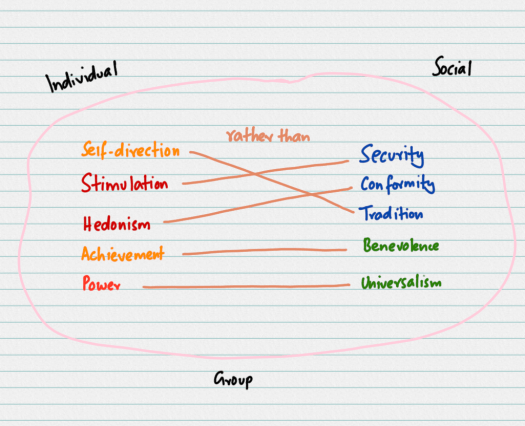
For the purposes of this post, however, let’s stick with the 10 values. In the theory the basic idea is that these values lie on a circle and the ones that are closer on the circle relate more closely to each other and ones that are further away are opposing ideas. In this post I want to look instead at the values using a bipolar construct – how does each one compare to the one that seems its polar opposite and does seeing that help you in any way?

Let’s start with security – the need for you and your family to be safe. The opposite of that might be stimulation. You could look at this as a choice to choose security rather than stimulation – a choice to go for a safe job rather than one in a different city, a choice to travel in safe countries rather than sail a boat in pirate infested waters.

What about hedonism – the desire to make the most of your life and enjoy everything, rather than settling for conformity and fitting in with what’s expected of you? Or opting for self-direction, deciding to do something that you enjoy for work rather than joining the family firm or going into a profession.

What about the need for achievement – to do the best you can, become the best surgeon, the best lawyer, rather than benevolence, working with Doctors without Borders or taking on a public defendant role. Which one would you go for?

Then there’s power, the need to get it for yourself, rather than universalism, feeling for, appreciating and working for the benefit of humanity as a whole.

These bipolar constructs, shown as X rather than Y, may not be accurate but they’re a good start to help you evaluate where you are in life and what’s important to you. You might be someone that values self-direction, security and benevolence – or you might be drawn towards tradition, power and conformity. It feels like you have to pick which values matter to you – some combinations work and others don’t – but you need to be clear on what you’re going after.

As important, perhaps, is knowing what others want. If you want to work with others and you know that they’re after one of these things then you can figure out how to arrange things so that they get what they want and you get what you want. There is always a conflict, for example, between power and self-direction. Terry Pratchett puts this nicely in one of his books when a character shows another some work he’s been doing that he’s interested in and the first says, annoyed, “In my time?” The implication is that the first person has bought the other person’s time and it now belongs to him. The second should have no thoughts that he controls his own time. How do you resolve this other than showing the first person how he benefits from the work?

Knowing someone else’s values tells you how you can work together – maybe it’s a handshake or perhaps it’s a iron-clad contract. You need what you need for the situation. And knowing how someone else ticks can tell you when it’s time to give up and go away – if someone you are with is far too interested in stimulation or hedonism for you then it’s worth knowing you can’t keep up as early as possible.

Values, it seems, are important. Knowing yours will help you make the right choices for you.

Cheers,

Karthik Suresh

References

Schwartz, S. H., Cieciuch, J., Vecchione, M., Davidov, E., Fischer, R., Beierlein, C., Ramos, A., Verkasalo, M., Lönnqvist, J.-E., Demirutku, K., Dirilen-Gumus, O., & Konty, M. (2012). Refining the theory of basic individual values. Journal of Personality and Social Psychology, 103(4), 663–688.

What Are Problem Structuring Methods And Why Are They Useful?

problem-structuring-methods-situation.png

Monday, 8.31pm

Sheffield, U.K.

Good management is the art of making problems so interesting and their solutions so constructive that everyone wants to get to work and deal with them. – Paul Hawken

Management as an art form is relatively recent. It was born in the United States to deal with the complexity involved in coordinating the work of increasingly larger organizations, like the continental railroads. The pioneers of management, like Frederick Taylor, dreamed of a scientific method that would reduce work to predictable elements. Taylorism made many improvements but didn’t quite realize that management is not just about the science of work – it’s also about the art of power.

This duel between work and power continued throughout the 20th century. The wars made it even more necessary to coordinate and organize large groups of people and things and managers of one kind of another were a crucial part of this process. Organizations got better at everything – mechanizing, optimizing, increasing efficiency – all amid a backdrop of power struggles between a group of European cousins – and the resulting loss of millions of lives.

The scientific approach works very well – so well that it seems like it’s the only way that works. So we try and approach everything using a science based mindset. But as history shows the one thing that science does not get is the way power works or what makes people tick. People and their feelings are irrelevant when it comes to scientific truth. But they are rather important when it comes to living.

Scientific approaches began to struggle in the 1970s with this issue of people and how they worked together. In wartime you can gloss over this because there is a clear objective – there’s an enemy and either we win or they do. In peacetime it gets more complicated and you have to get people to work together because they want to, not just because they have to. Managers, however, still operated like they had done for the decades before, using command and control strategies like generals commanding an army, not realizing that the battleground had shifted.

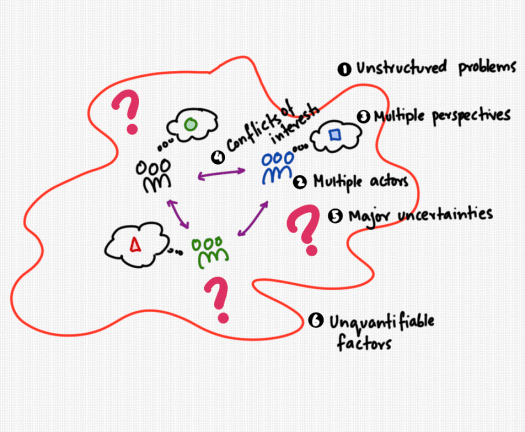
Problem Structuring Methods (Rosenhead, 1989), are a way to deal with the situations we are likely to find ourselves in these days. These situations have certain characteristics (Kotiadis and Mingers, 2006):

  1. They’re not clean and simple – they’re unstructured and messy situations filled with different kinds of problems.
  2. There are many actors.
  3. These actors have different perspectives or views of the situation and what they see as problems.
  4. The actors may have conflicts of interests.
  5. There are lots of unknowns – major uncertainties.
  6. You can’t put numbers to everything – many things are unquantifiable.

These kinds of situations send most people into a bit of a panic. They’re used to a world where there are clear goals – an objective that can be met. All you need is a plan and you need to work that plan and you’ll get there. In any real business situation, however, none of this is really that clear.

As an example consider the problem of home working that many organizations are grappling with these days. Some people think that you need to be in the office to do good work. Others have seen that being at home means they are more productive and provide better service. Do the people who want you in the office want you there because you work better there or because they feel they can control you better. Are some of the proponents the ones that own office blocks and shops that depend on occupancy? What about the reduction in emissions from commuting? Is your working from home policy helping productivity or damaging it if your people leave for a company that does let them work from home?

How do you go about considering such a problem space? Do you just go with what the bosses want or do you ask employees? What if you get the wrong answer? Should you try and arrange things so that you get the answer you want? And so on… the questions multiply and options diverge and converge and get entangled until you know that everyone will be unhappy whatever you do.

Problem structuring methods are a way of grappling with these situations. They are ways of thinking about these knotty problems and perhaps coming up with approaches that will make the situation better. They are, however, not general solutions – they are ones that can be used by a group of people in a particular situation to improve things. But a different situation will have different people who think differently and have different needs. And they will need a different approach and solution. And that’s ok. It’s about recognizing that life is complex and solutions have to deal with that complexity rather than reducing everything to a magic shortcut hack formula process.

Okay, you say, but what are these problem structuring methods?

Well, that needs a few more words and is perhaps one for another post.

Cheers,

Karthik Suresh

References

K Kotiadis & J Mingers (2006), Combining PSMs with hard OR methods: the philosophical and practical challenges, Journal of the Operational Research Society, 57:7, 856-867

J Rosenhead (Ed) (1989), Rational analysis for a problematic world: Problem structuring methods for complexity, uncertainty and conflict.

The Value Of Making Questions Specific

contraints-for-creativity.png

Sunday, 8.25pm

Sheffield, U.K.

The more constraints one imposes, the more one frees one’s self. And the arbitrariness of the constraint serves only to obtain precision of execution. – Igor Stravinsky

Terry Pratchett wrote that if time equals money then money must also equal time. One thing consumes the other – and what matters is who or what is doing the consuming and who or what is being consumed. For instance, if you hire a professional that’s paid by the hour, like a lawyer or consultant, don’t be surprised if they try and spend as much time as possible on your project. Their time consumes money. On the other hand, if you want something done fast you can offer an incentive for it – double the amount to get it done when you want it done, buying in the extra person-hours needed. In this situation money consumes time.

Work, creative or otherwise, has the same ability to consume time, as does entertainment. We’re constantly making decisions on how to allocate time and others are constantly constructing situations designed to consume our time.

This is where constraints start to help us.

Imagine you’re on a road and you come to a fork. One way narrows, taking you down a single path. The other widens, allowing you to go anywhere you choose, in any way you want. In both cases you will end up spending time travelling, but what’s the destination going to look like? In the first instance you’re going to get somewhere. With the other you’d do well to remember the saying, “If you don’t know where you’re going any road will get you there.”

Good questions act like constraints. Your choice of tools create constraints. The combination of the two make your path for you.

Let’s digress for a minute. Yuval Noah Harari is a historian and wrote 21 lessons for the 21st century. I’ve only just started the book but one idea jumped out at me. Harari says that three big ideas competed for hearts and minds during the last century. You had fascism, which believed that one group was superior to another and should rule by force. You had communism that believed that workers should be in control. And you had liberalism, which believed in the freedom of people, ideas and trade in things. Fascism lost early on, communism hangs on and liberalism took the lead.

Harari’s point is that the communist-liberal conflict has to do with labour and exploitation. A group fighting for workers has as its aim their protection and welfare. But what happens in a society where labour becomes not a question of exploitation but is increasingly irrelevant. Harari asks whether it’s worse to be exploited or to be ignored – deemed unnecessary?

Many people are coming to terms that the world doesn’t need what they do. Who would join a profession where they’re treated as a bridging solution to eventual automation? Jobs imply specialisation in the service of a larger entity, but what if that entity is in the business of getting rid of jobs. What do you do then?

You have to ask good questions. Questions like what sort of jobs are going to be needed in the future. We have an idea already. We need high skilled, high technology workers that can engineer the systems of tomorrow and we need dexterous manual workers that can do the things that robots can’t do well.

Of course, this isn’t the case everywhere in the world. Labour is still cheap and machines are expensive and break down quickly and spare parts are hard to find in some places. History matters – it has created the conditions for the present after all. Wherever you are you have choices – good ones or bad ones, but ones constrained by your history and present. You can choose what to do, what skills to work towards, what tools to use. But how do you decide, make that choice about the path to go down?

There isn’t a right or wrong answer – just nudges. But it comes down to time. What kind of skills and technologies will help you get more out of time. If you trade your time now for knowledge that means you can do more with your time later, that sounds like a good exchange. If you do less but that helps you work faster that’s a tradeoff that may be worth taking too. It’s like a craftsperson making a jig that lets them do a frequent task faster.

Perhaps the one thing to keep in mind is that once upon a time the constraints were put upon you – by your employer, your circumstances, your history. Your job today is to select the constraints that will help you achieve what’s best for you.

Cheers,

Karthik Suresh

How To Get Others To Do Things The Way You Want

notebook-easy-to-use.png

Friday, 8.36pm

Sheffield, U.K.

For quality procedures to be effective, they must be simple and practical enough to be used every day by the people doing the work. – Jeffrey Liker

I’ve been reading a few papers on how there is a plethora of methods in Soft Operational Research but they don’t get used very often by people other than the originators. This is a problem that’s not limited just to the OR field. Every time someone invents a new approach – a machine, a software program, a procedure – its success is measured by how many people go on to use it. So what makes the difference between success and failure?

One theory is set out in the quote that starts this post. If you want people to use a method or do something in a particular way make it simple to do – design it so they can use it every day. The canonical example of this in knowledge work is the notebook and a pen. If you have a notebook you can get to work – that’s what you need to get started.

This does lead to a paradox. There are often better ways of doing something but you end up doing things less effectively because of the skills that people have. This is acutely obvious with software. Most people don’t know how to use software well – they are given their computers, only allowed to use certain products and don’t have the skills needed to get the most out of their machines. Computers can help you be more productive but for many people they prevent you from getting work done.

What this suggests is that success is not merely a matter of numbers. Just because everyone uses it doesn’t mean it’s good. You need to get clear on what you want. The author Robert Kiyosaki told a story of how he was once questioned by a reporter who was annoyed at how successful his books were despite their lack of literary quality. Kiyosaki pointed out that his book covers said “best-selling author”, not “best-writing author”.

The other thing we have to remember is that successful things teach us very little about success. We don’t know how much luck was involved in the process. Timing is often everything when it comes to a product. Unless it isn’t. You might argue that YouTube was lucky and created a video sharing service at a time when the Internet was ready for one rather than a few years previously when it might have been victim to the dot com boom. But you could equally well argue that Steve Jobs’ perfectionism led to the creation of a handheld computing device that he had been working towards for decades – a device that changed everything and brought us the smartphone centered world of today.

Things that catch on are things that people want to use. Many of us like using paper and pen. Many of us like the way Apple’s computers work. Some of us are fans of GNU/Linux. Many of us will try recommendations – from diet plans to daily routines. We’re an open, experimental species. But we don’t like being told what to do, or having to follow complicated rituals that don’t seem to make sense.

Let’s bring this back to tools – and specifically thinking tools. Why do tools like Mind Maps, invented by Tony Buzan, take off while other tools like Concept Maps are relatively unheard of in most organisations? Why are tools like SWOT so popular while others that are perhaps more useful are never used? Why did the Business Model Canvas get worldwide attention while hundreds of other models languish in the literature?

As I think about this I realize don’t know the answer. Maybe it’s good marketing. It’s certainly all about good timing. Maybe its about charisma. It’s quite possible that there is no formula you can follow other than to follow Einstein’s dictum: “Everything should be made as simple as possible, but no simpler.”

Cheers,

Karthik Suresh

How To Think About Approaching A Problem

problem-approach.png

Wednesday, 7.54pm

Sheffield, U.K.

Good management is the art of making problems so interesting and their solutions so constructive that everyone wants to get to work and deal with them. – Paul Hawken

You cannot solve all the problems out there. In fact, by the time you’re aware there is a problem by, for example, seeing it on the news, it’s too late to do anything about it. The people that did know saw it building up weeks, months before and they either did something or failed to convince people with power that they had to do something.

Of course, if they did something and everything was fine you wouldn’t have seen it on the news anyway. It’s the failures that pop up and get everyone’s attention. But we digress.

The point is that there are problems that you understand and that you’re in a position to deal with. So how should you go about doing that?

You could start by thinking about what’s going on along two axes – the nature of the situation and the nature of your approach to the problem.

First, what kind of situation are you facing? Is it simple or complex? A simple situation is one where there is only one decision maker, there’s no power and politics involved and you need to figure out what to do one way or another. A complex situation is one that involves more people, has power relationships and the inevitable politics that come with those and twisted, interdependent decision pathways.

Second, what sort of approach are you going to take. Is it a simple one or a complicated one? A complicated one is easier to explain, oddly enough. A complicated solution involves lots of elements – many parts. You have many pieces that you need to juggle. A simple solution is a complete solution – a whole – even if it’s made up of parts.

This needs to be unpacked a little bit.

Say you have a simple situation – you’re sitting an exam in three weeks. What kind of approach are you going to take? A complicated approach may involve various elements: doing some cramming; taking some brain pills; trying to get notes off others; seeing if you can buy the questions from the underground market; or seeing if you can get out of it by being sick.

A simple approach would be to get into a routine. Set a time each day for a couple of hours and work through the material. And prepare for the exam. The simple approach will get you there. The complicated one may work, but you’ll be praying it does when the time comes around to put pen to paper.

How do these approaches work when you enter a complex situation? The complicated approach is the one that most people seemed doomed to follow. Take any project you’ve been part of. You might have had to work with engineers, with finance, with sales, with marketing, with operations – and they all have their own little bits of the organisation and their own ways of working – and somehow all of that gets the job done but also creates a great deal of stress. It never seems like the job is done right – customers keep complaining. Yes we get stuff out of the door and shipped but the boss is shouting and everyone is under pressure.

The thing that’s missing is how the pieces are connected together to work as a whole. That’s hard to do in organisations that are designed to work in pieces. The thing we need to remember is that the reason organisations are designed the way they are is because it’s more efficient to do things in that way – it makes sense for some people to focus on finance and some people to focus on engineering. But for the organisation to work the finance people and the engineering people have to figure out how to work together. And this isn’t simple – it’s complex. And you need to connect things up so that they can cope with this complexity. This relates to something called requisite variety – the ability to have a working structure that is able to match the complexity of the situation – so you can deliver what needs to be done without the stress that comes with the complicated but disconnected approach.

So how do you create an organisation that works that way – that has requisite variety? And the answer is that it’s difficult – it needs skills and practice and expertise. That’s why most organisations are and will remain complicated ways to deal with complex situations. Which is a bit of a shame.

Maybe someone should write a book on how to do better.

Cheers,

Karthik Suresh