The Challenge With Reading Critically

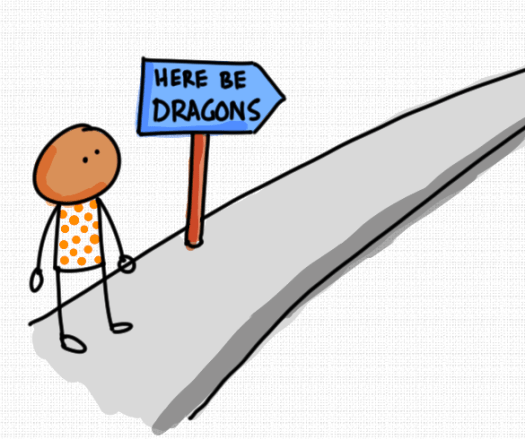
here-be-dragons.png

Sunday, 8.32 pm

Sheffield, U.K.

The darkest places in hell are reserved for those who maintain their neutrality in times of moral crisis. – Dante Alighieri

I had nothing to read this weekend so I bought a newspaper.

Not any newspaper, however. I bought one that is bought by people who think they run the country.

Newspapers such as the Daily Mirror plunge into the news and take positions – very clearly defined stances on what is good and bad.

I find myself agreeing with some of their points.

But I also question other points.

For example, the Conservative Party currently has the most diverse election leadership campaign in its history.

This is no accident but a result of actions taken 17 years ago by David Cameron to increase the pipeline of diverse candidates in the Conservative Party.

This does not sway the Mirror’s position – all the candidates are Conservatives and therefore bad for the country.

And so what is someone who is not sure what to think supposed to do?

There are key issues that are dominating the news right now.

How is one supposed to even enter a conversation about them?

Most of us don’t know where to begin.

I saw a social media post that attempted to “discuss” abortion using a systems thinking approach.

There were a range of reactions…

Some that stood out included the thought that any such discussion was rationalist and had embedded within it patriarchal systems of thinking.

Others simply called the framing of the question “evil”.

The papers don’t worry about this kind of thing, they take a position and shout about the reasons why they believe they’re right.

For my own part I recently learned a term that might be helpful.

What we’re trying to avoid is letting politicians take “politically regressive” actions.

Such actions are ones that are opposed to women’s rights, minority rights, universal civil rights, religious freedom, freedom of dissent and universal equality.

That seems like a useful starting point.

In my last post I wrote about exploring strategies and tools for an increasingly complicated one.

The first strategy, then, is to read critically.

Read widely, read what people say, read what others say about what those people say and come to a view that you can hold.

And a good way to do that is to come off your phone and buy a real news paper.

Cheers,

Karthik Suresh

The Difference Between Betting And Investing

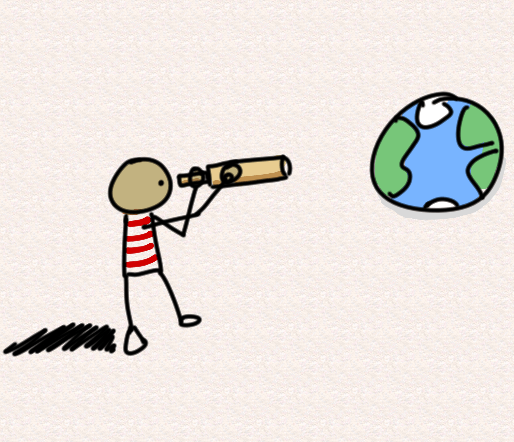
looking-through-lens.png

Tuesday, 8.17pm

Sheffield, U.K.

Investing should be more like watching paint dry or watching grass grow. If you want excitement, take $800 and go to Las Vegas. – Paul Samuelson

I gave away much of my library last month and, of the two hundred odd books let loose into the world, a significant number were about investing.

We aren’t taught how to invest when growing up, but we certainly learn how to spend.

The reason I didn’t need to keep those books is because investing is a solved problem – it’s simple to understand but not easy to do.

And I learned that the hard way, trying out every strategy that’s been touted over the last century.

Well, the main ones anyway, which are as follows.

A value based strategy looks for a company that looks underpriced, where it’s total market cap seems low when you look at the financial numbers.

An example might be an oil company that seems to be worth less than the oil it has on the ground.

A buy what you know strategy looks to invest in a field where you have an information advantage – perhaps you work in retail or energy and know what’s coming around the corner and if it’s going to be good or bad news for your industry.

An example might be understanding the way in which commodity prices are going and the impact that’s going to have on your sector.

And then there’s the buy a good story strategy which is where you look around and see what people you know are buying – what’s hot right now?

Apple and the iPhone come to mind, perhaps Tesla these days?

But do these strategies work?

The first doesn’t – computers can analyse the numbers much better than you can and if a company is cheap it’s probably because something is seriously wrong with it.

I lost everything I invested with this strategy.

The second is a good one, you can make a decent return although perhaps not a spectacular one.

The last strategy worked best for me, clawing back some of the losses from the first approach.

But I still lost money overall.

Which is why we come to the fourth strategy – which is to buy everything.

An index tracker doesn’t pick and choose stocks, it just buys the market in proportion to the market cap of individual companies.

This means you end up with more of some and less of others and overall what you get is based on how the global economy works out.

Now people who sell you financial products hate this last strategy – a low cost index tracker doesn’t rake in the high fees that a more active approach can ask for.

Which is why I was concerned recently.

There’s a lot of talk around Environmental, Social and Governance (ESG) approaches in companies – many people want investors to only invest in companies that have high ESG ratings.

Of course, that way people who push ESG ratings can make some money, but they don’t mention that.

I’m all for ESG but if you use any kind of strategy to invest you need to realise that you’re looking at the world through a lens – one that makes some things look brighter and other things look worse.

Just because a company scores highly on ESG doesn’t mean it will do well in the market- you’re essentially betting that it will if you build a portfolio around that argument.

Of course a company that works on improving ESG is doing a good thing – as long as it’s really doing something better rather than gaming the system to get a better score.

The big index trackers too some flak recently because they said they wouldn’t change their strategy to target companies that scored highly on ESG.

They said, quite rightly, that this wasn’t the mandate they had to set the funds up in the first place – which was simply to buy the market.

And I think that’s the right strategy – and here’s why.

If companies with good ESG do well then their market valuation will go up – and as a result the index trackers will buy them and they’ll make up a larger portion of their portfolios.

If they do badly, they won’t.

Which goes back to the key point – the lens doesn’t matter.

If you pick a particular point of view you’re taking a bet that that point of view is right.

Buying the market is the only neutral point of view – one that says the market is what the market is.

Your bet might pay off – you may get market beating returns.

But the chances are you won’t – in the long-term it’s really very hard to beat a market tracker.

The best thing to do these days, is to stick your money in an S&P 500 tracker or similar and get on with using your time to do something interesting, like reading a book or making something useful.

Often people aren’t satisfied with that strategy – it seems wrong to do nothing, to sit on your hands, and just put your money in a simple instrument.

But that’s why it’s not easy – we feel like we have to be active – to do something.

Obviously – I’m not giving you investment advice – this is just what I’ve learned and what I do.

And this is why most of those books are now in a second-hand store somewhere.

I did keep John Bogle’s book, The clash of cultures: Investment vs speculation, which talks about these ideas.

Bogle, in case you don’t know, was the creator of the first index fund.

It’s an interesting world at the moment, and things that were certain a year ago look much less certain now.

What strategies and tools are we going to need?

I might explore that over the next few posts.

Cheers,

Karthik Suresh

What Is Knowledge Anyway?

giving-away-books.png

Tuesday, 7.23am

Sheffield, U.K.

The best advice I ever got was that knowledge is power and to keep reading. – David Bailey

I had a clearout yesterday and took the majority of my library to the charity shop. I was saying goodbye to old friends, ones that had helped me at various times with questions and problems that I had.

In 2010 I was teaching myself investing. In 2013 I was learning about business. Marketing and copywriting books helped me when I started writing. Before all that, technical books helped me create software and systems.

The thing about books is that they are useless unless you read them. They don’t help me or anyone stacked on the floor for years. If they are out there in the world they may help someone else. And I’ve always believed that when I need it the right book seems to turn up.

More recently, as I read research, I’m starting to realise that the ideas in books are often quite old and often not critically evaluated. Too many books have one idea stretched over 300 pages. Too many have ideas that sound good but are wrong. Many are recipes for action that don’t take into account the complexity and unpredictability of the world.

People read differently too. I came back with a bunch of empty bags and watched a TED talk about Chiki Sarkar and Juggernaut books. Sarkar observed that Indians made up the largest smartphone market in the world but the country had very few bookstores. She started a publisher that focused on delivering cheap books that people could read on smartphones in the time they had available.

The rise of such publishers is a reassuring thought. The traditional form of the book – the codex – is an amazing thing. What’s important, however, is not the form but the ideas in there – and those ideas can flow into the small screen of a smartphone for those of us without the space for large libraries.

Getting rid of hundreds of books has not destroyed the knowledge in them – it’s preserved in the world and in particular made accessible through initiatives like the Open Library.

While ideas in books are being made more accessible there is need for ideas coming out of research to be similarly accessible. Perhaps that’s the next platform that needs building, one that makes cutting-edge research available at very low cost accessible on a smartphone.

Cheers,

Karthik Suresh

How Important Is Winning Anyway?

life-as-game.png

Wednesday, 8.27pm

Sheffield, U.K.

The person that said winning isn’t everything, never won anything. – Mia Hamm

I picked up Herman Hesse’s Siddhartha recently and have been browsing through it. At first I thought it was about the Buddha but it turns out that Hesse is writing a story that tends to follow a particular narrative. Hesse was popular in the counterculture sixties and writes about how his heroes turn away from what is normal and seek to forge their own path.

A few points stand out and are indicative of underlying assumptions that are worth considering.

The stories I grew up with talk about the concept of Maya – that the world is an illusion that we have to see through. It’s an obvious thought – after all everything we see and hear is actually reconstructed by our brains in their windowless caves. We believe there is a world out there but how do you know your reality isn’t closer to the one in the Matrix films?

The idea that everything is an illusion, however, is like running into a brick wall for those who believe the world is real. It’s all we have and it’s actually out there. There are trees and flowers and birds and colour and laughter and song. Robert Pirsig’s Phaedrus, in Zen and the art of motorcycle maintenance gives up his studies of Indian philosophy when the teacher is talking about Maya and claims that the atom bombs that were dropped during the war were also an illusion.

The problem with believing that nothing is real is that nothing actually matters. Hesse’s Siddhartha engages in business but treats it as a game not something that is important. Making money or losing money are the same to him – while his merchant boss loses sleep over lost time and missed opportunities.

The trouble with believing that nothing matters is that there is no point in doing anything. The trouble with believing that things matter is that you become a hoarder seeking to amass more of everything that you see as valuable. The former makes nothing better but it also makes nothing worse – you just exist. The latter can make better things – food, medicine, products of all kinds – but it also uses up everything on Earth.

What’s clear, what’s obvious, is that extremes don’t work. We have to walk a middle path, somewhere between recognising the world is real and our responsibility for looking after it and our desire to make things better for ourselves and the people we care about. This middle way, in the end, is what I remember as the Buddha’s message. A compromise, an accommodation – an acceptance of reality and a committment to making things better.

Cheers,

Karthik Suresh

Is There A Difference Between Western And Eastern Concepts Of Power?

principles-of-power.png

Tuesday, 8.16pm

Sheffield, U.K.

Power is not an institution, and not a structure; neither is it a certain strength we are endowed with; it is the name that one attributes to a complex strategical situation in a particular society. – Michel Foucault

I have been thinking about power and what it really means in our lives.

Let’s start with a misconception – people often say that something is power. Knowledge is power. The person who holds the pen has the power. But power is power and it shows itself in different ways – it’s contingent on the situation and what’s going on around us.

The simplest form of power is brute force or the power of superior weaponry. The person who invented the sharp stick had power over animals. The power of the modern nation state rests in how far its weapons travel – the most powerful nations are the ones that can attack targets anywhere in the world.

But while superior weapons can win a war they cannot maintain peace. It’s well known that a military force will find it hard to control a population that does not agree to be controlled. You see that play out in battlefield after battlefield – after the quick victory comes the grinding conflict until all too often victors give up and leave.

Some people argue that in old conflicts, such as colonial ones, the powers gave up military control in exchange for contractual control. Poor nations that were once colonies remain poor, trapped in contracts that force them to repay old debts or take on obligations that oppress them. The power of contract benefits the wealthy – if you can force people to do what you want through the power of a contract that courts will enforce then you have control – you have power over them.

The power of weapons and the power of contracts is a particularly Western concept, the former a product of the industrial revolution and the latter dating back to the importance of the “Word” in the nature of Western thought.

It’s different in the East, and one expression of this is in Kakuzo Okakura’s “The book of tea” published in 1906. This is a unique window into an Eastern view of the West before the wars of the twentieth century. Okakura writes about “the gentle art of peace” – which you might contrast with Machiavelli’s “The prince”. The latter is about getting and holding power. The former is about the importance of tea.

It’s interesting that Okakura talks about a harmonious society as being weak against aggression. Liberals in society, the people who don’t want guns and want their children to be able to live a peaceful life are, by definition, less able to defend themselves against violence. But violence is not a long-term strategy – it does not create winners but ends up with pockets of defended land – the castles of old. You need something different if you want to have a peaceful society.

Okakura was writing more than a century ago and the problem is that perhaps we’re all becoming the same now. The twentieth century sparked an arms race and we now have a world that is controlled through military power and global contracts. We can write and bemoan what’s going on but perhaps for real change to happen we need to be able to sit and have a cup of tea with those we share a planet with, even if they are less powerful than us.

Cheers,

Karthik Suresh

When Do People Think They’ve Been Treated Well?

procedural-justice.png

Monday, 7.40pm

Sheffield, U.K.

Fairness is not an attitude. It’s a professional skill that must be developed and exercised. – Brit Hume

Operations Research is about making things work better. That’s a relatively simple thing when it comes to machines and processes – go to where the work is being done and make it better. But saying it’s simple is not the same as saying it’s easy. And the difference comes down to people.

What makes one person happy and contented and another dissatisfied and unhappy? What drives people – how are they motivated to do the best they can do?

There’s a concept called “Procedural Justice” which may help explain this – but we need to unpack it a little and Tyler and Blader’s 2000 book Cooperation in groups gives us an introduction to they key concepts.

An economic approach to motivation assumes that what people need are incentives – give them the right incentives and they’ll move mountains. It’s all about salary and stock options and bonuses. Of course you could go with deterrents and threats instead – punish people for failure. Both these are instrumental approaches that drive selfish behaviour – either to get rewards or avoid being punished.

But what makes people cooperate and work together? Why would you work with someone else to make things better for both of you if you’re incentivised to do the best you can on your own? Not everything has to do with self-interest but an important component of group work is the concept of fairness – a justice-based model of cooperative endeavour.

Procedural justice is a particular kind of fairness that’s involved in cooperative work. If you had control over decisions then you could have things your own way. But if you’re not in control then you want to be satisfied that the procedures that are being followed treat you the same way as others.

There are three important components to this:

  • Are you treated politely and with dignity?
  • Are the people in charge trustworthy?
  • Are the procedures neutral?

At one extreme you can see how this works with your experiences with the police. You want to trust the police, you want them to treat you politely and with dignity, and you want them to use the same procedures with all people.

You can apply the same concepts in other situations – from the workplace to social activities. Issues of equality, diversity and inclusion can be viewed through a lens of procedural justice. For each opportunity that you go for are you treated politely and with dignity by trustworthy individuals who apply neutral procedures?

If you are then I think you’ll agree that you’ve been treated well.

Cheers,

Karthik Suresh

References

Tyler, T., & Blader, S. (2000). Cooperation in Groups: Procedural Justice, Social Identity, and Behavioral Engagement (1st ed.). Routledge. https://doi.org/10.4324/9780203782842

What Does A Management Consultant Actually Do?

soft-or.png

Saturday, 8.46pm

Sheffield, U.K.

My greatest strength as a consultant is to be ignorant and ask a few questions. – Peter Drucker

I call myself a Management Consultant – but few people really understand what that means. I don’t think I really do either, or at least, I don’t think I did.

There’s a thing called the Dunning Kruger effect that looks at the relationship between how confident you are in your abilities and how good you really are as judged by others based on your performance. It won’t surprise you to learn that people are sometimes overly confident when they shouldn’t be – but they don’t know yet that they aren’t as good as they think.

It’s only by immersing myself in the research in the field of Operations Research (OR) that I’ve learned that Management Consulting is really Operations Research by another name. It should be obvious really – OR is about making things work better – but not just machine things but people-machine things. People-machine systems if you will, although the word “system” will trigger some people into defining what a system is in the first place. If we sidestep around that point, however, Management Consulting and Operations Research are really about improving how organisations carry out their operations. So how do you go about doing that?

One way of approaching the question is in an “Expert Mode”. You bring in a titan of industry, an acknowledged expert, and you listen to his (all too often it’s a he) advice. That’s how it works or used to work or is the way some people wish it worked.

The world is much too complicated, however, to be solved by experts. There are too many factors, interconnected elements, intractable variables that do not allow for a simple solution. And that’s where Soft Operations Research (Soft OR) comes in. It’s where you’re asked to engage your humanity rather than your expertise.

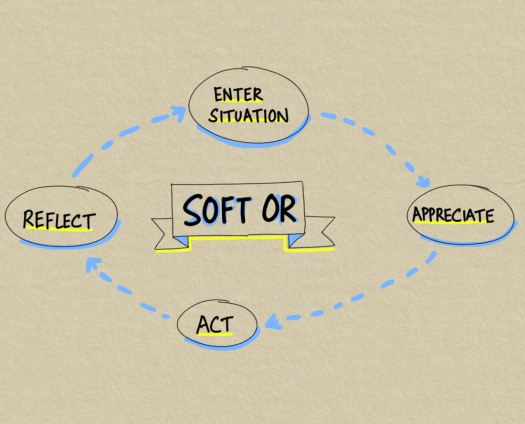
This is a form of “Process” consulting, where you work with your clients rather than instructing them. And you can think of this as a four stage process – one that you won’t find in the literature but one that might help see what needs to happen.

The first thing is that you have to find a way to enter the situation – be invited in to help or offer your assistance. You can’t really work on something if you aren’t actually part of the team.

The next step is to get a rich appreciation of what’s going on. That means speaking and listening and seeing the situation from multiple perspectives – asking questions about the nature of the situation, and its context, including who wants what and who controls what – issues of culture and politics that surround every non-trivial situation of concern. It’s only through that appreciative process that you can get a sense of what needs to be done.

And then you do it – you propose a course of action and if it’s agreed, you go ahead and act.

You then reflect on the process, on whether you were able to appreciate what was going on, whether your action improved the situation or not – and what you learned from the process. And then you can go into the situation again or into a new one – with your purpose always being to make things better.

The thing with the world is that if you take the time to look and listen – what you need to do next will eventually become clear to you. You just have to have patience.

Cheers,

Karthik Suresh

The Takahashi Presentation Method

key-point.png

The entertainment is in the presentation. – John McTiernan

The Takahashi method is a minimalist approach to presentations. Named after its inventor, Masayoshi Takahashi, it’s a technique that uses only a few words on each slide in large text. The words are meant to capture the key point that’s being made – somewhat in the style of a newspaper headline.

It’s an interesting approach and contrasts with other presentation methods such as conference style presentations, as described by Andrew Abela, and inspiring presentations, in the style of TED talks. Conference style presentations are detailed slides, filled with content, but structured with headlines in a way that means the general story can be told and the detail read later. Inspiring presentations often have a picture or a few words dominating the page, and are used to tell a story and draw you into the narrative.

These approaches are better, it is argued, than the traditional use of slides filled with bullet points and dense text – that’s the whole death by PowerPoint approach.

But is the Takahashi method a simple visual technique, different only because of the way it looks or does it possibly have a deeper use that’s isn’t obvious at first glance?

In the book Index, a history of the by Dennis Duncan we are told about the character Lotaria in Italo Calvino’s novel If on a winter’s night a traveller who reads by feeding books into her computer and looking at the frequencies of repeated words – deducing from them the meaning in the text. This might seem like cheating, a shortcut – why should authors put all that effort into writing carefully constructed prose if you simply look at an automated analysis of the work instead?

For a start it’s faster than reading everything and sometimes you want to figure out what the key points are in a text. I fed a number of papers into a program that extracted bigrams and trigrams – repeated two and three-word combinations to see if they helped get a sense of what the paper was all about. And I found that it was a surprisingly useful technique. If an author comes up with a bigram that usefully encapsulates a concept then it tends to be repeated, and the repetition helps you pick out what the author considers important. These bigrams can then be used as a connected set of ideas, a “string of pearls” to step through and talk about the ideas in the paper.

Takahashi’s method seems perfect for this approach, a distillation of key points that support the telling of a story. But will it work in practice? I need to think about how to try it out.

Cheers,

Karthik Suresh

Trying The Two Pages A Day Theory

two-pages-a-day.png

Tuesday, 8.20pm

Sheffield, U.K.

Almost all good writing begins with terrible first efforts. You need to start somewhere. Start by getting something- anything – down on paper. What I’ve learned to do when I sit down to work on a shitty first draft is to quiet the voices in my head. – Anne Lamott

I have been writing less this year than I have in the last four years. The main reason for this is that I’m doing more research and reading and that leaves less time for writing. I’m also less sure what to write as the more you look into something the more you realise that there are many different ways to see and appreciate and understand what is going on and it all gets a little messy on paper. Clear, simple writing may read well – but it sometimes does not reflect reality.

The other, smaller reason, is that I’m also trying to draft content for a PhD thesis and that’s slowing me down – I haven’t written stuff like that before and I don’t quite know what to do.

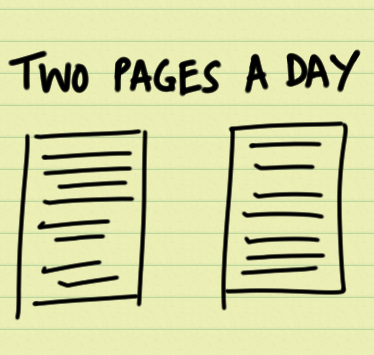
One approach that I’m trying is to do something, anything, that gets me going. So rather than typing on the computer, which is the easiest way to get material out, I have a composition notebook and am drafting by hand. I’ve tried it for a couple of days and the material is starting to trickle out. Each page holds around 200 words and so at the rate of two pages a day it’s going to take 250 days or most of a year to get a first draft written.

Anne Lamott’s theory, in her book Bird by Bird, is that you should just sit down and write two pages a day. She calls it a shitty first draft and some people take issue with that – just call it a first draft they say, something you will revise and improve when you do the next round of edits. Writing is revising after all, they argue.

Many writers would agree with this. William Zinsser in On writing well, John McPhee in Draft No. 4 and Natalie Goldberg in Writing down the bones, all write about the practice and effort that goes into writing. The quotes roll on, from Gene Fowler, “Writing is easy. You only need to stare at a blank piece of paper until drops of blood form on your forehead”.

The secret to writing was revealed by Mary Heaton Vorse: “The art of writing is the art of applying the seat of the pants to the seat of the chair.”

I’ll let you know how I get on.

Cheers,

Karthik Suresh

How To Draw A Rich Picture – And Think About Why You Are Doing It

rich-picture-practice.png

Monday, 8.11pm

Sheffield, U.K.

When you meet people, show real appreciation, then genuine curiosity. – Martha Beck

Before you can solve a problem you need to know what the problem actually is. This is harder to do than it seems. One technique for figuring out what the problem is in the first place is to draw a Rich Picture – one of the components of Soft Systems Methodology (SSM), developed by Peter Checkland.

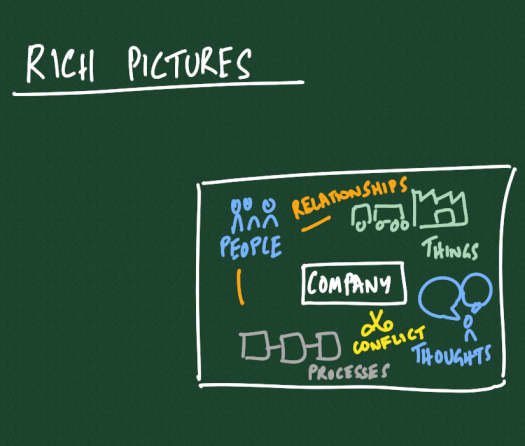
In their 1992 paper, Towards an SSM toolkit: rich picture diagramming, Avison, Golder and Shah write that a rich picture may show processes and their relationships, clients, people involved, environmental features, problem owners, constraints, conflicts, flows of information and much else still. Rich pictures are complex to draw because they try and incorporate the richness that is unique to a particular situation.

A rich picture is often drawn on a whiteboard during a face to face meeting. Avison et al suggest that a way to start is by writing the name of the company in a box in the middle and then developing the picture from there, drawing people, things, processes, the relationships between them, thoughts that people might have and areas of conflict that suggest themselves. The picture is used to support a discussion and can be changed based on feedback and observations.

In my own practice and research I have been working on digital approaches to drawing rich pictures. I thought that is what I was doing in the examples described in this early description but now I realize I was doing something different. A rich picture, within the framework described by Peter Checkland, is much closer to something in the image that starts this post.

Some things are worth pointing out about this picture. First, it’s not well-drawn. Writing on a computer using a stylus is not the easiest thing to do. If you pretend you’re using a whiteboard and can’t zoom in and out of the picture it’s harder to make the fine movements needed to make good drawings or letter forms. But that’s ok. If you’re focusing on the visual aspect of the picture rather than its use as an object that supports a discussion you’re missing the point about a rich picture. It’s about appreciation, not art.

The second, less obvious aspect of a rich picture, is that it’s a window onto an inner world of someone’s mind – an image that looks to capture how things look from their point of view. Thinking about it like looking through windows is a useful metaphor. Let’s say you’re in a city and want to get a feel for the place – you look out of your hotel window and get one view. You get to your office and look out of that window and get another view. Both are views of the same city but both are different and both are partial. You know more than you did but you don’t know it all and what you know is limited by what you saw through the windows you had a chance to look through.

The third aspect of a rich picture is that what you see is not all there is. You can have a discussion with a group of people about their company and situation and all the other things and draw a rich picture but, as Avison et al point out, there are often politics involved, where “some facts about the organization cannot be acknowledged and cannot be published so that there is often a hidden agenda between the analyst and senior members of the organization”.

This last point is the one that really complicates things. A rich picture is a tool to help understand and improve situations. But it’s just a tool and it can also be used to do bad things, just like writing has done in the past.

I’m reading This is the canon: Decolonize your bookshelf in 50 books edited by Joan Anim-Addo, Deidre Osborne and Kadija Sesay. They write that “decolonizing insists on change regarding practices and responses that oppress others, notably those burdened by historical injustices…” In the 18th century writing was exalted as the “age of authors” but writing was also “a key tool of colonial domination”. At the stroke of a pen some people could own nothing, allowing those that could to take all they had, including the bodies of those no longer deemed human.

A rich picture is a tool, just like a hammer. And, just like a hammer, the results you get depend on how you wield it. It would be wise to do so carefully and thoughtfully.

Cheers,

Karthik Suresh

References

Avison, D.E, Golder, P.A, Shah, H.U. (1992), “Towards an SSM toolkit: Rich picture diagramming”, Eur. J. Inf. Systs. Vol. 1, No. 6, pp 397-407