
How To Read And Re-present Ideas

The Art of Thinking

Sunday, 6.49pm
Sheffield, U.K.
I’m writing a book. I’ve got the page numbers done. – Steven Wright
As a researcher that eventually wants to get published I want to know how to produce good quality writing using a reliable and repeatable process. A key question is whether I should go straight to the computer and start typing or start with paper and write a longhand draft with a pencil or pen.
A computer is great for typesetting. Early software tools took text with markup and prepared it for typesetting and printing. Eventually we had word processing software that let you see exactly how your text would look when you entered it. But is using a computer from the start the best way to create quality work?
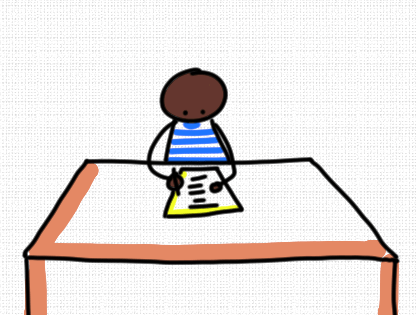
Writing by hand on paper is slow but you’re also not distracted, The only thing to do is keep adding words to the page. It’s portable, requires no batteries and you can write pretty much everywhere. But is longhand still relevant today – should it be part of your writing process or consigned to history? I’ve scoured the Internet and here’s what I’ve found.
Writing is a process
Writing consists of at least four phases. First there is prewriting. Then comes drafting, followed by revising, and finally editing. Once you have a finished text you can get on with typesetting and proofreading until you get to publication. Each paper you write will go through multiple revisions until it’s polished to your satisfaction. You will never get it right the first time. Using a computer from the start can give you a false sense of confidence in the quality of the finished product. Just because it looks finished that doesn’t mean it is finished. A handwritten first draft has to be rewritten at least once, when you type it into the computer. That means starting a draft on paper forces you to write with rewriting already in mind.
Writing is about producing words, sentences and paragraphs. A paragraph introduces and expands upon a single idea. Each paragraph ranges from 100-250 words. Jordan Peterson, in his essay writing guide suggests aiming for 10 sentences of 10 words each. If you write double spaced you will end up with a paragraph’s worth of content on a single page. The pad I’m writing on has 31 lines and I use 16 of them with 7-11 words on each line. That comes to around 120-130 words on average. Starting the page with a topic sentence and filling the rest of it with supporting sentences will give you a single paragraph, the building block of your paper. Write on only one side of the page because it makes it faster to type up but if you think of ideas later you still have space to add them on the back of the page. If you’re worried about wasting paper write the next piece using the other side of your used pages once you’ve entered them into the computer.
Writing a paragraph to a page makes it easy to visualise how much writing you need to do. A 500 word blog post will run to around five pages of writing. If you have an introduction and conclusion that leaves three pages or three ideas that you can introduce. This structural constraint encourages you to select the three strongest ideas that help you make your point. It encourages you to focus and develop the idea introduced in your topic sentence on each page. If you think of an unrelated idea it should be noted elsewhere. If you can’t think of enough to write leave the rest of the page blank and start on a new page. You’ll come back and fill it in when you think of something later.
Structuring your writing
Having a collection of paragraphs on individual pages makes it easy to structure and organise your post. All you have to do is shuffle the pages into an order that works. In the editing phase Jordan Peterson suggests expanding each paragraph into individual sentences and working on them one at a time, moving them around, rewriting them or deleting them entirely. Once on the computer I use a macro to do this and seeing each sentence on its own does make it much easier to visualise how to make it better.
I have never liked outlines but following this process has helped me see the value of having one. There is a lot to think about when you’re writing a paper and you can’t keep it all in your head. The only way to organise a lot of material is to group it into smaller, understandable chunks, aiming for 7 +/-2 elements in each group. Writing down a list of ideas gives you a jumping off point for each paragraph. The collections of paragraphs build into subsections and sections and eventually help you in creating large and complex pieces of writing like a thesis or book.
Looking to the past
To understand best practices when it comes to writing longhand you have to go back to older texts that predate the widespread use of computers. Methods of Authors by Hugo Erichsen is a delicious introduction to the habits and eccentricities of the writers that worked a century or so ago. Two excellent articles on how Charles Darwin made notes and wrote his books are on the Friends of Darwin website. Newspaper writing and editing by Willard Grosvenor Bleyer describes how newspaper articles were often sent to the compositor a page at a time, each one containing a paragraph called a “take”, which would be put together to make the final story. If such methods worked under the time pressure of daily news production perhaps they will work for you and me as well.
And now…
Writing by hand is not for everyone but if you do want to try it here are some rules to follow.
Cheers,
Karthik Suresh

Sunday, 7.02am
Sheffield, U.K.
God in His wisdom made the fly; And then forgot to tell us why. – Ogden Nash
I have seen David Graeber’s book “Bullshit Jobs” on shelves. I’ve picked it up, leafed through it, and put it back. Finally, I’ve read it.
The book is thought-provoking. It needs to be read in layers. It is also shrill. Graeber argues that many jobs are pointless, perhaps half of them or more. Not just pointless, but abhorrent, demeaning and humiliating. Somehow we’ve gone from producing things, farming, factory work and the like, to becoming administrators, paper pushers and form fillers. It’s not about a rise in services – as the jobs we do with our hands have dropped jobs working with information have increased while true services – waiting on tables, hairdressing, pharmacists – have stayed roughly level. We’re somehow so busy doing all this that we’re no longer have a life, this isn’t living. It’s a corruption of existence.
My first reaction reading this was defensive. How could it make sense that a large number of people are being paid to do useless work. Is it possible that we just don’t understand what is going on yet?
Take our own bodies, for example. We have the “doing” portions, our hands and feet and digits. What makes us different is a large brain with multiple layers that takes up a huge amount of energy. In that brain we have an older portion that controls our emotions, deciding whether we fight or run or mate. There are a lot of neurons involved in processing activity, laying down chemical memory trails and activating networks of processing activity to do everything from process what you’re seeing to learning how to do something. And then you have a part of the brain that dreams and thinks about possible futures and makes it possible for us to build tools, study everything and go to space. Would you argue that the brain and its information management function is bullshit and only having arms and legs matters? Is the vast economic activity that makes the world we live in possible a system something like that, where the jobs we do help to make things but also build relationships, process information and build the future? Are these jobs part of a complex system, and if so even if we can’t make sense of each one in isolation, they matter as part of the whole social structure we live in?
Before we can consider this Graeber moves on and says that a job is bullshit if the owner of the job feels that it is. It doesn’t really matter what you think or if the “system” needs those jobs – what really matters is what the holder of the job thinks because that is what affects their physical and mental health. I can see that point of view. Ok. There is no easy answer to that. Can you change your situation? Can you change your mind? Are you stuck?
But why do these jobs get created in the first place? We can try to answer this question with first, second and third thoughts. A first thought is that managers believe that the jobs are necessary and create them for sound, objective reasons in the pursuit of rational goals. A second thought is that managers pander to people in power and create jobs that get what powerful people want done. A third thought is that managers work to advance their own interests and gain power by accumulating resources and control. The third is closest to Graeber’s argument that we live in an age of managerial feudalism where an elaborate system of favours and demonstrations of power make the corporate machine work. Graeber argues that this is a problem – an obvious one open for all to see – and he is just pointing it out not offering solutions.
Is it a problem though? From a systems perspective that’s a difficult conclusion, because one can argue that the purpose of a system is what it does. Systems such as a corporate organization are stable when they can self replicate themselves – when they are autopoietic, from the Greek for self and create. A corporate system, with its hierarchies and controls and ways of getting new people in and old people out, is a system capable of surviving and replicating. Large companies with such structures currently dominate economic activity, with other possible structures like more egalitarian, communal or cooperative organisations, less powerful or visible. Things were different in the past. Perhaps they will be different again in the future.
But does it make sense to talk of these structures as “good” or “bad”. Isn’t that a bit like saying an elephant is good and a fly is bad? Both just are, they’ve evolved to fit into their niches. If, for some reason, you think elephants are bad, can you “solve” them. Let’s say you got rid of the current structure how do you know what you will get isn’t going to be worse? And maybe it will topple over and die all by itself when it gets old or when something fitter comes along. Dinosaurs once ruled the planet. Make your case for the alternative and time will tell whether it takes over or not. After all, we have examples of different structures in different countries around the planet? Given a choice, which system would you like to live in – the developed West? China? Russia?
Graeber also calls out a feature of modern society – an emerging caste system in the West made up of the poor, the rich, the influential and the intellectual. The very poor and the very rich have more in common with each other than with the influential and intellectual. A person from a poor background can, in theory, become very rich. It’s getting harder for that same poor person to break into jobs that influentials and intellectuals control – think of the years of training and the extensive social networks you need to become an internationally renowned art critic. There is a route to wealth, scholarship and fame for everyone but some have more roadblocks than others. Graeber provides more conjecture than evidence around this point but it’s hard not to be reminded of Sir Michael Rutter’s advice to “choose your parents wisely” if you want to be successful. But here’s the thing about being a parent. You want to give your children the best chance in life and that means you want stability and certainty, and the biological need to protect your offspring perhaps trumps any theory that argues that the social architecture you live in is not as good as it could be.
Perhaps what I relate to least about the book is the conceit that jobs are created purely for show as a result of a feudal favours structure. There are all these jobs that pay you a lot and where you have to do very little. Pity these poor people. The immigrant experience, which I have gone through, is very different. I remember how hard it was to get that first job. The hundreds of applications I sent out. The silence that followed. The few responses and the unfailing rejections. What I lacked was a right to work. I didn’t hold the “right” that would have allowed me to benefit from being paid a lot for not doing much. Eventually I had a chance and got that first job but my experience has been that I’ve had to create each job I’ve had, and along the way I’ve created many jobs that were then filled by others.
The reality of organisational life is that people with power and money have things they want to achieve. They are happy to pay money to talented and hardworking people that get those tasks done economically and quickly. Sure, some bosses are exploitative but others are not. The power balance decides how you get treated. It’s rare to find someone that’s exceptional from the start of their career. Even the basics – how many people do you know that can competently read, write and do arithmetic? You can develop people if they have the passion and determination to work. The people in Graeber’s book complaining about their jobs presumably found it easy enough to get them in the first place. The reward for working hard and doing good work, as anyone with real experience knows, is not a prize or big bonus. It’s more work. And being given more work is associated with more responsibility, more trust, more authority and eventually more money. It’s a compounding machine – the more you do the more you get to do – and eventually you become good enough that the power balance starts to shift and you can get what you’re worth from those who need what you can provide.
And really, are these bullshit jobs the really bad ones? Take a job that you probably wouldn’t consider a bullshit one. I had my eyes checked by an optician recently. As I sat in the uncomfortable barber’s style chair, thinking about the book, I looked around at the windowless room, a small air-conditioner, oddly painted walls and wondered about the nature of the job. Hour after hour sitting in a small, surely uncomfortable swivel chair, working at a cramped desk, going through an unchanging procedure with patient after patient, asking the same questions again and again, typing the results into an ancient Windows application. Surely looking after your eyes is a job of great importance. And yet it’s an assembly line working on people. “Look up please. Now to your right.” The job has little flexibility, you can’t avoid it or think about something else because you might miss that small sign of glaucoma. Like doctoring and nursing, the stream of patients never stops and you end your shift physically and mentally drained. And you probably don’t get paid enough. But we don’t know the history of that optician. Maybe his parents are proud that he has a safe professional role. Maybe he’s better off than they were.

For those of us who weren’t born with the right to the luxury of a meaningless but well paid job, the most important model that underpins life is that of cash flow. It marks the change from being a child to an adult. First you pay out cash (or your parents do) for your childhood and education. Then you start getting a return on that education, perhaps hourly work, an internship, that first job. At some time t you reach a critical point, one where you make enough money to meet all your expenses and have a penny left over. That’s the point where you shift into adulthood. You are now in control. Free. Responsible. From that point you’re ready to live your life as long as you stay above that line. If you get there you’re luckier than many. More than that may mean your life is nice, indulgent, even extravagant. But once you shift from negative to positive cash flow you’re finally on solid ground. Everything else is a bonus.
As we reach the closing pages of the book Graeber says he is an anarchist. That means he wants no government, no system of order, no institutions. Nothing. Perhaps that is a position that someone sitting in a world defined by institutions and with easy access to fresh air, clean water and safe food, can dream of as utopian. But I’ve seen what that utopia looks like. I flew into Haiti a few months after a coup. There were no police on the road. No evidence of visible government. It didn’t feel better. It didn’t feel safe. And I can tell you that the person with the better gun had a better change of staying alive. Hernando de Soto argued that democracy wasn’t about votes, it was having institutions and checks and balances like the separation between politics, the military and the judiciary. A society where you can say what you think and criticise what you see as wrong. Anarchy might work in the natural world where predators and prey seem to live in balance without the need for representative parliamentary procedure. But modern society works because of these balanced institutions and, however flawed they are, they produce better outcomes than countries that don’t have them, or that have dominant institutions like a single party state or a dictatorship. If part of that is that we produce what Graeber calls bullshit jobs, well then, it is what it is.
It is what it is.
Cheers,
Karthik Suresh

Thursday, 7.54pm
Sheffield, U.K.
The multiverse exists because every choice we make creates a fork in the road, which leads into a parallel world. – Blake Crouch
Real life decision making is hard. The technical term for it is decision making under uncertainty. We don’t know what the future might be but we still need to make a choice right now. Or do we?
Frost wrote about forks in roads and how taking the one less travelled by made all the difference. Choosing one area of study or another. Choosing one college or another, one country or another, one partner or another. Each choice we make opens up some paths and closes others.
One way of making sense of these choices is to draw a decision tree. What are the choices, and what happens if you choose one or the other. The tree and its branches, drawn sideways in the picture above, are possible paths you can traverse. Importantly, they are mutually exclusive, going down one means you forego the other. Each route has an outcome and the idea is that you choose the route with the best outcome, but the outcome that you can expect is a probabilistic combination of all the routes.
Leave the maths to ones side – I did this tree ten years back to choose between staying in a job, starting a business or doing further studies. The modelling didn’t give me an answer – all the options had roughly the same outcomes. So I made a decision with my gut and I haven’t been unhappy with the results. I went for knowledge and somehow knowing why things are the way they are gives you a feeling of equanimity in a complicated and complex world.
The secret to decision making is perhaps not making one. This is called preserving optionality. Keep all the options open for as long as possible. When given a choice between two options go for both. This is something I learned from the small people in the house. One will choose between options – a fearless decision maker. The other will want both options you’ve written down and demand the pen you wrote it with. I look forward to seeing the outcomes from both approaches as they progress in life.
The multiverse has caught the popular imagination – or at least those imaginations that are fired by the world of Marvel. If you say the words “Schrödinger’s cat” to fans of the Big Bang Theory they’ll get what you mean.
What this means for you and me is that everything you want to do is still possible unless you choose to close it down.
Cheers, Karthik

Saturday, 10.42pm
Sheffield, U.K.
It is better to keep your mouth closed and let people think you are a fool than to open it and remove all doubt. – Mark Twain
Over 30 years ago I had a class where we were taught how to draw bamboo stalks and leaves using brushes, ink and rice paper. It’s a simple set of strokes that has remained with me ever since.
Why is that? Is it because the actions involved were so pared down to the essentials, so succinct and perfect that they seared themselves into my memory? And why does other stuff take so much more time to understand or do?
Let’s go back to the point about the essentials of something. I’ve spent the last few months reading a lot of papers. Each paper has a lot of padding, stuff that introduces an idea, where it talks about other work, but somewhere in there is a sentence that tells you what the paper is all about – the thing that’s new – the thing that’s novel – the thing that didn’t exist before this work was done.
It like a golden nugget that’s waiting to be found. It’s an idea that, when you discover it, can be connected to other ideas to construct your own body of knowledge. Or more accurately, your graph of knowledge, the set of nodes and links that connects everything you know.
Knowledge then comes down to nodes and links. You have to create nodes and then lay down the links between them. The more links there are and the more you go over each link, the stronger certain connections become, the easier they are to retrieve, and the more important they are in your knowledge structure. If you want to learn or study or research an area you need a way to create nodes and links and a way to go over them again and again.
That’s where tools come in. Tools like notebooks and index cards, computer files and interconnected web pages. You need a way to collect information and connect it with other information. That’s hard to do for starters although the internet is pretty useful at helping with the task. The hard bit comes after – which is remembering how to find the information again.
Of course, it looks like we’ll soon reach a point where we won’t have to remember anything at all. It will all be a search or a query away. When that happens, however, the danger is that by not remembering anything we also know nothing.
Cheers,
Karthik Suresh

Sunday, 8.17pm
Sheffield, U.K.
Writing is my love. If you love something, you find a lot of time. I write for two hours a day, usually starting at midnight; at times, I start at 11. – A. P. J. Abdul Kalam
Writing is a process that, according to MIT, has four steps: prewriting; drafting; revising; and editing.
This misses out several important steps including: worrying, obsessing, messing, questioning, procrastinating, avoiding and complaining.
I used to think writing was a linear process. You started at the first word, put down more words, and kept going until you ran out of time.
And then you hit the publish button.
Now I think a little differently, but unpacking exactly how may not be the easiest thing to do. Let’s give it a try anyway by asking some questions.
Who do you write for?
Writing is always done for someone. When you start you often write for yourself – the act of writing is often the way in which you figure out what you think.
Sometimes people write for a specific person. Warren Buffett said that he addressed his annual letters to his sisters to help him remember to keep it accessible and jargon free.
In academic writing you write your thesis for your PhD supervisor and papers for the reviewers.
In journalism, I would guess, you write for your editor.
Somewhere along the way perhaps you get good enough or well-known enough that the gatekeepers are no longer important – and you write for your fans. You start to write the kind of stuff they expect to get from you.
Some writers throw out the rules and write however they want. I recently read an article that was written by two people who wrote separately, commented on each other’s ideas and created something that was presented as a mix of the two. It was interesting, as an idea, but hard to read as a piece of text.
How do you write?
I have always started writing and figured out where I’m going when I reached the end of the piece. That’s the way this post is written and how most of the others on this site were written.
Recently I read a piece on essay writing by Jordan Peterson and it opened my eyes to something that I had never considered before.
Peterson sets out a process to follow that starts with an outline and then goes through multiple drafts and finessing of sentences.
But the most important thing was that he wrote about how to use an outline. Instead of writing an outline and then going on to write the paper as a linear process he described how you should actually go from one to the other and back again. Write your outline, start filling it in and then go back from what you’ve written to the outline – and change it if it makes sense.
This may seem like an obvious and trivial thing to you but it’s actually really quite significant. We think that we make a plan and then go and execute it, put up scaffolding and then put up the building. What Peterson’s process gives you permission to do is alter the plan and move the scaffolding as part of your writing process. Not just permission – it encourages you to go between the two making your outline and text work together and sing.
How do you think?
Peterson’s essay is about the mechanics – about how to create a structure and form your thoughts. But how do you get those thoughts in the first place?
They come from reading and taking notes and reflecting on what you’ve collected – and that means you need tools to do that. Note-taking tools, idea-capturing tools, and concept-writing tools.
There’s an idea called literate programming where you think about what you want to do and put it down in prose and then you write the code that implements what you want.
This could work in writing as well.
Imagine writing down what you’re trying to say as a comment on the page and then writing what you want to say as text on the page. One bit is about the thinking – I’d like to say this thing in this way and connect it to another idea from over there but how do I do that and it’s really quite hard – and the other bit is about the sentence that you’re actually going to include in the paper.
You can use this idea of literate programming to do literate writing – putting comments and content in the same document and extracting the content that will be published while preserving the thinking that went into it – thinking that may contain some of those other elements that you don’t get in the four step writing model.
Why do you write?
The days when you write for money are numbered. AI systems like ChatGPT will read and summarise material better than you will be able to soon. They’re the ultimate research assistant and the cost of what they produce will inevitably trend towards zero – the marginal cost of production.
In the future you will write only because you want to.
Cheers, Karthik Suresh
Sunday, 9.25pm
Sheffield, U.K.
We all need people who will give us feedback. That’s how we improve. – Bill Gates
I think I’m lucky.
I’ve had the opportunity recently to get feedback on pieces of work, ranging from academic writing to business propositions.
And I have to tell you – it’s been brutal.
I can’t say that’s it’s undeserved, though – I can see the points being made and they are helpful – the point of having a peer review is to make the work better.
And that’s something you don’t get if you write a blog or even a book.
You get indirect feedback by the number of likes or reviews, perhaps even sales.
But you don’t get a clear analysis of whether you made your ideas clear or if you missed something big.
In fact, if you’re a big name author or renowned in your field then you’ll get even less feedback because people will be scared of telling you that something is wrong.
Even my barber asked for feedback the other day – he said that most people will say it’s fine even if they don’t think much of their haircut.
That’s the problem much of the time – you don’t get to learn what others think of your work.
Usually you’re just ignored.
Which is why, even though the feedback I’ve received is negative, I think I’m lucky.
Because I now have a chance to get better.
Cheers,
Karthik Suresh
Saturday, 8.06pm
Sheffield, U.K.
Practice is everything. This is often misquoted as Practice makes perfect. – Periander
I recently read “Terry Pratchett: A life with footnotes” and then watched Stutz, a conversation between actor Jonah Hill and his therapist, Phil Stutz.
Pratchett had a rare form of Alzheimer’s disease and Stutz has Parkinson’s disease, debilitating conditions that affected their ability to do their work.
Pratchett, despite this, wrote 41 books with ten more in progress crushed under a steamroller when he died. Although some people, who don’t really know what they’re talking about, criticise his work, his books are filled with insights into how people think and act and feel, very real things that matter in the world explored through the use of a fantastical setting.
A post on LinkedIn pointed me to the Stutz documentary, and then thing that really caught my interest was his “unique, visual model of therapy”. That’s in line with the theme of this blog. Stutz uses a number of models, what he calls “tools” and draws them for his patients on index cards. He uses a black pen and his wavering hand and the shaky lines of the drawings he makes are somewhat haunting.
One reason why these two individuals are interesting to me is that they have methods they use – Pratchett’s adult books are unique because he just writes them through – no planning, no corkboards filled with plotlines – no chapters. Just a story that he writes using a Word document filled with, we are told, different fonts and sections. And he’s usually working on a few of these at a time with other works or passages saved in the “pit”. Stutz’s uses index cards and drawings to help patients visualise and remember a particular tool so that they can remember how it works and use it in a situation when needed.
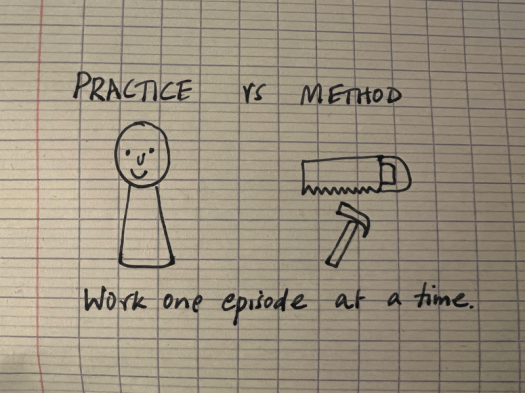
Methods are great – they can be described and written up and published and pointed to as approaches that can be used by anyone. But sometimes it becomes all about the method and people forget that there’s practice involved as well. Methods are like tools, like having a saw or hammer. But there’s a world of difference between my inept handling of a saw and how a joiner uses it to create a piece of furniture. Methods should be seen as a starting point for the development of one’s own practice – not as the end result of the work.
In my area of research – operational research – perhaps that’s why so few methods are used by anyone other than the founders. That’s the case for many tools – unless they are very simple. The extent to which you complicate methods seems to have an inverse relationship with the rate of adoption – that’s obvious really – the harder it is to do something the fewer people will do it.
Does that rarity make it valuable?
It’s hard to tell the difference between something that people don’t do because it’s too hard, even though it has benefits, or because it’s just not worth doing. That judgement has to be made by each individual practitioner, and that’s why practice is the step that comes after the creation of a method.
Practice is the application of method and the refinement of how it’s applied so that it fits you, the practitioner. The constraints you put on yourself affect how you do what you do – from the tools you use to the way in which you produce and share work.
These kinds of ideas are meta concepts – ideas about ideas – so how can we make this practical.
Take the theme of this blog – the idea that making drawings can help you think about situations. That can change the way you see and talk about everything from organisational development to how you interact with your children or process your experiences. But drawing is not a general method. It is, instead, something very specific to the particular situation you find yourself in – something you could call an episode, with a defined beginning and end.
These episodes, defined moments of time, are when you apply your method and practise your practice. When it comes to applying drawing you can do it like Stultz – naming a tool and creating an image that helps you remember it. One example that he uses that I wrote about in a different context is the idea of a string of pearls.
Where am I going with this?
In a blog post like this I can describe the context of the work that I’m trying to do – something about how we can understand situations using visual tools. The detailed description of that approach is what goes into a published paper – these thoughts are the context, the muddling-throughs that happen as we think about ideas and concepts and relate them to each other.
I think it comes down to this.
You try doing something and when it works for you again and again you write down what you did and call it a method. Others then see that method and try it out for themselves. The trick is not to see the method as the end result in itself but as a starting point for your own learning – your own practice – which is how you take something that works in principle and make it work for you in practice in your own unique and valuable way.
Cheers,
Karthik Suresh

Sunday, 8.06pm
Sheffield, U.K.
Propaganda is a soft weapon; hold it in your hands too long, and it will move about like a snake, and strike the other way. – Jean Anouilh
Social media is a dangerous place.
In the time-sink sense in my case.
I saw a post about a chap putting a point of view across in a debate and unwisely listened to it. I drew what he looked like as I listened. It’s a perfect likeness – the one on the left – if I say so myself.
I get it, he was putting across a point of view and it was all a show – but the points were wrong in two ways. First, they were obviously wrong and second, they were morally wrong. And yet he had a good, although obvious, next step, and yet the whole thing rankled.
Let me be specific – the debate was about climate change and specifically the UK’s contribution to climate change. The UK’s impact, the speaker said, was around 2% and so it didn’t matter what the country did. The problem was elsewhere.
Of course, if you think about this for a second it cannot possibly be true. The UK is a rich country, each person consumes a lot more than people in other countries, and all that consumption uses resources and energy. Just because that energy isn’t burned in the UK itself and is instead offshored to manufacturing firms in developing countries that doesn’t mean the UK isn’t responsible for the demand that creates those emissions in the first place.
Impact comes from everything you do – both your action and your consumption choices. And it’s right that those that consume the most should make better choices about what they buy – because that demand for better will drive change throughout the system.
I made the mistake of lingering on social media for one minute too long and then saw how our friendly neighbourhood artificial intelligence chatbot is being used to manipulate people. Or more accurately – to try and manipulate people.
Some chap had created a list of prompts you should put to ChatGPT so it would write sales emails on your behalf. This seems like a waste of time – and a waste of intelligence. But if your job is to write email automation campaigns maybe it’s worth seeing if you can outsource it to a machine that will probably do a better job.
The good thing is that the AI tool is probably going to be the thing that fact checks the first guy’s lies but then you’ll also have the AI tools writing a new set of lies – and the battle between participants jockeying for position and power will continue.
I am also, luckily, reading Terry Pratchett’s biography, “A life with footnotes” and the important thing, for this prolific author, was to get into his office and get on with the daily wordcount.
Which is what I should do – get off social media and focus on work.
Cheers,
Karthik Suresh
 Handcrafted insight