Why do cars have brakes?

fast-car.png

There is often tension in organisations about when and how decisions should be made.

Small organisations tend to initially concentrate power and decision making in the hands of a small number of founders.

This makes sense – they understand the business, know how much is in the bank and can tell when and what decisions are sensible.

As organisations get larger, managing larger groups of stakeholders becomes harder.

If one person needs to make all the decisions then a bottleneck will be formed as the increasing number of decisions is held up by that person’s ability to make them.

At this point, organisations think about splitting up responsibilities – giving leaders autonomy and delegated authority over decision making.

This allows more decentralised decision making and increases responsibility for those in charge. This can be a good thing.

At the same time, managers may now take decisions that optimise their own position at the expense of the greater good.

For example, in many organisations budget holders will refuse to approve projects that have excellent returns because the costs will go on their budget and the benefit to someone else.

An owner will see the returns to the company and make the decision to go ahead, while a manager sees the impact on his or her budget and decides not to proceed.

The situation becomes even more complex when the benefits of the decision are dependent on market movements.

In many situations – especially when it comes to commodities purchases – the return from a particular course of action may vary from day to day with the market price.

A natural reaction from the leadership team is to put controls in place – set targets and incentives or punishments to get the results they want – including removing people when they don’t meet targets.

This approach was satirised by Voltaire, when one of his characters said of the British style of naval administration in the mid-eighteenth century “in this country, it is good to kill an admiral from time to time, in order to encourage the others”.

The Soviet Union’s strategy for over 60 years combined unreasonable targets with a hanging-the-admirals approach to encouraging compliance.

It’s clear that such approaches are often not successful – and that is because the people involved spend more time in figuring out how not to get in trouble than doing what is right – a practice known as gaming.

Gaming can be defined as hitting the target – but missing the point.

The point about organisational decision making is that to make good decisions, you need managers who think like owners.

An owner (a good one anyway) will do what it takes to move the company along as fast as possible without wrecking it – slowing down when necessary and speeding up when it’s the right thing to do.

That’s why cars have brakes – to help them go faster.

How to ask a question

ask-a-question.png

Lawyers are taught never to ask a question to which they don’t already know the answer.

The smart ones also know that the right question to ask is the one that gets them the answer they want.

The issue with this approach is that one of the ways we try and make sense of situations and the world around us is by asking questions.

If the questions we ask lead to pre-planned answers then they don’t really help us gain an insight into the situation and look for alternative explanations.

A more insidious approach to questioning can literally re-write your memories.

The psychological scientist Elizabeth Loftus studies false memories. She found, for example, that showing people a situation – for example a car accident and then asking them a question like “How fast were the cars going when they smashed into each other” results in much higher estimates of speed than when the word smashed is replaced by hit.

In the same situation, if she asked them whether the blue car that drove past had something on its roof, people were more likely to say they had seen a blue car, even though the actual colour might have been green. The question in this form had distorted their memory.

Pollsters can use this approach to influence how you answer their polls. If they couch their question in the form of a idealogical position or in relation to a well known person, people are more likely to support it than when the question is posed in the form of a cost that they need to pay.

For example, the questions “Should we do whatever it takes to maintain the existing trading relationship with the EU” vs “Are you willing to pay X billions in order to maintain the existing trading relationship with the EU” may result in different and contradictory ratings of commitment.

If you are doing anything in business – trying to see if a new product has market demand, working on a culture change programme, or trying to transform operations – you probably want the questions you ask to give you useful and actionable information.

That means you need to try and ask questions that don’t have an inherent bias or lead the person in a particular direction.

For example, if you ask someone whether the government should force an outcome versus whether they should regulate it, many people will react viscerally and negatively to the word force and perhaps in a more nuanced way to the word regulate.

No one likes to be forced, but many will appreciate the need for regulation.

Finally – if you want to know whether there is demand for a product – there is a particular line of questioning that is very useful.

Don’t ask someone whether they want your product. Instead, ask them to describe how they currently approach the area of business that your product is designed to improve.

If they have a problem in that area, they will tell you what it means for them – and if your product really does solve that problem you may be on the right track.

How they currently do something is also the best indicator of how they are likely to do things in the future. If they are very conservative and risk-averse, you will not convince them to become innovative risk takers just because that is how you work.

If you really want to understand someone, ask them what they do or have done – not what they are going to do.

Why you should create lines, not dots

dots-vs-lines.png

It takes time for people to see what you can see.

You might have a brilliant idea: something that saves time, money, effort – or have a new approach or product that is going to bring huge benefits to someone else.

But, most people aren’t going to see it your way straight away.

Mark Suster, an entrepreneur, venture capitalist and blogger, introduced a great way of thinking about this. Thanks go to Dimitrios Kourtesis who shared this idea with me.

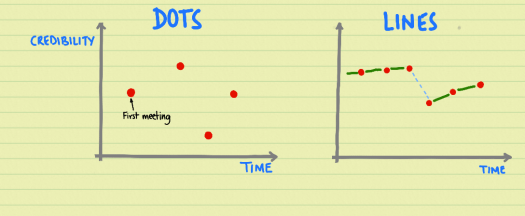
When you first meet someone, that creates a single data point – both for you and them. Your interaction creates a moment of credibility (Suster talks about performance).

The picture above shows this event (adapted from Suster’s original images).

In subsequent interactions you build up more data points. You learn more about each other, what you do and how do you it and so on.

Over time these interactions create more dots on the graph.

The key question is – are these dots connected or not?

If you have a set of random dots that don’t seem to have a clear relationship between them, people are going to struggle to connect them and understand what you are pitching.

People listening to you need to “connect the dots”, see the storyline that runs between them and helps them make sense of your proposition.

It doesn’t matter if there is a break or a change in the story. For example, in the second chart, you might have a particular set of dots connected by a line – and then something changes causing you to go in a different direction and you then have a new set of dots connected by a line.

The connection – the storyline – is what people buy into. It’s what allows them to see the pattern in what you are doing and start to trust that you have a plan and a destination in mind rather than just doing random activity based on what’s latest and loudest.

Suster recommends that you try and increase the number of data points with short, relevant updates when possible. Start well before you need something, and by the time you go for the “ask”, the people you are talking to can see the pattern in what you are doing and that reduces their perception of risk and increases their willingness to invest in you and your idea.

Reja Khadjavi of Shoelace has a good post on how regular, consistent updates to their investors helps them strengthen relationships and provides examples of what they actually send out.

It might seem basic, but sometimes we can get lost in the detail of what we do and forget that something that seems simple and obvious to us can be complex and opaque to someone else.

The way to get someone else to see what you see is to help them see the lines that connect what you do.

How fast can you grow?

rate-of-growth.png Everyone seems to be in a hurry these days.

Perhaps it’s the media and stories we see which give us that impression. Stories of companies that have shot to success, overnight celebrities and competition winners who leap the queue to create a personal brand in a very short period.

Many businesses that start up seem to have a growth mindset that believes in building a customer base fast, scaling themselves quickly and getting to a point where a larger player in the market will see them as a competitor or a source of innovation and snap them up, enabling the founders to exit with a nice payout.

This is the rocketship option.

The alternative is a business that starts out serving customers. It develops incrementally, adds capability and resources, reinvests in its core business and, as a result, grows over time.

This, perhaps, is the walking option.

If you want to reach the stars fast, the rocket is the way to go. Get in, strap on, start your engines and hold on for the ride.

At the same time, there are a few pre-requisites.

First, you need to build your rocket. You need the machine itself, the launching pad, the control centre and the army of people needed to keep everything going.

Then you need fuel, enough to get you first off the ground and then to keep you in the air.

All that takes money and resources up front – which you need to borrow or invest in the business.

The slower way is to get a backpack, fill it with the things you have or need and get walking. Every day you do a little bit more distance.

That needs less money up front, but you have to put in the daily effort required to move forward.

It might seem that the rocket is clearly the better way to get there. Time is money, after all, and why get somewhere slowly when you can get there faster?

Well, the one thing to remember about rockets is that you need enough fuel to escape the earth’s pull. Run out of fuel and things are going to end very badly. Startups use the term “burn-rate” for a reason.

As a six-year old will tell you, if you want to reach the stars and you have the two options open to you, the rocket will get you there fast, but the walk is safer.

How to work with other people

working-with-others.png

It’s easy doing things when you don’t need to work with anyone else.

There is no need to consult, persuade, argue, manipulate, coerce or flatter someone to get what you want.

But that’s what we need to do in real life – groups of people can produce more if they work well together than an individual toiling on his or her own.

So what is it that will make this process of working with others easier?

It might make sense to start with how you see yourself and your relationship with others. The Johari window is a technique that helps do this.

It’s a 2×2 matrix that looks at what you know or don’t know compared to what others know or don’t know.

The picture above is an adapted form to see what can be done rather than what is already in place, which was the purpose of the original work.

First, there are things that you and the person you need to work with know. This is a common space, where you can both discuss, agree or disagree based on common knowledge.

It is a collegial space where you can feel like equals.

Then, there are things that others know but you don’t know. These can be character flaws, research findings, inside knowedge about business politics and so on.

These are your blind spots, the things that will come back to bite you. For example, if someone knows you get angry in meetings, they can prod you to explode and undermine your credibility in a crucial setting.

After that come things that you know but others don’t know. This is where you get the opportunity to share, teach and perform.

Done well, people will appreciate your effort. Done badly, you will come across as superior or egotistical.

Finally, there are things that you don’t know and others don’t know. You’ll need to work together to explore the way ahead.

It seems like a good way to think about working with a new team or a new person is to work your way around the matrix.

Figure out the things you have in common, identify and eliminate blind spots on all sides, learn and share information with each other and work together to create new ideas, knowledge or capability.

Sounds simple.

But, is it easy to do?

What will make your change program succeed?

change-formula.png

Some people want to change the way things are done, some people like things the way they are, and some people aren’t really bothered and are just waiting for the working day to end.

Changing the way things are done is not just about saying that there is a better way and so obviously everyone should do it.

For example, if you want to try and be more energy efficient, you could just set the room temperature controls to 18 degrees C, lock the panel and leave.

You will, however, get complaints. Lots of them. From people that are too warm, too cold or liked having control. Some enterprising ones will work out how to hack your controls or subvert the temperature sensors.

When it comes to small or large programs, whether it is choosing to lose weight or changing your entire IT system, what are the factors that will make your program succeed or fail?

It turns out there is a formula. David Gleicher created the first version and Kathie Dannemiller made it easier to understand and use.

Kathie’s version says that three things must be in place for change to be possible. These are:

  • D: Dissatisfaction with how things are now
  • V: Vision of what is possible
  • F: First, concrete steps that can be taken towards the vision

Working against these factors is R: Resistance to change.

The formula says that D x V x F > R.

Or in words, the product of the three factors needs to be greater than the resistance to make change possible.

It’s a nice formula, but there are a couple of problems with it.

First, can it actually be used like a formula? What units do you use to measure D, V and F, and then what do you actually multiply?

Someone needs to do some dimensional analysis, or in simpler words, work out how to convert the factors to a common unit (like litres or centimetres).

But that would probably be a waste of time. Instead, a more useful representation may be to use a force field framework as shown in the image above. There are driving forces that move you towards a goal and hindering forces that block movement.

If you have more forward forces than backward forces, you are probably going to move towards your change goal.

The second problem with the formula is that it assumes you need to know where you are going and what you should start doing in order to change.

That is not necessarily the case. The only factor that is really necessary is Dissatisfaction with the status quo.

Instead of Vision and First steps you might have options and experiments. Jason Little has an interesting blog post about experiments here.

You might try a number of things out, see which ones face more or less resistance and work towards an approach that makes you happier (or less dissatisfied).

Perhaps we should keep in mind George Bernard Shaw, who wrote “The reasonable man adapts himself to the world; the unreasonable one persists in trying to adapt the world to himself. Therefore all progress depends on the unreasonable man.”

How do you work out what is important?

degrees-of-freedom.png

You usually have many options and lots to consider when approaching a problem.

Most people have experienced meetings where a number of people have opinions, approaches, suggestions and explanations for why you should do something in a particular way.

Quite often, you end up with a set of conclusions pulled together that include things that the group seems to like and things that important members of the group put their support behind.

That’s all good group work and “brainstorming” and does help with creativity and idea generation.

But how do you know which of those conclusions actually matter and are important?

A model from statistics called Degrees of freedom may help us here.

You need information and data in order to estimate a statistical parameter. The degrees of freedom in that estimate are the number of independent pieces of information needed to work it out.

In the picture above, to work out the result, you need four pieces of information: 1, 2, 3 and 4. The intermediate calculation a is from a calculation involving 2 and 3, and so is not independent.

This system has four degrees of freedom.

There are two things that this model helps us see.

The first is that information that does not affect the result should not go into the analytical process. You need to focus on the things that will “move the needle” and eliminate unrelated factors.

The second is that the larger the number of degrees of freedom, the more values the end result can take. In a physical example human upper arms have 7 degrees of freedom and can do a number of movements as a result. The hand has 23 degrees of freedom and can do much more.

The degrees of freedom concept can be generalised to help with general problem solving and business modelling.

You need to figure out which parameters can affect the result you want, and then isolate the parameters that are truly independent.

You then need to work out what a change in each parameter means for your result – you come up with scenarios. You can say things like if the first parameter changes by 10%, this is what it means for the result.

Then, if you want to get a little fancy, you vary all the parameters and come up with a range of results that might happen – modelling it stochastically. This lets you say things like I’m 80% confident that the result will be between X and Y.

In business, what this process lets you end up with are the parameters that matter to you – the ones that are important to monitor if you are going to achieve the necessary result.

These parameters are your Key Performance Indicators (KPIs). Keep an eye on them, make sure that they are within tolerance and doing what they should be doing, and you have a much better chance of getting the result you want.

The next thing then is to make sure that the result you are planning to get is the one you really want.

Can you explain what you do to a rubber duck?

rubber-duck.png

Many people have the experience of being stuck on a problem, or finding that they have to explain what they know or have done to someone else.

You might face this when trying to create some software, work on a business process, repair a leaky pipe or when you’re trying to explain what you do during a sale.

So how can you make this easier to do?

One approach explained in the book “The Pragmatic Programmer: From Journeyman to Master”, by Andrew Hunt and David Thomas is rubber duck debugging.

The method is simple:

  1. Get a rubber duck.
  2. Tell the rubber duck that you need a minute of its time.
  3. Explain to the duck what you’re trying to achieve and then go over your code or problem in detail, line by line.

Somewhere during this process, you’ll realize that what you’re explaining to the duck is not what you are actually doing – and this leads you in the direction of a solution.

Alternatively, as you explain the problem to the duck, the solution will pop into your mind and you will know what to do next to resolve the situation.

It’s quite important, it seems, to talk out loud to the duck. It’s the process of explanation and thinking out loud that gets your mind to loosen up and allows solutions to tumble out.

Of course, you could ask someone else. The only thing is that if it’s someone who knows what they are doing and you haven’t taken the time to formulate your question well, you’ll look stupid and they’ll feel like you’re wasting their time.

You could also ask a co-worker, but the main advantage of a duck is that it sits there, doesn’t talk back to you or judge you or suggest that it has a better solution and is much smarter than you are.

If this approach seems a little silly to you, perhaps you need to consider what it actually makes you do and how it helps you do better work.

  1. Your brain has to stop and switch tracks – from doing something to explaining what you are doing.
  2. You need to slow down – you can’t assume the duck already knows what you know and cannot take things for granted.
  3. You have to go line by line through your program or process, focusing on the details that you might be tempted to otherwise overlook.
  4. It forces you to try and work through and answer your problem or situation yourself, engaging your brain, before asking someone else.

Of course, the duck’s powers are limited. If you have talked to the duck and are still stuck, you should go and talk to a colleague or someone who might know more than you about the problem.

The chances are that you will come up with a much better question for them this time around.

How to create intelligent systems

evolution.png

If you have a complex problem to solve, do you need to build an equally complex system to solve it?

Most people, when they think of systems, visualize technology – robots, artificial intelligence, connected machines and autonomous vehicles.

A more general definition of systems includes the people that use the technology and the processes they follow when using it.

Complex systems include things like governments, religions and companies.

How does a large, complicated company come into existence?

Well – it probably didn’t start out large. It started as a small company once doing something simple. For example, General Electric, one of the largest conglomerates in the world, can be traced back to Edison and his lightbulb.

This idea forms the basis of Gall’s law, a rule of thumb from the book “Systemantics: How systems really work and how they fail” which says “A complex system that works is invariably found to have evolved from a simple system that worked”.

The reverse also appears to happen. A complex system built from scratch never works and cannot be patched up to work. You need to start again with a simple system.

The main problem with building a complex system straight away is that a system is simply someone’s approach to solving a problem – the system itself doesn’t solve the problem.

A complex system built without constantly testing whether it is doing something useful can end up doing hardly anything useful at all.

This is why many modern approaches to programming are “agile”, solving simple problems first and putting out software that people can try out to see whether it is actually useful.

A related observation from the book is that very efficient systems are dangerous. Loose systems, systems that hang together with some slack tend to grow larger and work better. An example of this might be the growth of the world-wide web.

The book is a slightly tongue-in-cheek commentary on systems theory, which has moved from a “hard” systems approach where people believed every situation could be mathematically modelled and solved to “softer” approaches that take into account the reality that people doing what they think is right have the inherent capability to mess up any system designed by a technocrat.

Intelligent behaviour is not something you design into a system but something that emerges from the way in which the system is arranged.

The only approach that has been shown to produce intelligent behaviour so far is evolution, and so it makes sense to prefer it when creating a new system.

Why does the rabbit run faster than the fox?

rabbit-fox2.png

If your business is based on you beating the competition, life is going to get very tiring.

A perfectly competitive market is one where there are a large number of players in the market, the product is no different from others, it’s easy to enter the market and everyone has all the information they need.

Examples of these kinds of businesses exist everywhere. In knowledge work, web-design could be seen as a modern example. Most websites will be built using WordPress, there are any number of people that can design acceptable websites and it costs virtually nothing to get started in the business.

If your web-design business does what most other web-design businesses do, then you will experience the side-effects of perfect competition.

In a perfectly competitive market, the price at which you sell the product tends towards the cost of production.

In other words, you make hardly any money selling it and profits are low to non-existent.

There are few perfectly competitive markets, however, and the traditional ones try and create systems to prevent side effects. In commodity markets such as oil you see the emergence of cartels like Opec that try to control supply so that they can affect the price.

At the other end of the spectrum is a market where one company has a monopoly. No one else does what they do, the product is unique, it’s near-impossible for new companies to enter the market and information is protected or secret.

That’s quite a nice situation for a business to be in – except that comfort and complacency leads to sloth and poor service and eventually governments have step in to break up monopolies.

The ideal place is to be somewhere in between.

There will always be someone who is willing to get up earlier, work harder, spend more time away from home selling, and who can hire workers that are paid less than you can.

If you compete on their terms, you will lose.

The strategy that is going to work is to position yourself and your business so that you have few direct competitors, what you do is different and unique, your competitors cannot easily enter your market and where information needed to do the work is protected – perhaps because it costs something.

If you had to pick just one thing out of the list, Bruce Greenwald and Judd Kahn in their book Competition Demystified suggest focusing on barriers to entry.

If it’s hard for others to enter your market, then you have the potential to earn above average profits.

If that isn’t the case, then you could spend the rest of your time running just to stay in the same place. And who wins then?

The answer to that is the same as the answer to the question in the title.

The rabbit runs faster because the rabbit is running for his life, while the fox is running for her dinner.