What to do when you’re struggling for ideas

becoming-unstuck.png

Sometimes I’m out of gas – running on empty – and the ideas just aren’t coming.

I want to write, I’m sat waiting for inspiration to strike. And I’m still waiting.

What am I doing wrong? And what could you do differently?

You wouldn’t be here at all

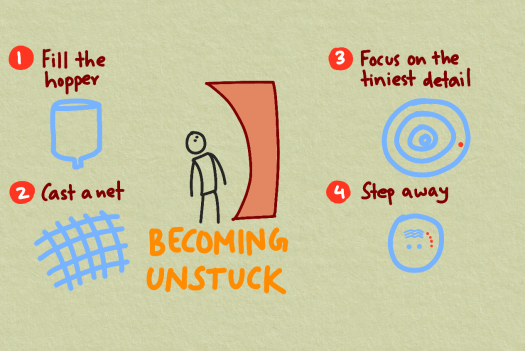
The first thing I should have done is kept the hopper full. The hopper is the collection of jottings, the notes from the day. The things you noticed, the things that stood out, the things that made you stop.

And the hopper doesn’t need to be that full. Say you write once a day, like I do, all you need is two or three ideas in the hopper and you’re sorted.

If it stood out in the first place, it’s probably a good one – good enough to get a first draft out anyway.

You’d look around for inspiration – go wide

We’re surrounded by stuff that could inspire us. All you have to do is pick up a book, or do a search and see what else is out there. The chances are that something will catch your eye.

The trick is taking an idea and making it your own. It’s not enough just to copy something that someone else has done. That’s no use.

Instead, it fusing a few ideas together and coming up with a new one that creates something interesting.

Still stuck? Focus – go deep

Robert Pirsig, in Zen and the Art of Motorcycle Maintenance tells the story of a student who came to him, wanting to write a 500 word essay about the United States.

He had a sinking feeling, and told her that might be too much – to focus instead on their town.

She came back and was still struggling. Narrow it down, he said, to the main street of the town.

Still no joy – she couldn’t think what to write.

He was furious now, she just wasn’t looking.

“Narrow it down to the front of one building on the main street”, he said, “Start with the upper left hand brick“.

She came back with 5,000 words.

Narrowing it down and starting with the smallest detail had finally unlocked it for her.

Finally, step away – but only when your forehead starts to bleed

Much advice on becoming unstuck says to take a break – but when is the right time?

Not straight away. Not right at the beginning.

First – spend some time just staring at the screen. Focusing. Willing yourself to have an idea.

Just sitting.

Why is that important?

Because what you’re trying to do is get your mind to move, like a stuck screw. And like that screw, you can’t just try once and walk away. You need to try it every way, apply some pressure, hammer it, scream a little – try until you’re exhausted and can’t do any more.

Then you walk away.

Then… you’re brain does its magic thing and moves and unlocks. When you come back, it happens – the screw turns and the ideas come pouring out.

And when all else fails?

The one thing you need to do to make a plan successful

godfather-scene.png

Coming up with a plan is simple, isn’t it?

Make a list of steps, work on them, think about them, tune them and act on them.

Once that’s done, we’re done and can get on with life as usual. Success is bound to come, isn’t it?

What do you think is missing from this process?

Imagine the last strategy session you were part of. The chances are that a bunch of people got in a room – minds on the things that they were working on earlier.

There is an agenda – everyone gets ready to go through it. Someone manages the discussion. Everyone gets a say. And the hours pass by.

Ideas go on the flipchart – mindmaps sprout with lines weaving across the page. Everyone is watching the MIPITR – and it’s not you.

The MIPTR is the Most Important Person In The Room. That person has power. What they say goes. So, everyone watches the MIPTR and says the right things to stay on the right side.

That’s not fair. Some people don’t. Some people have the guts to stand up and say what they think. They make good points that go on the flipchart and everyone nods, and some people hate them for being so brave.

The day goes by. In the last hour, someone starts to work through the actions and put together a list. The hard work of planning is over.

Then what happens? The plan gets emailed around. If it’s a very organised organisation, there are regular catch up meetings. Everyone makes sure they’ve got no unfinished actions. It all looks good and on track.

The months and quarters go by. It’s Q4 – what’s happening? Has the plan been successful?

Don’t know. If there is an organisation that’s still tracking its actions and plan nine months later – it needs a medal. That’s not how things usually work. In reality, after the first couple of months, the plan is no longer top of mind, and people forgot all about it.

This is not new. Dwight D. Eisenhower talks about something he heard in the army – *plans are worthless – but planning is everything.

So, what’s the missing ingredient?

The secret is found in a scene from the Godfather. Michael and Don Corleone are going over their plans and say the following words:

VITO CORLEONE (after a long pause) I don’t know – your wife and children – are you happy with them?

MICHAEL Very happy…

VITO CORLEONE That’s good. (then) I hope you don’t mind the way I – I keep going over this Barzini business…

MICHAEL No, not at all…

VITO CORLEONE It’s an old habit. I spend my life trying not to be careless – women and children can be careless, but not men. (then) How’s your boy?

The secret is to keep going over the plans. In the open, with your team. To talk about them – remind everyone what the plan was in the first place. Tell everyone else about the plan. Tell the people working for the people in the room.

A plan on paper is worthless. Actions alone are worthless. A plan will only be successful when everyone knows what the plan is and what they need to do.

And doing that is harder than it looks. That’s because one person, usually the one who came up with the plan, is completely clear on the plan.

Everyone else is trying to catch up. Talk with them about it. Let them restate it in their own words. Let them ask questions. Listen – and tweak the words in the plan to answer those questions up front next time.

The more you talk about your plan with the people you need to execute it, the more likely it is to be successful.

The 3 invisible ways leaders think about the future

leadership-challenges.png

Imagine you’re the boss. Or, you ARE the boss. What does your day look like?

You get all the crap that no one else can handle. President Obama said that by the time something reached his desk it’s really hard. Because the easy things mean someone else can make a decision and get it done.

So… what is your natural way to deal with problems – to get your people to do their jobs? And is what you are doing working?

The way most people start with such a problem is to come up with a plan – or ask for one.

A plan helps us to set out a series of steps that people can follow. We can give them tasks and show them how what they do makes its way to the next person and what happens next.

In theory, as long as each person follows the plan, we’ll get from where we are to where we want to be.

Except it rarely works out that way.

If you have watched how leaders operate they often seem to go about a plan backwards.

That is, they start from where they are and then show how they always planned to get there.

Which a bit like shooting an arrow and then drawing a bullseye and target around where it lands.

So, some people say planning doesn’t work – what leaders need is a compass.

They need to make it clear where north is – with what they say and how they behave.

Then, in theory, everyone will know what the goal is, and work out what they should do to navigate in that direction.

If everyone does that, then we’ll end up in the right place.

So, how does that work?

Well – that’s the way the US military operates – and it does pretty well at it. In the 90/91 Gulf War, for example, once the ground war started they routed Iraqi forces in three days.

But – this is hard to do. And it’s hard because people in most situations don’t have to deal with life or death choices.

Instead, they have to deal with whether the builders are here or the copy is through legal or whatever else.

And so it’s hard for them to relate their day to day with the big mission – whatever the leader says or does.

The last way to look at this then, which almost no one does, is to have a model.

The theory behind this is here but, in essence, a model is something that helps us to learn what is happening in real life.

Let’s say you do something great – achieve a sale, for example. If you list out the steps you followed – what you are doing is telling a story.

It may be a great story – but it’s a story nonetheless.

For it to be a method, you need to have explained what is in your mind before the achievement. Creating a model is one way of doing this.

A model could be like a plan – a set of connected activities. What makes it more than a plan is when you use it to learn about the people involved in the situation.

The best plans can be waylaid by problems of culture or politics.

Plans and Compasses assume that people will follow a plan or navigate in the right direction.

In reality, people will do what they think is best, and that is not the same thing.

What’s the point here?

These three ways of looking at things are invisible to most leaders – they are too busy doing their job. They don’t have the time to think about how they are thinking.

Even a President, it seems, has to remind himself that he’s not going to get everything right and hopefully things will work out if you’re moving in the right trajectory.

Why a great ad isn’t enough for a campaign to succeed

campaign-failure.png

Imagine you’ve spent the whole day working on a perfect ad.

You planned it out on index cards and arranged the ideas in order.

You wrote out the copy and set out all the points you need – the features, advantages and benefits.

Then you put it in a drawer and left it for the night.

The next day, you took it out and worked on it again. It had somehow gotten worse overnight, so you redid the whole thing.

Finally you had a piece that was good to go, and you sent it off to the magazine.

At the end of the year, how much business do you think that ad pulled in?

That’s right. Nothing.

The ad isn’t enough to get money in the bank.

The test to see whether a marketing campaign has worked is to see how much money it brought in.

And that can get derailed for any number of reasons.

Michael J. Baker’s The Marketing Book says that you can’t force new ideas into a system. It’s like injecting a virus.

The body will reject it, sending anti-bodies to “protect the status-quo from the germs of innovation”

Or, like Pac-Man, devour the innovation ghosts Binky, Pinky, Inky and Clyde.

Operational managers, in particular, hate change. They have a job to do and new rules get in the way of getting things done now.

Especially because no one gives them time off from the current job to learn the new one. So, they are hostile from the get go.

The next problem is that most organisations don’t invest in training their people. Few people understand how marketing works.

The skills aren’t there. People know how to do their jobs – but they get confused and fearful when asked to help in a marketing campaign.

Then there is information – or the lack of it. That situation is getting better – there are databases we can look at to figure out who our customers are. But – it takes time to understand all this, and it can be expensive.

Now, we may do some things well, like create an ad. But when there are no resources, the follow up falls apart.

For example, the phone line on the ad doesn’t get answered. The promised information isn’t sent. No one follows up to see what prospects think.

And the reason there are no resources is because structure is poor. The people needed to do the jobs aren’t there or are too busy to put in the time because they have other jobs.

The thing about a marketing campaign is that it’s easy to think of it as something only sent out to customers.

We need to spend as much time thinking about how it works inside the company – or it’s going to fail.

A marketing campaign needs a marketing system to get the most out of your ad.

What should you include in a brochure for a business product or service?

features-advantages-benefits.png

You need to use words that make sense to the customer

You may work in an established company or a startup but wherever you are, there will come a time when you need to make a case for a project, a product or a service.

The case may be a board paper, a powerpoint deck or a brochure – but it’s going to make the difference between getting your project approved or not, making a sale or not.

So it’s important. Very important. And most of us get it horribly wrong.

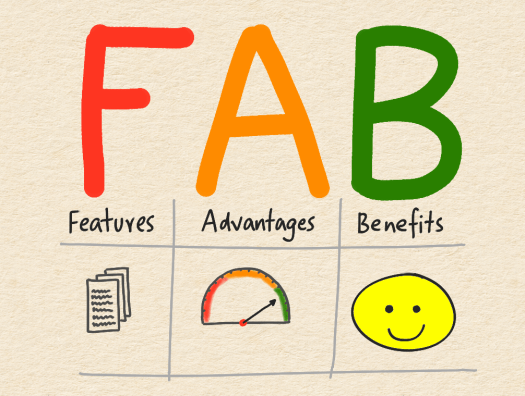
The Features, Advantages and Benefits or FAB model can help us get it right.

Nobody cares what you think is cool about your product or service

The problem is that most of us are far more interested in ourselves than we are in others. We also assume that others are more interested in us than they really are.

They don’t care about you. Not in an uncaring, they won’t help you if you’re comatose in the snow kind of way. Just in a they care much more about themselves and what they want kind of way.

For example, let’s say you’ve come up with an idea to create small promotional videos for customers.

You’ve got your kit – its a state of the art Canon EOS-1D SLR with 18 megapixels, 61 point AF, full HD… loads of cool features … and yada yada yada.

Some people will share your excitement about these features. Most will not.

They are mildly interested in how it compares to what they have now

Some people make the mistake of thinking that an advantage is an absolute – something that stands by itself.

For example – the advantage of the Canon EOS-1D is that you can use it to make a video.

Is that really an advantage?

An advantage is measurable. You can see how far it moves the needle compared to something else.

For example, one thing you rarely notice in films is depth of field. This is when the person or thing in the foreground of the shot is really clear and the background is out of focus.

It looks great – but you can’t get with most cheap video cameras. You could fork out a few $100k for expensive hollywood gear or you could get a EOS-1D for about $3k which lets you get that effect.

So, you can measure the cost advantage of an EOS-1D (for what you are trying to achieve) compared to a film camera.

The advantage to the customer is that instead of a poorly shot camcorder corporate video they can get a film quality one.

Only emotion endures

The poet Ezra Pound wrote that few poems still ring in my head. The ones that endured brought up feelings, and the feelings are what remain.

In the same way, a list of features and advantages doesn’t get someone to take action. They take action when they can imagine how good they’ll feel when they have your product or service – and you need to use the words that will evoke those feelings.

For example, when they can imagine their beautifully shot corporate video playing on screen during a presentation, or having photos from it printed at an extra large size hung on their walls for clients to see – then they can feel good about how professional it makes them look.

Connect the dots. Forwards and backwards

The Canon EOS-1D X page uses the features, advantages and benefits or FAB model faithfully in its copy.

Quoting them “A Canon 18.1 MP full frame CMOS sensor delivers stunning performance, producing exceptional low noise, high-resolution images even in the darkest conditions. The full frame sensor delivers optimum results from wide-angle lenses and gives you greater control over depth of field. Image resolution exceeds the quality demanded by leading photo agencies – making it ideal for extra large prints up to A2 size, even after cropping.”

  • Feature = the 18.1 MP sensor
  • Advantage = greater control over depth of field
  • Benefit = ideal for large prints

For each feature we have an advantage which means a benefit to the customer and we can put all these points in a paragraphs and include them in our brochure.

Once we make the effort to work across the table from our point of view to the customer’s point of view, the paragraphs that make their way into a brochure fall out almost automatically.

How to structure a chapter in non-fiction writing

chapter-design.png

In an information economy, getting our point across is more important than ever

The world is exploding with information. The technology we have allows us to create more information more quickly and cheaply than ever before. And this is not a good thing.

The more we have, the more we need to sort. Or avoid. What we’re getting very good at – and the technology even better at – is filtering information to try and focus on what we think is relevant.

As a result, when we do get a chance to speak with someone else, we need to make our point quickly and clearly – and this applies for a blog post, sales message or a chapter in a non-fiction book.

Structure helps us set out our points clearly

Writing that is easy to read doesn’t happen by accident. There is a structure behind it – one that is invisible if the writing is well done.

We know what is good when we read it. And we also know when something doesn’t work. Almost always, the thing that doesn’t work is a lack of structure.

One approach to tighten things up is to use a structure funnel. Start with general statements supported by specific ones that lead step by step to your point – the thesis statement.

We need to introduce concepts in the right order for them to resonate with the reader

Rudyard Kipling’s poem has the names of his six honest helpers, who taught him all he knew: What and Why and When and How and Where and Who.

Three of them, what, why and how are important in a non-fiction chapter.

What will the reader learn to do, why is it important and how are the steps that the reader needs to follow set out?

The order in which they are introduced depends on the point you want to make – but the how usually comes after the what and the why.

Facts and figures – evidence – show that we have a reasoned and logical argument

An accountant at a job interview was asked to work out the taxable profit due given a set of figures. The candidate got up, shut the door, stepped close to the interviewer and in a low voice said, “What do you want it to be?”

Numbers can be deceptive. But not using them can be disastrous. We like to see evidence for statements – proof that supports why an assertion should be believed.

89% of readers say that they don’t believe everything they read. The remaining 11% say they don’t read.

Telling stories and anecdotes creates pictures in the reader’s mind

Facts alone are dry, and reason and logic doesn’t change minds.

If someone has a point of view, no amount of logical reasoning will get them to change their opinion and back down.

Telling a story, however, can get them to see how someone else approached a situation. It might unlock feelings and emotions, evoke memories and associations that don’t come out any other way.

It’s one thing to read a list of benefits of being self employed. It’s another to imagine how different the day of a person is who has control over when and how work gets done.

A well designed chapter is a self contained block of goodness

A non-fiction chapter holds a thought – the answer to a question the reader might have.

You should be able to set out that answer in a few sentences – the subheadings of the chapter – that move from a general statement to specific points to end at your thesis statement.

The statements you write need to help the reader understand what is going to be explained, why it is important and how it works.

You need to sprinkle your sentences with facts and figures and build in stories to persuade the reader to believe in what you are writing.

The end result will be a well-designed chapter that takes the reader from beginning to end without getting lost or confused.

The test your chapter needs to pass is whether the reader found it easy to read or not – and you need to revise and rewrite until it passes that test.

Why it takes me a long time to get things

creating-tactics.png

I’ve never been the person who gets things quickly – the smart one that can figure out the answer in the middle of a tense situation while a riot takes place outside.

It takes me time – time to have a go at things, be terrible, keep going and eventually be less terrible.

The irony is that the things I find easy, I don’t stick to. The ones I find tough, I do – which seems a little strange when I look back at things.

For example, a long time ago, I couldn’t figure out chemistry. The equations didn’t make sense. And as far as I was concerned the lab work was just pouring stuff from one jar into a test tube and wondering what the point of it all was.

I was pretty sure I was going to fail the exams in chemistry.

And then salvation came in the form of one particular teacher who taught me how to use flashcards. I copied all the information in the textbooks needed for the exam onto index cards, carried them around all the time, flipped through to see if I remembered them every time I had a spare minute and eventually had memorised the textbook.

I still didn’t understand what it was all about… I could just answer questions about it.

Until the day of the lab exam. Sat outside, waiting to enter, I felt a mental block suddenly shift and realised what was going on in the lab. How chemistry was like detective work – trying to figure out what something we didn’t know was by seeing how it reacted with things that we did know.

Why am I telling you this?

It’s because many of the posts in this blog have to do with strategy – with what we are trying to achieve. And often that is a vague and fuzzy thing hidden in the mists.

To actually succeed – to achieve the aims of a strategy – we need to do things – and those things are tactics.

Tactics are about the application of resources – our time, energy and money.

The tactic I used to pass chemistry – the use of flashcards – helped me overcome my own limitations and mental blocks about the subject.

So, how can we select and deploy effective tactics?

All too often when we look for information on how to do something – a tactic we can follow – we are given lists of things to do.

30 ways to do this. 9 foolproof methods to do that, and so on.

These may be useful ideas – but they are simply building blocks.

For example, a tactic to get in front of a company may be to make a cold call. An alternative might be to ask a mutual friend for an introduction.

Other tactics include advertising, direct mail and buying the company outright.

The key is looking at what we can do and identifying building block activities – self contained pieces of work that will help us achieve our strategy.

Then, we need to select the ones that matter most.

Which tactics are likely to have the greatest impact? Which ones have worked for us in the past? Which ones do others say work for them?

The last step is getting the sequence right.

Which block should we do first, which one next?

We’ll need to try a few iterations and refine and improve our process.

The point is we have to implement tactics to actually make progress.

Some will work, some won’t.

But if we identify what we need to do, choose the tasks with the most impact and execute effectively, we increase the odds of succeeding.

And that’s the whole point of having a strategy and tactics in the first place.

What would you do now, knowing what you know

knowledge-practice.png

Brian Tracy writes about zero-based thinking, asking the question knowing what I now know, is there anything I would do differently?

That is a hard question to think about.

We know what we know. We don’t know how things might have turned out if we had made different choices along the way. We may think they may have turned out better – but doesn’t make today any less real.

Take knowledge, for example. What’s the point of it?

Some people study situations and come up with theories. Others work with real world problems and try to solve them.

A good application of knowledge is when we find a theory that can be applied to solve real world problems.

But things are hardly ever this direct – and that’s because the people involved want different things.

The people who generate knowledge – who sit at their desks and think through ideas and come up with theories – have a system of rewards and incentives based on the respect of their peers.

The people who solve problems have the satisfaction of improving things and knowing that they have created a better situation for others.

Clearly the two are linked – although the connections are not always easy to see.

Keynes wrote “Practical men who believe themselves to be quite exempt from any intellectual influence, are usually the slaves of some defunct economist. Madmen in authority, who hear voices in the air, are distilling their frenzy from some academic scribbler of a few years back”

There’s another thing that can pass us by – it’s almost invisible.

Why is it that there are so many books on management – on everything really these days?

It’s because one way of standing out is to come up with a new way of doing something – which is usually a new way of packaging an old way of doing something.

In marketing, for example, we always need to spend some time working out who our customers are – who wants what we have more than they want the money in their pocket?

Whether we use segmentation or psychographics or personas, what we’re trying to do is get a better picture of who these customers are – and then we can try and get to know them better.

So, what writers and consultants do is come up with tools – ways of turning knowledge into methods that can be applied to a problem.

This link between the generation of knowledge, creation of tools and application in a problem situation forms a value chain, according to John H.Roberts, Ujwal Kayande and Stefan Stremersch, who found that when it comes to marketing there is a good link between knowledge and practice – the tools are being applied on the whole.

They found that when the people doing the thinking are also doing some doing, it seems to work better.

Once again – it’s obvious.

That doesn’t mean its easy to do or commonly done.

We need to work to get such three such simple concepts aligned and working in practice in our businesses.

Has technology made us more or less productive?

productivity.png

Every generation probably feels that it is living through the most profound changes that have ever happened since the dawn of time.

From the printing press to the industrial revolution, from world wars to the world wide web, things have changed – and the most visible part of that change is the technology that enables the modern world and, in particular, the technology that affects how we live and work.

So, is it helping us or not? Are we more productive or not?

It’s hard to tell – and that’s because an abundance of something always results in a shortage of something else.

So, take how modern technology has transformed the world of work, making it easier for us to collaborate, have everything everywhere and communicate with others. How are these working out in practice?

Is it easier to work with others?

Many new companies and startups are delighted by how easy it is to collaborate with others on projects now.

Take Google docs, for example. We can share and work on a document at the same time – something impossible in the days when we had to write a draft, send it to someone else, wait for comments, rewrite and repeat the process until everyone was satisfied.

Now we can work together quickly, come to a consensus and publish anything we want pretty fast.

So why is that anything less than perfect?

For two reasons…

First, if two of us can collaborate, then so can others. If it’s easy to have five, ten, fifteen people all providing their input, then we can quickly get locked into a cycle of never ending comments, suggestions and changes.

Procurement is one area where such delays can increase delays massively. It takes much longer to get five buyers to agree than two and the trend towards decision by committee slows things down and doesn’t necessarily improve quality.

The second reason is that when it’s quick and easy to collaborate and produce something, the result is probably going to be of less quality.

That’s why we’re taught to be suspicious of things we read on the internet and to be more accepting of things we read in peer-reviewed journals.

Is it good having everything everywhere?

Dropbox, Google Docs, Office 365 – all these tools have changed the way in which we store information – taking us from a world of USB drives to being able to work on any computer anywhere.

It’s also meant that we can store everything – never lose a thing.

And so many of us pile on the gigs of storage, like the pounds we put on every year since college. It’s gradual, but it grows and, after some time, it shows.

Not every picture we take is worth saving. Not everything we write is worth preserving.

When we had limited space, we had to choose what to keep. So what we had was worth having. Now we have everything, but it’s hard to find what matters.

At some point we’ll probably wake up to the need for a digital diet. Just because its cheap to keep everything doesn’t mean we should, because it makes it more expensive for us to find what is important.

And it’s also annoying that when we get a phone call it could be one of seven contacts that system has scraped from all our accounts – although it’s just the one person…

We never apologise for sending a long letter these days

Blaise Pascal, the French mathematician and philosopher is credited with writing a long letter with an apology for not having had the time to make it shorter.

When we had to write to each other, we probably took care to express our thoughts clearly and concisely so that we wouldn’t have to fix it weeks later when the replies came back.

With email, we can write to someone so quickly that we no longer need to think about our words and how they might be interpreted – after all we can follow up with a clarification immediately.

And that means we probably take less care – and it shows up in the increased number of emails we need to send to get things done.

It’s easy to communicate – and because it’s so easy we spend more time doing it. It’s also easy to get a meeting in the diary – and that’s why more managers spend their time in meetings than ever before.

But – sitting in a meeting and sending emails is not work – it’s stuff that gets in the way of doing real, useful work – like thinking about strategy, improving operations, recruiting or expanding.

If we all got together less often and interrupted each other less we might get more done.

The problem isn’t technology… it’s us

What we come back to is that the way use technology better is to understand how we humans use stuff. Make it easy for us and we’ll do it more – but something else suffers at the same time.

Technology can help us – but it can also hinder us.

To get the most out of it, we need to remember who is in control – it or us.

Why we don’t get noticed as much as we think

spotlight-effect.png

Thomas Gilovitch, Victoria Medvec and Kenneth Savitsky carried out research to show that people overestimate how much others note what they do.

This is called the spotlight effect – the feeling we have that everyone is watching us, sitting in judgement or appreciation.

There’s a simple reason for that – it’s normal to feel that way – but it can also mean we’re too scared or embarrassed to do some things or are overoptimistic about our ability to make other things work.

Gilovitch et al point out that we’re at the centre of our own little worlds – and because we focus so much on us it’s hard to appreciate how much others actually see.

What’s inside us is not easy to see

The feelings and thoughts we have are private – but we often think others see them to a greater extent than they really do.

This can make us more anxious than we need to be. There’s no reason to assume that when we walk into a room, the people there will automatically notice things about us that are off – whether it’s a bad hair day or a stain on our clothes.

Some will… most won’t.

We shouldn’t assume others know what we know

Because we’re so focused on ourselves and what we know, we often assume that everyone else knows it as well.

This means that we might think we’re explaining something well, but because the listener doesn’t have the knowledge we’re assuming they have, they don’t really understand us.

Let’s say we’re in a sales meeting. If we spend all our time talking about ourselves and our product before we understand just how familiar the other people in the room are with the topic, our chances of moving things on falls off massively.

We’re probably having less impact than we think

It’s easy in group situations to think that we’re being noticed more than we are – that we’ll be singled out because of something we’ve noticed.

Conversely, it’s easy to assume that what we’re saying is important – and that other people think it’s important.

That often isn’t the case.

Listening to someone else is hard. Listening to a group is harder. And it’s almost impossible to really listen to someone else when we’re spending all our time thinking about what we’re going to say next.

The formula for moving on

Joe Gebbia, the co-founder of Airbnb has a formula that might help us overcome the spotlight effect – especially when we’re not being noticed as much as we want to.

SW2 + WC = MO

SW squared stands for some will love it, some won’t. Putting it together with the others, we get some will love it, some won’t plus who cares equals move on.

We just need to keep working, and eventually we’ll get noticed.