Why Trying To Respond To What’s Going On Is A Bad Idea

social-proof.png

Monday, 9.25pm

Sheffield, U.K.

It’s easy to fall into the trap of thinking that what you do is unimportant – to get intimidated by the very visible success we see others having all around us in a connected world.

Let’s say you’re starting a business and it’s in a pretty competitive industry like software development? How are you going to compete against everyone else out there?

You see this all the time, especially in new areas. For example, there is an emerging literati of blockchain, big data and machine learning specialists that seem to be doing very well, if you look at their presence on social media.

And you inevitably get marketers who come along and ruin everything.

Take reciprocation, for instance. That’s the idea that if you do something nice for someone else, they’ll feel obligated to you and do what you ask.

The basic idea is a sound one – be a nice person. Do things for others without being asked.

What this turns into is a series of posts that tag an influencer, praising them, with the aim of getting the influencer to thank the praiser and lift them into the limelight.

You’ll find a number of methods like this that promise to help you “growth hack” your way to success. Need content – just reach out to a hundred influencers, get their thoughts on the subject, compile that into a book and you’re on your way.

There are two fallacies at work here, and a knowledge of investing principles will help you identify and step around them.

The first is this – if you’re finding something out for the first time on the internet, the chances are that you’re too late to profit from it.

Many people invest in stocks the wrong way.

They see a stock going up and up, and get excited. They see it being covered in the paper – on the news – in tips in newsletters. They pile in, eager to ride that baby up.

Then, it turns and sinks. They’re sitting on a loss, panic and sell.

Buying high and selling low is not a good investment strategy.

But somehow it becomes the default strategy of many people.

If you don’t think you’re one of them, check to see if you sell much on Ebay. Do you buy (or does someone in your house buy) lots of nice things that they never wear and then sell them on Ebay later?

Do they calculate the loss they’ve made on buying new stuff and selling it second hand? Or are they overjoyed over the amount they’ve made selling on Ebay?

If it’s the latter, perhaps you shouldn’t let them manage your investment portfolio.

The point here is this. By the time the general public realises that something is happening with a stock, the thing that is happening is well on its way and close to petering out.

For a dramatic demonstration of this, just check out what happened to crypto last year and then what’s happened this year.

Most of the stuff on the Internet tries to get you to empty your wallet in return for learning how to make money on the Internet.

All the hacks you’re picking that rocketed others to success are ones that are unlikely to work as millions of others like you try and take advantage of them as well.

As Warren Buffett wrote about poker, “If you’ve been in the game 30 minutes and you don’t know who the patsy is, you’re the patsy.”

Don’t be that guy.

The second fallacy is thinking that you can predict the future and call the next big thing.

Many investors try and call sectors. Blockchain is the next big thing. A VC is going to raise a $50m blockchain fund. A startup has raised $30m in 31 minutes. So, it must be hot and worth investing in.

It’s incredibly hard to outperform the general market. You’re going to fail over 90% of the time.

Yet people persist in trying to do that. They argue that active investment adds value, even though the majority of active managers lag the market once their fees are taken into account.

The only people who get wealthy from actively managing your money are the managers.

So, what can you do to hold on to your money?

Most successful strategies are a variation on sticking to your knitting. Buy the whole index. Put the same amount of money in each month. Keep it simple.

Focus on your behaviour – not on what the market is doing. The market is there to serve you, not to guide you.

Okay… so what does that mean for me?

The point is that you can look at what’s happening around you and decide that the way for you to succeed is to do what other people are doing.

But – the chances are that kind of thinking isn’t going to work.

It isn’t going to work because by the time you see how the trick is done, the magic is gone.

Instead, you’re better off focusing on the work – the stuff you do that makes you feel like you’ve had a good day at the office. Or the workshop. Or the shed.

If you focus on the work, then one day it may lead to people getting to know your work, appreciating your work, spreading the word and eventually result in a raving fanbase who follow your every word.

If you try and build the fanbase without putting in the work – by trying to do stuff that you think will appeal to them – you’ll end up creating a shallow and insipid copy of someone else’s magic.

Real investors don’t chase trends.

They get in position, do the research and get ready. And then a trend comes along and lifts them up.

Do work that matters to you.

Then it won’t matter whether you get anything else. It’ll be gravy.

Cheers,

Karthik Suresh
Why Using Force Multipliers May Be The Smartest Thing You Do

force-multipliers.png

Sunday, 9.40pm.

Sheffield, U.K.

I got in touch with a few people some weeks back – a cold outreach for a service offering.

The details aren’t important – the point is that I was making a cold contact.

What are the success rates for that kind of thing?

Let’s look at what mailchimp says about email – it looks like open rates hover around 20% and click rates around 2%.

This approach had a 71.43% response.

Which was kind of a holy crap moment.

It also got me to thinking about what happens next. Clearly, when someone is courteous enough to acknowledge you then you have a responsibility to go back with something that is relevant to them.

This is something professional salespeople disagree with violently. On some social media platforms anyway.

They argue that it isn’t their job to do any research into a customer. No – once someone puts up their hand and expresses an interest, the salesperson’s job is to engage with that customer, have a conversation, understand their needs and move towards a close.

I think the real reason for their displeasure is simpler.

Doing research is hard work. It’s boring and time consuming.

Wouldn’t it be easier to have a research assistant go out and collate all that boring stuff and highlight the good bits so you can flick through it while waiting in the reception for your prospect to come and get you?

Let them do the hard work of educating you?

I did the research instead. And it took an hour for just one prospect. Multiply that by the number in your pipeline and the hours stack up pretty quickly.

which finally brings us to the idea of force multiplication.

It’s very much a military concept, the idea that you can “fight with limited resources and win”.

What do you think a consultant setting up a sales function would advise me to do?

Well – they’d probably say we needed resources. A CRM to track the prospects and everything associated with them. Trained salespeople to engage with prospects. Admin and research staff to help the salespeople.

You’d need a budget – probably a few 100k.

That’s sound strategy. It’s the application of overwhelming resource to the specific problem that you have. And it will fail.

It will fail because big strategies need a number of things to go right – as explained here – and the changes of that are slim.

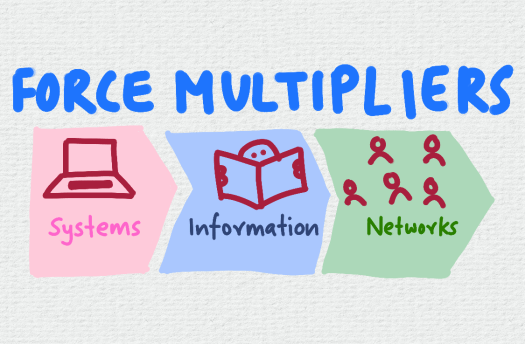
A better strategy is to look for force multipliers. And there are three that stand out.

Systems that automate the right stuff

What do we do when we carry out research?

These days, it’s all about Google. Type in the term, read the first page of results and you’ve got a pretty good idea of what the prospect is all about.

You could do this manually – click, read, click back.

That’s how I spent the first hour.

Then, I wrote some code.

That goes off, gets the results and pages and sticks everything into a single file, which I can read quickly and pick out the main bits.

The result – research time down from an hour to around 5 minutes.

Cost = $0.

The right kind of information

Information is the key to winning these days, not resources.

Take the response rate I started with.

The only reason for that is because I reached out to the right segment. A group of people that had a good chance of being interested in what I put in front of them.

And the problem many of us face is that we’re swimming in information and don’t know how to extract the important from the rest.

But again, that’s possible with the right systems. With a little bit of code I can figure out which companies are similar, which ones are worth going after and who is the right person to contact.

All that stuff is available now – often for free.

Anyone who doesn’t bother to spend the time getting the information they need is going to going to the next stage much harder.

Network based operations

Networks are interesting. Very interesting.

Take a typical large company. It’s going to be hierarchical – mostly. Orders come down. People do what they are told to do.

The typical company ossifies as it grows – it becomes slower, less responsive, less receptive to feedback.

A network operates differently – and many professional services firms use a model where they bring together the right group of people to work on a project, rather than just giving it to a department where it’s probably going to be done badly.

Modern armies do this – operate with a mission based approach rather than an orders and directives based one.

Let’s say you’re a graphic designer. If you team up with a copywriter and reach out to marketing directors, you’ll probably be much more effective than if you’re trying to do it all by yourself.

If you want to scale, then perhaps you need to bulk up your team with artists on Upwork, and focus on designing and selling propositions and outsourcing the artwork.

You could, all on your own, have the same impact as a large agency, but with a fraction of the overhead.

That’s a force multiplier.

The aim is to win

The problem with many strategies is that they’re about getting in position, getting resources aligned and deployed.

But that’s not the point.

The point is that you want to win – win your battle with the fewest casualties and fewest resources deployed.

The first approach is just the mindless application of force.

What you want to do is to look for opportunities where you can multiply what forces you have already.

Cheers,

Karthik Suresh

How Do You Know What’s Working And What’s Not?

organic-growth.png

Saturday, 9.16pm.

Sheffield, U.K.

Do you know how you learn? How does your brain work when it’s busy learning?

I remember watching a TED talk – can’t find the reference now – but it had a concept that stayed with me.

Our brains create new connections when we learn, literally rewiring our brains as we go through the learning process.

But, it doesn’t happen all at once. Learning or experiencing something for the first time lays a chemical trail.

Doing it more lays down more chemicals – more connections – more wiring that is related to what we’re doing.

This simple concept – the idea that how much we learn is linked to the amount of related wiring that’s built up in our brains – leads to certain logical positions.

1. Not everything in life is equal

When you’re young, you might have the time to do lots of things. You might be good at a sport, enjoy certain classes, be sociable.

Very soon, however, you start having to make choices.

At University, given the choice between playing competitive sports at a high level, achieving high grades and having a sizzling social life, you’ll end up picking any two.

And even that’s probably hard to do. You might end up putting one first.

2. Where you are is because of what you did

There’s a rule when you’re doing customer validation – trying to find out if your product has a real market or not.

Never ask someone what they would do.

For example – would you buy my new vegan rice cooker that also grills chicken?

You might say that you might…

But here’s a better question. What kinds of kitchen appliances have you bought in the last year?

That’s going to tell me a lot more about the kind of person you are and what you actually need in the kitchen.

What you’ve already done is the best predictor of what you’re going to do in the future. Once again, the trails you’ve laid down are the clue to the trails you’ll take.

3. It’s unlikely that things will work the same way exactly

Think of the last forest you visited.

Did you follow a trail? Several trails?

Were those trails identical to any other forest you visited? Were the trees obliging enough to be in the same places? The rocks situated exactly right?

The trails emerged – as a result of topography, footfall, perhaps plans drawn up by whoever was responsible for looking after it.

And the thing with lives and companies and organisations and countries is that they’ve been built up in this way.

In any company, for example, there is probably a general structure – a hierarchy of some sort – but the character and nature of the company is set by the unique people that make it up – and their lives and unique history.

And here lies one of the problems of organisational development.

Say you want to change something or do something new. Perhaps put in a new ERP system.

In many cases you need to change the entire way the organisation works to fit in with the new system. That’s easier than adapting the system to the organisation.

And it’s really hard changing the way people work. It’s easier to change the people.

So, if you really want to change the way an organisation works, throw out all the existing systems and install a new one. But if you want to succeed, you’ll need to get rid of the existing people as well.

It’s easier to just start from scratch.

And this is why startups work – the established paths and trails of organisations work for them where they are. But they’re the result of a unique set of circumstances at a period in time.

Some of the principles may be timeless but the methods and specific activities are less so.

4. It’s easier to build where it’s easier to build

I used to think that you could change things easily. Put in a new system or process and that would fix any problem you had.

That was naive. I know that now.

It’s like trying to change someones mind. You’re better off just not trying. The only mind you can change is your own.

When it’s just you – you can change things quite easily. Some of the time anyway.

When you’re part of a team it gets harder. The only way really is to spend a lot of time training people in the right way from the start.

And then you need to realise that they will adapt whatever you teach to their own way, so rather than expecting perfection, you need to make sure that they meet a minimum standard.

Working with others is often about finding the lowest common denominator rather than peak performance.

If you’re working with an existing organisation, as a new CEO for example, you need to spend most of your time first watching what’s going on.

What is happening right now. Where are the trails and how are they laid out?

Take the picture above. It’s pretty obvious where the activity is. Where things are working.

A wise CEO would look carefully at the existing situation. Then, instead of trying to put something new in, they’d look for a compromise – an accommodation – that improves things.

Like widening a trail that is used a lot to make it easier for visitors.

Big bang change is seductive in its simplicity. But it doesn’t work.

What works is building on what’s already there – whether it’s your own unique set of skills and experiences or that of an organisation.

That’s the way to keep growing.

Cheers,

Karthik Suresh

How To Select A Sales Strategy – Lessons From The Street

sales-strategy.png

Friday, 7.14pm

Sheffield, U.K.

We’ve just spent a few days wandering around Barcelona. Several miles and aching feet – looking at some stunning architecture, grand parks and fabulous views.

And then there are the streets.

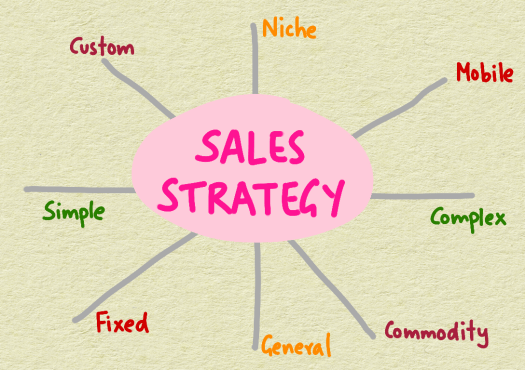
The most famous one, La Rambla, runs from the centre down to the sea and if you’re interested in sales strategy has lessons everywhere you look.

Let’s start with the most obvious one – the one that smacks you in the face.

These are people who sell stuff on the street, from catapults for children, to fans and plastic trinkets and jewellery. They carry a small number of items, in a plastic bag or in their hands, and set them out on the street for you to look at.

They are presumably unlicensed sellers – as when the police turn up they disappear quickly.

Some have large sheets filled with higher value items like branded shoes and designer handbags – with an ingenious string mechanism that means the whole lot can be quickly bundled up and the seller can move on.

One would assume that these are counterfeit – but it’s not clear. There are signs saying that there is a fine for buying from blanket salespeople. But, when you overhear the negotiations for a pair of Nike shoes, for example, the price is not that far off a shop price to start with.

That may just be good negotiating practice – just like when one of them tells you that they made the object they’re selling themselves. It’s odd, however, that the police simply watch the sellers setting up.

What’s common to these sellers is that they are mobile. And they sell commodities – certainly when it comes to plastic fans and counterfeit stuff.

But how can such low value stuff sustain such a high number of sellers?

Presumably there is an organised system behind this. A warehouse where someone with little capital can go and stock up on commodities and then flog them on the street.

And the warehouse is where the big money is being made. Stuff that can be made for 7p in China lands in the warehouse, is presumably sold for 50-70p to the sales person who then makes 30p a sale.

Not a get rich quick strategy for the person selling on the street. But if you’re possibly in the country illegally in the first place, perhaps your only option to get enough money to pay for rent and food.

So what do others do – the ones that operate legally?

An interesting variant on the mobile approach is to add a custom element – like elaborate statue artists or street dancers.

There you’re paying them for a performance that they do – and essentially tipping them for entertainment.

Larger traders start moving to fixed premises and custom strategies catering to a general audience.

For example, the stalls on the street have Barcelona related stuff – magnets, figurines and cards. A lot of people like that kind of stuff as a reminder of their trip.

Or they’re food places – ice cream sellers, restaurants.

The thing with going fixed is that the better the location, the more you pay for your patch of real estate.

An alternative step is to go niche. On a different street, closer to the coast, you find people with stalls selling elaborate masks – the kind you’d use for a masked ball. Specialist places that cater to a niche clientele.

That’s one way to stand out.

But most of the stuff you see on the street is simple. You’re not really going to be able to do a complex sell on someone passing on the street. It’s mostly stuff that you either want or don’t.

Except perhaps when it comes to food.

There are lots of plastic food choices catering to tourists and, if you’re hungry and tired, you might go for the fixed price options just to get something quickly.

But it’s worth going off the main streets and looking for more local fare – stuff that is real food with atmosphere and local chat. Something that gives you a more complex experience than cheap food piled high.

When it comes down to it, sales is less about pushing and more about positioning.

The way in which you position your product almost leads inevitably to a particular strategic approach.

You’re never going to expect great quality from a street seller – and if you think you’re getting a bargain, you’re always going to be wrong.

So, a street seller is going to have to push and persuade and charm you into buying from them.

You’ll be safe in a big chain store located in a shopping mall – but it’s not going to be exciting or different or anything you couldn’t get right here at home.

A bored sales clerk isn’t going to care too much whether you buy or not.

And between those two extremes are several sellers who are trying to get the right combination of characteristics to stand out and appeal to you.

The difference now is that you have the Internet on your side.

I found that I was checking Ebay to see what prices were for commodities on the street and finding it easy to step away when the quoted price was three times the price online.

The chances are that you’ll increasingly rely on recommendations from others to make decisions – from which hotels to select to the best places to eat.

So the sellers in the middle would do well to manage their reputation online – and many are doing just that. The statue artists, for example, display their Instagram information if you want to follow them.

Street selling is fascinating to watch – but it’s possibly the hardest, most time-consuming and lowest margin activity you can do.

It is a good way to learn if what you have actually has appeal – a good validation method when you’re testing the market.

But I wouldn’t recommend making it an core part of your route to market.

What Is Your Job As A CEO?

job-of-ceo.png

Sunday, 8.02pm

Sheffield, U.K.

I was thinking about what Tech CEOs have to do – what does the Chief Executive Officer of a tech firm need to think about and do every day?

Imagine you’re the CEO of a company. Even if it’s the CEO of your own one person business – you’re still in charge and everyone looks to you for direction.

It’s a scary position to be in – to be so completely and totally in charge. No one else that you can point to or blame. It’s not a position you can run away from.

In some ways it’s like being a writer or an artist. Every creative person, without exception, suffers from self doubt and isolation.

You’re making something – creating words or pictures or music. And when you’re done people will see the results of your work and judge you.

You have to get beyond those worries, push through them and create and be damned. The rest of the world doesn’t matter – if you create just for you.

As a CEO, you’re creating a business. More than anyone else in the business, the responsibility for shaping and bringing the business to life rests with you.

So, I was wondering, do tech companies have to do anything different? Are tech companies different in some way? What do you need to be aware of?

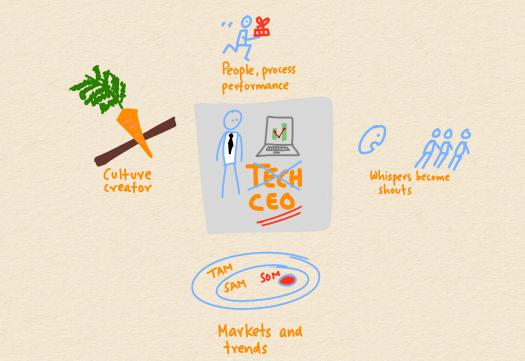
1. The basics – people, process, performance

Well, clearly there are the basics – who you hire, what they do and how well they do it.

And obviously, you must have a product.

Your job is to get the most out of your team, to motivate them, to work harder than them, to show them that you care – for the product and about them.

It’s a job where you need to have a lot emotionally invested in the business. It’s not like being an adviser or consultant – you are the business. To everyone that’s interested, anyway.

2. Be careful what you say

The thing with being the boss is that people listen to what you say.

In meetings, you’ll find people positioning themselves so they can watch you but you can’t watch them. People will hang onto your words and build on your ideas – whether good or bad.

What you say will matter.

Warren Buffett writes about this – it’s example number 3 of what he calls the institutional imperative – as follows

(3) Any business craving of the leader, however foolish, will be quickly supported by detailed rate-of-return and strategic studies prepared by his troops

No one will tell you that you’re doing something stupid. Not your employees anyway. Maybe your investors – perhaps some members of an independent Board.

But, if you’re aware that your every whisper can become a shout as it moves along the organisation, you might be more careful what you say.

3. Understanding markets and trends

A big part of your job is looking outside the company. What’s going on in the market, what are the trends?

Do you understand what your competitors are doing, which new firm is trying to turn your market inside out, and are you positioned to be lifted up by a trend or battered and tossed by it?

It’s things like knowing your Total Addressable Market (TAM), Served Available Market (SAM) and the Served Obtainable Market (SOM), and how you’re going to get to them.

As a CEO, your success depends just as much on what others in your market do as what you do – and you have a lot less control over them.

4. The big one – creator of culture

As a CEO, how you behave is how everyone behaves. Culture travels top down.

And that can be a shock to some people. If you’re an accountant or lawyer, accustomed to saying no or looking for problems, you’ll need to change your mindset to one that is more visionary and that can talk about where you’re going and what the opportunities are.

The things you believe in – whether you should rule with fear, or motivate with incentives – will become policies and norms and standards.

The types of attitudes you have – to the way people dress, what you expect from people in the workplace, how understanding you are about the challenges working couples with children have – will find their way into your company.

Your company is you. And the people in there will start to act like you act. So, you must decide how best to act – all the time.

Not a tech CEO – just a CEO

When you go through this list, nothing really jumps out as specific to a tech CEO.

It’s just skills that you need to have as a CEO.

Perhaps you also need to have an understanding of tech – but it’s more important that you understand the people you have on your team that understand tech.

When it comes down to it, being a CEO is about being the company.

And you’re just got to try and be a good one.

Cheers,

Karthik Suresh

The One Overwhelming Reason Why Marketing Campaigns Fail

initial-premise.png

Saturday, 9.51pm

Sheffield, U.K.

I’ve been listening to the audio book of From Those Wonderful Folks Who Gave You Pearl Harbor: Front-line Dispatches from the Advertising War, by Jerry Della Femina, and it is well worth doing.

It’s a story of how the advertising world worked in the 1970s – full of gossip and insider history – and later inspired the series Mad Men.

And strewn among the anecdotes and stories and personalities are nuggets of advice and wisdom worth picking up.

I wrote a few days ago about Felix Dennis – and his approach to talent. Hire it early, nurture it, guard it and when it is time, get rid of it.

Femina talks about the life of an advertising copywriter earning £30k a year, who is fired for being too much of a smartass – or so he thinks. The real reason is probably because his boss had his eye on a writer who could come in for $8k a year.

The more you earn – the more likely it is there is an eager young thing behind you – eager to take your place.

We don’t see this because we tend to fall in love with our own ideas, our own sense of value.

We sometimes believe that we’re irreplaceable. That we do something that no one else can do and so we’re protected from failure in some way.

In groups, that way of thinking can become magnified – until the group is so sure of an idea that it just cannot see how it can fail.

Until it does.

Femina gives an example of a beer ad. This company had come up with a new line of beer, one much lower in calories than the others on the market.

The job of marketing the beer was given to an agency. After much brainstorming and thinking, the creative geniuses decided that they would market the beer to healthy people – people who exercised – and push the health benefits of a low calorie beer.

Sounds good in theory, but the ad failed.

Why was that?

Femina argued that it’s because the creatives in charge didn’t really get why people drink beer.

They drink beer at leisure – it’s when they sit down with friends and have a drink – or sit on their couch at 9am in the morning open a can.

People drink sitting down, in the main. Perhaps they stand at the bar when there isn’t a seat. But really, how many times have you seen beer drinkers drinking as they walk, jog or press weights?

You serve beer to people having a break, having a good time. Perhaps they’re bowling, where every once in a while they get up, roll a ball, and then sit back down again.

Golfers don’t drink beer. Not while they’re playing, anyway. Have you seen a group pulling their clubs and also dragging along a cask?

The ad was going to fail, Femina says, because the premise it was based on was wrong. Beer drinkers drink for leisure, not for exercise.

But the advertisers spent $5 million. Surely they’d make a good ad for that kind of money?

It doesn’t matter what you do and how much money you throw at the problem. If the initial premise is flawed, the rest of the campaign is doomed.

If the initial premise isn’t right, everything from that point on will fail, because the whole foundation of your campaign is weak and unable to hold up.

When you think about this – it makes a lot of sense.

It takes a lifetime to build a reputation and only one indiscretion to ruin it.

You may have the most comprehensive case in the world, but if you’ve made one small mistake, everything you’ve ever done is in doubt. That’s what happens with prosecutors that do something wrong – all their previous cases have to be looked at again.

Napoleon thought he’d be able to invade Russia quickly and decisively- but was wrong about how his troops would fare in the Russian Winter. A couple of centuries later, the Germans learned that lesson again.

Campaign failures, whether in marketing or elsewhere, are often a result of lots of little things going wrong everywhere.

When you trace it back, however, there is usually a root cause – an initial premise – that is at the heart of it all.

And in marketing, you get the initial premise wrong by not understanding or discovering the real reason why people buy what you’re offering – the real benefit that they want from you in exchange for their money.

Beer drinkers don’t want you to give them a six pack. They want you to help them have a good time with friends.

Cheers,

Karthik Suresh

How To Think About Sales Differently

appreciative-system.png

Friday, 12.30am

Sheffield, U.K.

Technically, it’s Saturday. But who’s checking.

Sometimes life feels like we’re walking around with blinkers on.

We can see what’s in front of us, what we’re told is there and the rest of the world is hidden from view.

And what this means is that we make a lot of assumptions about the way things are. We form theories and the think that those theories are real rather than what they really are – guesses about how the world works.

One such theory has to do with communication.

If you’re a communications engineer, the Shannon and Weaver model of communication is the one you start with – it’s even called the mother of all models.

In this model, if you want to get a message from a sender to a receiver, you encode the message, use a channel to deliver it, decode it at the other end and have it picked up by the receiver – with some noise injected along the way.

If you’ve ever done sales, have you been taught that your objective is to communicate your message clearly?

To say it in words that the prospect will understand? To show what you do? To have brochures and presentations and much more that will help you make a sale?

The idea is that you’re the sender of a message and you need to get that message across to the receiver without losing it along the way.

If the receiver doesn’t want to hear your message – well that’s an objection – and you need to handle it. You need to sell past the objection.

Or do you?

The Shannon and Weaver model has to do with machines. It has to do with the technical aspects of encoding a vibration into a microphone and sending it across the world to be played back on a radio.

It tells us little about how humans communicate.

We’re not machines. We don’t receive messages in that way.

But the engineering way of thinking is so simple, so seductive, so logical, that we’re fooled into thinking that’s the way it happens.

That’s because technology and engineering so dominate the world we live in that we think that’s the only way to look at it. Sometimes.

Sir Geoffrey Vickers tried to understand how the process of communication actually happened in society. How do we actually communicate with each other? How do we “attach meaning to communication”?

Not many people have listened to his stuff, but systems thinkers like Peter Checkland have – and created a model that we can use to think more clearly about this.

At the core of it is something called appreciative systems.

And you can summarise the whole thing in one sentence – but you’ll need to jump to the end of this post to get that.

Here’s the longer version.

We’re wrong when we think that logic will seal a deal, or that a product will sell itself, or that something is a no-brainer.

In reality, the decisions we make and the actions we take are because we want to maintain, modify or avoid having relationships with others.

We start with everything that happens in the world – the flux of events and ideas.

As people living in the world – we have interests and concerns. When faced with a situation, we perceive certain facts.

For example, if you are selling consulting services, you may perceive your value as being a skilled Excel modeller. That’s a fact.

You may select certain facts – like your Excel skills – and look for the significance of those facts in a relationship. You can create a wicked workbook – and that will help someone that has a complex mix of data that needs working out.

You come up with a hypothetical form of a relationship – perhaps it’s offering 30 days of consulting.

Maybe the client only wants 3 days – you select and settle on a form of relationship that is good enough.

Now, have you noticed the thing that’s happening as we work through this process?

Most of the time, we’re thinking of what we want, selecting the facts and forms of relationship that matter to us.

Many salespeople will be reluctant to learn anything about the prospect. Why waste their time on understanding someone else when they could be selling to five others?

What we need to do is start to appreciate what others want.

What are their existing norms and standards – how they expect the world to be?

What are their interests and concerns? What facts do they notice and select? What do those facts mean for their relationship with you?

What form of relationship would they put forward, and what are they likely to settle for?

If you can appreciate that, then you can help them work towards a decision on how to build a relationship with you.

That will lead to action.

And that leads to a sale.

A new norm and standard that includes you in the prospect’s life.

So… that’s a lot of theory to say something obvious. Perhaps.

Sometimes obvious things aren’t that easy to see – because we have existing concepts and ideas cluttering our brains.

You see most of us know the golden rule – do unto others as you would have them do unto you.

But, thinking in terms of appreciative systems, involves a lot more appreciation of the other person.

And that gives you the platinum rule.

Do unto others as they would have you do unto them.

Cheers,

Karthik Suresh

What Is The Shortest Path From A to B?

the-shortest-way.png

Thursday, 9.37pm

Sheffield, U.K.

Sometimes the best mental models are the simplest.

Take the challenge of starting a business, for example.

If you attend a startup conference or study for an MBA, you’ll be shown a process to follow.

At a startup conference, you’ll probably come across the Business Model Canvas and work through the various boxes on there, from your value proposition to the channels that you are going to use to get to your customer.

If you do an MBA, the modules that you study include accounting, finance, marketing, human resources, operations management. And a few others that, looking back, are more complex variants of these four.

So, do you need to do a business model to start a business? Or do an MBA to run one?

Having participated in the first approach and gone through the second – I’d say they are valuable experiences.

The theory you learn in an MBA can be applied during a startup experiment and it might actually help.

But the question I’m asking myself is – is it necessary?

To answer that, let’s turn to John D. Rockefeller.

His book, Random Reminiscences of Men and Events, has a few gems in it. Nuggets that you should put in your pocket.

Starting with accounting – from the time he was a boy he kept a book keeping receipts and expenditures.

He called it Ledger A, and he writes that he was taught to give away a small amount of money regularly.

And that’s all you really need to know about accounting. Cash in. Cash out. And one needs to be more than the other.

If a business works at that level, it will work. If it needs a complicated accounting approach to make it work, you’re probably going to lose your shirt.

Human resources. Perhaps Warren Buffett can help.

He says – work with people you like, admire and trust.

Recruit for character and values – train for skills. Hire slowly and fire quickly.

How about operations management? The principle to use is KISS. Keep it simple.

Marketing? Marketing is about having conversations with people that have the power to sign a contract – the power to authorise payment to you.

Everyone else is just in the way.

People aren’t going to buy from you just because you want them to. They’ll buy because they want to. And if you somehow get them to buy against their will – they’ll feel rubbish about it and avoid you.

And no one gets rich on the first sale. It’s the second and third and fourth – the lifetime value of the customer – that makes you rich.

So the point of marketing and sales is not to sell.

It’s to introduce yourself, make people aware that you exist, not push for anything straight away or interfere with their current plans. Just let them know that you are available to serve them.

A slight digression on finance – and back to Rockefeller.

He tells a story where one friend asked another for advice on whether he should invest in cash or in Standard Oil stock. The person being asked didn’t want to answer – to put himself in a position where he was held responsible for the decision.

But the other was having none of it – and pressed for an opinion.

Finally the first one said – put half in cash and half in stock and see what happens.

In there is the secret to asset management – to wisely managing a portfolio of any kind.

If you don’t know – then go 50:50. Change that ratio only when you do know something.

Another sneaky little lesson. Does the rate at which you borrow matter?

No.

What matters is the return on how you invest your borrowed money.

Put it in projects that pay back in two years, and you can borrow money at 10% all day long.

All these little thoughts are mental models – models that can help you get from A to B in the quickest possible way.

In a straight line.

You can go to school to learn them. But you need to go to work to really learn them.

A lot of us spend a lot of time meandering about – zig zagging through C, D and E, before we realise that the straight route is the one to take.

The idea of going in a straight line is simple.

That doesn’t mean it’s easy.

Cheers,

Karthik Suresh

What Would You Do If You Got Fired Tomorrow?

fired-tomorrow.png

Wednesday, 9.59pm

Sheffield, U.K.

I had a chat with a friend of mine a few days back.

He’s the boss, and had to make some difficult decisions about letting some people go.

It was a big decision – he felt the responsibility. But it had to be done for the sake of the business. The business came first.

When you get the inside view of the process at the top of a business, you realise a few things about life.

First, no one is indispensable. No one is irreplaceable.

Felix Dennis, in his book How To Get Rich, says overhead walks on two legs.

He’s also blunt about the value of talent to an employer like him. Your talent and my talent.

Identify talent early, he says. Then you can underpay it for a short time, if the work is challenging enough. Then you pay the market rate. Finally, you’re paying it based on past reputation alone – at which time you must part company with it.

There’s a lesson there. The more expensive you are, the more at risk you are.

So why is it, when you type the headline of this post into Google, most of what you get is stuff on how to manage your feelings and the law about human resources?

Both those are all very well, but if you’re a well-paid employee, you should really have a backup plan in place.

You may never get fired – but you have insurance for your life, for your house. You have a disaster recovery plan at work. Why wouldn’t you have a disaster recovery plan for your job?

So, here are some thoughts about the most important things you need to have in place as part of that plan.

1. Know Your Runway

Robert Kiyosaki defines wealth as the number of days you can survive if you lose your job tomorrow.

Real wealth is not what you have in the bank, it’s not just a money number.

It’s how long you can live on that number.

Take a simple example.

Let’s say you have $100,000 in the bank.

You have a great job. The house, the car, the golf membership, elegant living and holidays cost you $10,000 a month. The same amount that the job pays you.

You’d last 10 months if the job stopped paying you.

That’s your runway.

The longer your runway, the more time you have to get yourself sorted again.

So the first piece of your your plan is to work out what you can slash your monthly costs to if you absolutely had to.

Then, look at your bank account and work out how many months you can go without pay.

If that number is more than 12 – you have a year that you could survive with nothing coming in – you’re doing well.

If it’s less – especially if it’s a lot less – you need to start building your runway now. The time to build it is when you don’t need it.

2. Know Your Value

There’s a saying – price is what you pay, value is what you get.

Value is your secret weapon. It’s the thing you offer that no one else does. It’s why someone should give you money and not someone else.

And in today’s world, there are an unlimited number of ways to become more valuable. Simply becoming good at one thing will make you more valuable.

Choosing that one thing is an important thing for you to do.

All too often, we let that thing be decided by others. You do what you’re told to do at work. You wait for workplace training. You progress up a chosen path.

That won’t make you rich, and it won’t make you safe.

What will make you safe is the stuff you do on your own, your homework, the stuff that you build after hours.

How you use non-billable time is how you increase your value.

Whether it’s a skill like coding or carpentry or a service like sales or social media management – you need to figure out the value you bring.

Because that’s what people will get out their wallets for.

3. Have A Product

But, people have to be able to give you money in exchange for something. In exchange for a product.

Think of everything you do as a product.

A product has certain characteristics:

  1. It is well defined.
  2. It has a price.
  3. It gives the customer a benefit.

A service is no different from a product in this sense. A plumber fixes your plumbing. A copywriter writes your webpages. A programmer creates an application.

What you want to do is avoid the fuzzy world of “jobs” that need to be done. Unless you turn your superb administration skills into a product like being a personal assistant.

The reason for you to treat yourself as a provider of products is that you take control. Instead of being someone that is told what to do by your employer, you think of yourself as someone that provides benefits to an employer.

Any employer willing to pay your price.

Which leads us to the last point.

4. Be Ready To Hustle

You can’t avoid being successful if you are prepared to tell your story to four or five people every day.

If you have something of value to offer, wrapped in a product with a price, then all you need is to find customers.

And the way you do that is by getting off the couch and going to look for them.

It’s like the dad that told his kid there was a million dollars under his shoe.

The kid kept looking under his shoe, until he realised what that meant.

Use up some shoe leather going to find those customers. It’s easier now with LinkedIn and email and the Internet.

It should take you less than a day to find 100 people that might benefit from what you have to offer.

It should take less than a month to contact them all.

As long as you have more than a month of runway – you’re bound to succeed.

At which point, the whole memory of being fired will be a distant one. And the chances are that you will look on the whole episode with gratitude because it set you on this new, better path.

There’s Only One Thing You Need To Do

Have your plan. And be ready to ACT.

Cheers,

Karthik Suresh

How Do You Know Something Is Worth Doing?

magic-zone.png

Tuesday, 9.26pm

Sheffield, U.K.

I’ve tried todo lists, and they don’t work for me.

The lists of actions fill up faster than I can tick them off. Then, all of a sudden, I have fifteen pages of todos and no real plan for dealing with them.

And I think it would be a mistake to force myself to do them in order. Or rank them in some way. Or work out some kind of process for managing them.

Because that leads down a rabbit hole of list holders and Filofaxes and text files and apps and all that kind of stuff.

The kinds of tools and books and stationery that are everywhere, tempting you away from doing the work.

And they have a seductive siren song – if you use them you will get better, more productive, more beautiful, more sexy.

Maybe that works for some people.

I just know I’ve spent many hours thinking about how to do things rather than actually doing them.

And that is not necessarily a bad thing.

Scott Fitzgerald once wrote “The test of a first-rate intelligence is the ability to hold two opposed ideas in mind at the same time and still retain the ability to function.”

Maybe I can use that as an excuse…

So, on the one hand you have the idea of sharpening your axe. If you have an hour to cut down a tree, spend the first 50 minutes getting it sharp and then get to work.

On the other hand you have the school of long hours and hard work. The workplaces where facetime matters more than anything else.

Doesn’t matter if your axe is blunt – just get on with it and work harder.

Which is problematic. As Scott Adams writes, the reward for doing good work is usually more work.

Promotion doesn’t help. Robert Frost suggested that if you worked hard 8 hours a day you could eventually become a boss and work 12 hours a day.

For many of us, we should make better choices about what is worth doing. How should we spend our time?

Warren Buffett writes about how he constantly looks for ways to make large investments but tries to avoid small commitments.

Your time is the greatest asset you have and investing it wisely is the biggest job you have to do.

Should you be spending it on minor tasks or focusing it where you can make a big difference?

Buffett says – if something’s not worth doing at all, it’s not worth doing well.

For those of us that work as consultants or any other profession where our time is what makes us an income, this is crucial to learn.

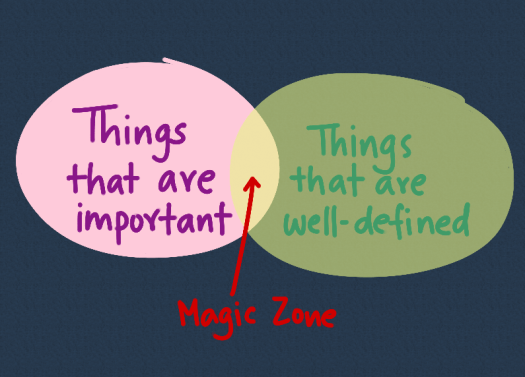
There are lots of things that are important. Tasks that are important to us, and tasks that are important to others.

We’ll get satisfaction out of accomplishing important tasks. Others will only pay us if they believe that we can accomplish an important task for them.

But that’s not enough.

If we want to do things that move us closer to our goals, the tasks also need to be well defined.

We need to be clear on the shape and size of what we’re doing. We need to know how long we’ll do it and at what price.

With knowledge work, this can be hard.

But we need to get rid of the fuzziness and be clear on what we’re doing. That’s the only way to build a business instead of having a hobby.

The task for us is to try and spend our time in the zone – the magic zone – where the majority of what we do is both important and well-defined.

The rest is not worth doing at all.

Cheers,

Karthik Suresh