Why Using Force Multipliers May Be The Smartest Thing You Do

force-multipliers.png

Sunday, 9.40pm.

Sheffield, U.K.

I got in touch with a few people some weeks back – a cold outreach for a service offering.

The details aren’t important – the point is that I was making a cold contact.

What are the success rates for that kind of thing?

Let’s look at what mailchimp says about email – it looks like open rates hover around 20% and click rates around 2%.

This approach had a 71.43% response.

Which was kind of a holy crap moment.

It also got me to thinking about what happens next. Clearly, when someone is courteous enough to acknowledge you then you have a responsibility to go back with something that is relevant to them.

This is something professional salespeople disagree with violently. On some social media platforms anyway.

They argue that it isn’t their job to do any research into a customer. No – once someone puts up their hand and expresses an interest, the salesperson’s job is to engage with that customer, have a conversation, understand their needs and move towards a close.

I think the real reason for their displeasure is simpler.

Doing research is hard work. It’s boring and time consuming.

Wouldn’t it be easier to have a research assistant go out and collate all that boring stuff and highlight the good bits so you can flick through it while waiting in the reception for your prospect to come and get you?

Let them do the hard work of educating you?

I did the research instead. And it took an hour for just one prospect. Multiply that by the number in your pipeline and the hours stack up pretty quickly.

which finally brings us to the idea of force multiplication.

It’s very much a military concept, the idea that you can “fight with limited resources and win”.

What do you think a consultant setting up a sales function would advise me to do?

Well – they’d probably say we needed resources. A CRM to track the prospects and everything associated with them. Trained salespeople to engage with prospects. Admin and research staff to help the salespeople.

You’d need a budget – probably a few 100k.

That’s sound strategy. It’s the application of overwhelming resource to the specific problem that you have. And it will fail.

It will fail because big strategies need a number of things to go right – as explained here – and the changes of that are slim.

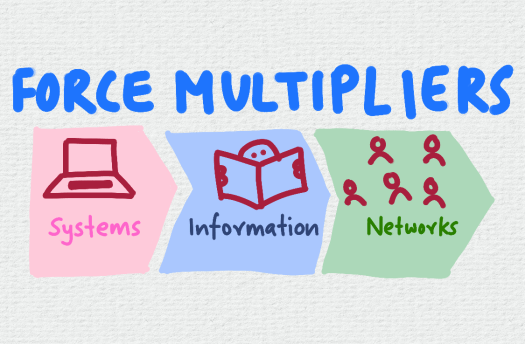
A better strategy is to look for force multipliers. And there are three that stand out.

Systems that automate the right stuff

What do we do when we carry out research?

These days, it’s all about Google. Type in the term, read the first page of results and you’ve got a pretty good idea of what the prospect is all about.

You could do this manually – click, read, click back.

That’s how I spent the first hour.

Then, I wrote some code.

That goes off, gets the results and pages and sticks everything into a single file, which I can read quickly and pick out the main bits.

The result – research time down from an hour to around 5 minutes.

Cost = $0.

The right kind of information

Information is the key to winning these days, not resources.

Take the response rate I started with.

The only reason for that is because I reached out to the right segment. A group of people that had a good chance of being interested in what I put in front of them.

And the problem many of us face is that we’re swimming in information and don’t know how to extract the important from the rest.

But again, that’s possible with the right systems. With a little bit of code I can figure out which companies are similar, which ones are worth going after and who is the right person to contact.

All that stuff is available now – often for free.

Anyone who doesn’t bother to spend the time getting the information they need is going to going to the next stage much harder.

Network based operations

Networks are interesting. Very interesting.

Take a typical large company. It’s going to be hierarchical – mostly. Orders come down. People do what they are told to do.

The typical company ossifies as it grows – it becomes slower, less responsive, less receptive to feedback.

A network operates differently – and many professional services firms use a model where they bring together the right group of people to work on a project, rather than just giving it to a department where it’s probably going to be done badly.

Modern armies do this – operate with a mission based approach rather than an orders and directives based one.

Let’s say you’re a graphic designer. If you team up with a copywriter and reach out to marketing directors, you’ll probably be much more effective than if you’re trying to do it all by yourself.

If you want to scale, then perhaps you need to bulk up your team with artists on Upwork, and focus on designing and selling propositions and outsourcing the artwork.

You could, all on your own, have the same impact as a large agency, but with a fraction of the overhead.

That’s a force multiplier.

The aim is to win

The problem with many strategies is that they’re about getting in position, getting resources aligned and deployed.

But that’s not the point.

The point is that you want to win – win your battle with the fewest casualties and fewest resources deployed.

The first approach is just the mindless application of force.

What you want to do is to look for opportunities where you can multiply what forces you have already.

Cheers,

Karthik Suresh
How To Select A Sales Strategy – Lessons From The Street

sales-strategy.png

Friday, 7.14pm

Sheffield, U.K.

We’ve just spent a few days wandering around Barcelona. Several miles and aching feet – looking at some stunning architecture, grand parks and fabulous views.

And then there are the streets.

The most famous one, La Rambla, runs from the centre down to the sea and if you’re interested in sales strategy has lessons everywhere you look.

Let’s start with the most obvious one – the one that smacks you in the face.

These are people who sell stuff on the street, from catapults for children, to fans and plastic trinkets and jewellery. They carry a small number of items, in a plastic bag or in their hands, and set them out on the street for you to look at.

They are presumably unlicensed sellers – as when the police turn up they disappear quickly.

Some have large sheets filled with higher value items like branded shoes and designer handbags – with an ingenious string mechanism that means the whole lot can be quickly bundled up and the seller can move on.

One would assume that these are counterfeit – but it’s not clear. There are signs saying that there is a fine for buying from blanket salespeople. But, when you overhear the negotiations for a pair of Nike shoes, for example, the price is not that far off a shop price to start with.

That may just be good negotiating practice – just like when one of them tells you that they made the object they’re selling themselves. It’s odd, however, that the police simply watch the sellers setting up.

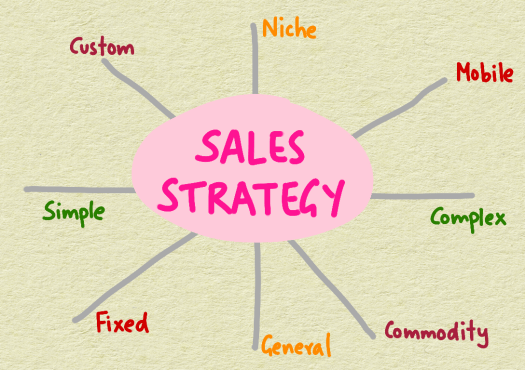
What’s common to these sellers is that they are mobile. And they sell commodities – certainly when it comes to plastic fans and counterfeit stuff.

But how can such low value stuff sustain such a high number of sellers?

Presumably there is an organised system behind this. A warehouse where someone with little capital can go and stock up on commodities and then flog them on the street.

And the warehouse is where the big money is being made. Stuff that can be made for 7p in China lands in the warehouse, is presumably sold for 50-70p to the sales person who then makes 30p a sale.

Not a get rich quick strategy for the person selling on the street. But if you’re possibly in the country illegally in the first place, perhaps your only option to get enough money to pay for rent and food.

So what do others do – the ones that operate legally?

An interesting variant on the mobile approach is to add a custom element – like elaborate statue artists or street dancers.

There you’re paying them for a performance that they do – and essentially tipping them for entertainment.

Larger traders start moving to fixed premises and custom strategies catering to a general audience.

For example, the stalls on the street have Barcelona related stuff – magnets, figurines and cards. A lot of people like that kind of stuff as a reminder of their trip.

Or they’re food places – ice cream sellers, restaurants.

The thing with going fixed is that the better the location, the more you pay for your patch of real estate.

An alternative step is to go niche. On a different street, closer to the coast, you find people with stalls selling elaborate masks – the kind you’d use for a masked ball. Specialist places that cater to a niche clientele.

That’s one way to stand out.

But most of the stuff you see on the street is simple. You’re not really going to be able to do a complex sell on someone passing on the street. It’s mostly stuff that you either want or don’t.

Except perhaps when it comes to food.

There are lots of plastic food choices catering to tourists and, if you’re hungry and tired, you might go for the fixed price options just to get something quickly.

But it’s worth going off the main streets and looking for more local fare – stuff that is real food with atmosphere and local chat. Something that gives you a more complex experience than cheap food piled high.

When it comes down to it, sales is less about pushing and more about positioning.

The way in which you position your product almost leads inevitably to a particular strategic approach.

You’re never going to expect great quality from a street seller – and if you think you’re getting a bargain, you’re always going to be wrong.

So, a street seller is going to have to push and persuade and charm you into buying from them.

You’ll be safe in a big chain store located in a shopping mall – but it’s not going to be exciting or different or anything you couldn’t get right here at home.

A bored sales clerk isn’t going to care too much whether you buy or not.

And between those two extremes are several sellers who are trying to get the right combination of characteristics to stand out and appeal to you.

The difference now is that you have the Internet on your side.

I found that I was checking Ebay to see what prices were for commodities on the street and finding it easy to step away when the quoted price was three times the price online.

The chances are that you’ll increasingly rely on recommendations from others to make decisions – from which hotels to select to the best places to eat.

So the sellers in the middle would do well to manage their reputation online – and many are doing just that. The statue artists, for example, display their Instagram information if you want to follow them.

Street selling is fascinating to watch – but it’s possibly the hardest, most time-consuming and lowest margin activity you can do.

It is a good way to learn if what you have actually has appeal – a good validation method when you’re testing the market.

But I wouldn’t recommend making it an core part of your route to market.

The One Overwhelming Reason Why Marketing Campaigns Fail

initial-premise.png

Saturday, 9.51pm

Sheffield, U.K.

I’ve been listening to the audio book of From Those Wonderful Folks Who Gave You Pearl Harbor: Front-line Dispatches from the Advertising War, by Jerry Della Femina, and it is well worth doing.

It’s a story of how the advertising world worked in the 1970s – full of gossip and insider history – and later inspired the series Mad Men.

And strewn among the anecdotes and stories and personalities are nuggets of advice and wisdom worth picking up.

I wrote a few days ago about Felix Dennis – and his approach to talent. Hire it early, nurture it, guard it and when it is time, get rid of it.

Femina talks about the life of an advertising copywriter earning £30k a year, who is fired for being too much of a smartass – or so he thinks. The real reason is probably because his boss had his eye on a writer who could come in for $8k a year.

The more you earn – the more likely it is there is an eager young thing behind you – eager to take your place.

We don’t see this because we tend to fall in love with our own ideas, our own sense of value.

We sometimes believe that we’re irreplaceable. That we do something that no one else can do and so we’re protected from failure in some way.

In groups, that way of thinking can become magnified – until the group is so sure of an idea that it just cannot see how it can fail.

Until it does.

Femina gives an example of a beer ad. This company had come up with a new line of beer, one much lower in calories than the others on the market.

The job of marketing the beer was given to an agency. After much brainstorming and thinking, the creative geniuses decided that they would market the beer to healthy people – people who exercised – and push the health benefits of a low calorie beer.

Sounds good in theory, but the ad failed.

Why was that?

Femina argued that it’s because the creatives in charge didn’t really get why people drink beer.

They drink beer at leisure – it’s when they sit down with friends and have a drink – or sit on their couch at 9am in the morning open a can.

People drink sitting down, in the main. Perhaps they stand at the bar when there isn’t a seat. But really, how many times have you seen beer drinkers drinking as they walk, jog or press weights?

You serve beer to people having a break, having a good time. Perhaps they’re bowling, where every once in a while they get up, roll a ball, and then sit back down again.

Golfers don’t drink beer. Not while they’re playing, anyway. Have you seen a group pulling their clubs and also dragging along a cask?

The ad was going to fail, Femina says, because the premise it was based on was wrong. Beer drinkers drink for leisure, not for exercise.

But the advertisers spent $5 million. Surely they’d make a good ad for that kind of money?

It doesn’t matter what you do and how much money you throw at the problem. If the initial premise is flawed, the rest of the campaign is doomed.

If the initial premise isn’t right, everything from that point on will fail, because the whole foundation of your campaign is weak and unable to hold up.

When you think about this – it makes a lot of sense.

It takes a lifetime to build a reputation and only one indiscretion to ruin it.

You may have the most comprehensive case in the world, but if you’ve made one small mistake, everything you’ve ever done is in doubt. That’s what happens with prosecutors that do something wrong – all their previous cases have to be looked at again.

Napoleon thought he’d be able to invade Russia quickly and decisively- but was wrong about how his troops would fare in the Russian Winter. A couple of centuries later, the Germans learned that lesson again.

Campaign failures, whether in marketing or elsewhere, are often a result of lots of little things going wrong everywhere.

When you trace it back, however, there is usually a root cause – an initial premise – that is at the heart of it all.

And in marketing, you get the initial premise wrong by not understanding or discovering the real reason why people buy what you’re offering – the real benefit that they want from you in exchange for their money.

Beer drinkers don’t want you to give them a six pack. They want you to help them have a good time with friends.

Cheers,

Karthik Suresh

What Is The Shortest Path From A to B?

the-shortest-way.png

Thursday, 9.37pm

Sheffield, U.K.

Sometimes the best mental models are the simplest.

Take the challenge of starting a business, for example.

If you attend a startup conference or study for an MBA, you’ll be shown a process to follow.

At a startup conference, you’ll probably come across the Business Model Canvas and work through the various boxes on there, from your value proposition to the channels that you are going to use to get to your customer.

If you do an MBA, the modules that you study include accounting, finance, marketing, human resources, operations management. And a few others that, looking back, are more complex variants of these four.

So, do you need to do a business model to start a business? Or do an MBA to run one?

Having participated in the first approach and gone through the second – I’d say they are valuable experiences.

The theory you learn in an MBA can be applied during a startup experiment and it might actually help.

But the question I’m asking myself is – is it necessary?

To answer that, let’s turn to John D. Rockefeller.

His book, Random Reminiscences of Men and Events, has a few gems in it. Nuggets that you should put in your pocket.

Starting with accounting – from the time he was a boy he kept a book keeping receipts and expenditures.

He called it Ledger A, and he writes that he was taught to give away a small amount of money regularly.

And that’s all you really need to know about accounting. Cash in. Cash out. And one needs to be more than the other.

If a business works at that level, it will work. If it needs a complicated accounting approach to make it work, you’re probably going to lose your shirt.

Human resources. Perhaps Warren Buffett can help.

He says – work with people you like, admire and trust.

Recruit for character and values – train for skills. Hire slowly and fire quickly.

How about operations management? The principle to use is KISS. Keep it simple.

Marketing? Marketing is about having conversations with people that have the power to sign a contract – the power to authorise payment to you.

Everyone else is just in the way.

People aren’t going to buy from you just because you want them to. They’ll buy because they want to. And if you somehow get them to buy against their will – they’ll feel rubbish about it and avoid you.

And no one gets rich on the first sale. It’s the second and third and fourth – the lifetime value of the customer – that makes you rich.

So the point of marketing and sales is not to sell.

It’s to introduce yourself, make people aware that you exist, not push for anything straight away or interfere with their current plans. Just let them know that you are available to serve them.

A slight digression on finance – and back to Rockefeller.

He tells a story where one friend asked another for advice on whether he should invest in cash or in Standard Oil stock. The person being asked didn’t want to answer – to put himself in a position where he was held responsible for the decision.

But the other was having none of it – and pressed for an opinion.

Finally the first one said – put half in cash and half in stock and see what happens.

In there is the secret to asset management – to wisely managing a portfolio of any kind.

If you don’t know – then go 50:50. Change that ratio only when you do know something.

Another sneaky little lesson. Does the rate at which you borrow matter?

No.

What matters is the return on how you invest your borrowed money.

Put it in projects that pay back in two years, and you can borrow money at 10% all day long.

All these little thoughts are mental models – models that can help you get from A to B in the quickest possible way.

In a straight line.

You can go to school to learn them. But you need to go to work to really learn them.

A lot of us spend a lot of time meandering about – zig zagging through C, D and E, before we realise that the straight route is the one to take.

The idea of going in a straight line is simple.

That doesn’t mean it’s easy.

Cheers,

Karthik Suresh

How Do You Know Something Is Worth Doing?

magic-zone.png

Tuesday, 9.26pm

Sheffield, U.K.

I’ve tried todo lists, and they don’t work for me.

The lists of actions fill up faster than I can tick them off. Then, all of a sudden, I have fifteen pages of todos and no real plan for dealing with them.

And I think it would be a mistake to force myself to do them in order. Or rank them in some way. Or work out some kind of process for managing them.

Because that leads down a rabbit hole of list holders and Filofaxes and text files and apps and all that kind of stuff.

The kinds of tools and books and stationery that are everywhere, tempting you away from doing the work.

And they have a seductive siren song – if you use them you will get better, more productive, more beautiful, more sexy.

Maybe that works for some people.

I just know I’ve spent many hours thinking about how to do things rather than actually doing them.

And that is not necessarily a bad thing.

Scott Fitzgerald once wrote “The test of a first-rate intelligence is the ability to hold two opposed ideas in mind at the same time and still retain the ability to function.”

Maybe I can use that as an excuse…

So, on the one hand you have the idea of sharpening your axe. If you have an hour to cut down a tree, spend the first 50 minutes getting it sharp and then get to work.

On the other hand you have the school of long hours and hard work. The workplaces where facetime matters more than anything else.

Doesn’t matter if your axe is blunt – just get on with it and work harder.

Which is problematic. As Scott Adams writes, the reward for doing good work is usually more work.

Promotion doesn’t help. Robert Frost suggested that if you worked hard 8 hours a day you could eventually become a boss and work 12 hours a day.

For many of us, we should make better choices about what is worth doing. How should we spend our time?

Warren Buffett writes about how he constantly looks for ways to make large investments but tries to avoid small commitments.

Your time is the greatest asset you have and investing it wisely is the biggest job you have to do.

Should you be spending it on minor tasks or focusing it where you can make a big difference?

Buffett says – if something’s not worth doing at all, it’s not worth doing well.

For those of us that work as consultants or any other profession where our time is what makes us an income, this is crucial to learn.

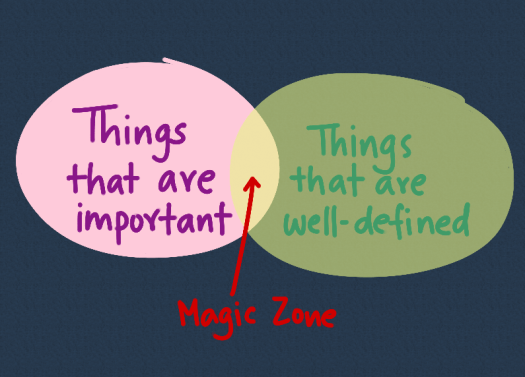
There are lots of things that are important. Tasks that are important to us, and tasks that are important to others.

We’ll get satisfaction out of accomplishing important tasks. Others will only pay us if they believe that we can accomplish an important task for them.

But that’s not enough.

If we want to do things that move us closer to our goals, the tasks also need to be well defined.

We need to be clear on the shape and size of what we’re doing. We need to know how long we’ll do it and at what price.

With knowledge work, this can be hard.

But we need to get rid of the fuzziness and be clear on what we’re doing. That’s the only way to build a business instead of having a hobby.

The task for us is to try and spend our time in the zone – the magic zone – where the majority of what we do is both important and well-defined.

The rest is not worth doing at all.

Cheers,

Karthik Suresh

What’s Andrew Carnegie’s Number One Secret For Succeeding In Business?

all-eggs-in-one-basket.png

Saturday, 10.56pm

Sheffield, U.K.

I don’t know how you go about writing your blog, if you have one, but my approach is quite random.

Really.

If you were to get some advice from a marketing person on blogging, you’d probably start by having a goal, understanding your target audience, coming up with a list of topics they’d find useful, getting a schedule set up, crafting headlines and spending a lot of time promoting what you’re doing.

That’s how it should be. Perhaps.

What I do is start with an idea – something random I’ve read. Say it’s about the Rule Of Frequency – which I’ll cover in a separate post.

This particular article is associated with GNU/Linux, so that gets me searching and gets me to the O’Reilly Open Books site. Which talks about the Open Library project.

A lot of what I learn and write about wouldn’t be possible without people putting time and effort into sharing what they know.

And since that seems a good thing – the fact that there is an Open Library project is also very interesting.

Because it seems to me that people create stuff for one of two reasons. They think it will help them in some way. Or they need to put down what they know before they burst.

The ones who do it for the second reason create much more interesting stuff. Stuff that’s actually useful.

And those are the books and articles that are worth reading. So, it makes sense to spend time hunting them down.

Wandering through the Open Library finally has me stumbling over Andrew Carnegie’s book “The Empire Of Business”, printed by Doubleday, Page & Co. in 1902.

The first chapter is a talk to young men – young people if we bring it up to date – where Carnegie tells you what he’s learned over a long business career.

His success secrets…

It’s good to start at the bottom, he says. If you’ve started there, you’ll be motivated to get ahead and much less likely to be led astray by the temptations available to those with more money than you.

Then there are three things you shouldn’t do. The first two? Don’t drink or speculate.

The third one… this is out of left field…

Don’t “indorse”. This means lending your name to support someone else. Perhaps as a favour to a friend – or as an influencer in these modern times. Probably “endorse” today.

In essence, be very careful who you lend your reputation to, because if things go wrong, you’ll be dragged down as well.

Then… what should you do?

Instead of looking at what you are asked to do – what you must do – for an employer, look for what you can do.

You’re paid a wage to do what you must do. To make more, you must do more.

Future millionaires have one sure habit, Carnegie goes on. “Their revenues exceed their expenditures”.

If you can save, if you can show that you can hold on to money – others will lend you hundreds and thousands what you have when you need capital.

And then… we come to his final secret – the big one…

You can make money in any business – in any legitimate one making or dealing in a product that people want.

If you want to make money you need to do one thing. “Concentrate your energy, thought and capital exclusively” on that business.

Stick to it, fight it out, resolve to lead, be the best, have the best and know the most.

In other words, he says, “Put all your eggs in one basket, and then watch that basket”.

And finally… be patient. You’ll get there.

Cheers,

Karthik Suresh

How To Engage Prospects Without Having To Sell To Them

engineering-as-marketing.png

Monday, 10.36pm

Sheffield, U.K.

Github, recently bought by Microsoft, is turning into the world’s largest software graveyard.

But, you don’t just find software there.

Take this cool collection of marketing resources for engineers, curated by Lisa Dziuba of Flawless App.

Flicking through these got me to the concept of Engineering as Marketing, popularised by Gabriel Weinberg and Justin Mares in Traction: How any startup can achieve explosive customer growth.

What does this mean?

You can’t just tell people what you do and show them a brochure and expect them to buy any more.

First of all, it’s hard to get to speak with anyone. They’re all busy. And, unless what you do is exactly what they are looking for right now, they’ll cut you off.

That’s if you get through the receptionist and the email only policy.

And that’s because telling isn’t selling.

Increasingly, what we’re trying to sell in product and service companies is technology. Brains aren’t enough.

You need tech as well – and with tech you have to show what you can do. Demo or die.

But what if you have a large, complex and expensive product?

Or what you have something like a book to sell? Something that doesn’t have a technology element to it.

Take the energy business, for example. It can take from tens of thousands to many millions to develop a new solar project.

I’ve just typed “solar irradiance calculator” into Google.

The first website that comes up is for a Solar Electricity Handbook.

The handbook is the best selling solar energy book today, the website says.

But on the website, they also have a calculator, which lets you see how much a solar installation will perform in the city of Masis, in Armenia – should you wish to do something like that.

And here’s the interesting thing.

The second link on Google is for a company that is using this calculator – and gives the first site a linkback.

That’s a perfect example of engineering as marketing.

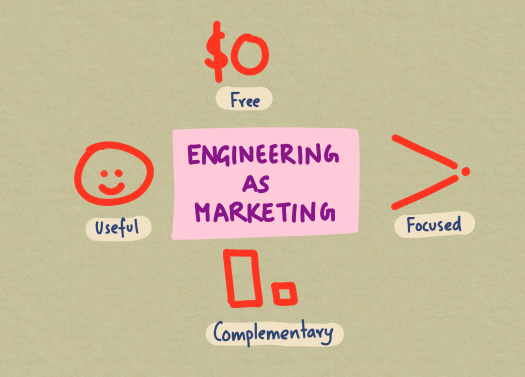
The company has created a free tool.

That is focused, no pun intended, on calculating a specific thing – how much sun energy do you get in a particular place.

It’s complementary – which means that it doesn’t steal sales from its main product. You can use the calculator without losing any sales of the book.

The book is the main product and the calculator is a useful additional bit that might get you to the website and even buy the book.

And its building useful links from other sites that use the tool.

Most examples of engineering as marketing focus on the big examples – Hubspot and the like.

But – small companies with small budgets can also use this strategy very effectively.

You might struggle to get time with decision makers to talk to them about what you do.

If your product is relatively expensive – it’s going to take time to develop a relationship with them at a number of levels.

If you provide free and useful tools that don’t cannibalise your core business – they could end up coming to you.

For example, if you use a calculator on someone’s website for long enough, you might be interested enough to talk more about the rest of your products.

Take the solar PV project business – if you can provide tools that make it easier to find locations with good sunlight – you might find people coming to you to ask about your design and installation services.

Like many of the best solutions, engineering as marketing doesn’t try and tackle a problem head on, you go around it instead.

And it doesn’t need to be expensive. Creating microsites, calculators and other small tools don’t need to cost a lot or take much time.

But you do want to make then free, focused and useful.

And, importantly, not make you lose sales.

Cheers,

Karthik Suresh

What Is The Secret Behind A Creative Leap?

problem-solution.gif

Saturday, 10.03pm

Sheffield, U.K.

Brian Tracy, the motivational speaker, starts one of his talks by saying something like “Before I came in today, I read every one of your resumes and I know all your job titles.”

He points to someone in the first row. “You sir, your title is Chief Problem Solver.” To another, “You’re VP of Problem Solving.” And to another, “Executive Problem Solver.”

This gets to the heart of where the interesting stuff happens in business today.

Either you’re in a job where you’re told by your boss exactly what to do, and you do it that way or you get fired.

Or, your boss doesn’t know what the right answer is and needs you to figure it out, in which case you have a client, not a boss.

The first kind of job is manual labour. And, when you think about it, many jobs need that kind of approach – from working at a fast food chain to carrying out heart surgery.

You wouldn’t want your meal cooked in whatever way the chef fancies – perhaps they’ll try it a little under cooked this time to test out if the flavour is better?

You’d want your surgeon to do exactly what is needed – and not go off on a diversionary expedition inside you to follow up something more interesting?

But, there was a time before those jobs and tasks existed in the way they do now. Someone figured out how to make fast food work.

The McDonald brothers worked it out. They created a restaurant where every move was orchestrated. Every step and action had a purpose.

At a recent visit to a McDonalds, I counted around 15 people behind the counter, and no one was getting in each other’s way.

In the film “The Founder”, you hear the story of how they did it – how they noticed that people wanted burgers and fries and not much else off the menu – how they tore down their restaurant and rebuilt it from scratch and created a whole new concept in dining as a result.

We see the end result, but we rarely see the process. Often, people who do creative things can’t explain how they do it – it’s almost magical.

But… it’s something many people are interested in and study. In this paper, Kees Dorst and Nigel Cross look at creativity in the design process.

There are two states we can be in – a problem state and a solution state.

Imagine them like mountainous islands separated by a forbidding stretch of water.

The challenge is to get from one side to the other.

People who do this well start by exploring their mountain in detail.

They look at the problem, what the client feels, how it impacts them. They try and look at it from different angles and viewpoints. They ask themselves questions that try to prod creative thinking, lateral thinking.

They look at possible solutions – explore the solution space. What are the approaches that have already been tried? What could we do differently? What’s the opposite of what is being asked for.

Then, they start to frame the problem – settle on a way to view it.

This means focusing on the things inside the frame and discounting the things outside it. Focusing on the things that matter.

Trying to match up the problem space and the solution space.

All this work is trying to build a bridge – a bridge between the problem space and solution space.

This bridge is the thing that links the two in a way that works. Some bridges won’t. Some will – and they will work well enough to be selected to go ahead.

So, the creative leap is like building a bridge. But what it takes – what it needs is immersing ourselves in the problem and solution space, going past the simple and default and first solutions that come to mind and forcing ourselves to look longer and further and harder.

When we see a finished product – whether it’s a book, an idea, a business model – we might think it sprang to life fully formed. This way of doing things is the only way.

And that way lie jobs that are filled with boredom.

The interesting jobs are the ones where you solve problems – where you make clients happy.

A warning, however. This doesn’t mean you’ll make money.

The McDonald brothers had to eventually sell their business to Ray Kroc, who went on to create the business we know today.

They solved the operations problem – to create fast food.

He solved the business problem.

Either way, they’re all creative problem solvers.

Cheers,

Karthik Suresh

What Are The Simple Rules That Will Radically Grow Your Business?

business-basics.png

Tuesday, 9.22pm.

Sheffield, U.K.

John Caples was one of the best known names in copywriting and advertising, and worked for 58 years in the industry.

What, one might think, would someone who started writing in the 1920s have to say to us – a century later – about the nature of life and business?

Plenty, it turns out.

Caples learned his trade in mail order advertising, a tough school where you could precisely measure the return you got from your investment.

Mail order advertisers learned what worked, what didn’t and quickly focused on the approaches that made them a profit.

So, what’s it like today.

In many industries, technology has swept away the old ways of doing things, but created chaos and confusion along the way.

Take emails, for example.

No one denies that email has made it easier to contact people. You can get a message to someone across the world in seconds.

But… can you find a contract in your records from five years ago?

What if you’ve changed email service providers? What if all the documents were sent electronically?

How many photos or documents or spreadsheets can you find from even a few years ago that relate to a project you’ve finished?

One of the things we’ve lost by going digital is memory – we forget too much.

What does that mean?

It means that we’re so overwhelmed with the new and shiny that we forget to focus on the basics.

Caples said that there are two basic rules we need to follow to be successful in business – especially if we want to move from having a hobby or lifestyle business to one that can grow radically.

The first is to create business formulas – repeatable steps that produce results.

Your business exists because it uses resources to produce something that people want.

You can follow a new approach every single time you need to do something.

For example, if you run a law practice, you can approach each project as a completely new thing – a blank slate.

You wipe your memory of everything that has been done before and start again from scratch.

Or, you could create templates and processes and repeatable fill-in-the blank solutions for common problems.

Which approach do you think will scale?

You can make a perfectly good living from producing bespoke work. To grow you need to be able to create standard work that you can do yourself, or hire other people to do for you.

In other words, find what you are successful at and repeat it. Then scale it.

The second is to try something new every once in a while.

If you stick with a successful approach and only do that, then one day you’ll wake up to find that the market has changed and you’re no longer relevant.

You do need to have ideas, invest in research and development and make sure your business isn’t obsolete.

And, in today’s technological world, the more your business is based around technology, the quicker it becomes redundant.

People, however, don’t change. If your business is appealing to people – technology is simply a channel to help you reach them.

Like most things – these two rules seem incredibly simple.

  • Repeat the successful
  • Try something new

Some people might say – that’s just obvious. So obvious it’s not worth pointing out.

Very well then – if they know this already – then they must already have a successful, growing business, no?

No?

Try going back to basics every once in a while. I know I need to.

Is It Important To Find Your Tribe?

tribes.png

Saturday, 7:01 pm

Sheffield, U.K.

What is a tribe, exactly? Let’s ask the Internet.

a social division in a traditional society consisting of families or communities linked by social, economic, religious, or blood ties, with a common culture and dialect, typically having a recognized leader.

Seth Godin talks a lot about tribes – why they are important, how they form and how you can lead one.

If you really care about something – it’s very like that there are others like you out there.

But, should you give a damn? Or are you better off spending your time working on your own? What is the benefit of belonging to a group?

There seem to be three broad reasons when you look into it.

You can change from what you are now to what you really are

We spend a large part of our lives learning to conform. From being told what to do as kids to signing contracts to do work as adults.

We learn there is a right way to act, to be, to think. The people around us act and behave in this way and anything outside the norm is odd or uncertain.

Along the way, we may have forgotten what we really are at the core.

If you’ve watched Sherlock Holmes, the one with Benedict Cumberbatch, there is a scene where a villain urinates in the fireplace to show that he can ignore any rules that others think is in place.

That’s probably not a wise approach to follow but the principle – one where we start to trust ourselves more and don’t try so hard to fit in – may help us move in the right direction.

And that’s one where you realise that most of the things that stop us from doing things are barriers that we have put up ourselves, barriers in our heads.

We may have stories about why we don’t fit in, why we’re different, why we’re not going to be accepted. We may have issues about gender, race, nationality among others.

But, these are stories we tell ourselves. And, if we want to change, we can find people with similar experiences and stories of change. People like us – and that’s one kind of tribe.

You can be part of a movement for change

If you believe in something – believe enough in it that you’re ready to change the world, then having a tribe will help.

Let’s say you want to stop fracking, change the law on cycling without a helmet or stop parents smacking their children – there is probably a group of people out there working very hard on the issue.

People will have different views – and so you will find multiple groups that will welcome you in. The price of entry, however, is that you have shared values and beliefs.

This kind of tribe is simply an emergent property of human society. It’s not good or bad – it just is.

Climate change activists and far right campaigners are simply different kinds of tribes. Society in general decides whether one tribe is good and another is bad – whether some can be allowed and other s controlled or banned.

If a well-defined tribe doesn’t exist around your area of interest, then you have the chance to be a leader, to bring together scattered people around your vision for a better (in your opinion) future.

You can be part of a group that has a common commercial interest

This final tribe is something that is so common that many of us just don’t realise how important it is.

Business – commerce – is an activity that happens because people trust each other. The easier you make it to trust someone, then more likely it is that your business activity and sector will do well.

That’s why every city has a Chamber of Commerce – a tribe that brings together local businesses. That’s why there are guilds and associations.

Imagine you’re setting up a market – should you put people that do the same thing close together or far away?

Should you group florists, food joints and book sellers close by or mix them up?

It turns out that having your competition close to you is better for customers.

When they can quickly compare between competing offerings, they make decisions more quickly.

When you can see what the competition is doing, you can become better at what you do.

A tribe isn’t a group of people that hang on your every word…

Some people think that finding a tribe is the same as finding a following – a group of people who idolize you and will buy everything you put out.

The people who have that kind of following, however, almost never seem to have set out with that in mind.

It looks like the ones that succeeded cared first – believed first, and the success followed later.

If you want to find your tribe – perhaps you should start by being clear on what you believe in.