How To Become a Professional At Whatever You Care About

Sunday, 5.30am

Sheffield, U.K.

apprenticeship.png

You can observe a lot just watching – Yogi Berra

We live in a world where there is a shortage of teachers and mentors and, at the same time, unlimited opportunities to get better.

Once upon a time, if you wanted to learn a trade, you found someone who needed an apprentice and worked under them.

That teacher-student relationship was the main way new talent was developed for generations.

Now, we have courses for everything. You can learn to code in a weekend. Write, make pots or learn business studies.

So, what happens then?

The movies and success manuals would have you believe that if you’re hungry, always looking for new opportunities and pushing for those big chances you’re going to do well.

And that may be true.

But, is it good?

Will it make you a professional?

We know that there are no shortcuts to excellence in any field of work.

The 10,000 hour rule is about time – time spent doing deliberate practice. Practice that stretches and challenges you.

Take writing, for example. You’re often told that you’ll throw away your first million words.

That seems like a lot but, if you write 500 words a day, two hundred days a year, that will take you exactly ten years.

That ten-year period seems to be needed whatever you do.

It takes ten years to integrate into a new society as an immigrant.

Getting the hang of running a business seems to take that amount of time.

Becoming a musician or artist or craftsperson takes that amount of time.

And that’s time spent learning.

I’m fascinated by approaches to learning.

I read a quote the other day, browsing in a bookshop, while waiting for a train.

No thief, however skillful can rob one of knowledge, and that is why knowledge is the best and safest treasure to acquire.’ – L. Frank Baum.

If you are fortunate enough to be apprenticed to someone then you have an opportunity to learn that few others have.

The Japanese have words to describe this process that are worth reading.

Minarai, for example, means “learning by looking”.

The idea is that a master does not “teach”. Instead, the apprentice, “steals the art” – works out what works over time.

An article by Dick Lehman gives us an insight into this process.

What is the teacher’s most important lesson?

An apprentice’s answer: “Your lesson to us is that we are to express ourselves as fully as possible – with all our might and strength; to be ourselves, and to work within the limitations that greet us; but, through our works, to express our spirit, mind and heart, as best we can.”

But what if you don’t have a master?

That’s where the Internet comes in.

There is an Indian story about a boy called Ekalavya who wanted to learn archery under the renowned teacher Drona.

He was rejected from the school so made a statue of Drona using mud and practised in front of it until his skills were better than Drona’s best students.

These days, the Internet gives us masters to watch on tap.

You can get everything from the words of Warren Buffett to interviews with artists who will show you what they do.

I think when you’re starting out it’s okay to think that you need to be shown what to do.

Very quickly, however, the most important thing becomes whether you spend your time watching, trying and learning.

Because it’s one thing to take a course.

It’s something else to walk the road towards being a professional.

Cheers,

Karthik Suresh

What Would You Suggest Your Kids Should Do For Work?

addingvalue.png

Thursday, 9.30pm

Sheffield, U.K.

There’s more than one way to do it. – Perl motto

I’ve been thinking a bit about where one really adds value.

The late Felix Dennis wrote a book called How To Get Rich where he said that there is one talent you must have.

And what is that?

The talent to spot talent in others. To recruit that talent and nurture it.

But what if you’re that talent… how are things going to work out for you? Or for your kids?

Felix has a lesson later on. As talent gets older, he says, it gets expensive. Young talent can be underpaid if the work is challenging. Then, it’s paid at the market rate. Finally, it’s paid for what it did in the past, and that’s when you part ways with it.

And really, that’s an important lesson. In a traditional career path we climb a ladder. The idea is that we get on the ladder because of what we do and then we climb it because of what we can get others to do.

Its the whole making versus managing thing.

But really, what is a manager other than an intermediary between an owner and the customer?

When you look around you at people and what they do you start to see that programming is increasingly at the heart of everything.

If you work in an office you probably spend a lot of time doing stuff using Excel. That’s programming.

If you’re creating music, or art, or architecture you’re still probably using a computer.

Even if you do something that is a craft, like designing and building wooden stools or jigsaws, you’re probably going to use a computer to help you.

Telling a computer what to do is programming.

Okay – so that’s obvious you say – clearly the world is heading that way. What’s the insight here?

Well, the point is that there is a period of transition.

A period of pain for those who don’t get it.

And a period when they have to make choices.

The kinds of jobs where we add value really fall into two areas.

Either we make something that people will buy.

Or we sell something that people will buy.

Anything else really is a cost – and costs are things that you really want to get rid of.

If you’re doing something that gets you labelled as a cost then you’re going to have a rather fear-filled working life.

I think kids need to get this straight.

Either they’re good with people and can build relationships with them.

That’s worth a lot.

Typically between 10 and 60% of the value of a product.

For example, wouldn’t any of us pay 20% of the price of our product if someone else brought in the customers?

The remaining 40-90% goes to the owners after they pay their staff – the ones that make stuff, and the other ones.

I’d tell my kids to make sure that they’re making something.

And that making is the same as programming – programming an app, automating something, creating music or creating a product.

And if they don’t like that then just go out and learn how to sell.

I suppose you might, at this point, point to the public sector.

Well… that’s where you need to ask how much value is being added by some of the things that happen over there…

Brexit anyone?

Cheers,

Karthik Suresh

Why Planning Is Really Mostly About Getting Ready And In Position

battle-plan.png

Tuesday, 10.05pm

Sheffield, U.K.

No plan of operations extends with any certainty beyond the first contact with the main hostile force. – Field Marshal Helmuth Karl Bernhard Graf von Moltke

What should you do when trying to think about dealing with a difficult situation?

Say you’ve been asked to come up with a plan. Something in writing. Something that sets out how you’re going to go about things.

Well, that’s what I had to do recently. So, I started with what seemed like an obvious place.

I took out the textbooks.

That seemed reasonable. Surely, there must be something in there that would help me in the situation I was in right now?

But, something odd happened.

First, the textbooks set out the main possibilities, the main ways you can think about the situation.

For example, let’s say you have a question about organisation structure.

The textbooks will tell you that people in organisations tend to act along a continuum from task oriented to relationship oriented.

Task oriented people want to get things done. They’re interested in todo lists, responsibilities, due dates and specific actions.

Relationship oriented people want to get people working well together. They want to create a culture and shared vision of what is possible.

The books will tell you how organisations develop styles or personalities depending on which approaches are dominant in their leaders – from laid back approaches to micromanagement and time tracking in 6-minute increments.

You can also describe organisations in terms of how they are structured – from strict hierarchies and siloed operations to a loose network of independent professionals.

But here’s the thing.

All those descriptions of organisations are actually very little use.

They describe what is there but don’t tell you what is good or what you should use.

Is being task oriented better than being relationship oriented? Or is it the other way around?

The answer is that it depends. In some cases, one approach will work. In other cases it won’t.

It’s actually very hard to predict how things will pan out.

Take war-making, for example. The German battle plans of the second world war called for sending troops quickly to France through Belgium.

So quickly that any resisting forces would be overwhelmed and the war would be over very quickly.

Ironically, as a Prussian General observed, plans tend to fall apart once the fighting starts.

Which makes one wonder whether looking to a textbook for thoughts on what to do is akin to a military planner working out how to fight the last war.

The next war is probably going to be different with a whole bunch of things that just weren’t around for the textbook writers to write down.

What if thinking about organisations and their structure is actually irrelevant in a world where either everything is going to be done by a computer or by networks of creative professionals who come together and separate as and when needed.

To some extent the fact is that the more you try and control the more likely it is that you’ll fail.

Or get nothing done.

What you’ve got to do first is be ready, and then, be ready to adapt.

A plan then is more about getting in position than about doing something in a particular way.

As Woody Allen said, eighty percent of success is just showing up.

Cheers,

Karthik Suresh

How Many Years Of Experience Do You Have?

junior-senior.png

Good decisions come from experience, and experience comes from bad decisions. – Rita Mae Brown

Thursday, 10.06pm

Sheffield, U.K.

Sometimes it takes me a long time to get things.

A really long time.

For example, I always thought of “u” and “w” simply as letters in the alphabet.

You know – how it goes in the song you learn with your ABCs.

It was only when I did a poor attempt at learning french that I heard the sounds “ve” and “duble ve” and realised that a “w” was actually two “u”s – a double “u”.

Maybe it was just that my kindergarten focused more on rote learning and less on making sense of the origin of language symbols.

Which also makes sense when you consider that the teachers were dealing with four year olds who were struggling with the concept of staying in one place for more than two minutes.

Anyway…

I read something on Medium that is totally obvious when you read it but that, if you’re anything like me, you might have missed until now.

It’s by Ariel Camus and says “What makes senior developers senior is not that they know the syntax of a given language better, but that they have experience working with large and complex projects with real users and business goals.”

We all start at the bottom of a professional ladder and it’s easy to assume that those higher up are there because they are more skilled than us.

And that can sometimes be the case.

But it’s often not.

Take a lot of academic work, for example. It’s very easy to spend a lot of time carrying out research into a particular area.

The problem is that when you come out of school you find that you’re starting at the bottom in the world of work.

Having those degrees and smarts and skills doesn’t automatically propel you up the career ladder.

What gets you up is being able to show people with the power to make decisions that you’re the person they need to get a job done.

I suppose we should be careful not to confuse seniority with power.

Some people get to the top because they’re good with relationships or politics or power.

That’s not the kind of thing I’m talking about here.

What I’m talking about is the kind of knowledge that comes from trying to solve problems.

Preferably ones that real people have. And ideally ones that are expensive to leave unsolved.

It’s obvious really. It doesn’t matter how smart your work is if no one cares. If someone does care, that’s good but you’re not going to make a living unless they care enough to pay you. And they’ll only pay you based on what you save them so the more impact you can make the more you can make.

It really comes down to the old saying about years of experience.

Have you got ten years of experience?

Or do you really have one year’s experience repeated ten times?

Cheers,

Karthik Suresh

Why Planning for When You’re Bigger May Be A Waste Of Time

scale.png

Monday, 9.19pm

Sheffield, U.K.

Do things that don’t scale. – Paul Graham (Y Combinator)

Why would you want to be bigger?

I suppose your size could be a measure of success?

I’ve read that some successful people say that they don’t really care about the money.

To them, it’s a way of keeping score.

So, if you were coming up with a goal for yourself or your business, should you aim to be big?

Should you want to be a millionaire? Or start a billion dollar company?

Or are these approaches looking at the wrong things altogether?

After all, money is presumably a byproduct of what you do.

This can be something that’s a little hard to talk about.

You tend to get very quickly into the differences between tails and dogs.

For example, if you’re looking for an education should you go for the one with the biggest salary prospects or the biggest probability of getting a job?

Many of us do.

So, one would assume, that the better your education the better the job you will get.

Although, why is it that the people who run companies are not usually the ones with the most degrees or letters after their names?

Why is it that so often in real life, as Robert Kiyosaki brutally puts it, A students work for C students, and B students work for the government?

Let’s look at another area that appears to be exploding.

Almost everyone has an idea for a killer app.

Something that, if they could only get it built, would take the market by storm.

The steps involved are pretty simple. Find a development shop, explain what you want, pay for their time and get your app.

How much would you bet that the shop would get things right?

If you’ve ever tried to get something like this done, you’ll know that at the end you now know exactly what you want and it isn’t what you’ve got.

Now, why did you go to the shop in the first place rather than making something yourself?

You could have picked up Excel or created something that worked in a paper planner?

But, by raising money and getting a team together you felt like you could get to scale faster.

It’s the rocketship model. Money is like fuel. If you can create customers before your money runs out you’ve achieved orbit. If not, you’re probably debris.

I was reading some advice on coding – procedural versus object oriented.

Use object oriented, an experienced programmer urged. It might mean you write more code but if you get successful it will be much easier to manage then.

All of these approaches say you should plan for what happens when you scale.

But, Paul Graham doesn’t.

And the experience of many others also suggests that scale can be a trap.

At the start of any process you need to do things manually.

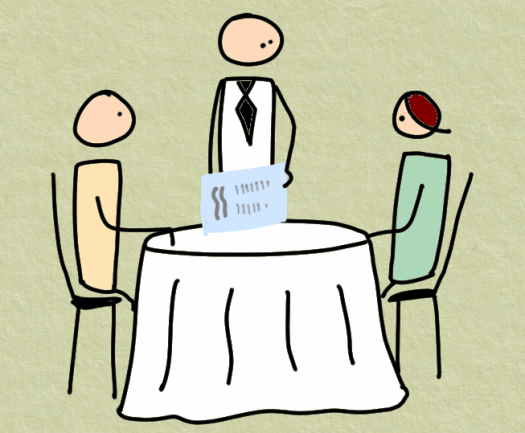
Recruit customers one at a time. Serve them, like you would as a waiter at a table. Get to know what they like and ask them how the food is.

Because, when you’re bigger you won’t have the time to do things like that.

And if right now, when you can talk to each prospect, you don’t, you’ll never know what they really want.

If you want to build something, build something you want.

If you’re building for someone else, like that shop you hired earlier, they’re less interested in giving you what you want than not being blamed when you realise that what you said you wanted wasn’t what you needed.

Building what you want is more than just building a product. It’s the same approach to building everything else – relationships, careers, interests.

The place where we go wrong is when we try to predict what will succeed rather than just working on what interests us.

And when we’re engrossed in our work we don’t think about money or size or scale.

We think about the work and if we’re lucky, those other things will turn up as well.

But it really wouldn’t matter either way.

Cheers,

Karthik Suresh

What’s The Most Important Question You Need To Ask Yourself?

shit.png

Friday, 8.35pm

Sheffield, U.K.

Okay, how do we sell this piece of shit?” – Steven Pressfield

I was listening to Steven Pressfield being interviewed on the Joanna Penn’s podcast, The Creative Penn.

You know Steven? The author of The War of Art, a writer of war books, and of the battles inside each of us.

It’s one thing knowing something and getting it. Really getting it…

Like realising that no one gives a shit about you.

It’s not that they’re unkind or self absorbed or nasty. It’s just that they are busy and have no reason to be interested in you or your stuff.

That makes it hard when you’re trying to do any kind of sales job.

Or… does it?

Yes it does. Really.

Which is why the question you need to ask is the one that’s near the top of this post.

The fact is that we’re all selling something. When we’re looking for a job we’re selling ourselves. When we’re working, we’re selling what we’ve done to the boss or to a client.

Selling matters. It’s the one thing that tells you whether what you’re doing is working or not.

If it isn’t selling, you’re doing it wrong.

Unless you are unfortunate enough to be an artist in the Soviet Union.

The New Yorker has a piece on the writer Sergei Dolatov who was one of many artists simply not allowed to publish their work behind the iron curtain.

What he had would have sold if it was allowed to sell and it did when it was, when he moved to America.

The thing that’s different now is that it’s harder to keep you silenced. You can say what you want, write what you want and publish what you want.

The problem is that no one is listening.

And the solution is simple. Simple, but not easy.

What you have to do is figure out how to make what you have interesting to someone else.

Which leads back to us sitting at a table looking at a steaming pile and asking ourselves how we can sell it.

There are two roads we can go down now. We can be “sales people” and try to sell. Or we can be human and try to help.

If you’re focused on selling then you’re focused on what you have and how you can get someone else to buy it.

That’s an attitude you see very often from people new to the job. I’ve got this thing. Now how can I tell everyone to come and listen to me?

Now you know that’s not going to work. What you’ve got to do is think like the person who might need what you have.

Or even better, listen to them. Not talk to them but listen.

Listen to what they have done, how they act and talk and frame their choices. People make decisions all the time.

If you can listen and learn how they make decisions then you can make it easier for them to see what you have, understand what you have and make a decision.

For example, I saw a LinkedIn profile recently that said “I’m a management consultant and entrepreneur”. The author then added that he hated those terms. He was actually a systems thinker. But saying that wouldn’t get him any jobs. That’s someone who has asked and answered the question.

A question that’s worth asking again and again about everything you do.

Cheers,

Karthik Suresh

What Should You Do If You Want To Be Free?

minimalism.png

Monday, 9.35pm

Sheffield, U.K.

There are two ways to be rich: One is by acquiring much, and the other is by desiring little. – Jackie French Collar

Sometimes a stray statement, a position taken by someone, can make you wonder whether we’re shackled by anything more than our own thoughts.

Not, of course, if you’re literally in chains but, assuming you live in a free and democratic society, when it comes to everyday living.

There is a famous photo of Steve Jobs taken in 1982 which shows him living in a sparse, unfurnished space despite already being rich.

Some people see that minimalist streak in Jobs brought to life through Apple products, with their emphasis on design, minimal interfaces and intuitive use.

So, when you hear of someone complaining that they don’t have a desk to work at, what do you think? What does that say about how free they are?

There is a story about Amazon, about when they started and needed desks. But desks were expensive and doors weren’t. So they bought some doors, fitted some legs and used them as desks.

Frugality is still a big thing at Amazon, as are desks made from doors, even though they are now one of the most valuable companies on the planet.

If you’re the kind of person that, when you don’t have a desk, can work anywhere else without complaining then you have what it takes to start and run a business.

If you can think of alternatives, come up with suggestions, sit and work on the floor if you need to, then no one can stop you from getting things done.

Because much of business is about being resourceful and inventive, about seeing opportunity where others see nothing. About solving problems, big ones and little ones, day after day.

And there are certain principles that are worth remembering when we try and deal with what comes at us every day.

When you’re selling, for example, after a while you’ll realise that most people you meet have pretty much the same questions about what you have to offer.

There’s also little excuse for not doing your homework before you meet someone. There’s so much information that people put out about themselves and their businesses that you can get a good idea of what they are all about before you meet them.

So, if you know what questions they have and have done some homework on who they are then, really, the main thing you need to do is to listen to what their problems are and see if you have a solution.

Your presentation becomes less about you and more about trying to get them to open up and engage with you. You know it’s working when they start asking questions, ideally ones to which you have the answer on the next slide.

There is a difference between this kind of approach and one that tries to tell your prospect everything about you.

It’s like a child with a box of toys, every one of which is special and important to him, so he wants to talk to you about each and every one.

You listen politely, but really, your mind is somewhere else.

But when that child wants something from you, his tactic changes. Now he is laser-focused on that one thing – that one toy and nothing will divert him from it.

What do these different concepts – minimalism, frugality, focus – have to do with anything?

Well, if you can craft a message that shows your prospect just what is important to them, shows them how you make it for them, at the lowest cost possible, and how it solves a problem that they are focused on, how do you think they will respond?

And I wonder whether if you want to be the kind of person that can pare down a message to just what is important, you also need to be the kind of person that can pare down what you have to just what is important.

Because, of the two ways to get rich quoted at the start, the second is the one more likely to set you free.

Cheers,

Karthik Suresh

Do You Realise How Much What You Do Shapes Who You Are?

tools.png

Sunday, 9.10pm

Sheffield, U.K.

We shape our tools, and thereafter our tools shape us. – Marshall McLuhan

I am not fond of gardening.

Gardens are nice to sit in when everything is tidy and the lawn is cut but, when it’s not, they remind you in silent reproach that it’s all your fault and you should do better.

There is a tree in front of our house, a large ash, and every autumn it deposits all its leaves with no apology on our garden.

Now, I would much rather be curled up with a book or stood at my computer reading or writing than almost anything else.

The keyboard is a tool I’m comfortable with. I know its parameters and its limitations. I learn more every day I write.

A rake, on the other hand, is much more problematic.

So, today I offered one of the small people that lives with us an opportunity to go to the cinema.

He said no.

I tried to bribe him, with popcorn and ice-cream and juice.

He still said no.

Exasperated, I said we couldn’t just sit in the house. If he didn’t want to do anything we’d just have to go out and rake leaves, expecting that the cinema would suddenly become more appealing.

Except it didn’t. He ran excitedly for his wellies and we then spent the next hour raking and sweeping leaves. You’d think it was the best thing he’d done all week.

And then he said ‘when I grow up daddy, I want to be a sweeper, just like you.’

The point, I suppose, is that whatever you do becomes your business.

I was at a networking event a few years ago and the keynote speaker was someone who had built her cleaning business from scratch into an operation now employing hundreds of people.

You could be forgiven for assuming that a rake is less complex than a computer and that one skill is worth more than the other but the fact is you can make money from both.

We know that work in the future that people do will be of two types: creative work, that needs imagination and insight; and dexterous work, making use of our hands to do things robots can’t.

The rest will be done by the machines. Unless, of course, you can’t afford one.

Then again, that might not happen at all.

William Gibson wrote: The future is already here — it’s just not evenly distributed. A quote much loved by the technocrats who’d like to shape us to fit their world.

What happens, however, is that whatever technology you choose then has an impact on what you do.

And, in many parts of the world, it feels like people are turning to technology that helps them be more human, like bicycles and cloth bags and recycling bins.

No one has ever had much luck predicting how the future is going to look.

It could be one where we’re all immersed in augmented reality and the majority of interaction is through a machine, or it could be one where we’re better informed, better connected and better people.

Who still probably have leaves to rake when we’d much rather be writing.

Cheers,

Karthik Suresh

How Do You Tell When Something Is Good?

critical-thinking.png

Friday, 9.06pm

Sheffield, U.K.

There is nothing new under the sun but there are lots of old things we don’t know. – Ambrose Bierce

Do you think we live in a world where what we see and read is better than ever before?

There is clearly more stuff. More people are writing and creating words, music and video. They are coming up with games and apps and platforms.

All shiny and new.

So, what makes one creation better than another? Why do you sit and watch one box set, unable to turn away, for week after week while others you abandon after the first ten minutes?

One test – much loved by the analytics folk – is to look at what people do. If they can watch your behaviour, see how you vote with your mouse and remote and money, then they can figure out what you like and give you more of it.

The thing with analysis is that it looks back at what has happened. You can try and do more of what worked in the past but, as the financial folk keep reminding us, past performance is no guarantee of future results.

Also, this whole thinking in aggregate, in big numbers, in terms of markets is applying statistics to people. And no one really wants to be a statistic.

Take consumer behaviour, for example. In his book Buy.ology, Martin Lindstrom writes about Socrates and how he told his students to think about a mind like a block of wax. If an image is pressed into the wax and stays there, then we remember it. If not, it’s like it was never there. In other words, it leaves an impression.

Lindstrom goes on to describe how the things that leave an impression on us, from touching a hot stove to being embarrassed when we told someone how we felt about them, shape the way we start to respond to things.

But, while we share many of these things none of us have exactly the same. Imagine all these experiences like strands hanging down in front of you. You pick and weave your experiences into your own unique sense of identity.

So, while a statistical approach can be approximately right the ideal approach is one that is made just for you. Not one that is designed to make you feel special but one that actually is special.

John McPhee is an American non-fiction writer. I heard about him in a podcast and was interested enough to take a look at the cover of his latest book, Draft No. 4: On The Writing Process, but not interested enough to buy it.

Until I read this review by Michael Dirda on the Washington Post that had these lines:

“However, its opening two chapters, in which McPhee presents his various systems for structuring articles, do require a bit of perseverance. There are graph-like illustrations, circles, arrows, number lines, maps and even an irrelevant excursus about an outmoded text editor called Kedit. The upshot of it all is simply: Take time to plan your piece so that it does what you want.”

There are two points that the writer makes: drawing pictures is a waste of time; and text editors are irrelevant.

Well, if you have read this blog for a while, you’ll know that drawings are a big part of how I write. And I write with a text editor, possibly one even older than the outmoded one that the writer of the Post excoriates.

So, of course, I had to buy the book. Because now I desperately needed to read those two chapters.

And that’s the funny thing about people. They don’t act in the way you want them to. Just because you think things should be one way doesn’t mean everyone is going to agree.

So, that takes us back to asking how we know when something is good. And one answer is that it’s good if it’s been around a while.

Like pencils.

Pencils?

If you’re a writer, you know how to use a pencil.

What’s newer than a pencil?

Pens, text editors, Microsoft Word, some kind of SAAS program?

If you write with a pencil your words will still be legible a few hundred years from now.

Penned words may start to fade.

Plain text will be readable as long as we have computers.

Your Word documents from even ten years ago are probably lost.

And that SAAS company went bust not long from now.

In other words, choose things that have some history because they have shown they can last.

Cheers,

Karthik Suresh

What Approach Should You Take If You Want To Succeed?

agincourt.png

Thursday, 9.01pm

Sheffield, U.K.

All things are ready, if our mind be so. – William Shakespeare, Henry V

The English insult is different from that commonly seen in much of the world.

Instead of a middle finger raised aloft, they hold up the index and the middle, palm facing inward.

This custom, apparently, comes from days when the longbow was used in battle and the French would threaten to cut off those two fingers of any prisoners to ensure they never drew a bow again.

And so, in battle, the longbowmen held up those fingers to tell the other side what they thought of them.

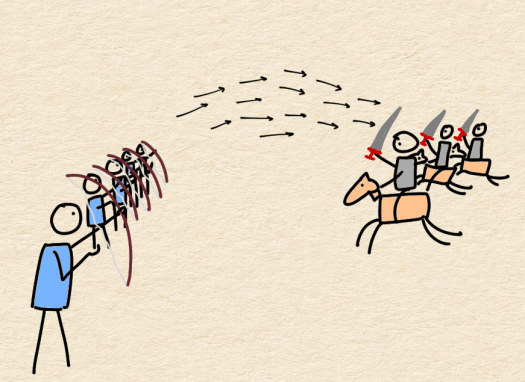
The longbow, apparently, came into its own at Agincourt in 1415. 8,500 English soldiers, 7,000 of which were longbowmen faced around 50,000 French troops.

They won – helped by their arrows – which travelled towards the enemy faster than they could run and walk towards them.

But, what does this have to do with business or sales and marketing?

It’s a story that can be used to look at the same situation from different points of view.

Let’s look at tactics, for example.

The losing side were just as brave as the winning side. If anything, they might have been braver, trusting in their armour to protect them from those pesky arrows.

They had a plan, to head towards the other side and so that’s what they did.

That’s a little like having an army of salespeople taught to smile and dial. They hit the phones, make the calls, make their numbers and succeed.

Is that approach, that works like a cavalry charge, all might and muscle and fury, going to work?

Increasingly, it seems to me, it doesn’t. A cold approach, whether on the phone, email, snail mail, is easily stopped, ignored or turned away.

The arrows, on the other hand, are multiple points of contact. Some might miss, some might hit, and the ones that hit may make a difference.

So, the way I think about this is to imagine that you want to build a pipeline of business. You could reach out to people directly or you could send a shower of arrows their way.

You could advertise where they are going to see it, you could engage with them in the places they are going to be, you could work with them on things that they feel are important and you could get introduced to them by people they already trust.

Is that going to increase your chances of success?

Possibly. Even probably.

I guess it simply comes down to this.

There are lot of things you could do.

You could focus on just one of those things – something you’re strong at, and just do that thing.

Or you could do as many of those things as you can at the same time.

For some people the focused approach will work. For others, the wider one.

Unfortunately, there is no right answer.

There is just what happens when you finally join battle.

Cheers,

Karthik Suresh