Should You Make The Big Leap To A New Future?

point-of-no-return.png

Sunday, 9.15pm

Sheffield, U.K.

The most dangerous thing in the world is to try to leap a chasm in two jumps. – David Lloyd George

I was watching a TEDx talk by Dr Benjamin Hardy who talked about his research into wannabe entrepreneurs and actual entrepreneurs.

The one difference between the two, he said, was that the actual entrepreneurs had experienced a point of no return – something from which there was no going back, while the wannabes hadn’t.

This is an interesting concept – an appealing one and a dangerous one – a concept you should approach with caution.

On the one hand many of us are in jobs that we’d like to leave.

Maybe we want to start a new business or pursue a different career or talent, and surely it’s only by taking the decision – committing to a new way of life – that you’ll make any progress?

After all, is the only memory you want to have of your life one of regret?

So, if you’re in that situation, don’t you have to believe in yourself – believe in your ability to take the leap and get to the other side?

We read so many stories of just that happening – but at the same time we need to remember that stories are written only about those that reached the other side.

The rest fell, and were forgotten.

Survivorship bias stalks such stories.

Hardy’s research probably controls for this bias but it’s hard to imagine that there are many entrepreneurs who take part in interviews to talk about how they failed time after time.

But then there are other kinds of leaps – after all, not all leaps have to be ones that show up in dramatic announcements.

You don’t have to quit your job, move to Silicon Valley, invest all your savings or mortgage everything you own and go all in on your dream.

A leap can happen just in your mind.

In her book, Thinking in systems, Donella H. Meadows writes about an experiment she does with classes.

She takes a slinky out of a box, holds it from the top in one hand, resting it on the palm of the other.

She them takes away her hand and the free end of the slinky drops, bouncing up and down until it comes to rest.

She asks the class why the slinky behaves the way they did.

The answers come fast – “Because you took your hand away.”

She then picks up the box the slinky came in and does the same thing with that, holding it in one hand, resting it on the other.

She takes her hand away and nothing happens.

Her point is that it’s the nature of the slinky that makes it act the way it does – not the hand.

The behaviour is a property of the system – not of its environment.

And this gives us a hint off the kind of leap we need to make in our minds.

If we want to change things then we have to start by changing ourselves.

Changing things that are outside us amounts to fiddling with the environment.

If we change our jobs, locations or investments, we’ve changed the things around us but if we are no different aside we’re heading for failure – because the chasm still exists when we take the run up.

When we’re ready the chasm disappears – maybe just because we’ve now found where the bridge happens to be.

Cheers.

Karthik Suresh

What Do People Expect To See When They See You?

genre.png

Tuesday, 9.27pm

Sheffield, U.K.

Always remember that you are absolutely unique. Just like everyone else. – Margaret Mead

I was listening to an interview on The Creative Penn and the topic of genre came up.

Genre is something I find hard to understand – and I’ve tried a few times to wrap my head around Shawn Coyne’s words on the topic and always come away with a headache instead.

So, let’s try again.

Coyne writes that “A Genre is a label that tells the reader/audience what to expect. Genres simply manage audience expectations. It’s really that simple. Don’t let the French etymology and pronunciation scare you.”

We’d all like to be appreciated for the unique person each of us is but that’s really too much to ask.

Most people don’t have the time or the interest in understanding someone else all that much.

Eleanor Roosevelt said ““You wouldn’t worry so much about what others think of you if you realized how seldom they do.”

In storytelling the point of genre is to help readers quickly select what they really want to read.

When I have some free time, for example, I read thrillers – books with action and very little real thinking.

It’s the opposite of the kind of stuff I read most of the time – and so it’s a welcome distraction.

Genre is everywhere – it’s really just a form of classification and if you want to be a member of a particular profession you need to learn the genre conventions that apply.

Not in a vague, theoretical sense but in a practical, applicable sense.

With stories, for example, Coyne talks about time, reality, content, structure and style.

Music has genres – from folk to jazz and beyond.

The hardest part for someone looking to stand apart from the crowd and be recognised for their individual and singular contribution is realising that they have to start by picking a crowd to join.

In the beginning, life is about which box you fit into.

In order to be accepted into a group you need to be similar to other members of the group.

If you’ve had the misfortune of having boxes full of microplastic beads you’ll know what happens when the colours get mixed up.

Having red pieces mixed in with the blue beads means you have to get the tweezers out and rearrange things.

It’s like that with most things in life.

You’re probably going to notice things that are out of place – and reject them.

Now – does that mean you should change the way you are to fit in?

It really depends on what you’re trying to do.

For example, if you’re starting a business it makes sense to think about whether your business model fits into a particular genre.

Some businesses are about freelancing. Others might be capital intensive or revolve around a brand identify.

The ability of a business model to deliver what you want is constrained by the characteristics of its genre.

A freelance business is unlikely to make you a millionaire while running a large corporation is unlikely to give you the time to spend six months writing a book on insect psychology.

Of course, none of this is new stuff.

I wrote a few years ago about the five ways your business can increase its earnings.

And this concept becomes really simple when you think in terms of biology.

A baby buffalo that is separated from the herd is the one the lioness takes down.

The secret to survival is to stay in the middle of the herd until you’re big and strong enough to face off a lioness.

First fit in.

Then, when you’re secure, stand out.

Cheers,

Karthik Suresh

What Does It Take To Create Something Useful AND Good?

alone-together.png

Monday, 9.55pm

Sheffield, U.K.

You must exorcise the evil proprietary operating systems from all your computers, and then install a wholly [holy] free operating system. And then you must install only free software on top of that. If you make this commitment and live by it, then you too will be a saint in the Church of Emacs, and you too may have a halo. – Richard Stallman

Do you work best alone or with others?

Do you have a point of view that is balanced or at one extreme or another?

Are you an activist or someone that just wants to get on with the day to day jobs that need to be done?

I recently found my installation disks for Red Hat GNU/Linux from 1999.

The reason we have the choice of systems and software technology that powers so much of the Internet is because of the work done by a small number of people.

And, along the way, we sometimes forget the lessons of history.

For example, if you use one of the popular Linux distributions out there now you will be interrupted by your computer asking to install updates on a regular basis.

If you use a browser from Europe almost every site will not have a pop up that attempts to comply with GDPR by asking you to click a button accepting unseen terms before you can get to the content.

I don’t know about you but I find interruptions unhelpful.

And I like coercion even less – and pop ups that demand you agree to terms before you get access to content are coercive.

So, what can you do?

The first thing is to figure out where the balance of power lies.

I was so irritated by the constant website pop ups that I turned off javascript on Chrome, the browser I use most of the time.

And something magical happened – most websites stopped hounding me for permission and just displayed content.

But Google didn’t – if you don’t turn on javascript you can’t access things like Gmail which are effectively a gigantic javascript program.

But you can enable javascript for certain sites – so that means you either turn it on because you want to or because the site is big and powerful enough to demand that you agree before it will let you interact with it.

It’s an object lesson in the balance of power.

Sometimes, as the user, you have it and at other times, the website has it all.

One way of getting back power is to retain control – to do everything yourself.

The patron saint of this movement is Richard Stallman, who has a fairly uncompromising approach to the ethics of computing.

His solution has been to use the law to protect rights – by creating software under a license that stops anyone from taking away rights from you or asking you to give them away.

The concept of free software – free as in free speech, not as in free beer – has underpinned the modern networked age.

Another individual that epitomises an individualist approach is Derek Sivers, who has been on the Internet for a while, doesn’t trust the cloud and runs his stuff on his own server.

In ages past people that wanted autonomy and control and freedom from oppression might have found it in monasteries and meditation.

These days you can have those things because other people who want the same things have helped to create tools that can help.

Other people, working in groups and organisations, in more traditional businesses have also created tools to help.

But how can you tell if the tools are good?

The simplest approach is to think in terms of utility – in terms of the benefits you get.

Many distributions of GNU/Linux focus on utility – on being useful and making things easier for you.

Platforms and services – from Facebook to Ebay exist to help people do things they never imagined they would need to do.

Isn’t that a good thing?

It probably depends on who you ask for an opinion.

I suppose you never really understand the value of freedom until you’re in a position where you’re unexpectedly deprived of it.

And that is not good.

Cheers,

Karthik Suresh

Why Trying To Force Information Into An Order Is A Bad Idea

knowledge-order.png

Friday, 10.16pm

Sheffield, U.K.

Never impose your language on people you wish to reach. – Abbie Hoffman

A few days ago I was writing about why it’s very difficult to put knowledge into some kind of orderly form – but just couldn’t remember where I’d read that before.

The Internet has, however, brought it to me – although through a rather circular route.

As you probably know, if you read these posts, I’m interested in the history of unix.

One of the oldest utilities in the unix environment is an application called dc, which stands for desktop calculator – it even predates the c language.

dc uses something called reverse-polish notation, which means that instead of writing 1 + 1 =, you write 1 1 + and get the answer 2. It’s more compact – using one less operator and you don’t need brackets.

It can be useful when you’re writing scripts and want do quickly do some maths.

The wikipedia entry for dc has a link at the bottom for a paper by Douglas McIlroy, called A research unix reader, where McIlroy talks about how they came up with a way to document their growing system – which came to be known as man pages.

He wrote: ‘The absence of any “logical” grouping of facilities was a deliberate result of discussion. (As encyclopedists have always known, the relationships among knowledge are too various to force into rational linear order.) Retrievability and honesty were the prime concerns.’

So we are there – from wondering about reverse-polish and dc to the concept of information and order.

Now, you may wonder, why think about a concept that is nearly 50 years old?

It’s because even now if you try and document anything or create a system to hold information the chances are that you’ll make a mess of it.

Let’s start with something as simple as knowledge in an organisation.

Do you work in an organisation – have any of us worked in organisations – that have successfully implemented a way to collect and share knowledge between employees?

When you want to know more about something do you head to your corporate information management system?

The papers that pour out of organisations – policies, risk assessments, quality statements – are they ever used to do anything actually useful?

Or are they used to tick boxes to confirm that you have such documents?

Or do you head to the Internet to a collection of disorderly information in which it is almost certain that what you need exists someplace.

It is slightly astonishing, to me anyway, just how that quote from McIlroy is still so relevant today.

All over the world eager young and not-so-young analysts are trying to create databases and spreadsheets, trying to corral and corner data, rather like trying to trap a swarm of bees using a pitchfork.

Yes the columns that make up the pitchfork are solid but they’re not going to keep many of the bees penned in for long.

Or, as the picture shows, it’s like trying to stuff a cloud into a cardboard box.

If you want to create a useful knowledge system you need to let it evolve freely – precisely what has happened with the Internet – and what does not happen with most organisational projects.

But you also need to think about two more things – how you retrieve the information and how you keep it honest.

The retrieval job for the Internet has been taken up by Google – they spotted the solution there.

The honesty point is what threatens to bring the Internet down now – from the problems of fake news to the way in which politicians use the platform to promote policies of hate and division.

But all this is encapsulated in a paragraph of a few tens of words written all that time ago.

This idea that things don’t really change that much is nicely illustrated in Sinclair Target’s blog post about the utility cat.

I love this quote: “My aunt and cousin thought of computer technology as a series of increasingly elaborate sand castles supplanting one another after each high tide clears the beach. The reality, at least in many areas, is that we steadily accumulate programs that have solved problems. We might have to occasionally modify these programs to avoid software rot, but otherwise they can be left alone.”

And cat is important because it is held up as an example of how things bloat and get fat over time – almost as a default.

If you aren’t interested in the programming aspects of this – there is one thing to take away from this post.

When you find yourself trying to control information – trying to create a system to put around it – like a CRM for customer data or database for analytics – breathe to ten and walk away.

In reality the very last thing you should do is think about such things.

The first thing you should do is figure out what your customer needs you to do.

Cheers,

Karthik Suresh

How To Get Better At Doing The Right Things

being-productive.png

Tuesday, 9.33pm

Sheffield, U.K.

Hofstadter’s Law: It always takes longer than you expect, even when you take into account Hofstadter’s Law – Douglas Hofstadter

Many people feel guilty when they’re not busy.

Part of this has to do with expectations – with what you think you should do with your time.

There’s always so much to do – from tidying up to sorting out the finances, and if you’re not doing all that you’re just wasting your time.

A different kind of pressure comes from managers at work who, not being able to see inside your mind, instead watch what you do with your time.

The reason managers like having employees in the office is not so they can help them work better, or coach them, or train them but so they can make sure they’re not goofing off.

How often, when you’re at work, can you put your feet up on the desk and just think before someone comes along and asks you why you’re not working?

But does being busy or working all the time lead to something good – or is there a different model that might be more useful?

Something I remembered reading that might help with this is in Gary Keller’s book The one thing.

He says that there is a myth out there – in fact a lie – that you can lead a balanced life.

Let’s take two things that matter to you as an example: life and work.

Life is a catch all for all the things that are not work: your health, your family, your finances and so on.

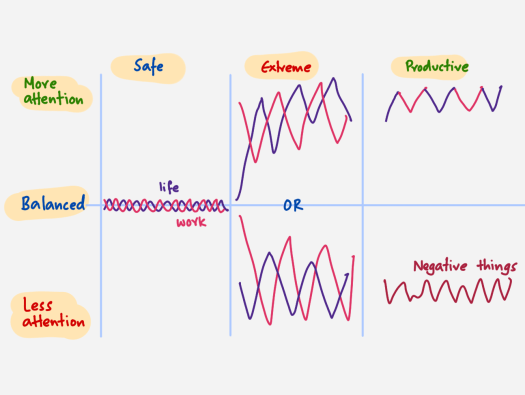
Keller has a few models in his book that I’ve adapted in the image above to explore this concept.

First, you could play things very safe and keep things close to the centre line – close to the notion of being balanced.

That means doing things like working your contracted hours and making sure you get there on time and leave on time so that you can spend time with your family.

It means being firm that you make no personal calls at work while at the same time ensuring you take no work home.

That may seem like a good approach but you’ll also end up living a life that is very much in the middle – one where you don’t get too far in work and not too far in life.

That may be just fine or you might end up, decades from now, wondering what might have happened if you had taken a few more risks or tried a bit harder.

Could you be a senior manager or a CEO or running your own startup rather than still working at the same role you were doing two decades ago?

Or you could take life or work to the extremes – you could pay so much attention to one that you completely neglect the other.

This is the life of the workaholic or the permanent party animal. You’ll get everything done and wake up one day to find your family gone or spend your time having so much fun that you find there’s no money in the bank.

Extremes can sometimes lead to fabulous things, but by their very nature they also tend to extreme failure.

This is the story of the people who overextended themselves when money was cheap and who then lost everything when it became expensive again.

This is the Wolf of wall street lifestyle.

Then there is a third way, what Keller calls counterbalancing.

It’s essentially multi-tasking, paying attention first to one thing that’s important and then moving to the other.

The thing is that if you want to achieve anything you have to give it time – you need to be single minded and focused.

Creating new things takes time – whether it’s a business, a new application or working on yourself or your relationships.

You can’t just hack you way to an enduring solution – it often takes time and attention to get things done.

So, if it’s important to you then it’s important enough for you to give it attention – and you need to choose which things you’re going to give your attention to, and then cycle between them.

That means, for example, working really hard at work and then taking a week off to spend with your family with no devices.

It means working a day solid at a hard problem and then taking a few naps the next day during work hours to recover.

The thing that isn’t in Keller’s model is the item in the bottom right, which is also paying less attention to the negative things in your life.

That includes thoughts that pull you down, people that are corrosive and making decisions when you’re low on energy.

If you want to spend time on the thing that are important you also need to decide to spend less time with the things that get you down.

As the quote that starts this post suggests, everything takes longer than you think, and then some.

If you want to get good at anything you need to be prepared to spend five years working at it – because that’s the only way you’ll build up the 10,000 hours of practice you need.

And that’s also why it’s hard to become good at a number of things – because there is only so much you can pay attention to without running out of time altogether.

Keller says that instead of aiming for balance what we should do is aim for counter-balance – the act of moving from one important thing to another.

It’s a dynamic state of balance rather than a static one.

And perhaps that’s the approach that’s more likely to help you build a life you look back on as a good one.

Cheers,

Karthik Suresh

How To Get Better At Doing One Thing Well

doing-one-thing-well.png

Monday, 10.03pm

Sheffield, U.K.

The only way to write complex software that won’t fall on its face is to hold its global complexity down — to build it out of simple parts connected by well-defined interfaces, so that most problems are local and you can have some hope of upgrading a part without breaking the whole. – Eric S. Raymond

I was watching a video of an Indian comedian from the southern city of Chennai.

Everyone in Chennai, he said, is an engineer.

That’s the default profession that your parents want you to go into.

You could choose to be a certain kind of engineer – say a mechanical engineer or a chemical engineer – but when you’re done only a software company will hire you.

Then they’ll train you in a host of languages, get you ready to program in any way the client wants – and then you’ll end up doing everything in Microsoft Excel.

This is the reality of work in business – days, months, years spent doing stuff in Excel.

Lives spent doing stuff in Excel.

The thing is that it’s clearly very hard to get anyone brought up in a Windows environment to think that anything else exists or could possibly be an alternative.

Which is ok – the point is not to ask anyone to do anything they don’t want to do.

It’s to see whether there is something better out there and what that might look like if it were used more widely.

For example, in the unix world one of the core principles is to “write programs that do one thing and do it well.”

The idea is that if you have a number of such programs then you can make unexpectedly cool things happen when you also make them work together – especially if they communicate using a universal interface, like text files.

Now, how would you use such a principle in real life work?

Let’s take marketing, for example.

The biggest mistake people make when it comes to crafting a message is trying to say too much.

Any message should have one clear idea.

You might build on the idea, support it with facts, burnish it with credentials and make it engaging through story.

Through all of that, however, your message has to shine through.

That’s the point of an elevator pitch for your business – being able to concisely summarise what you do well.

The people I see doing well are the ones that have nailed that message – where it’s really clear what they do.

Not all professions or companies are like that, however.

Some do more complicated things that it’s hard to summarise in a nice, easy pitch.

Although that sometimes means that they haven’t taken the trouble to break it down so it’s simple.

It’s hard to tell whether something that looks complicated is actually just so big that no one really knows how it works anymore, or even whether it works at all.

When you think of the concept of doing one thing well there are echoes of the same concept in many different places.

Take the idea of lean service archetypes where what you want to do is work on single piece flow.

That means that one person tries to complete an entire task in one go.

If they can’t do that then they pass “clean” output to the next person to work with.

That’s almost exactly similar to a program that does one thing well and then passes output in the form of text that the next program can use as input.

Almost anything you do can be thought of in these terms, individual, self contained activities that can be connected through a common thread – just as you see in the picture.

The main result of this way of thinking is the possibility of emergence.

When you make something that is big and complicated it ends up doing what you want – hopefully – and is the sum of its parts.

When you make a number of things that are small and self contained and you connect them together, surprising things often happen – something emerges that is more than the sum of its parts.

It seems counterintuitive that doing one thing well may, in the long run, end up helping you do a surprising number of things better than you hoped to do.

And that might feel a little more fulfilling than spending a life trapped inside Excel.

Cheers,

Karthik Suresh

Is Storytelling Really A Programming Language For Our Minds?

story-asimov.png

Sunday, 8.24pm

Sheffield, U.K.

Myth is much more important and true than history. History is just journalism and you know how reliable that is. – Joseph Campbell

It’s can be a little dispiriting reading Isaac Asimov’s autobiography It’s been a good life.

This is someone who remembered everything he read or heard, through whom plot and story just flowed with ease and who never had writer’s block.

But he still had to serve his time – eleven years where he didn’t make enough to live off and years of rejections before he became known enough that he could just write and sell.

Asimov was a scientist, a proper one, who could also write science fiction. His fiction had real science in it and the stuff he made up also sounded like science.

He also liked history and his Foundation series is really the story of the decline and fall of the Roman Empire except set in a future galactic period.

As I write these posts I am conscious that there has been a change in the way I think about thinking.

In the very beginning I thought that what might interest people was technical information.

You might be very interested, I presumed, in the rate of glacier melting, the economics of battery storage or the intricacies of obesity-fuel ratios.

I quickly found that even I was having trouble staying interested.

I then moved to a much longer period investigating models – primarily ones around management.

There are so many heuristics, rules of thumb and conceptual models that people have come up with over time and some of them seem obvious and some of them make us stop and think a little.

After a while, however, they all run into the same problem – which is that although they give you a way to describe a situation they don’t really tell you what to do.

We are told that the goal is to be able to think critically, to look at everything and construct an explanation that works in a particular situation which is easy to say and very hard to do.

So, models are worth understanding but so what?

As the saying goes, they’re all wrong, but some are useful.

Now I feel like I’m entering a new phase, one where story and narrative are getting more important.

The reason for this is that I am coming to a belated understanding of the importance of story to our belief systems.

In a nutshell, the story you tell me about what you think is the best way I will get a understanding of what is your reality.

There is a bit (lot) more at this Sunday essay – but it seems to me that stories can be seen as programs we run in our minds.

If we want to understand others we have to understand their stories – not in context or in relation but as stories, unique and complete in themselves.

It’s like the quote I go back to from time to time that “Reality is a shared narrative we choose to believe.”

For many of us stories are reality.

And the way to change our reality is to write new stories.

I wonder if that is a line of thinking worth exploring.

Thoughts?

Cheers,

Karthik Suresh

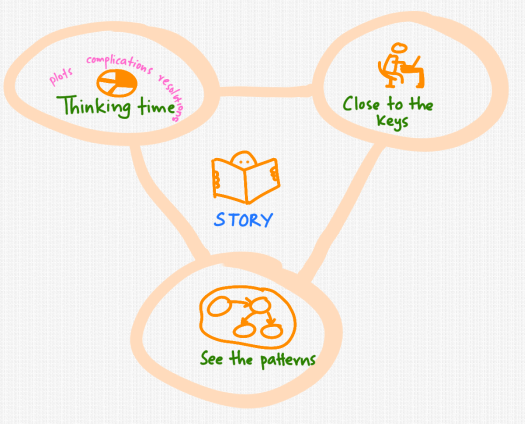
p.s. About the picture: Asimov said that to write you needed thinking time, time in front of your keyboard and the ability to see patterns of story.

How To Get Your Head Around A Pull System Of Working

pull.png

Tuesday, 7.57pm

Sheffield, U.K.

Kanban is like the milkman. Mom didn’t give the milkman a schedule. Mom didn’t use MRP. She simply put the empties on the front steps and the milkman replenished them. That is the essence of a pull system – Ernie Smith, Lean Event Facilitator in the Lean Enterprise Forum at the University of Tennessee

When you have a conversation with someone the ideas can flow quite easily – you can think of any number of ways to do something or to collaborate.

How should you think about what to do – how can you work out what’s worth doing?

The idea of push systems versus pull systems seems a useful one to understand for these situations.

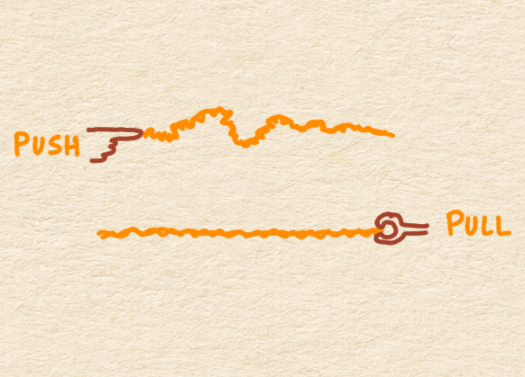
The easiest visual analogy is to think of moving a rope.

If you push it along, it bunches up and twists and generally remains stubbornly in place.

If you pull it, however, it will follow you to the ends of the earth.

So, that’s easy to say but how does it actually help you?

Well, one practical place to start is with todo lists.

A while back I wrote about my way of doing todo lists.

I write notes in plain text files and when there is an action that I want to remember I write it on a new line starting with [].

That makes it easy to search for all lines that denote actions and come up with a list of everything I need to do.

The actions list emerges from the notes I take over time.

My argument in that post was that lists get stale over time – especially if you keep them separate and have to manually update them.

The fact is that lists kept in the way I describe also get stale over time.

What I did was write a command to pull out all the actions and that list simply gets bigger and bigger until eventually I stop paying attention.

The point is that I’m still pushing actions onto my list.

And that’s ok – you need to capture the things that need to be done.

The obvious next fix is to figure out how to pull my attention to the tasks that need doing.

So, typically the default is to list everything and then tag things by priority.

Sort of like saying list to get everything and list A to get the ones tagged at priority A.

What if I turned that around so that list only shows me tagged items.

Get rid of all the priority codes and allow only a specific number of items that can be marked as priority at any one time.

Say 3.

That means when I list my actions the three that I’ve marked as ones to do turn up.

Those pull my attention and I spend my time either doing them or deciding that they can be deprioritised and taken off the list.

In a nutshell, what you’re doing every day is figuring out what should pull your attention.

And the thing that should pull your attention is the thing that most needs doing.

Sometimes that is urgent and sometimes that’s important – but that’s the decision you need to make from the mass of stuff that’s in your entire list.

When you stop thinking in terms of where you spend your time and start thinking in terms of what activities should pull your attention then you can start to choose between options.

Should you start work on a proposal or presentation before you first meet with a client?

Or should you always have a conversation to understand what they are thinking before you put forward your ideas?

Things like that are really hard to do especially if you have a boss who believes in being prepared or have a hard charging sales process where you need to talk someone into buying.

I suppose it comes down to having a very simple rules.

Do work for only one of two reasons.

First, do work if it’s something a customer wants you to do and is willing to pay you to do.

Or, second, do it if you want to do it.

Anything else is probably wasted effort.

Cheers,

Karthik Suresh

How To Understand Just-In-Time vs Just-In-Case In A Service Business

service-value.png

Sunday, 8.50pm

Sheffield, U.K.

how do you identify wasteful transaction costs or coordination activities? I believe that you ask yourself, “If this activity is truly value-adding, would we do more of it? When?” – David J. Anderson, Kanban

I was reading The Toyota Leaders: An executive guide by Masaaki Sato which talked about how the management there were introducing just-in-time (JIT) in the early fifties.

The idea of JIT makes perfect sense – don’t do anything until it’s needed by someone else for something they have to do.

It’s also fundamentally at odds with our human nature and how we think about things.

Imagine you wanted a coffee but had forgotten your wallet and suddenly say that there were two five pound notes in front of you – with no owner in sight.

Would you take one to pay for your coffee and leave the other one for someone else?

It’s ridiculously hard to stop ourselves hoarding things – from keeping things when we don’t need them to buying more than we need just in case.

The place where you see this most is in the weekly supermarket shop where the clever people who design the experience seem to have worked out how to make sure we always come out having bought 40% more than we had on the list.

So it’s ironic that the insights of JIT came to Toyota at the same time supermarkets came to Japan.

They saw that each customer at home had a small fridge and would make a trip to the supermarket to buy only what they needed.

And the reason the customer would only buy what they needed was because they could trust the supermarket to never run out of stock – so the customer didn’t have to hold any just in case.

In fact the ideal situation for a supermarket would be that whenever a customer took an item off a shelf a little factory right behind the item would make a new one.

So the main point about just in time was that if you could trust you could get what you needed when you needed it then you wouldn’t need to worry about keeping a stockpile just in case.

Now, the way in which you’d implement this is by having the people doing each activity ask for what they needed when they needed it.

This request was like an order form – and that’s where the term kanban comes from – from these order forms and Toyota saw that they could link activities together using these order forms and create a just in time system that pulled what was needed to where it was needed.

Now, as most of us don’t work in manufacturing what would that look like in a service environment?

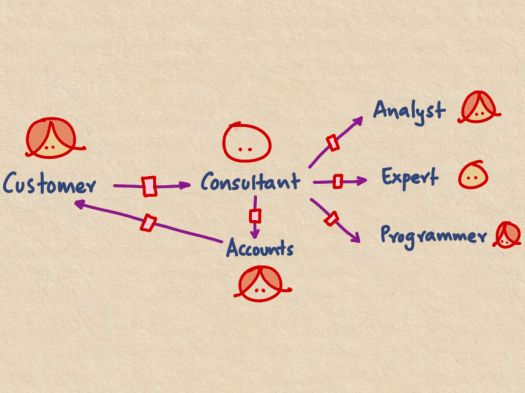
In the model above everything starts with the customer.

The consultant’s job is to work with the customer, understand their situation until the customer is ready to sign a proposal asking the consultant to do something – that’s the first equivalent of a kanban or order form.

The consultant might need resources for the project – let’s say it’s going to involve an analyst, a subject matter expert and a programmer.

So now the consultant needs to engage with his or her colleagues to get them to work on the project.

Now, this is where it gets a little interesting.

Let’s say you’re the consultant and want the cheapest possible service then what you might do is go onto upwork or fiverr and try and get someone cheap.

The chances are, however, that you won’t get the kind of work you need because it’s a transactional relationship and the one thing that we know about customers is that they change their minds – which cheap outsourcers find has an impact on their costs.

What you probably need is to work with colleagues that you know, like and trust – people with whom you have a long-term relationship.

And that means committing to them, having one preferred supplier for that element of the service.

And, in return for always giving them the business, when you send them a signal asking for help they’ll respond.

But that doesn’t mean you can shortcut the time it takes to get them briefed and ready to start working.

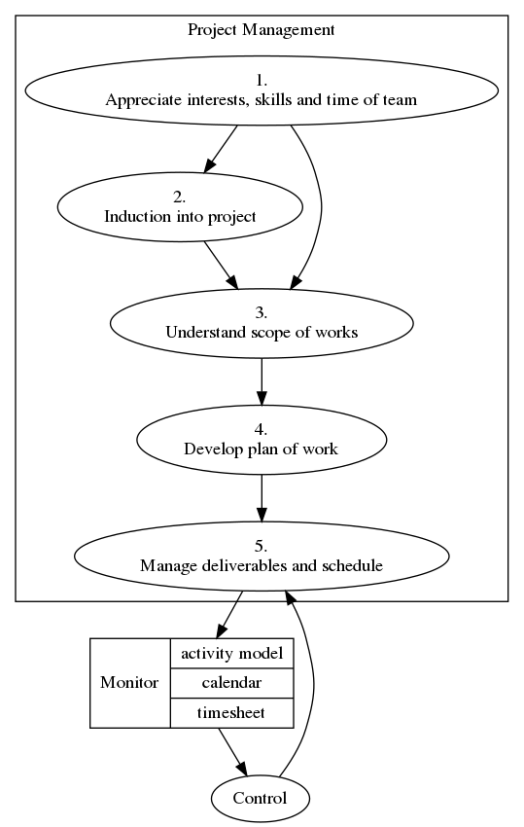
For example, I sometimes use something like this to manage that process and, unsurprisingly, it does take a couple of hours to get everything going.

project-management-lean.png

The thing is that you can’t simply fire off a request and forget about it – it takes time to understand what’s going on from the point of view of the client and the consultant’s job is to make sure the client gets what they need.

And, of course, we can’t forget the job of billing.

That’s another request through to accounts to send an invoice and get paid.

If you put this kind of model in place you’ll find that you have meetings only when you need to have them.

The point is to manage the client’s expectations, to explain to them how this process works.

If they take six months to agree a proposal and want a deliverable the next day you should probably suggest they talk to someone else.

Because no one can, and you shouldn’t, maintain the capacity in your business just in case a client walks through the door.

It makes much more sense to arrange things so that you can draw on the capacity when you need it.

As the quote that starts this post says – when you look at your day what would you do more of and what would you not do at all?

Perhaps you’ll find you’re most satisfied when you can take an hour off just for a nap or just because you feel like it – because you know that what you’re spending your time doing is what matters when you’ve awake.

If nothing else, you’ll spend a lot less time in pointless meetings.

And a lot more time getting your client results and keeping them happy.

Cheers,

Karthik Suresh

p.s. Another Sunday article on the same theme is How To Think About And Improve Service Design which may also be of interest if you’ve made it this far.

How To See What Is Really Going On In Your Business

vanguard-check-model.png

Wednesday, 10:00pm

Sheffield, U.K.

All we are doing is looking at the time line, from the moment the customer gives us an order to the point when we collect the cash. And we are reducing the time line by reducing the non-value adding wastes. – Taiichi Ohno

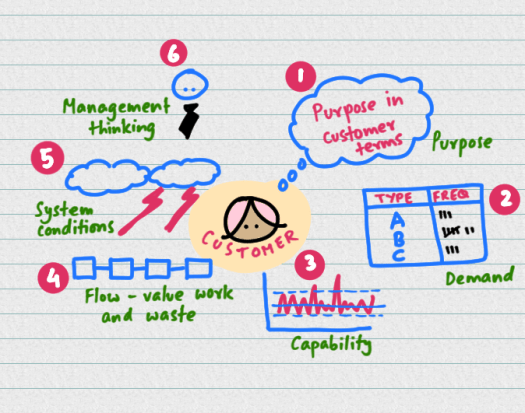
I was lucky enough to attend a masterclass by the Vanguard team recently, led by Professor John Seddon about going beyond traditional command and control management and the insights in there are still sinking in.

So much of what we do can only be described as waste – time spent filling out forms, commuting, collecting figures for reports, filling in surveys or sending emails.

At the heart of the Vanguard method is learning how to see what is going on around you.

That’s something worth understanding how to do and it might make sense to work through an example.

I’m still learning this – so this might not be right, but it’s a start anyway.

1. Start with understanding purpose in customer terms

Do you really understand what your customer wants?

For example, if you’re meeting with a prospect what is it that he or she is looking for?

Are they looking for your product?

Or are they looking for a product that meets their needs?

It’s probably the latter so before you say anything about your product you should probably take the time to really understand what they need.

That might seem obvious but I have yet to see a salesperson who knows how to do that properly.

It’s an easier thing to appreciate if you look at it in the context of a break-fix archetype – a situation where something you have is broken and you need it fixing.

Essentially, you want it fixed, you want it fixed right and you want it fixed as soon as convenient.

Not it’s not as soon as possible – it’s when it’s convenient for you and that might be right now if it’s the middle of winter and your heating has broken down or in a week’s time when they’re back home from a holiday.

The reason why it’s important to get clear on purpose is so you know what isn’t contributing to what the customer sees as their purpose.

For example, none of the calls you make or reports you write or review meetings you have with your manager have anything to do with fixing the customer’s problem – from their point of view.

They just want things fixed right.

2. Understand the type and frequency of demand

The next thing you do in the Vanguard method is to study what’s happening in terms of demand.

That means starting at where the calls are coming in – a service centre for a break-fix system or anywhere else where customers call in and ask you to do something.

When they call in they usually want to talk about one of two things.

Either they want something – a product or a service – the kind of thing that makes them happy and that’s called value demand.

They want to buy something.

Or they’re calling to complain about something – because the fix hasn’t been done, the goods aren’t right or someone hasn’t turned up.

That’s a call about something going wrong and it’s called failure demand.

So, how many types of demand do you get and how many of each type come through?

3. Study the capability of your system

Now it’s time to start measuring how you respond to the demands on your system.

There’s all that demand coming in so how long does it take you to satisfy that demand?

For example, if a customer calls in wanting you to fix a problem how many days does it take from when they called to when the problem is fixed for good?

Or, how long does it take from when they place an order to get it to them?

The faster you get either of those things done the better the capability of your system.

Just think about how Amazon and Ebay have changed the buying process.

Amazon suggest that when someone buys off you that, even though you could take a couple of days to post something, you should get it in the mail as soon as possible.

For one thing, once the order is dispatched they can’t change the order.

But, more importantly you have a customer who expected to get something in three to five days getting it the next day and being delighted.

4. Map the flows and identify value work and waste

Now, if the customer isn’t delighted that’s because something is going wrong – you’re doing work that’s a waste.

Worse still you’re paying someone to first do work that the customer wants – value work and then if it’s not done right paying someone else to fix it – wasted work.

The thing to note is that in the Vanguard method you start mapping flows of work only after you’ve done the analysis of the types and frequency of demand and measured how your system responds at the moment.

After all, you need to know if you get better or not when you start to try and improve the system.

5. Start examining the system conditions

Most of the problems your customers are facing have to do with the system – not your people.

The system is almost always the problem.

The controls and structures and processes you have put in place are probably what get in the way of your employees making your customers happy.

What they’re doing is working to serve the system rather than the customer – working to meet targets, fill quotas, get bonuses and all the other things that either demotivate them or suck the intrinsic value of doing a good job out of what they’re doing.

The fact is you need to get rid of almost all that stuff that you use to control and monitor what’s going on.

In manufacturing at least you use that information to monitor the work.

In a service business all you’re doing is spying on your staff.

Instead – just help them do a good job and watch what happens to your failure demand figures and how quickly your team meets customer purpose.

6. Change management thinking

This is the hardest bit and you won’t get to it by telling the managers to change.

I learned about intervention theory at the masterclass.

This is the idea that there are two types of interventions.

Rational interventions are where you tell people why they’re being stupid.

And when you do that you shouldn’t be surprised that they get angry and offended and stop listening

The other type of intervention is a normative intervention where you help them to see what’s wrong for themselves and realise that they need to change the way things are.

That takes longer but it is a change that sticks – because they’ve decided it for themselves.

Hard to summarise, hard to do

The thing with this kind of systems intervention is that it’s a non-trivial task.

We’re so conditioned by a particular kind of goal oriented, target driven culture of organisations that it’s hard to imagine any other way.

Each step in the process is something that needs to be learned and practised and reflected upon.

And many organisations just don’t have the appetite or willpower to do that.

But if you can you could create an advantage – a competitive advantage that actually does endure.

Because if you have a business that meets the needs of your customers and your competitor has a business that meets the needs of the business – which one do you think is going to prosper?

Which one would you rather work in?

Cheers,

Karthik Suresh