Can you pick a winner?

picking-winners.png

Is it possible now, given all the information we have, to predict which sectors and organisations are going to succeed?

Take crypto-currencies, for example. What’s going to happen with them?

There is a proliferation of Initial Coin Offerings (ICOs) taking place – moving from pure currencies to valuing virtually anything, from content on platforms like Steemit to studies on tracking tuna fish.

The big choice many of us face is how to engage with a world of applications that start to bring some of these technologies together.

Software, for example, is increasingly sold only as a service, accessed through a web-browser or API with a sprinkling of blockchain to prepare for the future.

This creates a problem for buyers of such technology – especially ones that are expected to be transformational.

The first is that we don’t know which one will be the next google or facebook.

When it comes to a product designed for everyone – the more people that use it, the more we feel like we need to use it to connect with the others on there.

It’s not like we choose between competing platforms.

Once one platform is ahead, it dominates the space in a winner-takes-all way because there is no physical capacity in terms of the number of users it can serve in the way an airline only has a certain number of seats at any one time.

Warren Buffett, writing in 1999, described two industries that were expected to be transformational as well.

Cars and planes have changed people’s lives. Yet, during the course of the last century, there have been over 2,000 car makers and 300 airlines.

We are now down to a few global car makers – with Tesla being the first major disrupter of the status quo in a long time.

Airlines, at the start of this century, may have made a grand total of zero money between them.

Clearly – technology benefits us. It makes us more productive and transforms the way in which we do things.

The challenge is working out which technologies are going to do that – it’s based on survival of the fittest and the luckiest.

The lesson we should take, according to Buffett is this:

The key to investing is not assessing how much an industry is going to affect society, or how much it will grow, but rather determining the competitive advantage of any given company and, above all, the durability of that advantage. The products or services that have wide, sustainable moats around them are the ones that deliver rewards to investors.

Why are some people inspirational?

why-how-what-sinek.png

Why do some people and companies inspire loyalty and dedication from employees and customers? What’s different about them?

Simon Sinek argues in a TED talk that has been watched over 35 million times that it’s because such companies have a pattern of thinking that is inside out.

Many of us can easily say what we do.

That’s our profession, our job, our position in a family – we might be doctors, consultants, accountants, husbands, wives, parents and so on.

In particular, when it comes to work – we can point to the roles we have as what we do.

We also usually know how we do things.

We may have some extent of control and autonomy over the work we do and so design how we work, or we operate in a way set out by someone else.

In either case, we still know how to do something.

Where many of us struggle is in explaining why we do something.

Why are we in this particular profession? Why are we in a particular relationship?

Are we there because it’s something we truly believe in or is it just something we have ended up doing?

Many people make the mistake of thinking that companies exist to make a profit.

That’s wrong – companies make a profit by creating value for customers – profits are a result of good work and not the motivation for good work.

Sinek argues that if we know why we do something – if we have a sense of purpose and belief and mission – then others are more likely to buy into that than there are to buy into any particular product that we try to sell.

Take Apple, for example. Apple was infused by a zen-like focus by Steve Jobs on creating products that could change the world.

Jobs said nearly 40 years ago that “We’re gambling on our vision, and we would rather do that than make “me too” products. Let some other companies do that. For us, it’s always the next dream.”

That vision turned Apple into one of the most uniquely successful companies in history.

Again, from Jobs “you can’t connect the dots looking forward; you can only connect them looking backwards. So you have to trust that the dots will somehow connect in your future. You have to trust in something — your gut, destiny, life, karma, whatever. Because believing that the dots will connect down the road will give you the confidence to follow your heart even when it leads you off the well-worn path and that will make all the difference.

Interestingly – the why is not something that we can logically justify – it’s something that we need to believe in.

It is a matter of faith and and trust – a feeling of having a higher purpose – and perhaps it’s not surprising that people that radiate a sense of purpose and mission inspire us more.

Why what we believe matters more than we know

mindset.png

How do we make decisions that may influence our lives for many years in the future?

A surprisingly simple answer may be that it depends on our mindset.

According to Carol Dweck, a Professor of Psychology at Stanford University who researches motivation, what we believe about what we are capable of doing has a huge impact on the eventual outcome – and success or failure.

This starts early. Four year old children given a choice between an easy puzzle and a hard one split into two groups based on what they believed.

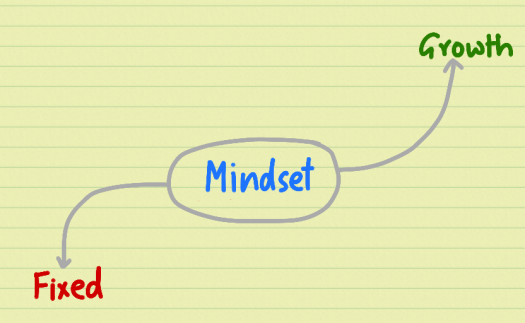
The children with what Dweck calls a fixed mindset stuck with the easier puzzle, telling the researchers that smart kids didn’t make mistakes.

The children with a growth mindset took the harder one, finding the easy one boring and apparently more comfortable with the idea that they might not succeed.

The point, Dweck explains in her book Mindset, is that children taught to view intelligence and creativity as innate, fixed characteristics are more likely to view setbacks as permanent.

On the other hand, children that are taught that failing at something simply means that they have not yet succeeded can go on to practice, get better and try again.

Dweck’s is one of an increasing number of scholars that work in the field of positive psychology – studying how to live better rather than the more traditional approach of studying what is wrong.

The work they do, as a result, is based on modern research techniques rather than simple motivational thinking.

A sceptic, after all, would simply argue that it’s obvious that people who think positively do better. Where is the insight in that?

It turns out, however, when you carry out brain imaging scans of people with different mindsets the brain activity of growth oriented people showed more activity in processing meaning and relationships – literally having more neuronal connections firing trying to get to an answer.

The other thing that came out from the imaging studies was that growth oriented people were focused on finding the answer while people with a fixed mindset had more brain activity in regions that dealt with their emotional responses – how they would feel about getting the answer right or wrong.

In summary, a fixed mindset believes that capabilities are innate and fixed – people are born smart, for example.

A growth mindset believes that capabilities can be improved over time – persistence and hard work can make a difference.

This matters, especially when it comes to changing outcomes for children born into deprived areas where there may be a prevailing belief that they are simply less smart than others and will never amount to anything.

Most people will be on a continuum between the two mindsets.

Knowing which one we tend towards, however, may be the first step towards explaining some of the decisions and choices we have made so far in our lives.

Recognising that we can develop a preferred mindset may open up new opportunities – things that we can yet do.

Should families have regular meetings?

family-meeting.png

How can we raise a happy family?

Modern families are often overwhelmed by the amount things we have to do – it often feels like are out of control.

And, according to Brice Feiler, the author of The Secrets of Happy Families, our children sense that is the case.

The way to make things better, it turns out, may be to bring some practices from work into our homes.

Many organisations, whether they realise it or not, are having to become more agile – a way of working that involves small teams working for short periods of time on small elements of projects, with a focus on making real, tangible progress.

These teams use tools like checklists, daily updates, weekly reviews and feedback.

An agile approach shifts power from executives directing work to teams that work towards a goal and increasingly manage themselves.

In this TED talk, Feiler says that when some families tried to use this approach in their homes, their children loved it, it helped reduce stress, increase communication and made them happier.

Everybody likes checklists. Children really like them.

If they have checklists of things to do in the morning, they quickly get into the habit of doing things on the list and checking them off.

But to make a real difference, we need to sit down and talk together.

During weekly family meetings, which don’t need to last more than 20 minutes, we should asks things like what worked well this week, what didn’t work well and what shall we agree to work on next week.

The agile manifesto sets out the principles that underpin agile work – highlighting the importance of face-to-face communication, adaptabilty, self-organising teams and regular reflection as a group.

As parents it’s instinctive to want to tell our kids what to do.

That is not going to prepare them for a job market where they will be valued more for their creative ability than their willingness to follow orders.

Instead, Feiler says, we should try and empower our kids – helping them practice how to make decisions, come up with consequences for their actions.

If we help kids set their own goals, make plans to achieve them and teach them how to reflect on how things are going and how they should adjust their own actions – we may raise children better prepared for the changing world of work.

And, more importantly, we may be able to build a happy family that feels like it’s a close knit team.

The case for quitting

why-dont-we-quit.png

Choosing what to quit and when to quit it is more important than we sometimes realize.

So, why don’t we quit more often?

Why do we persist with a job, a relationship, growing a moustache and a myriad other activities that we should really just drop and walk away from?

According to Steven Levitt and Stephen Dubner in Think Like a Freak, there are three main reasons why we don’t quit.

First, we’re afraid to be seen as a failure.

Phrases like “Winners never quit and quitters never win” have been seared into our brains from a young age.

The second reason is the idea of sunk costs.

If we have already invested time into a career, energy into a relationship and money into projects and investments, then quitting means effectively writing off all that investment.

Having sunk all that we have into something, we’re afraid of stopping just before the big payoff.

What if we carried on for just a bit longer?

The third reason is our tendency to focus on costs now instead of opportunity costs.

If we do something now with our time, that also means that we have to give up the idea of doing something else with our time, even if that something else might be more valuable.

We have limited, scarce resources of time, money and energy.

For every unit that we spend in one place, something else needs to be abandoned.

It’s easier, however, to focus on what we need to do now than to think about what we are giving away.

For example, we’d rather buy something nice now than put the money into a pension to use in 50 years.

These three reasons are rooted in our past, present and future: what have we invested already, what do we choose to do right now and what will we look like to others in the future.

The point, Levitt and Dubner write, is that we don’t really know. We can’t run experiments that simultaneously test quitting and persisting.

Or can we?

The authors set up a site, now defunct, called Freakonomics Experiments, and asked people to put in their questions and take a decision based on a coin toss.

That mean’t half the participants would quit and half would persist.

The results were eye opening. On almost every question, the people who quit were happier 6 months later than those who didn’t.

As they write in their blog on the topic “We just came up with a basic truth, which is: when you’re not sure what to do, you should quit. This is what the data tells us: if you can’t decide, it means you should have quit already and you should quit right away.”

Perhaps the last word on this should go to W.C. Fields, who said If at first you don’t succeed, try, try again. Then quit. There’s no point in being a damn fool about it.

How ideas spread and go viral

how-ideas-spread.png

What makes a video, business concept, blog post or social media update go viral?

How much does it have to do with how good the work is, how inspiring the message may be or how insightful the comment turns out?

Less than we might think, it turns out.

The network effect has been around before the internet, and offers perhaps the best explanation of how ideas spread.

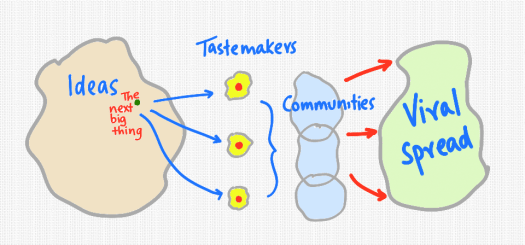
Kevin Alcoa explains in this TED talk that on YouTube the thing that may lead to an idea going viral is to be picked up by a tastemaker.

Tastemakers are people with large communities of their own – they are well networked and when they share something it can go out to a large audience.

Tastemakers sit at the centre of their network. What they see and share is what their community is exposed to.

This means that instead of finding the next big thing, tastemakers are in the business of creating the next big thing – whether they know it or not.

Their act of observing the world of ideas results in them selecting ideas that may then go on to be successful.

This happens when the community of people sharing the idea starts to intermingle and becomes a large enough group.

At that point, the idea is on the cusp of going viral, and after that it can spread through the rest of the population like a self-sustaining infectious disease.

Tastemakers have another advantage. When you have a large enough network, the ideas come to you – and so your task is to select what you think is going to appeal to your network.

Marketers know this, and so are increasingly investing in sponsoring people with large networks to get their ideas out – a more effective method than mass advertising for many products and services.

This is not new – it’s been applied in regular business in niche areas as well.

Warren Buffett simply places a small note in his shareholder letters asking people who want to sell business to get in touch and listing out his criteria – and this method has helped him build a collection of companies with market beating returns because so many people read it every year.

The difference now, with the Internet, is that rather than being a niche approach, this way of spreading ideas is going mainstream.

The implication, however, is that the thing that makes an idea successful is not how good it is, but whether it gets picked up by the people at the centre of a network of their own.

The difference between Eastern and Western strategic thinking

strategic-thinking.png

As companies and as individuals we should be spending time thinking about strategy and the business environment around us but inevitably end up focusing on the here and now – the urgent rather than the important.

That means we tend to be inward looking – spending time thinking about management and control when we should be also looking outward, developing a strategy to follow.

So, what do we need to do in order to develop our strategic thinking skills?

In Developing Strategic Thought: Rediscovering the art of direction-giving, Bob Garratt writes that the Western approach to strategy formulation thought of it as a process of corporate planning.

What this means is that we should follow a series of analytical steps.

First, we decide what our goals and objective are.

Then we look at the internal and external factors around us – doing a SWOT analysis of strengths, weaknesses, opportunities and threats and a PESTLE review – political, economic, social, technological, legal and environmental conditions.

We take all that information and identify the strategic options open to us, analyze them and select the ones we intend to follow.

These selections are then used to decide what resources are allocated, how budgets are developed and the management controls that need to be in place. Once the strategy is set, it is followed.

This is all very linear and logical. And Bob argues that it misses the point.

All of this is very me me me.

Competitors are only seen as threats. Customers are simply revenue sources. Strategic alliances are not considered.

That said, the approach worked for a long time, but in a globalized business environment different models are now in play.

Much of Japan’s success in developing new markets rests with the approach its companies took to developing strategy.

It was a much less tidy approach.

Kenichi Ohmae, writing in The Mind of the Strategist: The art of Japanese business, describes an approach where views and opinions about competitors, customers and allies – their approach and likely strategies is blended with the company’s thoughts – and goals and plans emerge as a result.

It’s less like following a path and more like playing chess, except there are more than two players.

The choices we make depend on the moves other people make and our expectations of how they will move and how they will respond to the moves that we make.

The Eastern approach, therefore, is non-linear and continnual, and strategy emerges rather than being planned.

Both approaches have their place.

Understanding which approach we naturally tend towards, however, may help us when considering what do do in a broader context.

And, a wise strategist will probably combine both approaches to inform one’s own strategy.

How to develop a new product or service offering

product-offer-cycle.png

Mark Brinda, David Mortlock and James Dixon of Bain and Company write in this article about how forward looking tech firms are moving to a customer-centric approach to delivering new products and services called Offering Management (OM).

The line between products and services is blurring. Is it a product? Is it a service? Or is it both?

Perhaps it’s simpler to call everything an offering.

The basic principles of creating a new offer, however, are simple.

We design an offer, work out how to deliver it to customers and then get feedback and respond, improving the design of the product.

Traditionally, organisations worked out what they could do well, packaged that up into a product or service, and marketed that to customers.

This requires a combination of systems, processes and training – a number of individual pieces that need to be brought together.

All too often, however, we end up with a collection of pieces that don’t actually deliver an experience that the customer values.

The problem with this approach is that it starts with thinking about what we do first and of customers only later on in the process.

Offering Management tries to change that.

It keeps the same Design-Deliver-Respond development cycle, but asks product managers to engage with users much earlier in the process.

Rather than first making something and then asking whether a user likes it, this process suggests that we talk to users, find out their needs and then design the offer around meeting those needs.

It seems obvious, really, but many organisations just don’t do this.

They stick with the mousetrap fallacy – build a better mousetrap and the world will beat a path to their door.

The Bain study shows that organisations that manage their offerings well outperform their peers on a range of measures.

Organisations like IBM are establishing new roles and practices to create Offering Managers – individuals with responsibility to drive not just design but the entire customer experience cycle, from managing how the offer is going to be delivered and collecting and pushing for revised designs based on feedback.

The acid test for a new offer, according to the authors of the study, is whether we are gaining market share.

If we have successfully designed an offering around customer needs, we’ll see it in the numbers signing up for it.

What really motivates us?

components-of-motivation.png

It’s not money for starters.

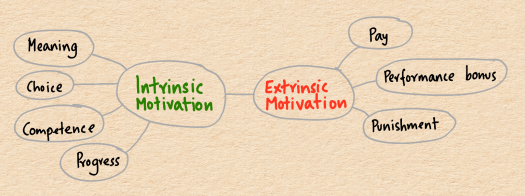
Many organisations still have compensation systems built entirely around the concept of extrinsic rewards.

This is the idea that if you give a rat a reward for performing an action, like cheese if it runs through a maze, then it will be motivated to keep doing that for the reward.

Extrinsic rewards in the workplace are things like pay, bonuses based on performance and punishment, like the threat of being fired for being late to work.

The theory that most of us believe is that if you pay people more you get a more motivated workforce that performs better.

Even better, if you make rewards conditional – i.e, if they meet targets they get a certain reward – that will focus their minds and they’ll perform even better.

Except, it appears that it doesn’t.

A number of studies show that the link between pay and performance is weak, and this is the case around much of the world.

Once you get beyond a reasonable standard of pay, each increase has a temporary and diminishing impact on motivation.

It turns out that for a few weeks after we get a pay rise, we work harder and then the rush fades and we slip back to previous levels of performance.

The next time around, it takes an even bigger pay rise to get the same uptick in motivation.

What’s worse is that if we’re paid to do something we like, we tend to stop doing it unless we’re paid – so being paid for doing what we love could end up stopping us doing it at all unless we’re paid.

That makes sense – we’re paid because if we weren’t we’d be off doing something that we wanted to do, so perhaps we should only take jobs at things we wouldn’t do given the choice.

The worst kind of extrinsic reward, it turns out, is a conditional if-then reward.

Dan Pink, in his book Drive: the surprising truth about what motivates us, writes about experiments showing that when people were paid for completing tasks based on meeting certain performance scores, their overall performance actually dropped.

So, what does motivate us?

That’s where intrinsic motivation comes in.

Kenneth Thomas, in his book Intrinsic Motivation at Work, writes about four characteristics of work that increases intrinsic motivation.

We like working on things that have meaning and purpose. It feels good to know that what we’re doing is adding value rather than being parasitic.

We like being able to choose how we go about things – to use our judgement, select what should be done and in which order. That makes us feel like we own what we do.

We like being able to do things competently and know that we are performing well. This is more about having personal standards and knowing that what we do is good.

Finally, we like knowing that we are making progress – not running all the time to stay in the same place. It feels good to know that we are building something and moving in the right direction.

All this doesn’t say that money doesn’t matter. It does, but not as much as people think.

What’s perhaps more more important is fairness.

We really don’t like being paid less than someone else for the same work.

How to spot fake news quickly

components-of-fake-news.png

Fake news is not new. What is recent, however, is how quickly it can spread through the internet.

It’s impact is increasing, especially in politics, and may well have influenced BREXIT and the US Presidential election.

So, what can we do to spot such news – quickly?

Most of us scan news fast, and the writers who create such news know how to get our attention and draw us in.

The most important component is the headline.

Many news creators don’t write their own material. Instead, they find the story and create a sensationalised headline.

A sensational headline may:

  • Appeal to our emotions
  • Take a controversial stance
  • Introduce misleading information

The headline pulls us into the story, so we need to be especially wary of it.

The next part to look at is where the story is from – does it have authority?

We need to look at the website and the writer.

We can trust some sources, especially the major news outlets, to do good journalism. They should check their sources and facts before putting something out there for us to read.

There is an industry, however, of organisations that create material and then use social media to get it in front of people, and they can be hard to distinguish from reputable ones.

We don’t need to do it all ourselves though.

The chances are that someone else has already flagged the story as untrue or fake and posted a comment on the post or the site.

Scanning through the comments will give us an idea of whether the story is likely to be true or not.

If we have the time, before we believe something, we should try and look for another independent source that confirms the story.

This is different from stories that reference the same source. The internet is full of circular references where stories cite each other.

We just need to read more carefully before sharing these days.