What day is it?

every-day-is-day-one.png

Jeff Bezos of Amazon has a philosphy that he shares with the Securities and Exchange Commission (SEC), and his shareholders.

Every day is Day 1

In his 1997 letter to shareholders, Bezos wrote that this is Day 1 for the Internet, adding that Amazon’s hopes were to create an enduring franchise, extend its market leadership position and take decisions to create long-term shareholder value.

In 2016, the Day 1 message remains unchanged.

Day 2 is statis, he writes, followed by irrelevance, decline and death.

So, what does staying in Day 1 mean?

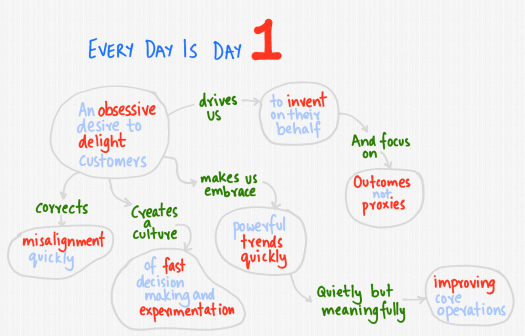
The picture is a model of Bezos’ 2016 letter which sets out a starter pack of essentials to stave off Day 2.

It starts with an obsessive desire to delight customers, which leads us to try and make things better for them.

This drives us to invent new capabilities and functions on their behalf to make things quicker and easier for them.

Companies that have this kind of focus rely on outcomes – do customers love this and does that show up in market share growth – rather than proxies such as focus groups that show a mild preference between options.

In Day 2 companies, the process is more important than the outcome – everyone is crouching below the parapet.

Powerful trends are sweeping along the corridors of industry.

From artificial intelligence (AI) to nanotechnology, the way in which we do things will be changed by new technology.

Amazon is embracing trends such as AI and machine intelligence to deploy algorithms that make its supply chain and customer experience systems more effective.

Much of this is invisible and quietly but meaningfully improves core operations.

Things just work – and customers are happy.

Many companies, even large, established ones, do not know which strategy will work out of a number of options.

Many companies default to the opinion of the highest paid person – which is okay in some cases, but most of the time we are better off taking decisions fast and experimenting.

Bezos’ uses the term disagree and commit – when we’re not sure give people permission to have a go rather than shutting down an approach just because we think it won’t work.

Finally, and this is something we must have all experienced, it’s easy for approaches to get misaligned.

If groups of people have fundamentally differing views, for example making a choice between doing a service in-house or outsourcing it, then no amount of arguing can resolve this.

It needs to be kicked upstairs, escalated to a team that can make the decision and make it stick, correcting misalignment quickly.

The Day 1 approach appears to have kept Amazon lean and focused despite now being a huge and dominant player.

It also worked for them when they were starting up and small – and perhaps it’s a model that many other firms can use as well.

Time to take a step back from Day 2 to Day 1, in that case.

Do you want to know everything before making a decision?

optimal-complexity.png

How much does having information help when making an important decision – when buying a house, choosing a partner or making a deal?

The hedgehog theory of behaviour helps us out. Archilocos, the ancient Greek poet, wrote a fox knows many things, but a hedgehog one important thing.

Edward L. Walker, in his book Psychological Complexity and Preference : a hedgehog theory of behavior said that one thing explained all behavioursubjective complexity determines preference.

Unpacking that statement – preference is the reaction we have – pleasure or pain. The zero point is where we feel neither pleasure nor pain, a neutral reaction.

So, what drives us in the direction of pleasure or pain?

If things are too simple, then they get boring and no fun. Imagine having to hole punch 5,000 sheets of paper and file them.

If things are too complex, it feels chaotic and turbulent and out of control. Imagine trying to rescue your daughter from the path of a tornado.

Daniel Levitin, in his book The Organized Mind, describes an experiment where participants had to play a strategy game where they received two,five, eight, ten, twelve, fifteen or twenty-five pieces of information in 30 minutes.

They performed best with around ten to twelve pieces of information – that was the optimal complexity level for the game.

In real life, the number ten is closer to the maximum we can operate at, and the level that is closer to the number of things we can effectively hold in our minds and process is five.

If we need to consider twenty factors when buying a house, the chances are that we’re going to find it very hard to make a good decision.

The same problem affects people in a world where online dating sites let people look at hundreds of possible partners.

When one has the whole world out there it makes it much harder to decide than when you met potential partners at the village dance.

All this, however, has to do with how much information is given to us.

Levitin points to research by Dan Ariely showing that we make better decisions when we can control what information we get.

So, for example, imagine we’re shopping for a new car,

If we get information on the things we care about – for example, whether it can hold four kids and two dogs, fits into the neighbourhood and comes in black – we’ll make a better decision than if the salesman harps on about engine capacity and trim options.

A very real problem – Levitin writes pointing to Kahneman and Tversky of Thinking Fast and Slow – is that we can’t ignore information once it’s in front of us. We’re burning brain fuel just looking at it.

In a nutshell, then, to make better decisions and feel good we should focus on the five or so pieces of information that are most important to us in a situation requiring an opinion or decision from us.

And then get on to the next thing.

What is a good foundation for career satisfaction?

humanity-pyramid.png

John Hagel, an author, Silcon Valley veteran and management consultant with some very well known names, writes about the learning pyramid in an article on his blog.

The idea in his post is that we spend too much time focusing on the skills needed to survive in a world where artificial intelligence (AI) takes on more and more jobs.

Instead, we need to think about how we can learn faster to learn what is needed at the moment – and the learning pyramid model helps with that.

Looking for a source for the learning pyramid model, however, tends to bring up a model of how different activities influence learning – and focuses on the narrow question of how to learn something new.

Looking at Hagel’s learning pyramid through a different lens might help us approach the AI vs human question asking what makes us human – perhaps it should be a humanity pyramid that we use to ask questions about whether the work we do is sufficiently human.

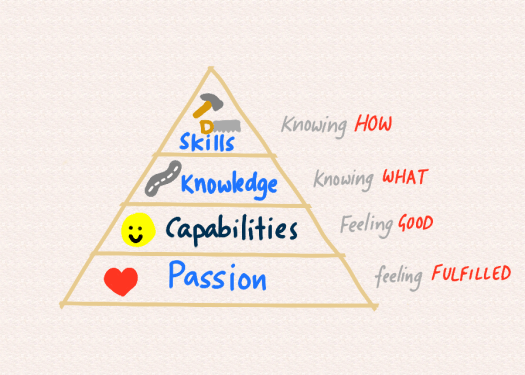
At the top of the pyramid sit Skills. A skill is knowing how to something – wield an axe, write a piece of news copy, manage an unhappy customer over the phone.

We need to hone our skills throughout our career and quite often we do this just by doing what we do. A craftsperson gets better the longer he or she works at a task.

Early in our careers, we need to focus on acquiring skills – reading, writing and arithmetic among others such as drawing, woodwork and martial arts.

But these are the areas where technology and AI will also look at first – text processing, robot news writers, Excel spreadsheets, computer controlled laser cutters and drones will do more of the reading, writing, arithmetic, machining and defence we need.

I’ve written here about the skills that are more likely to stay in demand but in essence they are the more human ones of empathy and social engagement and the practical ones of dexterity and manual manipulation.

Going down the humanity pyramid brings us to knowledge, knowing what to do.

That comes with experience and learning – as we do more, reflect on what we do, learn from the successes and failures of others – we develop models of what might work and when that we can use to make judgements.

Knowledge is a collection of mental models about different situations.

These two, knowledge and skills, will take us a long way in a career.

In the early days, to some extent, which skills we focus on matters less than whether they are going to clothe, feed and house us.

Eventually we’re going to want more about life and work, and that’s when we start questioning whether what we’re doing is aligned with our capabilities – the next level down on the pyramid.

Do we feel good about going to work? Are we working on something that engages us and gets us into flow?

If we are in a fairly secure position, but dislike what we do – then this is the point where we need to question and change things, perhaps get a side hustle or a hobby that gets us to use our natural capabilities more.

Finally, at the base of the pyramid, Hagel puts Passion.

That’s a difficult word – sometimes tortured in general usage – a little like authenticity. Can you really feel passionate about customer service? Some people say they do, and who are we to argue…

In the context of work and life, however, I take this more as feeling fulfilled – experiencing peace of mind, as in Zen and the Art of Motorcycle Maintenance by Robert Pirsig.

So, in summary, the learning pyramid or humanity pyramid, is a useful structure through which we can view the work and career choices we have made so far, and question whether we have our skills, knowledge, capabilities and passion aligned.

And if not, what can we do about it?

How to do A/B testing

AB-testing.png

What do we do when there are multiple opinions on the best approach to use to tackle a particular problem?

Quite often, we end up going with the HiPPO – the Highest Paid Person’s Opinion, as described in Richard Nisbett’s book Mindware.

But a better way is to use a data-driven approach to testing options and selecting the one that works best.

A/B testing is one of the simplest and oldest methods around.

It’s also called bucket testing or split-run testing, and has been around for a long time.

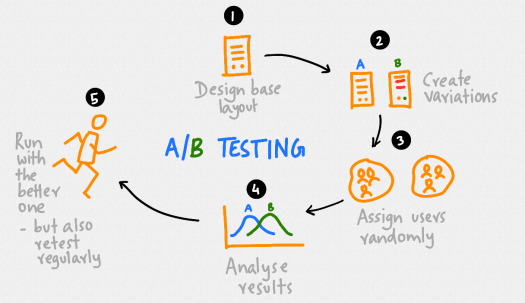
In essence, it has 5 steps we need to go through.

We start by selecting a situation – we may need to solve a new problem or improve an existing situation.

Take, for example, the issue of GDPR compliance.

Many companies are sending out emails to their lists asking them to confirm if they want to stay on the list and what they want to receive.

What should it say? Perhaps we should come up with a base layout.

Maybe we can start with one that explains GDPR in detail and then asks people to update their details. This is the control.

Should we just send out one email?

That’s not something that can be answered easily because we don’t have any data – do we just need to get a decision from someone?

Or can we run a test?

Say we have a database of a thousand people.

We might create variations of the base layout – instead of explaining GDPR we write one that simply says this email is being sent to comply with the GDPR, perhaps linking to a site that explains what it is, and stresses the benefits of staying in the list and what they will get for most of the copy.

We wouldn’t run the test on the entire database. Instead, we select a sample, perhaps 100 users picked at random out of the list.

Then, we assign users randomly. Of the 100 users in the test sample, 50 will get the control version of the email, and the rest the variation.

Then we look at the responses and analyse results.

This might require some familiarity with statistics and the ability to interpret what a statistically significant difference is and if the variations has performed better than the control.

If the variation performs better than the control, we run with it and send it to the entire list.

In theory, this should produce a better outcome. By testing and selecting options based on how well they have performed according to the data, we should boost results.

We need to remember to retest on a regular basis. Some of our results may be false positives, so we need to watch out for errors or more general changes in the environment.

It’s important to recognise that the aim of this approach is to select the one that gives the user clearer information and a better experience.

It’s also a defensible approach that takes away much of the arguing and opinions that often accompanies choices that involve strategies or the wording of copy.

Instead, we can just offer to run an A/B test and go with the evidence.

Why brand awareness is the most important thing for an organisation now

customer-decision-journey.png

Things sell themselves these days.

Whether we’re talking about placing products in front of consumers, or trying to persuade others to adopt a particular strategy in an organisation, the point at which we reach them is crucial.

The traditional approach of a funnel, where we go through defined stages is starting to show its age – because it can’t cope with the idea that consumers may know as much, if not more than product and service providers.

Take recruitment, for example.

For a long time, the only way for a person to understand what it was like working for a company was to ask friends and family who worked there, or apply for a position and spend some time working there.

So, they entered a funnel – experiencing the recruitment process, negotiating salaries, starting work, mixing with their colleagues, understanding the hierarchy and so on.

Now – they have access to much more information on the working experience at a company – especially if it’s a large one.

For example, Glassdoor has 5,021 review of Barclays, 8.596 salaries and 1,920 interviews with employees.

A prospective employee looking there will know more about how the company treats its staff than almost anyone else internally, especially the top management.

The democratisation of information has levelled the playing field in every aspect of organisational interaction.

Most service and product providers understand their products in detail, but spend less time comparing themselves with others than potential consumers.

The consumers therefore are more likely to have a better understanding of the market and trends and the differences between brands, just through the basic research they do before engaging with providers, than the brands do themselves.

This change in the way of how consumers interact with products and services has been called the customer decision journey by McKinsey.

In this model, consumers start with an initial consideration set, a collection of brands that they are aware of and may have been exposed to recently.

They then get information from a wide variety of sources – internet reviews, personal recommendations, traditional media – which all contribute to an active evaluation of their options. At some point, they reach a moment of purchase, where they decide to go with a particular option.

According to the customer decision journey model, this is where the hard work begins.

The postpurchase experience then shapes success or failure.

Many people, once they make a decision, experience a degree of anxiety.

The first thing they then do is to go online and check that they have made the right decision – looking for reassurance from others in the same position.

This works, sometimes, as they get more information, realise that they are with a good brand and are reassured. On the other hand, they may see more information from competitors that show them what the alternatives might be.

The trigger for entering a loyalty loop and making follow on purchases depends then on the quality of what they get and their ongoing assessments of the options open to them.

This continuing change in the way consumers make decisions is changing everything from sales to recruitment in an organisation.

And the starting point – the thing that one must do to even play the game – is to be included in the initial consideration set.

And that means that the potential consumer needs to be aware that a particular organisation exists – it needs to be discoverable.

Which brings us back to the importance of brand awareness: why it matters so much now, and why it will become even more important in the years ahead.

When will a new app or IT solution benefit our work?

TAM-TTF-model.png

For many of us, a standard work IT package consisted of a laptop or desktop and a Microsoft Office suite.

That has let us do most things for a number of years, and remains a solid foundation for the kind of day-to-day office work we need to complete.

In most functions, however, the number of tool options are exploding.

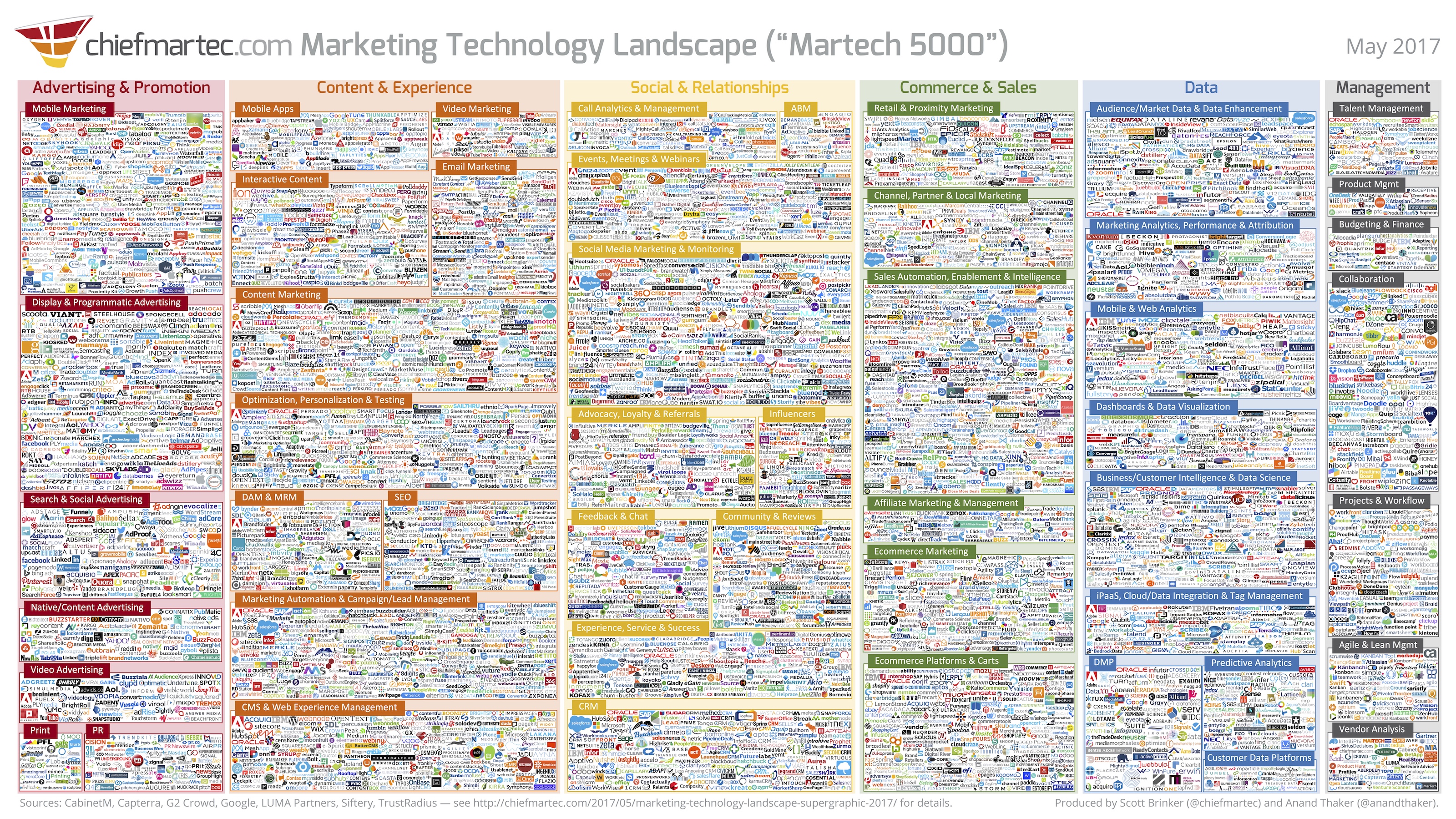
Take the graphic below from Scott Brinkler who writes the Chief Marketing Technologist Blog. It shows the marketing technology landscape where we can now choose from 5,381 solutions from 4,891 unique companies – and has grown from around 150 to 5000+ in six years.

marketing_technology_landscape_2017_slide.jpg

A similar transformation, although less dramatic, is happening across other organisational functions.

What are the things that managers who are tasked with investing in tools for users that need information systems and tool developers trying to develop such tools need to keep in mind – given the inevitable competition they will face?

One approach comes from a paper by Mark T. Dishaw and Diane M. Strong that puts forward an integrated model that tries to explain the likelihood of a tool actually being used.

It combines two existing models, and the new, extended version is more effective than either alone.

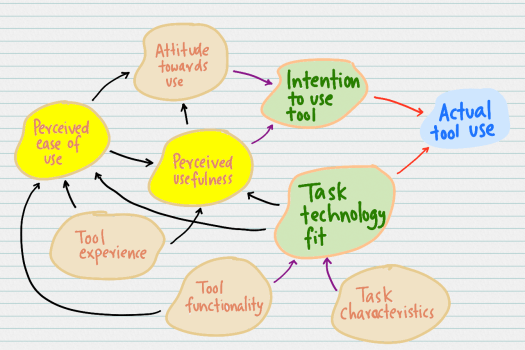
First, the Technology Acceptance Model (TAM) suggests that actual tool use depends strongly on an intention to use the tool.

The strength of the intention depends on the user’s attitude towards use, which in turn is a result of his or her perception of how useful the tool might be and how easy it is to use.

The Task-Technology Fit Model (TTF) focuses instead on the ability of technology to support a task – and matches the technology to what the task demands.

This fit depends on the tool functionality and the task characteristics – and suggests that a rational assessment that matches functions to tasks will result in the best choice of solutions.

The TAM depends on perception and attitude while the TTF focuses on rationality and comparison.

In reality, we use both, and the extended model, shown in adapted form in the picture above, is an integrated model that selects from parts of the TAM and TTF and connects them with the hypotheses set out in the paper.

It turns out that this extended model explains more about actual tool use than either model on its own.

How can we use this when selecting and implementing a technology stack in our organisations?

To start with, this model gives us an approach to scope what is required in terms of both technical capability and user-centric capacity.

All too often we select a package based on the sales pitch and technical functionality, forgetting that the value it will add depends on how the people in our organisation use it – and they will default to using systems they find easy and useful.

And the quality of our choice will show up in the statistics of actual tool use.

What’s the difference between a plan and a novel?

research-process.png

We all make plans – from planning a trip to setting out a marketing strategy for the next five years.

There are many moving parts in a business environment – from internal capabilities, dynamics and politics to external influences like regulation and social transformation.

What differentiates one kind of plan in such a dynamic environment from another?

Is it success – if a plan succeeds is it a good one?

Or is there something about the nature of the plan itself – does a good plan have a particular architecture?

Take marketing on the internet, for example.

Search engine optimisation or SEO is something that many people try and sell – ways to manipulate search engines into ranking sites above others – and it was popular in the early days of the web.

So, is that something that we should do now?

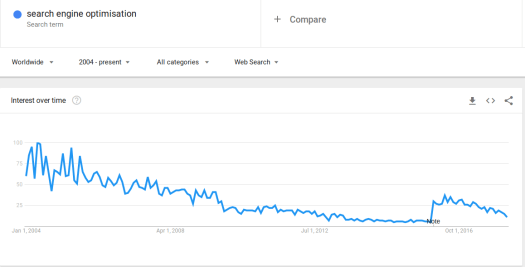
Looking at Google trends – perhaps not. Interest in the term has steadily dropped over time as search engines have become smarter, using semantic analysis and tracking to provide hyper-personalised content.

seo.png

SEO these days is more about making it easier for the engines to understand what we do rather than tricking them.

A plan based on taking a shortcut or tricking the system may work for a short while.

It can then form the basis of a story, which can be used to sell the plan to others – but it’s unlikely that the results will be reproducible to the same extent.

And that’s the operative word – what distinguishes a plan from a novel is that the former is designed to produce reproducible results while the latter is a narrative of what once was and what might be.

The picture above is from Peter Checkland and Sue Holwell’s book Information, Systems and Information Systems: Making Sense of the field and sets out the basic architecture of a research process – something that can be generalised to much of business.

We start with a framework of ideas – things we believe about our environment.

Taking the marketing process again as an example – these might include the importance of video, a belief in the process by which concepts go viral and the extent to which elements of the work can be outsourced.

The standard process is to them come up with a strategy, a plan and then apply it to an area of concern A – the sales process or pipeline management.

Directors set targets, managers review progress and the standard process rumbles on. Perhaps they hit targets, perhaps not – that’s not really important.

What’s important is the bits that are missing.

A set of ideas by themselves are just opinions. What makes them useful is setting out, in advance, the methodology that underpins our strategy and plans.

Our objective is to cause a change for the better in the area of concern that we are looking at.

Continuing with the marketing example – we may be able to see and measure the change in a metric like sales – but that is an output of the process.

What’s important is that having the intellectual structure in place – a framework F, methodology M and an application area A – then lets us reflect and learn about the system we have put in place.

It’s the learning that matters – and that’s what helps us adjust and refine our plan and create an approach that produces predictable results.

And this is perhaps the biggest thing we miss when we think about a plan in the narrow sense of having a goal or target and define success as hitting it and failure as missing it.

The journey we take and the lessons we learn are just as important – if not more so.

We often learn more from failure than we do from success.

Why goals and control are not enough for business and society

appreciative-systems.png

We have been conditioned for a long time to think that setting goals is the way to achieve success.

This may partly be due to the work of Herbert A. Simon, a Nobel prize winning economist who pioneered work in goal-seeking, which spawned fields such as artificial intelligence, decision science and complex systems.

This kind of thinking leads to the unquestioned assumption that the way to make something better is to throw technology at it – a very common theme at present in the energy world.

We think energy markets aren’t working, so the way to make them work is to implement blockchain, AI, machine learning, comparison engines and other types of solutions – which will magically transform it into a clean, lean machine.

Except it doesn’t work that way.

A countering approach comes from the work of Geoffrey Vickers who came up with the notion of appreciative systems.

He argued that ways in which we often thought about the world were inadequate.

The goal-seeking method leads to a narrow reductionist view.

An alternative – the cybernetic view, where there are controllers and actors and one controls the other doesn’t really exist in reality.

Take for example a prison guard and a prisoner. While one is behind bars – both are in prison – and we know how the environment can quickly turn good people bad.

Vicker’s approach is one where life is experienced as a flux of events and ideas – brought out in the picture above from Checkland.

Imagine a loud, raucous party. You arrive, having been invited. You meet a few people, get to know more. Over time, you make friends, have conversations, even throw your own mini-parties in a corner of the room. Then you leave – but the party carries on.

That’s pretty much how life works.

Appreciating the world, or life, then means perceiving it in the first place and making judgements about the things we see.

Those judgements are usually about fact – what we believe is – and value – or what is good.

Given our perceptions and judgement, we can envision what might be and take action.

And we do all this not to meet goals, as a rationalist approach might assume, but to maintain relationships – our place and friendships at the party, if you will.

All this activity results in standards – our expectations of fact and value.

What needs to be seen is that our previous experience results in standards which are then modified in the light of future experience.

At a very basic level, this is what happens when companies become more diverse – the introduction of new thoughts and approaches from a greater range of individuals can change our standards.

A few years ago, no one would have questioned mostly male panels. Now it would be a brave organiser that didn’t have any women up at all.

Why does thinking about any of this matter?

It’s easy to be cowed by what seems like the unstoppable march of technological progress – the bots are going to take our jobs and there will be nothing left for humans to do.

Except to be human – appreciate life as it is and aim for better standards and relationships in business and society.

What does it mean when an organisation has a social purpose?

social-purpose-organisation.png

Organisations are changing and the boundaries between them are getting blurry.

Once upon a time it was simple. The government did some things. Profit driven companies did other things. And non-profits picked up the pieces.

The regulatory structures in many countries grew up to support organisations that fell into one of these three categories.

But, that’s not enough for people any more – they want to work with organisations that do more than just make money – that have a social purpose.

But what does that mean exactly?

In this BCG article, Cathy Carlisi and Dolly Meese from Brighthouse define purpose as the why of an organisation, resulting from the intersection of two questions:

  • Who are we?
  • What need do we meet in society?

Does this become a social purpose if we just add the word social to it?

Not according to the Advertising Standards Agency, which ruled that A4E, now known as People Plus, could not describe itself as a social purpose company because its activities made a profit but people could mistake it for a non-profit.

So, while leaders in organisations are trying to make their businesses about more than just money, the system of regulation and oversight is trying to understand what this means and how it should respond.

In the U.S, the concept of a for-benefit organisation is being mooted, one that makes a profit and acts like a normal business, but whose primary purpose is provide social benefits.

The normal way to get this message across is through marketing – by structuring branding and messaging around concepts like “social enterprise” and “sustainable business” according to this article in the Harvard Business Review.

But, the article argues, it can also be achieved through organisational architecture – by creating a set of rules and operating principles that go beyond profit and involve suppliers and customers in decision making and even profit sharing.

A report by the Mission Alignment Working Group of the G8 looked at a new form of organisation called profit-with-purpose businesses – a type of organisation that has the freedom to distribute profits like a traditional business but also commits to prioritise, deliver and report on their social impact.

They also propose a way for these organisations to become formally recognised in law – with a definition, legal framework and operating model.

So… it’s not that easy to understand social purpose – the words make sense, but what does it really mean when an organisation starts to focus on the impact it is making rather than the profit it is taking?

The starting point is getting the internal and external narrative right – the story we tell ourselves and others.

And we can start by answering a few fundamental questions.

Who are we, what need do we meet and why do we exist?

Why I sold my crypto holdings

ethereum-mar-2018.png

Like many other people, crypto currencies weren’t really something I looked at seriously until the staggering rise in their valuations in 2017.

In December and January, the price of Ethereum went from under $500 to over $1,250, more than doubling in two months.

The entire world got very excited.

Everyone seemed to be looking at these currencies and talking about buying it.

Was crypto something I should get into as well?

Buying a crypto currency is not like buying a stock or an index fund.

With a stock, we are taking an ownership stake in a company, with underlying cash flows and the possibility of growth and more income over time.

As an owner, we share in the growth (or not) of the business – and it makes sense to buy good businesses and hold them over time.

An index fund that covers a market is taking a position that an entire economy will grow and we will share in that.

For example, a S&P tracker will simply follow the performance of the largest companies, and they will probably be worth more in 20 years than now.

Cryptos are a pure trading play

Currencies don’t work like that – they have no intrinsic value.

They are worth what someone else is willing to pay for them in another currency.

That means we need to understand how buyers and sellers in that market work.

I needed a trading method

In many situations, we only need to be good at the buy side.

We’re going to buy and hold for the long term – and as an investment method that works quite well for things like buying stocks or making decisions on commodities like electricity and gas that we actually need for our homes and businesses.

In trading, however, we need to be good at the sell side as well.

More than good actually.

Lets say that we are 70% right at picking when to buy. That seems good, right?

If we are also 70% right at picking when to sell, then for any trade that involves a buy and sell, our probability of success is 0.7 x 0.7 = 49%.

That means we have a less than 50% chance of being right over time on both elements.

That’s where a system comes in, so my first step was to code one up to use for crypto currencies and I decided to apply point and figure charting (P&F).

A P&F system is designed for long term traders that want to understand how buyers and sellers are operating and make decisions on taking positions in that market.

The picture above is a snapshot of my P&F chart for Ethereum.

A position with actual money makes it more real

It’s easy to talk about what we would do, but to really get a feel for how we will act in a trading situation, it’s necessary to put down real money.

After the fall in value in February 2018, I entered the market with a very small position on the first reversal – marked as BUY on the chart.

I bought at around $725, and set a stop-loss at $650 – the red line.

The price went up a bit, down a bit, up a bit and then started to come off consistently during late February and into March.

When it crashed through my stop – I sold.

There isn’t much point having a trading system if you don’t stick to it

The point is that my sell wasn’t due to market conditions or timing or emotional decision making.

At the time I bought, I had a sell in mind, both for the upside and the downside.

This was a trading play, not an investment one – so when it went against me, the only rational thing to do was cut my losses and stop playing.

The next thing to answer is – when should I enter the market again and have another go?