How To Keep A Commonplace Book Using John Locke’s Method

locke-commonplace-method.png

Sunday, 6.20am

Sheffield, U.K.

The business of Education, in respect of knowledge, is not, as I think, to perfect a learner in all or any one of the sciences; but to give his mind that disposition and those habits that may enable him to attain any part of knowledge he shall stand in need of in the future course of his life. – John Locke

Ever since the printing press was invented people have worried about being overwhelmed by a deluge of information.

Making sense of it all, gaining understanding, organizing and recalling it when needed – these were the concerns of intellectuals in the centuries following the widespread availability of books.

A commonplace book is one solution to this problem.

How do you read?

If you’re anything like me, there is information everywhere you turn.

From the results of google searches to the increasing availability of digitized books and open access papers, there is a huge quantity of information out there and it’s increasing all the time.

One way of dealing with this is to give up – give the algorithms the power to select what you should read.

The algorithms are there to serve you, to give you what you want – but will they give you what you need or more of what they think you prefer?

Sometimes you have to follow a trail to discover what you need to learn, and that means going from source to source and having your own means of recording, organizing, accessing and recalling information.

But, with so many different sources, how do you do this?

John Locke and his commonplace book

John Locke was an English physician and philosopher who published a method in French of indexing and keeping commonplace books in 1685 that lasted for the next few centuries.

In 1706, this method was published in English as A new method of making common-place-books after his death.

The brief document sets out Locke’s method, which starts by telling you to first just read through a book.

If you find something interesting that you want to extract later, mark the page on a piece of paper, but don’t stop the flow of your reading.

You should only starting thinking about extracting and copying out passages on the second reading and, even then, copy only the things that are new, that add something to your knowledge rather than sentences that sound good but say little.

In other words, create a filter for material right at the beginning, try and record only what is really worth having to hand later or you risk simply being overwhelmed with material once again.

I think this is good advice but not easy to follow – but I suppose you could make it a habit.

The writer Ryan Holiday, as an alternative, talks about marginalia, underlining books and writing in the margins.

This is not something you can do with an online book or a website.

You could screenshot the page or copy the text into a file but again, the ease of recording increases the amount of stuff you have.

Whatever approach you take, the thing to recognize is that your first job is not to accumulate but to filter, to select what is worth keeping rather than keeping everything.

The next, and probably most unique thing, about Locke’s method is his index.

The index is created on two facing pages and you write out the letters of the alphabet subdivided by the vowels, A and then A,E,I,O,U and so on.

It’s easier to see this in the image from the book below.

locke-index.png

A couple of interesting points, Locke suggests missing out K, Y and W because you can use C, I and U and Q only needs one line because it’s always followed by U.

Locke’s advice is to keep a bound commonplace book and so the next element is to number the pages.

Then, you start making notes.

Say you come across a passage you like and want to record, the first thing to do is select the topic this relates to, what Locke calls a “Head”.

The thing about this head is to choose something that will lead you to the right section of your book later.

For example, I find that whenever I read a Terry Pratchett book there are passages I’d like to copy out later.

I could select from his series and use the topic “Discworld” or stick with the author’s last name and go with “Pratchett”.

Choose a way of grouping subjects that works for you and stick with it.

Taking Pratchett as an example, then, as your first entry, choose the first set of blank facing pages and write the head “Pratchett” on the left, before the margin.

Then make your notes after the margin.

This way, you’ll always be able to easily skim the heads and see where passages start.

Here’s an example from Locke.

locke-notes.png

Then you record where the section is in the Index by using a combination of the first letter and first vowel.

In Pratchett’s case, this means you would add the page number to the line PA in the index.

Then, you use these two facing pages to record all the topics that start with the combination of first letter P and first vowel A, such as Painting, Palaces and Plans.

When you finish a set of facing pages then you continue that particular combination on the next free set, and record the page number of the next starting point on the previous set and vice versa.

This way, you can go through the book by topic following the page numbers or jump to a particular point by looking in the index.

If you’ve come to the end of a facing set and the immediate next two pages are blank, you just turn over and carry on, noting a “V” for the continuation.

So, what this method does is give you a way to read widely and copy your material into your book by topic, while also providing a fairly compact indexing system that balances ease of recording with the effort needed to skim and find the material you want by topic.

But, will it work for you?

E.M. Forster and his commonplace book

The English fiction writer. E.M. Forster started keeping a commonplace book in 1925, at the age of 46.

He started doing this when he inherited a 12 inch by 8 inch bound book with around 400 pages that had been bought in 1804 by John Jebb, a rector who was going to use it as a commonplace book.

Jebb only used 18 pages or so and bequeathed it on until eventually it came to Forster, who recorded that he was now continuing it on October 21st, 1925.

Now, what’s interesting is that Jebb had created the indexing method using Locke’s system as described above but Forster doesn’t seem to have been aware of how to use it.

On his first page, we are told, he made three general entries “Commonplace”, “Isolation”, “Resentment”.

That already breaks the indexing approach set out by Locke and Forster clearly already hated “this awful arrangement by topics”.

Forster instead just wrote although he started the first word of the entry in the margin, like Jebb did, but let go of the topic structure.

Jebb, on the other hand, apparently didn’t make much use of the index, while Forster listed 196 entries by subject.

Forster, it seems, used his book not just to record material he wanted to recall later but also observations and thoughts – and made use of the blank pages and the freedom they provided to put boxes around sentences, put content side by side, draw connections between them, add color and use text styles for emphasis.

It’s also a notebook for thinking, not just a record of material.

Know the rules so you can break them

I thought this was an interesting example of how thought flows through the ages.

You have words and thoughts from 1685 that affect how a book is structured in 1804 which is then picked up and used and changed all the way until its last entry on November 11th, 1968.

Forster’s book was in use for nearly 164 years and the ideas in use for 283 years.

The book was eventually published as Commonplace book by E.M. Forster, edited by Philip Gardner.

My first response, on seeing the index, was unease – it seems regimented and organized, the opposite of what I do naturally.

It seems Forster shared that view.

Then again, maybe it’s because I am not organized that I have piles of paper, notebook after notebook with material that is not organized and accessible.

The thing with material locked in a rigid, sequential structure like a notebook is that, as Robert Pirsig writes in Lila, “when any distribution is locked into a rigid sequential format it develops Joes that dictate what new changes will be allowed and what will not, and that rigidity is deadly.”

But, that has to do with locking away your ability to think, but not about recording the original material in an accessible way.

And original material has to do with what you read and what you think.

So, how would I use a commonplace book now?

I would start with a single notebook for recording notes from what I read and my own thoughts.

I would create the index and try to follow a topic structure for the material that I was copying down exactly.

For general notes, I would just write daily, letting the material flow, a little like a scientific notebook or any other daily record of work.

I think it would also make sense to have a topic list somewhere, perhaps on a couple of pages on their own.

The thing that Locke’s structure allows you to do is hack the sequential, bound notebook to create a more fluid was to access what you want by using the indexing structure.

Which means you can then benefit from the most powerful aspect of the bound notebook – which is that there is no filing, you can simply put it on a shelf and start a new one.

I find that when I come across loose sheets of paper I struggle to keep them – they’re messy and unfiled and it seems easier to throw them out.

Throwing out a book is much harder – especially a book with material you want to remember and that has been indexed in a way that makes that possible and easy.

Now, here’s the takeaway.

Locke’s method is just that – a method that worked for him and that he put down.

Over the years, that method was used and transmitted and forgotten and rediscovered and used in unintended ways.

The beauty of the Internet is that you can find all that out there.

But you have to thread the pieces together, make sense of things in a way that works for you.

And then you need to adapt that method to your circumstances, to the things that interest you and that you want to study, building on the suggestions of people that had similar problems before you came along.

And if you do that maybe you’ll also have a way of working that will make life easier for you for decades.

After all, Forster started his book at the age of 46 and then kept on going for 43 years.

How long are you planning to keep learning?

For me, that’s hopefully only going to happen when I stop living.

Cheers,

Karthik Suresh

How To Build Your Listening Tracking And Trailing Skills

trails-and-tracking.png

Saturday, 6.39am

Sheffield, U.K.

I was no longer following a trail. I was learning to follow myself. – Aspen Matis, Girl in the Woods: A Memoir

Tracking, I learned a few days back, is when you go into the woods and go where you want to go, laying down signs for others to follow.

An arrow, for example, says go this way and you make one by laying three sticks on the ground.

Two crossed sticks mean not this way.

And then you have signs for split up, obstacle ahead, left and right turns and gone home.

When you’ve put down the tracks someone else can follow what you’ve done, or you can walk it yourself and see if it’s clear or confusing or if you need more signs.

And it actually gets hard very quickly, you can forget where your own tracks were laid, you can confuse yourself with the directions and when you try and follow anyone else’s tracks you often come to a point where they just disappear or run out or you come across someone else’s tracks and follow their route instead not realizing you’ve changed direction altogether.

Now this, I think, has a resonance with the way memory works.

This talk by Lara Boyd, which you can skim with the transcript here says that the brain has three ways of learning.

Short-term learning has to do with chemical signaling – your neurons communicate and become active and this helps you remember stuff now.

A little bit like laying down those tracking markers, go this way and not that.

Then, to support longer term memory, the brain starts altering its structure, making those connections and actions permanent.

If you have enough kids tramping their way down those trails, eventually you will stamp down a path, perhaps a new one.

And then finally, the brain can change its function to support your learning, with areas becoming bigger and more specialized.

And that happens in the woods as generations of walkers and children make some parts of the wood fill with trails and hideaways and play there often while other parts of the wood stay hidden and unseen for longer.

What can this tell us about what happens when we want to understand a situation?

Start with short-term learning

All too often we expect to go into a situation and come out with a long-term answer in next to no time.

We need to let go of this idea and starting thinking about a longer-term involvement in the process.

The first few times you enter a situation and ask questions and take notes, all you’re doing is following a path through the woods, setting down notes as markers.

As you start to see a trail emerging, a path that others follow even if they don’t know it you now have something to work with.

Work with the underlying structure, not against it

You may be an expert in what you do – and let’s say you provide consultancy services.

Almost every consultant will come in with an “expert” mindset – they know what to do and will come up with a plan and impose it on the situation and things will work.

But things usually don’t.

And that’s because what worked for you somewhere else, at a different time, with different people – worked because it was then and there and with them.

Now is different – it always is.

And you need to see what is happening now before you can really work out how you can help – how your expertise can contribute in this situation.

Learn to adapt your methods

The thing that matters is process – how you work through the specifics of the situation with the tools you have to gain a better understanding of what needs to be done.

Now, to some people, all this will seem horribly imprecise – tell me what to do, they will say, and I will do it.

But be clear – just what do you mean.

I think this is what I mean.

The real world is messy, full of detail, full of confusion and angst and feelings and worries and hopes and dreams and ambition and hate and friction and dissent and power and politics and ignorance and contempt and narcissism and a belief in one’s own superiority and intellect.

You can’t abstract away from that.

It’s a mess and you have to realize that if you want to deal with the real world you are going to have to get involved, you are going to have to participate in it to understand it and to work with it.

This is the basis of anthropology – participation – and of action research – where the researcher gets involved in what’s going on.

If you want to understand something, if you want to change something – you can’t do it at a distance, you have to get your boots on and walk into the middle of everything.

And hope you don’t get lost.

How do you know when it’s working?

There are three things that you need to watch out for.

The first is whether your methods work for you, are the process you are using for data collection and meaning making ones that work with the way you work and are you comfortable with them?

For example, some people are rigorous and logical and hard working – they will take notes but also be disciplined about keeping indexes of what is where.

I find that a difficult task to do – I prefer methods where structure emerges naturally rather than having to maintain a structure because that seems like it’s hard work.

The second is whether your methods work for others – can you communicate and collaborate usefully with other people.

Here, clarity and speed matter – the more complex your material and the longer it takes to get then the less your chances of actually being able to do what you want to do.

The final thing is whether, when you’re done, you have peace of mind – you know that what you’ve done is what you wanted to do and the results are good.

We need more detail, please.

One of the challenges we face when trying to talk through something with someone else is that it’s hard to understand something unless you know it already.

If you have read Zen and the art of motorcycle maintenance you’ll know what I mean.

What I’m trying to do is work towards an approach that will help us navigate the vast, unmapped, constantly shifting terrain of individual and group minds.

It’s more than method, but we have to start with method, with procedure, with something that has worked, at some time, for some person.

So, over the next few posts, I’m going to try and be focused and practical and deconstruct methods of collecting and processing information, covering things like commonplace books, logbooks, diaries, journals, sketch notes, zettelkastens, concept maps, holons and so on.

I think I also want to look at analog versus digital and the pros and cons of each.

I want to take an approach that looks at the models behind these methods and takes a critical approach to them.

Because there is no one best method – there is what works for you in the situations you face.

Think about it like going on a hike.

You have to decide what to carry with you.

But to do that you first need to know what’s available out there.

Let’s go shopping for supplies in the next few posts.

Cheers,

Karthik Suresh

How To See The Forest As The Forest

uncarved-block-characters.png

Friday, 5.51am

Sheffield, U.K.

In a forest of a hundred thousand trees, no two leaves are alike. And no two journeys along the same path are alike. – Paulo Coelho

I remember how much I loved my first laboratory notebook.

We got them for a biology class, and we went for a walk and stopped to draw a flower – a Vinca rosea – a name and experience I remember three decades later.

Those of us who rely on taking notes to make sense of things probably got the habit way back in school.

A famous note-taker is Richard Branson, the billionaire founder of the Virgin group.

In his book, Screw it, let’s do it, he has this passage:

“I have always written everything down in school notebooks. It started when I found reading and writing hard at school and, to make up for that, built up a very good long-term memory. Now I jot down key words in my notebooks and later, if I need to, I find a note and I can recall entire conversations. This has stood me in very good stead more than once when I have needed to prove something. But it’s not just conversations – I also jot down my own thoughts. Anything I see and hear can spark an idea in me. I note it down at once and often look back through old notebooks to gain fresh ideas or to see what I might have missed. I would advise young people starting out in life to keep a notebook with them. It’s a good habit to get into.”

John McPhee writes for the New Yorker and in this interview on The Open Notebook talks about his approach to taking notes.

“I’m just listening. Tons of stuff streams by, and I’m obviously not using 100 percent of it, but I do use a tape recorder if I have to. I never try to remember later what they said. There have been writers writing non-fiction who claim that they went home at night and wrote it down. I don’t do that. I scribble constantly. If I’m climbing up the North Cascades, I have a notebook in my hand, trying to keep my balance, and I’m scribbling, scribbling, because I much prefer to scribble in the notebooks than to transcribe endless tape.

But if you have 15 Appalachian geologists of the first rank standing around some outcrop, arguing about exotic terrains in Vermont, the language is unbelievable. I take out a tape recorder and put it on the outcrop. And then I go through the whole process with the thing with the foot treadle and all that to type up the taped stuff. But my first go is a notebook.”

And for an insight into how Tim Ferriss takes notes read this post.

Now, in my last post I said I’d look at how some people took notes but really you can find tons of stuff on famous people on the Internet – it’s full of stuff like this.

So, there are a couple of directions I could go in.

First, there’s less well-known stuff, like books on how to keep science notes and laboratory books.

Then there is a more interesting digression into the combination of sketching and writing and snippets.

And then there is stuff I was reading about yesterday around Taoism and the lessons it might have for all this.

So bear with me as I work through some of these ideas in this post and try and get somewhere useful.

Let’s start with forests

Yesterday I helped with a cubs event – the thing organized by the Scouts and we had a tracking exercise in the woods.

This activity, for those of you who don’t know what it is, involves running through the woods putting down tracks – using bits of wood to make an arrow showing which way to go, that sort of thing.

So, you’re in the forest, there are the normal, well trodden paths, and these kids are laying down tracks for others to follow, which meander along and then cut across the undergrowth, go around obstacles, double back on themselves, go in loops.

In one situation, the kids laying the tracks came back on their own original tracks and confused themselves, so they turned their arrows around to point the way they were going now – which probably led to no end of confusion for the other groups involved.

But what can we learn from this situation?

The Uncarved Block

This image of a forest where we are laying down tracks as we find a path through is at the heart of Pu – the uncarved block.

In the Tao of Pooh, by Benjamin Hoff, we’re introduced to the principles of Tao through the medium of Winnie the Pooh.

The image above is supposed to represent Pu in simplified Chinese – and my apologies in advance if I’m off the mark with my brushwork.

But the point of this is explained by Hoff in this passage.

“The essence of the principle of the Uncarved Block is that things in their original simplicity contain their own natural power, power that is easily spoiled and lost when that simplicity is changed.”

The forest in front of you is in its natural state – and the further you try and abstract away from that natural state the more you might miss the point of the whole thing.

Which is to make your way through the forest and lay down your tracks.

Let me contrast all the stuff you’ve read so far with something from the book Rational analysis for a problematic world which has a section on the strategic choice approach.

It turns out that the world has uncertainties, and you can look at them as uncertainties in the environment, uncertainties on values and uncertainties on related decisions.

These can be represented, according to the author, John Friend, as UE, UV and UR for short.

You could… but why?

Well, anyway, what happens next is that you can start to organize this stuff, using structures and techniques for analysis.

Eventually you can build quite complex mathematical models that let you manipulate variables and see what’s happening.

At this point, however, you’ve lost 95% of the people out there, who can no longer follow your reasoning.

They got bored with the structuring and don’t know whether they can trust the math.

Do you have to have all this complexity to understand what’s going on in that forest?

Where’s the fun in all this?

If we go back to Hoff, he has this to say.

“When you discard arrogance, complexity, and a few other things that get in the way, sooner or later you will discover that simple, childlike and mysterious secret known to those of the Uncarved Block: Life is Fun.”

So, this is why I am going on about learning how to listen and how to listen with a notebook in your hand.

It’s because the people who use notebooks do it because it helps them have fun – they discover new things, they come up with ideas or learn about possibilities, and they find out more about each other and what makes us tick.

That listening and learning process breaks down the barriers built from assumptions and expectations and prejudices – it’s hard to hold onto an incorrect point of view once you’ve seen what’s really in front of you.

And in our notebooks we can get down what we see – we can jot down notes, we can draw sketches, we can record data, write down possibilities – those pages help us collect and remember and are silent, supportive companions as we head into the forest to find our way.

But as we do that we need to get better at laying down tracks.

As I learned from the kids doing it yesterday you can blunder around and confuse yourself and others very quickly.

But, if you do it a few times, you will get better and be able to lay down complex trails that go to interesting places and help others to follow along as well.

So, in the next post, let’s talk about making tracks, now that we’ve learned that the thing to do is start by finding the forest and seeing it for what it is – natural and in its original state.

Let’s leave behind abstractions and theories and start to learn to listen and see things as they really are.

Cheers,

Karthik Suresh

How To Use Your Notebook To Help You Make Sense Of Things

notebook.png

Thursday, 5.44am

Sheffield, U.K.

I can’t predict how reading habits will change. But I will say that the greatest loss is the paper archive – no more a great stack of manuscripts, letters, and notebooks from a writer’s life, but only a tiny pile of disks, little plastic cookies where once were calligraphic marvels. – Paul Theroux

In my last post I said I would start looking at specific cases and instances that call for listening skills to see what approaches work and what has changed over time.

The approaches you take probably depend on where you are in your career and what you think is important right now.

The thing to notice is that time changes things – even your point of view and for me the biggest change in thinking happens when you move from being a student to being adrift in the world of work.

Jumping in at the deep end

You learn reading and writing at school, and judging from the way my kids react to the process, it’s not the most exciting thing around.

The ability to listen and take notes is not innate – we have to learn it and, importantly, teachers need to model how to do it.

Think back to the way in which you were taught in school or, for that matter, the way you would present or teach something now.

Can you see that there was an underlying structure, a curriculum that the teacher followed when giving you information?

What happened what that structure was revealed class by class, as the teacher introduced ideas, followed arguments and showed you the territory of thinking that covered the subject.

The same thing happens when you listen to a lecture now, a TED talk or a company presentation.

What’s happening is revelation, revealing what is already there set out in some kind of structure.

But when you start working those structures no longer exist in that kind of way – no one has been kind enough to map the territory for you.

For example, think back to the first time you went to speak with a client along with your boss.

You were heading into uncharted territory, even if you didn’t know it then.

No one else had had the conversation you were about to have, no one else had mapped the thoughts that would be expressed in the way they would expressed when you had your meeting.

You were about to discover something new.

And the tool that you should always bring, the one thing that will help you with this journey of discovery, is your notebook.

Capturing what is being said

As far back as I can remember notebooks and paper and pencils and pens have fascinated me – an obsession I share with many people.

I am typing this on a computer and computers are amazing and I think they are your friends.

For example, I have been writing in this blog for around three and a half years, regularly writing since 2017.

I have a writing process – first I write three or so paragraphs of freewriting, anything that’s on my mind just to loosen my mental machinery.

Then I write this post.

Later in the day, I jot down a quick journal entry that thinks through what’s happened and ideas around the writing and what might come next.

I write everything in text files on a computer running Linux, which makes it trivial for me to tell you that I have written 901,455 words by running a script.

You can’t do that with a notebook – but you don’t have to and there are things you can’t do as easily on a computer as you can in a notebook.

And in many ways that blank sheet has its own kind of magic.

Let’s focus on the kind of listening you have to do in a client relationship.

Bring an image to mind of a lawyer or counselor.

They’re sat there, aren’t they, with a pad of paper?

What do they do with that, what do they jot down – what are they trying to achieve?

To understand, see and act

Do you remember what it was like to move from school to your first job?

You went from taking notes on stuff that was taught in school to taking notes on the things you had to do – the tasks you were asked to complete as part of your work and instructions on how to do them.

You were still studying, but it was training on the job instead.

But then, do you remember the first meeting you had where you were trying to figure out what to do, what the problem was, what steps you needed to take.

Think about this carefully – was there a point where you first experienced truly deep water, of thought, where there was no bottom and no certainty?

Those moments are significant, because they end with you heading back towards the safety of shore, towards being told the answer, being told what to do, or learning to stay afloat in that unsupported space, to get comfortable with not knowing what to do.

Yet.

I learned, during my first experience of that kind of meeting, that your life jacket was your ability to take notes.

I was fortunate in that the people I worked with modeled what good note-taking looked like – they wrote things down furiously and referred to them and captured actions and were extremely good at understanding what was going on.

And so I copied what I saw them do – learn to write fast, write down what you hear, write down as much as possible.

The first distinction you start to make in your notes is what is background and what is an action.

Things you have to do are embedded within the torrent of notes you take over time.

And as you probably already know – it is a torrent.

You will fill notebook after notebook, easily.

I know, for example, that I can fill a standard reporter’s notebook in around 20 days – a book to a month.

That piles up quickly – but what’s the point of all this?

What are you trying to do?

Record the past in its entirety? Surely that’s an impossible and pointless task?

Seeing what you pay attention to

The thing is, your notes aren’t really about recording everything.

They’re really about paying attention – about what you pay attention to.

Life comes at you in this unceasing rush – there’s data and information everywhere you turn.

But what matters is what matters to you and the people you’re working with.

And that’s what your notebook is doing, it’s helping you filter everything out there to the things that matter to those of you in the situation right now.

When someone talks to you they’re telling you about things that they think are important to know.

So you jot those down, write down as much of what you’re hearing as they speak.

As you jot things down you’ll see connections – the things before will relate to the things after.

You’ll see relationships and missing bits – which will lead you to ask questions that will lead to answers which will lead to you writing down more notes.

And at the end of your session you will have a few pages of notes and a better understanding and something to look back on later – something that captures points your memory has simply let float away and something that captures things you have to do next.

Now, all this might seem really very basic.

What I’m saying to you is that you should take notes.

Well, actually what I’m saying is that if you want to be a professional then you must take notes.

If you’re early on in your career then you should never turn up to a meeting without your notebook.

Quite frankly, if you’re later on in your career and turn up without a notebook, I’m not sure you should be in the meeting.

Speaking for myself the ability to take notes – to be the person that remembers what was said, what was meant and what must be done – gives you an advantage.

You have a better chance at recognizing what must be done next.

But do others see it this way as well – perhaps in the next post I might look at a few other people and see what they say about this business of taking notes.

That might be interesting, to some of us anyway, before we move on to what happens next after you’ve captured what you’ve heard and seen.

Cheers,

Karthik Suresh

What Are The Steps To Take To Fill In The Story In Front Of You

start-by-looking-at-the-environment.png

Wednesday, 5.33am

Sheffield, U.K.

It’s like everyone tells a story about themselves inside their own head. Always. All the time. That story makes you what you are. We build ourselves out of that story. – Patrick Rothfuss, The Name of the Wind

In the last post in this Listen book project I looked at tools for taking notes in order to understand a situation and start to work towards creating methods for doing this effectively in the situations we face.

A field that has much to offer when it comes to understanding how this is done is ethnography – the branch of anthropology that studies a people, society and culture from their point of view.

At the heart of an ethnograpic study is fieldwork – you must go out and immerse yourself in the society you are studying, become a part of it and try to experience it as they do, while remembering that you are also there are an observer and must eventually describe what is going on.

These two roles can be tricky to manage.

And that’s because your ability to use tools and methods will first depend on the environment you’re entering.

Your environment determines your options

Let’s look at some situations where you might need to listen carefully to make sense of what’s going on.

Your children or other family members might be distraught, wanting something or worrying about something.

You might be preparing for a sales meeting with a prospect you really want to land.

You may be dating someone from another culture and this are about to experience your first family festival.

You’re researching inner city gang culture and have arranged a meeting with a leading local gangster.

In some of these situations you’re not going to be able to bring along a notebook or a computer.

People will think you’re rude if you stop in the middle of festivities to take notes on what’s going on.

Or your gang member will have conditions on what you can record or say because they don’t trust you yet.

In these situations all you can take away is what you see and hear and remember in your head.

In many other situations, however, it is helpful and even expected for you to take notes and even co-create a record of what is going on.

For example, when my children were young and were really upset about something I found that trying to talk to them through the flood of tears didn’t really work.

Instead I would start drawing pictures of what had happened – something we called “drawing a story” and use that to talk through the situation.

But before we look at co-creation let’s look at how an ethnographer might go about entering and listening to what is going on.

What should you notice and when?

In their book Writing Ethnographic Fieldnotes, by Robert M. Emerson, Rachel I. Fretz and Linda L. Shaw, the authors describe the kinds of things you should be jotting down as soon as possible.

The model below tries to describe the approach they’re recommending.

taking-notes.png

The first thing you have to do is tune into your sense impressions, see what is there for what it is and rely on all your senses for information.

For example, in a business context you can get a feel for culture – you’ll face different approaches if you are in a boardroom filled with suits than if you’re in a plantroom talking to operators.

What’s around you has a huge impact on what is happening.

With your children, for example, before you react to what they do you should probably tune into how tired they are, how late in the day it is, whether it’s before or after school.

All these things will affect how resilient they are and how much or little it will take for them to get upset about something.

From a cultural context are you entering a quiet, sober affair or is it a noisy, joyful thing?

Now, it’s worth focusing this on situations where you are trying to work with someone else or a team of others – perhaps you’re trying to do business together or work on a strategy to solve an issue you are facing.

What you’re going to do is focus on events and happenings – the flux of every day life that the people in face in the situation that you’re jointly exploring.

For example, if you sell digital commerce solutions you want to explore what they’re doing and facing when it comes to online sales.

And that means talking through their experience, the events they remember and how they see things as happening.

Now, if you spend all your time talking you’ll miss something important – which is what they see as important.

What you want to do is get the people involved to pick out what they see as crucial.

For example, if you’re trying to sell your solution you may spend most of your time talking about technology and features and benefits.

But the important thing you’d have learned, if you had encouraged others to tell you what they saw as important, might have been that the people who control the budget are not at the table and you really need to persuade them that you can guarantee payback within a year.

And here’s the crux of the skill you need to have to listen – you have to let people tell you what they see as important but you might have to infer it from what you see them seeing, what they talk about and how they seem to feel about it.

The questions you ask and the connections you make will help you make sense of what’s going on – they will help you see what kind of meaning the people involved are making of their situation.

Now, why is this crucial.

It’s because no one cares what you think – they’re immersed in their own worlds thinking what they think.

If you want to work with them or understand them better you have to start with where they are, not where you are.

You have to truly see things from their point of view.

Making a change

Now, when you are at a point where you are able to appreciate someone else’s world from their point of view – that is when you can add your own perspective to the picture.

For example, if your child is upset and you tell them what to do you’ll be astonished to find that you haven’t helped at all.

Instead, encourage them to talk to you – listen to them describe what’s in their minds and what’s upsetting them.

Listen without interrupting, except to ask questions and don’t deny their feelings by saying things like, “That’s not the case now, is it?”

You’ll find that the process of talking with you and seeing that you are really listening will help to calm them down and then eventually, when they’ve got everything off their chest, that’s when you might be in a position where you can add what you think, make suggestions that they could consider for how to move forward.

This process is no different when you’re dealing with adults – bar perhaps the crying and tantrums.

Although those can happen as well.

The point is that before people will be ready to listen to what you have to say they first need to know that you care.

And one way of caring is to give people the time to talk through things with you, to get it clear in their own heads how they think and feel about something.

If you listen to them then they will, eventually, be ready to listen to you.

Now, I’ve spent a lot of time so far in this series of posts talking in general terms about listening and how important it is.

For this to be useful I think we need to look at a number of specific cases and the kinds of issues you might face, and I’ll need to draw on my own experiences over time.

Let’s look at some of those situations over the next few posts.

Cheers,

Karthik Suresh

How To Help Your Brain Cope With Managing Information And Complexity

most-powerful-thinking-tools.png

Tuesday, 5.42am

Sheffield, U.K.

The two offices of memory are collection and distribution. – Samuel Johnson

I came across a book called Mental models: Towards a cognitive science of language, inference and consciousness by P. N. Johnson-Laird that makes a few interesting points about the way we think.

The first point has to do with the way in which we see the world.

As human beings we build internal models of what is out there in the real world and then we manipulate these models in our minds to figure out what might happen before we make a decision.

One example is your model of a TV set.

In your head, perhaps you think of a TV as a box with a remote and menus to select the things you want to watch.

If you’re more technically minded, however, perhaps you understand how liquid crystals work and the way in which they affect polarized light and how they are arranged in a modern display.

You don’t need to have a model in your head of how liquid crystal displays work in order to operate your TV – you just need a model of how the remote and TV interact.

Many of us take this process of modeling and reasoning for granted – it just works.

Johnson-Laird’s book tries to look at this in more detail, digging into the computational structure of thinking.

At times, however, it feels like he is trying to understand how to work a TV by starting with the chemistry of how you build a TV – and I’m not sure that is as helpful as you might think.

Not for you and me trying to think more clearly, anyway.

You don’t necessarily need to understand the grammar and semantics of language to express yourself and understand something.

What gets in the way, assuming you can read and write, are the limits of how much you can hold in your memory.

Johnson-Laird suggests that the limits of working memory is the main obstacle we face and what we need to do is increase those limits, but seems to discount tools that can help you do that.

Which seems odd – after all, the most powerful tool we have for increasing our memory is the humble pencil.

The thing that lets us write stuff down.

Once we have something on paper we no longer need to hold it in memory, we’ve freed up space to think about other things.

It’s the equivalent of RAM and a hard disk in computer terms – we store stuff on paper so that our brains can take in more stuff.

For a few thousand years we’ve used writing as a way to increase our memory capacity but the actual processing is still done just in the brain – we haven’t increased capacity there at all.

Which is where computers come in.

There are a few places where they increase our capacity for thinking.

The first big benefit is in mathematical modeling – they’re perfect for creating models that involve numbers.

If you learn how to build effective spreadsheet models, for example, you can do things like scenario analysis and work out what might happen under a range of conditions.

The next benefit is that you can use them to represent what you do in your brain when you listen and understand – but in a more easily retrievable way.

You may have heard of the memory palace technique – where if you want to remember many things you think about them in specific locations, combining the memory of the thing with a spatial memory to bind it more closely in your brain.

Over the last few years I’ve spent more and more time taking digital notes – sketchnotes, concept maps, cognitive maps and so on.

And what’s become clear as I do this is that being able to take notes in a way that spreads out all over the page makes it easier to remember what’s going on because you have the geography of the thinking working for you in addition to the words that represent the thinking.

For example, here are some notes I took while listening to a conference.

2020-09-14_cbi-net-zero-conference.png

They’re not necessarily useful in themselves to anyone else but me – but they’re an extension of working memory.

All the things in there are things that I would have to either strain to remember or accept as forgotten over time.

And that brings us to the third benefit of using tools to think which is that we can take something like the picture above and express it in a form that we can talk about with others.

Johnson-Laird talks about this as a “procedure” and there are overlaps with what Peter Checkland called a holon, “a set of activities connected together in such a way that the connected set makes a purposeful whole.”

I like the idea of using a programming approach to lay this out – a set of statements connected in a flow like in the example below.

thinking-tools.png

What I’ve described in this post is an emerging way of working with situations that I use.

It’s very me-specific, based on tools that I like using, flows that work for me and in situations that I face.

It’s contingent on my context.

You may need or prefer or use different tools but the map above is one way to ask questions about how you do what you do.

For example, an alternative to the concept map picture I’ve put above is to use a Zettelkasten – a slip box full of notes.

Niklas Luhmann is the sociologist who made this famous – but historians of his material wish that he had put dates on them, because they can’t easily work out what order he wrote stuff down.

The modern equivalent – a blog or wiki – is different because it is time-stamped, but of course they are also different because they’re not just for taking notes but also for presenting thoughts… but that’s going to take us down a different track.

Now, as I continue to work on my Listen book project I need to see if I can use the methods I use to make sense of the methods suggested by others in other disciplines to make sense of situations.

And perhaps the starting point there is to look once again at ethnographic field notes in the next post.

Cheers,

Karthik Suresh

Do You Have To Understand Everything About A Situation Before Acting?

requisite-variety.png

Monday, 5.42am

Sheffield, U.K.

There comes a stage, however, as the system becomes larger and larger, when the reception of all the information is impossible by reason of its sheer bulk. Either the recording channels cannot carry all the information, or the observer, presented with it all, is overwhelmed. When this occurs, what is he to do? The answer is clear: he must give up any ambition to know the whole system. His aim must be to achieve a partial knowledge that, though partial over the whole, is none the less complete within itself, and is sufficient for his ultimate practical purpose – W. Ross Ashby

Many of the comments I see on social media relating to Systems Thinking talk about something called Viable Systems.

I’ve come across this a few times and found it quite hard to get to grips with, so I’m going to spend a little time working through what’s out there to see if it makes sense this time.

The reason for doing this is to see if it’s a useful way to think about the situations we face all the time – the everyday choices, both big and small that we have to deal with.

And the place to start, it seems, is with Ross Ashby.

Understanding variety

It’s pretty obvious that there are a lot of things out there in the world – and there are a lot of ways they can be.

What does that mean?

Take a lightbulb, for example.

From one point of view, a light in your house can be in one of two states – it’s on or off.

The day before yesterday, the bulb in my dining room was off – but that was because it was broken.

That’s a third state.

I replaced the bulb, but the new one was broken as well – for some reason I had carefully stored the last broken one in its box, presumably so I could order a new one but had forgotten to do that.

A fourth state.

I replaced the bulb, a halogen one with an LED – so a different type of bulb.

A fifth state.

Yesterday, the bulb didn’t work again, and that was because the power had gone off.

A sixth state.

In this example you see something that initially looks simple – something where you believe you can understand everything about it starting to increase in complexity, increase in the possible states it can take.

A state, really, is a particular situation, something that is possible.

And if a lightbulb can be in so many states just think about everything else in life – just how many variations are possible in the way things could be.

This is variety – and Ashby’s argument is that if you really want to be able to deal with something you have to be able to deal with its variety.

And that’s something your brain is designed to do, it will figure out how to survive when the lightbulb fails without going through an existential crisis.

We’re looking for the main things, not the one thing

Now, we just can’t deal with everything out there, every fact, every bit of information – we’d simply explode.

And so our brains are very good at doing to things – filtering out stuff that doesn’t seem to matter and focusing on stuff that does.

In the wording of systems thinking in this area you have attenuators and amplifiers.

I’m going to stay away from the jargon, actually, because it doesn’t really help apart from giving your new words for things you already know happen.

Essentially, in any given situation, you have to get your head around what are the main things.

Now that’s easy if your situation is a point – a dot, a single thing.

For example, if you’re playing basketball and you have to take a free throw – there’s nothing in that moment except you and the basket and how you take the shot.

Shortly after, things will explode in complexity, but at that moment the world stops and waits for you to get done.

But most situations are more like the shape in the picture above, all blobby and with bits poking out everywhere.

And if you want to do something that involves working with that kind of shape you can’t focus on just one bit, you need to understand it in all its messy complexity.

And how much of that you need to do depends on what you’re trying to do.

As the quote that starts this post explains you need to know enough to do what you want to do.

See…

I said some of this was obvious.

So, where do we go wrong?

Understanding regulation and control

Warren Buffett wrote that a management that always makes the numbers will at some point be tempted to make up the numbers.

What does that mean?

The way we monitor things these days is through numbers – the number of sales, the number of calories, the amount of billable time on a client.

That’s because we have learned what numbers do – we need profit to be positive, we need to take in fewer calories than we need a day to lose weight.

In Ashby’s mathematical treatment you look at this from the view of set theory.

There a set of things that can happen.

And for each of those things there’s a set of responses you can take.

The responses you take result in outcomes – that can be good or bad or near or far from a desired value.

For example, there’s a virus going around at the moment.

You could choose to go to a party or you could choose to stay at home.

In one case you could meet friends and have a great time and maybe catch the virus.

Or you could stay home, be safe from the virus and maybe get pushed out of your friends group because you aren’t engaging.

What happens will depend on what you do.

Unless you have a peek into the future.

Understanding requisite variety

Now, this is where things get a little hazy so you might want to consult original sources for exact definitions but here’s my take on this right now.

Doing something and then waiting to see what happens is a very good and scientific and experimental approach but it’s useless with people.

People don’t do things in the same way all the time, they act with purpose and don’t follow the rules of physics in the way that balls dropping from a height do.

With people you can try and make a call on what they will do in a situation.

In the virus example above, if you think your friends will stop talking to you because you don’t do stuff with them, then perhaps they aren’t very good friends – but maybe you need them because of the situation you’re in more than you fear getting ill.

Or, in an organization change project, you need to think about what different people will do to get your plan approved – how the board will think, how managers will react, what IT will say, what facilities will say.

If you want to come up with a plan that has a chance of working you’ll need to engage with the main players and understand how they will respond and then work out what will work in that situation.

Still seems obvious right?

But how many times do people start with a single message or get given a target and then set off hell-bent on achieving that target without really understanding the system they are operating in, the complexity of their environment?

Don’t you see that happening again and again?

Then again, you can’t understand everything, maybe you just need to focus on the next thing, but try and get ahead of the information.

Use your eyes and ears

Later on in Ashby’s paper on Requisite variety and its implications for the control of complex systems he puts aside the math and starts talking sense.

You’ve seen those bugs that are programmed to move around and when they bump into something move backwards and forwards until they bump their way away from the obstacle and head off.

In the real world if the obstacle is a tiger and you repeatedly bump into it your odds of surviving that encounter go down dramatically.

Which is why if you can see and hear the danger before you bump into it you have a chance to climb a tree or run away.

When it comes to your life and your business what this means is you need to look beyond what is immediately in front of you.

For example, you can look at your bathroom scales every day and see the weight changing, perhaps in the wrong direction.

But if you want to control that what you have to do is focus on what causes the change in weight, where you take in and burn energy rather than what the result is in weight.

Rather than focus on the thing, look at what causes the thing in the first place – use information to your advantage.

And here’s the point that I think I’m getting to after some time.

The way for you to get ahead of things is through the better use of information, through the better use of understanding.

If you have a behavior that is affecting your life you can try stopping that behavior or stop the things that give rise to the behavior.

Like snacking.

You could decide to have fewer snacks, and then you get stressed and the crisp packets get attacked.

Or you could avoid buying crisps at all and then you reach for fruit as a stress-reliever instead.

Or instead of doing a huge amount of work evaluating a possible software solution and then finding that IT will not approve it – you work with IT in the first place to find out what kinds of things they will approve and then decide the best way to respond.

Which might include doing things like outsourcing the task if you can’t get it done internally.

Here’s the takeaway.

Computers may be able to collect and process all the data out there but they still find it hard to deal with variety, to deal with patterns of complexity.

But your brain is designed to do just that.

Together you’re stronger.

So maybe it’s time for us to have a look at how we can use technology and computers to help us understand complex situations better.

Maybe that’s the thing for the next post.

Cheers,

Karthik Suresh

Don’t Make These Mistakes When Listening To A Prospect

want-need-help-sell.png

Saturday, 5.41am

Sheffield, U.K.

So the universe is not quite as you thought it was. You’d better rearrange your beliefs, then. Because you certainly can’t rearrange the universe. – Isaac Asimov

We’ve all had our share of conversations that just didn’t work – where somehow what needed to be done was lost in the middle of everything that went on.

Why does that happen and what can we do to avoid such an outcome?

Perhaps it has to do with common problems with the way we listen in the first place, so let’s look at some of those.

Pseudo-listening

The first mistake we make is when we don’t really listen at all.

This often happens in meetings or lectures where someone is talking about something and we drift off, thinking about something else.

Some people aren’t subtle about it, doing their emails during the meeting itself – or you get very little engagement from the group.

It can happen in relationships or with your children, when you are busy doing something and they are trying to talk to you and you throw in the odd grunt hoping that will sound like you’re paying attention.

Now, sometimes it isn’t worth paying too much attention – something may not be relevant or impact what you do.

On the other hand, perhaps it does and you’ve not noticed because you haven’t put in the time to think through what it means.

For example, budget meetings can be boring and perhaps the fact that you’re going to miss your forecasts as a company is something you’re not too worried about – your focus is on making sure you do your job and your area of responsibility is well managed.

But, if your area isn’t making money then you might find that you’re seen as an area that needs dealing with – or getting rid of.

The big risk, then, is you don’t see what’s actually going on – the information is there but you’re not in the right position to see it.

Selective listening

The next kind of problem is when you do listen – but for your own reasons.

Think back to a sales call, perhaps when you were cold-called by someone who wanted to sell you something.

They have a goal and an agenda, probably wrapped up in a script.

This script tells them how to talk to you, how to go through a process that will get you to buy what they have to sell.

Now, the thing with this setup is that there is conflict everywhere anyway.

You probably didn’t want to take the call and start by being mildly irritated at being interrupted.

The salesperson has to try and build rapport with the initial questions, asking how you are, for example and then move onto getting time from you to make their pitch.

The thing both of you are really trying to do is work out quickly whether this conversation is worth continuing or not.

I think that if you get to a point where you know that this is something you’re never going to buy you might as well say that to the person calling and end the call.

A few times the person on the other end has gotten stroppy – irritable – because this means he (and it’s been only he’s) wasn’t given a chance to finish his pitch.

That makes it even less likely that he’ll actually make any sales.

Now, arguably, the world of cold calling has been changed entirely – you probably get calls only when you’ve opted into something.

Or if it’s a scam, which appear to be most calls these days.

Some time back I wrote about how a problem from one point of view is often a solution from another.

And selective listening is one of those.

From one point of view, if you don’t listen to the other person and instead just look for ways to advance your own agenda you’ll find it difficult to really connect with someone.

On the other hand, if you make it easy for them to figure out whether they want to learn more or not – if you put in the effort to make it easy for them to select you, then that can be a positive thing.

And that’s one of the reasons why you might shift from cold calling to investing in content marketing – attracting people who are looking for what you do, rather than trying to call and persuade people to listen to you.

Critical listening

Another problematic approach to listening is where you listen but interrupt to add your own views and judgment on what is going on.

I read a post recently where someone talked about doing a pitch where they were constantly interrupted and belittled.

There are several reasons why that could happen – perhaps one person feels like they need to show they have something to contribute during the meeting, or they’re just the kind of person who believes that confrontation is important, showing who’s the boss matters.

There is a tendency for many of us to jump to creating solutions before we fully understand the problem in the first place.

For example, you may have a technical solution to a particular problem.

The question is whether you have a solution to the problems faced by the company, because there will be more than one.

Your software may help with managing a particular data flow but how does it help the buyer deal with their manager, or talk to their board or help negotiate with the supplier.

But that’s out of scope you say – we just do this thing here.

But the thing you have to understand is that the thing you do fits within the thing they do – and unless all the issues they face are addressed your solution can’t really work to its full potential.

It’s important to practice slowing yourself down, stopping being critical too quickly without taking the time to understand why that thing you think is being done wrong may have been created in the first place.

Listen to understand

All too often we approach conversations with a conflict based or confrontational mindset.

We need to change someone’s mind.

We have something to sell.

We have to make them want it.

In sales, especially, people are taught to build rapport, to effectively pretend that they want to know all about you and what you need.

The overt, the open reason for doing this is because they want to understand your business so they can provide you with the right answer.

The implicit, the hidden purpose is that they have something to sell and been given a script and targets and need you to buy from them.

Now, that’s all very well, but it’s a tiring and unfulfilling way to have to be.

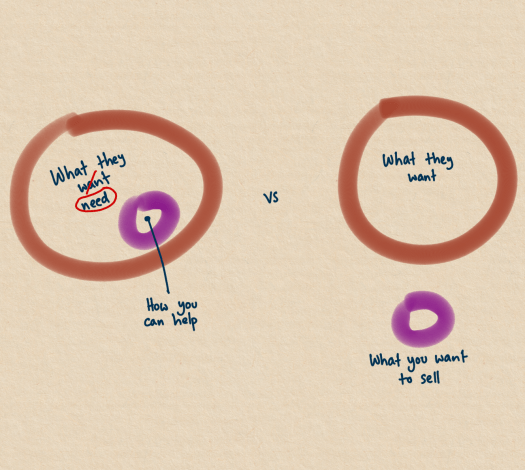
A much better approach, in my view, is to take the time to listen and understand what someone really needs.

When you understand that you’ll be able to see how you can help.

And if you do this in the right way there’s a good chance that the person you’re talking to will see that as well.

They’ll see the value in the help you’re offering and can work out if they can afford to have you on their team.

The challenge here, then, is for you to understand everything they’re facing – but how do you go about doing that?

After all, that’s an infinite amount of information – where do you start and where do you stop?

We’ll look at that next.

Cheers,

Karthik Suresh

How To Start Spotting Patterns In The Conversations You Have

loops-in-conversations.png

Thursday, 5.33am

Sheffield, U.K.

From where we stand the rain seems random. If we could stand somewhere else, we would see the order in it. – Tony Hillerman, Coyote Waits

One of the things it took me a while to understand is that you never experience the same situation twice.

For example, let’s say you develop a solution for a particular situation – you have a client who needs something doing and you create something that solves their problem.

If you now want to go out and do that for other people the temptation is to scale it, to standardize, to duplicate.

That seems like the sensible thing to do – after all, if you’re making cups you might as well make them all from the one mold.

Now, that way of thinking works fine with products, where a cup is a cup is a cup but it’s less useful when it comes to services.

And the reason for that is that services involve people, and the people in one situation are going to be different from the people in another situation, and the first challenge you will face is that the new set of people will want to know how your solution will work for them in their situation.

With services, then, rather than having a standard approach where you do the same thing for everyone you need to have an approach that is able to cope with variety – which can adapt to the kinds of things people ask for.

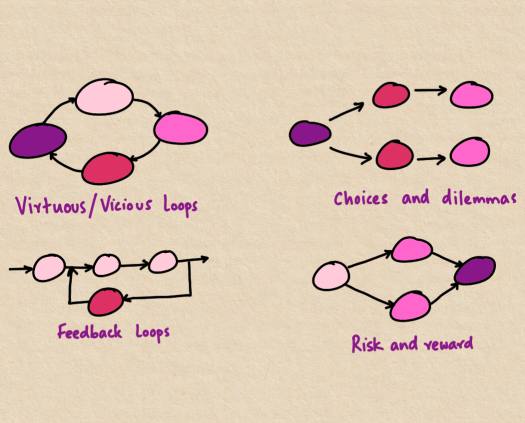
That doesn’t mean that you have to start from scratch every time – there are patterns that you can look out for, patterns that you will see again and again and you need to develop the skill to see these patterns by asking questions that reveal them to you and the people around you.

What kinds of patterns will you see?

Virtuous and vicious loops

Loops are things you will see all the time.

They have a variety of names but really it comes down to one thing after another in a circle.

The question is whether the circle is doing well or poorly for you.

For example, if you do something that compounds over time – put money in a savings account, follow a daily routine, go for a walk every day – then you’re probably going to end up better off, achieving more and healthier over time.

And the opposite is going to happen if you keep spending more than you earn, lounge on the sofa all day and chain smoke.

Now, studying loops can take on a fascination of its own, especially when you start looking at interacting loops.

The idea there is that some loops reinforce things while others balance them out, so you end up with this constant, dynamic interplay between things.

And if there is a delay in the process – something happens, you wait, and then something else happens you get oscillations, swings and lots of noise in what’s going on.

Being able to see a loop can take time – which is why you should never react to the first thing you see, but instead follow what happens next and what happens after that.

If you start to see where the connections are and where things go round and round then you’ll be more likely to figure out the point at which intervening is going to be most useful.

Choices and dilemmas

Another thing you will see often is choices and dilemmas – what road to take when you come to a fork.

You perhaps have few truly life changing situations like this – I can remember only a few anyway.

And it does help to have a way to think through the options and complexities and select the best path.

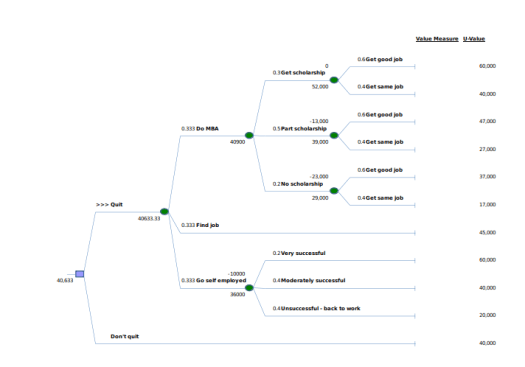
I did use an approach involving decision trees when I made a big choice – whether I should go and do an MBA or stay at work.

I went back to my files to find that decision tree and you can see it in the image below.

decision-tree.png

What’s interesting is that the actual monetary difference between doing and not doing it is very small in the analysis.

But the process of thinking it through helps you work out which road you really want – but with a clear view of the risks you are taking.

With dilemmas you have a different problem – when both roads lead to problematic outcomes.

In that case you have to take the least worst path and that does involve difficult decisions.

Feedback loops

Another kind of situation you might face is feedback loops, where the output from one thing is fed back into the input of a previous thing.

You’ll often see this in how your manager works with you – when they ask you to rework something because it doesn’t work for them.

But you’ll also see it in your own work – when you do research, work on a paper or a presentation.

You’ll have a first pass and then refine your material based on what you think of the output.

That iterative, feedback led approach is crucial to getting a good piece of work done – no one ever gets it perfect the first time.

You have to build in time for feedback, for review, time to digest and consider and come back and change.

All too often we rush into things, try and get stuff out quickly.

I know I’m one for that – I like writing and creating and then I Want it off my desk,

Re-reading, revising, editing – all those are things that are much less interesting, that take up more energy and that I find hard to do.

But you have to find ways to help yourself do the things you find difficult to do too.

Risk and reward

And that takes us to another pattern, one where we may have more than one way to do something and we have to figure out which one we’re going for.

Or, more importantly, when we’re going for one.

A good example here is the popular idea of a side hustle – where you have your job and you also have income generation on the side.

There are many examples of entrepreneurs who keep going with their main job while working on their own projects in their own time.

You might feel like you have to quit your job and devote yourself entirely to your idea but that’s a big risk.

You’re probably better off trying to get it off the ground while still bringing in an income rather than putting yourself in a that situation where you jump off a cliff and have to build your parachute on the way down.

If you can do both things then you can shift from one to the other when it’s the right time, when you have enough income coming in from your business so that you can give up your job.

That’s a case of balancing the risks you take and the rewards on offer.

Doing this in practice

When you’re exploring a situation or listening to someone you need to start looking out for these patterns.

Where are the loops, the reinforcing or destructive patterns of behavior?

What are the dilemmas – what’s stopping them from moving forward?

Where is the learning and feedback, what should they pay attention to so that they can improve what happens earlier?

And how can they balance and navigate between options?

You won’t really see these things unless you are listening carefully and completely – so it’s worth taking a look at when that doesn’t happen in the next post.

Cheers,

Karthik Suresh

Why We Need To Get Better At Waiting Rather Than Doing

see-all-the-effects-of-last-action.png

Wednesday, 5.39am

Sheffield, U.K.

Waiting is a period of learning. The longer we wait, the more we hear about him for whom we are waiting. – Henri Nouwen

As a reminder, I’m writing these posts to come up with a first draft for a book project, as I described here.

So far I’ve got 19 posts, 20,000 odd words, jumbled together, spilling out.

And maybe it’s time for a little bit of reflection, some angst, a look back at whether this is working at all.

You see, what I’m trying to do is make sense of thing – first for myself and then in a way that makes sense to others.

But that’s a difficult process, more difficult perhaps than many of us realize.

Maybe it’s because we are brought up to think that we have to be active, always moving, always working, always driving ourselves as hard as we can because…

That kind of thinking does seem to have resulted in the world we have today – none of it is the result of passive acceptance of the status quo.

Animals, after all, do just what they have to do, nothing more – and you don’t see them going around inventing writing or going to the moon.

So, in principle, doing stuff is a good thing.

Is doing too much a good thing as well?

The picture above shows you a wave form – it’s been a while since I did physics and I’ll need to look up the exact words at some point – but you’ll get this if you imagine a puddle or a pond.

Drop a stone into it.

Now you’ve done something, made a splash.

That act, the energy you’ve transferred to the water by dropping a stone into it sets off the wave.

But then, what do you get?

You get ripples, the wave moving further and further away, getting smaller over time until finally the energy is dissipated and the water returns to being smooth and undisturbed.

To get the full sense of what you’ve done you need to let the ripples happen.

If you throw in stone after stone and stir the waters with a stick for good measure, the waves overlap, the forces are different and you get a mess, a churning, a roiling, your own little storm.

What does this have to do with listening.

Think of any news interview you’ve seen on TV – does the reporter ever give the interviewee a chance to say something fully?

Often questions are posed in a way to force an answer that is hopefully headline material and the reporter interrupts, pushes to try get something newsworthy.

Experienced interviewees, knowing this, ignore the question that is asked and simply say what they want to say.

This dance is not about listening, it’s about performing.

What would listening look like?

You start with the initial disturbance, which is your first question.

That’s the stone that starts it all off.

But then, when you get an answer to that question, you need to watch for the ripples, but to make them visible you may need to ask for something more.

For example, let’s say you sell a technology that halves the cost of doing something for your prospect – you pitch your idea and ask what they think.

They’re enthusiastic – anything that saves money is worth considering.

That’s your first response.

Now, if you have ever actually gone through the process and tried to get them to sign, you’ll know that it never is that simple to get the deal done.

Why is that?

One reason that comes up again and again is that the people involved didn’t take the time to see the big picture – they went from the first positive reaction to trying to close a deal – and there’s often quite a few other things that you might not see.

For example, the technology may cut your costs but you have to spend money up front.

So the impact on cashflow may be a concern.

Now, the technology is sold on the basis that it cuts your costs – but the investment you make will add something to your accounting costs for the year – so that does mean net profits will be down by the cost of the technology.

That’s ok, you say, you’ll more than recover that because of all the savings you’ll make on the projects you have with clients.

But, if the person selling you the technology is also selling to all your competitors then someone is going to try and win business by passing the savings on to the customer by lowering their costs, and so to compete you will need to drop yours.

The person who benefits from more efficient technology is usually the customer, in the form of lower prices.

Not much sticks to the ribs of the person buying the technology.

Now, none of this will be said explicitly – most managers haven’t looked at the theory around these issues.

What they have are rules of thumb, things that protects them from the rippling consequences of a decision.

And that’s one of two things – either they don’t make decisions until they absolutely have to or they ask for huge, quick and guaranteed paybacks.

So, you will find people asking you for 1 or 2 year paybacks.

Nobody wants to take a risk on your bright idea.

Now, you’re not going to find out any of this unless you take the time to listen, to ask questions, to find out which projects have worked at the company you’re talking to and which ones haven’t.

It’s by following the ripples that you’ll get a sense of where the dilemmas are, where conflict rears up, where misunderstanding lies.

All too often sales people think sales is about them talking.

It’s not – it’s about getting your prospect to talk through their situation, their problem and, most importantly, the kinds of solutions that might work for them.

Once they tell you that you know what they’re looking for and you know what you need to deliver.

The questions for you are – can you do that and can you do it well and can you prove that to them?

It’s when you’ve seen the ripples die away that you will be invited to say your piece and that’s really when you should do your bit of talk.

Here’s a model of what that might look like.

questions.png

The thing you really have to get is that it’s not about you.

It’s about them.

And to really help someone else you can’t just throw what you know at them.

You have to first understand them and, in particular, understand what they’re up against.

Let’s dig into how to do that in the next post.

Cheers,

Karthik Suresh