Innovation Teams In An Age Of AI

2025-11-17_innovation-teams.png

How do you build innovation teams in a world of AI?

Pretty much the same way you built teams before AI.

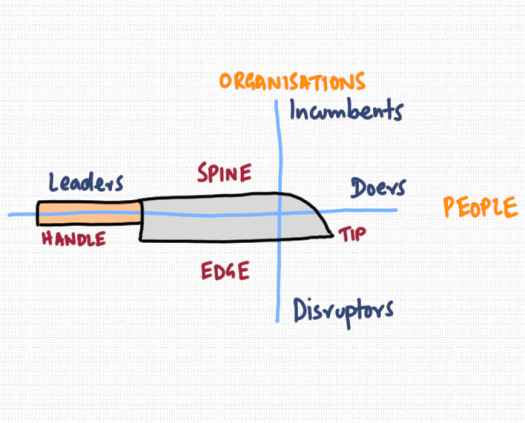
There are four roles that are crucial but most firms only get three right.

You need a developer – someone who can make what you need.

You need an SME – someone who knows what do do.

And you need an architect – someone who knows how something should be made.

One person can deliver all three roles if they have the experience.

But what’s usually missing from the conversation is the voice of the user.

Maybe it’s because users introduce real world complexity and nuance – they bring context.

It’s messy and untidy and hard to solve.

But building for context is what results in success.

Are You Describing Your Value In The Best Way?

2025-11-14_career-strategy.png

It’s a tough time for older job seekers.

We once interviewed an experienced, gray-haired candidate for a sales director role.

It was a no – not because of age but because their responses didn’t match the level of career maturity the role needed.

It got me thinking about how careers evolve, and what employers expect at different statges.

1. Early career: It’s a job

Your first roles are about learning, working hard and doing what you’re asked.

You build capability.

2. Mid-career: It’s about reliability

You’ve shown you deliver.

You’re a safe pair of hands.

The reward for good work is more work – and more importantly, responsibililty.

3. Experienced: It’s about knowing what you offer

Now you’re not just doing the work, you’re shaping how it’s done.

You sell ideas upwards.

You say, “Here’s what needs doing, and why.”

4. Senior: It’s about bringing about change

You recognize patterns – using knowledge and experience gained over decades.

You know what’s coming next, what needs to happen and what’s stopping us from getting better.

Your value is helping stakeholders in the organisation align, improve and move forward.

That salesperson we met?

We wanted level 4 vision – how they’d transform our go-to-market, upskill the team, build strategy.

What we got were Level 1 answers: “I’ll do anything you need me to do.”

I don’t think every rejection is about age.

Sometimes it’s because the way we describe the value we bring hasn’t matured as we have.

Should You Use AI Less Rather Than More

2025-11-11_ai.png

Should you use AI less rather than more? Extracts from a philosophical and a legal opinion.

Our goal as thinking beings should be to cultivate the faculty of reason – according to Daly (2026) – working on habits to develop excellence in five intellectual virtues.

These are:

  1. Knowledge of one’s field
  2. Intuition based on knowledge
  3. Wisdom in how one’s field relates to life and society
  4. Decision-making skill in how to achieve a desirable end
  5. Practical ability to make something using reasoning

The use of generative AI threatens the development of all these virtues.

The problem is that we experience sustained cognitive declines by outsourcing these habits to generative AI.

We literally get more stupid.

If that wasn’t enough the case for using Gen AI – that it makes us faster and more effective is undermined by Yuvraj (2025)’s verification-value paradox hypothesis.

In a nutshell, this hypothesis argues that the time saved by using Gen AI is offset by the increased time needed to manually verify the outputs from Gen AI.

This is because truth matters. Knowing that a collection of words belong together statistically is not sufficient justification to use them uncritically.

Verify. Then use.

Our cognitive skills matter. We should be very sceptical when it comes to replacing or diminishing them.

REFERENCES

Daly, T., 2026. A ‘low-tech’ Academic Virtue Ethics in the Age of Generative AI. J Acad Ethics 24, 13. https://doi.org/10.1007/s10805-025-09683-3

Yuvaraj, J., 2025. The Verification-Value Paradox: A Normative Critique of Gen AI in Legal Practice. https://doi.org/10.2139/ssrn.5621550

Knowledge As The New Foundation For Business Value

2025-10-31_knowledge.png

What explains the $100m to $1b salaries being paid to top AI researchers?

The way business value is created has changed forever – but our mental models haven’t caught up yet.

What is value anyway? In the 18th century, it was all about land. In the 19th, it became about labour. In the 20th, the narrative shifted to resources.

And now? It’s knowledge.

I was reading Grant (1996) and a quote stopped me in my tracks.

‘All learning takes place inside individual human heads; an organization learns in only two ways: (a) by the learning of its members, or (b) by ingesting new members who have knowledge the organization didn’t previously have’ (Simon, 1991: 125).

Some people think knowedge is safe in organisational rules and procedures. But we’ve all seen what happens when a key person leaves, and someone else picks up that rule book and finds it’s useless.

Will AI rescue us? That’s still up for debate – maybe if we can fix hallucinations and guarantee quality output. It’s still not clear if this is the answer.

But if these two are mirages – if knowledge can only be held and exercised by individuals, the foundations of shareholder value shift under our feet.

Value becomes about people, specifically ones that can create knowledge and apply knowledge. Finding ones that can do both is like hunting unicorns.

And that perhaps explains why some companies are willing to pay so much for them.

REFERENCES

Grant, R.M., 1996. Toward a Knowledge-Based Theory of the Firm. Strategic Management Journal 17, 109–122.

Simon, H. A. (1991). ‘Bounded rationality and organizational learning’, Organization Science, 2, pp. 125-134.

Why We Should Use Systems Thinking More

2025-10-28_systems-thinking.png

A recent HBR article by Bansal and Birkinshaw (2025) suggests we should use systems thinking more, especially when it comes to complex, wicked problems.

They argue that we often reach first for two approaches that seem to promise quick results.

Breakthrough thinking cuts through the mess, dealing with a knotty problem by simply cutting the knot.

Design thinking focuses on users – how they interact with products and services and how that can be made better.

But some situations seem intractable. They’re so complex and wicked that something else is needed.

Systems thinking looks at the big picture, at the interconnections between elements, and what might happen if we intervene – including knock on effects elsewhere.

We try and engage with the complexity of a situation but some systems thinking approaches can feel quite muted, like they almost lack ambition.

They seek to incrementally improve situations, not radically transform them.

That’s partly because radical approaches cause pain. And demolishing existing institutions without a coherent plan for a replacement tends to cause more problems down the line. And it’s partly because you’re working with people and have to deal with politics and culture along with the situation itself.

There’s no clear cut answer, and there’s a place for all these approaches.

The trick is knowing when you to cut, when to fix, and when to improve – and choosing the approach that helps most.

REFERENCES

Bansal, T., Birkinshaw, J., 2025. Why You Need Systems Thinking Now. Harvard Business Review 103, 124–133.

Making It As An Entrepreneur

2025-09-19_entrepreneur.png

Can a career manager make it as an entrepreneur?

Yes, if they get one thing right: openness.

I’ve always worked in startups – in that space where we try and identify opportunities, build systems and try to create value for clients.

In that time I’ve worked with lots of managers in large organisations. We’ve even hired some of them.

Most found the startup pace hard.

It’s the lack of support that gets you – having to do everything from creating a complex spreadsheet to fixing the printer yourself.

But that’s just the foundation. The boring but necessary stuff.

The real difference is whether they’re open or closed.

I must confess – I’m naturally quite closed.

As an engineer I’m heads down, focused on work, building things.

Fortunately, I work with partners that are the opposite of me and I’ve learned over time that being open is an essential skill to develop.

Open people are heads up. They connect with others, build relationships and look out for opportunities. They’re optimistic and politically astute. They’re likeable.

Drucker said that the purpose of business is to create and keep a customer.

Being open is how you do that.

Adding Consulting Services

2025-09-17_muck.png

In consulting, we add services only when it’s clear that clients need work done and every other option is worse.

Sometimes it feels like mucking out stables.

The work never ends, and just when you’re done it’s time to start again.

Take working with utility data, for example.

When I started out suppliers would email you billing files every month. Then portals came along and turned a one minute task into an hour of watching spinning loading screens.

And without the data, you’ve got nothing.

So we hired people, trained them as analysts and got them collecting and checking these bills.

We thought many times about outsourcing the task – but it takes a certain kind of person to care enough about getting this right – the detail, precision and technical complexity puts off most of the population.

And getting data and making sure it’s clean is the first step to doing everything else we do.

So we kept doing it in house. Because clients needed us to. And we had learned how to do it well.

This is the challenge clients have with outsourcing work- especially work that has to be done but isn’t strategically core to your business – like energy and carbon data management.

Jim Collins said it best – “If you can’t put your best people on it, then find someone else and get them to put their best people on it”.

Go Back To Doing What You’re Good At

2025-09-16_ai.png

Two years ago I started building AI tools to help me with tasks. Now, I’m leaning back into doing some of them myself.

Things that are too easy to do have no value. One of the few things I remember from the one economics module I took was that the price you ask will drop to your cost of production in a competitive market.

Work that AI does for you for pennies is only worth pennies to your buyer. You may imagine that your prospects will value the time and effort that went into crafting your prompts but really they’re thinking two other things.

  1. Can I do this myself for free?
  2. Can someone else do this for less?

The downward pressure is inexorable.

Let’s take one particular example – using AI to summarise documents.

A couple of years back I built a simple tool. It took pdfs, converted them to text, split them into segments that would fit in ChatGPT’s context window, and then automatically extracted the key points that mattered.

Not as summary – a distillation. The job was to remove the fluff and leave the facts and key strategic points.

The advantage – it was quick. The disadvantage – it did something that wasn’t really worth doing.

A document worth reading will already be structured in a way that does this for you.

An introduction or executive summary will lay out the key facts and points.

The rest of the text should only include information that is important and relevant.

The only reason not to read the whole document is if it’s badly written. The logical response is to ignore it, not use AI to summarise something that isn’t worth your time to read.

This is just one example – the lesson for me is do your own reading. And your own writing.

You’ll learn more that way.

I still use AI every day. It’s a powerful tool.

We just need to figure out what’s it does that’s really valuable.

Choices, choices, choices

2025-09-12_burritos.png

How would you answer if someone asked what you were most proud of?

Burritos.

That’s was the answer that popped into my mind.

Admittedly, I was making burritos at the time.

Here’s the background. A year or so ago, I was making lunch packs for the kids.

White bread or a wrap. Ham. Cheese. Mayonnaise. A sliver of lettuce.

This was bothering me. For a few reasons.

The news was talking about the carcinogenic effects of processed meat. You had the embodied emissions in red meat. And the health problems of a diet high in animal protein.

Should I really be shovelling this stuff into my kids?

But they loved the stuff.

Then I thought about burritos. And the more I thought about them, they seemed the obvious solution.

Slow cook dry beans in batches. Red, black, pinto, chickpeas. You’re spoiled for choice. Add salt and spice. Nothing fancy. Rice as a base on a wrap. Beans on top. Chopped salad and tomatoes.

I tried it as an experiment. Sent the kids off with the new packs. They came back glowing. “That was the tastiest lunch ever.”

My morning now looks like this. Make porridge. Make burritos. 11 a week for the road warriors. Over 400 a year. Thousands as they go through school.

It’s the small things one remembers.

Is The Jobs Market Broken?

2025-09-11_jobs.png

I’m a little confused about the jobs market at the moment.

I’m a little out of touch. But when I was starting my career it was the down bit of the dot-com bust.

I sent out hundreds of letters and got no response. It didn’t feel like there were jobs out there, at least not any that I could get.

But it seemed like it was a fair shot – if you kept trying you’d get something.

I’m not sure that’s the case now.

I keep hearing and seeing that people apply for a thousand jobs and hear nothing.

Okay – first, you can’t thoughtfully apply for that many jobs – it’s pretty much spam.

And on the other hand, recruitment managers must be overwhelmed by applications, and there’s got to be businesses set up just to maximise applications and play a numbers game.

So, the standard apply and be judged fairly system must be broken.

Which means the people getting the jobs, the opportunities, must be getting them through connections. Through knowing someone that can cut through the mess.

Technological solutions are making it easier for the haves to keep what they have rather than creating a level playing field.

Of course, this is a pessimistic zero sum view.

If technology destroys the existing job market something new will come up.

The people succeeding are the ones using unconventional ways to get ahead – building portfolio careers from the age of 16, leaning into new technology.

There are people creating new careers that didn’t exist a year ago. New business models that are being floated and tested.

What would you tell your kids now? Do you think the university -> job -> pension route is now done for?