When will we have have more zero energy buildings?

costa-coffee-eco-pod.png

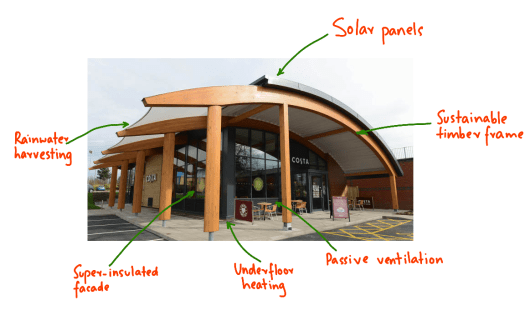
In 2015 Whitbread, the parent company of Costa Coffee, announced that they had built the first zero energy coffee shop in the UK.

In an example of how constraints help create innovation, the building has a number of features that help it reach the ‘zero energy’ standard including:

  • A frame made from sustainable wood rather than steel
  • Solar panels
  • Capturing and using rainwater
  • Lots of insulation to keep heating and cooling needs low
  • Use of natural or passive ventilation
  • Underfloor heating

Two of the three things on that list, solar panels and rainwater harvesting systems can be added to existing buildings.

The others involve more work and disruption – insulation, changing heating systems and installing passive ventilation can’t be done without getting in the way for some time.

And changing the frame just isn’t an option for most buildings.

The amount of energy lost because a building structure is inefficient can be considerable.

These parts of a building also have a long life cycle and may only be replaced or upgraded in some cases after more than 60 years.

Organisations that look at the life-cycle cost of their buildings may find that the long-term benefits of investing in more energy efficient design now can create huge savings over time.

But they are also fighting the short-term needs of their organisations to conserve cash and limit budgets.

So, will things be better in the future?

It is easy to predict a future full of super-efficient buildings such as Costa Coffee’s, a de-carbonised transport system and zero-carbon development.

The problem is that there are many possible futures. Which one is most likely?

A good way to predict the future is to ask what you have done so far.

In other words, instead of asking “What are you going to do to become more energy-efficient”, you ask, “What have you done so far to become more energy-efficient”.

For the vast majority of people and organisations, the answer is going to be “not much”.

And for a futurist, that suggests that in the future, people will still not do very much.

A key reason for this is that the costs of investing in projects like Costa Coffee’s needs resources now and the benefits come later.

As human beings, we are built to overvalue the present and discount the future, and this naturally leads to inaction and apathy when it comes to looking at such projects.

This is why regulation and government action in this space is so important to spur innovation and creativity.

So, while in many areas we need the government to get out of way of business, building standards is one where we may need more intervention and not less to create a low energy future.


Why constraints are crucial to innovation

person-climbing-into-box.png

We are often told to “think outside the box”.

Working within constraints, however, may be crucial to actually being able to innovate and create something new and different.

When you are free of any constraints or limitations, it is difficult to see what will truly make a difference because you don’t really have anything to measure yourself against.

You might end up doing new things for the sake of newness, rather than because they are going to be a improvement on what has happened so far.

Take, for example, Frank Gehry’s design of the Walt Disney Concert Hall, hailed as one of the “most acoustically sophisticated concert halls in the world”.

According to the architect, the interior space was designed for stringent acoustic standards, and the limations and constraints that resulted from the standards drove the design and innovation choices that have made the hall a landmark.

A simple constraint can focus attention and create the conditions for generating innovative solutions.

Take the idea of Zero Emissions Cities. If you wanted to reduce emissions in a city to nothing, what would you do?

Governments and city officials would need to radically change their policies and incentives to support zero emissions energy initiatives.

You would need to think about how the energy infrastructure could be upgraded, the issues around smart mobility and logistics – moving passengers and freight around, and the way in which the environment and ecosystem would be managed.

The possibilities for innovation are endless – once you have imposed a constraint or target.

Coming closer to home, constraints can increase your own productivity.

One of the biggest time sinks for us is mobile phones. The endless screens mean that you could keep scrolling and reading for ever.

Software with features can result in you spending more time with the features and less time doing any useful work.

Most advice around personal productivity involves turning off phones and distractions and slimming down your work tools to the essentials needed to get on with the job.

According to Donald Sull of McKinsey, the key to improving the way in which you innovate is to pick simple rules to guide how you work.

Having these rules helps you prioritize, to assess where you are, to keep an eye on whether you are on target and can make a step change in improving your innovation processes.

You do need to think outside the box to come up with ideas and in order to be open to possibilities.

When it comes to action and innovation, however, the crucial next step may be to choose the right box to step into and work within.

Should knowledge be accessible to everyone?

closed-door-or-open-door.png

Publically funded research in Europe could be free to access by 2020 if the European Union carry out necessary reforms.

At the moment, despite there being more information available than ever before, access to high quality research is still limited to people who can either pay for it or belong to universities that can afford the subscriptions.

This freezes out the vast majority of people from accessing scientific knowledge.

The Open Science movement is an attempt to change this, making the results of research and the underlying data more accessible to all levels of society.

The main arguments against open science are:

  1. The peer-review system operated by journals maintains quality.
  2. Scientists should be compensated for their work
  3. Widely available data could be misinterpreted by lay people.
  4. Making certain kinds of research findings public could mean they are misused, for example to create biological weapons.

The proponents of open science argue that:

  1. Publically funded research should be available to the public.
  2. Open access means that there will be more review by a more distributed readership.
  3. Open science will make findings more reproducible.
  4. More people can apply the findings

For individuals and businesses, the easiest thing to do right now is rely on the first few results of a google search to provide all the evidence they need to make a decision.

This results in inevitably narrowing the amount of information that is taken into account when analysing a situation and deciding what to do.

One of the benefits of a well written paper is that the author takes the effort to examine prior lines of thinking, point to seminal works in the field and set out why the information in the paper is new and relevant to you.

This contextual approach is crucial – relying on easily accessible information can create a bias and it is important to consider alternatives to the options that seem most obvious to make good decisions.

There appears to be little truly useful scientific information out there to help businesses improve how they operate, especially ones that operate in niche manufacturing fields.

Perhaps making scientific research more open and accessible is one way to change that and make organisations more productive and sustainable.

Some open science resources are:

How to create energy from underwater kites

underwater-kites.png

In 2015, a £25m project was launched to install underwater “kite-turbines” in Holyhead Deep, off the coast of North Wales.

Swedish developer Minesto has built the turbines and plans to commission the project in stages, starting in 2017 with a 0.5 MW demonstration unit of their patented Deep Green ocean energy power plant.

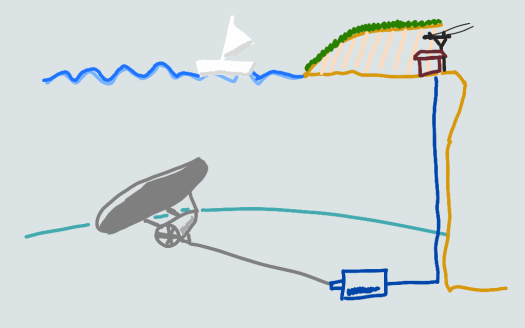
Unlike airborne kites, which turn a generator on the ground, these underwater kite-turbines have a wing with a turbine attached directly to it.

The underwater current lifts the wing and the kite is steered in a figure-of-eight at several times the speed of the current.

The water flows over the turbine blades and turns them, producing electricity, which is then transmitted through to a cable to the kite-turbine’s tether on the seabed and from there to the grid onshore.

Most existing tidal technology is large, fixed and can operate only in currents that are faster than 2.5 meters per second.

Because the movement of Deep Green increases the speed at which currents flow over the turbine, it can operate at lower speeds than fixed installations, down to 1.2 meters per second.

Each turbine is rated at between 150 and 800 kW and can work submerged in depths of 15 meters to 300 meters.

Kite-turbines can also be up to 15 times lighter than fixed alternatives, at around 10 tonnes.

The locations for these generators have to be chosen so that they don’t interfere with shipping or other sea users.

Following the demonstrator project in 2017, the site will be gradually expanded to house 20 power plants producing 10 MW.

Minesto have also announced that they are looking to take the eventual size of the array to 80 MW.

The cost of energy from this technology could be around £1 million per installed MW at this point, although costs could decrease with scale.

The UK is in a unique position to harvest energy from tidal resource – it has around half the European tidal resource and 10-15% of global resource according to Minesto.

Tides are also very predictable, making this kind of technology very attractive if it can be deployed at scale because it uses renewable resource and its output can be predicted with a high degree of accuracy.

What the prices of batteries mean for storage applications

Battery-price-chart2.png

The prices of battery packs fell from close to $1,000 per kWh at the start of the decade to $227 in 2016, a drop of around 80% according to a McKinsey study released at the start of the year.

Current projections put them on course to fall below $200 per kWh by 2020 and below $100 per kWh by 2030.

What impact does the cost of batteries have on the overall business case for producing an electric vehicle?

Some interesting numbers are discussed in this Tesla forum article:

  • There are claims that Tesla’s internal cost of batteries ranges from $150 to $240 per kWh now.
  • GM revealed that their battery cost at cell level was around $145 per kWh.
  • A 60 kWh battery pack would make up $10,440 of the $37,495 Chevrolet Bolt at a pack price of $174.

This means that the cost of batteries for an electric vehicle drops to under a third of the price of a car and could drop to under a fifth by 2030.

Lithium-ion technologies dominate the battery storage market, making up 95% of new energy storage projects according to McKinsey research.

The same research found that battery storage applications are already economic in four important areas – demand charge management, grid scale power, small-scale renewables and storage and frequency response.

They also note that in applications such as demand charge management and small-scale renewables, lead-acid batteries may work better than lithium-ion.

It is likely that in the coming years packages of energy storage solutions for industrial and domestic use will become simpler and easier to buy and install.

Falling prices as the technology improves in any industry benefits consumers more than the producers – buyers will gain most of the benefit from price reductions in battery technology.

Energy storage has the potential to tranform the energy system as we know it, and it looks like it could happen faster than anyone expected.

When getting a cup of tea is a crucial decision

expectations-and-reality-over-time.png

In one of Austin Kleon’s talks, the writer and artist describes how the process of creative work unfolds.

It all starts with an idea.

It might be an idea for a new piece of art, a book or a charitable project.

It could be an idea for a new spreadsheet model, an asset purchase or a renewable investment.

Those count too – there is no reason why what we think of as “work” can’t be as creative as “art”.

The idea seems like the best thing in the world, especially if you have just come up with it in the shower.

Cue big, excited, smiley face.

Then you start work on that idea and begin to develop it and create packages of work to complete.

As you get deeper into doing that, you start to realise that this might be harder than it first seemed.

Once you get into the detail, various problems appear that you need to deal with as you move things along.

Cue pensive face.

At some point, you reach rock bottom. This is where nothing seems to work and you can’t see a way to fixing all the problems you have.

All you have done so far is in danger of being completely useless. You might just have wasted days/weeks/months/years on this project.

Cue sad face.

This is a crucial point in the process.

This is the time to go and get a cup of tea.

Or coffee. Or whatever that will give you a break and then let you get back to work.

It’s when you keep going and work through to the next stage in the process that things start to get better.

Just by spending time and working on the problems, you come up with ways to solve them and get things moving again.

It doesn’t seem that bad now.

Cue return of pensive face.

Then you’re starting to speed up again, and you enter the final stretch.

At this point, the work is done – whether it is art, writing, a spreadsheet or a construction project.

It’s perhaps not reached the lofty heights that you first imagined, but its a good piece of work and it is now done and you can be pleased about it.

Cue smiley face.

The message in Austin’s talk is that you should think “process not product”. Creating good work is as much about working on the process as on the product.

And a crucial part of that process is being able to recognise when you need to take a break and get a cup of tea, so that you can return to work and keep going after that.

Why do fuel prices go up fast and down slow?

Gas-stations-opposite-each-other.jpg

Households in the UK spend between 12 and 27% of their disposable income on transport, of which a third can go on the cost of fuel.

People spent, on average, £72.70 on transport in 2016 and the cost of petrol and diesel was the biggest contributing factor.

Oil prices went up and down in 2016. At the start of the year, they were low and went lower on abundant supplies, with the spot price of crude oil heading towards $25 a barrel.

In the second and third quarter of 2016, producers responded with spending and production cuts, which helped prices head back towards $50 a barrel.

By the end of the year, OPEC’s decision to curb production and stick to quotas and an agreement from other countries to reduce output sent prices towards $55 a barrel.

So, in a market where global prices can double or halve in a year, why do these increases or decreases not show up in prices at the pump?

A litre of unleaded petrol in the UK went from around 102 pence per litre to 115 pence per litre by the end of the year.

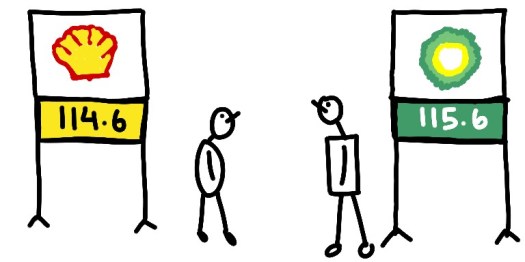
We’ve all seen that when global oil prices fall, the reductions don’t seem to show at the pump. But when they rise, the price at the pump seems to go up straight away.

Why is this?

It’s not just imagination. It turns out there is a phenomenon, described in the industry as “Rockets and Feathers” that takes place.

In a commodity market, where prices are posted daily for all to see, as in the domestic fuel market, retailers know what each other is charging.

If oil prices go up, one retailer can raise prices in the knowledge that others in the area will see the increase, and feel like they can increase their price as well to benefit from the increased margin.

As everyone can see the posted price, this can even act as a signal to other producers – although there is no actual collusion taking place.

On the other hand, when global prices fall, each retailer can wait for someone else to take the first step.

Again, because they can see all the prices, there is no need to drop their price until someone else does first.

So there are different incentives when prices go up compared to when they go down.

This is why price go up fast, as one retailer raises its prices, the others notice and they raise theirs as well. On the way down, everyone waits for someone else to make the first price reduction.

And so, prices rocket up and drift slowly down.

How long will it take before we are all driving electric cars?

Conventional-cars-vs-electric-cars.png

777,497 electric vehicles were sold globally in 2016 while global car sales in total were 77.31 million, meaning that electric vehicles made up around 1% of sales.

Electric car sales are growing fast, although from a small base. They increased 41% in 2016 and have shown a 32% Compound Annual Growth Rate (CAGR) over the last four years.

Conventional cars, on the other hand are forecast to increase sales by 1.5%, with nearly 94 million units of light vehicles sold in 2017.

The last few years have seen a supportive environment in the US, Europe and China – all key markets for electric vehicles.

California, for example, accounts for more than half of electric vehicle sales in the US because of its zero-emission vehicle (ZEV) mandate that requires manufacturers to sell a certain percentage of electric vehicles.

People are nervous, however, about U.S policy under the new administration.

China has a reduced vehicle exise duty of 7.5% for qualifying vehicles that is expected to support auto sales in the world’s largest car market, with 28 million units expected to be sold in 2017.

Analysts at UBS predict that electric vehicles could reach cost parity with conventional vehicles as soon as 2018 because they will become cheaper to produce.

At present, the Tesla Model 3 is expected to lose $2,800 per car for the base version while GM loses $7,400 per car on every Chevy Bolt.

Car manufacturers need to achieve scale before they will start to break even.

While the running costs of electric cars are much cheaper than conventional vehicles when charged at home, around a sixth of the price at £2-4 per 100 miles, there are some things to watch out for.

Charging at rapid chargers away from home could cost as much or more than filling up with fuel.

Home charging systems add to the total cost of ownership and, as electric vehicles increase in number, will place strain on the grid in areas with high purchases.

The vehicle industry has long product cycles – cars are used for many years, and high capital investments.

This means that change is necessarily slow as the entire system adapts to a changing transport mix.

Oil is still expected to make up a third of European energy consumption due to transport demand.

If governments start banning sales of non-electric vehicles between 2025 and 2040 as many have indicated, we could all be driving electric vehicles by 2050-2060.

Where does the world’s LNG come from?

world-LNG-supplies-2016.png

Three quarters of the world’s natural gas is used in industrial applications and for power generation.

It burns more cleanly than oil or coal, which means that emissions from natural gas are lower.

As a result, governments around the world have policies that make using natural gas more attractive than the alternatives.

The IEA estimates that global gas consumption will grow from around 120 trillion cubic feet (TCF) in 2012 to 203 TCF by 2040.

So where does this gas come from?

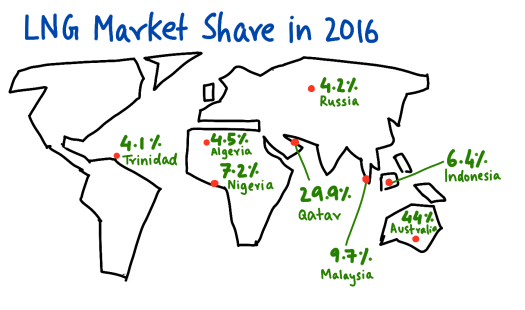
The graphic above shows the top exporters of LNG by market share in 2016 according to the IGU World LNG Report 2017.

Australia now has the largest market share of LNG, going from 12% in 2015 to 44.3% in 2016, a huge increase.

Qatar remains an important source of gas, although the problems it is currently experiencing with its neighbours may have an impact on gas production this year.

Russia, despite its enormous gas reserves, is a relatively small player in the LNG export market.

The one to watch is the United States.

In 2016, the U.S. had a market share of 1.1%, making it the 16th on the list.

Over the next few years, however, it is expected to ramp up exports significantly.

In the next decade, Australia and the United States are expected to be the dominant exporters of LNG to the global market.

Who will win when it comes to developing clean energy technology?

VC-Investment-Factors.png

A series of high profile failures and strategic changes by cleantech companies raise questions about the whole sector.

Acquion energy, a maker of battery systems filed for bankruptcy in March 2017 after raising nearly $200 million from investors including Bill Gates.

Lightsail Energy, a startup co-founded by a charismatic prodigy, Danielle Fong, raised funds to develop compressed air storage energy systems, but is now changing tack to sell its containers to gas markets.

Solyandra a manufacturer of thin film solar cells, filed for bankruptcy in 2011, leaving the US Federal government liable for half a billion in a taxpayer funded loan.

An MIT study in 2016 found that more than half of the $25 billion invested in clean energy startups from 2006 to 2011 was lost, effectively result in a drying up of capital and investment to the sector.

What is going on here?

Many companies have still not figured out the economics of energy. The ones that will survive from now on will have to get their heads around some key factors.

1. Money

Cleantech companies often create new technologies, materials or processes.

These require investment in research and testing facilities, demonstration units and development installations or a track record in order to be accepted by consumers.

This means that they need a lot of money to invest in their infrastructure.

Many companies ran out of money before they created a sustainable income stream.

2. Time

Bringing a new cleantech product to market can takes months and years rather than days and weeks.

End user products such as battery packs have to go through rigorous testing, product certification and safety checks before they can be sold to the public.

The returns on individual technology projects for a customer are also likely to have paybacks that are longer than the typical corporate will accept: 5-6 years rather than 2 years.

As a result, the rates of return to investors in cleantech have been less than in other sectors traditionally backed by private / venture capital.

3: Competition

Electricity is a commodity. Makers of cleantech selling a system that creates electricity cannot control the price of the power from their systems.

They are, instead, forced to compete with existing alternatives in a commodity market.

Even in a cleantech market such as that for solar panels, new technologies struggle to compete against silicon panels.

This is not because the new technologies are not better. It’s just that the massive investment in silicon fabrication facilities worldwide has made the cost of silicon panels fall much faster than alternatives.

4: Policy

A huge amount of momentum in cleantech is driven by government policy.

Over several years, clean energy in Europe and the UK has been driven by subsidies.

In the US, tax treatment for energy from wind has resulted in large-scale developments by the likes of MidAmerican energy.

As we go forward, however, the new Trump administration wants a renaissance in oil and coal and will change policy to support those industries.

5: Buyers

Buyers and investors in cleantech companies are more likely to be existing utilities now rather than VC investors.

This is because the incumbents can add new technologies to their portfolio of existing assets rather than having to depend entirely on the new technology for income.

The energy sector has been around for a long time and change is slow. You need deep pockets to hang around

Summary

In summary, cleantech companies that have a core proposition built around a technology or process may struggle to create a sustainable income stream.

Larger systems are more economic. Scale succeeds.

TEsla has succeeded by going big fast, and its latest thing is to build the world’s biggest battery facility.

The sector will continue to need a supportive policy environment to move ahead, and we will need to wait and see what happens.

This is especially important in the US, given its size and innovative capacity.

Ultimately, the energy sector will be driven by large scale projects and policy – much like it has always been.