How to tell whether you act like a startup or a big business

startup-vs-corporate.png

What is the difference between a startup and an established business? Is a startup simply a small company – a small version of a big company or are they fundamentally different?

Steve Blank thinks so.

Steve is the author of Four steps to the epiphany and writes extensively about startups, their characteristics and the strategies they follow.

Among these characteristics are three crucial ones – and successful startups do these very differently from big companies.

The first characteristic has to do with what they do.

Big companies are good at execution.

They create a vision, agree a mission, set goals and targets, allocate resources and set the machine in motion.

All the parts of the company work in a hierarchy, following what they are programmed to do to head towards the targets they have set.

A startup, on the other hand, searches for opportunities.

It has its eyes wide open, scanning the environment for signs that something is missing, someplace where it can add value through innovating, adapting and creating something new and different.

The second characteristic has to do with how companies do what they do.

The purpose of a company, according to Drucker, is to create a customer.

Big companies already have customers or believe they know what a customer wants – either because they know the market or because they have done studies of some kind.

This means that they can sit at their desks and get on with creating product following their usual process, which is some form of plan-do.

A plan-do approach means that we follow a structured approach to developing a product – starting with understanding requirements, gathering information, developing the product and finally shipping it to customers.

Startups recognise that no plan survives first contact with the enemy.

Instead, they follow a test-learn approach.

This means getting out of the building, going and finding potential customers and talking to them about what they need and testing whether what they say they need matches what our product does.

This matching exercise – sometimes called validation – tells us if we are on the right track or whether we need to change something.

As Gary Halbert wrote, what we need to succeed is a starving crowd – a group of people that are desperate, starving for a particular product or service.

Lastly, the two approach who they recruit differently.

Big companies have lots of roles that they fill with specialists.

A specialist is someone who is good at one thing – sales, marketing, operations.

They do what they do well and competently, but they often don’t have the capacity or ability to do more than they can with their two hands.

Startups need generalists, people comfortable with doing everything and with the ability to do much much more with very little.

Startups eventually want to become big companies, so will recruit specialists, but only later on when the product is more mature and its time to scale up.

In summary, the way to tell whether we act like a startup or an established corporate is to look hard at what we do, how we do it and who we recruit.
How to become better at innovative problem solving

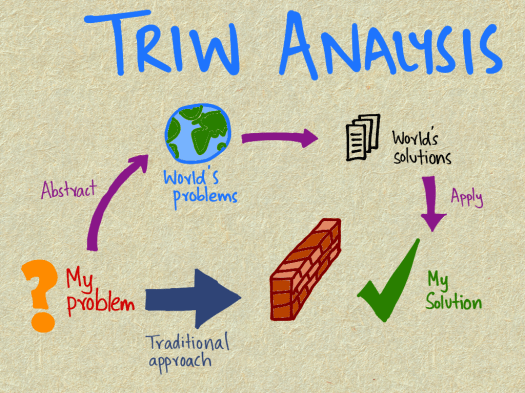
triz-analysis.png

Brian Tracy, in one of his talks to a small audience, begins by saying that he took the time before he came in to read a brief biography of everyone in the room and memorize their photos and job titles.

He looks around and people start to shift in their seats nervously. He points to a person and says, “Your title is Problem Solver”. Another is Chief Problem Solver. Yet another is a Vice President of Problem Solving.

Everyone’s job is to solve problems – the things that turn up day after day and cause big and little issues.

So, how do we normally approach problem solving and how can we get better at it?

The traditional approach when we have a problem is to treat it as something that is just our own – it’s my problem.

We get started working on it and face a brick wall. All the issues, complexities, computations and knowledge gaps emerge.

Eventually, we keep working on it and break through to a solution. Our solution.

That didn’t seem like a sensible approach to the Soviet inventor Genrich Altshuller, who came up with a theory of inventive problem solving, abbreviated as TRIZ.

Altshuller reviewed a number of patents and identified ideas that popped up again and again in innovations and found that around 40 principles could account for nearly all inventive ideas.

Take, for example, flexible films, foils and membranes. These approaches underpin relatively recent innovations such as solar PV coatings, energy generating floor tiles and a coating that makes objects super strong.

TRIZ’s starting point was to solve physical challenges. For example, there are often physical contradictions that limit systems.

These can be resolved by applying principles such as:

  • Time: Schedule differently
  • Space: Separate them
  • Condition: Have the system meet requirements under different conditions
  • Alternative/Structure: Spread contradictions across the structure

The TRIZ approach is little known – it’s not mentioned in the standard textbooks at an MBA level – perhaps because of its origins and issues with translations.

The Internet makes it easy to find this stuff now though. The TRIZ journal has a useful summary of the method, including an example, and says there are over 2 million analyses backing the method spanning fields from aerospace to human resources.

TRIZ is a simple but potentially transformative approach to problem solving.

All too often, we think that we need to start from scratch and work something out.

A systematic approach to using the world’s knowledge could be much more effective, especially now that we have the Internet.

Using it effectively just means that we need to start by retraining ourselves to follow the less traditional route.

What day is it?

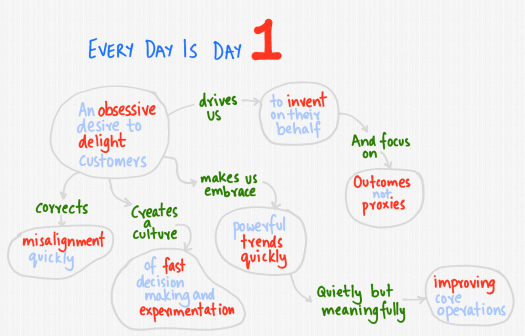
every-day-is-day-one.png

Jeff Bezos of Amazon has a philosphy that he shares with the Securities and Exchange Commission (SEC), and his shareholders.

Every day is Day 1

In his 1997 letter to shareholders, Bezos wrote that this is Day 1 for the Internet, adding that Amazon’s hopes were to create an enduring franchise, extend its market leadership position and take decisions to create long-term shareholder value.

In 2016, the Day 1 message remains unchanged.

Day 2 is statis, he writes, followed by irrelevance, decline and death.

So, what does staying in Day 1 mean?

The picture is a model of Bezos’ 2016 letter which sets out a starter pack of essentials to stave off Day 2.

It starts with an obsessive desire to delight customers, which leads us to try and make things better for them.

This drives us to invent new capabilities and functions on their behalf to make things quicker and easier for them.

Companies that have this kind of focus rely on outcomes – do customers love this and does that show up in market share growth – rather than proxies such as focus groups that show a mild preference between options.

In Day 2 companies, the process is more important than the outcome – everyone is crouching below the parapet.

Powerful trends are sweeping along the corridors of industry.

From artificial intelligence (AI) to nanotechnology, the way in which we do things will be changed by new technology.

Amazon is embracing trends such as AI and machine intelligence to deploy algorithms that make its supply chain and customer experience systems more effective.

Much of this is invisible and quietly but meaningfully improves core operations.

Things just work – and customers are happy.

Many companies, even large, established ones, do not know which strategy will work out of a number of options.

Many companies default to the opinion of the highest paid person – which is okay in some cases, but most of the time we are better off taking decisions fast and experimenting.

Bezos’ uses the term disagree and commit – when we’re not sure give people permission to have a go rather than shutting down an approach just because we think it won’t work.

Finally, and this is something we must have all experienced, it’s easy for approaches to get misaligned.

If groups of people have fundamentally differing views, for example making a choice between doing a service in-house or outsourcing it, then no amount of arguing can resolve this.

It needs to be kicked upstairs, escalated to a team that can make the decision and make it stick, correcting misalignment quickly.

The Day 1 approach appears to have kept Amazon lean and focused despite now being a huge and dominant player.

It also worked for them when they were starting up and small – and perhaps it’s a model that many other firms can use as well.

Time to take a step back from Day 2 to Day 1, in that case.

Why brand awareness is the most important thing for an organisation now

customer-decision-journey.png

Things sell themselves these days.

Whether we’re talking about placing products in front of consumers, or trying to persuade others to adopt a particular strategy in an organisation, the point at which we reach them is crucial.

The traditional approach of a funnel, where we go through defined stages is starting to show its age – because it can’t cope with the idea that consumers may know as much, if not more than product and service providers.

Take recruitment, for example.

For a long time, the only way for a person to understand what it was like working for a company was to ask friends and family who worked there, or apply for a position and spend some time working there.

So, they entered a funnel – experiencing the recruitment process, negotiating salaries, starting work, mixing with their colleagues, understanding the hierarchy and so on.

Now – they have access to much more information on the working experience at a company – especially if it’s a large one.

For example, Glassdoor has 5,021 review of Barclays, 8.596 salaries and 1,920 interviews with employees.

A prospective employee looking there will know more about how the company treats its staff than almost anyone else internally, especially the top management.

The democratisation of information has levelled the playing field in every aspect of organisational interaction.

Most service and product providers understand their products in detail, but spend less time comparing themselves with others than potential consumers.

The consumers therefore are more likely to have a better understanding of the market and trends and the differences between brands, just through the basic research they do before engaging with providers, than the brands do themselves.

This change in the way of how consumers interact with products and services has been called the customer decision journey by McKinsey.

In this model, consumers start with an initial consideration set, a collection of brands that they are aware of and may have been exposed to recently.

They then get information from a wide variety of sources – internet reviews, personal recommendations, traditional media – which all contribute to an active evaluation of their options. At some point, they reach a moment of purchase, where they decide to go with a particular option.

According to the customer decision journey model, this is where the hard work begins.

The postpurchase experience then shapes success or failure.

Many people, once they make a decision, experience a degree of anxiety.

The first thing they then do is to go online and check that they have made the right decision – looking for reassurance from others in the same position.

This works, sometimes, as they get more information, realise that they are with a good brand and are reassured. On the other hand, they may see more information from competitors that show them what the alternatives might be.

The trigger for entering a loyalty loop and making follow on purchases depends then on the quality of what they get and their ongoing assessments of the options open to them.

This continuing change in the way consumers make decisions is changing everything from sales to recruitment in an organisation.

And the starting point – the thing that one must do to even play the game – is to be included in the initial consideration set.

And that means that the potential consumer needs to be aware that a particular organisation exists – it needs to be discoverable.

Which brings us back to the importance of brand awareness: why it matters so much now, and why it will become even more important in the years ahead.

When will a new app or IT solution benefit our work?

TAM-TTF-model.png

For many of us, a standard work IT package consisted of a laptop or desktop and a Microsoft Office suite.

That has let us do most things for a number of years, and remains a solid foundation for the kind of day-to-day office work we need to complete.

In most functions, however, the number of tool options are exploding.

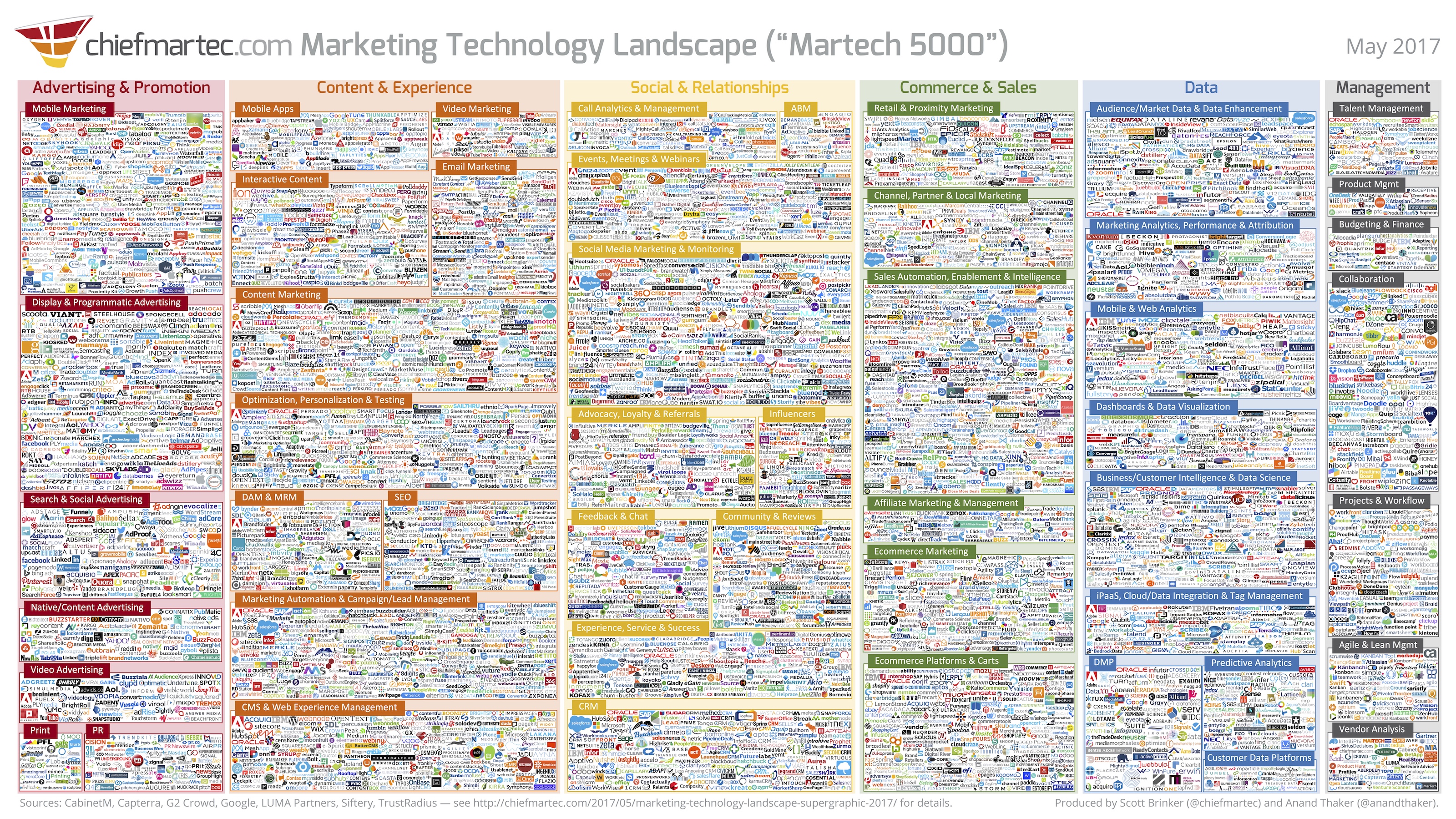
Take the graphic below from Scott Brinkler who writes the Chief Marketing Technologist Blog. It shows the marketing technology landscape where we can now choose from 5,381 solutions from 4,891 unique companies – and has grown from around 150 to 5000+ in six years.

marketing_technology_landscape_2017_slide.jpg

A similar transformation, although less dramatic, is happening across other organisational functions.

What are the things that managers who are tasked with investing in tools for users that need information systems and tool developers trying to develop such tools need to keep in mind – given the inevitable competition they will face?

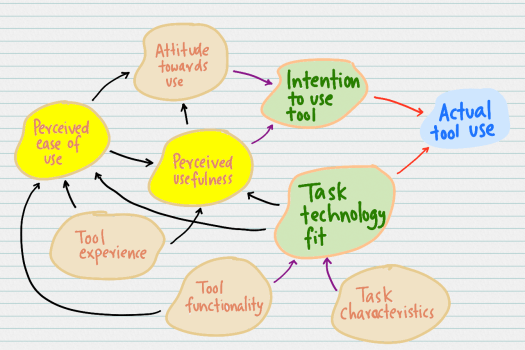
One approach comes from a paper by Mark T. Dishaw and Diane M. Strong that puts forward an integrated model that tries to explain the likelihood of a tool actually being used.

It combines two existing models, and the new, extended version is more effective than either alone.

First, the Technology Acceptance Model (TAM) suggests that actual tool use depends strongly on an intention to use the tool.

The strength of the intention depends on the user’s attitude towards use, which in turn is a result of his or her perception of how useful the tool might be and how easy it is to use.

The Task-Technology Fit Model (TTF) focuses instead on the ability of technology to support a task – and matches the technology to what the task demands.

This fit depends on the tool functionality and the task characteristics – and suggests that a rational assessment that matches functions to tasks will result in the best choice of solutions.

The TAM depends on perception and attitude while the TTF focuses on rationality and comparison.

In reality, we use both, and the extended model, shown in adapted form in the picture above, is an integrated model that selects from parts of the TAM and TTF and connects them with the hypotheses set out in the paper.

It turns out that this extended model explains more about actual tool use than either model on its own.

How can we use this when selecting and implementing a technology stack in our organisations?

To start with, this model gives us an approach to scope what is required in terms of both technical capability and user-centric capacity.

All too often we select a package based on the sales pitch and technical functionality, forgetting that the value it will add depends on how the people in our organisation use it – and they will default to using systems they find easy and useful.

And the quality of our choice will show up in the statistics of actual tool use.

Why goals and control are not enough for business and society

appreciative-systems.png

We have been conditioned for a long time to think that setting goals is the way to achieve success.

This may partly be due to the work of Herbert A. Simon, a Nobel prize winning economist who pioneered work in goal-seeking, which spawned fields such as artificial intelligence, decision science and complex systems.

This kind of thinking leads to the unquestioned assumption that the way to make something better is to throw technology at it – a very common theme at present in the energy world.

We think energy markets aren’t working, so the way to make them work is to implement blockchain, AI, machine learning, comparison engines and other types of solutions – which will magically transform it into a clean, lean machine.

Except it doesn’t work that way.

A countering approach comes from the work of Geoffrey Vickers who came up with the notion of appreciative systems.

He argued that ways in which we often thought about the world were inadequate.

The goal-seeking method leads to a narrow reductionist view.

An alternative – the cybernetic view, where there are controllers and actors and one controls the other doesn’t really exist in reality.

Take for example a prison guard and a prisoner. While one is behind bars – both are in prison – and we know how the environment can quickly turn good people bad.

Vicker’s approach is one where life is experienced as a flux of events and ideas – brought out in the picture above from Checkland.

Imagine a loud, raucous party. You arrive, having been invited. You meet a few people, get to know more. Over time, you make friends, have conversations, even throw your own mini-parties in a corner of the room. Then you leave – but the party carries on.

That’s pretty much how life works.

Appreciating the world, or life, then means perceiving it in the first place and making judgements about the things we see.

Those judgements are usually about fact – what we believe is – and value – or what is good.

Given our perceptions and judgement, we can envision what might be and take action.

And we do all this not to meet goals, as a rationalist approach might assume, but to maintain relationships – our place and friendships at the party, if you will.

All this activity results in standards – our expectations of fact and value.

What needs to be seen is that our previous experience results in standards which are then modified in the light of future experience.

At a very basic level, this is what happens when companies become more diverse – the introduction of new thoughts and approaches from a greater range of individuals can change our standards.

A few years ago, no one would have questioned mostly male panels. Now it would be a brave organiser that didn’t have any women up at all.

Why does thinking about any of this matter?

It’s easy to be cowed by what seems like the unstoppable march of technological progress – the bots are going to take our jobs and there will be nothing left for humans to do.

Except to be human – appreciate life as it is and aim for better standards and relationships in business and society.

What does it mean when an organisation has a social purpose?

social-purpose-organisation.png

Organisations are changing and the boundaries between them are getting blurry.

Once upon a time it was simple. The government did some things. Profit driven companies did other things. And non-profits picked up the pieces.

The regulatory structures in many countries grew up to support organisations that fell into one of these three categories.

But, that’s not enough for people any more – they want to work with organisations that do more than just make money – that have a social purpose.

But what does that mean exactly?

In this BCG article, Cathy Carlisi and Dolly Meese from Brighthouse define purpose as the why of an organisation, resulting from the intersection of two questions:

  • Who are we?
  • What need do we meet in society?

Does this become a social purpose if we just add the word social to it?

Not according to the Advertising Standards Agency, which ruled that A4E, now known as People Plus, could not describe itself as a social purpose company because its activities made a profit but people could mistake it for a non-profit.

So, while leaders in organisations are trying to make their businesses about more than just money, the system of regulation and oversight is trying to understand what this means and how it should respond.

In the U.S, the concept of a for-benefit organisation is being mooted, one that makes a profit and acts like a normal business, but whose primary purpose is provide social benefits.

The normal way to get this message across is through marketing – by structuring branding and messaging around concepts like “social enterprise” and “sustainable business” according to this article in the Harvard Business Review.

But, the article argues, it can also be achieved through organisational architecture – by creating a set of rules and operating principles that go beyond profit and involve suppliers and customers in decision making and even profit sharing.

A report by the Mission Alignment Working Group of the G8 looked at a new form of organisation called profit-with-purpose businesses – a type of organisation that has the freedom to distribute profits like a traditional business but also commits to prioritise, deliver and report on their social impact.

They also propose a way for these organisations to become formally recognised in law – with a definition, legal framework and operating model.

So… it’s not that easy to understand social purpose – the words make sense, but what does it really mean when an organisation starts to focus on the impact it is making rather than the profit it is taking?

The starting point is getting the internal and external narrative right – the story we tell ourselves and others.

And we can start by answering a few fundamental questions.

Who are we, what need do we meet and why do we exist?

How to take your company digital

digital-enterprise.png

Amazon is ruining things for many businesses – teaching customers that they can expect to get products and services quickly, have a great user experience, no errors, 24-7 availability and personalised interfaces – and save money and time.

What about everyone else? How should they think about transforming their organisations to stay competitive?

Tunde Olanrewaju and Kate Smaje from McKinsey set out seven traits in this article that they have discovered effective digital enterprises share – and that we can use as a blueprint for our own programmes.

Going digital is less evolution and more reinvention.

We need to set unreasonable goals, make choices about targets and strategies that make people around us nervous about the scope and extent to which things will change.

Someone, somewhere is working on an idea that will make our existing business obsolete, our products expensive or redundant and that will satisfy our customers more.

We need to work on destroying and rebuilding our business before they do.

And the skills we have in the organisation now are not the ones that will take us there.

We need to recruit for skills, not experience.

The capability that built our organisation is unlikely to be the same capability needed to build a new digitized one.

The kinds of people needed – developers, user experience designers, system architects – are likely to be in other fields and need to be recruited.

Most organisations will be better off in the long term with in-house capability because a digital transformation is a core strategic initiative.

Then, talent needs to be protected, perhaps in a Skunk Works.

Lockheed Martin’s Advanced Development Programs are referred to as the Skunk Works, a group given a high degree of autonomy and freed from bureaucracy, and told to get on with new projects.

It’s very hard to stick talent in the middle of an existing organisational structure and expect them to innovate.

The resistance from people used to business as usual is too much, and can slow everything down.

Nothing is sacred – challenge everything

When going through a transformation, every aspect of the business and how it works needs to be questioned.

Do certain processes have to be carried out? Are there things we can stop doing?

A formal way to this is a method called Final Cause Analysis (FCA).

We ask what is this for? over and over again – and focus on the essential elements we discover as a result.

We haven’t got a year – we need to move fast.

These days no one has 12-24 months to put a new system in place.

We’re talking weeks and months to getting working systems that we can test and refine based on customer feedback.

Lean and agile ways of working are taken for granted now.

There are more projects than we can do, so we need to prioritise based on value – follow the money

Our projects will help us increase revenue.

At the same time, and as importantly, they can help us cut costs.

We need to rank our projects based on contribution to the bottom line and then commit to a programme – putting money, resources and management in to get things done.

All of this effort and reinvention is focused on one thing – the customer.

Customers leave because they are unhappy – so successful digital organisations are obsessed with the customer and their experience (in a healthy way).

Digitization is not a choice – it’s just what we now have to do to stay in business.

Key principles for smart appliance standards

smart-appliance-standards.png

The appliances in our houses – washing machines, fridges and air conditioners – have a key role to play in the transition to a low-carbon economy.

Electric vehicles and electrification of heat could increase peak demand from 60-70 GW now by 18 GW by 2020.

That will need around 6 new nuclear reactors the size of Hinkley Point C and a huge investment in additional network reinforcement.

Smart appliances that can change when they use electricity could reduce that additional demand from 18 GW to only 6 GW, according to a government consultation on smart appliances that runs from March to June 2018.

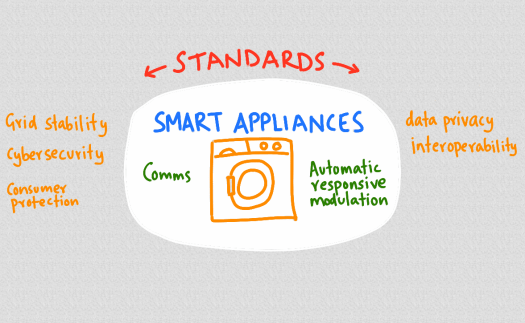
The consultation is looking at defining standards – the principles and associated functionalities required for smart appliances – to give industry something to aim for.

A smart appliance is, according to the policy, a product which:

  1. Has communications: It can connect to a network and communicate
  2. Is flexible: It can change how it uses electricity based on a signal like price (automatic, responsive modulation)

The standards will not apply to all products – only the ones with the most potential for flexibility. In particular, lighting and cooking are not included.

The kinds of products that could be smart are:

  • Cold appliances: fridges, freezers
  • Wet appliances: Washing machines, dryers, dishwashers
  • Heating: Electric heaters, controls, heat pumps, air conditioners
  • Battery storage: Standalone or combined storage like PV-Solar systems

The standards for smart appliances look at five key areas.

It’s important that people can choose brands of product without having issues with how their machines talk to each other.

Open standards that promote interoperability help with this – and using a common data model that has a standard instruction set is a preferred approach in the policy for communications between machines and between machines and their controllers.

The point about smart appliances is that they help with grid stability, for example by shifting when they are on away from times when there is lots of stress on the grid.

Clearly, they can also do the opposite: add load to the grid if misused and put more stress on the grid – potentially leading to faults and blackouts.

So, cyber security is an essential part of all internet connected devices these days to make sure this doesn’t happen.

A secure by design approach is a recommended one.

The appliances will create and store data so data privacy requirements will be in the standards.

Finally, when it comes to consumer protection, the standards will cover product safety and end-of-life process – and these will cover how the physical product is recycled and how the data on the system is handled.

Products that comply with the standard will have a label, and the standards will also be aligned with what is happening internationally.

A smart energy system could save taxpayers £17-40 billion to 2050, so many people will be watching this space with interest over the coming years.

How to create an online marketplace

online-marketplaces.png

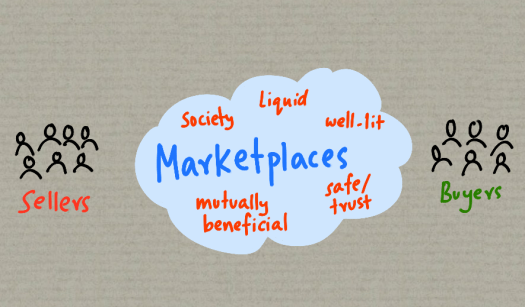
Markets connect buyers and sellers, bringing them together to carry out mutually beneficial transactions.

Village and town markets are still popular because they give people a chance to come and browse the goods on offer, compare between different sellers and choose something they like.

Usually, there is enough business for everyone – but the markets themselves are operated and regulated by something like the town council.

Online marketplaces take the same idea and create a platform to do this instead – and there is a rush to create new platforms at the moment.

We see marketplace systems to make transactions easier in everything from selling houses to paintings, from comparing energy suppliers to recruiting freelancers in a gig economy.

An article in the Harvard Business Review by Andrei Hagiu and Simon Rothman sets out some of the key things to look out for when creating an online marketplace.

The point out that the network effect – where reaching a critical mass of users that then results in exponential growth – is not enough.

What is more important in getting a market working is that it gets the buyer-seller fit right.

The platform will only work when both sides are happy.

This means that transactions need to be mutually beneficial. Both sides need to be happy with what they get.

But, the parties don’t know each other – it’s the marketplace that brings them together.

So, the market needs to create a safe, trusted environment – by providing contracts, guarantees and insurance.

The point of a market is to help people easily compare goods and services – reducing the search costs of finding information, reducing the friction involved in negotiating a transaction and lowering the total cost of doing a deal.

This is the equivalent of a well-lit showroom, where we can walk around and compare things and see the good and bad points.

Doing these basics correctly will mean that it is more likely that buyers and sellers will enter into deals and come back to do more of them.

Having lots of buyers and sellers then creates a liquid market, one that becomes self sustaining and is used repeatedly.

That’s the point where the marketplace has staying power and is likely to be around for a while, and the marketplace operator earns a good commission on providing it as a service.

The final point raised in the article is that marketplaces need to contribute to society.

They are centres of commerce online, and so the tax collectors and regulators are interested in them.

They want to get their share of the profits and make sure people’s rights are protected.

Marketplaces are the future of business – when we walk down high streets in towns now they are often a dismal collection of charity shops, pound stores and cash advance places.

Business is moving online to new marketplaces.

And, some of us will create some of them.