The one surprising state of mind you need to call on to succeed

samurai.png

Thursday 8:27pm Sheffield

Did you do what you were supposed to do today? Go to work? Follow the rules? Keep your head below the parapet?

That sounds like a good day’s work. Let’s say it was better than that – let’s say it was a great day’s work.

You finished your todo list, helped a co-worker complete a few more jobs and got a large contract signed. Everything is fabulous.

You go to your manager, bursting with excitement – you’ve got all this stuff done, it’s time to pick up some praise and a well-deserved reward.

So… what do you think you’ll get?

  1. A huge cash bonus.
  2. An all-expenses paid trip to Bali with your family, with everyone flying first class?
  3. More work.

Most of us spend our lives working on other people’s priorities

We live in a world where the education system teaches us to fit in – to be good workers. And that’s great for lots of people.

But not for everyone. And the system doesn’t know how to cope with those people in any way other than putting them in straitjackets.

So we get contracts and rules and policies and training – all things designed to squish us into a role where we do what we are told to do and nothing else.

In other words, we act like pragmatic, reasonable people – agreeing what we should do and doing what we agree, most of the time.

What would a Samurai do?

Hagakure is The Book of the Samurai, a collection of conversations with Yanamoto Tsunetomo, an 18th Century Samurai who became a Buddhist priest.

The Samurai point of view that comes out of these writings is not pragmatic, not reasonable – and it’s not a philosophy. It’s a state of mind, and not one that is easy to understand.

In one of the stories, a warlord attacks and kills another one. When this happens, the soldiers of the dead warlord are ronin, masterless Samurai. What should they do?

The answer is clear. They must take revenge. The way of revenge is simply to force your way into the other warlord’s house and be cut down.

Don’t stop and think. Don’t consider details – like how many soldiers guard the place or what you need to attack. When you do this, the time goes by, your start to think, and then you give up.

It doesn’t matter if the enemy has a thousand soldiers waiting to fight you. You go in with the mindset that you will start with the first one and cut them down, one by one.

Even if it looks like you will lose, take action – recklessly, irrationally. Go in, cut them all down, or be cut down.

Don’t wait and think. Act. With no regard to reason or outcomes.

Would you attack a warlord guarded by such people?

Sometimes life needs that kind of attitude. Was Steve Jobs reasonable about removing all the buttons from the iPhone? Was Elon Musk reasonable about going to Mars?

George Bernard Shaw wrote “The reasonable man adapts himself to the world; the unreasonable one persists in trying to adapt the world to himself. Therefore all progress depends on the unreasonable man.”

To win, you need to be the kind of person that will fight, even when it is absolutely certain that you must lose.

When the time comes, you do not reason – you must only act.

What would you do now, knowing what you know

knowledge-practice.png

Brian Tracy writes about zero-based thinking, asking the question knowing what I now know, is there anything I would do differently?

That is a hard question to think about.

We know what we know. We don’t know how things might have turned out if we had made different choices along the way. We may think they may have turned out better – but doesn’t make today any less real.

Take knowledge, for example. What’s the point of it?

Some people study situations and come up with theories. Others work with real world problems and try to solve them.

A good application of knowledge is when we find a theory that can be applied to solve real world problems.

But things are hardly ever this direct – and that’s because the people involved want different things.

The people who generate knowledge – who sit at their desks and think through ideas and come up with theories – have a system of rewards and incentives based on the respect of their peers.

The people who solve problems have the satisfaction of improving things and knowing that they have created a better situation for others.

Clearly the two are linked – although the connections are not always easy to see.

Keynes wrote “Practical men who believe themselves to be quite exempt from any intellectual influence, are usually the slaves of some defunct economist. Madmen in authority, who hear voices in the air, are distilling their frenzy from some academic scribbler of a few years back”

There’s another thing that can pass us by – it’s almost invisible.

Why is it that there are so many books on management – on everything really these days?

It’s because one way of standing out is to come up with a new way of doing something – which is usually a new way of packaging an old way of doing something.

In marketing, for example, we always need to spend some time working out who our customers are – who wants what we have more than they want the money in their pocket?

Whether we use segmentation or psychographics or personas, what we’re trying to do is get a better picture of who these customers are – and then we can try and get to know them better.

So, what writers and consultants do is come up with tools – ways of turning knowledge into methods that can be applied to a problem.

This link between the generation of knowledge, creation of tools and application in a problem situation forms a value chain, according to John H.Roberts, Ujwal Kayande and Stefan Stremersch, who found that when it comes to marketing there is a good link between knowledge and practice – the tools are being applied on the whole.

They found that when the people doing the thinking are also doing some doing, it seems to work better.

Once again – it’s obvious.

That doesn’t mean its easy to do or commonly done.

We need to work to get such three such simple concepts aligned and working in practice in our businesses.

Has technology made us more or less productive?

productivity.png

Every generation probably feels that it is living through the most profound changes that have ever happened since the dawn of time.

From the printing press to the industrial revolution, from world wars to the world wide web, things have changed – and the most visible part of that change is the technology that enables the modern world and, in particular, the technology that affects how we live and work.

So, is it helping us or not? Are we more productive or not?

It’s hard to tell – and that’s because an abundance of something always results in a shortage of something else.

So, take how modern technology has transformed the world of work, making it easier for us to collaborate, have everything everywhere and communicate with others. How are these working out in practice?

Is it easier to work with others?

Many new companies and startups are delighted by how easy it is to collaborate with others on projects now.

Take Google docs, for example. We can share and work on a document at the same time – something impossible in the days when we had to write a draft, send it to someone else, wait for comments, rewrite and repeat the process until everyone was satisfied.

Now we can work together quickly, come to a consensus and publish anything we want pretty fast.

So why is that anything less than perfect?

For two reasons…

First, if two of us can collaborate, then so can others. If it’s easy to have five, ten, fifteen people all providing their input, then we can quickly get locked into a cycle of never ending comments, suggestions and changes.

Procurement is one area where such delays can increase delays massively. It takes much longer to get five buyers to agree than two and the trend towards decision by committee slows things down and doesn’t necessarily improve quality.

The second reason is that when it’s quick and easy to collaborate and produce something, the result is probably going to be of less quality.

That’s why we’re taught to be suspicious of things we read on the internet and to be more accepting of things we read in peer-reviewed journals.

Is it good having everything everywhere?

Dropbox, Google Docs, Office 365 – all these tools have changed the way in which we store information – taking us from a world of USB drives to being able to work on any computer anywhere.

It’s also meant that we can store everything – never lose a thing.

And so many of us pile on the gigs of storage, like the pounds we put on every year since college. It’s gradual, but it grows and, after some time, it shows.

Not every picture we take is worth saving. Not everything we write is worth preserving.

When we had limited space, we had to choose what to keep. So what we had was worth having. Now we have everything, but it’s hard to find what matters.

At some point we’ll probably wake up to the need for a digital diet. Just because its cheap to keep everything doesn’t mean we should, because it makes it more expensive for us to find what is important.

And it’s also annoying that when we get a phone call it could be one of seven contacts that system has scraped from all our accounts – although it’s just the one person…

We never apologise for sending a long letter these days

Blaise Pascal, the French mathematician and philosopher is credited with writing a long letter with an apology for not having had the time to make it shorter.

When we had to write to each other, we probably took care to express our thoughts clearly and concisely so that we wouldn’t have to fix it weeks later when the replies came back.

With email, we can write to someone so quickly that we no longer need to think about our words and how they might be interpreted – after all we can follow up with a clarification immediately.

And that means we probably take less care – and it shows up in the increased number of emails we need to send to get things done.

It’s easy to communicate – and because it’s so easy we spend more time doing it. It’s also easy to get a meeting in the diary – and that’s why more managers spend their time in meetings than ever before.

But – sitting in a meeting and sending emails is not work – it’s stuff that gets in the way of doing real, useful work – like thinking about strategy, improving operations, recruiting or expanding.

If we all got together less often and interrupted each other less we might get more done.

The problem isn’t technology… it’s us

What we come back to is that the way use technology better is to understand how we humans use stuff. Make it easy for us and we’ll do it more – but something else suffers at the same time.

Technology can help us – but it can also hinder us.

To get the most out of it, we need to remember who is in control – it or us.

How entrepreneurial are you really?

entrepreneurial-orientation.png

We live in a world where we increasingly have to take responsibility for our own careers. The ladders that used to be around are getting old and have missing rungs.

For some of us, the ladders weren’t ever there. We had to make our own and clamber up as best we could.

The problem is knowing where to go and what to do next. What do we do if we’ve just entered the workforce? What do we do after twenty years? After forty?

Knowing ourselves better may help answer such questions. In particular, knowing how we’re oriented when it comes to entrepreneurial activity may help us make some tough choices.

Jeff Covin and Dennis Prescott introduced the concept of Entrepreneurial Orientation (EO) in 1985 and came up with a scale to measure it.

The model has been tested over time and is well accepted and essentially measures three aspects of a firm:

  1. How innovative it is.
  2. How proactive it is.
  3. How much of a risk taker is it?

How innovative are you?

Managers at an entrepreneurial company emphasises research and development and its technological lead over competitors. It has many products and changes them quite quickly.

At the opposite end, a company might prefer proven products, bringing out nothing new or making minor changes.

How proactive are you?

Entrepreneurial companies strike first – doing things that their competitors have to respond to. The bring in new products, services, processes, ways of doing things – and have an attacking mindset when it comes to the competition.

Their opposite numbers prefer harmony and carving up the market, responding to change and usually introducing anything new later.

How much risk do you take?

Entrepreneurial companies are willing to take bold, aggressive steps and make decisions that have a high risk but associated with high reward.

Less entrepreneurial companies prefer low risk opportunities, believe in caution and incremental progress and wait to see what happens before committing themselves.

So, does being innovative, acting first and taking risk work?

Entrepreneurial firms do better – but as a whole many fail as well.

Firms that tilt towards the high end of an EO scale are entrepreneurial in the sense that some people on the OCEAN scale are agreeable.

It clearly helps to be innovative when small because people meet us because they see the prospect of something new and shiny- but sometimes large firms only want to work with firms that are low risk.

It’s better to be proactive than not – many a salesperson has been told that they’ll find a million dollars under their shoes if they get going.

Risk is perhaps the tricky one. It’s easy come up with cliches – swing for the fences – go hard or go home.

The entrepreneurs that succeed are probably good at maximising the upside while limiting the downside.

And there are lessons for us as individuals as well – being innovative, proactive and being willing to take risk will get us further this century than looking for ladders to climb.

How some companies are creating opportunities from CO2

catching-carbon.png

Many of us see emissions as a problem to be resolved – at some time – by someone else.

Yes, there is the Paris accord and, in theory, the world is going to try and keep carbon dioxide levels to a safe level, although it appears that we are already past those levels, according to some models and measurements.

So, is there anything that can actually be done, or is being done?

It turns out there is, and an article by R.P Siegal pulls together some interesting and innovative work being done by companies out there.

It turns out there are three main ways these companies are trying to make carbon work for them:

  1. Putting it somewhere where it is more useful
  2. Creating raw materials out of it
  3. Creating products

1. Carbon capture and storage (CCS)

The first approach is the one that most people are familiar with and, in the UK, has had money thrown at it.

The CCS association says that the main components of CCS are extracting the CO2 from the atmosphere, transporting and then storing it underground in depleted oil and gas fields or aquifer formations.

Another approach is to inject the CO2 into rock formations, where it becomes part of the rock eventually.

2. Creating raw materials

Some companies reuse materials – in effect reusing the CO2 that went into making them in the first place rather than creating new emissions – creating things like carpet tiles.

A more direct approach, however, extracts CO2 from the air and turns it into plastics or fuel.

3. Creating products

Siegel then points to companies that turn pollution into products – such as an Indian company that turns exhaust particles into carbon black for ink.

Other companies create concrete, cement and bricks.

Early stages – but a promising start

It’s still early days for these kinds of innovations – but they are coming. Smart people are spotting opportunities and creating companies to take advantage of the pollution in the air.

As the saying goes – where there’s muck, there’s brass.

3 things managers have to do if they are going to manage remote teams

managing-remote-teams.png

Imagine setting up a new business or expanding an existing team.

The first things many organisations do is think about adding people at an office. We need desks, computers, software, phones and all the other things that go with bringing that person online – and that takes time, effort and money.

Why do we do this?

In a world where most people we want to work with already have a desk, a computer and an internet connection that lets them get all the software and communications tech they need – why do we keep thinking working in an office is the way to go?

Or is that still the case? Research from Upwork, the freelancing website, says that two thirds of companies use remote workers. As talented specialists get harder to find, companies that are willing to offer remote working can choose from workers around the world.

Many organisations that have started up now have entirely virtual workplaces – with no central office at all.

So, what do our organisations and managers need to do to make virtual teams work well?

There are three things we need to get right.

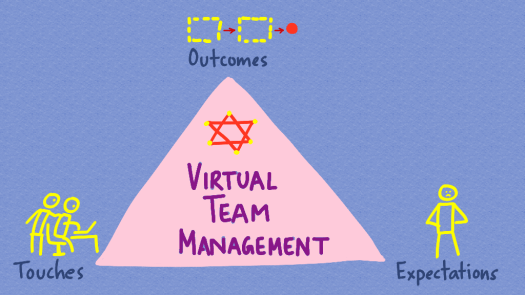
1. Focus on outcomes, not process or how we would do it

Individuals now are developing increasingly individual ways of working – and that can be a challenge.

Take something as simple as taking notes – a fundamental part of work.

I’ve jumped from using a reporter’s notebook to a legal pad to One Note to text files to journalling software to Google spreadsheets to custom Excel files back to Moleskine notebooks.

In some businesses notes need to be recorded in a particular way for legal reasons. Reporters need to keep their notes in case they get sued. Policemen need to keep their pocket notebooks as evidence.

For most jobs, however, how people take notes doesn’t matter. What they do after that does matter.

For example, do they liberate the main points from their notes and share them with colleagues who need to know them? Does a sales person’s notes provide enough information for a service team member to take on the account?

With remote teams we need to focus on outcomes – the way things turn out – rather than the way in which they are done or the way in which we would do it.

2. Be clear on what you expect from others

I remember being on a train down to London and hearing a conversation a few years ago.

The speaker, who sounded like an entrepreneur, was quite loud and making no effort to speak quietly – but the gist of the talking was that a remote worker who was at home couldn’t be contacted on instant messaging – and that wasn’t acceptable.

Any sort of situation that makes us want to stand with our hands on our hips crossly is one where our expectations are not being met.

In this case, the entrepreneur’s expectation was that the remote worker needed to be available to contact during work hours on this system.

The worker may have had a perfectly good reason to be away from the desk at that time – or may have been in the park throwing snowballs. We don’t know – but that simple inability to contact the worker was enough to cause a work problem.

Some organisations recognise that instant messaging interruptions are as bad as actual interruptions, and set expectations that such contact is by arrangement and usual business is conducted by email.

The point is that much irritation can be avoided if expectations are clarified up front.

3. Make the effort to make contact and stay in touch

At the same time, workers will find managers much more relaxed if they make the effort to keep in touch.

Where there is little or no face to face contact, email updates, messages and phone calls can all help keep the lines of communication open.

Managers get nervous when they don’t hear anything for long periods of time. And – quite probably – when people don’t keep in touch it’s because things aren’t working and they are looking for, or working on, something else.

Lack of contact quite often leads to termination of appointments.

Interestingly – sharing personal updates before moving to business can help reinforce the feeling of being on the same team and help maintain a warmer relationship.

Summary

Many of us, if we don’t already, will experience remote working, virtual teams and more flexible ways of working.

For new starters, it will simply be the norm. For older workers, it is what they do as they move away from corporate jobs and focus on a more balanced life that looks after their health and family.

Whether we’re in offices together or on the phone – the things that make us human are what will cause us to succeed or fail.

Working towards a common outcome, being clear on what we expect from each other and taking the time to keep in touch and talk will help us manage this new world of work.

Why the best questions have to do with what is invisible

looking-for-what-isnt-there.png

Imagine having to ask the CEO of a company about their strategy or a prospective employee about his or her capability.

What they show and tell us will depend on the kind of questions we ask.

How do we know we are asking the right ones? The ones that will throw up opportunities and show us what is really happening?

There are lots of lists of questions we could ask. The important ones are about what is not there – and there are three important versions of these.

What is the unmet need?

The first comes from Jo Miller’s conversation with Ellie Pidot, VP of Strategy at Medtronic who asks What are your customer’s unmet needs?.

One way to think of this is like whitespace on a page.

What is left out helps us make more sense of what is there.

We can ask people what they do and what they want and we will be told a story, probably one that is logical and coherent.

They might tell us what they are doing – and the things identified as needs.

All too often, what they tell us and what they actually need can be different.

This happens quite a lot in IT, for example. There is often a gap between what software developers think people want and what they actually need.

The best programmers are able to bridge that gap and create the right kinds of tools to help us.

What would an outsider do?

The second question comes from Freek Vermeulen who asks what would other, external people do, if they found themselves in charge of this company?

This can be thought of like a blank page.

What would we do if we were starting from scratch? From a zero base – with no sunk costs or investments of time, effort and energy?

Bryan Tracy suggests asking – knowing what I now know, would I do things differently?

Are there things we would do more of, less of, start or stop?

It’s hard looking at the same things through the same eyes.

It might help if we try and look at them through the eyes of someone else, someone we respect. What would they say or do?

Then – do we have the courage to do that ourselves?

What would be least risky?

The third question is from Tim Ferriss’ interview with Joe Gebbia, the co-founder of Airbnb.

Many people think that to get ahead we need to take more risk. Higher risk equals higher returns.

That’s not really the case.

Take B2B sales, for example. Joe points out that B2B customers, given a choice between a low price and low risk, will take the lower risk option.

Entrepreneurs who have taken what seem to be huge risks often have carefully calculated the downside and decided that they can live with the odds.

The Dhandho approach follows this – Heads I win. Tails I don’t lose much.

Often the course of action that people will follow is not the one that gets them the most but the one that looks the safest.

So, in this case, its the absence of obstacles that matters.

Summary

There are more questions that we could ask than ever could be answered.

We need to ask the ones that show what isn’t there.

The whitespace, blank page, absence – that’s where the opportunities are hiding.

The 3 critical processes you must try and improve at your business

three-timelines.png

If we had to make sure that just three processes were working as efficiently as possible in our business, which ones should we choose?

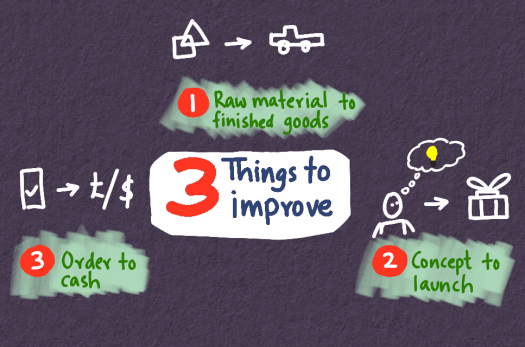
According to David Bovis three timelines developed by Toyota are enough:

  1. How we convert raw material into finished goods
  2. How we go from concept to launch
  3. How we go from order to cash

So, what are we trying to do when improving each of these?

Raw material to finished goods

The whole point of our business is that we add value to something. Whether its taking raw materials and turning out a physical finished product or providing a service that carries out some kind of knowledge work, we still need to work our way from a start point to an end point.

In a world with infinite digital storage space we end up keeping everything. Emails from ten years ago to every bad photo we ever took.

It takes real discipline to stop things piling up – whether in visible piles of stuff or paper or in ever growing digital folders.

So how can we improve this process? There are four things to look at:

  1. Maintain systems before they fail: From manufacturing systems to computer equipment, we need to look after our kit.
  2. Reduce the amount of parts and supplies: Do we need to have ten different types of notebooks in the supply cabinet or buy a year’s work of cleaning supplies?
  3. Keep things in the right place: We often can’t find stuff just because it’s not put back properly.
  4. Put stuff that needs to be thrown away in a set place: When things are ready to go, put them in an agreed place so they can be removed.

Concept to launch

This is an interesting one – especially if it’s taking a new product to market.

We need to create things that customers want more than they want the money in their wallets.

Just building it isn’t enough – it needs to be saleable – exchangeable for real money.

That means we have to work backwards from what customers really need (which isn’t the same as what they say they need) and build products to address their needs.

Everything that doesn’t do that is optional – perhaps even wasteful.

Another consideration – not always taken into account by product developers – is that customers, especially business-to-business ones – will choose an option with less risk over one that has a better price.

If something does what is needed and can be shown to be robust, it can often beat a competitor with more bells and whistles.

Order to cash

The final process to get right is the timeline from order to getting paid.

For many products, or services sold like products, we pay up front and receive the product later.

Service businesses, on the other hand, tend to invoice after the work is done.

Improving an order to cash process means looking all businesses, whether product or service, as product businesses where all or some of the payment is made earlier in the process.

Summary

For all three timelines, we’re trying to keep only what is needed – remove everything that adds waste and keep the things that add value.

It’s how we do that which matters.

How to do more of what matters and less of what doesn’t

value-to-waste-ratio.png

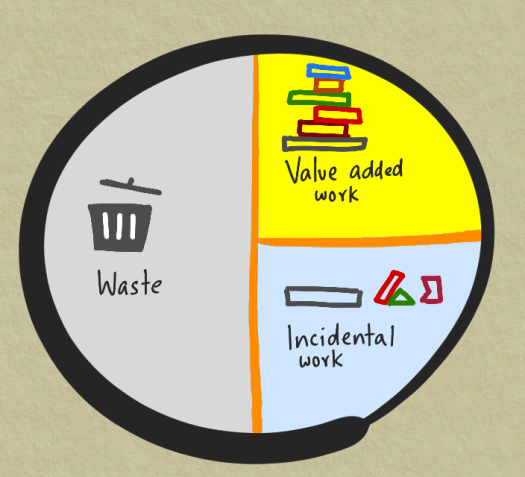
Taiichi Ohno, the man behind the Toyota Production System, believed that only a quarter of the work done adds value for the customer.

There are two linked words there – value and customer.

Some things that add value are seen by the customer – better service, making it cheaper and more simple.

Other things are not – improved safety, better screws, brighter tail lights.

What takes the other three-quarters of time?

Another quarter is incidental work, stuff loosely associated with the main value adding activities.

The rest is waste.

With physical systems – like making cars – we can focus on waste because it’s visible.

If there is excess stuff, it piles up. At home, if we’re buying the kids too many toys that’s clearly visible.

So we can focus on removing and eliminating waste wherever we can see it.

That’s easier said than done, especially when we need to get rid of stuff we already have.

But we can try and create rules and habits that mean less new waste is created.

In knowledge work, that waste comes in the form of emails and meetings and requests for long reports.

In this paper by Matthew May, he argues that because we can’t easily see waste piling up in knowledge work we need to focus instead on what work adds value.

That means working on our own lists of jobs before looking at our emails and responding to other people’s priorities.

It means avoiding all meetings.

It also means picking up the phone sometimes instead of sending out emails.

But that doesn’t really get to the point of it all.

The point is that there is a ratio between doing things that add value and everything else.

We’re trying to maximise that value to waste ratio – cut down the waste and increase the value.

At the same time, the size of the whole work package also needs to shrink.

It doesn’t make sense to do more. A lot of the time it actually makes a lot of sense to do less, to have less, to need less.

An attitude of removing, however, focuses our attention on the rubbish around us.

Which means we might miss the good stuff.

We should instead develop the ability to work on things that add value – and incidentally get rid of everything else.

How simple rules can help us become better at everything

simple-rules.png

Complex situations need equally complex solutions. Or do they?

This is the question explored in Simple Rules, a book by Donald Sull and Kathleen Eisenhardt.

Let’s be honest – how many times do we make something look really complicated so that we can come across as knowing more than everyone else or justify the fee we are charging.

But really, in many many areas, just using simple rules will give better results than complex ones.

So, what are simple rules and how can they help us?

Sull and Eisenhardt split simple rules into those that help us become more effective and those that help us become more effective.

Becoming Effective

Becoming more effective is squeezing more out of the time we have and that means saying yes to some things and no to others.

We can do these in three ways.

Boundary rules

First there are boundary rules. These are binary decisions of the yes/no variety.

What should we do and what shouldn’t we?

For example, when revising for exams for my first degree, I had two very simple rules.

I never worked after 12 in the afternoon and on weekends.

Working from 9 – 12 for four weeks before the exams was more than enough time to revise and prepare for them.

Prioritisation rules

The next kind of decisions revolve around what to do first.

The classic example of this is how medics triage patients during an accident.

Everyone is tagged based on the severity of their condition and how urgent it is that they are seen.

I remember being in an aircraft accident simulation as one of the volunteers to train the response teams where we were all labelled with the injuries we had supposedly sustained.

I had a broken foot and so was transported slowly by ambulance while enviously thinking of the helicopter ride being taken by the person with far more serious injuries.

Prioritisation can be a double edged sword, however, leading to unnecessary escalation and messing about unless the rules are clear and applied consistently.

Stopping rules

The last kind of effectiveness rule has to do with when to stop.

Enough needs to be enough. Cultures that have a rule that people should stop eating just before they are full have much lower obesity levels than others that stop eating when they are full.

Perfectionists sometimes don’t know when to stop. In most cases, it’s good to stop early – and that leaves us with the capacity to go longer on the things that matter.

Becoming Efficient

Where effective is about doing the right things, being efficient is about doing things right – and once again there are three types of rules.

How-to rules

How-to rules set out a pathway, a series of steps to follow.

The best example of this is the idea of mise-en-place – laying out everything that is needed and following an efficient sequence of operations to cook.

One thing I learned here was to put the pan on the fire before starting to get ingredients out. By the time I had everything, the pan was hot and I could get on with cooking.

Coordination rules

Coordination rules are about playing nicely with others – working as a team.

A nice example is when to use the words you and we.

When we talk to someone else and need to talk about a negative situation, say the person did something wrong, how should we phrase the sentence?

Is it You made a mistake or We made a mistake.

Using you will immediately result in the listener getting defensive and upset. With we, there is a recognition of collective ownership and a more likely move towards thinking of ways to stop the problem happening again.

Timing rules

The last set of rules are about timing – when to do things.

For example, many productive people believe that we should the things that are most important to us first thing in the morning.

When I started writing this blog, I did just that – the first thing I did every day was to write. And having that rule made it much easier to do the work needed

Many activities have cadences – a sequence that needs to be followed to get results. Getting the timing right on these is crucial.

Summary

Simple Rules is an easy-to-read book that sets out a clear map of what simple rules look like and how to come up with them.

So here is a simple rule – Read the book.