How Can You Come Up With Amazing And Workable Ideas?

imagine-exercise.png

If you’re reading this, you’re probably a entrepreneur, founder, CEO or someone with a leadership role in an organisation – even an organisation of one with you as the only employee.

The challenge you have is growing your business – how are you going to go from 0 to 1, from no sales to the first few, from the first few tens of thousands to your first million.

How are you going to change and compete and be efficient in every part of your business?

There are some very important decisions you need to make – about who you work with, what stuff you need and how you do things.

How should you go about things if you want to get it right?

Let’s start with how to do it wrong.

Imagine you’re the CEO of a company that makes bottled vinegar and you think it might be a good idea to go into the ketchup business.

You call in your team and ask them to do a study – work out whether this is a flyer or not.

What is that team going to do?

Warren Buffett wrote in 1989 about the institutional imperative – that force in business that makes smart people do stupid things.

For example, he write that “Any business craving of the leader, however foolish, will be quickly supported by detailed rate-of-return and strategic studies prepared by his troops”.

It happens because organisations and groups of people interacting together have dynamics – and the factors that make us human also cause problems when it comes to making decisions.

You would think that most managers and people that work in businesses are rational and take decisions on a reasoned basis.

It often doesn’t – reminding us of the story of the accountant who, when asked during an interview what he thought the profit from an example set of accounts would be, got up, close the door and, in a hushed voice, asked the interviewer “What do you want it to be?”.

Instead, start by imagining you can have anything you want

Give yourself and your people free rein. Imagine you could do anything – get whatever resources you wanted, go wherever – you could have anything you asked for that you needed to achieve your goals.

Note the point about what you need. Let’s say you want to meet 10 companies. What do you need? Is it lists? Is it telesales people? Is it a website?

What do you need to have in order to hit that goal of meeting 10 companies?

Then – insist that whatever you have pays for itself in a reasonable time

You want to hire 10 people? Fine – as long as they pay for themselves in 12 months.

You want a website? Fine – as long as it brings in enough money to pay for itself in 24 months.

You want to go out and exhibit at conferences? Sure – as long as the sales from the people you meet there pays for the costs.

Make people take responsibility for results

When you do this – the ideas you come up with and those that your team come up with are likely to be more reasonable.

You’ll get a plan from operations that says by investing in new machinery, you’ll cut costs.

Sales will add people, but this time it will be the right ones.

Marketing will create material and content – but this time it will be aimed at informing and educating customer and not stroking the egos of the managers who work here.

People respond to incentives

If you want amazing ideas – put the right incentives in place.

When there are no rewards for success or penalties for failure, people come up with weak and lazy ideas.

When challenged, however, they come up with good ones that they know will work.

Your job as a leader is to create the right conditions for your team to get on and deliver results – and then get out of the way.
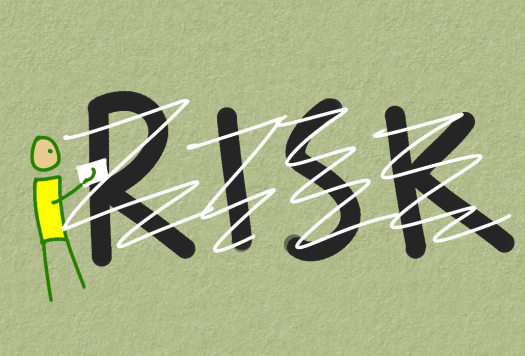
What Is The One Thing You Must Wipe Out In Every Sale?

removing-risk.png

Thursday 10:05pm

Sheffield, U.K

Are we in a brave new world where technology is all that matters and classic human skills are not going to be needed any more?

Or is human nature going to prevail – as we obstinately cling to our biological ways of doing things?

Take the success of Amazon, for example. What makes it special? Why has Ebay become so popular?

The most obvious answer is that they timed it well – they had the technology and created the systems and processes – the infrastructure – needed to do business in the world of the Internet.

You could buy books on Amazon and sell your old stuff on Ebay.

But – just because you can do something doesn’t mean you will.

The two internet giants (and others) created new markets that were transparent and that you could trust.

Reviews, Ebay seller ratings, guarantees, escalation processes – all these helped reassure people that their money was safe if they used the platform to make a purchase.

Many of us can still remember a period when we didn’t fully trust things online. We might look it up online, but then go into a store to buy it.

Then we went into stores and checked online to see if we were getting a good price.

Now, we use stores like display cabinets – a place to look at things before we place an order from the cheapest place online.

The thing that Amazon and Ebay got right, eventually, was removing all risks for us as buyers of products.

And this is something Facebook is learning, perhaps painfully.

Facebook enables us to be producers and consumers of information – of stories and pictures and memories.

The problem is that they have also allowed their platform to be a seething quagmire of misinformation, propaganda and sleaze.

We don’t trust them or their platform, or feel it’s a safe place for us and our kids – and now they are having to do something about it.

They’re learning something that great marketers have always known – if you want someone to make a decision, take away every barrier, every risk that they could possibly face.

Let them try it out, pay later, offer a guarantee, let them have their money back at any time if they’re not happy.

Bend over backwards to make sure that they can make a decision and be confident that they can back out if they have even an iota of regret.

Some people are scared of doing this – what if they get taken advantage of?

But – back to human nature – more people will do the right thing. There will be some people who take advantage of you, but that will be a small number that is more than offset by people who decide to take a chance on you because of what you say you’ll do to remove any risk for them.

And, if you have a good product or service, you know they’ll be happy.

If we’re not confident that we have something good – then we need to fix that first.

But after that… you know that it will help the customer.

So… wipe out every last little bit of risk and then let them make the choice that is best for them.

How To Stand Out From Your Competition

how-to-stand-out.png

Monday, 9.33pm

Sheffield, U.K.

What is the single biggest problem with looking at what your competitors are doing and trying to emulate them?

For example – if they have a flashy website and spend loads on pay-per-click advertising – do you have to do that as well to compete?

If they attend particular trade shows or go to awards, do you need to have a presence there as well.

Does a me-too strategy work?

The problem is that if you do what everyone else is doing, then what is it that sets you apart? Why should someone choose you over someone else?

This is something that many organisations struggle to get right. The boss looks over at the competition – perhaps she gets an email newsletter – and wants to know why her company isn’t sending out stuff like that.

It’s much easier to mock up a newsletter and start sending it out instead of questioning whether the newsletter adds value and if clients would actually read it.

Competing on such a basis is effectively an arms race, with everyone spending money to keep up with everyone else.

And, because the Internet effectively makes it free to send out stuff, ridiculous amounts of crap floods into our inboxes every day.

There’s a simple principle that we should keep in mind when advertising what we do.

If you are holding a red flag in a sea of blue flags, you’ll stand out from everyone around you.

That doesn’t happen if you’re holding a red flag and are surrounded by others also holding red flags.

If your business is doing what everyone else is doing then you have to come up with something new, something unique – that makes you look different from everyone else.

Many businesses are too scared to appear anything but corporate. They think that by projecting an image of themselves that is all polished wood and starched shirts they will come across as professional and competent.

Fear rules how they make decisions. They don’t want to send out controversial messages that polarise their audience. The words they use are dull and insipid.

It’s not about shocking an audience. Instead it’s about attracting their attention and then getting a message through to them.

And that’s very hard to do with everyone else shouting at the same time – especially on the internet.

Imagine how you would act if it cost you $10 to send each message. You’d be much more careful about who you sent it to, what you said and how you created a deal for them.

This doesn’t mean we should ignore the competition.

You should study them, read every message they put out and learn exactly how they advertise themselves.

Then – figure out what you can say and show that is different.

An Amazing New Way to Store Energy With Old Technology

ares.png

We’re heading into a renewable future – and the way in which people keep coming up with remarkable ideas seems to make that inevitable.

Take how we deal with one of the biggest problems with renewables, for example.

The wind doesn’t blow all the time. The sun gets switched off at night. That doesn’t happen with coal, or gas or nuclear power – we can rely on power from them 24/7.

So, do we have to live in a world where we need to still burn things to make energy?

The answer, many people said, is having a way to store energy.

Why not use massive batteries – have enormous installations with racks and racks of batteries to store all the energy we don’t need when the wind does blow, and then use it later when we do need it?

The problem is that batteries aren’t exactly good for the environment either.

First, there’s all the mining needed to get the rare earths we need in the first place, and they happen to be in not entirely friendly countries.

Then there is all the plastic needed to make the batteries safe.

After they get used, they are essentially a toxic little package – you can’t just throw them into landfill – and need to be processed and recycled.

All this adds up to a problem building up for the future.

There are less problematic ways of storing energy – in dams for example. But those don’t work anywhere and quite often you need to entirely change landscapes and move entire towns to make one.

But now, a Santa Barbara startup called ARES has had a good idea.

ARES stands for Advanced Rail Energy Storage, and it’s a brilliantly simple concept.

They build a railtrack up a hill. When the sun is shining or the wind is blowing and there isn’t enough need for all of it, they use what is left over to push a train filled with rocks up a hill.

Then, when they need the energy, they let the train roll down the track and get all the energy out again as electricity.

It’s effectively using some iron, rocks and gravity to create an energy storage system – and those items are a lot less polluting than batteries.

Building a railtrack doesn’t take the amount of land needed by a dam, and when you’re finished you can recycle the iron, put the rocks back so they look nice and pretty soon it will look like a normal hillside again.

You can stick them anywhere you have a hill – and if there’s one that’s dry and not much use for anything else so much the better.

So… we’re left with something that is brilliantly simple with very few drawbacks – other than getting to market and creating a business in a pretty hard to crack market.

Hope they can do it.

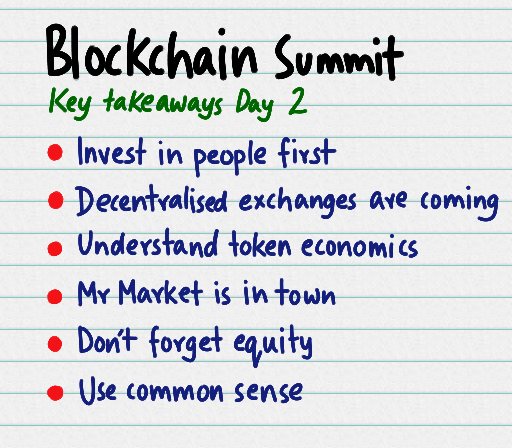
Key Takeaways From Day 2 Of Blockchain Summit London 2018

blockchain-summit-day-2.png

Thursday, 11:59pm

London

I have 10 pages of notes from today’s session, not counting conversations with the exhibitors. That’s a little too much to condense into one post, but here are some of the highlights.

It’s still all about people

If you’ve got some money burning a hole in your pocket – where are you going to put it?

Well, if you’re sensible, not in an investment of any kind if you need it anytime soon. But let’s say you’ve done the basics and are actually in a position to put some money into a market.

Many people will be only too happy to take your money in exchange for a promise.

Some will be charming and personable. Some shy and serious. Some will have a televangelist’s pitch, others a flamboyant show.

We need to look at them carefully – then look into them. Remember that a technology or an application will not in itself take over the world. Behind it is a person, a team that needs to drive it and take it to market – and it is that team you are investing in.

But it’s still too hard to invest with any real confidence

So, we have this new world of distributed ledgers and currencies. But, for most people, the only way we can access them is through an exchange – and these are the things that get hacked.

It also seems counterintuitive – we’re creating a distributed system and then accessing it through an exchange – a middleman – which centralises transactions and control once again. Where is the real peer to peer element in all this?

Distributed exchanges seem to be on their way, where we can actually transact with people we don’t know by creating a market where prices are posted and accepted – leading to transactions and commerce.

That’s quite exciting – it’s having a market that works – with lots of activity that becomes self sustaining and prosperous.

And when you do, understand what you’re getting – read the detail

The new phrase is Token Economics – which I assume is much like ordinary economics…

Basically, you’re giving someone money and they are giving you a piece of paper.

The piece of paper says what you get – is it a stake in the business, is it a share of profits, is it regular interest payments and return of the capital, can you convert your paper into a different kind of paper?

All these rules set out what you get from your investment, and they are likely to be similar to existing options in traditional markets – equity and debt being the main ones, for example.

Seriously… read the detail. In many cases you don’t get a stake in the company. You’re simply lending them money that they don’t have to give back if things go south.

Read Ben Graham, and then read him again

Ben Graham, the father of value investing, had a story about Mr Market – and this should be required reading for all investors.

Prices go up, and they go down. The market is there to guide you – in the short run it’s a voting machine and in the long run it’s a weighing machine.

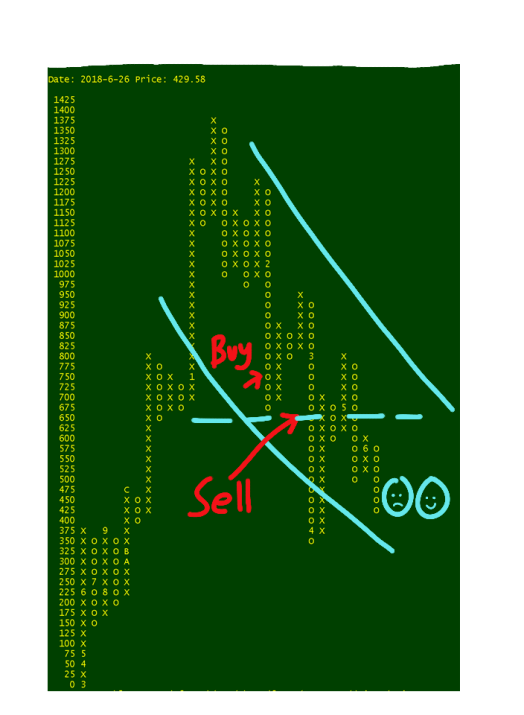
You need to have a strategy. For example, I wrote previously on why I sold my crypto holdings. The updated chart on this is below.

eth-update-june-18.png

Now, I’ve been lazy and not traded this as I could have, but on the whole, the sell still was the right call at the time – but this market is volatile and so at times it looks bad.

The point is that you can make money in an up or down market, if you have a strategy. And, depending on your position, you’re either sad about losing value or excited about buying something cheaper.

And that is basically how markets operate, so get used to the ride.

And, in case I haven’t said it enough, have a strategy before you jump in.

We still need to remember the purpose of the whole thing

The point about decentralised technology was that it could make things more equal, let those who had less also participate in the system.

In network economics with a winner takes all model, it’s easy to lose sight of the equity principle.

I don’t know how this will turn out – whether commerce will win or whether the system will create fairness… let’s wait and see.

Finally… don’t forget common sense,

The best presentation for me was one by Michael Messele of Pillar who not only went through his ICO story but also reminded people again and again to use common sense.

Want to get money? Then think about how you come across to people and pitch in a way that works for them.

Think about design, legals, management. Think about how you will deal with trolls, with your ICO going viral and your brand. Get help from experts. Create ways for people to work with you, in exchange for promises if necessary.

In summary… there is life in this market – and the big businesses are coming

The final takeaway is that this is starting to go mainstream. The big players are involved – the enterprise level players, and blockchain is going from a mathematical curiosity to a commercial proposition that we will see emerging over the coming years.

Any questions or if you’d like to talk more about any of the points here – please get in touch or leave a comment.

Key takeaways from Day 1 of Blockchain Summit London 2018

blockchain-summit-day-1.png

Wednesday 7.10am

London

An interesting day of presentations about Blockchain at Blockchain Summit London from a range of speakers – from large and small organisations.

It appears that Blockchain is moving from the early adopter stage and getting more mainstream interest.

We need to think beyond the technology

The basic idea of distributed ledger technology is what many people are interested in. Raymond Cross of SAP talked about what enterprises look for – and it is much more than technology.

The technology is only one component for enterprises. They also need to think about their existing operations – the scale of them in particular – and how they can move without disruption and risk.

That means that they want to know about standardisation and process and the way in which their business will operate in five or ten years and create a transformation plan that moves them from where they are now to an intelligent enterprise

Regulation is coming

The blockchain space, and most visibly cryptocurrencies and Initial Coin Offerings (ICOs) have been something of a wild west, with regulators and governments scrambling to keep up with the technology and its implications.

KPMG talked about how governments around the world take different views, from acceptance in Gibralter to bans in China. Where you set up matters. Tax is complicated – and where your company is located is one component, but the residency of directors could also affect things.

One thing is clear – governments will want their taxes, and the rules around money laundering, terrorist financing and knowing who your clients are will help enforce this.

There aren’t enough advisors for the need

Many people want to know about how to invest in cryptocurrencies, and traditional advisors are struggling to keep them informed.

Or Barmatz of Crypto Finance said that millenials in particular want to have this as part of their asset mix, but cannot find people who understand and can explain what their options are.

At the same time, funds are starting up that allow a range of investors to add these assets to their portfolio mix, so eventually crypto may become a standard part of portfolios.

Venture Capitalists are adapting

Traditionally startups went to VCs, cap in hand, asking for money.

Now entrepreneurs are starting to question why they need VCs and Silicon Valley at all, when they can go directly to the public and raise staggering amounts of money in minutes.

VCs are adapting, pointing out that it takes $200-300,000 to run a successful ICO – actually the new name is Token Sales, and they can help with that initial funding.

So, they’re setting up accelerators and trying to identify even earlier stage startups to invest in – which vaguely reminds me of the Dilbert cartoon where a VC asks a couple if their unborn child is going to be an engineer and if he can invest something now…

BOTs will be treated like illegal aliens

We’re moving towards a world where bots are everywhere – automated programs that do things for us.

In that world, however, if someone takes control of your bot – say one that you trust to do all your banking – they could steal all your money.

And bad people are working hard to figure out how to do just that.

So, the good guys are probably going to have to come up with a way to register bots – check that they can only do what they are allowed to do, and register them using identity technology.

That could be interesting for governments – now not only do they need to manage people but also the bots living in their jurisdictions.

Peer to peer is the future

My favourite quote of the day is from Associate Professor Alex Nortas who says inefficient coercive pyramids rule society.

He put up an example, with Black Insurance, of how people could collaboratively create and fund products through a platform, without having to go through the traditional structures that exist today.

These models are still developing – but it’s clear that they are coming and are going to change many industries – making them more accessible to more people, freeing up capital and driving down costs as a result.

Which sounds like a good thing – it’s more efficient after all to connect the people with money and the people with an idea directly – and that looks like how things will increasingly happen in the future.

How To Recognize The Moment When Everything Changes

harajuku-moment.png

Sunday 10.02pm

Sheffield

There is no reason for us to do anything, really.

If you don’t believe in a god, for instance, then the fact of your existence is an improbable series of coincidental happenstances.

Or, in other words, you’re lucky to just be here.

But – that doesn’t mean you have to do anything.

Yes, the people around you might want you do stuff, you may feel like you should do stuff and you may need to do stuff to afford money for food and shelter…

What’s the point of all this?

Once you get past the first couple of levels of Maslow’s hierarchy of needs the quality of your life depends on the choices you make over time.

Now, some people argue that everyone is responsible for their choices. Regardless of background, we can choose to change, if we just had the willpower to do so.

Others say that we have recordings of our parents in our heads and we do things that are consistent with those. For example, if we were told to always clean our plates, we keep eating – even though the sensible thing would be to stop.

And then there is the argument that willpower is a finite resource – like a battery. If we use up all our willpower on working very hard during the day, we have little left to resist the urge to flop on the sofa and order a takeaway.

How do we make important choices – or decisions – when it really matters?

For example, when do some people decide to lose weight, and actually take it off? Or change careers, and actually do it? Or start a business, and do that?

As the old saying goes, if wishes were horses, beggars would ride.

Wanting isn’t enough. Needing isn’t enough.

The change doesn’t happen until it is a visceral longing, a critical point, like leaping off a cliff – when we commit and there is no turning back.

After that point, it’s going to happen. Before that point, it’s still a dream.

We will all have stories of when we had that moment. When we decided to start a particular class. When we met a particular someone. When we make a decision to leave or go or change.

This is why goals alone aren’t enough, tracking alone isn’t enough – it’s the mind shift that’s required.

If that mind shift is missing, then the energy needed to get us through the change process isn’t there, and it just won’t happen.

But, if you can recognise the moment when it turns up, see and feel the moment as it’s there, and use the energy of that moment to take action – you will change.

Only you can do it.

3 Critical Reasons Why Owners Let Their Businesses Fail

reasons-why-owners-dont-invest-in-productivity.png

Saturday 10:31pm

Sheffield

There is a problem – definitely in the UK and more widely in Europe and small businesses in the developed world – and it has to do with how much work we’re doing.

Many businesses are not productive enough – the amount of work done by each person in the business is flatlining.

And this is a problem for one very simple reason.

As more people look for work, including from the vast labour markets in India and China, the supply of qualified, skilled people increases.

Existing businesses will face more competition from more places – and if they’re not getting better at what they do all the time, then someone else will take them out.

So why do small businesses, in particular, struggle to keep up?

To start with, there are three things they can do to improve their businesses – they can invest in better systems, create better processes and hire better people. And this creates three problems.

1. They’re Too Busy Paying Rent To Worry About New Technology

Most businesses owners are neck deep in work.

There are customers to deal with, suppliers to shout at, employees to manage, rent and wage bills to pay and tax to collect and give the government.

Almost every small business owner is spending too much time working in the business to step back and make the time to work on the business.

So – wanting money out of them for something they don’t understand is not going to go down well.

However good a new technology – most business owners just haven’t got the time to get their heads around it and work out if they will benefit from it.

2. They’re Entrepreneurs – Not MBAs Or Accountants Or Lawyers

May people who start businesses have a passion for what they do, or they’ve taken over the family business, or they spotted a gap in the market for a product or service.

They’re creative opportunity spotters, risk takers and problem solvers.

That’s great when you need sheer force of will to convince suppliers to give you credit, customers to give you business and people to work for you in exchange for promises.

It’s not so good when you need to pass a security audit or comply with GDPR or file an environmental compliance application.

Often businesses don’t have the skills in-house or the contacts outside to get qualified advice on what they should do and how they can do things better – whether it has to do with improving sales and operations, cutting costs or having better contracts in place.

3. They Don’t See The Point Of Investing In Training

This is the hardest one for many business owners to get – and it’s the equivalent of shooting themselves in the foot.

You only have two options – you can hire someone with the skills you need, or you can train them to the level you need.

Many business owners don’t want to pay for training. They see that as an immediate cost and, once the person has been trained, what happens if they simply leave?

All that investment disappears. Instead, why not just hire someone that another company has spent a lot of money to train?

That’s Why They Die A Slow, Lingering Death

People don’t want to mess up their business – they just do because sorting things out for the long term is just so much harder than dealing with things right now.

But we should… think about these three sayings:

  • If you don’t make time to exercise, you will have to make time for illness.
  • Forewarned is forearmed
  • If you train people, they may leave. But, what if you don’t train them and they stay?

If you’re too busy to fix your business now – then it will be a lot harder when the competition has moved in and taken most of your customers.

Understand the value of good advice.

And – train your people. Having a good training system in place that takes inexperienced people and turns them into superstars is the best insurance against having to hire superstars that will leave you the first chance they get for a better offer.

It takes one set of skills to create a business. It takes another set of skills to keep it alive.

There are three kinds of people in the world. Which one are you?

three-kinds-of-people.png

Friday, 8.56pm

Sheffield.

At the end of the week, do you feel like you’ve had a good one?

It started, if you remember, with Monday.

Monday is meetings day – lots of meetings. Not much gets done on Mondays.

Tuesday is an inch into the week. Perhaps we’ll do something on Tuesday. Open a file, make some notes.

Wednesday is rock bottom – can’t go forward or back. It’s right in the middle and the worst day of the week. Probably time to get some takeaway or junk food to forget it.

Thursday – perhaps that’s a brighter day, looks like we’re over the hump and it’s downhill from here.

Friday is a long day and, when it’s done, we can forget about the working week and get on with the weekend.

That sounds like a productive week – or not.

Now, hopefully, that wasn’t your actual week. You probably crushed Tuesday and spent the days around it getting some real work done.

But, however your week turned out, that isn’t the point.

This is.

Did you do one of these three things:

  1. Get some big projects away – do some work that made a difference to your company, your business or for the people around you?
  2. Get on with your job, the role, what you are paid to do. Go in from 9 to 5 and do what’s in the job description.
  3. Do what you’re supposed to do, while studying, planning and thinking about what else you could do to develop your career or improve your life.

This isn’t a trick question – the chances are you did all three in some way. Perhaps you worked on the garden and sorted it out finally. Perhaps the filing system is now better at work. And you’re through the first module of the accounting course you’re doing part time.

Did you do things that helped you get better, accomplish goals and get yourself sorted. Or did the days just pass by, and it’s hard to remember what actually happened.

We lose time without noticing. Life seems so long, until it isn’t.

We’d be horrified if we lost our life in an instant – but we barely blink as it ebbs away second by second.

What’s the answer to the question in the title – the three kinds of people?

There are people who make things happen. There are people who watch things happen. And there are people to whom things happen.

Which one do you want to spend the most time being?

The Single Best Tactic to Use to Achieve Your Goals

no.png

Life is just too busy.

There’s always too much going on.

If you’re young, there are parties to go to, friends to meet, movies to watch and places to visit.

If you have a family, the kids take up all your time, and what is left is spent tidying up and trying to get some sleep.

If you’re older, perhaps the grandkids keep you busy. Or there’s holidays with the friends, cruises and charity work.

Is this a good thing?

Possibly. Many people have worse lives and struggle with daily living.

But the fact that others have it worse doesn’t change the reality of the life we live.

So, what can you do about it?

There’s a great ad that Saatchi and Saatchi did for The Health Education Council.

It just says No. And below, it says still the most effective form of birth control.

And this is good advice with almost everything we do.

The point is that we spend a lot of our time doings things others want us to do.

At home, we need to deal with asks from family.

We exchange our time at work for money, and get told what to do as a result.

And, if we want to be nice and useful and not get fired, we do the things we are asked to do.

But, at some point, we could lose track of why we are doing anything in the first place.

What drives you, what do you really want?

And is what you are doing every day getting you closer to or further away from what you want.

Perhaps we can’t remember – all the years have buried our real wants under layers of reality, demands and expectations.

A good tactic to peel back the layers is the perfect day exercise.

Imagine your perfect day. The one that would make you totally happy. What does it look like?

Where do you wake up. What is the room like, the bed, the view?

Maybe it’s not a room, but a hammock on your beach hut in the Caribbean.

What’s the first thing you do? Who is there with you? What is breakfast like?

How do you spend your morning? Do you jet off to a high powered meeting in NYC or LA or are you having brunch with friends in Paris? Or walking the dog in the highlands of Scotland?

Describe your day in detail, from start to finish. Write it down quickly, without censoring yourself. No one is going to see this, so be completely honest with yourself.

Then, look back at what you have written and compare it with what your life looks like now.

If you’re dreaming of being a documentary film-maker but spend your days doing forensic accounting for waste management companies, then something has happened along the way to nudge you off course.

It’s not a problem.

You have the rest of your life to get back on track – starting right now.

And the way to get started is by saying No to the things that take you further away from your perfect day.

Not to all of them, not all at once – that will just get you fired and ruin all your relationships.

But, perhaps – that’s what’s actually needed in some cases.

For most of us, we need to correct course, not sink our boat and swim, spluttering and flailing, towards a new one.

Try saying No to more things from now on.