Why The Cages That Keep Us In Are First Built In Our Own Minds

gilded-cage.png

Sunday, 8.49pm

Sheffield, U.K.

They makes cages in all sizes and shapes, you know. Bank-shaped some of ’em, carpets and all. – Bert in Mary Poppins

For many of us a job started as something we fell into and then became something we started to depend on and then became something that the people around us relied on.

How about bosses?

For some business owners a sense of feeling responsible for their employees is a very real thing – something that affects how they make decisions about who to hire and keep and let go.

For other owners – perhaps not quite so much.

But what about employees? How many are loyal to the business that has put food on the table for the past several years? How many would just walk away for a little bit more?

And how many stay, afraid that they will never make as much somewhere else – afraid that they would not get another job?

We watched Mary Poppins this weekend and Dick Van Dyke as Bert said to the Banks children that the person he felt sorry for was their father – caged in that cold, heartless bank where he worked.

And, for many of us, has the modern world indeed become one of cages?

The typical day for someone working in an office is effectively a process of prisoner transfer – from vehicle to building and back again.

You might be your own prison office but the results are much the same.

You’re dragged away from your warm cosy space and transported somewhere else at a time decided by others.

There’s something vaguely uncomfortable about seeing things like that. Aren’t you there of your own free will?

You signed a contract – agreed to the corporation’s terms.

You are there in the way that you are because you chose to be.

Isn’t that right?

I’m not sure. I think the conditioning starts early.

Some people suggest it all started with the invention of modern armies that needed well trained recruits – a structure that was equally useful to create well-trained recruits for businesses.

So, is education really all about equipping people to fill jobs? To fit into the openings available out there?

By the time you emerge, blinking, out of school and university in your twenties what most of us have learned is that we need to look for a job.

It takes ten to twenty years to get good at something.

Some of us do – we get good enough to perhaps start our own businesses, create new industries.

Although that can be a whole new learning experience as many of us have never run a business before.

Others reach a plateau and watch with increasing concern as other younger, cheaper, better trained recruits look hungrily at their jobs.

So, what does all this boil down to?

Well, if you were in prison for ten years, what would you do every day?

Me – I’d read and exercise – preparing for the day when I’d get out.

I’d hope that I’d know enough and have enough health to be able to start a second life.

At the start of a working life maybe the next ten years is just a sentence you have to serve to get skills that someone else values enough to pay for.

If you haven’t got those skills then freedom is likely to be cold and miserable.

If you’re in a cage – so be it.

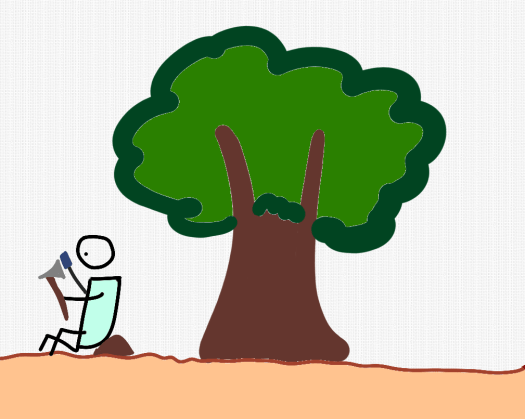
After that you might think about opening the door – it’s been unlocked all this time waiting for you to decide when to walk through.

The question is are you brave enough after all this time?

Cheers,

Karthik Suresh

What Is It We’re Trying To Do Here Anyway?

picasso-camel.png

Saturday, 8.22pm

Sheffield, U.K.

It took me four years to paint like Raphael, but a lifetime to paint like a child. – Pablo Picasso

My eye fell on a copy of Brutal Simplicity Of Thought: How It Changed The World at a charity shop today and, when browsing through it, stopped at a line drawing by Picasso of a camel.

Well, actually it’s a single line, which gets across the idea of a camel well enough that I, several hours later, can reconstruct it from memory as you can see above.

And this line drawing has revealed something to me that I just hadn’t seen until now.

If you’ve been reading these posts you’ll remember that I got a little angsty sometime back about being too theoretical and not having enough hard, practical stuff in here.

Others seem to do it much better.

Tim Ferriss, for example, is all about routines and habits and precise doses of complex chemical compounds.

Tim Urban at Wait But Why has long-form posts that go into complex topics in depth.

Writers like Seth Godin dominate marketing strategy and John Carlton delivers much needed straight talk about copywriting.

What makes this blog different from those? what is it that I can do that adds to the world of knowledge we live in?

And to answer that I have to go back a few years to when my eldest child was born.

If you’ve had contact with children you’ll know that they’re not very rational about most things.

The whole crying and making a fuss thing works so well for them that any “adult” way of dealing with it soon fails.

So, when I wanted to get something across I would draw with the sprog – something we called Drawing A Story.

We’d sit down and draw situations and people and emotions and interactions and try and talk about them.

And when we did that interesting things happened.

For example, a three-year old, it appears, doesn’t seem to have the capacity to understand the golden rule.

If you show the kid a drawing of a big kid laughing and being mean to a small one and ask them how they would feel if they were the small one they’ll probably say sad – tearful.

The big kid on the other hand is having fun – and they can see that as well.

What’s a little harder to compute is that if they’re the big kid they shouldn’t be mean to the small one because if they were small they’d feel bad.

In other words – the whole do unto others the way you would have them do unto you doesn’t seem to be wired into their brains yet.

So, in cases like that, you have to lay down the law and make not being mean a rule rather than appealing to the child’s better nature.

Anyway… I discovered that drawing was a way to discuss quite complex things with a child and explore the limits of their understanding and, for that matter, my understanding as well.

And when I started a management degree it turned out that using drawings to discuss ideas with a three year old worked just as well when discussing ideas with a thirty-three year old.

What’s happened since then is that simple drawings – situations, people, structures, relationships – have become the way I try to learn and understand ideas and concepts.

What Picasso was doing was reducing art to a kind of essentialism – down to lines and form.

What minimalists do in life is try and reduce their possessions to the essentials – what they need to live and survive and be happy.

I think what I’m doing is working towards a kind of intellectual minimalism – to understand ideas and concepts that might help us live better in a way that I can explain to my children by drawing a story.

After all, we live in a world where things last for ever and the clutter builds up – physical clutter, intellectual clutter and media clutter.

But the world is full of great stuff, thoughts and ideas that can help us live better lives, create better businesses, communicate with others better and focus on the thing that matter.

And maybe what I’m trying to with this blog is help us see things with that child-like vision – that beginner’s mind – which is the foundation for real understanding.

And hopefully that is a useful thing to do.

Cheers,

Karthik Suresh

How Do You Get So Good At Something That You Can’t Be Ignored?

deliberate-practice.png

Friday, 8.49pm

Sheffield, U.K.

It’s hard to beat a person who never gives up. – Babe Ruth

An acquaintance mentioned the other day that he had been out climbing roofs.

Roofs? Like house roofs? Who does that and why?

Not many people, it turns out. He’d been talking about cave roofs – where you climb and then hang from the roof.

Absolute madness, in my view, requiring more abs than I’ve seen in a long time.

Sheffield apparently has some of the best climbing rocks in the world. And this is the sort of thing people get good at.

And people get really good at things like climbing and sports and music – things where you can win or show how good you are.

Researchers studying such people worked out that they had something in common – they spent years and practised their skill in a way that has come to be called deliberate practice.

The way you get good is by doing practice deliberately.

As the saying goes, you don’t just go out for a walk and find yourself on top of Mount Everest.

If you practice something for long enough you’ll get good. And then you’ll hit a ceiling and really not make much more progress.

In fact, in many professions, you spend a lot of time getting to a certain standard and then stop trying – and the only way then is down.

As I read somewhere recently, you don’t rise to the level of your training. You sink to it.

So what does it mean to practice deliberately and how can you do it?

Ericsson et al tell you how in a long paper – but it boils down to three things.

  1. You need to build on existing knowledge.
  2. You need to get immediate feedback on your performance
  3. You need to put the time into trying again and again.

Seems simple – but is it easy?

If you’re on track to be an elite athlete or musician then you already know what to do.

What about the rest of us?

What if you’re trying to become a better programmer or writer or marketer or entrepreneur?

The starting point here is to realise that you’ll do better building on what you know than what you don’t.

If you never used a computer don’t expect to become a whiz at C# overnight. Or, if you’ve written an essay at school, expect to publish your best selling novel next year.

But… you can do those things as long as you climb the rungs in between on the way.

Then there is feedback.

When you watch your kids’ sports teachers do you notice that they have a game where you need to catch a ball and if you drop it you have to leave the game?

How inane is that? The kids that need to spend the most time with the ball learning how to catch it are asked to sit out while the ones who are good get to stay in and practice some more.

What you need is time – time to repeat and try again and again.

As a writer, for example, you’re advised to throw away your first million words.

Those are your learning words.

Now, I’ve not been writing that long – 445 posts, 250,000 words plus another 150,000 in warm up text. That’s 400,000 words over the last couple of years and I still feel like I’m just learning every time I start a new piece.

And I’m prepared to keep feeling that way for the next ten years because I enjoy writing and the only way to get better is to keep trying.

But you also need feedback and that’s where a coach comes in or, if you don’t have a coach, getting tools to help you coach yourself.

That’s easier in some fields. A programmer, for example, gets feedback all the time when a program doesn’t run.

But what about things like business where there are complex things you do that aren’t easily measurable?

But I suppose the point about deliberate practice is that it has nothing to do with the results of your business.

It has to do with your results.

It’s a way to work on yourself to get good at something – something that matters to you and that you care about.

And when you do that you just can’t help getting better every day.

Cheers,

Karthik Suresh

Are There Really Shortcuts In Life To Success?

short-cuts.png

Wednesday, 9.32pm

Sheffield, U.K.

It worries me that young singers think you can shortcut the training and go straight to fame and fortune, and programmes like Pop Idol have encouraged that – Lesley Garrett

I was listening to Jay Abraham’s podcast for the first time and he said something that is obvious and yet clearly not obvious at the same time.

Most businesses, he said, do exactly what other businesses like them do.

You look around and act in the way other people act.

And that’s not surprising. For years we’ve been taught to conform, to do what we are told, to say at the table until we’re finished and do our homework.

So we end up looking to those around us for confirmation that what we’re doing is right.

You see this in financial markets – most fund managers want to be in the middle of the pack. Not the best, not the worst – not an outlier.

In a Goldilocks band of not too hot and not too cold – just right where there is little chance of being blamed.

So what happens after ten, twenty years of thinking like that?

We naturally assume that the way to do it is the way others do it – the way we see it being done around us.

So we see websites that look identical, messaging that is a variation on a theme, everyone trying to stand out by doing much the same thing as everyone else.

Are there shortcuts? Perhaps you get there swinging like a gymnast, flying from bar to bar to the top in one smooth motion?

Of course, you need to be a gymnast first.

For the rest of us the stairs are the only sensible option.

So this poses a problem – how can you stand out if you play it safe?

That’s the point at which a quick response starts to falter.

Jay, for example, talks about what you could do differently. For an audience of real estate agents, for example, you could stress that your list can be found nowhere else – that you have gems that no one else will see first.

That, of course, requires you to corner a market, something which is not easy to do.

Or you could stand out because of who you become – you could wear orange like Joe Pulizzi, swear like Gary Vaynerchuck or get a job as the CEO of Microsoft.

Maybe the reality is simpler than that.

Your competitors behave in a certain way because that’s how buyers want them to act.

What they show is what the market wants – that’s why it’s there in the first place.

No one wants to hire someone with a completely different point of view.

For example, there are Government guidance documents that are plain wrong. Wrong in a way that can be proved mathematically.

But, can you convince someone with a Government job to do something differently?

The fact is people will do what they feel is the lowest risk option – not the best one, not the most exciting but the one that is safest.

We’re wired to hate risk much much more than we love opportunity.

And that’s why shortcuts don’t work.

We don’t trust them.

We value a track record, a demonstrable history of achievement and improvement.

In most things the key is little and often not a lot every once in a while.

As Longfellow remarked, people don’t get to the top “by sudden flight, but they, while their companions slept, were toiling upward in the night.”

Cheers,

Karthik Suresh

Why What You Know Can Get In The Way Of Getting It Done

spaghetti-challenge.png

Tuesday, 9.02pm

Sheffield, U.K.

To succeed in life, you need two things: ignorance and confidence. – Mark Twain

Megan McArdle, in her book The Up Side of Down: Why Failing Well Is The Key To Success, writes about the spaghetti problem – a challenge where teams are given some spaghetti and asked to build the tallest structure they can.

Things kind of work out as expected.

The engineers get it sort of right and build something that stands up.

Business students and lawyers spend all their time arguing about who is the leader and don’t actually build anything.

The ones who get it right are the kids – who crack on with it and figure it out as they go along.

Crucially – they tend to be the ones that ask for more spaghetti – and there’s nothing in the rules to stop them getting more.

They just didn’t know what everyone else assumed – that what you had was what you got.

There’s something common about many successful business people. You often wonder how they got to be so successful – and it certainly wasn’t their smarts.

Sometimes, you can talk to them and think to yourself “If you only knew how crazy an idea that was you’d never get started.”

But they don’t know. And they go right ahead and make a ton of money.

Mark Twain’s comment is tongue-in-cheek but it’s one of those comments that is also literally true.

Industries get turned upside down when someone comes along and creates a new way of doing things – something that everyone thought was impossible.

After all, people once thought there wouldn’t be a need for more than ten or so computers in the whole world.

So, should we cultivate ignorance then? Is not knowing stuff the answer to being successful?

And that’s not the case either. Those successful people are smart – but just not in the traditional way. They’re smart about people, about what sells, about what excites others. They’re smart about getting smart people to work for them.

It’s a kind of smart that’s called instinct.

When that’s paired with confidence those people go far because they’ll do whatever it takes to get the job done while the rest of us play it safe and do the sensible thing.

And there are two other things.

One is luck.

You can’t discount the effect of luck in how many things turn out.

And the second is who wants it more.

The lawyers and the business students want to lead the group.

The engineers want to figure it out.

The kids want to win.

In any situation the people who want it the most are the ones who are going to make the most of things.

So, for those of us who do not have Mark Twain’s qualities it may be useful to act as if we do – to stop letting what we know and the fears we have get in the way of what we could be.

Cheers,

Karthik Suresh

How To Avoid Having To Do Real Work

sharpening-axe.png

Monday, 9.50pm

Sheffield, U.K.

If you have any trouble sounding condescending, find a Unix user to show you how it’s done. – Scott Adams

Sometimes I feel like much of what I write is too theoretical.

It’s all very well exploring ideas but what are you actually doing?

As Jay Abraham writes, people don’t need strategies. They need solutions.

The world is full of solutions – some of them very complex and many of them solve problems that have been solved before.

Take a simple thing – managing a database.

A database, in its simplest form is like a box of index cards.

Each card is a record and you write stuff on it.

Now, you can get very excited about big, complex databases but in the Unix world a text file can be a database where you use a line for each record.

Interestingly, I strugged to find any applications that would let me create a simple personal database that I could use – for example to maintain a contact database or customer relationship management (CRM) tool.

Odd, I thought.

Back when I was young, my dad let me help him create a database for a medical conference. I can remember showing the visiting doctors their data on the screen and checking if it was right.

This was on an old IBM PC/XT using some version of dBase, I imagine.

Anyway… you wouldn’t believe how hard it is to find something that lets you manage a text file as a simple database – that lets you do the basic operations: create, read, update and delete on the files.

Now, of course you can just open the file and edit away, but that’s no fun.

So today’s diversion was to create a small crm. That’s a bit like taking time off from chopping down a tree to work on sharpening the axe.

If you’re being generous, that is.

On the other hand, it’s possibly a complete waste of time, implementing something widely available in a way no one else might ever use.

But here’s the thing.

I’ve found the Internet and the stuff other people have put out there immensely useful in all the work I do.

So, maybe sharing this bit of code, unfinished as it is, may be useful to you as well. Apologies for the formatting – tired of struggling with WordPress!

Cheers,

Karthik Suresh


#!/bin/bash
# Script to manage a simple crm
# It's going to be as terse as ed

crmfile=$1

# Setup file
if [ ! -f $crmfile ]; then
echo "Name:Company:Phone:Email:Next Action" > $crmfile
fi
while [ "$command" != "q" ]
do
read command
case $command in
q)
exit 0
;;

h)
echo "Commands"
echo "q: exit"
echo "a: add record"
echo "r: show records"
echo "e: edit record"
echo "d: delete record"
;;

a)
echo "Full name:"
read fullname
echo "Company:"
read company
echo "Phone:"
read phone
echo "email:"
read email
echo "Next action:"
read nextaction
echo "Write to file? (y/n)"
read confirm
if [ "$confirm" = y ]; then
echo $fullname":"$company":"$phone":"$email":"$nextaction >> $crmfile
fi
;;

r)
cat $crmfile | column -s":" -t | less -NS
;;

d)
echo "Line to delete?"
read line
sed -i -e $line"d" $crmfile
;;

e)
echo "Line to edit?"
read line
sed -n -e 1,$line"p" $crmfile | column -s":" -t
str=$(sed -n -e $line"p" $crmfile)
IFS=":" read -r -a NAMES <<< "$str"
fullname=${NAMES[0]}
company=${NAMES[1]}
phone=${NAMES[2]}
email=${NAMES[3]}
nextaction=${NAMES[4]}
#echo $fullname $company $phone $email $nextaction
echo "Press enter to keep existing values"
echo "Full name:"
read value
if [ "$value" != "" ]; then
fullname="$value"
fi
echo "Company:"
read value
if [ "$value" != "" ]; then
company=$value
fi
echo "Phone:"
read value
if [ "$value" != "" ]; then
phone=$value
fi
echo "email:"
read value
if [ "$value" != "" ]; then
email=$value
fi
echo "Next action:"
read value
if [ "$value" != "" ]; then
nextaction=$value
fi
echo "Write to file? (y/n)"
read confirm
string=$fullname":"$company":"$phone":"$email":"$nextaction
echo "Current entry"
if [ "$confirm" = y ]; then
ed - $crmfile <<EOF
$line
c
$string
.
w
q
EOF
fi
echo "Record changed. Press r to show"

;;
esac
done

How To Understand The Economics Of The Information Business

information-economy.png

Sunday, 9.53pm

Sheffield, U.K.

Information technology and business are becoming inextricably interwoven. I don’t think anybody can talk meaningfully about one without talking about the other. – Bill Gates

Recently a German supermarket removed all non-German products from its shelves – leaving them almost bare.

It was trying to draw attention to just how many products come from outside the country – the result of a globalised economy – and how sparse life would be if we could only have things that were made by others like us.

If you walk down any high street in the UK you’ll see a lot of stuff for sale and much of it is made in China.

You know it is, because it says so on the label.

It’s the information on the product that tells you what to think – whether you see it as an expensive high end gadget or a cheap throwaway.

If you walk through a factory it’s quite possible that you’ll see the same product going into different packaging and being sold for different prices, with one perhaps three times as much, just because of the information content on the packet.

Bill Gates was really focused on the technology part of Information Technology when he talked about its relationship with business.

But what is information doing to businesses around us and how can you make it work for you?

Information is weird – as Wikipedia explains – it’s easy to create but hard to trust. Easy to spread but hard to control.

You or I can now write what we think and publish it without needing agents, publishers, printing technology or much capital.

Whether people read what we write is a different story.

Why should anyone take anything we write more seriously than anything else that gets in front of them.

The fake news industry, with people engaged full time in creating stories with catchy headlines so they can surf the traffic monetisation wave is probably going to beat the pants off you.

Mainly because they give people what they wish was true.

Let’s say you make something using a 3-D printer – now technology that you can have at home.

If you use a set of plans provided by the manufacturer does the thing you make have value?

Could you go down to the market and sell it to someone passing by?

Probably, but not for much, as if you were able to do that others would use the same plans to try and get some of that profit you’re raking in.

So is the value in the thing you’ve made or the ideas and designs you used to make it in the first place?

The thing with ideas is that they don’t really have intrinsic value – not in the way a gold mine does.

Ideas are precious and valuable but it’s not obvious how they are economically precious and valuable.

That’s because once you’ve had an idea it costs nothing to make copies of that idea.

If you give your idea to one person, nothing stops you from giving it to someone else, or for the first person to pass it on in turn.

In fact, once the idea is out in the open, it’s quite hard to keep it secret.

Finally, you could tell someone that you have a great idea but unless you tell them the idea they have no way of telling whether you’re right or wrong.

Ideas then are great to have. When they’re expressed as books and art and music they make society better.

Imagine just how joyless your life would be if you didn’t have music and colour and books.

So, things like copyright law were created, not to protect businesses, but to give authors and artists a way to make money from their ideas.

And that’s a confusing things for businesses and people who have, for a few millenia, made their money from controlling property.

Now property is only worth what you get from the information about it.

A house in a good school area is worth more than one that is not – and you know the good schools and bad schools because of the information available to you.

You start to see the way people are dealing with this as the new titans of the information business emerge.

Tim Ferriss, for example, has written about he stopped worrying about his books being stolen and pirated and focused instead on giving his readers the best experience he could.

It just makes sense because while some people will steal your stuff it costs you nothing. It’s not like they’ve stolen your TV or car. Instead of letting that worry you focus on the tens, thousands or millions of consumers who do business with you.

The challenge for us is being able to figure out a way to work in this new economy where what you do is worth something between zero and a lot.

Cheers,

Karthik Suresh

How Far Do You Have To Take It Before It Becomes Worthwhile

exhaustion.png

Saturday, 8.57pm

Sheffield, U.K.

Genius is one per cent inspiration, ninety-nine per cent perspiration – Thomas Edison

I can never walk past a second-hand bookstore without going in.

A library is the same. I feel like I’ve missed out if I have to leave without having run my fingers over a row of books.

But these days when I stop on books, especially ones about management, marketing and business I find it hard to justify picking them up.

Most books are written with a structure and formula, not entirely visible, yet still there.

For example, there is usually an anecdote, a story of someone that did something and how as a result something happened.

Then there are the lists – the lists of questions to ask yourself, the lists that are designed to be psychological measurement tools that tell you where you lie on a spectrum and the lists of characteristics and features that you should look for.

Now the writing business is a business so if you want to make any money your books need to be what people expect – a certain size, a certain type – because we don’t like things we don’t know.

The point of picking up the book is to learn something you didn’t already know. To discover thoughts that might help you with the kinds of things you want to do.

Let’s take an example – in Brian Tracy’s books you’ll often find exercises to do.

One of them is a sentence completion task. He asks you to complete sentences like:

  • I am …
  • People are …
  • Life is …
  • My biggest goal in life is …

If you were working through the book fairly quickly you might write a word or phrase right there and then.

But, then you would have missed the opportunity in the exercise.

What you should do is come up with as many completions as you can.

You might think about all the ways you could end “I am…”

Are you a

  • Writer?
  • Marketer?
  • Programmer?
  • Manager?
  • Entrepreneur?
  • Father?
  • Husband?
  • Daughter?

… and so on.

The value comes when you keep going and then when you are exhausted going some more.

Why is that?

Because the answers that come easily – the first few – are what you think you are.

They are the words and phrases that you and others have used for many years to describe such things.

They may not be who you really are right now – just because you haven’t thought about this for a while.

And I think that when something isn’t born out of exhaustion you can tell.

You can tell when an author has written a book to market.

When they have written something that hasn’t drained them – taken them to the edge of what they know – and caused them to question the foundations of their thinking.

It’s safe writing – and that’s not where you are going to get value.

It’s easy to come up with a list of things to do. But often, what is needed is not the list but the time spent in staring at the first question on the list and coming up with every response you can.

That’s sometimes called divergent thinking – expanding your thinking.

Then, you might look at that mess and pick out the ones that resonate with you.

Or go for a walk. Or to bed.

And then the next day you might come up with something entirely new – not on the list at all but something that is right and new and something you can share.

It’s insight born from exhaustion – you’ve reached the finish crawling on your hands and knees and that’s what it took to discover that new thought.

As I was reading quotes by George Polya one about the sayings of a maths professor jumped out: “In order to solve this differential equation you look at it till a solution occurs to you.”

That’s the thing about insight – it doesn’t come from a line on a page or a talk from someone.

It emerges when those lines and words mix with your time and effort and create something new that is right for you.

So that’s the thing about these books I see now – I look at the lists and wonder whether I have the energy to do what is needed to really use them well.

Because when you realise that you will need to keep going for a long time to make it worthwhile you also have to get much choosier about what to do in the first place.

Choosier about which race you’re going to enter – because you’re so determined to finish – come what may.

Cheers,

Karthik Suresh

How Can You Become Better At What You Do?

letter-to-shareholders.png

Friday, 8.59pm

Sheffield, U.K.

A tool, to paraphrase George Polya, is a trick I use twiceSanjoy Mahajan

Mahajan, in his book Street-Fighting Mathematics, writes how the best teachers say little and ask much because questions, discussions and wonder help you learn so much better.

Learning maths, however, seems relatively straightforward.

As the most purely intellectual subject there is Maths doesn’t have to deal with emotion and mess and life.

Or does it?

You could argue instead that the application of maths is fundamental to modern life and everything we do can be done better with maths.

William Shakespeare mused about the gap between thought and action – and how it was filled with uncertainty and doubt.

He was talking about Brutus’ decision to murder his friend Caesar but I’m thinking about it more in the context of using software more effectively.

For example, many years ago when I was reading about marketing I came across Neil Patel who, on his blog at Quicksprout, created long, in-depth content to help you learn how to market better online.

And he made it simple and step by step. If you followed his instructions, opened a spreadsheet, entered in lots of keywords, came up with topic ideas, created a content schedule and worked every day you could also possibly end up like him.

Which sounded great, but didn’t work for me.

Partly because I really don’t like working hard, especially at something that really should be done by a computer.

The principle was right – we need to create content because that’s how the world will find us and, perhaps more importantly, how we will find ourselves, but his method didn’t work for me.

The tool wasn’t right.

Now, the tool that I use that does work for me is perhaps ridiculously specialised.

I use a text file filled with thoughts and ideas and use a markup syntax to identify important ones and the ones that should go into the diary.

A program then extracts what’s important and creates a content calendar for me.

I get involved in the messy thinking and let the computer create the structure and framework and order.

So, this is one of the challenges of going from thought to action.

We can have our eyes opened to principles but it’s only by trying stuff out ourselves that we can really learn and figure out whether we’re happier with a hammer or a chainsaw or just getting someone else in to do the work for us.

Now really, where I wanted to go with this post was to talk about where we get these principles from in the first place.

And one good source is shareholder letters.

Most people are familiar with Warren Buffett and his letters, which are hosted on a site that is so unconcerned with fancy design that it remains a precious corner of the Internet.

Charlie Munger’s letters are worth reading as well and Jason Zweig suggests a few more worth reading and these from Sardar Biglari are worth a look as well.

Reading these letters gives you a look into how people who have made a career making decisions make decisions – how they look at and examine situations.

And, often, how they use maths to explain what has happened and what they want to make happen.

So, to really make the most of a situation it seems to me we need to use better principles and questions, to really figure out which tools are right for us to get better at what we do.

Cheers,

Karthik Suresh

How To Get Out Of Your Own Way This Year

toolbox.png

Tuesday, 9.00pm

Sheffield, U.K.

Choose your tools carefully, but not so carefully that you get uptight or spend more time at the stationery store than at your writing table. – Natalie Goldberg

Happy New Year.

The great thing about the first day of a new year is that you have a chance to change things at the same time that millions of others are planning to as well.

Clearly, not everyone is going to succeed, but that isn’t the point.

The point is that you ought to at least try.

We were watching a film the other day where a character quoted Dr Seuss, “You have a brain in your head. You have feet in your shoes. You can steer yourself any direction you choose.”

And one of the things that is either enjoyable or panic-inducing is choosing your tools.

I can spend far too much time obsessing about whether I should be doing things electronically or on paper. Whether it’s best to use a software program or code something myself. Whether a reporter’s notebook is better than a Filofax.

That’s just the way I’m wired and, quite probably, many others as well.

That’s why so many rules and resolutions and goals don’t work.

They may have worked for someone else, worked really well, but that doesn’t mean they’ll work for you.

What you need to do is figure out what will work for you and that may be getting organised or getting stuck into the first thing you see.

Trying to get it perfect often means not getting started at all.

Which brings us back to tools.

What is going to work for you this year?

One approach that works for me is to think of having lots of small tools rather than a singe big one.

Sort of like having a toolbox filled with hammers and screwdrivers instead of carrying around a single Swiss Army knife.

If you think of this like writing a computer program – you’re creating a program to follow this year.

The chances are very slim that you know exactly what program to write if you haven’t already got one in place.

So it makes sense to start with what’s important right now rather than what might be important in five years.

The more lines of code you write the more likely it is that the program will fail to run or have bugs when you do run it.

Small programs are best. And small programs that work together are even better.

So, for example, if I decided that I was going to run every day for the next year I’d probably fail in a week or less.

But, if I tried to get my 10,000 steps every day there’s a good chance I could do that and get in the odd run.

How could you combine that with better diet, more rest and better time with your family?

What could you do to make your job more interesting and work on stuff that felt like it was helping someone?

When it comes down to it we live our lives following programs – often ones that have been written for us and downloaded into our brains by parents and society.

The first step, then, to getting control of your life is to start writing your own program.

And today is a good day to get started with that.

Cheers,

Karthik Suresh