How To Get Your Head Around A Pull System Of Working

pull.png

Tuesday, 7.57pm

Sheffield, U.K.

Kanban is like the milkman. Mom didn’t give the milkman a schedule. Mom didn’t use MRP. She simply put the empties on the front steps and the milkman replenished them. That is the essence of a pull system – Ernie Smith, Lean Event Facilitator in the Lean Enterprise Forum at the University of Tennessee

When you have a conversation with someone the ideas can flow quite easily – you can think of any number of ways to do something or to collaborate.

How should you think about what to do – how can you work out what’s worth doing?

The idea of push systems versus pull systems seems a useful one to understand for these situations.

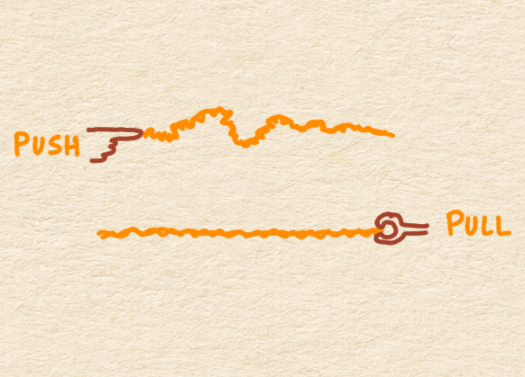
The easiest visual analogy is to think of moving a rope.

If you push it along, it bunches up and twists and generally remains stubbornly in place.

If you pull it, however, it will follow you to the ends of the earth.

So, that’s easy to say but how does it actually help you?

Well, one practical place to start is with todo lists.

A while back I wrote about my way of doing todo lists.

I write notes in plain text files and when there is an action that I want to remember I write it on a new line starting with [].

That makes it easy to search for all lines that denote actions and come up with a list of everything I need to do.

The actions list emerges from the notes I take over time.

My argument in that post was that lists get stale over time – especially if you keep them separate and have to manually update them.

The fact is that lists kept in the way I describe also get stale over time.

What I did was write a command to pull out all the actions and that list simply gets bigger and bigger until eventually I stop paying attention.

The point is that I’m still pushing actions onto my list.

And that’s ok – you need to capture the things that need to be done.

The obvious next fix is to figure out how to pull my attention to the tasks that need doing.

So, typically the default is to list everything and then tag things by priority.

Sort of like saying list to get everything and list A to get the ones tagged at priority A.

What if I turned that around so that list only shows me tagged items.

Get rid of all the priority codes and allow only a specific number of items that can be marked as priority at any one time.

Say 3.

That means when I list my actions the three that I’ve marked as ones to do turn up.

Those pull my attention and I spend my time either doing them or deciding that they can be deprioritised and taken off the list.

In a nutshell, what you’re doing every day is figuring out what should pull your attention.

And the thing that should pull your attention is the thing that most needs doing.

Sometimes that is urgent and sometimes that’s important – but that’s the decision you need to make from the mass of stuff that’s in your entire list.

When you stop thinking in terms of where you spend your time and start thinking in terms of what activities should pull your attention then you can start to choose between options.

Should you start work on a proposal or presentation before you first meet with a client?

Or should you always have a conversation to understand what they are thinking before you put forward your ideas?

Things like that are really hard to do especially if you have a boss who believes in being prepared or have a hard charging sales process where you need to talk someone into buying.

I suppose it comes down to having a very simple rules.

Do work for only one of two reasons.

First, do work if it’s something a customer wants you to do and is willing to pay you to do.

Or, second, do it if you want to do it.

Anything else is probably wasted effort.

Cheers,

Karthik Suresh

How Not To Fail

failure.png

Monday, 8.37pm

Sheffield, U.K.

If you’re not failing every now and again, it’s a sign you’re not doing anything very innovative. – Woody Allen

Most things fail.

Most businesses set up in the last century don’t exist any more.

The vast majority of species have died out.

And ideas once thought eternally true are being invalidated all the time.

Failure, then, is a natural thing to happen – everything dies – it’s the surviving that’s unusual.

These are the kinds of things Paul Ormerod explores in his book Why most things fail: Evolution, extinction and economics, taking an economist’s view of how businesses and governments operate or, more commonly, fail to operate.

There are some quite interesting ideas in the book – not least among them the fact that while it’s easy to say things about business it’s very hard to do them.

For example, it’s easy to say that you should make more money than you spend to stay in business – but how much?

Do you make a penny more, or ten times what you spend?

Should you locate yourself near a competitor or far away?

Do you specialise and do just one thing really well or do you become a generalist, able to do many things but not as well?

Ormerod explores failure in many forms – using an economists analytical insight.

What comes across, after all that analysis is just how poor maths is when it comes to explaining the world around us.

The models that are used to explore ideas are very simple and the one thing they tell us is that simple rules lead to complex behaviour you can’t predict from knowing just the initial rules.

In other words, the number of possible futures facing us is so vast that it’s impossible to predict which one will happen.

So, what should you do if you want to survive into one of those futures?

You need to do two surprisingly simple things in order not to fail – maybe even just either one of them.

The first thing is to get knowledge.

In the simple models agents with knowledge survive longer.

In the business world this means that before you start a fast food restaurant, get experience working in and managing a fast food restaurant.

Start a business you already understand and you increase your chances of success.

Start something you don’t know at all and you’re on the fast track to failure.

The second thing is to innovate – to try things out and create something new.

That’s where the successes that you’ve heard about come from – the facebooks and googles all come from people doing something new – from innovating.

In evolutionary terms that’s the equivalent of trying out really long fangs or extra spiky claws.

These are two really very obvious things, but like many obvious things we don’t do them as much as we should.

Learn your business and try out new things on your customers.

That’s simple, isn’t it?

Is it easy to do?

Cheers,

Karthik Suresh

How To Understand Just-In-Time vs Just-In-Case In A Service Business

service-value.png

Sunday, 8.50pm

Sheffield, U.K.

how do you identify wasteful transaction costs or coordination activities? I believe that you ask yourself, “If this activity is truly value-adding, would we do more of it? When?” – David J. Anderson, Kanban

I was reading The Toyota Leaders: An executive guide by Masaaki Sato which talked about how the management there were introducing just-in-time (JIT) in the early fifties.

The idea of JIT makes perfect sense – don’t do anything until it’s needed by someone else for something they have to do.

It’s also fundamentally at odds with our human nature and how we think about things.

Imagine you wanted a coffee but had forgotten your wallet and suddenly say that there were two five pound notes in front of you – with no owner in sight.

Would you take one to pay for your coffee and leave the other one for someone else?

It’s ridiculously hard to stop ourselves hoarding things – from keeping things when we don’t need them to buying more than we need just in case.

The place where you see this most is in the weekly supermarket shop where the clever people who design the experience seem to have worked out how to make sure we always come out having bought 40% more than we had on the list.

So it’s ironic that the insights of JIT came to Toyota at the same time supermarkets came to Japan.

They saw that each customer at home had a small fridge and would make a trip to the supermarket to buy only what they needed.

And the reason the customer would only buy what they needed was because they could trust the supermarket to never run out of stock – so the customer didn’t have to hold any just in case.

In fact the ideal situation for a supermarket would be that whenever a customer took an item off a shelf a little factory right behind the item would make a new one.

So the main point about just in time was that if you could trust you could get what you needed when you needed it then you wouldn’t need to worry about keeping a stockpile just in case.

Now, the way in which you’d implement this is by having the people doing each activity ask for what they needed when they needed it.

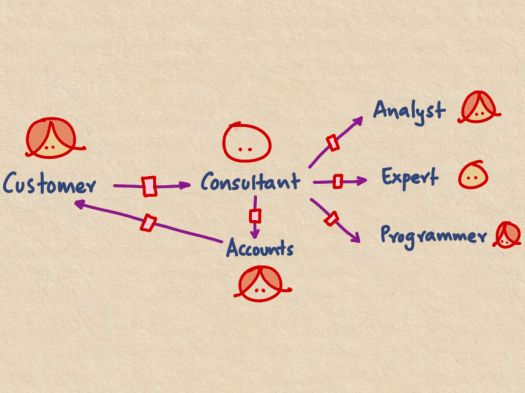
This request was like an order form – and that’s where the term kanban comes from – from these order forms and Toyota saw that they could link activities together using these order forms and create a just in time system that pulled what was needed to where it was needed.

Now, as most of us don’t work in manufacturing what would that look like in a service environment?

In the model above everything starts with the customer.

The consultant’s job is to work with the customer, understand their situation until the customer is ready to sign a proposal asking the consultant to do something – that’s the first equivalent of a kanban or order form.

The consultant might need resources for the project – let’s say it’s going to involve an analyst, a subject matter expert and a programmer.

So now the consultant needs to engage with his or her colleagues to get them to work on the project.

Now, this is where it gets a little interesting.

Let’s say you’re the consultant and want the cheapest possible service then what you might do is go onto upwork or fiverr and try and get someone cheap.

The chances are, however, that you won’t get the kind of work you need because it’s a transactional relationship and the one thing that we know about customers is that they change their minds – which cheap outsourcers find has an impact on their costs.

What you probably need is to work with colleagues that you know, like and trust – people with whom you have a long-term relationship.

And that means committing to them, having one preferred supplier for that element of the service.

And, in return for always giving them the business, when you send them a signal asking for help they’ll respond.

But that doesn’t mean you can shortcut the time it takes to get them briefed and ready to start working.

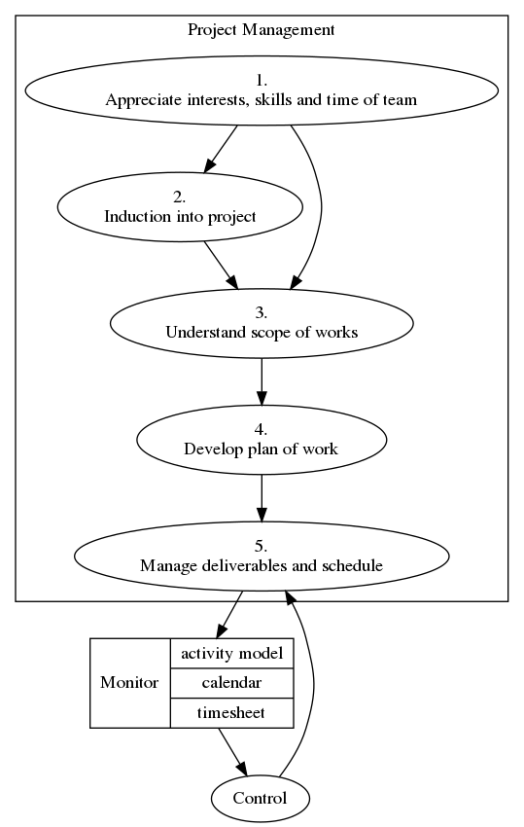
For example, I sometimes use something like this to manage that process and, unsurprisingly, it does take a couple of hours to get everything going.

project-management-lean.png

The thing is that you can’t simply fire off a request and forget about it – it takes time to understand what’s going on from the point of view of the client and the consultant’s job is to make sure the client gets what they need.

And, of course, we can’t forget the job of billing.

That’s another request through to accounts to send an invoice and get paid.

If you put this kind of model in place you’ll find that you have meetings only when you need to have them.

The point is to manage the client’s expectations, to explain to them how this process works.

If they take six months to agree a proposal and want a deliverable the next day you should probably suggest they talk to someone else.

Because no one can, and you shouldn’t, maintain the capacity in your business just in case a client walks through the door.

It makes much more sense to arrange things so that you can draw on the capacity when you need it.

As the quote that starts this post says – when you look at your day what would you do more of and what would you not do at all?

Perhaps you’ll find you’re most satisfied when you can take an hour off just for a nap or just because you feel like it – because you know that what you’re spending your time doing is what matters when you’ve awake.

If nothing else, you’ll spend a lot less time in pointless meetings.

And a lot more time getting your client results and keeping them happy.

Cheers,

Karthik Suresh

p.s. Another Sunday article on the same theme is How To Think About And Improve Service Design which may also be of interest if you’ve made it this far.

How Should You Spend Your Time?

spending-time.png

Saturday, 8.28pm

Sheffield, U.K.

“If something is not a “hell, YEAH!”, then it’s a “no!” – James Altucher

I was leafing through the big enough company: Creating a business that works for you by Adelaide Lancaster and Amy Abrams and stopped at the bit where they talked about the importance of learning to say no.

It’s interesting, really, that we can only make progress when we realise what we should not do.

After all, there are unlimited options open to us, any number of routes we can take, a plethora of choices.

But we have to winnow them down to the ones we want to take.

And that takes some thought.

So, I wondered, what kind of model could you use to do that.

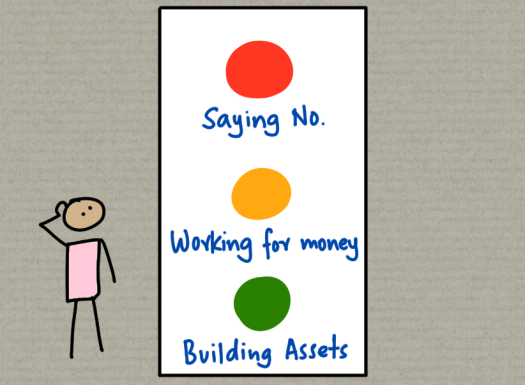
Let’s take a traffic light and see if that helps us think about how to spend our time.

What if we spent some time saying no, some time working for money and some time building assets.

What would that make our life look like?

Saying No.

Saying no, I think, is about being very choosy about what you say yes to.

That includes saying no to having a mess on your desk – but saying yes to the two painted stones and misspelled Christmas card from your son.

It means saying no to unpaid work, demands on your time for free consulting or help but saying yes to charitable work or pro-bono support you do because you want to.

It means saying no to having a drawer full of free pens from conferences and rubbish pencils but saying yes to two Tombow Mono100 2B pencils that feel like you’re writing with butter.

The thing with being productive or efficient or having good relationships is saying yes to having the things that matter – that add value or, to use Marie Kondo’s phrase, spark joy.

The rest has to go and be replaced with nothing – or with something that can be used to respond politely but firmly.

So, for example, if you keep getting requests to explain what you do then create something that you can point them to – we’ll come back to this in a minute.

Or draft a polite response that says why you can’t do what they want and use that draft again and again.

Because you need your time to do other things.

Working for money

Other things like working for money, although you need to proceed cautiously.

Working for money is a dangerous thing to do – in some cases it has benefits – like the money but you are also exchanging time that you’ll never get back.

Think of it this way – let’s say a very wealthy person came to you and asked how much you wanted to sell 10 minutes of your life – ten minutes that would pass to him and ten minutes less that you would live.

You might ask for quite a lot.

But, that’s the same thing you give away every day for whatever you make, and if you don’t make very much or are forced by an auction process to reduce your price to what the market clears at – what sort of bargain are you making?

The only time to work for money, given a choice, is when you are learning – when you’re growing.

If you turn up and that isn’t happening then you need to be concerned – because maybe you aren’t proceeding with as much caution as you should.

It’s the difference between working in a fast food place because you need how many every dollars they pay an hour and working there because you want to see how a business like that works and want to buy a franchise of your own eventually.

Building assets

Where you should be spending your time is building assets.

Assets are things that live on after you put your time into creating them.

A clear explanation of what you do on a website, in a video, in something you can show is an asset.

It’s the kind of asset that you can use when someone asks you to explain – rather than getting on the phone and losing an hour you can point them to it.

Assets can be those physical things you have – stuff that helps you serve customers but it’s also the content you have, the intellectual property, the skillset and the experience.

Your assets also include your relationships – the ones with colleagues, other professionals and, perhaps most importantly, your family.

There’s no point building a business that makes loads of money and losing your family along the way – finding that your grown up children have nothing in common with you and want nothing to do with you.

Think before you move

I suppose the point is that we’re all going through life pretty quickly – speeding up as we age.

Each time we come to do something that makes a demand on our time we should probably stop and look at a mental traffic light, always set to red.

Then move forward carefully, setting off on orange if everything seems safe and committing to the move when it’s all green.

Hopefully, when you look back over time, you’ll have gotten the decisions mostly right.

Cheers,

Karthik Suresh

How To Find The Place Where Real Action Happens

gemba.png

Friday, 9.37pm

Sheffield, U.K.

Start where you are. Use what you have. Do what you can. – Arthur Ashe

I think we were in a market in France – a famous one – where a young Picasso once lived and where now painters sit and draw portraits of tourists.

The kids wanted ice lollies and so we were handed some by the vendor – and they expectantly opened the wrapping expecting a riot of colour and delight.

What they got was a brown, congealed mess.

To give the vendor his due, he did open a number of others – all of which were equally dismal – until we gave up and tried ice cream instead.

Maasaki Imai wrote the book Kaizen: The key to Japan’s competitive success in the early eighties and brought the idea of continuous improvement to the rest of the world.

If you want to improve things you can try two ways.

You can spend a lot of money and buy the latest technology.

Or you can use common sense and what you already have.

Kaizen is the second way and Imai’s second book Gemba Kaizen brings the idea of Kaizen to the workplace.

Gemba in Japanese means “real place”, the place where the action happens – where customers experience happens.

Any business, the book quotes, has two kinds of people – those that earn money and those that don’t.

People who come up with products, make them and sell them make money for the company.

Everyone else tags along for the ride.

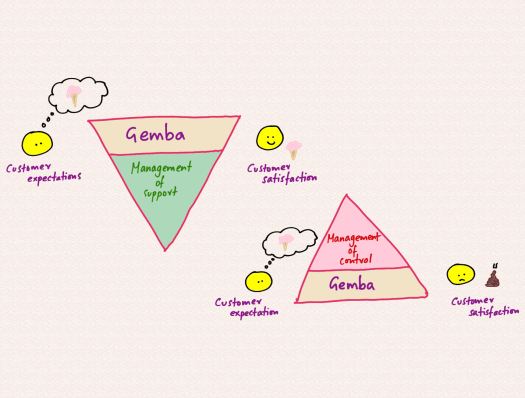
It’s easier perhaps to think specifically of what happens when a customer comes in contact with your business.

They have expectations – they want strawberry ice cream.

In gemba, they get something – and hopefully it’s strawberry ice cream.

If it is, they are happy.

Now think of what everyone who doesn’t work in gemba does with their time.

Are they helping the people that are in gemba or are they trying to control them?

If you’ve stepped away from the coal face – if you’re a manager or worse, if you’ve come in as a manager and you’ve never done the work then what’s the approach you take?

Do you manage your desk, manage by numbers, manage by KPIs?

Or do you go to gemba and see what is happening for yourself and support the work being done there?

The question is rhetorical really, because the framing of the structure tells you what Imai thinks.

If you don’t do the work that helps meet customer expectations then your only job is to support those who do.

If you see your job as controlling them then you’re going to deliver a poor result.

The ideal thing really would be to have no management at all.

We all simply work in gemba – on things that deliver value to customers.

Because here’s the thing.

Being a manager sucks.

The work is where you get any sense of accomplishment.

And working with people you like, admire and trust makes it fun.

So, if you want to make a difference the axiom to follow, according to Imai, is “Go to gemba first.”

Go and see – and then you will see what to do.

Cheers,

Karthik Suresh

Why Going Round In Circles May Be The Only Way To Getting Somewhere

circles.png

Thursday, 6.59pm

Sheffield, U.K.

I told you. I wake up every day, right here, right in Punxsutawney, and it’s always February 2nd, and there’s nothing I can do about it. Phil Connors (Bill Murray) in Groundhog Day

I have been reading about writers and one thing stuck in my mind.

A writer’s life, one said, is actually quite boring.

You do the same thing day after day – you get a routine going that works for you.

You get up at the same time.

Maybe you get up early and write, or maybe you go to work, come back and write then.

Maybe you get some time to exercise and you write after that.

A writer’s daily journal pretty soon must look something like this.

“Got up. Had breakfast. Wrote. Had lunch. Wrote. Had dinner. Watched telly. Went to bed.”

Well, that’s an ideal daily routine anyway – for many of us who want to do some writing family and work and odd jobs get in the way.

Which is why it’s important to schedule time to do the writing when no one else is around if you do have those distractions – like first thing or late at night.

If you have watched Groundhog Day you’ll remember that once Phil realises that he’s going to live the same day forever he starts to use it well.

He learns to play the piano, do ice sculpture and be nice to people.

It’s a repeated game, one you play every day and once you get used to the idea that every day you get a chance to do it again.

But this time you get to do it better.

Not to be depressing or anything but I count down my writing days assuming that I’m going to have a few decades still – which works out to 13,818 days left, counting today.

Not as long as you think, given we all start out with around 30,000.

Less than half actually.

Now, for some people that means that they need to go and see things, travel, have experiences, meet more people.

For some of us that means we want to read and write.

Which is why I found coming across a collection of Isaac Asimov’s autobiographical material edited by his daughter, Janet J. Asimov so interesting.

It’s titled “It’s been a good life”, after what he said at the end.

In the book he talks of a dream he once had.

The context is that he’s not religious and when you think of the kind of heaven different religions suggest is waiting for you they don’t seem that attractive – to him anyway.

Would you want to go to Valhalla and spend all your time either eating and drinking or fighting everyone else?

What would you do if you went to heaven and had the rest of eternity ahead of you?

In Asimov’s dream, he’s died and in heaven – he’s knows it’s there because of the clouds and fields and the angel smiling at him.

He explains that he’s an atheist and probably not supposed to be here – and the angel tells him, rather sternly, that that’s their decision, not his.

So then he looks around and asks “Is there a typewriter here that I can use?”

The point is that he knows he’s been in heaven for the last half century already because his heaven is in the act of writing itself.

It would be nice, I suppose, if we were all so lucky in being able to do what we want to do with our time here.

If you aren’t, however, going round in circles for a while may be one way of getting you there.

Cheers,

Karthik Suresh

How To See What Is Really Going On In Your Business

vanguard-check-model.png

Wednesday, 10:00pm

Sheffield, U.K.

All we are doing is looking at the time line, from the moment the customer gives us an order to the point when we collect the cash. And we are reducing the time line by reducing the non-value adding wastes. – Taiichi Ohno

I was lucky enough to attend a masterclass by the Vanguard team recently, led by Professor John Seddon about going beyond traditional command and control management and the insights in there are still sinking in.

So much of what we do can only be described as waste – time spent filling out forms, commuting, collecting figures for reports, filling in surveys or sending emails.

At the heart of the Vanguard method is learning how to see what is going on around you.

That’s something worth understanding how to do and it might make sense to work through an example.

I’m still learning this – so this might not be right, but it’s a start anyway.

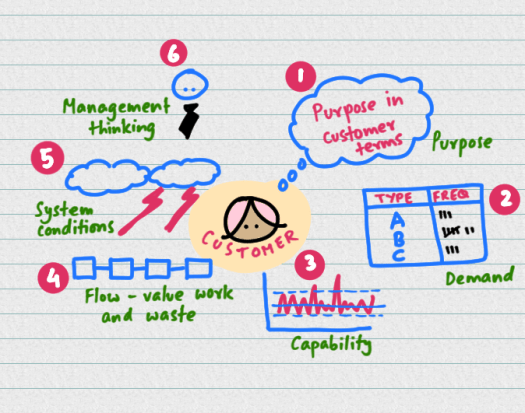
1. Start with understanding purpose in customer terms

Do you really understand what your customer wants?

For example, if you’re meeting with a prospect what is it that he or she is looking for?

Are they looking for your product?

Or are they looking for a product that meets their needs?

It’s probably the latter so before you say anything about your product you should probably take the time to really understand what they need.

That might seem obvious but I have yet to see a salesperson who knows how to do that properly.

It’s an easier thing to appreciate if you look at it in the context of a break-fix archetype – a situation where something you have is broken and you need it fixing.

Essentially, you want it fixed, you want it fixed right and you want it fixed as soon as convenient.

Not it’s not as soon as possible – it’s when it’s convenient for you and that might be right now if it’s the middle of winter and your heating has broken down or in a week’s time when they’re back home from a holiday.

The reason why it’s important to get clear on purpose is so you know what isn’t contributing to what the customer sees as their purpose.

For example, none of the calls you make or reports you write or review meetings you have with your manager have anything to do with fixing the customer’s problem – from their point of view.

They just want things fixed right.

2. Understand the type and frequency of demand

The next thing you do in the Vanguard method is to study what’s happening in terms of demand.

That means starting at where the calls are coming in – a service centre for a break-fix system or anywhere else where customers call in and ask you to do something.

When they call in they usually want to talk about one of two things.

Either they want something – a product or a service – the kind of thing that makes them happy and that’s called value demand.

They want to buy something.

Or they’re calling to complain about something – because the fix hasn’t been done, the goods aren’t right or someone hasn’t turned up.

That’s a call about something going wrong and it’s called failure demand.

So, how many types of demand do you get and how many of each type come through?

3. Study the capability of your system

Now it’s time to start measuring how you respond to the demands on your system.

There’s all that demand coming in so how long does it take you to satisfy that demand?

For example, if a customer calls in wanting you to fix a problem how many days does it take from when they called to when the problem is fixed for good?

Or, how long does it take from when they place an order to get it to them?

The faster you get either of those things done the better the capability of your system.

Just think about how Amazon and Ebay have changed the buying process.

Amazon suggest that when someone buys off you that, even though you could take a couple of days to post something, you should get it in the mail as soon as possible.

For one thing, once the order is dispatched they can’t change the order.

But, more importantly you have a customer who expected to get something in three to five days getting it the next day and being delighted.

4. Map the flows and identify value work and waste

Now, if the customer isn’t delighted that’s because something is going wrong – you’re doing work that’s a waste.

Worse still you’re paying someone to first do work that the customer wants – value work and then if it’s not done right paying someone else to fix it – wasted work.

The thing to note is that in the Vanguard method you start mapping flows of work only after you’ve done the analysis of the types and frequency of demand and measured how your system responds at the moment.

After all, you need to know if you get better or not when you start to try and improve the system.

5. Start examining the system conditions

Most of the problems your customers are facing have to do with the system – not your people.

The system is almost always the problem.

The controls and structures and processes you have put in place are probably what get in the way of your employees making your customers happy.

What they’re doing is working to serve the system rather than the customer – working to meet targets, fill quotas, get bonuses and all the other things that either demotivate them or suck the intrinsic value of doing a good job out of what they’re doing.

The fact is you need to get rid of almost all that stuff that you use to control and monitor what’s going on.

In manufacturing at least you use that information to monitor the work.

In a service business all you’re doing is spying on your staff.

Instead – just help them do a good job and watch what happens to your failure demand figures and how quickly your team meets customer purpose.

6. Change management thinking

This is the hardest bit and you won’t get to it by telling the managers to change.

I learned about intervention theory at the masterclass.

This is the idea that there are two types of interventions.

Rational interventions are where you tell people why they’re being stupid.

And when you do that you shouldn’t be surprised that they get angry and offended and stop listening

The other type of intervention is a normative intervention where you help them to see what’s wrong for themselves and realise that they need to change the way things are.

That takes longer but it is a change that sticks – because they’ve decided it for themselves.

Hard to summarise, hard to do

The thing with this kind of systems intervention is that it’s a non-trivial task.

We’re so conditioned by a particular kind of goal oriented, target driven culture of organisations that it’s hard to imagine any other way.

Each step in the process is something that needs to be learned and practised and reflected upon.

And many organisations just don’t have the appetite or willpower to do that.

But if you can you could create an advantage – a competitive advantage that actually does endure.

Because if you have a business that meets the needs of your customers and your competitor has a business that meets the needs of the business – which one do you think is going to prosper?

Which one would you rather work in?

Cheers,

Karthik Suresh

How To Program Your Life And Business

programming-world.png Saturday, 8.37pm

Sheffield, U.K.

But if thought corrupts language, language can also corrupt thought. – George Orwell, 1984

When it comes to dealing with the complexity of the world around us, thinking in terms of machines and computers seems to provide some useful approaches worth considering.

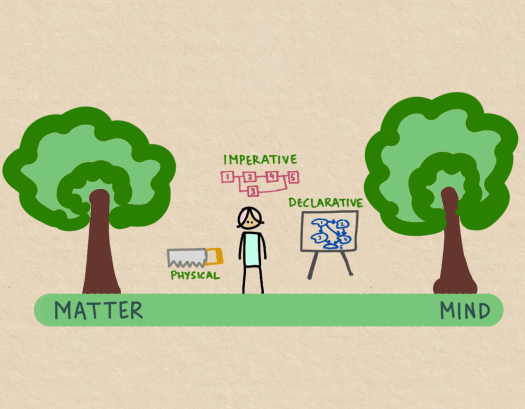
Philosophers have wrestled with questions of matter and mind for millennia.

Is matter something that exists out there independent of all thought?

Light and trees and animals and movement?

Or, since everything we perceive is actually reconstructed inside the dark chamber that houses our brains, does everything really exist only in our minds?

Such questions are perhaps best left to the philosophers.

From a practical view whether a tree exists in the material world or exists only in our minds is less important than what we spend our time doing in the world we inhabit.

Most of our existence is a search for control of the world around us.

So, we build houses, create factories and form societies.

But we don’t always think about or recognise the different kinds of thinking that go into doing those things.

So, if we think of ourselves as machines – maybe as computers – what kind of programming are we following and are there ways in which we could do things better?

Let’s start with the physical transformation of the world around us.

That comes down to having tools – tools that help us change material from one state to another.

That seems a pretty obvious first step for the species and it’s something that we’re pretty good at now.

The next step is about putting different physical tranformations in a process – arranging them so that they result in something bigger than the individual things themselves.

The classic example here is a car factory – whether the gigantic integrated facility designed by Ford which ushered in the age of mass production or the lean facilities pioneered by Toyota that run to a heartbeat set by customer demand.

The task here is of saying what must be done to change from one state to another – something that is called imperative programming.

Imperative programs tell you how to do something – what the steps are that you need to follow in order to make something happen.

If you have a morning routine or insist that your staff complete their tasks in a particular way you are doing imperative programming.

Most things work just fine if you approach them with an imperative programming mindset – knowing how to do things is important most of the time.

As you go from problems of matter to problems of mind, however, there comes a point where it stops being enough.

And this usually happens when what needs to be done is not clear and the people involved look at things in different ways and have different thoughts.

This is called a pluralist situation – and things start to get fuzzy and messy and a little complicated.

Maybe even complex.

At this point what you need to do is shift from thinking about how something should be done to what needs to happen.

In programming terms the easiest one to appreciate these days is css – the cascading style sheets that govern how a web page looks.

css is a programming language – one in which you set out how you want things on your page to look and then it all happens at once – your page goes from simple html to being displayed in whatever style you wanted.

In other words you describe what you want and the programming language takes care of the details.

This kind of programming is called declarative programming and it’s closer to the idea of a mental model than a process model – what rather than how.

So, why might this be useful?

The U.S military, for example, does declarative mission planning – it sets out what needs to happen and lets its units work out how to make things happen.

That’s the essence of business and life strategy as well – without having a clear model of what needs to happen there is no point in spending time working on the how because the chances are you won’t make the right things happen.

The problem in the modern world is that there is lots of knowledge on how to do things and much less insight into what needs to be done.

A programmer or programming shop, for example, can build you anything you want as long as you can tell them exactly what you want.

Most of the time clients don’t know.

And that’s the secret – nobody really knows – bosses don’t, managers don’t and workers don’t.

And that’s because they have been trained for years to program their lives and business using imperative programming techniques but never been exposed to declarative ones.

Even the whole neuro-linguistic programming stuff seems to be (on a cursory reading) imperative programming.

Of course there are lots of discussions in the programming world about the precise definitions of these terms and which languages you should use.

For the purposes of my argument here you can ignore all that.

The point I’m making is that you should consider thinking about what you do before working out how to do it.

That’s pretty obvious really.

But what’s not obvious is how to go about doing that – how to think about the what that’s in your mind.

Perhaps you will notice the slight irony in using an imperative approach to illuminate a declarative activity.

A paper that might help you get started if this is of interest is Thoughts on learning and taking action which is about how to construct declarative mental models.

And if you’re too busy to read the paper the answer to why you might do this is to get peace of mind.

Because that is all that matters.

Cheers, Karthik Suresh

How To Get Market-Product Fit

market-product-fit.png

Wednesday, 8.46pm

Sheffield, U.K.

If your desk isn’t cluttered, you probably aren’t doing your job. – Harold S. Geneen

If you have a profession, are developing a technology, founding a business, creating a product or just living you probably spend a lot of time thinking about yourself.

If you were to take a minute and list all the things that are rattling about in your brain right now you’d quickly come up with a pretty long list.

How many things on those lists have to do with other people’s products or services?

So, looking at this from someone else’s point of view what are the chances that they’re thinking about your product right now?

A while ago I wrote about the concept of product-market fit and likened it to evolution – a way to survive and fit in.

But have we got the words the wrong way round?

If we start with the idea of a product then we have something already and what we’re trying to do is figure out who will buy it or whether they will buy it if we change something about it.

By putting the word product at the start then we are inevitably promoting it – marking it out as the important part – as the prime mover.

So what happens if you look at it from the other side – look at trying to get market-product fit.

In that situation, what is a market?

Well, it’s not a statistic or a demographic or a psychographic.

It’s a person.

More importantly, it’s the inside of one particular person’s brain – your potential customer.

And what does it look like in there?

If you look at the picture above it’s quite possible that a lot of people would say that’s what their brain looks like.

It’s full of all kinds of things – layers upon layers of thoughts and worries and frustrations and plans.

So, how do we make sense of all that stuff that’s in there – it’s not like there’s much room and all these thoughts are squished together and jostling for space and attention.

Your attention.

We make sense of things through story – through narrative.

A story links concepts together, creating a plausible whole that we can believe.

“Reality is a shared narrative we agree to believe”, said the librarian.

So when we talk about a market what we’re really talking about is a story that someone agrees to believe.

Maybe it’s a story you tell – a story that people choose to believe.

Or, best of all, it’s a story that they come up with.

When someone creates their own story about what their problems are and what they need to do to solve them – you have just found a market.

What’s emerged from that cluttered mess we call our minds is a story, a concept, a cluster of related ideas, first dim and then increasingly clear until it’s an obvious way to go forward.

And, if that story matches what your product does you’ve just achieved market-product fit.

Now, you would argue, if you were in an argumentative mood, that this is exactly what validation does in the lean startup / business model canvas world.

But, being pedantic, those approaches still put the product first and, in the guise of being open ended questions their primary aim is to determine whether you need the product or not.

If you put the market first, what you’re doing is putting the person in front of you first – and making your first task understanding what’s in their mind.

Or, helping them understand what’s in there.

One way to do this is by creating “rich pictures”, freeform drawings of ideas and thoughts as they come up in an interview.

There’s a little bit about rich pictures in this article and I’ll try and put up some examples at some point.

If you do this for long enough, you’ll find that patterns emerge – areas that you need to look at start to become clear and things that you need to do become obvious.

What happens is that a market starts to define itself as a result of your discussions.

Then all you have to do is see if you have a product that fits.

Or create one if you don’t.

And it’s possible that a market first approach is a little like shaping your environment to fit you rather than fitting yourself to the environment.

There’s a good change it’s an easier way to create something profitable.

Cheers,

Karthik Suresh

How To Construct A Program That Actually Works

obvious-and-right.png

Monday, 6.27pm

Sheffield, U.K.

There are two ways of constructing a software design: one way is to make it so simple that there are obviously no deficiencies and the other is to make it so complicated that there are no obvious deficiencies. – Tony Hoare

Too much in life is about compromise.

If you work in a business, for example, do you think you’ll get the best tools and finest training available on the planet to help you do your best work?

That question isn’t worth answering but it is interesting to ask why that doesn’t happen.

Take the practice of programming, for example.

A program, in its most general sense, is a plan, an algorithm, a set of steps which, if followed, reach a specified end.

And a good question to start with in any problem situation is to what end?

What end are we hoping for by following this program.

Perhaps it’s a program to help us lose weight, to become less anxious, to market our company more effectively or get a particular product to market.

Or, of course, it’s a program that does something – a web application, for example or a spreadsheet.

In all these cases what approach is going to help you construct a program that works?

Tony Hoare’s observation in the quote at the start of this piece can also be looked at as a matrix, as in the image above.

Some things are obviously wrong – obviously a bad idea.

Like stepping into a puddle on the road or leaning too far over a deep hole.

A small number of things are obviously right.

Given a set of choices about what to do next one of the options is often a fairly clear next step.

The fifth step or the fiftieth step might be harder but the next action, the next move can sometimes be obvious.

This situation where it’s easier to be certain about the short term and much harder to be certain about the long term means we can make the right decisions for right now – but they are also almost always compromises.

When we work in groups anyway.

That’s why so much business is done using spreadsheets when almost any other alternative would be better.

We use spreadsheets not because they are the best tool but because they meet the requirements for a lowest common denominator.

It allows the largest number of people to collaborate on a project that involves numbers where they can understand and manipulate both the tool and the data it holds.

In many software packages you can manipulate the data but not the software itself.

And, in a sufficiently complex package, your ability to change the data is also limited until eventually you grind to a halt, stuck in the equivalent of a digital swamp.

The approach many people take is to take refuge in complexity – creating more complicated programs that try and address their complicated needs.

The problem with this complexity is that it also makes what’s going on much less obvious.

You don’t know if this particular approach is going to result in your falling off a cliff or making a successful moon shot.

These two extremes – between obvious and not obvious – dominate our thinking and so we go for safe solutions because we don’t want to take the risk of doing something more ambitious.

Unless you’re working on your own, of course.

If you’re doing things your way – ignoring what is happening everywhere else then you have a chance to create something new.

Or fail, of course, but on the whole you’ll learn something whatever happens.

If you want to break through this the challenge is to get the right perspective.

And that really comes down to the number of lines in your program.

As humans we can really only hold five to seven things in working memory and think through whether the way in which they are connected works or not.

If your plan or program is a hundred items long you need to group them and keep grouping them until you can describe them using five to seven lines that cover the major things you’re trying to do.

That’s the point where you can differentiate the wood from the trees – where the big picture emerges from the detail.

Okay – those are cliches but they make a point.

But, if you want to go past the cliches and look at how you might actually do this this article has a go at distilling a long Wikipedia article into its main points and comes up with a model that you can look at for yourself and see if it meets the need to be obviously right or wrong.

I suppose the point is this – thinking in terms of programs is a very powerful approach.

Once you’ve written a program that sets out what you need to do to reach a specific end you can run that program and see what happens.

And you can change it if the results aren’t what you want.

Because the secret to constructing a program that works is not just about making a great design.

It comes from running it, testing it and debugging it.

And if you do that enough times you’ll end up with a program that makes a difference.

Cheers,

Karthik Suresh