How Do You Calculate The Area Of A Country?

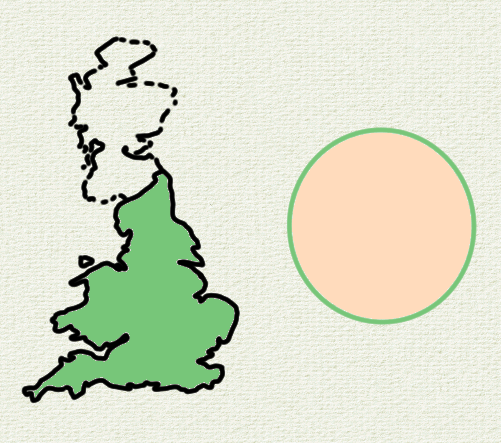
england-wales.png

Saturday, 8.01pm

Sheffield, U.K.

Life isn’t black and white. It’s a million gray areas, don’t you find? – Ridley Scott

In Boris Jardine’s paper “State of the field: Paper tools” the author tells a story about Edmund Halley, the guy that found the comet, who was asked by John Houghton to figure out the area of England and Wales.

That’s actually quite hard to do, when you think about it. Most of us can work out the area of a circle or a rectangle, but how to you work out an irregular shape like the outline of a map?

It’s also quite an important question because the areas of places have implications for what can happen there – what kind of industry might arise, how many people can live there, and what sort of taxes you can raise.

The technique Halley used was one that is a little unexpected, although it was well known in the 1600s, called “cut and weigh”.

Halley selected a map that he felt was a good representation of the country and cut it out. Then he cut circles from the same paper as the map until the cut out map and a circle weighed the same. Now, he could work out the area of the circle and based on the scale of the map calculate the area of England and Wales. He came up with the number 38.7 million acres, which is not far off the modern number of 37.3 million acres.

We think of paper as just a place to hold ink, but it turns out it can do more than that, and sometimes its weight matters more than you might think.

Cheers,

Karthik Suresh

Are We Living Through A Forgotten Century?

affordances-paper.png

Friday, 7.58pm

Sheffield, U.K.

There are only two lasting bequests we can hope to give our children. One of these is roots, the other, wings. – Johann Wolfgang von Goethe

I have been thinking about how digital content is so easy to make and also so easy to forget about. If you keep a journal in digital form, for example, it weighs nothing, takes up no space. It’s simply a file in a space somewhere and it’s easy to forget it exists. And if you forget it then it’s as good as gone. And it will really be gone when the last hard drive has been thrown out and the webserver deletes your pages.

I read somewhere, or heard a news report, that there are moments of the history of this new century that are hard to find, that may have been lost. They were recorded on media that is old and obsolete, that has been overwritten or deleted or corrupted.

In 2015 I remember writing a sentence that said something like “If it’s not online it doesn’t exist.” It was an alternative to a thought I’d held for a long time before that which was “If it’s not written down, it doesn’t exist”. I wrote that first sentence down, took a picture of it and used it in a blog post. On a website that I can’t remember creating. In a folder I will struggle to find.

I am beginning to think I was wrong. Not about writing things down but about the online part – about the digital part – because unlimited space creates its own problems, not the least of which is why we need so much.

Here’s the thing. If you own a digital camera or a phone you’ve probably taken thousands of pictures over the last ten years. Many of us are too busy to do anything with that material – one day we’ll sort it out we think. But sorting takes time – organising stuff takes time. So we put it off. But if we put it off for long enough it’s like having no record at all – there is a gap in your history, one that used to be filled with photo albums and diaries, but now it’s gone. The abundance of the digital age threatens an unexpectedly dark age, one where there is no material to look at.

Social media companies exist to harvest your attention. They are starting to realise that your feed, the scrolling list of things that you look at, is insufficient to keep your attention. I heard a segment on the news recently that said their plan is to make their platforms more engaging, more interactive, more ephemeral, more like the real world. This is a “metaverse” a world with which you have to interact like you do with the real world. Where you have to pay attention when something is front of you or it will vanish, never to be seen again. Like a sunset. If you don’t see a sunset when it happens you won’t see the same one again.

What we end up with, then, is a world where we interact with everything but we don’t pay attention. It doesn’t matter whether the world is real or virtual, it’s experienced but not… seen.

To understand the difference you have to think like a photographer. I grew up with a film camera, one with 36 shots, and you had to pay attention to what was in front of you to try and get a good picture. These days you take 200, review them instantly and think you’ve got it. But that’s just looking, not seeing.

I think I’m falling out of love with digital – perhaps because I’m a digital immigrant rather than a digital native. Paper exists in a way a text file does not. There are innumerable advantages to having digital tools – but they should complement rather than replace one’s photos and notebooks.

And my plan is to tilt the scales, get the balance back towards the analog and see what’s really happening around me.

Cheers,

Karthik Suresh

How To Think About Content Using Paper Tools

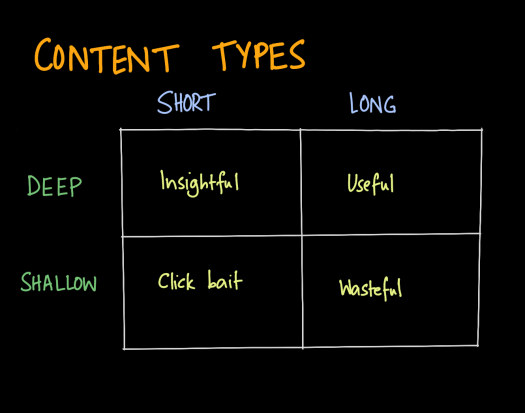
2x2-tables.png

Thursday, 10.15pm

Sheffield, U.K.

We become what we behold. We shape our tools and then our tools shape us. – Marshall McLuhan

I’ve been wandering down a path looking at how scientists, writers and artists used their notebooks – in what we might call their workshop – and the nature of the marks they made. In doing that I came across the idea of “paper tools”, a methodological concept introduced by Ursula Klein in a few papers.

The term caught my eye – “paper tools” – a nice term for something that we’re all familiar with even if we don’t really think about it much. Bargheer (2001) goes into one specific tool in more detail, the 2×2 table, and shows how it became a popular tool in the first half of the last century among sociologists.

As is often the case the outdated tools of yesterday’s research are used by businesses and consultancies today as the latest thing they’ve learned. But while there are better approaches now the 2×2 table is still powerful because it lets you analyse pairs of concepts in a rough but useful way.

Take, for example, a problem I have been facing with writing content for this blog. As I read academic research it gets harder to find ideas that I can write about quickly. Some of the concepts I’m coming across need time to work through and understand before one can write about them with any authority. At the same time it would be nice to keep going with the blog as I carry on towards my goal of getting a million words out as I try and learn how to write better.

This is a good problem to analyse using a 2×2 table – looking at the length of content vs the content of content. You can write stuff that’s long or short or you can write stuff that’s deep or shallow.

When you put this information into a 2×2 table it helps you make sense of your options. For example, most of the stuff that comes up on your feed is short content that’s shallow – it’s click bait that delivers nothing of value. At the same time you get long content that’s just as shallow – usually a tired sales pitch that thinks that long form content selling some rubbish is going to work on you. All this does is waste your time.

On the other hand you can have short content that is insightful – something that you can take away and use immediately. A tip, a hack, a method. I saw one recently on how to draw gears – a useful trick for a visual thinker. You could argue that this is the kind of material Seth Godin puts out, writing short content every day but aiming to make it punchy and insightful.

At the other extreme you have long form content that is genuinely useful – Tim Urban’s blog comes to mind here. Perhaps a few others.

So there are two takeaways here – the first is the use of the 2×2 table as a paper tool that helps you think about key features or elements of a situation. There is real power there. And then there is the bit about content types.

For me, I think it would be nice if the material in this blog was short enough to read but good enough to be insightful. There is little point in writing shallow material. The long form work, however, needs to make its way into papers and books.

I’ll aim for fewer words next time, then.

Cheers,

Karthik Suresh

References

Bargheer, S (2021), “Paper tools and the sociological imagination: How the 2×2 table shaped the work of Mills, Lazarsfeld and Parsons”, The American Sociologist, Vol 52, pp 254-275.

Drawing The Contours Of An Object Without Looking At The Paper

Friday, 6.41pm

Sheffield, U.K.

Seeing much, suffering much, and studying much, are the three pillars of learning. – Benjamin Disraeli

Betty Edwards, in her famous book, Drawing on the right side of the brain introduces the idea of “Pure Contour Drawing”, based on Kimon Nicolaides’ 1941 book The natural way to draw.

The method is simple. Look at an object and let your eyes slowly follow an edge. As you do so draw the line your eyes are tracing with your pen or pencil, moving it at the same speed at which your eyes are moving. Do this very slowly – like your eyes and your hands are connected – the latter moves only when the former does and exactly the same amount.

Edwards writes about how this is an intensely hard thing to do. You will be tempted to look at the paper. You will want to move slower or faster. But you have to resist, you have to set a time and then slow down into the exercise. Eventually time will fade away and there will just be the movement of your eyes and your pen. That’s why you need the timer – to tell you when to emerge again.

This exercise is not going to result in a good looking picture. You’ll be lucky if you or anyone else can recognize it, as you can see in the video above. So why would you do this?

The reason is because most of us draw what we think we see rather than what we actually see. If I asked you to draw a maple leaf you could draw one from memory. If you drew one from a picture you would probably draw the lines quickly, relying on your memory of what the lines should be. We are not trained to see what’s actually there, whether there is a nick in the leaf, whether the join between segments of the leaf is triangular or an odd elongated nipple shape.

A pure contour drawing takes away your ability to just draw what you think you see. Instead, by slowing down, and following each edge you really see what’s there. And as your pen traces the movement of your eyes you draw what is really there. Artists develop this ability with practice over time but for the rest of us it’s a disorienting practice and we wonder what’s the point.

Most of the time we go through life relying on shortcuts – and that’s fine – we can’t pay attention to everything. But sometimes we should slow down and really look at what’s in front of us. What your child really looks like, for example, rather than the picture you carry around in your mind. Because that moment exists for a moment and then that child is a moment older and you can never see that moment ever again the way it was.

One day, perhaps you’ll be glad you paid attention to the things that mattered.

Cheers, Karthik Suresh

Shelley’s Notebooks And Why You Should Keep Your Pen Moving

shelley-boat.png

It’s been such a deep and amazing journey for me, getting close to John Keats, and also I love Shelley and Byron. I mean, the thing about the Romantic poets is that they’ve got the epitaph of romantic posthumously. They all died really young, and Keats, the youngest of them all. – Jane Campion

Percy Bysshe Shelly (1792-1822) was an English Romantic poet, part of a group of poets that came up with an innovative way of writing poetry that distilled emotion from reflecting how humans lived their lives. It came out of thought, out of a serious contemplation of lived experience poured into poetry to capture meaning.

In Allen (2021) we learn that a poet’s notebook is their workshop. When we look at these notebooks we are tempted to focus on the words, the text – because that’s what makes its way into print and a book of poetry. But in the poet’s workshop, in Shelley’s books we can see the sawdust and cutouts – doodles and sketches and scribbles that surround and intersperse the words that sometimes make their way into print.

These drawings and marks are not childish or simple – they are a way for someone that is thinking hard to keep their hand moving, “keep the ink flowing” as the head works out what it’s trying to say or do or write. The movement helps with the thinking because being still is hard, focusing on just one thing is difficult and maybe it’s easier to focus when you have something else to distract you.

Then again, when it’s hard to see something, to think your way to it, it’s useful to do something else, to have a distraction – to walk, to read or to draw. You do something simple in the foreground while your mind works away in the background and when it’s ready it lets you know what its found.

Sometimes a doodle is just a doodle – it doesn’t mean anything, but it acts as a bridge from one state of thinking to another. But it’s also tempting to pour meaning into it, see an image as suggesting something more than the thing it shows you. Is that picture at the top copied from the Bodelian Shelley Manuscripts a boat and boatman or is it the grim reaper heading towards a fallen soul and does it mean more or less than what you see on the page?

Drawings in notebooks can be surreal – they are not made to be looked at but made in the process of making something else and perhaps they just fill the time between one thing and another. Or they are glimpses into the state of the mind that has created the work, perhaps it shows you the mess in their mind that resulted in the poetry you love.

You can read too much into the marks on a page. The one thing that is certain, however, is that you cannot make your art without making marks. If you’re stuck, then, just keep your pen moving, draw something, anything, until you’re free again.

Cheers,

Karthik Suresh

References

Allen, G (2021), “Shelley as visual artist: Doodles, sketches, ink blots and the critical reception of the visual”, /Studies in Romanticism”, Vol 60, No 3, pp 277-306

How Picasso Cuts Through The Clutter

picasso-birds.png

Tuesday, 7.04pm

Sheffield, U.K.

I paint objects as I think them, not as I see them. – Pablo Picasso

In my last post I decided to explore the work of people who use drawing as a part of their process.

I recently read Deep Work by Cal Newport and 21 lessons for the 21st Century by Yuval Noah Harari and they both suggest that you stop looking on the web for information. That’s slightly ironic, as you’re reading this online, but their basic argument is that searching for information will present you with that which is popular. That, fortunately, is not a condition this blog suffers from. They suggest that instead of googling we should go and read peer-reviewed papers.

And that’s what I intend to do for these posts.

A good place to start, as good as any other anyway, is with the work of Pablo Picasso. Picasso said that it took him “four years to paint like Raphael, but a lifetime to paint like a child.” He was trained in a formal academic style by his father but went on to create a number of new styles.

What is the essence of a thing – what can you reduce it to as you look at it and try to make sense of it? Picasso had a history with poultry – one story says that his father retired from drawing when he saw how well the young Picasso drew a pigeon’s feet. Spiller (2012) writes that “He didn’t just recreate, he stripped, lacerated, and re-presented.”

Take the images above, for example. These are birds drawn with a single line, reduced to their essentials. They are still recognizably birds, arguably even chickens – but it’s this idea that what you see comes down to a few lines, as few as you can, perhaps even just one line – which captures the essence of what’s in front of you.

Picasso’s work is supported by work in brain science – the line – the contour – is the at the heart of vision. We can recognize expressions with very few lines – just the elements that move on the face. It takes just a few lines to transform a scribble into a recognizable form. Sometimes there is so much out there that we need to start by reducing what we see to the essentials – to a single line that has all that is important in that situation.

So, the first lesson from Picasso is to ask yourself whether you can set down what you see in a single line, without lifting your pen from the paper.

Cheers,

Karthik Suresh

References

Spiller, H (2012), “Cock-A-Doodle”, Gastronomica, Vol 12, No 1, pp 9-11.