Which path would you take?

small-steps.png

Edward de Bono wrote about a small but significant difference between the way we think about the physical and mental world.

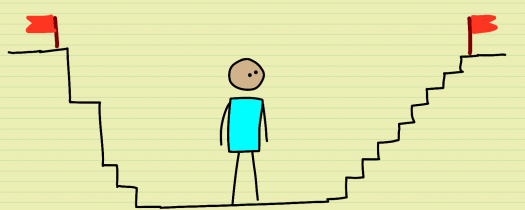
Let’s imagine we had to build a staircase.

Would it look like the one on the left in the picture – or the one on the right?

Most people, in the real world, understand that small steps are the way to go.

But, when it comes to mental work, we try and take shortcuts.

Take investing, for example.

Tom Dorsey wrote about a colleague of his who said – Tom, ain’t but one way to make money in the stock market. Slowly.

Most of the people and businesses that survive compounded their value over time – they didn’t simply skyrocket to fame and fortune.

The recent falls in the value of cryptocurrencies, although there has been a rise again, have left some people feeling elated, and some despondent.

If you bought at $16,000 hoping to hold until it went up, $12,000 is going to keep you nervous for a while.

But, the prices simply reflect supply and demand – and someone who takes a position needs to be aware that buying a currency is not a one-way ticket to riches.

Over the last year, a fairly sensible trading strategy could have resulted in a 6x return on Litecoin. Around 6-7 trades would have turned $20,000 into $122,000.

If you knew how to do it, had the money, were willing to take the risk and had the discipline to monitor markets at least daily that is…

On the other hand, a much easier approach would have been to buy a selection of low cost index funds five years ago and then get on with life.

That would have gained almost 30%. That’s not a bad return either given where interest rates are.

The same principles – going step by step – apply to most of the knowledge work we do now.

People who create anything of value do so piece by piece over time.

It’s tempting to take a shortcut.

But a shortcut may turn out to be the harder path.

The story of Mr. Market

mr-market.png

Benjamin Graham, the father of value investing and Warren Buffet’s friend and teacher wrote about the kind of mental attitude that would be most useful for investment success.

Imagine that we own part of a business – a privately held one – and have a partner called Mr. Market.

Each day, Mr. Market comes into our office and names a price where he will sell his share of the business to us, or buy our shares of the business.

Our business might be in something quite normal – a restaurant, retailer, a professional services firm.

Mr Market, on the other hand, is anything but normal.

Some days he is euphoric, wildly optimistic, and the price he gives us is high because by selling to you he may lose out on future gains.

At other times he is down and depressed – unable to see anything but problems ahead – and names a very low price because he doesn’t want us to dump our shares on him.

The other thing about Mr. Market is that he comes back day after day.

He doesn’t take offence if we ignore him for a while – he’s always willing to offer a price to buy and to sell.

So, the question is would we sell to Mr Market at his prices? Should we be up when he is up and down when he is down?

That would seem very odd in a business we owned.

We would know the value of the business – how much it makes and is likely to make. We understand the costs and profits.

So, if we were to go through all the hassle of selling, we’d only do it when we felt like it.

We’d let the results of the business tell us how well we were doing rather than rely on Mr. Market’s opinion.

Mr. Market is there to serve us – to allow us to buy and sell when we want – and not to guide us and tell us when to do something.

Benjamin Graham also said – In the short run, the market is a voting machine but in the long run it’s a weighing machine.

The story of Mr. Market is a useful one to keep in mind when trying to make our own investment decisions.

What is the flippening and would you take a position?

ico-fear-greed.png

It’s hard to get one’s head around how currencies like bitcoin are changing things.

Two things exploded in 2017 – cryptocurrencies and Initial Coin Offerings (ICOs) and will probably get more attention in the weeks and months ahead.

Take the choice of cryptocurrencies themselves. New ones are being added all the time – so what should we be buying or selling?

Warren Buffett says that he wouldn’t get involved.

But, what he would do is buy a five-year put on every one of the currencies out there.

What that means is that if he could buy an option to sell a currency at a fixed price within the next five years, then he would buy that for every currency.

That means that he believes that in five years the price of all currencies would be lower than they are today.

So – should we take the advice of the legendary investor?

Well – the counterpoint is Arthur C. Clarke’s comment that if an elderly but distinguished scientist says that something is possible, he is almost certainly right; but if he says that it is impossible, he is very probably wrong.

Is the world a different place now? More like it was in 1971?

That was when the gold standard ended, and dollars were no longer pegged to gold.

All of a sudden, currencies could be whatever value they wanted and the total amount wasn’t linked to the amount of gold a country held.

With a fixed supply of cryptocurrency – the idea of a standard comes back into play.

What do those that are bullish on the space say then?

The idea behind cryptocurrencies is that they are fair – they take away the control of the large financial institutions and redistribute power to the community and network in a democratic way.

In a sense, bitcoin’s founder had the idea of one-cpu one-vote.

Where are we now?

Some Initial Coin Offerings (ICO’s) have staggering valuations – they raise millions in minutes.

In 2017, Gnosis raised $12 million in 15 minutes, OMG raised $25 million, and Qtum raised $15.6 million.

The latter two sold tokens at at around $0.30 which have gone up by around 40 times in under a year.

That’s an interesting return.

So greed kicks in – a new technology that looks like it’s going to take over the world, fast returns and the ability to lock in incredibly high returns.

On the sidelines we have fear – this doesn’t make sense and the valuations are not tied to any real world value and revenue.

Are investors – and there are a few who seem to take up most of the offering value – focused on making money from volatility rather than from the underlying business?

And is the basic business case the greater fool theory – where we can find someone more dumb to buy the stuff we hold?

Just the idea of a company being involved in this space is like giving it steroids. Kodak – a 130 year old company – tripled its shares after announcing it was going to start a currency.

Back to the title – the flippening is what happens as sentiment flips from one asset class to another.

It’s used mostly to monitor the possible flip from bitcoin to ethereum as the latter becomes more valuable.

Will 2018 be the year when there is a flippening from the dollar and stock markets to cryptocurrencies and ICOs?

Never send a human to do a computer’s job

human-computer-jobs.png

Why do we spend so much time doing things that could be automated?

Often, we’re too busy to spend the time to learn how to do things to save time.

And what doesn’t really help is the way in which software systems are evolving.

What is the single biggest problem many software vendors face?

It’s keeping us hooked – interested enough in their platform for us to come back to it again and again.

The apps that succeed are the ones that get and keep our attention – the more time we spend on them, the more addicted we are to using them – and the more reliable we are as a source of income to the owners of the software.

So, what does the current trend towards software as a service mean for us?

At one extreme there are some truly useful services – like Dropbox. That sits in the background and makes all our files available everywhere and really does increase productivity.

In the middle are a large number of so-so services.

Do we really need to store everything that we read in a cloud based notetaking system? Are platforms necessary for everything from bank accounts to electricity billing?

One argument is that it makes access easier – when everyone can sell on ebay then there is more choice and better value for consumers.

On the other hand, some services are designed to make it cheaper for the providers to do their thing and for users to do the hard work instead.

Service in this case really means self-service.

And that’s perhaps where some business models don’t work – where people want a service and are instead offered a self-service option.

The point is that they don’t want to do the work, they want it done by someone else or something else.

Most of us now probably have around 300 logins and passwords for various platforms but use a handful regularly.

The rest simply take up time and effort.

Perhaps the primary test for buying a new piece of software is not what it can do, but how much time it will save us.

A good starting point might be to select software that doesn’t have a login screen at all – no graphical interface to bother us – and which really does just sit in the background doing work that needs doing while we put our feet up.

How to value an Initial Coin Offering (ICO)

value-an-ico.png

For those of us overwhelmed with the hype and news around bitcoin, cryptocurrencies and initial coin offerings – where should we start, if at all, in this space?

A useful first step might be to go back a hundred or so years and think about the fundamentals of value.

If we were looking to invest in a company that did something – make tyres for example – we might look at the amount of money it throws off as profit every year.

Then the total value of the company is the sum of all that money over its lifetime, lets say 20 years to be conservative.

In that case, we should be willing to pay a percentage of that total (a discount) today in order to get that return over time.

And that, essentially, is the way businesses are valued in stock markets.

Currencies, on the other hand, are thought of as a way to exchange value. Instead of exchanging my rice for your beans, we exchange notes instead.

But really, a currency is a form of IOU – it represents a debt.

If you look at a £10 note from the Bank of England, it has the words I promise to pay the bearer on demand the sum of ten pounds.

This comes from the days when the pound was pegged to gold – if we took ten pounds to the bank, they would be required to give us its value in gold.

That doesn’t happen any more – the value that £10 now has is created by our belief in its value.

And what we believe is that the £10 will buy us something – a meal, a football, a cinema ticket.

So, what is important in a currency is that we are willing to give it away. We exchange it for something that we believe has the amount of value represented by the money we have.

A fundamental requirement for a currency, then, is that we are willing to use it as a medium of exchange.

If the value of the currency itself becomes too high relative to other thing we value, like bitcoin has in relation to the US dollar, then we are likely to hoard it.

This sounds like hyperinflation and has happened before. In 2008, one US dollar was worth $2,621,984,228 when converted to the Zimbabwe dollar.

The Zimbabwe dollar, unsurprisingly, no longer exists.

So, what’s the difference between a cryptocurrency coin and an initial coin offering (ICO)?

An ICO is a way to raise cryptocurrency money for a new business.

Instead of raising dollars like an Initial Public Offering (IPO), an ICO can create new currencies or raise funds in existing cryptocurrencies or even standard currencies.

The general idea is that the value of tokens exchanged for currency in an ICO represents a share of the value of the business.

Investors can gain from a rise in the value of the tokens as the underlying business grows.

Or lose everything…

This, however, sounds very similar to the way in which existing markets work.

The fundamental value of a token issued by a business will depend on the cashflows expected to be generated by the business.

In very early stage businesses, these may be almost impossible to predict. We may invest purely on the strength of the founding team, their experience and previous record of success.

As we understand the business more and where it makes its money, we may be able to make a more rational assessment of value.

At that point, the market price of the tokens can be compared to what we think intrinsic value might be, allowing long term investors to take a position.

The fundamental principle of investing is that the amount of money we give today should have a relationship to the amount of money we expect to be returned by the business over time.

That’s where value comes from.

Putting money into the market hoping to catch a wave – like housing markets in the mid 2000s or dot coms in 1999 – is betting on valuations and is essentially speculation and gambling.

Some people may get very rich…

But for the rest of us, the first step to valuing an ICO is to do the basics – look at the underlying company, the management team, the proposition and the expected cashflows and come up with a number that represents the value of the business.

Then, see how much of a premium over value we will have pay for a token in that business in order to make an investment decision.

What would it look like if ESOS were easy?

energy-savings-opportunity-scheme-esos.png

ESOS is the Energy Savings Opportunity Scheme run by the Environment Agency to comply with the EU’s Energy Efficiency Directive.

It applies to businesses, charities and non-public sector organisations that are large enough to qualify.

Organisations qualify if, on the 31st of December 2018 (or the financial year just ended), they meet the ESOS definition of a large organisation – i.e, they employ more than 250 people or have a turnover of more than €50 million or a balance sheet of more €43 million during the year.

In a group company, if one part qualifies, then the whole qualifies and the highest UK parent company needs to be responsible for compliance – unless the responsibility is transferred to another group company.

The UK parts of overseas companies need to take part if any part of their group activities qualify in the UK.

So, the quick way to ESOS compliance is:

1. Work out your total energy consumption

This is simple if there are already systems in place that collect and process invoice data. If not, there is some data collection to carry out.

Most organisations will have quite good electricity and gas information. Other fuels and transport records are sometimes harder to find.

2. Identify areas of significant energy consumption

You need to identify at least 90% of usage and then figure out what existing assessments already cover these such as ISO 50001, DECs or GDAs.

The rest need to be covered with ESOS compliant audits.

The scope of the audits are decided by the lead auditor but the Association of Energy Engineers (AEE), for example, suggests than an ASHRAE Level 2 Audit which includes some measurement is appropriate.

Other schemes may have different requirements but they all will include a review of data, analysis of consumption and efficiency, identification of opportunities, site visits and a completed evidence pack that sets out the organisation’s approach to compliance.

3. Appoint a lead assessor

A lead assessor needs to do and oversee or review energy audits and overall assessment.

They (or their team) can either do the work, or work with you to review existing work – although they will be responsible for signing it off as compliant.

All lead assessors will be listed on their professional body registers.

4. Notify the Environment Agency

The Environment Agency must be notified using an online form by the 5th of December 2019.

5. Keep records

You need to keep an evidence pack of how you have carried out ESOS.

Then what?

Many ESOS reports the last time round were done and then left on a shelf to gather dust.

A significant issue is that many organisations are already quite energy efficient, especially when it comes to the large process tasks and pieces of kit that use the majority of industrial energy.

These pieces of kit can’t be quickly replaced and will have a upgrade and replacement cycle of their own.

As a result, a good ESOS assessment isn’t just an external audit at a point in time but a move towards an ongoing system of energy management and continuous improvement in energy efficiency.

Eventually, the activities being done could be formalised in an energy management system such as ISO50001.

Ideally – the output from the ESOS assessment will do two things:

  1. Come up with an action plan: Identify and rank projects that are doable – technically feasible – and have a payback that works for the company.
  2. Create a tender: Package up the rest of the projects for an Energy Services Company – so that the organisation can benefit from the savings while someone else takes on responsibility for implementation and financing.

Although the notification deadline is still some time away many of the activities can be carried out over the entire four-year period between deadlines, for example, the audits can be carried out on different parts of the portfolio during different years.

So… the place to start is with the data – and please do get in touch if you have any questions.

How to connect management, measurement and focus

management-systems-strategy.png

There are three questions that many businesses will need to address in 2018:

  1. How can we create business operations that have fewer emissions while creating more value?
  2. How can we protect the value we create – the intellectual capital – from pirates?
  3. How are we going to ethically use personal data?

These three questions are important because there are regulations and rules that need to be looked at now.

The Energy Savings Opportunities Scheme or ESOS requires large companies to audit their energy and transport use and look for savings.

The Cyber Essentials programme, run by the UK’s National Cyber Security Centre, aims to help all businesses and consumers become more secure.

And the General Data Protection Regulation or GDPR tells us how to manage personal data and keep it private.

So, what are the links between management, measurement and focus?

First, the standard approach to complying with requirements like these is to put in place a management system.

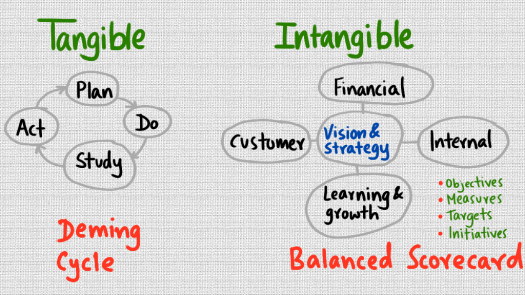
Most management systems, especially those that follow an ISO type standard, are based on the Deming Cycle – named after the engineer who helped transform Japanese manufacturing after the war into a lean powerhouse of quality.

The essential elements of the Deming Cycle are based on the principles of scientific enquiry and are:

  • Plan: Look at the situation and come up with an approach to manage it.
  • Do: Do the things in the plan
  • Study: Study what has happened and learn how to improve things. Some people use check instead of study – but Deming thought study was better as check is more about inspection, while study is about learning.
  • Act: Change the plan based on what has been learned and go through the cycle again.

This approach works well for tangible things such as reducing process waste or figuring out which items of kit to replace to reduce energy use.

But… things can get messy.

All too often a management system becomes an exercise in paperwork rather than a real effort to improve something – we do it to comply or pass the audit rather than actually becoming a better organisation.

And that’s because the technical element is only one part of an organisational system.

The intangible elements are just as important to get right.

The Balanced Scorecard is a method created by Robert Kaplan and David Norton that tries to look at the organisation as a whole.

Clearly, the way in which success is measured by an organisation is in the financial returns that come from doing a project.

Customers, on the other hand, focus on what they get out of the partnership.

In order to keep customers happy, the organisation needs to have the right internal capability to do the right things.

And that only comes when the people in the organisation are given the right learning and growth opportunities.

So, once again, how does all of this connect to management, measurement and focus?

It’s because it all starts with culture.

If the people in an organisation know and get with the vision and strategy – whether it’s becoming cleaner and greener, more secure or more ethical – then we’re starting with a firm base.

We can create a strategy using the Balanced Scorecard approach that works out what people need to know and helps them learn, puts the internal processes in place that are required, shows customers how this makes us better service providers and also gives us the financial returns needed to keep shareholders happy.

Our of the Balanced Scorecard comes a set of objectives, measures, targets and initiatives.

Otherwise called a plan.

We can implement the plan using the Deming Cycle and continuously improve our organisation – and that’s where quality comes from.

That’s sort of management and measurement covered, but where does focus come in?

Well, with all these kinds of things, there are two approaches we tend to take.

Either we look for the lowest cost compliance approach – because really none of these things are really that important and the existing financial pressures and priorities don’t leave any time for the hard work of business transformation.

Or we believe that we need to change to survive – and so the work involved in really becoming cleaner, safer and more ethical is worth doing.

And the results we will get in the next year will depend on which approach we focus on.

What are the trends to watch in 2018?

trends-watch-2018.png

Forecasts are usually a waste of time

At the start of the year, a number of predictions are made about what may disrupt life and business in the year ahead.

If we start, instead, by taking a look back, some of the biggest stories of 2017 came as a surprise.

Was anyone surprised by Trump’s policies?

The policies of the Trump administration are perhaps more of a series of road bumps to be endured rather than a revolution in how things are done.

Despite the US withdrawal from the Paris accord, it remains a leader in electric car technology and its technology companies still dominate global markets.

Attempts to support old industries will probably result in the money going to executives at large oil, gas and coal firms rather than actually helping people and communities with cleaner energy and new opportunities.

And the effect of the policies may well be to hand the Chinese a leadership position in the actual manufacturing of clean energy technology as well as increasing dominance over emerging markets.

The Brexit process was triggered

The UK will leave the European Union.

How and when and how much it will cost and who will win and lose are still being discussed.

The UK is not in a strong position.

It faces a juggernaut which is its main export and import partner and takes a long time to decide anything.

The EU can take its time – the UK needs decisions to be made soon.

And that pressure means the UK may have to settle for less than it hopes for.

Cyber-security and hacking are making headline news

2017 was full of news about Russian involvement in the US election and the extent to which foreign nations are carrying out cyber-warfare.

At the same time, criminals are targeting individuals and businesses.

Government and business are increasingly conscious of the risk of being hacked – but are still working out what to do in response.

The Grenfell fire caused 71 deaths and will result in changes to building regulations and fire safety

As more of us begin to live in cities and high-rises, the Grenfell Tower Fire has to spur action to improve safety in such buildings.

Better, more energy-effient infrastructure is needed to both prevent electrical fires from starting in the first place and stopping them quickly when something fails.

Electric cars may have reached a tipping point

Electric cars sales are still low, but their public perception as a viable alternative to petrol and diesel cars may have reached a crucial point.

Falling battery prices and increasing government support, including long-term targets to make electric cars the norm are helping the industry.

Bitcoin – bubble or not?

It’s probably one…

So, what could happen in 2018?

Security should be on our minds.

Recent news about hardware and software vulnerabilities should not be a surprise.

There are always bugs in systems.

The weakest point, however, is usually people.

Many organisations still need to really get to grips with digitisation and what it could do for them.

It’s not just doing things with computers the way they are done on paper.

And it’s not simply moving to the cloud – that is a particular type of solution – the point is what type of solution actually works for us in a particular situation.

Digitisation and security go hand in hand – we should use computers to do more, and we should be able to keep what we do on those computers confidential and secure from competitors and hackers.

The increasing complexity of everything, however, means that specialisation is now normal.

Advanced economies look at Everything as a Service, where we can find organisations and people to help with specific tasks.

It’s more about the specific solution OR the specific person that does something.

And, as no one wants to take the risk of paying up front for something they don’t understand and can’t use, paying to try things out and then use them if they work seems to be the model for the majority of products.

Unless you’re Apple, in which case you can deliberately slow down your old stuff to make people buy your new stuff…

So, for all those services, we really need to start looking at global/local partnerships.

For example, what’s stopping us from working with admin assistants in the Philippines, sysadmins in Brazil or developers in India?

Well, in 2017, nothing did…

The fact that countries are increasingly nationalistic and making it harder for people to cross boundaries, partly as a result of global terrorism, makes less and less difference in a world where everyone is connected by the Internet.

We should be looking for partners and services wherever they are – and select them based on what they do and how much they charge – and how much value we get.

Then there is the mail…

Many of us probably do the majority of our shopping online.

Vans are the fastest growing automotive segment because of all the deliveries being made.

We can order stuff from China or Taiwan on Ebay and have it here in a few weeks. If we pay more, we can have it tomorrow from the UK in the mail.

The mail order business is simply going to grow – shops are turning into places where we go and browse, like catalogs.

And then there will be all the things that no one predicted

As Donald Rumsfeld said in 2002:

Reports that say that something hasn’t happened are always interesting to me, because as we know, there are known knowns; there are things we know we know. We also know there are known unknowns; that is to say we know there are some things we do not know. But there are also unknown unknowns – the ones we don’t know we don’t know. And if one looks throughout the history of our country and other free countries, it is the latter category that tend to be the difficult ones.

In 2018 – the unknown unknowns will be the ones that get the biggest headlines.

How to analyse a dataset

data-analysis.png

When we say we analyse data, what do we actually mean?

For many, it means looking at rows and columns in a spreadsheet, with a sense of quiet desperation.

So, where should we start.

The American Institute of Certified Public Accountants (AICPA) defines data analytics (in the context of audits) as “The science and art of discovering and analyzing patterns, identifying anomalies and extracting other useful information in data underlying or related to the subject matter of an audit through analysis, modeling and visualization for the purpose of planning or performing the audit.”

That’s probably as good a place as any.

The first thing we try and do when looking at a dataset is to figure out where to look more closely.

We’re trying to take a journey from data to insight – and that involves a few steps.

Take patterns, for example. Patterns tell us that something happens regularly – and so help us predict the future.

For example, a heatmap of energy use in a building that consistently shows hot spots of high energy usage outside normal working hours is a pattern worth looking at more closely.

The human brain is wired to detect patterns – but sometimes we can fool ourselves into thinking a pattern exists and then convince ourselves by selecting only evidence that confirms our belief.

But, that’s where computers come in, and the ability to visualize and run a correlation analysis should help sort that out.

Once we have an expected pattern, then we have something to compare against when looking at new data values in the future.

Then there are deviations.

Most things – and their associated data points – fluctuate.

They go up and down – sometimes up for a while and sometimes the other way.

Our task is to figure out which movements are significant.

And we can do that by using methods like control charts – where we work out where we expect values to be most of the time and call out the ones that go out of the bands we have set.

Finally, there are outliers.

These are the data points that are simply different from everything else.

They could just be wrong, or they could point to a major problem.

For example, it could be a sign of fraud, or a breakdown of equipment.

A thematic review of audit quality by the UK’s Financial Reporting Council (FRC) finds that a lot of firms talk about their use of data analytics in auditing financial statements.

Not many, however, have the in-house capability to get and process data in this way.

It seems that it makes a lot more sense to have a centralised team that can provide this kind specialised IT capability – from extracting data from other systems, getting it into the right format and carrying out the necessary analysis.

One point to note is that some companies offshore this kind of data capture and analysis – which may become an issue as more governments create controls over data governance, security and privacy.

On a practical basis, however, if we have tools and processes that can analyze patterns, deviations and anomalies or outliers, we’re off to a good start.

How many data-driven business models can you come up with?

data-driven-business-models.png

We’re all aware of big data – the ever expanding collection of data points around us.

The data dump piles up daily.

From the tens of thousands of photographs we have to social media postings, from smart meters monitoring electricity usage to databases full of supply chain variables – the amount of stuff around us just keeps increasing.

Which creates new business models and opportunities for old and new firms.

In a working paper published by the University of Cambridge, Josh Brownlow, Mohamed Zaki, Andy Neely, and Florian Urmetzer put forward a framework to think about data driven business models.

They suggested that we need to ask ourselves six questions:

  1. What do we want to achieve?
  2. What is our offer?
  3. What data do we need and how are we going to get it?
  4. How are we going to process and use the data?
  5. Where is the money?
  6. What’s in our way?

The team also put forward a taxonomy to help classify data-driven business models.

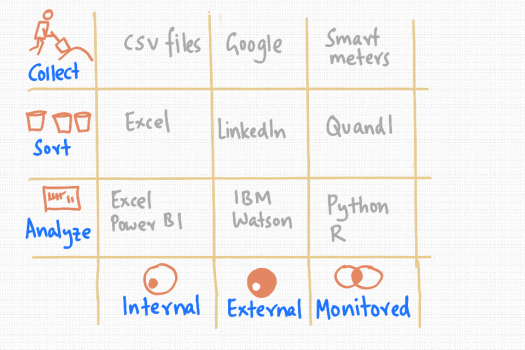
An adapted form of this is shown in the picture above, to help see what products, organisations and solutions are already in this space.

So, data comes from broadly three places.

Internal data is generated by individuals and companies.

External data is broadly everything that we haven’t created.

Monitored data is collected and processed in a planned way – like website analytics or electricity metering data.

With data – we need to do three things to turn it into insight and decision support material.

We need to collect it, sort it in some way and then analyze it.

This classification system gives us a way to start thinking about business models in this space.

Also, clearly, models will overlap and some firms will do more than one thing.

So, for example, lots of data sits in comma separated value (csv) files. While we’d like to think databases are everywhere, the csv format is still very useful.

Many companies rely on Microsoft Excel to process their data – most people know how to use it after all.

The gorilla in the room when it comes to collecting information that is out there is Google.

On the other hand, when we want to find someone in business, LinkedIn is probably the place to go. It’s sorted everyone’s professional information rather well.

Now, lets say we want to analyze twitter feeds – IBM’s Watson has a suite of services that might allow us to do that.

Then there is the data we collect on purpose.

Like electricity smart metering – that’s rolling out in households in the UK – which is 20 million more places to read data from.

When it comes to market price data of all kinds, Quandl provides a convenient way to pick up feeds.

Finally, to analyze all this data, tools like Python and R come into their own – as scripting languages that can cope with the size and complexity of analytical needs.

So, the next time we’re thinking of a data-as-a-service type opportunity, this classification may be a useful one to keep in mind.