Why You Can’t Wait For Someone Else To Sort Out Your Life For You

do-anyway.png

Thursday, 7.54pm

Sheffield, U.K.

Long-term, we must begin to build our internal strengths. It isn’t just skills like computer technology. It’s the old-fashioned basics of self-reliance, self-motivation, self-reinforcement, self-discipline, self-command. – Steven Pressfield

I’ll be up front with you, I’m a little tired. So tired that I didn’t realise that my previous post was my 1,000th. A nice round number, a little bit of a milestone that should be a cause for celebration. Then again, I have a cultural background that doesn’t really go in for celebrations. But we don’t go in for misery either. It’s more the Kipling lines, “If you can meet with Triumph and Disaster And treat those two impostors just the same;”

I was listening to a very experienced person talk about what they would suggest younger people do – and it really didn’t come down to waiting for someone else to sort out your life for you. If you expect your politicians or your employers or the state to make life better, you’ll be waiting a long time. You need to get off your behind and sort yourself out. And that comes down to learning – training yourself, getting up to speed in the skills that are needed for the world of now. It’s not even really about tomorrow or the day after. Most of the stuff we learned is obsolete – we can’t even use it to cope with the world around us today.

I think of myself as fairly technical but my kids run rings around me when it comes to mobile technology and the games they play on there. Part of me is grumpy and doesn’t really want to learn what this is all about. And part of me hopes that what I know will be relevant when they grow up so that I will still know something. But the chances of that are slim. On the other hand, the technology might change but people will remain the same. If you can understand them and work with them, you’ll have a chance of still being relevant.

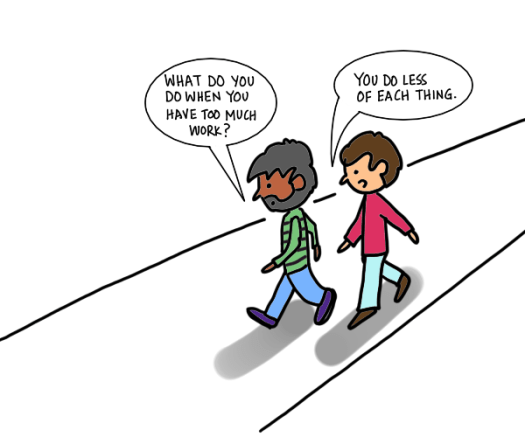
Now, to address the question in the picture above – I drew it before I’d realised that I got to the 1,000 post mark – but it’s still relevant. Why spend that time, do all that writing when one could be doing anything else? I’m sure you could think of many more interesting alternatives to sitting at a desk and tapping away at keys. The answer to that is I enjoy doing this. I enjoy learning and writing and reflecting and I write because it’s one way to get these ideas out of my head and into a form that helps me see them for myself. I’m sometimes asked what’s the point, or how you could monetize this. The practice, however, has no point and doesn’t need to make any money. It only needs me to want to do it.

That said, the practice has value for me. How do I know that, you ask? This is an academic question I’m going to have to face in the years to come. How do you know a method works – that something you do has value? It may have intrinsic value – you might enjoy doing it and think that you’re doing it well but how do you really know? The academic answer is that you get feedback – you ask people. But of course, people can’t always be trusted so you analyse what they do and try and get insights from that. You can do a lot of study to see if people value what you do.

Or you can look at the money.

Here’s the thing with an academic definition of value – it’s probably not worth the paper it’s written on. Human beings have figured out how to exchange things of value a while back and they did it my attaching a price to it. As Buffett writes, the price is what you pay. Value is what you get.

This is not a particularly appealing thought but it’s a hard one to ignore. You should do things because you want to. Well – legal things anyway. But if what you do has value a byproduct is that it will also create wealth. But it’s a byproduct, a side effect and you shouldn’t take it seriously because once you start thinking of what you do as a job it will probably take away much of the fun of doing it.

Anyway – to end with the main point from that experienced person again. Keep learning. That’s valuable.

Cheers,

Karthik Suresh
Why You Must Make Technology Your Friend?

getting-there-fast.png

Wednesday, 9.55pm

Sheffield, U.K.

The first rule of any technology used in a business is that automation applied to an efficient operation will magnify the efficiency. The second is that automation applied to an inefficient operation will magnify the inefficiency. – Bill Gates

I’ve always been a little puzzled by the kind of people who want to know everything before they can make a decision. The ones who collect tons of data and try and analyse everything, working out all the stuff you could possibly work out.

What usually happens is that the person doing all this work then has to show it to someone else who doesn’t think that way – and who then makes a decision based on what their gut is telling them. It’s rare that you find anyone actually listening to the analysts.

The pandemic is a rare situation where you can probably see an A/B test taking place across the world. In general, the reaction of people is to ignore, then reluctantly accept, then overreact and look for someone to blame, and then start to do something, and say it was all part of a plan all along. Many countries listened to their scientists, some didn’t. Some had draconian policies, some didn’t.

The quote by Bill Gates is about automation, but it’s really about more than that these days. It’s about the application of knowledge. The challenges we face now are less about machinery and more about how people work with machines and it’s not that clear how you can do this well.

For example, anyone trying to sell a software solution will talk about how it will do everything. Or, more often, how it will help you to do something. Take images, for example. Once upon a time you needed a graphic designer to create attractive templates. Now, you can make things that look pretty good in minutes. Or you can stitch video together and create a clip that explains a particular point. And this is a good thing.

In the relentless quest to make things easier to use, however, we end up often making things that aren’t worth using. But that’s ok as well, isn’t it? We now access information almost exclusively through recommendation algorithms. When was the last time you found something without searching for it? The algorithms do the job of matching us with the “best” stuff out there, helping us avoid the ever-increasing pile of everything else. At the same time some good stuff probably gets missed because it’s not the kind of thing that’s pushed up to the surface by the algorithms.

An article by John Kay in Prospect Magazine makes the argument that business as we knew it is no longer relevant. In the past you had to raise lots of money to do something – build a railroad, start a factory. The big businesses of now, however, don’t need money. They need brains. And technology – mostly computing tech. Stock markets have stopped being a way to raise money for a business and become a way to release money for founders. The number of listed firms you can invest in has been dropping, and the options are increasingly moving towards private ownership – which could actually be a good thing allowing companies to engage in long-term thinking without the burden of quarterly disclosures to a feverish and excitable investor population.

You don’t need much analysis to come to the conclusion that if you want to be recommended you have to be liked – and that’s something that humans do. But you’re probably liked for what you do – and that’s a result of how you use technology. Master the art of technology and the art of being human and you’re probably in a good place for a while.

Cheers,

Karthik Suresh

How To Cope With The Good Times

reduce-scope.png

Tuesday, 9.27pm

Sheffield, U.K.

I’d rather do less work than do bad work. – Sobhita Dhulipala

Every once in a while I get to the point where there is too much on, it feels like there are quite a lot of things to do and deliver. And when this happens it’s worth remembering that not everything matters. As Robert Fulghum sort of said, “If it’s not worth doing, it’s not worth doing well.”

You can have too much of a good thing. Overtrading is a thing, where you bring in so much business that you go bust. If everyone wants what you want it can kill your business. Tim Ferriss writes about how he’s careful who he recommends because if he finds someone who sells something good and talks about it on his podcast, his millions of followers try and buy it as well and crash the company’s website as a result.

If you do a great job at work your reward will, most likely, be more work. It’s the same with most things. When you watch people in films they’re driven, competitive, trying to be the best they can be, working all the hours they have. And that looks good but it’s a bad strategy. Research into the way the brain works tells us that you’re better off doing something for half an hour and then waiting a day before trying again than doing it all day, pushing yourself to get better. It’s when you sleep that your brain processes learning and helps strengthen the neural patterns associated with what you’re trying to do or the skill you’re trying to develop.

Okay, now if you’re busy what’s the best way to deal with all the things on your list? This is where the book Algorithms to live by has some suggestions – and it depends on what you’re trying to achieve.

Let’s say you have a list of tasks and you just want to get them done. Well, in that case order is irrelevant. Just do them one after the other until they’re all done.

Now, what if you want to do the biggest number of things – tick off a bunch quickly? Then you order them by the amount of time they take – shortest to longest and blast through them. If you want to get them done so that they’re not late, then do them in order of due date.

An interesting problem comes up when you want to have the least number of people shouting at you. In that case, you start by ordering by the due date and if one task is going to be late you drop that one if you can’t get help and move on to the next. That one task might be very late but the rest will be on time.

If you’ve had a late parcel during the pandemic this is probably why. Bad weather and staffing issues have probably cause a delay. Should the post office deliver delayed packages first and then do the rest or just get on with the newest? Someone told me about the phrase “toss it over the pile” – which is what probably happened. The ones that are late were already late, but if they were delivered first then everyone else’s parcels would be delayed. It’s better to have a small group of furious customers than have the entire population irritated by constant late deliveries. Wouldn’t you make the same choice?

Now, when you’ve scheduled everything and still are struggling, what you have left is the option to do less – to reduce scope. If you normally do ten things can you get away with two? What is essential and can you deliver just that, leaving the rest for later or, even better, never?

When it comes to life the best tasks to do are the ones you don’t have. If you don’t have clutter in your office you don’t have to tidy it away. If you don’t have “stuff” everywhere you don’t need space to put it or have a struggle finding it. The problem many of us have is not one of scarcity but one of abundance. We have too much to deal with. And the way to happiness is to have less and do less – but do it better.

Cheers,

Karthik Suresh

This May Explain Why You’re Working Too Hard

three-levels-of-fix.png

Sunday, 7.45pm

Sheffield, U.K.

A lot of people mistake habit for hard work. Doing something over and over again is not working hard. – Shannon Sharpe

In my last post I looked at twelve common reasons why people make mistakes. There are hundreds more, I’m lead to believe, but we all know things go wrong and people don’t do what they’re supposed to do. Why is that and what can we do to make things better?

I saw a post from an entrepreneur who was talking about how hard they worked. David Allen, the author of Getting Things Done talks about every boss has four times the workload of their direct reports. And then I saw another post about Brian Joiner’s Three Levels of Fix which perhaps explains why this is the case.

Brian Joiner is the author of Fourth Generation Management, which is a few decades old now, and writes about what it really means to fix a problem. Joiner’s work is inspired by that of W. Edwards Deming and you can see that in his Three Levels of Fix method.

Deming wrote that 5% of the problems you see in a business are due to the people and 95% is due to the “system”, the environment they operate in. The only people with power to change the system are the management, the people who make decisions on what to do and what not to do.

I’ve adapted Joiner’s words a bit in the picture above so let’s work through it. Fixing a problem is often the easy bit – a bit like shooting at a target. If there’s a leaking tap or a missing piece of paperwork or a broken part – you can fix it. You probably get this all the time at work – something goes wrong and you have to sort it out. This is just work and people work hard to sort out all the problems that happen every day, just like that entrepreneur above. And at the end of the day you can be happy because you’ve moved 10 or a 100 things on.

But if you’re wondering why you have all those problems the next step is to look at the process that results in the problems. This is a box or a series of boxes that tend to be done by people and somewhere in there something is being done incorrectly. A form isn’t well designed and it’s filled out wrong more often than not. You don’t get the right items in your online shopping order because the staffing rota means that people struggle during changeover times. These kinds of process problems can be fixed by looking at all the steps that happen and focusing on the ones that seem to result in a problem further down the line.

The next level of fix, and this is the one the managers and leaders have to do, is to fix the environment that supported the process that cause the problem. This has to do with fuzzy things like culture and norms and politics and so the container is funny shaped because there isn’t a simple answer most of the time. If you have a boss who is hard to deal with and shouts a lot at everyone then people are scared to speak up. Unless you’re able to change the way in which people are treated, the problems will keep happening and that change might need to start by making the boss more aware of the impact they’re having and helping them to change. And that kind of thing is incredibly hard to do.

Of course, this is where evolution lends a helping hand. Organizations that can learn from their problems and change themselves to avoid those problems in the future will be more likely to survive than ones that don’t. If things work well and you aren’t stressed and people have the right capacities then it’s likely that you’ve got the hard, fuzzy bits right. If you’re maxed out and working very very hard but getting nowhere it’s likely that you’re focusing on targets or on hard edged processes.

The challenge is that this kind of stuff isn’t taught to people in charge. So most people muddle through working hard and wondering why it doesn’t seem to get any better. And that’s because there is no silver bullet, no simple hack, no fast way to fix things.

If you want an easy life you have to be ready to wrestle with the hard questions.

Cheers,

Karthik Suresh

Why Do People Make Mistakes?

dirty-dozen.png

Saturday, 8.26pm

Sheffield, U.K.

We learn from each other. We learn from others’ mistakes, from their experience, their wisdom. It makes it easier for us to come to better decisions in our own lives. – Adrian Grenier

LinkedIn as a social network is turning out to be a good place to learn new things. Perhaps it’s the nature of the network I’ve been connecting with but I’ve been seeing some useful and interesting ideas and concepts surfacing on my timeline.

For example, I recently learned about human reliability – it turns out there is a whole field that studies how much you can depend on people to do things right. And here we were just blaming it on incompetence. But then, you know that old thing about the world being full of bad drivers and on some days you’re the bad driver.

The aircraft industry is one that takes human reliability very seriously and seems to have done a lot of work to reduce the chances of a mistake being made. I remember this from the few flying lessons I did – how we followed a set process to walk around the aircraft and check everything, from the condition of the wings to the colour of the fuel. Then we followed a checklist to go through the steps from starting the engine, taxiing, a full power test and then onto the takeoff.

There are hundreds of reasons why people make mistakes but The Dirty Dozen is a starting point, a distillation of the most common mistakes people make at work. Now, the list is pretty self explanatory as you can see from the image above. If you look at the way in which air accident investigators approach a study of an incident – they start by looking at the facts, they analyse their findings, come to their conclusions and then summarise the causes and contributing factors. Some of these may be technical and require changes to equipment and material. And then there are the contributing human factors, which are often from the dirty dozen list.

Now, if you are a manager and need to get others to do things then it’s interesting looking at this list and asking yourself how aware you are of how your colleagues feel about these factors. Do they feel under pressure, are they struggling with inadequate resources, are they scared to speak up because of the norms and culture in the organisation? Or are you doing really well, scoring highly on all these factors – but does that mean there is a danger that you’re becoming complacent?

The takeaway here is that if something goes wrong, this list may act as a useful checklist to look at contributing human factors. More importantly, however, it also gives you a list of things to look out for and try and head off proactively.

The thing you have to remember is that most employees are in a situation where they may feel these things and find it affects their work. The people with the power to change things, however, are the managers and leaders and if you are one of them it’s up to you to change the conditions people are working in so that the risk of a mistake being made due to one of these factors is reduced. After all, what else are you there for other than to try and get the best out of the people who work with you?

Cheers,

Karthik Suresh

If You Can Make Money Doing What You Do Why Are You Teaching It?

teach-do.png

Wednesday, 8.28pm

Sheffield, U.K.

Those that know, do. Those that understand, teach. – Aristotle

Everything is a business these days. Even things like the business of health and the business of knowledge. And when there is money to be made you get things that look like what you need but are different – that somehow don’t deliver what you’re really looking for. Of course, this isn’t helped by the fact that often we don’t know what we’re looking for or need in the first place.

I feel like a cranky old person, someone who is complaining that the way other people do things is wrong. Is that because I’m envious that they’re doing it and I’m not? Is it because I think they’re wrong and I’m right? Or is it that there is something just not right about the way we make a business of everything?

Maybe it’s a cultural thing. When I first came across the idea of Pay What You Want – that seemed the kind of thing that really gave users a choice. If you felt something had value you felt the obligation to pay for it. And it probably didn’t make anyone a great deal of money but it did give them an income of some kind.

Now, of course, there are arguments that it takes money to make anything and if you don’t treat it like a business then it won’t have any value. But then again, what is a business? The bits that add value are marketing and operations, as I think Drucker said. Everything else is a cost. If you can create a customer then you’re on your way to having a business, or at least something that is value adding.

Here’s the thing. How do you tell a real “business” from something that is simply a transfer of wealth from one person to another? Warren Buffett seems to have the answer to these sorts of questions in his many letters. In one he reminds us that “Price is what you pay. Value is what you get.” In another you have a story of a family – the Gotrocks – who might more accurately be called the Hadrocks. This is because they get hooked into paying for advice on how to handle their money. It’s worth reading the full story but the key takeaway is that the more activity there is the less your return. What you want to do is make a return as efficiently as possible in whatever you do. That’s the goal.

What this means when it comes to a person trying to convince you to learn from them is that if they were so good at doing what they say they do – then why aren’t they making money doing it rather than teaching you how to do it? I remember going to one of those “free” seminars where someone talks to you about Forex trading and how they’ll teach you everything you need to know about trading and making money almost risk free. Well, if it were that easy, surely they should do it and not tell everyone else? Or is it the more likely case that they make more money from your teaching fees than they do making trades with their own money?

The reason I’m wondering about this is that I like the idea of teaching – especially because it helps me learn better. But I don’t like the idea of teaching a secret, proprietary or some made-up method that has no grounding in research or practice. I am irritated by a particular person who has started a line of courses priced in the thousands of dollars that tries to create a certification program to teach something that, from what I have read of the material, is not good. But… if I think I can do better, shouldn’t I be doing that, rather than complaining? Shouldn’t people just make up their own minds?

Anyway….

I suppose when it comes down to it, experience is the best teacher. And then when you understand what your experience has taught you, perhaps then you can actually teach others. Because I think that the best teaching happens when what’s important is what you’re teaching and what the student learns – and it stops being about the teacher at all.

In fact, that makes it very simple to decide what’s good and bad. If you go to something where the teacher is the centre of everything then you’re the product, someone who is just there to pay for a performance. If you go to something where you’re the centre of it and the teacher helps you discover and practice, then there’s a chance that you’ll learn something valuable. And that will only happen when your teacher is confident enough about what they do and have done to put away any ego and focus on helping you become better. If you find one of those kinds of teachers stick with them.

It’ll be worth it.

Cheers,

Karthik Suresh

What Should You Do Or Not Do?

effort-to-do-something.png

Monday, 9.17pm

Sheffield, U.K.

The most general law in nature is equity – the principle of balance and symmetry which guides the growth of forms along the lines of the greatest structural efficiency. – Herbert Read

Do you believe that if you work really hard at something you’ll be recognised and rewarded? That you’ll catch up with those in front of you? Overcome the benefits that people get because they’ve been born into wealthier families in the right parts of the world?

Maybe you will. The first choice you make, after all, is who your parents are and that sets an anchor – a point from where you begin and then you try and go as far as you must. Which for some people isn’t far at all. And for others it’s going to take a few lifetimes to get there.

I think the advice we get on what to do is too general, unrealistic even. Hard work is for suckers and let me explain why.

Work should be easy. If you want to build a house it makes no sense starting with your bare hands. There are tools out there that are better than your fingernails. Use them. In fact, you weren’t considering not using them. The last time you built a structure with your bare hands was probably a den, built from sticks stacked against a tree. But I’m willing to bet you aren’t living there now.

Work should be easy – if you’re spending too long on a spreadsheet, you’re probably doing it inefficiently. Ditto for putting up a stud wall or installing a washing machine or laying bricks. If you know what you’re doing then it’s easy. It takes time and sometimes you have to sweat a bit but if it’s really killing you then you should probably be getting some help.

But, if you want work to be easy you have to spend time learning, which can feel even harder. For a long time my only criteria for hiring analysts was if they could use the Excel function Vlookup – with the help of google and the rest of the Internet. If they could, then they could do pretty much anything. Or, more accurately, they could learn to do anything. The good jobs these days come down to being able to read, write, do arithmetic. Later on in your career it helps if you can speak to others as well.

If you want work to be easy you have to spend time reading and thinking. I learned today that what we call thinking is really just talking to yourself. That’s what I’m doing right now, except you can read that internal monologue as I talk to myself. We have a limited capacity for everything. Our capacity for speech processing, for example, is around two seconds of audio. We’re constantly swapping information in and out of the parts of our brain trying to make sense of things and the harder we make it the longer it takes to get done.

So you make it easy – by working harder on learning how to do that. If you learn your trade and learn it well then the work is easier to do. So maybe it should be learn hard, work easy?

Then again, you should work hard at certain things but not because they’re work. If you want to play an instrument then you need to practice. It’s the same if you want to write or paint or create something. I know a person who spends hours working on detailed art – and that’s because it’s a flow state where time ceases to have meaning and while it looks like hard work it’s something that doesn’t feel like it.

It’s not easy figuring out what to do. But maybe here’s the takeaway.

If you’re finding things hard, maybe you’re doing something wrong? And if that’s the case it’s probably something you can learn to do better.

Cheers,

Karthik Suresh

Do You Think You’re Where You Should Be Right Now?

answer-to-whom.png

Sunday, 9.20pm

Sheffield, U.K.

I mean, did you even wonder why I told you to do your own evaluation? … Clam up! I wanted you to think about yourself – and I mean really think. What are you good at? What do you suck at? And then I wanted you to put it down on paper. And not so I could see it, and not so anybody else could see it, but so that you could see it. Because, ultimately, you don’t have to answer to me, and you don’t have to answer to Kelso, you don’t even have to answer to your patients, for God’s sake! You only have to answer to one guy, Newbie, and that’s you! – Dr Cox in Scrubs, “My Fifteen Minutes”

I’ve been watching “Scrubs” again, for the fourth time or so in the last ten years. It’s a cleverly written program and those of us who have experienced the challenges of starting a role and growing in it will see a little bit of the story in the lives we’ve lived as well. And that’s all of us really.

I think it’s true that we need to answer to ourselves – but what does that really mean? Is it holding ourselves to a standard or trying to always get better? Is it doing what we’re happy doing, and it’s okay if that means finishing at five and going home to spend time with your family? Or is it being the best as measured as being better than everyone else you know – and measuring yourself by how you do against the competition?

What I think brain science tells us is that it’s very hard for us to imagine doing anything else than exactly what we’ve always done. For example, think back over your own life. Are there any decisions that would have made an absolutely critical difference to the way your life turned out? I have a few of those – my choice of school, the choice of country in which to study, the choice of what to do after that. Did anyone else make those choices for you – or are you responsible for them yourself? And do you think things would have turned out differently if you had made a different choice back then?

If you’re like most people your brain has accepted its reality – you are pretty happy with where you are now. Yes things could be better in some ways but the big things are ok, aren’t they? When things are really wrong it’s probably not because of the things you did or what you were able to control. But if you were able to make a choice you mostly did ok – it’s only in the movies where people make obviously bad decisions, isn’t it?

Then again I don’t know anything about you. Maybe you do make decisions differently. I was listening to the radio the other day and this was clearly the story of the day. Someone had called in with some kind of relationship problem – they messed around a lot and then liked a person and then messed things up and then got that person back but were not worried they were going to lose them because their ex was threatening to tell all – that sort of thing, the kind of thing the presenters described as the plot of every 90s romantic comedy. And one of the presenters suggested going for the deny everything approach and the other talked about bad decision after bad decision and why on earth you would do this – and there was no real consensus on the advice other than the person calling in had made their bed and should get on and lie in it.

Life’s hard enough without making it more complicated by making decisions that are going to end up causing you more misery. Then again, thinking about it now, I can remember people who went on and did just that – making choices that might be pleasant but that had a non-zero probability of turning out quite unpleasantly indeed.

So, what am I saying here?

If you don’t know how to make good decisions then your first decision should be to learn how to make better ones. Because what matters is not where you are and how you got there but what you’re going to do next.

Cheers,

Karthik Suresh

Why You Need To Make It Easier For People To Understand What You’re Saying

cognitive-cost.png

Friday, 9.13pm

Sheffield, U.K.

Fools ignore complexity. Pragmatists suffer it. Some can avoid it. Geniuses remove it. – Alan Perlis

Have you ever had to work through your notes of a discussion and turn them into some kind of sense? It’s not that easy to do. You can, of course, just type up what was said but the thing you actually need to do is somewhat more complicated and it is, like so many things are, explained in “Yes Minister” by Sir Humphrey Appleby, as follows:

“The purpose of minutes is not to record events, it is to protect people. Minutes are there to reflect what people thought they should have said, with the benefit of hindsight.”

The challenge we have, much of the time, is not listening to what people say but working out what they mean and what that means in the context of everything else that’s going on. Once you’ve done all that you’ve then got to write it down in a way that gets across what matters.

The way the government do this is unsurprisingly set in a guide on how to take minutes and, on the whole, it makes a lot of sense. But it’s 25 pages long and you might lose the will to live before you get to the end of it. This issue with length is not a new problem. Churchill complained about it in 1940, asking his colleagues and staff to write briefer briefs.

churchill.png

One way to think about whether what you’re doing is clear enough is to start measuring the cognitive cost of understanding what you’re trying to get across. And the simplest form of this is to check whether you have to do anything other than move your eyes to get the information you need.

For example, Churchill’s memo is a single sheet of paper. You can read that in one go, only moving your eyes. If you had to turn the page, however, that would incur a cost – and if you can avoid that you’ll make life easier for the reader.

The same thing goes for models and presentations and all the other things that we use all the time to explain concepts and ideas to people. If you use spreadsheets of any complexity I’m willing to bet you haven’t seen a single one that has all the information you need on one screen. Presentations will spill information from slide to slide instead of chunking what they want to say so that it’s one slide to one idea. And of course bloggers, this one included, use far more words to say something than they really need to.

The problem, of course, is that it’s far easier to make something complicated than it is to strip it down, pare it back and make it easier to understand. I’ve used too many words in this piece already and if I took the time to write it again I’d probably use far fewer words and make it a crisper piece. Even better, if I had to write it by hand I’d use even fewer, because of the cost of having to move a pen instead of pressing keys.

Then again, sometimes people weigh the value of information by looking at the size of the report rather than its content. You feel like real work has gone into producing a tome – even if there is far more work involved in condensing a tome to a few pages. It’s hard to see that just because something you see looks simple that it was easy to get it to that point. It’s often a labour of love – that sort of thing – than something you do for profit – because there’s always more profit in getting the job done fast, even if it’s not as good.

Then again it’s the people who don’t do that who we remember – the ones that create unique and interesting work that lasts for generations.

Or at the very least, is useful for someone else. Maybe that’s what we should be trying to do.

Cheers,

Karthik Suresh

How Do You Know When You Have A Solution For A Problem That Doesn’t Exist?

eyes-needed-to-drive.png

Thursday, 9.57pm

Sheffield, U.K.

The whole problem with the world is that fools and fanatics are always so certain of themselves, and wiser people so full of doubts. – Bertrand Russell

The first fortune I wanted to make didn’t happen – and at the time I didn’t understand why. I had done everything I needed to do, what needed to be built was built but what I expected would happen didn’t – and I didn’t know why.

So, I went back to university and learned some economics for the first time – and those sparse lines of supply and demand and the terse text that explained the difference between a monopsony and a competitive market suddenly helped me understand why that business I was in didn’t make money and never would unless things changed fundamentally.

The last fortune I will make will come if I live for long enough. That’s because it’s based on a very simple principle – investing in the world economy and letting the power of compounding do its bit.

What is it about us as human beings that we dash for the new and exciting, hoping to make a fast buck and ignore the tried and trusted ways that are almost certain to get us what we want – perhaps more slowly, but quite probably more surely? For example, you’re probably still wondering if you should have bought bitcoin. If I had done I’d have lost money, not made it but that still doesn’t stop one wondering “What if?” And if you’re looking for regret – in the last year you should have invested in clean tech. Some of those companies are up 5-10x. Of course, they made very little progress for the ten years before that.

But I digress – the thing I was wondering about is whether you can tell if something is going to work or not – will there be a market, will it be successful, what are the chances of making it?

I learned today why one particular technology – 3D visualisation – may have a hard time making it, especially in the world of business. And it has to do with the biology of vision.

It turns out that visual information goes through different pathways in the brain depending on what we’re trying to do. If we want to perceive things – make out shapes and sizes and objects and designs – we follow one route. And if we want to look at our hands and guide them to do precise motions the information goes through a different pathway. This second pathway is where having two eyes comes in handy. Stereoscopic vision helps us grasp things, thread needles and remove thorns and ticks.

But we don’t need stereoscopic vision to make sense of the world around us. We can do that through other cues – objects that are further away are smaller, shadows give you hints about shape and perspective gives you an idea of an object’s relationship with you. Just looking at things from different angles, like you would through a camera gives you a sense of what’s going on. If it didn’t you wouldn’t watch a movie without feeling like something was missing. But have you ever really felt that way – like a film experience was missing some kind of three-dimensionality? The reason you don’t really think about it is that you don’t need the third dimension to be able to “get” what’s going on.

Now, in the mundane world of business – I saw a visual – a graphic representation – shown in a 3D form and my first reaction was “Cool, can I do that?” Just so you know, this was a mountain and there was a path curving around it with labels and little stick figures and so on. But now, having read this material, I’m starting to wonder whether that is really going to take off – if anything, the three dimensionality makes it more complex to see the information because you have to move around to see what’s on the other side. Which you wouldn’t have to do if the whole thing was on a flat sheet of paper. If you decided to start a business in 3D data visualisation – what are the chances that there is a market where this stuff is actually useful? Well, the biological argument would say that you need to find a place where it’s important to pick things up and use that ability to control where your hands go.

And it just so happens that there’s one business where that’s something people want – and it’s the video game industry where every game has more and more realistic immersive environments where your job mostly to shoot people and do active stuff with your imaginary limbs and stereoscopic vision and 3D seem perfectly suited for the job.

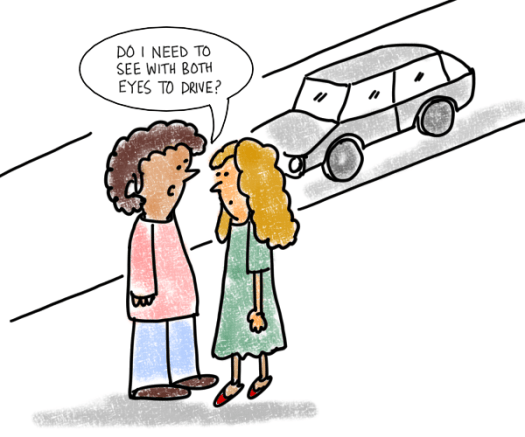
But, you don’t need two eyes to drive. I checked.

I started this post wondering if there was a way to avoid spending a huge amount of time and money working on something that doesn’t have a future. I think, unfortunately, biology has something else to tell us about this. The natural world is not perfectly efficient. It’s actually pretty much the opposite. We see huge waste everywhere. Why do fish have to lay millions of eggs if only a few make it, for example? It may just be that it’s quite hard to find that idea that’s guaranteed to succeed. What happens is that people have ideas and then the fittest survive – there’s a social and intellectual process of evolution that means some works are passed on from brain to brain and other works simple fade away and are forgotten.

Perhaps the wisest thing to do is not to try and carve a new path in the wilderness but to extend the path you’ve travelled on a little more, so that the person coming after you can travel a little further than you did – taking the hopes of humanity with them.

Cheers,

Karthik Suresh