Radical Change And Money And Winning – Some Complications

radical-change.png

Saturday, 9.32pm

Sheffield, U.K.

All we have to do is search this island until we find a book with a title like Practical Boat-Building for Beginners – From Terry Pratchett’s “The Last Continent”

Do you think I should be pleased with a 20x increase on my cryptocurrency assets? They’re still tiny, by the way. I’m not sure. I didn’t really do anything. At the start of 2021 I updated my position on trading crypto and came to the conclusion that I would have lost money over the period if I had tried to be clever and do any actual trading.

What I did do was buy a bit back in 2018, sell almost straight away, then buy in again in 2019, mainly because I didn’t know how to withdraw the money and then I did nothing. Then, as you probably are aware, crypto became news again in May 2021. Prices soared and then started coming down. I would have probably done nothing if not reminded by my other half that it’s going down, why not sell. That seemed obvious once it was pointed out so I did and now the market is continuing to do its thing. You can see this history in the chart below.

2021-05-22-crypto-update.png

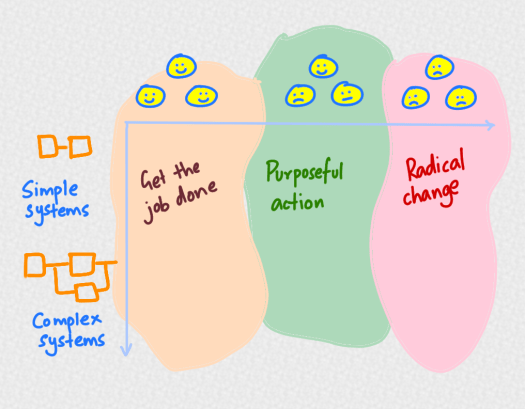
I didn’t really want to talk about trading but it’s relevant in a way to what I do want to explore. In my last post I talked about radical change and trying to understand it better. So I started watching videos from the momentum community. What I’ve learned so far is that there are lots of change models and one way to look at them is using the categories that are in the image that starts this post. So, how can things change?

One kind of change is around individuals and groups. You can change your own mind, work with those around you to change theirs. If you want to catalyse change on issues that matter to you, from the environment to equality, you can take the first step and start doing things differently.

Another kind of change is by creating or choosing alternatives. There are options and you can make a strong statement by the choices you make for how to spend your money or time.

And yet another kind of change is by changing dominant institutions, doing things that will replace them, get them to change how they do things and better represent and protect the people that live under their influence.

It’s not hard to think of how we can all make a difference, however small, in all of these ways. Eating less meat, using less packaging, going for environmentally friendly alternatives, recycling, being kind – they’re all changes that help. Using free software, where the free is free as in freedom not as in free beer.

It’s hard to be ignorant these days and it’s also very easy to be ignorant. You can wall yourself inside your personal echo chamber or you can look around and see what’s going on and do a little thinking, maybe a little reading.

Take blockchains and cryptocurrencies, for example. Their selling point is that they’re decentralised, not controlled and so give people back their freedom. I’m a fairly technical sort of person and I had to use an exchange to get involved in this game – an exchange that recently listed for over $70 billion. I’m trading an asset class that’s so volatile that it’s created its own speculative ecosystem. Today is Bitcoin Pizza day where pizzas were bought with bitcoin that now has a market value of somewhere in the region of half a trillion dollars. If you believe that you can get hold of something that will appreciate in that sort of way then why would you ever give it away? I suppose it depends if you’re the owner of the mine or someone looking to buy a pizza.

The point I’m trying to make is that it’s hard to see how this decentralized utopia is being realised. Maybe it will, one day, when you can give all those unbanked people the ability to do transactions without banks. Create an alternative. Or you could create micro loans, like Muhammad Yunus. Depressingly, if you read the Wikipedia entry, this is not without issues either.

Here’s the thing. Institutions work. But people don’t always know why they work – and that’s the problem. The Peruvian economist Hernando de Soto wrote a book that I have lying around somewhere that explained this pretty well. Older democracies have institutions that have evolved over time, and work because they’ve found a way to work that works. For example there is usually a separation between politicians, judges and generals in countries that work. In countries that don’t – well, just think of whether these institutions are truly separate or not. Who controls the legislature, do judges act independently and who will the army back – the country or the person they want?

Change is complicated but it’s needed in the world. You can change yourself. You can make better choices. And you can put pressure on organisations to be better.

If you want to, that is.

Cheers,

Karthik Suresh

Why Advising Others Is Not A Great Business To Be In

critical-systems-thinking.png

Friday, 8.25pm

Sheffield, U.K.

An expert is somebody who is more than 50 miles from home, has no responsibility for implementing the advice he gives, and shows slides. – Edwin Meese

One of the most useful books I have read on systems thinking is Systems Thinking: Creative Holism for Managers by Mike Jackson, which introduced me to the system of systems model, something that I talk about in the introduction to this blog. It’s from this book that I created the image below.

ssm.png

Now, what’s interesting about this model is the x-axis, the people part. The place where a lot of good real-world happens is in the central column, where you have people who want to try and make things happen and who are willing to work together, even if they don’t always agree. In such situations you have to understand their purpose and once you know what that is you can figure out what needs to be done and how to do it.

This is a good place – it’s the place where business happens. But it’s also a safe space, where you don’t rock the boat and you accept the prevailing ideology because you’re getting paid. For example, if you get hired by a corporation to advise them on something you don’t then go about criticising their practices. If anything you go easy on them. Don’t bite the hand that feeds you and all that.

But there are places where you start to see something more like the right hand column, where people don’t just get along. Russell Ackoff sort of talked about this as a situation where the system does not serve the people in it and where they want to point that out. People who are disadvantaged and want a voice.

Mike’s 2001 paper on “Critical systems thinking and practice” talks about these areas – the complex problems in societies where you have people who are disadvantaged in situations that involve conflict. Solutions that involve “hard” approaches, logic and analysis, or “soft” approaches that don’t question the status quo – find it difficult to deal with “coercive” contexts, one’s where there is an unequal power distribution and the person with the power uses that to “solve” the problem. This raises questions of how to intervene in such situations and how to free the downtrodden – how to emancipate them? Or free oneself.

This kind of change is radical change and you can’t do radical when you’re afraid of losing what you have. People are scared of losing what they have – and that’s why our natural state of being is conservative. We’re biologically wired to “bury the hatchet in the head of a common enemy” – from what I remember of Wole Soyinka. Being liberal is hard – it takes a certain kind of person to be open to others and care about more than their immediate family. And liberals lose when people are afraid – and we’re seeing that all over the world in country after country.

So what’s the solution. Jackson argues that it comes down to helping people help themselves. I remember listening to a TED talk where one of the speakers talked about how their skills in leading workshops went back to training their received during the civil rights movement. These days I suppose that kind of thing is what you find in things like the momentum movement. The kind of things that have actually started to make things like environmentalism and social equality matter in the world today.

I might look at these a little more in the next few posts.

Cheers,

Karthik Suresh

What Is A Safe Space And How Do You Create It?

safe-spaces.png

Thursday, 6.44pm

Sheffield, U.K.

The purpose of anthropology is to make the world safe for human differences. – Ruth Benedict

I’ve been thinking about differences for some time now. It’s probably because of the media. The choices I’m making about what to watch are conditioned by what appears and there is clearly a shift in content that’s on offer. Take “The Good Doctor” which addresses themes of neurodiversity and colour really quite well.

When you start being aware of differences you also think about how you can create a situation where they don’t matter or don’t make a difference. The characteristics people have, whether protected or not, may impact their observable behaviour and interactions with each other. From a systems point of view these interactions overlaid with activities create the day-to-day experience we have. If that experience isn’t working how do we approach the problem – what can we do to have an informed discussion about what’s going on and what can be done?

I think this is a problematic area and a solution within a group seems unlikely – and this also dents one of the tenets of the research area I’m interested in. Action Research is a way of carrying out research where you engage with a group and try to create change as a process. But what if it’s not possible to create change in certain situations by entering the group – what if the only way to do it is to work away from the group itself. How would that work?

The obvious starting point is to look at what some papers say. “Fragile subjectivities: constructing queer safespaces” by Gilly Hartal (2017) talks about how frame theory might help by showing what is important in a particular context. The paper argues that five frames can help to understand what “safe” looks like, and these are captured in the picture that starts this post. First, the space needs to be separate, fortified. Then, within the space people must be able to speak and know that they will remain anonymous. Next, it needs to be inclusive but also needs to be able to separate people with very different identities. And finally it needs to be protected from unpredictable happenings.

Now, in any group that’s trying to fix itself you have the problems of anonymity and identity and the challenges of saying what you really think and feel. If the problem is really the situation then you can get on and talk about what’s going on. But if the problem is the people then how can you ever get started?

If we look for models of dealing with people problems we come across an old one – the confessional – and a newish one – therapy. The confessional is fortified, a box, it’s anonymous – you’re hidden and whatever you say is secret and will never be revealed. The therapist’s practice tries to recreate that experience. In both situations you probably have everything you need to construct the safe space model in Hartal’s paper.

The approach to these sorts of questions in the Systems Thinking space appear to be related to critical systems thinking although I’m not entirely sure if what I think of as the approach that is needed and the approach that is actually described in the literature are the same. In fact I’m pretty certain they’re not.

So I better get on and study that a bit more.

Cheers,

Karthik Suresh

What Will It Take To Make You Feel Safe At Work?

organisational-levels.png

Wednesday, 7.16pm

Sheffield, U.K.

Where justice is denied, where poverty is enforced, where ignorance prevails, and where any one class is made to feel that society is an organized conspiracy to oppress, rob and degrade them, neither persons nor property will be safe. – Frederick Douglass

I’m reading Brian Wilson’s Systems: Concepts, methodologies and applications as I reflect on my own practice and puzzling over something. If you’re trying to make a situation better and you understand that you can’t do it by just working on one element in that situation then you’re well on your way to thinking systemically, about the whole that’s in front of you. Just like you can’t become the best runner you can be by exercising just your left leg so that you can accelerate from a standing start as fast as possible. You also need to do the rest of the work, build up other muscles and your heart.

Anything we do consists of a set of activities. In organisations, we do these activities in concert with others. At the highest level, then, you can map out the activities and how they relate to each other. Think of this like the interactions between marketing, purchasing and engineering, for example, among others. Activities tell you what should be happening but of course they don’t happen by themselves. There are also people involved and there is a network of relationships between them that lies below the activities that you have identified. It’s the connections and interplay between the people in the organisation that makes it all work.

When you want to improve the situation you start by looking at the activities and seeing if you can do them more effectively. To do them more effectively you then focus on the people and how they work together. The thing is that even if you try and restructure the work or add or remove reporting or change or add people it’s possible that things don’t get better. And I wondered why this might be – why is it that if we are more efficient in what we do and who does what things can still just not work.

This reminded me of the basement model of your body and how you might not be aware of what’s going on under the surface of your conscious self. In the same way we don’t always see what’s happening below the obvious and visible aspects of our organisations. If you look below the activities and the network you might see people and how they feel – and I saw this as in the picture above. Maybe some people are fine – they’re on the boat doing a job they can do well or they’re in charge steering things. Others have fallen overboard, struggling with what they have on, beset with problems. Others have been overwhelmed, sinking below the surface, with nothing left to give.

The challenge for leaders in organisations is having conversations at the deeper levels of the model. You can talk about activities and you can talk about roles and interactions. The last level, however, is hidden and hard to access, not least because people are worried about the impact it will have on their jobs and how they are perceived. It’s difficult to create a truly safe space to have these kinds of difficult conversations. But if you don’t then everything you talk about is at a superficial level, treating the symptoms and not the underlying cause.

I have no answers to this problem. Maybe Wilson’s book will address it later in the text but for now, it’s an open question. How do you create a safe space for others and yourself?

Cheers,

Karthik Suresh

A First Pass At Understanding Viable Systems

viable-systems-model.png

Tuesday, 6.38pm

Sheffield, U.K.

Many leaders are tempted to lead like a chess master, striving to control every move, when they should be leading like gardeners, creating and maintaining a viable ecosystem in which the organization operates. – Stanley A. McChrystal

I’ve been thinking about organisations and how you can work out if something is working or not. I saw a presentation about how informal networks between people play a large role in what happens in organisations, regardless of the formal organisation chart and read an article about the viable system model (VSM) and how it can help you think about training – and this got me interested in looking once again at the VSM and whether it’s useful.

The VSM was developed by Stafford Beer and the images that are used to represent it have always felt alien and ugly to me. There are too many straight lines and icons and connectors. That’s fine if you’re designing an electronic circuit or an architectural floor plan but I found it hard to deal with when working with the fuzzy business of day-to-day work and life.

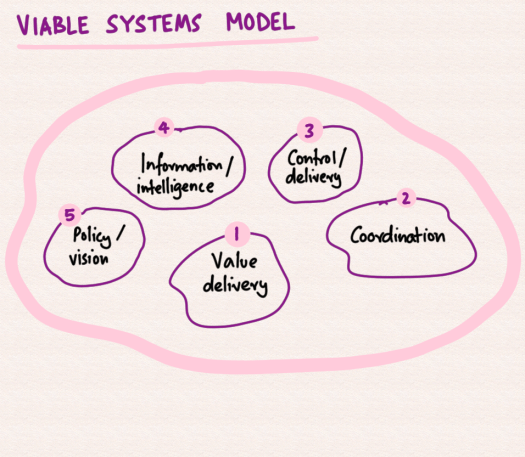
But if I redraw what the VSM means in the less intimidating picture that starts this post it lets me see what’s going on. We start by looking at where work is done, where value is delivered. You probably create value in more than one place – with different products and services so we next look at how you coordinate what’s going on. Next, you look at how you control and deliver – what’s important and what’s not and what happens first and what happens next. Then you look at information, how do you look outwards and decide what to communicate inwards. And finally you have the policy and vision – what is it that you are trying to do as a whole.

These five elements are called System 1 through 5 respectively. And you can look at them at different levels – they’re recursive so each value delivery unit has these five elements in there as well. It’s easy to recognise this when you think of something like your house. What are the value centers – doing your work, raising the kids, looking after the house? You have to talk to each other and coordinate what you’re doing. You decide what to do based on what’s on your schedules and what you’ve agreed to do. You decide what to do based on the information you have, choosing one class over another for the kids or going for a job that’s closer to home. And you do all this because of how you want to live your life and raise your family.

Now, is knowing this model valuable? Does it help us understand what’s going on any better? On the one hand, it’s simply labelling things you do anyway, things you have to do otherwise nothing would work. On the other hand, having these elements named gives you a checklist – how often do you get into trouble because you haven’t taken the time to coordinate things with your other half and the kids have ended up being forgotten at nursery? Once, in my case, which is not bad going for a decade or so.

I have to say, I’m not sure it’s much more useful than as a checklist. Yes you have to have those five elements, but then again you don’t. Sometimes what you want to do is something you figure out after doing lots of things for a while. Policy might emerge from the work. Coordination is all very well if you have the time. But sometimes you have to make the call and just get it done your way. Even though this model tells you that these things need to happen it can’t tell you how you should do each bit in your particular situation – that’s something that’s up to you.

And the biggest issue of all is that people don’t fall neatly into a model. If coordination is not happening because two people aren’t communicating you can’t fix that by asking them to use a particular form because the underlying problem might be that they were in a relationship and then fell out and now hate each other.

Sometimes I think that the solution to most human problems might come down to the simple approach. Get people to change. If that doesn’t work, change the people.

Cheers,

Karthik Suresh

How To Build Something That’s Useful

making-a-point.png

Monday, 9.02pm

Sheffield, U.K.

Deep down, I’m pretty superficial. – Ava Gardner

It’s amazing just how hard it is to do something that has depth, solidity – something that has solid foundations and that you can rely on.

Take writing, for example. It’s pretty easy to write, to rant, to ramble – but it’s much harder to make a point clearly. When you start trying to do that you see that there are many things that can trip you up, like the meanings of words that different people interpret differently.

In my last few posts, for example, I’ve been thinking about story. How is narrative different from story? To some people it isn’t – they’re the same thing. To others, story is the content while narrative is the vehicle. For example, there is a story of Peter Pan and there are narratives – the ones you read in a book or watch in a film or that you were told by your granny at bedtime. And then there’s another definition of a narrative as anything that’s told to you – even a shopping list read out is a narrative – but a narrative turns into a story when it has a purpose behind it, when there is something that brings it together.

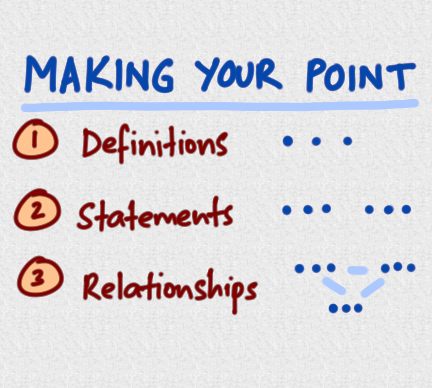
Of course, these explanations of the difference between story and narrative are still fuzzy and don’t explain it very well. To do it better we need definitions, not to explain but to constrict and restrain. We need to know what something means in a particular context. We don’t need to know what a story is but what we mean as a story when we’re talking about using it in a business context. We need these definitions so that we can start to make statements that are built on those definitions. Once I define a story as a particular thing it can be used to explain and elaborate on whatever I’m trying to get across.

Statements don’t stand on their own, however, we’ve got to connect them and show the relationships that exist. This can be as simple as paragraphing and sectioning content, but you have to do this unless you want to end up with a wall of text that is impossible to penetrate and understand.

What one realises quickly is that this kind of thinking is hard, it takes time to build up definitions, statements and relationships that make sense. The more words you add the harder it becomes to keep them together, to have them keep making sense. That’s why when you come across a theory that has been well thought through and that hangs together you’re impressed – because you recognise the work that’s gone into it. And when you see something that’s superficial and cobbled together you feel a sense of disquiet, a sense that it’s missing something and that it has no foundations.

When you’re young you want to get to places quickly. Perhaps you have to get older, to realise that it takes time to build something worth having. And even more time to give yourself the permission to take the time that it’s going to take.

Cheers,

Karthik Suresh

Do We Need To Start Listening To More Stories Again?

letting-go-of-ideas.png

Sunday, 7.52pm

Sheffield, U.K.

Our identities really are a constant negotiation between the story we tell about ourselves and the narrative our societies like to recite. – Thomas Chatterton Williams

A paper by Kenneth Mølbjerg Jørgensen and David M.Boje called “Resituating narrative and story in business ethics” is helping answer something that’s been puzzling me for a while.

It has to do with interventions in situations that are considered problematic by the people involved in them. This is pretty much everything that’s going wrong, from arguments over having cereal at bedtime at home to the way in which an organisation to respond to the challenges of climate change. How should we approach these situations and what does it take to improve them?

When we’re not certain what to do we tend to fall back on the narratives we’ve grown up with. It’s a little like being stuck in treacle – we find ourselves anchored to the thinking that’s surrounded us when we grew up and it’s hard to pull away. My tendency, for example, is to default to the relatively ascetic nature of my upbringing. If there is a problem the best way to resolve it is to get rid of everything. If you have less then there is less to worry about and logically if you have nothing other than what you absolutely need then you have no worries.

This approach does not go down well with anyone brought up with a predominantly Western narrative where the world exists for humans, where God said, “Let us make mankind in our image, in our likeness, so that they may rule over the fish in the sea and the birds in the sky, over the livestock and all the wild animals, and over all the creatures that move along the ground.” The dominant institutions of the West have internalised this belief, along with a few others to do with rationality and truth that can be traced back to the Greeks, and the result is that they do things for their own benefit and let society pick up the costs.

Society, in general, has been less than amused by the results and has tried to push back. The problem, of course, is that the richest in society benefit from the status quo. The pandemic has shown that rather starkly, with those who have getting more and those who have not suffering most. The disadvantaged, which the paper helpfully lists as including “immigrants, refugees, homeless, landless, poor, sick, underpaid and exploited”, are not heard.

When we enter a situation we tend to take on the views of those that are in there. As parents, we have certain beliefs. When working with organisations, we accept their view of looking at the world and then we try and work within those views. But what if we’re doing it wrong? I have friends who parent very differently. And we see organisations who are doing things differently. What does that tell us?

It tells us that they are listening to a different story, one that may even have more value than the ones we have grown up with. My ascetic story does not burden the earth but it creates new value and if you are born into poverty it makes no effort to change your fate. The materialist story consumes the planet and there isn’t enough for us all to have the same standards of living. But we all want our children to have a better future, and we want our societies to work better for everyone. So we have to watch out for these stories, for these new, inclusive, diverse tales that show how things can be better.

Take a company like BrewDog, for example. They are in an old business, the one of making beer, but they tell a very different story, one where buying their product is not just about good beer but also about saving the planet. It’s a good story and it’s one their competitors will have trouble matching, especially if they are invested in their existing narrative – one that their investments in carbon reductions have to be profitable. But to be profitable you have to stay in business.

The paper argues, however, that stories have been crowded out by dominant narratives, that we are much less tolerant of things that don’t have a simple beginning, middle and end – ones that try and say that they’re telling you the truth. This leads to polarisation, one narrative versus another rather than the understanding of living stories, what’s actually happening in people’s lives. But that’s a larger problem and we’re only going to address it by being open to listening.

Cheers,

Karthik Suresh

Why The Stories You Hear Matter

story-as-sense-making.png

Saturday, 7.18pm

Sheffield, U.K.

Humans think in stories, and we try to make sense of the world by telling stories. – Yuval Noah Harari

The small people in my house are fascinated by stories. It’s the first thing they want in the morning. Not a traditional story, with a start and an end, but a game story. One of those stories where you start somewhere and you have to make decisions and things happen one after the other and you end up somewhere. And sometimes you win – if we get to the end.

I went through a phase last year of reading Terry Pratchett. He’s the first writer in a very long time that has prompted me to take notes on his books, copying out passages of text. What’s fascinating about Pratchett is that he took the world we know and the settings and stories we have heard and reimagined them in a fantasy world. And he wrote about normal things and made you look at them again.

So what is a story anyway. It’s a pathway through a web of thoughts. Sometimes the web is made up and the story teller is someone who wants to entertain you, so you get taken on a pathway that twists and turns and shows you new things around every corner, keeping you interested from start to finish. In other cases the story teller just wants to tell you about the path they took and so you get to retrace their steps. Or it’s about a future that they’ve imagined and so they talk to you about the path they plan to take and how they get to it through the paths they already know. Other pathways exist but this is the one that they’re telling you about.

In the collection “Turning points in qualitative research: Tying knots in a handkerchief” an essay by Susan E. Chase talks about how stories – narratives – are complex things, and there are disagreements about stories and what they tell us about life and subjectivity and culture and truth and fiction, but “most scholars point to the ubiquity of narrative in Western societies and concur that all forms of narrative share the fundamental interest in making sense of experience, the interest in constructing and communicating meaning.”

We miss this fundamental point when we try and “study” people. There is always the temptation to reduce reality to data, to analysis, to questionnaires and surveys. Without such data, however, you are unlikely to be taken seriously. By people who are in power, anyway, because they need to be able to blame someone else for the decisions they take. And it’s hard work, listening to stories and making sense of what is really going on. We probably need better tools to help us do this better. Any suggestions?

Cheers,

Karthik Suresh

What Kind Of Contribution Do You Make?

kind-of-people.png

Friday, 9.15pm

Sheffield, U.K.

It takes a lot of people to make a winning team. Everybody’s contribution is important. – Gary David Goldberg

We were talking about what people brought with them to an organisation the other day. There are at least three things that make a difference. Do you bring in revenue, do you create value or do you come up with ideas? These three are useful contributions and if you’re doing one of them then you’re in a good position.

Revenue generating people are the ones that are happy networking and reaching out to the market, engaging with prospects and starting conversations. These people are vital because without those conversations you don’t have a business.

When you do have a conversation, however, you have to think about what is going to interest and excite the person you’re talking to. What are the insights, the ideas, the approaches you’re going to talk about? How are you going to do things differently? How are you going to create something that’s perfect for the people you’re trying to work with? That’s where idea generating people come in, the ones who can see what’s needed and create it. The ones that can give people what they need rather than what they say they want.

Conversations and ideas aren’t enough. You also need to deliver something of value. Value creating people are the ones that do the work – that create more for the client than they cost. Everyone in an organisation needs to add value. The language of cost centers and revenue centers is not enough – nothing is a cost if it creates value across the piece. But if you have people that don’t contribute, that act as a drain on resources, then you have to ask yourself why they’re there – what are they doing? You can’t do anything about it sometimes, but it’s worth knowing what’s happening.

But in your own case it’s a good idea to aim to contribute in one or more of these three ways – bring in opportunities for revenue, come up with ideas and try and add value.

Cheers,

Karthik Suresh

What Happens If You Never Improve On Anything?

no-going-back.png

Wednesday, 7.59pm

Sheffield, U.K.

“One Sunday . . . we went down to the flower market and bought some irises and came back and spent the afternoon drawing . . . He would just draw one line and then leave it, and when I would draw things, I was always erasing, changing, and improving. And he never improved on anything. Rather than do that, he would draw a new one, which is something I never thought of doing in those days.” (Charles Lisanby on Warhol: 1978) – Retrieved from pens.co.uk

It probably comes down to a personality thing but I’m not a fan of rework – or of going over and making work better, for that matter.

This is not a good thing, I am told. William Zinsser, the author of “On writing well”, says that “rewriting is the essence of writing”. You need to rewrite your sentences over and over again and then rewrite what you’ve written. And he must know what he’s talking about.

But Zinsser is talking about WRITING, in all caps, the act of creating something worthy of publication. Something that will stand the test of time. Something you can point to, as a professional, and say, “I made that.”

That kind of making is not what I’m after. That approach assumes that what you want to do is create works of ART, a gift for others. The way I use writing is as a tool for thinking. It’s a utilitarian exercise, the act of bashing out words as I work through a concept because no one will sit for long enough to listen to me talk about it or be kind enough to write down what I say so I can understand what I think myself.

It’s the same with drawing, which is why I liked the reflection on Andy Warhol at the start of this post. Why do we have to go back and make things perfect? Why does it have to be “right”. We’re always telling ourselves that we have to be in the moment – like children are. They don’t worry about making it perfect, while they’re still young, anyway. Drawing is, to me, a process of working out ideas too, and I need to allow myself to make a line and then move on, without regret. I drew the picture above in this way, leaving every line, without erasing. And it does what I need for me.

If we organized our lives so that we didn’t worry about what people thought of us would we do as much rework? Do we try harder because we’re afraid of being judged, or is that why we sometimes don’t try at all? If we weren’t attached to the lines we’d already put down would we have been able to create something even better?

The arguments are not simple. On the one hand you could say that by going over and improving what you’ve done you create works of better quality. The response might be that the work is not what matters. What matters is the observation, the act of doing the work. And if you are going to act why not go ahead and act on creating a new thing than trying to massage an old one? If you don’t like your line draw a better one next time.

Cheers,

Karthik Suresh