How To Analyse Your Personal Situation – Deeply

swot-analysis.png

Wednesday, 8.34pm

Sheffield, U.K.

No one saves us but ourselves. No one can and no one may. We ourselves must walk the path. – Buddha

There are a few problem structuring tools that are so familiar that we simply assume we know how to use them.

This often isn’t the case.

They are powerful techniques – that’s how they became popular in the first place – but if we use them in a careless way we don’t make full use of their power.

One of these techniques is the SWOT analysis – where you reflect on your strengths, weaknesses opportunities and threats.

It’s a basic model that you learn well before business school – the kind of model you bring out whenever you’re trying to think through a new project.

In this section I’m going to revisit the SWOT analysis and try to see if we can deepen our understanding and use of the tool by being more specific and critical of what we focus on as we do the analysis.

What are your strengths?

Imagine that we’re testing whether a business idea has potential – that’s the kind of place where a SWOT analysis comes in useful.

Let’s start with why this business idea is a good one for you to do – what is it about you that is going to help.

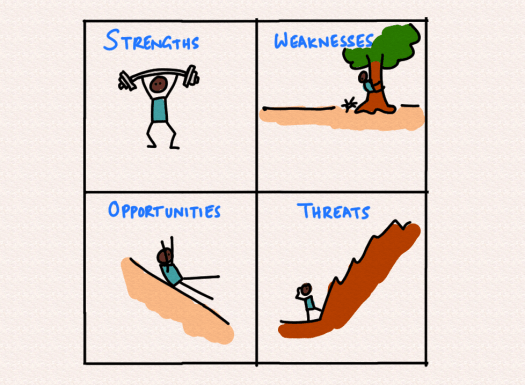
These are your strengths and you should list them in the first quadrant of the SWOT matrix, as above.

This can be surprisingly hard to do.

If you ask someone to list their strengths they’ll probably come up with things like their experience, their qualifications and their personal qualities.

Something like 10 years work experience, an engineering degree and hard work.

And then they start to run out of things to say.

Now, are these strengths?

Well, the thing to notice is that they aren’t too different from what anyone else in the same situation might say.

If you’re going for a job or trying to win a client – everyone who is in the running has the qualifications, experience and personal attributes – you wouldn’t get shortlisted if you didn’t.

So you have to look deeper, draw on the factors that set you apart.

Look for proof points – what results did you achieve, how much revenue did you bring in, how many clients did you add, what volume of work did you do.

When you’ve been involved in a billion pounds worth of transactions you’ve probably learned a few things along the way.

The other source of strengths are the things you are obsessed by – what is it you do on which you spend more time and effort than almost everyone else?

That’s the thing that’s most likely to set you apart.

Circle those strengths – and keep them in mind as you carry on through the process.

What are your weaknesses?

People hate admitting that they have weaknesses.

The classic interview coaching response to this question is, “My greatest weakness is that I don’t know when to stop working.”

You might lie on an interview, but you shouldn’t lie to yourself.

There are some things that you are just not going to be good at – things you don’t like to do.

They are things that you avoid doing and so you practice them less and so you’re not as strong.

Maybe it has to do with managing others, or keeping up with administrative paperwork.

Look hard at your weaknesses because quite often they are simply the counterbalance to your strengths.

For example, if you are a creative person who spends the majority of their day engaged in focused creative activity – you probably don’t have time to file away documents and do the garden.

It’s your focus on creative excellence that means you are weak at administrative excellence.

A weakness simply means it’s a job you should give someone else to do.

If you are clear about your own strengths and weaknesses, you’re now ready to look around and examine opportunities and threats.

What are the opportunities you have?

When you look around and see booming businesses it’s tempting to think that there is opportunity everywhere.

Surely you can make the next Facebook, Google or Amazon?

What’s stopping you from making a killing in the property market?

With all these people making money on YouTube what’s stopping you from achieving passive income and financial freedom as well?

If you’re asked to list the opportunities out there you might easily put down technology, property and finance.

That’s where most fortunes are made, after all.

But what you also have to work out is whether that opportunity is one that’s going to work for you.

If it’s the right opportunity it’s like a greased slide, you’ll be able to get on and gravity will be on your side.

So you have to look hard at your list and think about why you’re going to be able to develop those opportunities.

Do you have a background in property?

Do you understand finance or technology – are you an analyst or a coder?

Just because you can see other people making money from an opportunity – it doesn’t mean that those are the only ways to succeed.

In fact, it’s more likely that there is a way for you to succeed that you are perfectly positioned for.

Maybe it’s a change in the market, maybe it’s a job that others find hard to do, maybe it’s something you’ve developed for your own use that could be useful to others.

Rather than looking for opportunities, what you need to do is think about how you can develop them – using the strengths at your disposal.

Opportunities are not things you find – they are things you create.

But in order to develop them you have to do one last thing – remove risk.

And you do this by analysing the threats you face.

What are the threats?

As with the other three categories it’s easy to list threats in a vague and general way.

You might be threatened, for example, by bad customer feedback, cash flow problems, late payments from customers.

These threats might cause you to trip, make mistakes, cost you money.

But there are two elements to a threat – the first is the impact it has on your business and the second is how likely is it to happen.

The less you understand about your business, the more likely it is that you will make mistakes you can’t recover from.

It really comes back to knowing where you’re strong and where you’re weak – and being clear about what opportunities you pursue as a result.

If you’ve got those first three elements lined up, then the last job you have is identifying and eliminating threats.

It’s risk management, really – if you’re climbing a steep hill with loose rocks – start by asking yourself whether you really need to do the climb at all.

Why not go around, get a cab or hire a helicopter.

But if you have to climb it wear good footwear, take some equipment to help and have a plan in case you run into trouble.

There are some threats you can’t do anything about – the weather, the electricity network.

So you only focus on the threats that you can do something about – the ones you can mitigate.

And by doing that you’re dramatically increasing the overall chances of success you have.

The key is being specific

A SWOT analysis is least useful when it’s done in a quick and lazy way – when you fill it with the first thoughts that come to mind.

What you need to do is sit there and keep writing until the second and third thoughts come to you.

Draw, doodle, do anything but keep that pen moving until you get down more ideas than the ones that come immediately to mind.

Be critical of what you put down – ask yourself whether they are really different from what anyone else would say – are you drawing on what is your own unique experience or is this something anyone could put down?

The purpose of the exercise is to deepen your understanding of yourself and the situation you are in.

Armed with this knowledge you can start to move on to understanding the next part – seeing yourself in context and figuring out how to play nicely with others.

We’ll talk about that next time.

Cheers,

Karthik Suresh
How To Discover Where You Are Right Now

your-present-reality.png

Tuesday, 10.06pm

Sheffield, U.K.

Yesterday is gone. Tomorrow has not yet come. We have only today. Let us begin. – Mother Theresa

Over the next sixty to eighty days I will be roughing out the structure of a book in these posts.

I’ve tried this a few times in the past and it hasn’t quite worked out, but I’m using a different process this time, so bear with me.

The working title of the book is “Getting Started” and it’s about the messy process of getting going on a project, an idea I introduced yesterday.

Eventually, I’ll turn the raw material from these posts into a book – I hope.

But for now I want to talk about understanding where you are right now.

What is it that makes you you?

You learn a lot by listening to children, by trying to understand what they’re going through and trying to remember how you felt back then.

Perhaps the most important thing you can help your child to learn is the art of interaction – the skill to play with others.

Not, you should notice, play nicely, but play with others.

That means learning how the game is played and, equally importantly, how you’re playing it.

Each of us is a complex mix of chemicals and signals – bags of thinking water as Terry Pratchett puts it.

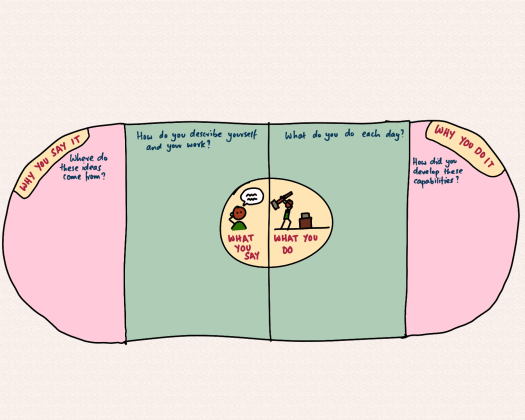
And what people around us get from us is what we say and what we do.

They listen to our stories and look at what we produce – these are the two categories of things that help them learn about us.

For all practical purposes, what the world thinks is “you” is this bundle of words and actions – so if you want to understand how you are seen, you have to start here.

Let’s take each one in turn.

How do you describe yourself to someone else?

We’ve all heard about the elevator pitch – but life isn’t really spent in elevators.

It’s spent in social and business gatherings, where you’re introduced to people and eventually they ask you to tell them about yourself.

When that happens you usually have a selection of stories ready to choose from.

Maybe it’s all about your job for you – what you do in the office and how important or powerful you are.

Maybe it’s about your research, your interests, your hobbies.

Perhaps it’s about where you live, your family.

There will be things that come to mind as you talk about yourself and you need to write them down – the actual words you use, not what you think you would say.

Next, write down what you do each day

Once again, go through your days and pick out the main things you do.

What do you work on, what kind of projects take up your time, how much time do you spend doing creative work and how much doing managerial and administrative work?

Perhaps you spend a lot of time in front of a computer doing analyses.

Maybe you’re doing a lot of internal work, helping various departments operate more effectively.

Or you’re out there, getting in touch with prospects and taking them through a sales development process.

Get these activities down – you’ll need to look at them every once in a while to remind yourself what was important then.

Why do you say what you say?

If you’ve followed these steps you now have a collection of words and phrases that capture what you say and do.

It’s time to look at these in some more detail.

What you need to ask yourself is where these ideas come from, starting with what you say.

For example, you might have written something like “money is not important.”

Where does that kind of idea come from?

Does money not matter because you had everything you wanted when you were young and you don’t want for anything now?

Is it because you’re not materialistic and don’t really need things to make you happy?

Is it because you went to boarding school and learned early on that if it didn’t fit in your trunk you needed to throw it away?

Those ideas you have about yourself have roots – roots in experiences and stories and families.

Pay attention to them – write them down.

The ideas held by an immigrant will quite often be very different from those held by someone who has had generations live in the place they are in now.

Think about why you do what you do

Finally, do the same exercise for what you do now.

Is the work you do something you trained for?

Are you a doctor or lawyer, did you spend years building your knowledge of an area?

Or is what you do a job you stumbled into when you were young, a temporary job that turned into a career 20 years later?

Or did you develop a skill to the point where you could get a job – perhaps you’re good at computers or got accepted into an apprenticeship because you were interested in a particular subject or craft.

This exercise is about knowing who you are and why

You may feel like you know all this stuff but this exercise is designed to make you look through yourself, not just at yourself.

The world sees what’s on the outside – what you say and do.

So, first you need to try and understand what they’re looking at.

But then you also need to try and understand why you are the way you are – look back to see what pressures formed you over time into the person that you are now.

None of these exercises have a “correct” answer – they’re about collecting impressions, collecting data about yourself.

We’re going to look at a few ways to do this – some different approaches to see yourself through someone else’s eyes.

Because before you try and make any changes, you really have to see yourself the way others see you.

It’s the difference between looking in a mirror and seeing a recorded video of yourself.

The video is always surprising because it’s a different point of view.

And that’s what we’re trying to do here.

We’ll try another approach, a more traditional one tomorrow.

Cheers,

Karthik Suresh

What Is The Best Way Of Getting Started?

start-from-where-you-are.png

Monday, 9.00pm

Sheffield, U.K.

If you have a dream, you can spend a lifetime studying, planning, and getting ready for it. What you should be doing is getting started. – Drew Houston

I was thinking about the kind of advice people give you when you’re thinking about starting a project.

Let’s say it’s a marketing campaign or a new book or a startup idea – what are they likely to say?

There are two main places people start – at the end or at the beginning.

For example, backward thinking starts with where you want to be and works back from there to work out exactly what you need to do.

With a startup this might mean knowing exactly what your customer looks like – working out their avatar, their persona – whatever description helps you to get a really clear idea of how they think and feel and act.

If you know that your target market is a particular age, gender and demographic you can then work back to figure out which channels are the best ones to reach them.

On the other hand you could start at the macro level – look at the environment you will be operating in and the main characteristics.

Look at the political, economic, social, technological, legal and environmental factors – the PESTLE – and see how you need to position yourself to fit in.

There’s nothing wrong with these methods – they’re all useful ones to have in your toolkit.

But is it the right advice when it comes to starting something?

Let’s stick with the startup example for a minute – imagine that you have to start your business tomorrow morning.

There’s no time to prepare, no time to research or question – it’s late.

You’re going to go to bed and in ten hours or so your new day begins.

Where will you start?

The answer is pretty obvious – you’ll start from where you are.

Right in the middle of now.

If I were to sit you down and ask you to tell me about all the stuff you do right now and all the tools you have right now – that’s the core of your startup, that’s the raw material you have to get started with.

For some people this means that what they have to start with is their brains – the knowledge they carry around inside their heads.

For others it’s the skills they have in their hands, the muscle memory they’ve built up over years of doing something.

Brains and hands – those are the assets you’ll have tomorrow morning.

Now everyone will be in a different stage – some will be young and still learning their trade.

Others will be old and will have forgotten what they know and not learned anything new in a while.

It really doesn’t matter – it’s not going to change that reality of what’s happening right now.

And that’s actually quite exciting, when you look at it in the right way.

There’s a reason why writers are told to start their books in the middle of the action – that’s where things are happening.

The middle is where the action is taking place and where the possibilities are – you are in the best possible place you could be right now.

You might as well believe that – there’s no real alternative to that reality.

When you open that window into your space – when you look at yourself in the middle of the action and what you’re saying and doing – you’re know where you’re going to start.

Right there and right now.

We’ll come back to how you do that in another post – first it’s worth looking at why you should do this, why you shouldn’t go back and do your research on everything from the start or work backwards from the end.

And it’s because when you’re in the middle, possibilities stretch out both backwards and forwards in time for you.

When you start at one beginning, it might seem like you can do anything, but you’re also constrained with the possibilities that start from just that point.

In the same way when you start from the end and constrain what you do to activities that help you get to that end – you’ve limited what else could happen.

In the middle, you have the opportunity to craft a beginning and an end that suits your purpose.

For example, let’s say that your skillset right now is data science – advanced analytics in nanotechnology.

What led up to that expertise?

It’s probably a mix of things – you found maths easy, a friend liked the same subjects, your parents pushed you in that direction.

Let’s say you’re talking to a prospect and they really want someone to help them with analysing social data – Twitter feeds.

If you started by limiting yourself to data science work in nanotechnology, you might simply pass on the Twitter feed analysis opportunity.

And you might just have missed your opportunity to found a cutting edge data-driven marketing consultancy.

You might not know anything about marketing – but you probably use Twitter, you can probably get up to speed on the APIs in a few hours.

But why should they work with you?

Well, that comes back to your origin story – your beginnings.

And if you’ve left yourself room you can craft an origin story that helps customers understand why they should trust you with their business.

Now, as you develop your business you’ll start to see different opportunities to progress.

Maybe you see yourself becoming a consultant, telling others what to do, standing on stage.

Or you get on and produce tools and content, books, podcasts, videos.

You make what your audience wants and what you want to make – and if you’re lucky those two things will be the same.

But all that comes later.

The journey begins with realising an inescapable truth.

You are going to start from where you are right now.

Cheers,

Karthik Suresh

What Are Your options When You Come Across An Obstacle?

water-and-obstacles.png

Sunday, 9.24pm

Sheffield, U.K.

There are plenty of difficult obstacles in your path. Don’t allow yourself to become one of them. – Ralph Marston

The essential ingredient you need to make a story work is to give your hero an obstacle to overcome – something that they can beat.

That’s the essence of conflict – put your characters in a difficult situation, make it so it beats them down and then show how they fight back and emerge victorious.

Stories are about triumph, about victory, about winning.

They are not about real life.

In real life the detective does not pick on a collection of tiny clues and figure out the entire life story of a person.

In real life a teacher does not walk into a deprived school and turn the lives of all the children there around.

In real life getting that huge promotion doesn’t hinge on you getting that lucrative contract signed against all the odds.

Real life is about finding the easiest way to move onto the next thing – move through the day and get ready for the next one.

If you want to be happy – to create a life that is low-stress, what you have to learn is the art of getting around problems.

It is far better to notice problems when they are some distance away and take steps to avoid them.

In much of life the image to keep in mind is that of water.

Water flows downhill – it goes the way it’s easiest to go, the way gravity tells it to go.

And there are always obstacles in the way, sometimes big ones, sometimes mountains.

When this happens there are two main choices.

The first is to go around the mountain – as long as you have gravity on your side you can keep moving.

Find a way that’s easier than climbing the mountain.

It’s the same in business – go around problems whenever you can rather than fighting them.

Handle objections before they turn up.

Train staff before they have a chance to make silly mistakes.

Don’t put your money into projects you don’t understand.

If you stick to the easy path you will rarely put a foot wrong.

But, the romantic side of you screams, you’ll never achieve greatness, you’ll never create the next Amazon or Google.

Why not?

Google’s big idea is pretty simple – peer review is the basis of getting you good information.

Amazon’s big idea is pretty simple – make online shopping frictionless.

Now, those founders didn’t get there with gigantic, heroic leaps.

They had the right background, were in the right place with the right idea and executed it as best they could and survived and grew to the point where they are now.

The fact is that you are where you are right now – not where those founders were then or are now.

And the only thing for you to consider is which way is the easiest for you to keep moving.

Standing still is the problem – becoming stagnant, building up behind a dam.

That’s what stops you.

While there are options to keep flowing you’re never really stopped – you just need to find another way.

Which brings us to the second main option.

Sometimes you are stuck, sometimes there is no way forward.

You need to be absolutely sure about this.

Because when there is no way around an obstacle the only way left is to go through it.

That’s not always easy.

It helps if you have nothing to lose.

Most of us are not in that situation – we are lucky enough to have some element of choice.

We’re not restricted by oppressive regimes or the limits of our education.

We’re lucky.

The only real obstacle that stands in our way, all too often, is our self.

The self that talks to us, filled with doubt and fear – the voice that says we cannot do it or are not good enough.

The voice may be right.

But gravity is still gravity and downhill is still downhill.

And all you have to do is move – find a way to flow.

Cheers,

Karthik Suresh

Should You Hold On To More Things Than You Absolutely Need To?

holding-on-to-things.png

Saturday, 6.01pm

Sheffield, U.K.

As the biggest library if it is in disorder is not as useful as a small but well-arranged one, so you may accumulate a vast amount of knowledge but it will be of far less value than a much smaller amount if you have not thought it over for yourself. – Arthur Schopenhauer

For a while I was a fan of David Allen’s Getting Things Done approach to work.

It worked when there were lots of things to do and you wanted to capture them all, make sure that they were moved on.

Now, however, as I look back – what is the main purpose of a system like that?

Is it to do things in the best way possible – to apply yourself to the most important problems?

Or is it a way to avoid being shouted at?

I think productivity systems like GTD are actually armaments for the workplace – a way of showing people that it’s definitely, absolutely not your fault with extreme prejudice.

Here’s the task, I sent you the analysis and then I followed up every week and you didn’t respond.

So, how can you blame me for the mess you’re now in?

Now, in many situations, you need that kind of approach, especially if you work in an industry that addresses failure demand.

Failure demand, if you remember, is John Seddon’s term for work that has no value – work that is done to fix failures elsewhere.

It looks like work, but it isn’t.

Real work is value demand – stuff that matters and makes a difference.

Should you treat value demand the same way – record everything, list it all out and make sure you get it done?

I’m starting to think that isn’t the point.

Stephen King, I think, said something like he doesn’t take any notes, doesn’t put down ideas when they come to him.

If they’re good enough they’ll stick in the mind, they’ll come back to nag at him.

I guess you should pay attention to the things around you, the thoughts and events, but you don’t need to document everything, put everything on a list.

“Not-doing” is a form of filtering.

You have a limited amount of time – you should probably spend it doing the highest value work you can – the work that calls to you.

Everything else can wait – preferably for ever – but certainly for next week.

Until someone nags you, anyway.

This idea has a certain power when you start to implement it.

There are so many boxes you could pick up – but only so many you can hold.

There are only so many things you can own before you become a person whose job it is to own things, to look after them and sort out their care and maintenance.

Having more things might make you feel rich – but it’s also a form of imprisonment, an open jail that you have to bar against others.

Now, does that mean you should never collect anything, never look back, never finish jobs?

Nothing really is ever that absolute.

It all depends.

If you want to do something – write a book, create art, grow a business – there are things you need to do and things you don’t.

You have to decide which things are which.

Doing everything will probably just make you tired – too tired to notice that an opportunity has passed you by.

You were too busy working to see it.

There will always be more jobs to do, more tasks to do, they will fall from the sky like rain.

And like rain, they will come around again.

But your time will not.

So spend it wisely.

Cheers,

Karthik Suresh

What Are The Main Things You Shouldn’t Lose Track Of In A Crisis?

balancing-the-main-things.png

Saturday, 7.25am

Sheffield, U.K.

The main thing is to keep the main thing the main thing. – Stephen Covey

As we continue to experience the Covid 19 lockdown in various places in various ways – there are some things that seem to have changed for the better.

Remote working, especially – many places are finding that they can get quite a lot done by letting their people work from home.

That’s a good thing, isn’t it?

Well, maybe not, depending on the particular situation you’re in right now.

Particularly if you can do everything from home.

Because if you can, why can’t anyone?

Especially someone who is willing to work harder and longer for less – maybe someone in a different state or country?

Even before we had to do what we’re doing now there were comments from people who were willing to be paid less if they could have more flexible work.

That may become a reality for many faster than you think – as companies that see demand drop make savings cuts of their own – which often comes down to headcount and salaries.

If that happens, are you ready?

To answer that question there are four areas you should look at critically.

Start with your projects – the things you are working on.

Are they easy or hard, are they essential or not?

Are you working on something that someone really needs done or is it a discretionary thing, something that takes up time but perhaps could be put to one side for a while.

Which projects do you think will be shelved first?

Now, clearly the projects you do are the projects that you have the resources and capability to do.

Your capability travels with you, it’s what you have in your head and muscle memory.

But what about your resources?

If you need a multi-million pound studio to do your work, or very expensive software – how will you carry out your projects if you don’t have access to them through work?

A lot of people only have their work equipment – they haven’t invested in their own kit because they believe that it’s something that they should be provided with as part of their job.

That may be a little short-sighted.

If you want to carry on doing projects, it might be worth thinking what you can do with the resources you personally own or what it will cost you to get set up.

If you can reduce the resource costs of working with you, then you make it more attractive for someone to hire you as well.

Then there’s your network – the group of people who are peers and champions and supporters.

Have you taken the time to develop a network – can you reach out to them and ask for help when you need it?

And lastly, there’s your market – again make up of people.

Markets and networks are not abstract, conceptual things – you measure them in the numbers of people you can reach out to that will respond.

And again, it’s easy to be short-sighted – to think that the market you have will not change.

But if those people you know move on, will you be able to have a connection with the new ones, especially if their job is to cut costs?

These four areas are common to all of us, whether you’re just starting your career or you’ve been in it for a while – and it works at the level of an entire business as well.

It’s very easy to focus on one of the areas and neglect the others.

Think about how you spend time learning how to do something and then spend all your time on projects – but perhaps not ones where you learn anything new.

You don’t tend your network or keep developing your market.

Your mix of projects is static and things change around you.

The point is that change is always going to happen.

And it might not be change that’s good for you.

You are, after all, at the centre of all this – and you have to look out for you.

When change happens, you have to be prepared – and these four areas are the main ones – the ones that make the difference.

And it might be necessary to stand back, take a look at where you are right now, and then take action to move the dial to a happier place.

And then you’ll be ready.

Cheers,

Karthik Suresh

How To Make The Shift From Student To Participant In An Intellectual Ecosystem

learning-to-contributing.png

Thursday, 6.53pm

Sheffield, U.K.

What you leave behind is not what is engraved in stone monuments, but what is woven into the lives of others. – Pericles

It takes time to be able to see the same thing through different eyes.

What comes to mind when you think about learning and developing – yourself, your career, your relationships?

Probably a bunch of books, mainly self-help ones – that genre which packages inspiration and motivation and serves it with a helping of guilt.

Books have been my friends, my companions for a long time – the places where I have discovered ideas and approaches and strategies and tried many of them out.

You have to try things out.

And over time I’ve learned that lists of things you want stay in the pages where you’ve written them.

Writing daily affirmations ends with you using up stacks of paper and wondering whether you should throw out the pads or keep them.

Maybe it helps, maybe it doesn’t.

But maybe the greatest value in starting with that kind of material is that it gets you started.

If you’re stuck somewhere taking a step in any direction probably won’t make things worse.

One area where many of us are stuck – I certainly was, perhaps still am – is the quagmire of culture.

I was watching a documentary on Leonardo Da Vinci which talked about how an idea formed and escaped from East to West in the fourteenth century.

Knowledge, before that period, was all about theology – it was god centric, deity centric,

If you said anything that disagreed with doctrine, it usually turned out pretty badly for you.

The idea that escaped was humanism, a way of thinking that put humans at the centre – and opened up new fields of study about what it was to be human.

Now, more than five centuries later, we’re still confused about the difference between ideas trapped in books and ideas that live in the human experience.

Let me explain.

I come from a culture that venerates knowledge – where books are worshipped.

Which perhaps accounts for why I’ve always turned to books when I need to find out something.

But that kind of thinking has a trap – it pushes you towards thinking that the stuff that’s written down is knowledge.

It takes some time to realise that’s knowledge for a particular time and place – not knowledge for the ages.

And I learned that lesson the expensive way.

If you are a fan of investing you may have come across the work of Benjamin Graham, who developed an approach to value investing in a time of social and economic crisis.

Some of his fame comes from having had Warren Buffett as a student.

Buy bargains, he said.

Around seventy years later, I tried doing what he said.

With real money.

And I lost a lot of it.

That was an expensive lesson – but a worthwhile one because it helped me change my approach when it came to investing money I couldn’t afford to lose.

A more modern approach to knowledge sees it as rivers of dialogue – a continually constructed reality held in the minds of a community.

That community holds useful knowledge, some of which is established lore, some of which comes along and upturns certain principles – which are then removed from the group consensus over time.

It’s that image of a party, where lots of people are talking and the conversations are the knowledge.

In that image modern social media stops being a distraction and turns into the manifestation of a community.

If knowledge is held in a community and that community shares its thinking on social media – then what is held in social media is the knowledge you want.

Not the stuff locked in books or papers or institutions.

So what, you ask yourself – what’s the point of all this?

For me, the point is quite important – it marks a major shift in the way I think I should view knowledge.

I should put down my books.

And I should engage more with the communities that talk about the things I’m interested in.

If you want to do that it’s not going to happen quickly.

Communities form over time, they accept newcomers in a more or less friendly way depending on how you act.

If you come in as a know-it-all then you’ll probably be ignored.

There’s a right way and a wrong way to join a group in a playground.

And that way doesn’t change when you leave primary school.

Hang around the edges, make a few contributions, positive ones, and wait to be invited in.

Because, in sharp contradistinction to what your parents told you all your life – what you really should do is stop studying and go to the party.

Cheers,

Karthik Suresh

What Must You Do When You Decide That It’s Time To Do Your Own Thing?

copyright.png

Wednesday, 9.09pm

Sheffield, U.K.

The idea of copyright did not exist in ancient times, when authors frequently copied other authors at length in works of non-fiction. This practice was useful, and is the only way many authors’ works have survived even in part. – Richard Stallman

We all learn by copying – we start by looking at what other people do and trying to do it ourselves.

We start jobs that way, progress in careers, make choices about what to study and which relationships to be in.

Learning from others is a fundamental part of what it means to be human.

For example I find that teaching children using the content put out by schools is quite hard.

Perhaps it’s the environment, the social urge to conform, that means children will do things in a classroom of their peers that they won’t do with their parents.

It’s easier to say no if they don’t want to do it.

Which means that if you want to get them to do something, a good way is to start with something they do want to do.

Throw away the English worksheets, for example, and start by reading Harry Potter aloud and stop and talk about interesting things you see about the way J.K Rowling uses language.

As you grow up a few things happen.

The first is that, at some point, you finish school, and the expectation to keep studying starts to ease.

Perhaps you go to university, or start a job – but eventually the book learning stops and the job learning starts.

And then forty years go by and that stops as well.

There’s something wrong with this picture – something deeply wrong about what’s happened over the last few hundred years.

And a bit part of it, I’m starting to suspect, has to do with ownership.

Somewhere along the way someone in power decided that it was in the interests of people with power to keep that power.

And, of course, knowledge is power.

So the codification of knowledge started to have walls put around it – because knowing stuff made the difference between having power and not having power.

And this leads to a situation now where you are almost certain to infringe copyright if you do work that does not start with a blank sheet of paper.

If you look at anything else first then that could count as infringement, because what you are making is derived from that original work.

And that leads to some interesting points for creators.

At some point you will decide that you need to grow up.

You’ve spent years learning from the world, from keeping your eyes open and looking out to see whatever is out there.

You’ve sucked in that knowledge, greedily absorbing it and learning from it and adapting it and shaping it and, in the process, finding out more about who you really are.

Now, you have to close the windows, shut the door and face the empty page on your own.

That’s a scary thought, isn’t it?

No more research, no more reading, no more checking what’s out there first?

And yet, it may be as long as we do a few things.

The first thing is to be careful about what we let into our world – we want ideas but not the expressions of those ideas.

Ideas can’t be copyrighted, but once they’re put down in some way then you start to hit those protection issues.

A simple way of doing this is not going on the Internet with a javascript enabled browser – vast tracts of the web will now be closed to you.

Clearly, the safest course of action is to let nothing in.

Or, in any case, old stuff.

Read the classics, read histories, read the stuff from a long time ago.

That’s out of copyright now and so you’re ok.

And then if you’re still looking for knowledge, read the stuff that’s released under a copyleft licence, something that encourages you to share and borrow and use.

It’s worked brilliantly for software, and maybe it will work for knowledge as well.

I guess something like Wikimedia commons is a starting point.

I think the sad thing about this kind of thinking is that knowledge should set you free – but instead it’s used to chain and bind people.

And the only way to get away from that is to refuse to play that game.

But few people have the courage to do that.

Stallman, for example, set out to develop a “clean room” version of Unix, locking himself away and writing the components he needed and it’s because of that work that we have a free software ecosystem and the alternatives we use now.

The editor I’m writing this in is emacs – Stallman’s emacs.

I’m going to try and experiment for a few weeks.

I’m going to see if I can write these posts without research, without references – only creating original work starting with a blank sheet of paper.

I don’t know if that’s even possible.

Shall we find out?

Cheers,

Karthik Suresh

p.s. I’ve now set up a dedicated Twitter account at @HndcrftdInsight for this project and to collect ideas that might help with future posts.

The Three Kinds Of Habits You Need To Develop

kinds-of-habits.png

Tuesday, 10.12pm

Sheffield, U.K.

When one begins to live by habit and by quotation, one has begun to stop living. – James Baldwin

If you really want to learn what people think you should go and read the reviews people leave on Amazon.

Says Jay Abraham – the marketing guru – so I thought I would do just that.

You’ve probably heard about James Clear and his book Atomic habits – and I wondered what people thought of that kind of material.

You see, the problem is that most of the business books we’ve heard of are written by people who don’t always know the theory that underpins their ideas.

Many books are repackaged common sense and what mother would say.

It’s nice, uplifting material that makes you feel good and motivates you to do something – anything.

But is it going to work for you in your circumstances?

At the other end you have academic papers that are detailed studies of a very specific situation – so specific that you learn that something works – but only under those conditions.

How is that going to work for you if your conditions are different.

So, between these extremes, common sense and old wise sayings, and new, cutting edge research – you have to find a set of ideas that you’re happy to cling to.

Now the approach you need to take to find your way in this treacherous swamp of ideas is to get better at critical thinking – at looking at ideas and figuring out what to take and try and adapt so that you make it yours.

For example, the first comment that came up for me on Clear’s book was by Timothy Corwen who talks about how Clear doesn’t make it quite clear what kind of habits he’s talking about.

And this is something that’s easy to confuse – are all habits equal?

Corwen points out that they’re not – and there are at least three that you need to get your head around.

The first are habits that you do in order to make life easier for yourself.

The fictional writer Hank Moody, in the TV series Californication only has black t-shirts and blue jeans.

That makes choosing your outfit easy.

Or you only drink tea – coffee or any other kind of beverage is a no-go area.

These kinds of habits are about doing the same thing to reduce the number of decisions you need to make, saving your energy for the big stuff.

The second kind of habit is about removing friction for the things you want to do because they’re good for you.

Exercise, for example.

If you lay your clothes out the previous night or join a routine at the same time every day, like the nation is doing with PE in the morning in lockdown, you’re making it easy to perform that task.

These first two types of habits make it easy to do easy things and easy to do hard things.

When you’ve got those two nailed you can now focus on making it easy to do the important things.

Like climbing your mountain.

Your mountain might be your career, writing a book, doing your art, creating your music.

It’s your body of work, your life’s purpose, the asset you build, the legacy you leave.

And too many of us spend our lives so busy choosing the next outfit and watching TV on the sofa that we never have the time to look out and see which way our mountain might be.

So, when you look at your routines today – the habits you’re trying to develop – keep this model in mind.

They’ve got to help you address those three problematic areas in your life – the easy problems, the hard problems and the important problems.

And if you get this right you might be on your way to becoming healthy, wealthy and wise.

Cheers,

Karthik Suresh

Three Different Ways You Can Position Yourself And Your Philosophy

ultra-frugal.png

Friday, 7.37pm

Sheffield, U.K.

Wealth can only be accumulated by the earnings of industry and the savings of frugality. – John Tyler

I’ve been spending a lot of time on YouTube recently as I try and understand how to use different approaches to make sense of the work that I’ve been doing on this blog.

Over the last three years I’ve been exploring ideas – reaching into various places and finding models and approaches to dissect and put back together.

All the writing here is a first draft, a way of putting down what I’m learning as I’m learning it.

An exercise in collection – much like going out and finding interesting things in nature and bringing them back home, much to the distress of everyone around who suddenly finds a weird looking bug walking across the dining table.

But after you have the first draft down – the raw notes – you have to go back and work and re-work them, shaping them into something more useful.

For example, of the nearly 800 posts on here 208 have something to say about marketing.

Which ones are useful?

Well, to do that I have to go back and look at the models again, see which ones are more or less useful.

And one way of doing that is to approach it as an exercise in teaching – if I had to run a course teaching some of this content, how would I go about doing that?

Well, the first thing I would do is put some unnecessarily stringent constraints around how I do things.

For example, I’m not a fan of non-free software anywhere in my personal work processes.

And the same goes for the cloud and closed hardware and all that kind of jazz.

And that’s because of the philosophy that I have about this kind of thing – my views on knowledge and sharing.

But before I get to that what else is out there?

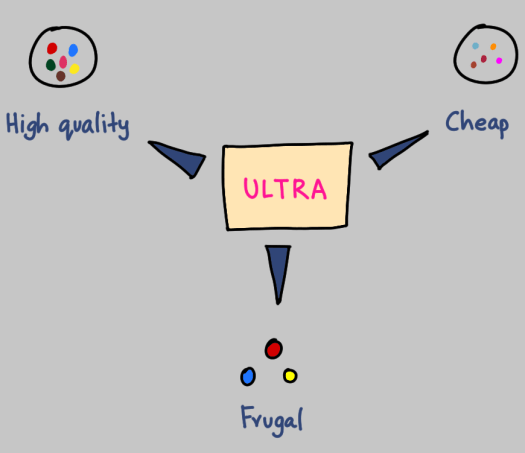
Well, if I take YouTube as an example, there are two main types of things you see out there.

They both start with Ultra.

First, there are the people who believe that what makes them stand out is putting out the highest quality content you can find – ultra high quality stuff.

And that’s really useful as you learn about the kinds of things that are possible if you really put your mind to the task.

Then you have the stuff that’s ultra-cheap – perhaps a webinar or a recording of a lecture as it happens in real-time that’s uploaded.

Now you can get a lot of value from both approaches – after all, you can watch lectures in MIT and other amazing universities in this format.

You find this same distinction in other markets – Ebay is a good example of where you can find cheap stuff and then you have the Apple store, where you pay a premium for what is perceived to be the highest quality product out there.

My preference is what you might call an ultra-frugal approach.

Frugal in terms of resources but, equally importantly, frugal in terms of time.

So, for me, that means learning how to use tools that make my life easy – not tools that have the best quality or brand, but ones that do what’s important in an effective way.

And that’s a personal thing – what matters to me is probably going to be different from what matters to you.

For example. I like a workflow that is based entirely around the command line.

So, I’m learning how to use ffmpeg and recording video directly to the computer rather than having an intermediate device like a phone or camcorder in the way.

Just because it’s faster if you can grab the video directly – which you can do with some cameras, just not the ones I have, unfortunately.

The purpose of all this is to make it easy – easy to carry on learning – learning how to create a second draft and how to package information in a way that’s more useful to readers and viewers.

And myself.

The thing is we need the people who want quality – they drive the creation of new markets.

We need the people who can make things cheap – they make it possible for all of us to have things.

But then, for some of us, all that choice out there is not a good thing.

We don’t want the best things out there, and we don’t want lots of tat.

We want to have peace of mind.

And that often comes with being frugal.

Cheers,

Karthik Suresh