Is there a difference between an expert and a beginner?

knowing-vs-learning.png

Adam Fisher of Soros Fund Management says in Tim Ferriss’ book Tribe of Mentors that finding an area of expertise is a bad idea. Just learn how to learn and we can figure things out.

That’s an interesting thought – because we become experts by getting to know almost all there is about something.

How do we do that?

We study and we practice.

When we are experts – when we know something, then we’ll come up with adaptations on existing ideas and even our own original ideas.

On this… all too often people say that everything has already been written. There is nothing new under the sun.

But we’re discovering new things all the time. New species, new places, new ways of understanding how our brains work.

So, how do we learn?

We study and we practice.

We take in ideas, think about them, let them take root and grow in our minds.

Perhaps the problem is that we are looking for signs. Looking for validation.

If we appear to be experts – if the world accepts that we are experts – then does that make us expert?

Is it our expertise that shines through? Or are other people just so good as coming across as expert that they fool the rest of us?

What is the point of all this?

The point is that there is a difference between what is and what appears to be.

When we start learning something new – we don’t have to pretend to know it – we can be open and take in ideas and just learn.

When we have many years of practice behind us – we don’t have to pretend that we know – we can be open and share our ideas.

It’s the bit in between that can get us – the part where we have learned enough to be dangerous and think we know, but not where we know how much we still have to learn.

It’s very Zen. Before Zen, mountains are mountains. Then mountains are not mountains. And then, mountains are once again mountains.

It’s just going to take time to get it.

What managers can learn from pilots

pilot-training.png

Charlie Munger, the Vice-Chairman of Berkshire Hathaway, has strong views on picking the best ideas from different disciplines and use them to become better at what we do.

In Poor Charlie’s Almanack, a collection of Munger’s writing and speeches, he talks about broadscale and narrowscale professionals and how the former can learn from the latter.

Broadscale problems are ones that can only be solved by using ideas from more than one discipline.

Take management, for example. Good managers need to understand accounting, psychology, economics, technology, logistics among other skills.

It is possible to be an expert in just one area, like engineering, but if we don’t understand how accountants think we’ll find it hard to explain what we are trying to do to them.

The thing is that focusing on a specialist area – narrowscale thinking – is how we get to be very good at something.

But, one of the criticisms of academia is that the system forces people to know more and more about less and less – and so the insights that emerge can be hard to apply in practice.

Munger suggests that one solution to developing broadscale knowledge is to find the best elements of narrowscale education and then scale them up and suggests looking at pilot training as an example of the best kind of approach.

He talks about how pilots are trained in a strict six-element system.

The starting point is formal training. We need to have a broad knowledge of practically everything that is useful to fly a plane.

How often are managers formally trained in management methods before being put into a management role? That’s an investment more organisations need to make.

Training alone isn’t enough. We need to practice until we are fluent at what we are trying to do.

It’s one thing learning about economics. Being able to model supply and demand to maximise total revenue is a different thing. Hint – we should almost always raise prices…

We also think a lot about what we want to do – goals we want to reach. This focus is good, but we also need to think about what not to do, the things we should avoid.

Then we need to spend more time on the things that are more important. That might seem obvious – but how often are we distracted by things that take a lot of time but have little to no impact.

Pilots are trained to always use checklists. And they are better at it than doctors – leading to the quip that this is because doctors are involved while pilots are committed. Doctors who have pilot experience must have an advantage…

Finally, just because we’ve done a course doesn’t mean we know all there is to know – we need to maintain knowledge over time, with more lessons and more practice.

Pilots are required to spend a certain amount of time flying to maintain their license. All professionals need to spend time on continuous professional development – but do we?

A lecturer of ours once said that when we graduated we would have a Masters in business administration. That did not mean we were masters of business administration.

Not yet anyway.

What happens when a group has to decide what ice cream to serve?

consensus.png

We are warned about how groupthink destroys creativity with sayings like a camel is a horse designed by a committee.

People making decisions in groups have sent astronauts to the moon and started two world wars – they have created the modern world and carried out genocide.

So, when is groupthink good and bad and can we recognise the difference?

One thing that often happens is that a group tries to reach a solution that is acceptable to everyone.

This usually results in a bland compromise – with everyone being served vanilla ice cream.

Is the way we live a compromise then?

Our societies operate within a framework of laws set out by a group of people who set out to debate and agree acceptable ways of living.

The difference is that each legislator fights for his or her constituents, and it is the process of debate and negotiation that results in laws.

Perhaps there is some insight in that process.

If a group of people try and decide what is best for a group as a whole, then at best they will come up with vanilla ice cream.

At worst, they will come up with the idea of fighting another group and starting a war.

Neither option is particularly attractive.

What seems to work better is people doing things that are in their best interests and standing up for what they want.

It’s more like a market, where everyone has a choice where to put their time, energy and money.

The individual decisions that they make create larger flows of decisions in the population, from which collective ideas and choices emerge.

This bottom up approach results in a more robust way of life and forms democracy as we know it.

As Churchill said democracy is the worst form of government, except for all the others that have been tried from time to time.

We can’t avoid operating in groups – that is the way society is organised and functions.

What we need to be aware of is how quickly groups can start to function poorly. All we need to do is look around the world at conflict zones to see how this happens.

Individuals acting in their own interests but cooperating in a group tend to come up with societal structures that have a chance to endure.

Decisions imposed on groups have to be enforced – and lead eventually to a more coercive form of control and government.

So… to make groups work better, we must try harder to think for ourselves.

But even then, we’ll probably vote for vanilla much of the time.

How to write a case study to use in marketing a business or a person

spin-case-study.png

We will all need to come up with case studies for something or the other at some point.

A case study essentially answers the interview question of Can you give me an example of when you…?

So, why can they be so hard to write?

Perhaps it’s because we often default to thinking about ourselves – what we do and how we do it and start working on writing that up.

What is the end result we’re trying to describe? Is it that we made a customer happy?

Whether it’s for a business or a person describing how they did something in a particular role – the end result is that they made someone else happy about something.

Which means that they weren’t happy about something to begin with.

Neil Rackham’s best selling book SPIN Selling is perhaps the best model that describes what to do next.

In Rackham’s approach, good salespeople act as consultants acting in their customer’s best interests.

So, what does a consultant do?

Well, we start by understanding the customer’s situation – where are they right now and what is making them unhappy about something?

Perhaps they have been surprised by an unusually large bill for a commodity that has resulted in a big negative impact on their budget this year.

This has resulted in the CFO firing the financial controller and cutting staff and now the Board wants to make sure that this never happens again.

The problem is that the company operates in a fairly traditional way and is suspicious of things like financial markets, so makes decisions about commodities in the same way as it buys furniture.

But a commodity market is not like furniture. Prices fluctuate daily and are volatile – so prices could double or halve while decisions aren’t being made.

The implications are that the chances of being surprised again are quite high – prices go up and go down but have a nasty habit of being too high just when we are ready to buy.

The way in which we resolve the needs of the company might be to engage with a third party that will monitor the commodity markets daily on our behalf and calculate the impact of market movements on our position against a budget.

Such a report, issued to the CFO and financial controller regularly, would mean that they see changes early and can take a decision to manage their position and stay inside their budget limits.

Also, by being informed, they can manage how this information gets to the rest of the company and the Board so that there are no surprises.

A case study, in essence, is a story about how we made someone else happy.

This format will help us get the words down.

Next, we need to make it look pretty, but that’s another story.

How to earn loyalty online

online-persuasion.png

We know its much easier to retain a customer than it is to find a new one.

The costs of acquiring a new customer run to many multiples of the costs of providing great service to an existing customer.

We all know this – but do we really understand it – viscerally understand what this means?

Robert Cialdini, the author of Influence: The psychology of persuasion had six principles that he found guided how people make decisions that guide their behaviour.

These are:

  • Reciprocity
  • Scarcity
  • Authority
  • Consistency
  • Liking
  • Consensus

In a nutshell, when someone does us a favour we feel obliged to reciprocate. We are galvanised into action when we fear we will lose something. We go with the experts’ views. We prefer to be seen as consistent. We want to be liked. And we often go along with the group’s view.

Things are different online – but the principles that affect how we react don’t change all that much.

The thing everyone wants from their customers is loyalty.

And customers are loyal to brands and firms that they trust.

One of the benefits of the connected world we live in is that it is much easier to redress an information imbalance.

For example, on platforms such as Ebay, the availability of seller and buyer scores and feedback mean that it is a better option to be a good Ebay citizen than a bad one.

It takes time to build a reputation, sale by sale, delivery by delivery.

People often pay no attention when something arrives on time in the expected condition.

It’s when things go wrong that the proverbial rubbish hits the fan.

That means an essential part of doing business online is to act in a trustworthy way. The incentive is to be good rather than take advantage of a customer.

In today’s connected world it’s not enough to be good – one has to make things much easier.

We are willing to pay for convenience. That’s why apps that make it easier to do things from order taxis to order food are changing how we move and eat.

That is a trend that will not change. Many of us are willing to pay a little more to park using our mobiles than carry around the exact amount of change.

So, how do we select with whom we should place our business?

Two of Cialdini’s principles stand out.

The first is that we prefer the most authoritative site. We would rather shop on Ebay and Amazon than on some unknown store or search engine.

The second is that of commitment and consistency. Once we have started doing things and engaging with customers in a particular way, we find it hard to change.

The point is that the online world is different – the content we put on our websites has to earn trust with customers, make things easier for them and come across as authoritative.

If they believe us, then they will engage and place business with us – and once that is done they will be committed and consistent in placing new business.

The good thing about the internet is that it makes information available to everyone.

So, when everyone knows whether we have been good or bad, it makes sense to be good for goodness’ sake.

Why it helps to put things off until later

procrastination.png

What would you do if you had five minutes to chop down a tree?

An experienced person would spend the first two and a half minutes sharpening his or her axe.

Putting things off is a form of laziness – isn’t it?

How many people do we know that are too busy working on their work to spend any time thinking about their work.

How many business owners are working so hard in the business that they have no time to work on the business.

Most of us are trying to create value – to be useful in some way.

Our abilities to think, reason and create help us write books, solve problems, design structures and do myriad other things.

But we don’t arrive at the end result in a nice, linear way – starting by creating a plan and following it until we succeed.

There are often a few detours along the way, strange encounters and experiences that inform and infuse what we do.

Let’s say we have a task to do. Just putting it off for a while and doing something else doesn’t mean that the task has been forgotten.

Instead our brains put the idea on the back burner, simmering away.

In that period between being aware of the task and doing work on it, the brain beavers away and pulls out connections, thoughts, associations and extrapolations that would not have been available had we just started working.

We might even stumble over something new. An idea from a different discipline or an unrelated activity may be the perfect thing to use in our situation.

Procrastination – the act of delaying something – may in fact be one of the most useful skills we have.

Taking the time to sharpen an axe might mean that we can do the job better and faster.

Taking the time to think might mean that we see something new – come up with a radically different idea or result.

We throw our ideas into the air and, like a paper plane, they come to rest somewhere new and unexpected.

And that’s more interesting than just getting on with the way things are done right now.

How to think about your business model in the digital age

digital-business-models.png

Every industry is being transformed by digital technologies in front of us right now.

The overlay of information and abstraction onto the products and services we use every day creates new experiences, expectations and possibilities.

While we see and talk about this often in the context of entertainment, advertising, social media and mobile technology the industries that feed, move and power us – agriculture, transportation, utilities among others – are also being transformed.

So, how can we think about this changing environment and where we fit into it?

Professor Venkat Venkatraman is the David J McGrath Jr Professor of Management and the Chairman, IS Department at the Boston University Questrom School of Business and writes about the interface between strategic management and digital technology.

His book, The Digital Matrix: New Rules for Business Transformation Through Technology, explores the kinds of companies that play in this changing business landscape, what changes and transformations they will experience and the strategic moves they can make to win.

Venkatraman says in an interview with Antoine Abou-Samra that we often use two main ways to think about situations.

First, we look at successful companies and see what they did and the lessons they might have for us.

Or second, we look at new technologies such as Blockchain or digital tracking and imagine the implications they might have for us.

Venkatraman argues what is needed is to have a framework that can be used to understand the players and the actions they might take, and use that to inform and position ourselves strategically.

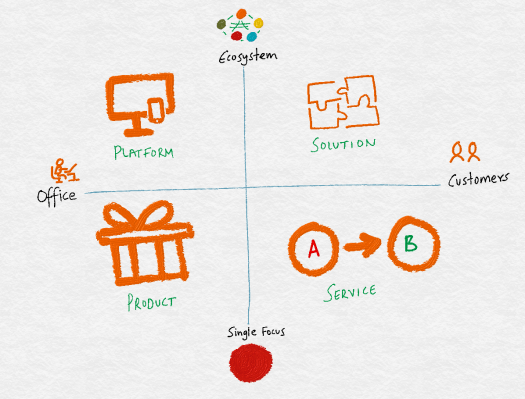
An interesting framework that can be used to understand which business model we are using in the digital age is shown in the picture above, adapted from this summary.

Traditionally, we think about the business we are in and whether we provide a product or a service.

This single focus on ourselves and what we do has been how business has been done for a long time. We make something – a product – or we help someone get from one point to another – a service.

Products are developed in the office while services are provided to customers.

Digital extends this simple matrix upwards to turn us from a small village of trades to a global market for anything we want.

Two new types of models emerge in this space.

Platforms aggregate and put forward options we can select from and Solutions address complex and ‘wicked’ problems that we face.

This is an elegant and simple approach to thinking about what our business model needs to be in this new world.

Do we provide a product, a service, a platform or a solution?

What the Terminator has to say about success

terminators-success-rules.png

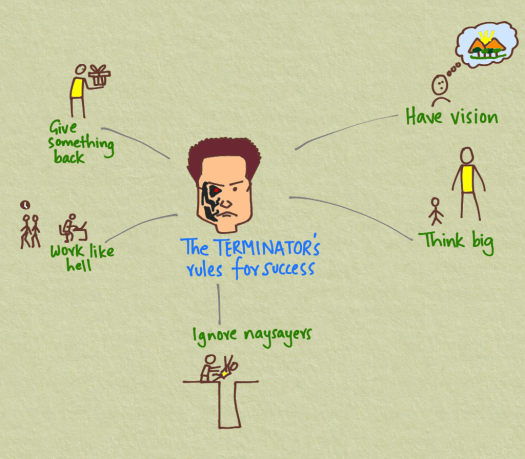
Arnold Schwarzenegger, bodybuilder, actor and Governer talks about success in this video, where he sets out five rules to follow.

Schwarzenegger is inseparable from his role as the Terminator, a cybernetic android assassin, which made his career as an actor.

In the video, Schwarzenegger talks about how all the things that would seem to be barriers to success, the characteristics that would appear to be disadvantages, actually turned out to be unique and distinctive features of his performance and character.

For example, growing up in post-war Austria, he had a vision, a dream to be a bodybuilder – and he worked on making that dream a reality every day.

That was a very specific dream, and one that required a precise and focused set of activities to make happen, but the principle can be applied to any endeavour, whether our dream is to be a chef or a computer programmer.

The next rule was to think big. He didn’t want to just be a body builder – he wanted to be the best in the world. He didn’t want to just be an actor, he wanted to go to Hollywood and be a star.

All too often, we compromise – we settle for less because we don’t believe we can get what we want.

And the fact is that for every Schwarzenegger that made it, there are countless bodybuilders who didn’t get there as well.

In today’s economy, however, compromise seems to be a bad strategy. Winners take all in a network economy, and the people and organisations that succeed are the ones that refuse to compromise themselves.

Which leads to the third rule – ignore naysayers.

There will always be people who will delight in pointing out all the ways in which we can fail, perhaps some that will even give us a little push into the abyss.

We need to seek out a network that has similar goals and aspirations, that is supportive of what we are doing and can help us get on, rather than give up.

And we need that drive and support to keep going. The fourth rule is to work like hell.

Many people work during work time, and then stop. The people that go further are the ones that work longer and harder and better.

There is billable time and non-billable time. Often, what makes it possible to have billable time is everything we do during non-billable time – the extra effort to create and meet people and build capability.

The final rule Schwarzenegger has is to give something back.

A responsibility, a duty many successful people have is to give back to the society and world that has helped them succeed.

Many successful people are portrayed as greedy rentiers.

The thing is that it is likely that more people became successful by being good at what they did, giving more value than they took and building long lasting successful partnerships with others than by stealing or swindling their way to the top.

These people give back – because they got what they had in the first place by giving more than they took.

It’s easy to assume that a character like the Terminator has little of value to say to us.

That would be a mistake – because he does keep coming back.

How to tell whether you act like a startup or a big business

startup-vs-corporate.png

What is the difference between a startup and an established business? Is a startup simply a small company – a small version of a big company or are they fundamentally different?

Steve Blank thinks so.

Steve is the author of Four steps to the epiphany and writes extensively about startups, their characteristics and the strategies they follow.

Among these characteristics are three crucial ones – and successful startups do these very differently from big companies.

The first characteristic has to do with what they do.

Big companies are good at execution.

They create a vision, agree a mission, set goals and targets, allocate resources and set the machine in motion.

All the parts of the company work in a hierarchy, following what they are programmed to do to head towards the targets they have set.

A startup, on the other hand, searches for opportunities.

It has its eyes wide open, scanning the environment for signs that something is missing, someplace where it can add value through innovating, adapting and creating something new and different.

The second characteristic has to do with how companies do what they do.

The purpose of a company, according to Drucker, is to create a customer.

Big companies already have customers or believe they know what a customer wants – either because they know the market or because they have done studies of some kind.

This means that they can sit at their desks and get on with creating product following their usual process, which is some form of plan-do.

A plan-do approach means that we follow a structured approach to developing a product – starting with understanding requirements, gathering information, developing the product and finally shipping it to customers.

Startups recognise that no plan survives first contact with the enemy.

Instead, they follow a test-learn approach.

This means getting out of the building, going and finding potential customers and talking to them about what they need and testing whether what they say they need matches what our product does.

This matching exercise – sometimes called validation – tells us if we are on the right track or whether we need to change something.

As Gary Halbert wrote, what we need to succeed is a starving crowd – a group of people that are desperate, starving for a particular product or service.

Lastly, the two approach who they recruit differently.

Big companies have lots of roles that they fill with specialists.

A specialist is someone who is good at one thing – sales, marketing, operations.

They do what they do well and competently, but they often don’t have the capacity or ability to do more than they can with their two hands.

Startups need generalists, people comfortable with doing everything and with the ability to do much much more with very little.

Startups eventually want to become big companies, so will recruit specialists, but only later on when the product is more mature and its time to scale up.

In summary, the way to tell whether we act like a startup or an established corporate is to look hard at what we do, how we do it and who we recruit.

Why we need to have a story

narrative.png

Stories are how we make sense of things.

Whether we are coming up with a personal narrative or working on a company brand, we use stories to show and tell other people what we are all about.

Sequence is key to a story.

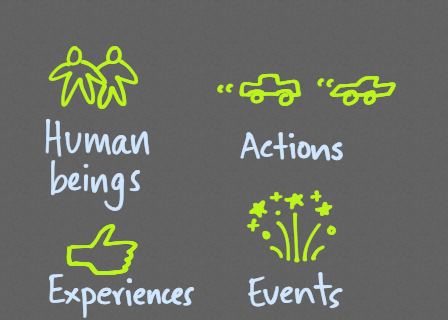
We link together human beings, actions, events and experiences to create a narrative that has a beginning, a middle and an end.

This is something we do all the time. To some extent, we don’t remember the past so much as recreate it through the lens of story.

We pick the events, actions and experiences that support and confirm what we want to believe, welding them together and trying out story arcs until we find one that fits.

Herminia Ibarra, in her book Working Identity: Unconventional strategies for reinventing your career, writes about this as putting a frame around experience – looking at what is happening now and what happened in the past and linking the two through story.

But it’s important to recognise that the things happening now and the things in the past are both being interpreted and reinterpreted – history is written by the victors.

I’ve written here about the kinds of stories we tell, and how we can structure success and failure stories.

Why is it important to have a story – whether personal or for a business?

Ibarra writes that it is only through a story that we can really get to know someone.

The story – the narrative – gives unity, purpose and meaning to their lives.

Whether we are trying to understand ourselves, someone else or an organisation, the stories we hear and tell bring things alive and create a sense of connection that it’s impossible to get in any other way.

Stories also help us step back and see the bigger picture.

As we tell and retell them, picking out events and experiences to recite, we start to create a narrative that seems more real and robust over time, until the story we tell is how it happened.

Which is why the reaction to many a fantastical story is often “Is it true?”.

Things happen.

When we’re in the middle of things, we look for a defining moment, a period where everything becomes clear and comes into focus.

All too often, however, we recreate that moment as we look back at the past and realize that it was one – the turning point of the story we are telling – and how it fits into our lives so far.

And so, to explain who and what we are, we need to have a story.