
Reading maketh a full man; conference a ready man; and writing an exact man. – Francis Bacon
Introduction
Do we still need to write in a world where machines can pump out pages of text in a few minutes?
I think so. And for one simple reason. For survival.
Prehistoric people didn’t have gyms because daily life was hard work that exercised their muscles.
We exercise to keep ourselves fit in a world that no longer requires us to lift heavy things or work hard for food. As a result, our muscles atrophy unless we put in extra work.
The same thing could happen to our brains if we delegate the work of thinking. But while we have machines to do the physical labour for us – do you really want to have to spend your days in the equivalent of a mental gym to stay occupied?
Writing work is thinking work. It takes effort to figure out what you know and explain that to someone else. It’s also hard to keep a reader’s interest. Every sentence needs to add value.
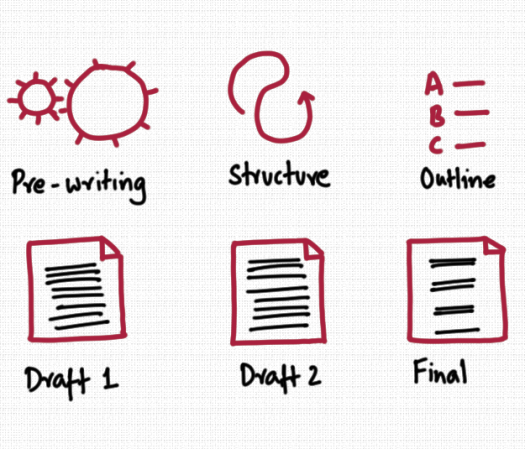
And that requires a process. One that lets you build a piece in a systematic way. This is the process that I’m trying out.
Start with Prewriting
I tend to leap straight into writing and that’s not a good thing.
The first few paragraphs of any writing are like getting rusty machinery moving. You need to oil the parts, complain about how rubbish everything is, and get the gears moving.
A good place to start is with freewriting – in a document that no one will see where you can drop in whatever is on your mind.
No one wants to read about writer angst. But it needs to get out of you to get your brain and fingers moving. So write it, and then move on. This isn’t going to be published.
Draw a Structure
The next practice I’ve found useful is to draw a diagram. Something that expresses what I’m trying to get across.
This blog is full of such diagrams. Making them helps me get a sense of what I’m trying to get across. Is it a process, a feeling, an observation, a structure?
There’s something that I’m trying to capture with a piece of writing – and drawing helps me unlock that before I try and get the words out.
Make an Outline
I know that outlining is a good thing but I’ve struggled with it all my life.
I think I’m the kind of person that has to go into the detail, struggle with the mess, before trying to frame it in some way.
I was in Copenhagen the other day and the person I was with marvelled at how the buildings were made without any scaffolding.
That wasn’t true, of course. Scaffolding has been used since prehistoric times. You can’t build a building without planning, diagrams and scaffolding. But at the end, you take everything away, and you’re left just with the finished structure.
An outline is just scaffolding for writing. It helps you stay on track and it makes it easier for the reader because it gives your piece structure.
I find it easier to keep the outline text at heading level, rather than trying to go deep into sections. It’s hard to get into a writing flow if you’re constantly interrupted by reminders.
Write the First Draft
Then it’s time for the first draft.
I go down the outline, and start to create sentences.
The point at this stage is to get words down – to create a messy first draft. No stopping, no going back, just moving forward and laying down words.
Write the Second Draft
The second draft is about editing.
Remove the scaffolding and read and edit each phrase and line.
Choose better words, polish paragraphs and sentences, make the sentences active.
See the shape of the piece. Add headlines, connect sentences.
Make the piece easy to skim read.
Write the Final Draft
And then we’re on to the final stretch.
Look at the piece from a reader’s point of view.
Is it easy to read? Does it flow? Does the order of ideas make sense?
Move sentences around. Move paragraphs up and down. The easier it is to follow, and the more sentences logically and naturally transition from one point to the next, the more useful it will be to a reader.
And readers only stick around if what they’re reading is useful.
Publish
And then it’s time to press the publish button and send your work into the world.
This is an ideal writing workflow – and not one that’s worth using for every piece of writing.
A quick blog or social media post doesn’t need all this work.
But longer pieces deserve it – because writing them is as much about you as it is about the reader.
It’s the ability to work through an piece from start to finish that makes you still relevant in a machine age.
 Handcrafted insight