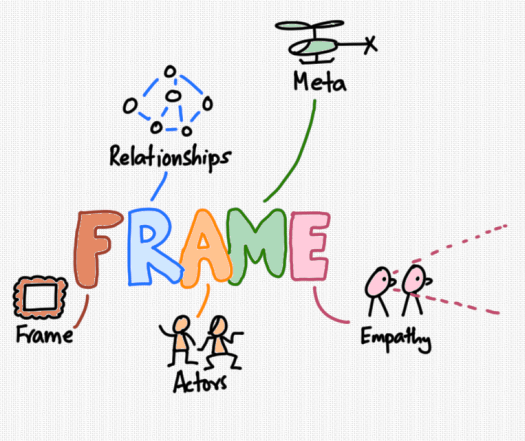
The FRAME Model As A Thinking Tool

frame-model.png

Tuesday, 8.04pm

Sheffield, U.K.

I tend to approach things from a physics framework. And physics teaches you to reason from first principles rather than by analogy. – Elon Musk

How do you make something useful – something relevant – something that’s so interesting it grips your reader or customer and draws them in irresistibly?

You do that by understanding them inside out – by learning and discovering exactly what they want and need and then giving them that. But how do you go about doing that? The FRAME model may help.

There are five elements, one for each letter of the word. You can start anywhere, but you need to have all of these in place to make progress.

Start by thinking about your Frame. Work out what’s in and out, what matters and what doesn’t. The tighter the frame around what you’re interested in the more focused you’re going to be – and the easier it will be to figure out what you need to do. Sometimes you can make the frame too small, and you don’t see enough of the picture. Getting the balance right is key. Think of it like taking a picture of your family – you need enough background to know where you are and what the context is but you need to be tight enough to see them in enough detail. There’s an art to framing – and that’s why it’s important.

The next two elements go together and that’s Actors and Relationships. Actors can be human or not – you might have a person in a role, a robot carrying out a function or an algorithm processing a data set. Actors do something – they play a part in the frame you’ve created. The way they interact with other Actors is shown by drawing the Relationships between them. These connections are what make things happen.

The next element is Meta – the helicopter view. Take a ride up and look down at the frame you’ve drawn, the actors you’ve placed in that frame and the relationships between them. Have you included everything you need to include? Is the level of detail right? Can you see the main features – the natural ones and the artificial ones? The Meta element is about seeing the big picture – knowing why the terrain below is set out the way it is.

The last element is Empathy. See your creation through the eyes of your user or customer – one of the human actors that’s living in your frame. You’re building this thing for them, so what do they experience, what do they go through and does it work for them? Does it deliver for them? Does it delight them? Does it delight you as you see the world you’ve created through their eyes?

Does this model work in practice? Apply it to a company you know – something like Amazon? Amazon does retail – it helps “consumers find, discover and buy anything”. It’s build a formidable logistics network, with a group of human and non-human actors bonded together with relationships in a remarkable display of engineering. If you take a helicopter view they’ve spread out across the landscape doing things ranging from technology to warehousing. And in the middle of all that they aim to be the “Earth’s most customer centric company” – they empathise with their customer’s need to get what they want, fast. And they deliver on that.

Is this model complete? No – it can’t be. Real life is too complex and we can’t capture everything. Is it useful? Try it for yourself and see.

Cheers,

Karthik Suresh
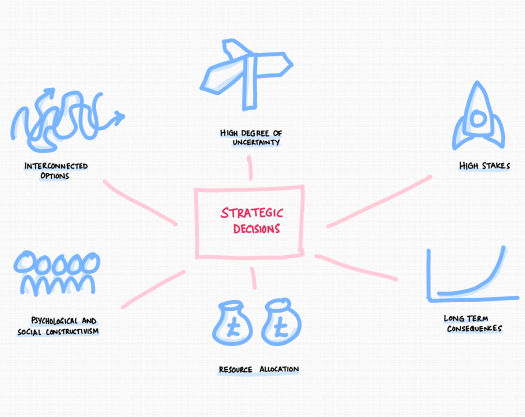
How Strategic Decisions Are Made

strategic-decision-characteristics.png

Wednesday, 7.47pm

Sheffield, U.K.

Control is the source of strategic power. – Noam Chomsky

Some decisions are strategic ones – the kind of decision where you don’t know what’s going to happen but it’s important you make the right choice.

Decisions like whether to go to university or straight into work, to let your kids choose what they study or encourage them to do a safe role, to stick it out at your job or start your own business. Strategic decisions are hard so it’s worth knowing what they look like [1] when they appear in front of you.

Strategic decisions have a high degree of uncertainty. You have to pick a road without knowing whether you’ll reach your destination or be lost on the way. You won’t know whether you’ve chosen wisely until you reach the end.

Strategic decisions have high stakes. The choice to stay at home and find a job with a local company rather than moving to the metropolis could mean the difference between being a CEO or staying in middle management.

Strategic decisions have long-term consequences. Money in the bank, health in your body, happiness in your heart – do you have them, are they compounding over time or are your balances declining or even negative?

Strategic decisions involve interconnected options. A decision may depend on another one which in turn depends on the first. Should you pick a school in one location or wait to see if your offer goes through in another? Do you quit and then look for a job or do you accept one and then leave the first? You may be unable to do anything until something resolves itself.

Strategic decisions involve resource allocation. You have to invest time and money into doing one thing or another or both or neither. Whatever decision you make there are opportunity costs – you will have to give up the chance to do something else.

Strategic decisions involve people who come together to talk about a situation and come to a negotiated agreement on the way to go forward. This is hard to do. Psychological and social constructivism is the idea that we create the culture we live in – finding meaning and creating things that reinforce and support the way things are done where we are.

Decisions we make on our own are difficult but not often strategic. Deciding your daily routine or what time you get up are important decisions – but they’re easy to make. You just need to have a chat with yourself and decide what you want to do. Strategic decisions involve other people and that’s where it gets complicated. You need to be able to work with others to get things done.

As the old proverb goes, if you want to go fast, go alone. If you want to go far, go together.

References

  1. Montibeller, G. and Franco, A. (2010). “Multi-criteria decision analysis for strategic decision making”, Handbook of multicriteria analysis.

How To Discuss A Difference Of Opinion With Another Professional

knowledge-arguments.png

Tuesday, 7.43pm

Sheffield, U.K.

The purpose of anthropology is to make the world safe for human differences. – Ruth Benedict

At a meeting a few years ago a speaker described how a particular software development method, Agile, did not work. It was meaningless, a collection of rituals and there was no evidence that it improved the process of software development. An audience member challenged this statement, saying that the approach the speaker had presented, a customer centered way of delivering high-quality services was in fact the Agile way – others must simply be doing it wrong. This little vignette is played out daily in different fields and with different professionals as they try to figure out who is right or wrong, which is better or worse. Why does this happen and is there anything we can do to improve the situation?

The place to start is by redefining what we think of as “knowledge”. There’s only a small portion of knowledge that’s objectively true for everyone – and it’s limited to the natural sciences. Physics works the same way for you and me. The further you get from physics the less certainty you have about whatever you’re looking at. At the other extreme is religion – a belief in something that has no existence that we can confirm. People who believe in a religion instead have a set of ideas they hold, usually written down in a book. “Knowledge”, to them, is what’s in the book.

As we head from religion to the day-to-day work that we do we see the pattern of belief playing out again. A group of professionals or practitioners will point to a collection of books, a canon, that contain the set of ideas they consider as authoritative [1]. You have to know what’s in these books to be knowledgeable in that field. And the professionalisation of a field is done by centering its practice on a set of books – a “distinct knowledge base” [2].

This means you cannot have a discussion with someone else unless you acknowledge that what they think of as true is what’s in their books. You can’t come up with a new book and say, “Look here, this tells you why you’re wrong.” They’ll just point to their book and say, “No I’m not, and this is why.”

A wholesale shift from one point of view to another, then, is like asking someone of one religion to change to another. It’s not an easy thing to do. Evangelism is a full-time job for some.

Since we’re not talking about religion, however, but about professional practice there is a little more hope that better methods will carry the day. If you can show something is better then people will often listen.

In fact people are asking for “applications papers” [3]. What they want is information about ways that work, ways that are based on careful observation and underpinned by good-quality models and rigorous thinking.

But if you come up with a way that works how do you approach a group that thinks in a certain way? How do you make your case?

This is where you need to watch Larry McEnerney from the University of Chicago who talks about the way in which you enter a group and make your case. You have to first know the field, read their books and understand the way they see knowledge. Then you can say something like, “There’s a lot of good stuff here and I’m really impressed with the work. But have you thought about this one point here?” When you write in that way then people will listen, because you flatter them and then suggest something that they should consider. That’s the simple secret of getting new ideas into an existing group.

But of course you need to decide whether it’s worth the effort. Not all groups are worth entering. You can waste a lot of time learning stuff that is just wrong. But if you’re a professional you’re probably not in that kind of situation. You probably want to do better work. And that means balancing your approach – knowing your stuff from your books but being open to learning new things from your practice and also from other fields.

The takeaway is this. Before you argue with anyone take the time to read the books that have put their ideas in their heads. If you can’t be bothered to do that then just walk away.

Cheers,

Karthik Suresh

References

  1. Bazerman, C. (2012), “The orders of documents, the orders of activity, and the orders of information”, Archival Science.
  2. McLeod, J (1999), “Practitioner Research in Counselling”, Sage publications.
  3. Miser, H.J (1998), “The easy chair: What kinds of papers will contribute to a well-rounded view of the conditions and craft of OR/MS practice?”, Interfaces.

The Confusing Art Of Just Getting Along

mountain-river.png

Monday, 6.26pm

Sheffield, U.K.

Today’s tactical victory does not guarantee tomorrow’s strategic success. – Peter Pace

The return of the Taliban in Afghanistan in a matter of days following the withdrawal of American and Allied forces has led to interesting headlines. Some commentators, mostly right wing, suggest that the reason the Taliban prevailed is because they believed in something – values that sound conservative mostly, a religious conviction, absolute morality and so on. The tenor of the articles seems to suggest that if only the West was more like the Taliban it would have won the war in Afghanistan.

I’m not sure it’s worth linking to these articles because the point they’re making is not important. It’s the kind of point they’re making that we need to notice. It’s a simplistic narrative that you have no hope of changing – any evidence to the contrary will get them to dig their heels in.

The important point is this. It’s natural to feel threatened by others, to band together in your tribe and create a safe space for yourself. If possible it’s better to dominate others, to control more, to have more – because that shows you’re better. We know this is natural because we see it happening when we watch any nature show – tribes and territory are what matter. The creature with the most is the best – the apex predator.

Conservative viewpoints simply harness that natural urge – genetically etched into our animal brains. That’s the way we would be if we had been born a few million years ago. It’s the way we’re made.

An evolutionary way of thinking is one that is able to recognise that we share a planet with others, people with different beliefs and ideas and aspirations – and that’s ok. We can work out a way to live together. Terry Pratchett puts this well in his many books – as fantastic races of all kinds live and work alongside each other – doing business together. You get on with your work and don’t cause trouble – that’s all others ask for.

This kind of thinking is hard to do. Getting along with people who are not like you takes effort. You have to first overcome your innate suspicion of the strange and new. Then you have to fight against the resentment that comes from thinking that the new people are taking what should be yours. Then you have to learn to trust and work with and deal with others. All this takes time, generations in some cases. Democracy is not just about having a vote. Democracies exist because of the institutions that have been created over hundreds of years. Democratic countries now don’t know how lucky they are to have those institutions in place – they should watch and learn from how newer democracies struggle to maintain themselves.

Taking the liberal approach and getting on with everyone is the human way to act – and that’s why it’s difficult. We fall back on our animal instincts with ease. We have to remind ourselves to behave like good human beings.

What does this have to do with the war? The fact is that the United States can win any war in any location in the world. What they can’t do, what no army can do, is win the peace in a country without creating the conditions for liberal thinking – teaching people that’s it’s better to get along and do business together than to keep fighting.

And if you live somewhere where you can just get on and do that – you shouldn’t take it for granted. It’s a gift worth having.

Cheers,

Karthik Suresh