What Role Do You Play In Your Organisation?

waves.png

In the military, as in any organization, giving the order might be the easiest part. Execution is the real game. – Russel Honore

Every once in a while you look around and wonder what people do at work.

One answer is found in Robert X. Cringley’s 1993 book Accidental empires.

In his book he talks about the way companies grow – and likens what happens to a military operation.

As an army brat I grew up conscious of uniforms and rank; packing light and always being ready; and learning that I didn’t like being told what to do by anyone else.

There’s a place in an organisation, however, for almost any kind of individual – whether you fit in or not depends on what stage of growth the company is in.

In a startup, for example, you’re low on resources.

You don’t walk into a startup and get an induction and a tour and a few days briefing.

When you’re employee number one or number two into a startup you probably spend the first day building your computer.

I did anyway – I think I worked off my own machine for a while, actually.

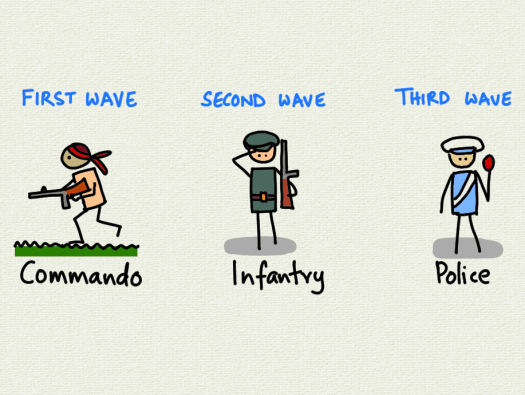
The point is that the people you want on your team in the early days are the ones that think and act like commandos.

If you want to invade a country you don’t stroll up with your army.

You send in commandos first – so they can blow up roads and supply lines and generally soften the target before you commit your main forces.

The job of a startup is to take the beach – establish a presence in a market.

That means nothing matters except customers and product.

All the rest of the stuff can wait – policies, HR, timesheets, legals. None of those matter until you have a product or service and customers ready to try you out.

When you’ve established your presence, that’s when you send in the infantry.

These folk get into their trucks and tanks and roll up.

Yes, they’ve got to do some work. They’re the main force and they take over the job of securing and expanding your presence, fighting their way through the rest of the country.

That’s the scale up stage of your startup – when you go part the three or four people who were there from the start and bring in people to do jobs – jobs that didn’t exist till you created them.

Now, once you’ve taken control of your territory you need to get settled for the long haul.

This is when you need the administrators and the police – the rules and regulations that make for a society.

That’s the point in the life of the company where you bring in people who write policies and administer them. The ones who make rules and make sure you all follow.

This is when it becomes important to monitor and measure and watch over what your people are doing.

Customers are a lot less important now – what’s important is control and process and standards.

The first stage is exciting and you get a chance to be creative – but there’s also a very real chance you’ll fail – but also a chance you’ll do very well.

The last stage is safe and you’ll have a good career – perhaps end up being a well-regarded professional.

The middle is a solid place to be – good experience that you can take to any other company looking to scale up and build its business.

The important thing really is figuring out which one of these three types of workers you are – and then checking if you’re in the right kind of company.

If you’re a commando, you won’t last long in a third-wave company – they just wont know what to do with you and your habit of not following the rules.

And, a police officer in a first wave company will have nothing to do – everything will need policing because it’s all being done too fast and doesn’t follow the rules – but no one will stop long enough to listen.

But what’s important is knowing what’s right for you.

Cheers,

Karthik Suresh
Why You Need To Know The Stages Of Motivational Readiness For Change

stages-of-change.png

The world as we have created it is a process of our thinking. It cannot be changed without changing our thinking. – Albert Einstein

The writer and podcaster Tim Ferriss came up with a soundbite that he found resonated again and again with audiences.

“The major fears of modern man”, he said, “could be boiled down to two things: too much email and getting fat.”

I don’t know about you, but I have any number of excuses for why I can’t exercise right now or tomorrow or every day.

And many of us have experienced the oscillations of diets and impulse eating and in general just how hard it is to get and stay healthy.

But this challenge is the same in many other fields as well.

It’s hard to create and sustain a healthy sales process, an operations process or a commitment to creating research output or content.

Now, when we look at problems we often come at them in one of two ways.

We think of solutions – ways to solve problems.

Or we think of them as investigations – looking to understand and explain what is happening and, in doing so, improving the situation.

But, even if you know using these processes or others what needs to be done – what stops us or our clients from implementing them?

For example, if you know and your clients know that they should have a social media marketing strategy – then why don’t they just go ahead and do it?

Are they lazy? Uninformed? Lacking in vision? Unable to grasp the nettle? Reach for the stars?

Cliches leap to mind when we think of others and how they fail to do the bleeding obvious.

The situation is more nuanced when it comes to ourselves, of course.

So, in such situations the stages of motivational readiness for change model by Prochaska and DiClemente (1983) might be a useful one.

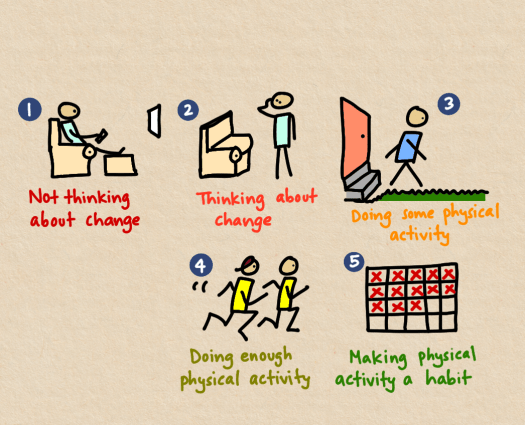
The model, as shown in the picture above adapted to the problem of physical activity has five stages.

In the first stage you’re just not thinking about being active – it’s home from work and feet up in front of the telly.

In the second stage you’re aware of your expanding belly and wondering what you might do about it.

In the next stage you take some tentative steps – walking more, perhaps. Going for a run.

In the fourth stage you’re doing enough activity and you have been doing it for some time – perhaps exercising three times a week for the last six months.

In the last stage you’ve made it a habit – you exercise regularly and have arranged your life so that it’s something you do as part of your daily routine.

There are a few things worth noting about this model.

The first is that if you skip stages you are more likely to fail.

For example, if you are in stage 2, thinking about change and jump straight to going to the gym three times a week, the effort required and the increased chances of injury are quite likely to stop you when something goes wrong.

And when that happens you don’t go back a stage, but perhaps all the way back to the very beginning – when you stop thinking about change at all.

The second is that wherever you are in this model, you could always slide back – it’s sometimes seen as a cyclical model for that reason, as you fall back a stage and then clamber forwards again.

If you do social media marketing the similarity with a client’s journey is probably obvious.

A tool making company’s crusty old founder thinks that this whole social media thing is complete nonsense.

The next generation are more digitally savvy and trying to see what they can do.

If they move too quickly the founder will rein things in – so that have to start with a little activity.

Then, as comfort with the process grows they ramp up until they’re doing enough to keep up with the competition.

And finally, they reach digital maturity – become digitally native and thrive.

Or slide back and go out of business.

Each one’s mileage varies.

So, if you recognise that you’re in one of these stages what can you do to move forward?

Here are a few suggestions.

First, start with small changes and work up to bigger ones. Try and do things that result in success – remember that nothing succeeds like success and that works for this too.

Second, make choices that work for you and not because you think they are the right ones to do.

Don’t go running because your friends do – when you would rather lift weights or jump rope.

Pick things that work for your body and environment.

Third, assume you will fail and work out what you will do when that happens.

If you planned to go for a walk, for example, and the heavens open – what are you going to do?

Watch telly or do some yoga?

It’s important to decide ahead of time what you’ll do when things don’t work out because you’ll probably do the easiest, most pleasurable thing – like flopping on the sofa and watching telly.

The main point of this model is that even if you know what you should do – it’s really hard to get yourself motivated to do it.

The key is making it easier for you to create, grow and sustain a habit – whether it’s do with exercise or the way you run your business.

And it all starts with being more aware of which stage you’re in right now.

Cheers,

Karthik Suresh

The Difference Between Hard And Soft Systems Thinking

hard-soft.png

Wednesday, 9.02pm

Sheffield, U.K.

Remember, always, that everything you know, and everything everyone knows, is only a model. Get your model out there where it can be viewed. Invite others to challenge your assumptions and add their own. – Donella H. Meadows

It is worth asking, every once in a while, where the ideas and opinions we have come from.

Take the word system, for example.

It’s a word that is used all the time in all kinds of situations.

We think of collections of things as systems – like computer systems and gaming systems.

We think of big, complex things as systems such as the justice system, the economic system or the financial system.

And thinking of things in this way causes us to come to a very simple, and very wrong conclusion.

We think of systems as being “real” – as existing for real in the outside world.

As real as flowers and ponies and tigers.

But, the thing is that the “system” only exists in your mind and in the minds of the people that you’ve shared your idea of the system with – or vice versa.

So, why is this important?

Many approaches over the last century have focused on our ability to create things that we call systems – and human beings have been very successful at making lots of cool things as a result.

People have made railways and rockets and medicine that actually works.

Now, having used such a way of thinking very successfully in certain situations – we often make the assumption that it will work equally well in any situation.

Which is why you get technical people who believe that they can build a solution to any problem because they have built a solution to a particular problem.

It’s an engineering mindset – and one that sits behind a number of approaches to problem solving – including AI and machine learning.

But history is also littered with failures of an engineering approach – what might be called a ‘hard’ approach to deal with problems that are not in its natural domain.

Problems that involve issues of politics and culture and belief, for instance.

Problems where it’s possible to prove that you can’t prove everything which, if you believe Godel, is the case with any system of logic.

So if you find you’re in a situation where you can’t “engineer” a solution – like how to deal with a problem like Brexit, or what to do about an ageing problem – you have a couple of choices.

The first is to plough ahead with a technical solution anyway – create a committee, set up a negotiating team, create backup plans and so on.

In others words – put systems in place.

Or you could look at the problem for what it is – complex and complicated or even, as Peter Checkland writes, mysterious.

The picture above is adapted from Checkland’s drawing of the hard and soft system approaches – and the basic thing to take away is that when a problem is complex what you can do is be systemic in the way you think rather than trying to make the world systemic.

This is a hard thing to wrap your head around, so let’s try an example.

If you are a manager and have an employee who is not performing what are you going to do?

Speak to HR? Fire the person? Go through a disciplinary process?

You’ve probably got a system – one that’s written out in the manual, one that can be defended if you have to go to court.

This rarely ends well for either party.

This system is also what makes it hard for women with young children to fully participate in work, for people who would like flexible work to get enough and for people to make the most of their talents.

You could argue that the system is broken.

Or you could realise that you just don’t know enough yet.

You don’t know enough about the employee – and why they are not performing.

You don’t know enough about yourself – the way you’re training, coaching and supporting your staff.

What you know is that you have a system and by gosh you’re going to follow it.

A soft approach is not a weak one – just one that realises that real world problems are almost always more complex than you realise.

How scary is the thought that you might need to actually sit down and listen and engage with the employee to understand what’s holding them back and how you can help them?

The thing about such an approach is not that you will get a result – but that you will, in the end, know you’ve done the right thing.

Not just done things right – the way the system tells you to do things.

But done the right thing for the situation you’re faced with right now.

Cheers,

Karthik Suresh

What Kind Of Prison Are You Keeping Yourself In?

escape-prison.png

Tuesday, 9.01pm

Sheffield, U.K.

I am a poor mendicant. My earthly possessions consist of six spinning wheels, prison dishes, a can of goat’s milk, six homespun loincloths and towels and my reputation, which cannot be worth much. – Mahatma Gandhi

Have you ever wondered how you would pass the time if you were in prison?

Not because you’ve done something wrong and been punished by the state – but because you have done something that you believe in.

Like the people we see in stories in other parts of the world – stories about people protesting for freedom, protesting against their politicians, falling foul of a state, or perhaps as a consequence of conflict – as a prisoner of war.

The point really is not why you’re in prison, but what you’re going to do once you’re there.

This arresting TEDx talk by Captain Charlie Plumb is about the 6 years he spent in captivity in Vietnam.

Six years where he paced three steps up and three steps down – the 8-foot length and width of his prison cell.

If you were in prison, perhaps having books or even pen and paper might make it more bearable.

Surely you could at least be with your own thoughts?

Charlie Plumb didn’t have those.

Neither did Jakow Trachtenberg – who was imprisoned in a Nazi concentration camp – where he came up with his system of mental mathematics to keep himself occupied.

So, how did Plumb make it through the six years he was there – what lessons does he have for the rest of us?

The starting point, he says, is that a prison eight feet long is bigger than the prison 8 inches wide that many people keep between their ears.

Whether you’re trapped in a situation you don’t know how to get out of, or are unsure about what to do next – the things holding you back can often be found in just one place.

You can do three things to escape, Plumb says.

The first thing is to pack a parachute – to be ready physically, mentally, spiritually for what may come.

Prison is a scary place – and yet people throughout history have overcome that fear to make their point.

Gandhi, for example, ate from metal prison dishes even after he was released to show that he was always ready to go back to prison in the service of his cause.

Plumb, as a military officer, had been trained for what he might face – but that didn’t make it any easier.

But being packed must have helped.

The second thing you can do is drop an anchor.

That means having something to hold on to – memories of home, of people. Faith in a higher power.

Something more than yourself – a purpose that flows through you and helps you get through each day one at a time.

And the final thing, he says, is to tug on the wire.

The wire, in his story, is the way the prisoner in the next cell communicated with him.

They had a code they could use to pass messages by moving the wire – and suddenly he had the ability to talk to someone else.

But, at first, he nearly stayed away from the wire – away from something new and risky.

And the lesson there is that when you are given a chance to try something – take it.

Be open to experimenting, to learning, to finding out.

The chances are that we’ll never have to have the same kind of experience – we hope we never have to.

But, if you think about what you would do – you probably can’t help but get stronger inside.

Cheers,

Karthik Suresh

Are You Doing These Things To Develop Your Business?

reality-check.png

Monday, 8.22pm

Sheffield, U.K.

Good luck is when opportunity meets preparation, while bad luck is when lack of preparation meets reality. – Eliyahu Goldratt

If you go to work every day and focus on what needs to be done then pretty soon you’ll start to lose track of what’s going on outside – what’s happening in the real world out there.

Guy Kawasaki’s book Reality check: The irreverent guide to outsmarting, outmanaging and outmarketing your competition is a collection of lists, Q&As and short pieces covering topics from starting up and raising money to making work less unpleasant.

At the end he has a reality checklist with ten points, out of which I’ve selected six (maybe seven) that are worth asking yourself regularly.

1. Do you make meaning with what you do?

I suppose this is a little like asking what value you provide?

It can be a slightly off-putting question – we probably all agree that teachers, police officers, first-responders and firefighters add value to society.

Every profession, in its own way will argue that it adds value.

Loan sharks, for example, make the argument that they provide credit where no one else will.

But it would be nice if it were possible to do more than that.

If you’re unsure about whether you make meaning right now, just think about it a bit more.

Maybe you just need to discover it for yourself.

2. What curve are you on?

A lot of people start things by looking at the competition – what else is out there?

That’s the red ocean strategy – the one you don’t want to follow.

It’s where there’s lots of competition and the sea is red with creatures fighting each other.

Where you want to be is the blue ocean where there is space and no competition.

Okay, not always.

If you sell a commodity product, you want to be where everyone else is so that people can compare and choose quickly.

This is the world of Amazon and Ebay.

If you do something a little more involved, then you should think hard about where you are on the innovation curve, and whether you can make the leap to an entirely new curve.

3. What’s your mantra?

Kawasaki asks if you have a three-word statement that sums up what you do.

I suppose it doesn’t have to make perfect sense – that’s the point of having time to elaborate on things.

Right now, if I were to have a mantra it would probably be Soft Systems Methodology – a useful approach to understanding and dealing with problematic situations.

4. Can you pitch or demo clearly and quickly?

The saying used to be publish or perish in the academic world.

It’s similar with marketing – you have to create content to explain what you do – with articles and white papers and presentations.

You still need to be able to pitch an idea – explain what you do in a way that people understand.

But even better is showing what you do – it’s now a demo or die world.

You’ll get a lot more enthusiasm if you show people stuff than if you tell them about the cool stuff you can do.

If you haven’t got a demo as part of your marketing package – build one.

5. Can you go to market with no budget?

In The Knack: How street smart entrepreneurs learn to handle whatever comes up Norm Brodsky writes about the business lessons he learned from his father.

Sell with a big markup, he explained. Make sure you can collect from your customer. Be fair – don’t take advantage.

And then the important one – “There’s a million dollars under your shoe; you just have to find it.”

Too many people wait until everything is right before looking for customers.

Start now – because it will take you time and you will be glad you did later.

6. Don’t ask people to do stuff you wouldn’t do

This is the basic rule of management – ask people to do only useful work.

Too many owners and managers ask people to do work that doesn’t create value for a customer.

Keeping timesheets, sending in status updates, form filling, follow processes – we need to ask which of these help with the central task of filling customer demand.

If the customer doesn’t need it doing then don’t do it.

If you own the business and wouldn’t do it yourself if you had a few minutes spare – then is it really worth doing at all?

Look around every once in a while

The point of this list, according to Kawasaki, is to act as a reality check – important points that will get you on the right path.

Because, as he quotes from Indiana Jones, “If you want to be a good archaeologist, you’ve gotta get out of the library!”

Cheers,

Karthik Suresh

Why Do Cathedrals Have The Same Basic Plan In Most Places?

cathedral.png

Sunday, 9.00pm

Sheffield, U.K.

The bearing of a child takes nine months, no matter how many women are assigned – Fred Brooks, The Mythical Man-Month

I have finally gotten around to reading this collection of essays by Fred Brooks – not all of it but what I have read so far is already illuminating.

Take for example, how many people you really need to get a job done.

Say you have a project and you put one programmer on the job.

The task starts looking too big – so you look at adding a person to help.

This will make things go faster, no?

No.

The first thing that Brooks points out is that you can only share out tasks between people when the tasks can be done without the people communicating with each other.

Picking cotton, sorting beads, moving pallets – all these tasks can be done in less time by fewer people.

Supermarkets, for example, get every employee in a store – from the top manager to the entry level clerk – to rumble the place – get every item on the shelf pointing the right way.

But, if you are doing a knowledge based project then communication is essential and communication causes two main problems.

The first problem is one of training. Say you add a person to help your programmer – the first thing the programmer has to do is train the person – and if that takes a week you’re another week behind schedule.

So, never get your existing programmers to train others unless you’re happy to fall behind even more.

Then, when people start to work together the increased need for communication scales exponentially with the number of people.

The more of them you have to talk to the less work gets done.

But you have to work with people – you need teams to get things done.

Here, Brooks points out that big teams with managers don’t work well.

Instead you need small teams and not just that – you need teams organised like surgical teams where you have a surgeon who does the work, an co-surgeon who is learning or can take over and support staff.

The way you work on a big project is by having lots of these surgical teams.

But the way you get them to work in a way that gets you moving in the same direction is to be very clear on the overall architecture.

A cathedral, for example, is pretty much the same wherever go in Europe because of the general design that Jean d’Orbais came up with.

Generations of builders can add their unique approaches and flourishes but within the overarching and coherent design that guides the development.

That approach – having a clear and coherent “what” allows experts to go ahead with the “how” in creative and inventive ways.

Just these three concepts – be wary of adding people to a project, organise yourself like a surgical team and work within an over architecture – alone can transform the way you manage knowledge work.

It goes beyond programming – and can be used pretty much across service industries that rely on using skilled people to deliver a benefit to a customer – it can even help you design a better sales process.

Because the whole point is to create a better experience for your user – your customer.

Wouldn’t it be nice if they looked at what you’d done for them with even a fraction of the wonder they have when they enter a cathedral?

Cheers,

Karthik Suresh

What You Can Learn From A Theory Of International Relations

theory-paradigm.png

In the longer run and for wide-reaching issues, more creative solutions tend to come from imaginative interdisciplinary collaboration. – Robert J. Shiller

Every once in a while I look for books at random – picking up something just because its title looks interesting.

One such book that caught my eye is Thinking theory thoroughly: Coherent approaches to an incoherent world by James N. Rosenau and Mary Durfee – dedicated to “all those who are willing to acknowledge and probe the complexities of world affairs.”

That’s a good start, in my view.

What’s also nice about the book is that in the very first chapter we’re given a useful model for thinking about theory.

But before that, why should you think about theory at all?

Well, it turns out, in case you hadn’t noticed, that the world is complicated.

It’s full of people, groups, countries, institutions, societies, tribes…

So much detail that it’s hard to imagine being able to understand any of it.

But, we can’t just give up because something is complex – we ought to make the effort to make sense – try and find meaning (or the lack of it) in what’s going on.

Rosenau and Durfee suggest that there are two things we can do.

First we can be humble – remembering always that what we think could be wrong and be open to being corrected.

And second, we can use theory.

So, what is theory.

The model of theory in the book starts with asking what reality is.

Reality is clearly the best model there can be – it’s there in complete detail laid out in front of you.

The problem is that we can’t capture all of it – imagine trying to draw a life size map of the world.

So what you have to do is choose, picking out features of interest – trees, streams, animals, houses, roads, hills.

You select things because they seem significant – in effect you’re sorting and ordering information and that is when you start creating theory.

Now if you imagine a ladder grounded in reality, the minute you step on the first rung and look around – you’re no longer standing in reality.

You are now looking down, selecting features that you can see and that seem significant.

What people forget is that the set of selected features (let’s call it theory) is no longer the same as reality – what you’ve selected forms the basis of how you look at things but a different observer may pick different things and see the same reality differently.

In other words your theory is not the same as “truth” – it’s just one point of view.

Why this matters is that as you climb the ladder and continue to select and order features and start to create stories that make sense of what you’re seeing, the theory you create evolves and changes.

And that’s how religions are created.

One comes up with a theory about a god bringing the world into creation and another comes up with a theory of a big bang.

Different facts for different folks.

Now, at the very top of the ladder you’re quite some distance from reality and a platform emerges that floats in mid-air, suspended on theory alone.

This is a paradigm – a set of ideas that can explain everything that matters.

A person who is very religion and a person who is very scientific both stand on platforms that are paradigms.

They don’t agree with each other because, to each one, they look down on a world that makes perfect sense to them.

Now, the purpose of this post is not to reconcile science and religion, but to look at other situations where arguably it’s more important that we find an accommodation.

The debate between the use of renewable energy and low carbon energy, for example.

Some people argue that we should only invest in energy from renewable sources – wind, PV and so on.

Others argue that if our aim is to use forms of energy that emit less or no carbon, we should also look at gas and nuclear.

This makes choosing which party to vote for a difficult proposition.

We like the Greens, but if we live in an area where we have the skills to make the components needed by the nuclear industry should we vote for the party that promises new nuclear jobs?

Going back to the book – it’s about the use of theory in international relations – how to manage the relationships between countries that have differing ideologies, societies and economies.

For example it argues that one paradigm – the “Realist” one – is captured in this quote from Thucydides, “The strong do what they have the power to do, the weak accept what they have to accept.”

A variant of realism called neorealism explains how any superpower will act – its fundamental goal will be to prevent others from reducing the gap in their relative capabilities.

You just have to look at what’s happening in the world now to see this playing out.

A more hopeful variant is idealism – that thinks of humans as good and moral and looks to use education and reform to improve things, with the rare use of force.

The point, I suppose, of understanding this model of theory is that you can see that we’re all stood on ladders of one kind of the other.

What you do depends not just on what you believe but on what the others around you believe – because the way they act is going to be based on the theories they have.

The tactics of non-violence that worked with the British, for example, have been less successful with other nations.

In a nutshell – it’s important to know yourself.

But more important to know your friends and enemies.

Cheers,

Karthik Suresh

Why We Seem Incapable Of Fixing Things Before They Break

capability.gif

Friday, 7.01pm

Sheffield, U.K.

Our house is on fire. I am here to say, our house is on fire. […] Adults keep saying: “We owe it to the young people to give them hope.” But I don’t want your hope. I don’t want you to be hopeful. I want you to panic. I want you to feel the fear I feel every day. And then I want you to act. I want you to act as you would in a crisis. I want you to act as if our house is on fire. Because it is. – Greta Thunberg

One assumes that you are aware of the issue of climate change – and you are also aware of the news stories about how young people are asking for something to be done about it all.

It’s a reasonable question that they have, really. Why aren’t you doing more?

You older people, that is – the ones with the power and the money and the responsibility – the ones who can make things happen.

We older people…

Is it unwillingness or inability?

The thing is that the whole issue falls into a general class of problem to do with change.

Let’s say you’re driving a car and you see on the overhead signs that there is a lane closed ahead, at what point do you change lanes?

Few people pull over immediately – most carry on.

Some start to pull over as they see other cars doing so.

And some wait till they can see the lights flashing or the line of cones appearing that warns of the closure ahead.

And a few wait till the very end, coming to a complete halt at the end of the road before attempting to change lanes.

We’re just not wired, it seems, to fix things before they break.

So, I thought it might be interesting to ask why that’s the case – but it seems hard to find an answer.

One possible answer is in a paper called Nobody ever gets credit for fixing problems that never happened: Creating and sustaining process improvement by Nelson Repenning and John Sterman.

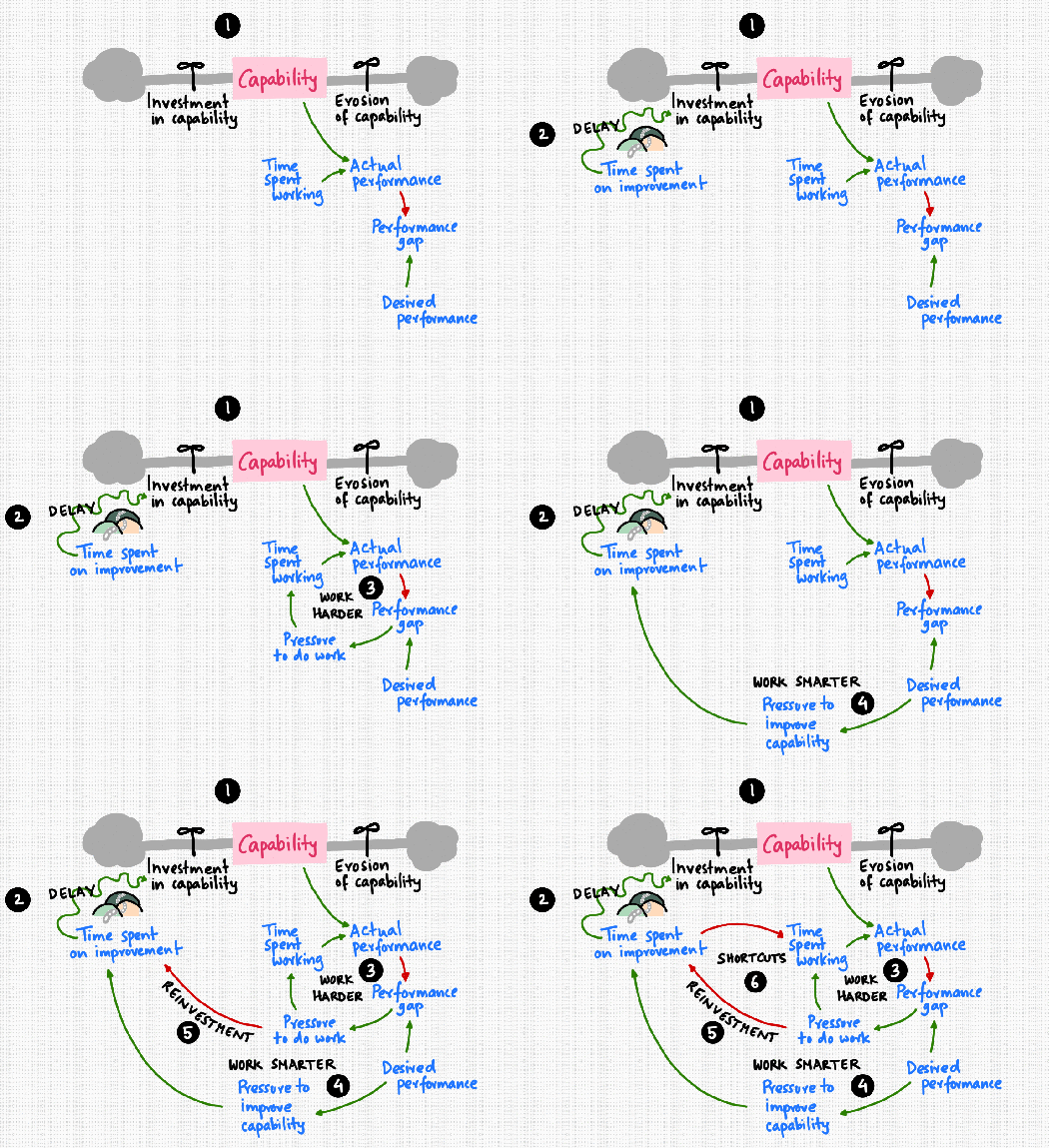
They use a systems dynamics model to explore what happens – and this is shown in the picture above.

In a systems model, then you can think through six steps.

1. Actual performance comes from capability and time

You can think of capability as a stock – a quantity that you can add to or lose by investing in it or simply allowing it to erode, for example by losing people through resignations or retirement.

How you do at anything you’re working on depends on two things – the capability you have and the time you spend.

The combination of these results in actual performance.

So then you can look at the performance gap – the gap between desired performance and actual performance.

A change in the desired performance widens the performance gap while a change in the actual performance can reduce it.

2. Spending time on improvement increases capability

The next obvious insight is that spending time looking at how you do things and trying to find ways to do them better increases your capability.

If you study your processes and do things with less materials, less energy or fewer people, you become more effective, more efficient and more capable.

But, it doesn’t happen at once – you first experience delays as you take the winding roads and wrong turns before you learn how to do things better.

This delay is quite important – we’ll come back to it later.

3. Improve performance by working harder

You can get a boost in performance by spending more time on the job.

If you work 40 hours a week, then work 50, or 60 or 200 hours a week.

Whatever it takes to get the job done.

Ah… there are only 168 hours in a week – so you’re going to max out at that limit.

Except, if you work 24 hours a day for two weeks you’re probably going to be unable to do much more work for a while.

So working harder boosts performance but often only in the short term – and you often sink below the original level as people and machines burn out.

4. Improve performance by working smarter

Working smarter means putting pressure on people to get better at what they do – to improve capability.

This means they have to spend more time on improvement work.

Which in turn improves capability – not immediately, but over time.

But people don’t like to wait or are uncomfortable with the idea that they might not get a result – or at least not the same kind of immediate result they get by just working harder.

5. The pressure to work harder takes time away from improvement work

When you ask people to work harder, they stop doing less important stuff – like maintenance and improvement.

In a sense they reinvest in doing less improvement – and so things start getting worse again.

6. Start taking shortcuts

At which point, people start taking shortcuts – hiding things, cutting corners or doing the minimum.

In effect they trade short term performance for long term maintenance.

But, as you’ve guessed by now, this also eventually causes problems as the shortcuts mean machines fail, documentation is non-existent and training gets cancelled.

The only way is to take the time

The only long term sustainable solution is to take the time to improve capability – and accept that there will be a delay before things improve.

If you start a business right now – accept that it could be three years before you invoice your first client.

Accept that if you start a sales and marketing program now it could be three years before your pipeline looks healthy.

And accept that if you want to reduce the amount of carbon you emit, it could be three years before you see a statistically significant reduction.

Or it could be longer.

The point is that just saying that we are going to reach a point of no-return in a year is not enough.

If that is the case, we’re going to have to learn to live with that new normal.

What we can do is start to work towards long-term change, by improving the way in which we live on the planet.

Because here’s the thing – the planet really doesn’t care whether you exist or not.

If you accept the Gaia hypothesis, the Earth will find a way to self-regulate itself – perhaps by creating conditions where humans cannot live.

Or, it could just stop being able to support life at all – become just another rock in space.

The fact is that humans have to act smarter – together.

Can we?

Cheers,

Karthik Suresh

What Do You Do When You Can’t Be “Scientific” In Your Approach?

pearl-model.png

Thursday, 8.29pm

Sheffield, U.K.

It is the recoverability criterion, that is the crucial one in action research. If we imagine a spectrum of knowledge acquisition from experimental natural science at one end to story telling at the other, then along that spectrum will be very different criteria for judging the truth-value of the claims made. Traditional scientific experiments would be at one end and at the other, the weaker criterion that this (research) story is plausible. However, action researchers have to do better than simply settling for plausibility – Peter Checkland and Sue Holwell

I have a stack of books that fall into the genre of what Shawn Coyne calls “narrative non-fiction” and I’m starting to wonder whether they’re worth reading at all.

The problem is telling the difference between stuff that is true and stuff that just sounds true – the essential issue with anything that falls outside the remit of your basic set of physical sciences.

If you want to learn how people tick and how economies work what you need is carefully controlled experiments – from which you can figure out How Things Really Work.

The scientific method has been so successful at explaining the world around us that it now feels like the only way to create knowledge.

Except, a lot of time, there is a horrendous amount of noise in the situation you are trying to understand.

For example, let’s say you’re a consultant trying to come up with a marketing plan for a large organisation.

At one extreme everything you need to know is catalogued and figured out to two decimal places.

The Neilsen Norman group, for example, have identified 85 factors that go into making an About Us page to help your users.

It sounds very scientific – looking at over a hundred sites and observing 70 users – collecting data for the research that resulted eventually in this set of insights.

They write, with no trace of irony, that “Organizations that stood out from the crowd in favorable ways used tactics that helped them appear authentic and transparent.”

In other words – do these things and you will be able to fake being real.

Now, the point is not to have a go at the research – there’s nothing duller than trying to rubbish someone else’s work – but to understand how reliable this kind of research might be.

It’s likely that if someone else replicated the research they would end up with a different set of factors – none of the 85 on the list are going to be on the same level as, say, gravity.

The best you can hope for is that if you sat down and wrote a piece of copy that incorporated all the features it would outperform whatever was there already or “average copy”, whatever that is.

In a nutshell – it’s really hard to come up with an objective and neutral way of looking at things that involve people.

Systems that involve people are just plain messy.

So, when you read books that tell you how to solve problems that involve dealing with people you need to approach them with some scepticism.

And that’s because most of them make arguments that are plausible – but not much more.

What does that mean?

It means that if you want to write this kind of narrative non-fiction book what you do is collect a load of research, sift through it to come up with a Big Idea, search for stories that illustrate what is happening and put them all together in an engaging, conversational, easy to read package.

When you read these things the tips and tricks and hacks sound good – and you’re keen to try them out.

I try these out just as much as anyone else does – from David Allen’s GTD to Morning Routines from Tim Ferriss.

But these tips, while entertaining, do not help us move towards sustainable improvements in complex situations.

For those we need something a little more rigorous, something like action research – a process where we get involved in the situation as a participant AND researcher aiming to generate knowledge which is, if not repeatable, at least recoverable.

What this means, going back to our marketing example, way back when, is that the thinking and steps we follow to do what we do should be capable of being looked at and critiqued by someone else.

Which is a scary thing to allow – and so we don’t. Usually.

But, if you wanted to, just because it was the right thing to do what should you keep track of in the first place?

In a paper by Donna Champion and Frank Stowell called Validating action research studies: PEArL, they suggest that we should record five crucial elements to help us think about what we’ve created.

In the marketing project example – we might start with the participants. Are we satisfying the whims of the business owner or are we responding to a crucial change in the market?

Who is engaging with the project? Is it seen as something that is a one-off or do you have a team within the company that is interested and eager to make a difference?

What is the authority structure within the firm – is there someone who can make decisions or is this a project that is being done with no hope of taking action at the end?

What do the relationships look like? Are they collegial or based on power dynamics and politics?

Finally, is real learning being generated – not wishy washy marketing vaporware but real, reflective thinking that looks at things warts and all?

And a handy mnemonic for remembering these is PEArL – where the small r represents the importance of the soft relationships that exist within the group.

The chance are that if you look at the vast majority of commercial projects through the PEArL lens you will find all kinds of nasties and unmentionables hidden away.

Because in most organisations day-to-day life is about face and power and hierarchy and order – not about truth.

That’s the thing that “scientific” types need to understand about the real world.

It’s about people.

Cheers,

Karthik Suresh

The Easiest Thing To Forget When Starting A New Project

scaffolding.gif

When one puts up a building one makes an elaborate scaffold to get everything into its proper place. But when one takes the scaffold down, the building must stand by itself with no trace of the means by which it was erected. That is how a musician should work. – Andres Segovia

Over the last couple of years I have drawn nearly 600 pictures, trying to find different ways to visualise and explore conceptual models.

There are some days when the models dominate – where the elements and relationships are the main things to get right and line and colour simply embellish the core message.

At other times it’s simply the visualisation of a metaphor – a literal depiction of what is going on.

Most of the time there isn’t much time to try and do detailed work – and that’s not really the point of the exercise anyway – As Dan Roam writes we’re aiming for communication, not art.

But every once in a while it’s refreshing to go back to the books and see how proper artists go about their work – and thing we need to remember is that nothing springs into existence perfect and fully formed but is instead built over time and in layers.

I thought I’d have a go at one of the exercises in Christopher Hart’s book Drawing on the funny side of the brain, which you can see in the animation above.

What also spurred me on was watching a few videos of artists using the software that I use to draw.

It’s called MyPaint and it’s only by watching someone else work, someone far more experienced than I am, that you pick up tips and tricks for making the most use of the tool.

It’s a similar situation with the software I use to create the articles I write – using groff to lay out the pages from marked up text.

The thing with these tools is that they’re becoming like favourite pencils and pens I once kept in a case (and still do).

The more I use them the better I get to know them – and they have their own quirks and peculiarities – but there is a sense of community and shared use that you don’t get with anything else.

For example, I use Microsoft reluctantly and with unease.

But, if you want to work with large companies – and they are the ones that benefit most from the kind of work I do – you need to be able to engage with their ecosystem.

Using those tools doesn’t give me the same sense of artistic freedom and shared history and community – I just feel resentful that it’s something I have to do.

That is perhaps the great illusion that underpins modern society – many people want to convince us that whatever they’re selling is perfect.

People who actually create things, however, know that the reality is much more complicated than that – they remember the twists and turns and wrong paths they took as they created something that was eventually useful.

The problem with thinking like a salesperson is that you think only of convincing someone to take what you’re offering.

Thinking like an artist involves starting with a blank page and creating something new – something that is created for one person – perhaps the artist themselves or for the person who will stand in front of the creation one day and take their own message from it.

The biggest mistake we make is when we try and jump to the end without going through the stages in between.

These are necessary – just as necessary as building up a drawing from simpler blocks.

Andrew Loomis in his book Fun with a pencil writes that “As you proceed to build all sorts of shapes out of simpler ones, it is amazing what you can do with them, and how accurate and “solid” the resulting drawings will appear. The surprising part is that, when the construction lines are erased, very few could guess how it had been done. Your drawing appears as complicated and difficult to the other fellow as mine might seem to you now.”

This principle could apply with very little modification to problems of operations, sales and technology development.

And it just needs one simple mental model to remember this principle – an approach that will help you work in a structured way, building from the basics to a finished product.

Start thinking using a pencil and, when you’ve got the outline you need, go over your final lines in pen.

Cheers,

Karthik Suresh