Why you should create lines, not dots

dots-vs-lines.png

It takes time for people to see what you can see.

You might have a brilliant idea: something that saves time, money, effort – or have a new approach or product that is going to bring huge benefits to someone else.

But, most people aren’t going to see it your way straight away.

Mark Suster, an entrepreneur, venture capitalist and blogger, introduced a great way of thinking about this. Thanks go to Dimitrios Kourtesis who shared this idea with me.

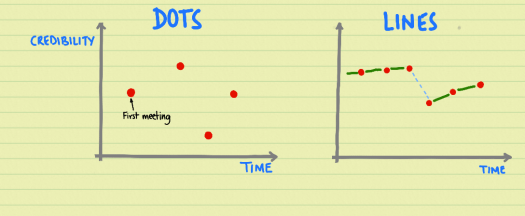
When you first meet someone, that creates a single data point – both for you and them. Your interaction creates a moment of credibility (Suster talks about performance).

The picture above shows this event (adapted from Suster’s original images).

In subsequent interactions you build up more data points. You learn more about each other, what you do and how do you it and so on.

Over time these interactions create more dots on the graph.

The key question is – are these dots connected or not?

If you have a set of random dots that don’t seem to have a clear relationship between them, people are going to struggle to connect them and understand what you are pitching.

People listening to you need to “connect the dots”, see the storyline that runs between them and helps them make sense of your proposition.

It doesn’t matter if there is a break or a change in the story. For example, in the second chart, you might have a particular set of dots connected by a line – and then something changes causing you to go in a different direction and you then have a new set of dots connected by a line.

The connection – the storyline – is what people buy into. It’s what allows them to see the pattern in what you are doing and start to trust that you have a plan and a destination in mind rather than just doing random activity based on what’s latest and loudest.

Suster recommends that you try and increase the number of data points with short, relevant updates when possible. Start well before you need something, and by the time you go for the “ask”, the people you are talking to can see the pattern in what you are doing and that reduces their perception of risk and increases their willingness to invest in you and your idea.

Reja Khadjavi of Shoelace has a good post on how regular, consistent updates to their investors helps them strengthen relationships and provides examples of what they actually send out.

It might seem basic, but sometimes we can get lost in the detail of what we do and forget that something that seems simple and obvious to us can be complex and opaque to someone else.

The way to get someone else to see what you see is to help them see the lines that connect what you do.

Creating a strategy with 3 circles

3-circles.png

How do you come up with a strategy for your business?

This can be an unexpectedly hard question to answer. We tend to think of things like USPs – the unique service propositions that differentiate us from others – but are we missing the bigger picture?

Joel E. Urbany and James H. Davis developed a simple tool to help work through this problem – the 3 Circles model.

An adapted form of the model is shown in the picture above. In essence, we need to consider 3 broad areas:

  1. What we do.
  2. What customers need.
  3. What competitors do.

If you draw a Venn diagram representing these three areas, you end up with seven sections, each of which are important to review and consider.

Urbany and Davis suggest that you carry out a thinking exercise. First, what do you think your customers want? Next, how well do you think your products overlap with their needs? Finally, how well do your competitors do it?

Then, work through the various sections of the Venn diagram.

In section 4, if you and your competitors both do something that doesn’t overlap with what your customer needs that’s obviously not much use. You need to find a different customer for those services or stop doing them.

Sections 7 and 5 are ones to think about carefully. You have an advantage in some areas and your competitors have an advantage in others. If neither of you can meet all your customer’s needs, then you need to figure out how to overcome your weaknesses in their eyes when it comes to what your competitor does.

Section 6, where all the circles overlap, is a bit like being in stalemate. You and your competitors produce something that your customer needs about as well as each other. It’s a 50:50 chance which one of you gets the job.

The amount to which there is a strategic fit between your products and your customer’s needs is important.

Urbany and Davis point out, however, that the green area – what you do better and what makes up your USP, is often much less important than you think to the customer.

The thing that comes across from working through the 3 circles model is that if you think about things only from your point of view, then you’ll end up being squished into a small space that you think is your sweet spot in section 7.

If you speak to your customer about what they need, you might discover a vast empty space in section 2. where neither you nor your competitors are yet providing a service and where you might be able to grow your offering.

Perhaps not surprisingly, if you want to grow your business, the best strategy is to try and see things from your customer’s point of view.

What kind of impact does a short-term strategy have?

sandbag-strategy.png

A short-term strategy is one that focuses on what is going to happen soon rather than what is going to happen over time and what you should do as a result.

In business, that might mean focusing on current stock prices, maximising near-term earnings or working out what you are going to say during the next quarterly earnings call with analysts.

It also means that if something is going wrong, you try and patch it up, fix it with something quickly.

Ari Wallach in his TED talk calls these sandbag strategies.

This is where you know there is bad weather on its way, the rivers are overflowing and the dam is broken, there has been no investment and so all you can do is put sandbags around your property.

And this strategy works. The sandbags protect you. The water goes down and everything is back to normal, after the cleanup and disruption. You can do this time after time.

According to Ari – “the insidious thing about this strategy” is that it works – it can help you make numbers, get elected and look like a hero.

In 2012, Francois Brochet, Maria Loumioti, and George Serafeim from the Harvard Business School tried to work out what impact a short-term strategy had on companies.

The hard thing is working out which companies have a short-term approach and which don’t. The team decided to take quarterly conference call transcripts and analyze them.

They coded the words used by senior managers and worked out a measure for short-termism based on a ratio of words that referred to the near-term (a year or less) and the words that referred to the long term.

After looking at over 70,000 transcripts they found that on average more companies focus on the short term rather than the long term.

At the same time, not as many companies are being managed for the short term as one might imagine – many firms are being run with a long-term mindset.

The interesting thing is that companies that are managed for the short-term tend to arract investors who also think of the short-term.

That creates pressures to perform and meet the numbers rather than build the business.

The researchers found that such an approach results in more volatility in stock prices and increases the risk and costs for investors.

As is often the case, a quote from Warren Buffett succinctly sums up the risks inherent in a short-term focus when it comes to business.

Charlie and I cringe when we hear analysts talk admiringly about managements who always “make the numbers.” In truth, business is too unpredictable for the numbers always to be met. Inevitably, surprises occur. When they do, a CEO whose focus is centered on Wall Street will be tempted to make up the numbers.

How fast can you grow?

rate-of-growth.png Everyone seems to be in a hurry these days.

Perhaps it’s the media and stories we see which give us that impression. Stories of companies that have shot to success, overnight celebrities and competition winners who leap the queue to create a personal brand in a very short period.

Many businesses that start up seem to have a growth mindset that believes in building a customer base fast, scaling themselves quickly and getting to a point where a larger player in the market will see them as a competitor or a source of innovation and snap them up, enabling the founders to exit with a nice payout.

This is the rocketship option.

The alternative is a business that starts out serving customers. It develops incrementally, adds capability and resources, reinvests in its core business and, as a result, grows over time.

This, perhaps, is the walking option.

If you want to reach the stars fast, the rocket is the way to go. Get in, strap on, start your engines and hold on for the ride.

At the same time, there are a few pre-requisites.

First, you need to build your rocket. You need the machine itself, the launching pad, the control centre and the army of people needed to keep everything going.

Then you need fuel, enough to get you first off the ground and then to keep you in the air.

All that takes money and resources up front – which you need to borrow or invest in the business.

The slower way is to get a backpack, fill it with the things you have or need and get walking. Every day you do a little bit more distance.

That needs less money up front, but you have to put in the daily effort required to move forward.

It might seem that the rocket is clearly the better way to get there. Time is money, after all, and why get somewhere slowly when you can get there faster?

Well, the one thing to remember about rockets is that you need enough fuel to escape the earth’s pull. Run out of fuel and things are going to end very badly. Startups use the term “burn-rate” for a reason.

As a six-year old will tell you, if you want to reach the stars and you have the two options open to you, the rocket will get you there fast, but the walk is safer.

How to work with other people

working-with-others.png

It’s easy doing things when you don’t need to work with anyone else.

There is no need to consult, persuade, argue, manipulate, coerce or flatter someone to get what you want.

But that’s what we need to do in real life – groups of people can produce more if they work well together than an individual toiling on his or her own.

So what is it that will make this process of working with others easier?

It might make sense to start with how you see yourself and your relationship with others. The Johari window is a technique that helps do this.

It’s a 2×2 matrix that looks at what you know or don’t know compared to what others know or don’t know.

The picture above is an adapted form to see what can be done rather than what is already in place, which was the purpose of the original work.

First, there are things that you and the person you need to work with know. This is a common space, where you can both discuss, agree or disagree based on common knowledge.

It is a collegial space where you can feel like equals.

Then, there are things that others know but you don’t know. These can be character flaws, research findings, inside knowedge about business politics and so on.

These are your blind spots, the things that will come back to bite you. For example, if someone knows you get angry in meetings, they can prod you to explode and undermine your credibility in a crucial setting.

After that come things that you know but others don’t know. This is where you get the opportunity to share, teach and perform.

Done well, people will appreciate your effort. Done badly, you will come across as superior or egotistical.

Finally, there are things that you don’t know and others don’t know. You’ll need to work together to explore the way ahead.

It seems like a good way to think about working with a new team or a new person is to work your way around the matrix.

Figure out the things you have in common, identify and eliminate blind spots on all sides, learn and share information with each other and work together to create new ideas, knowledge or capability.

Sounds simple.

But, is it easy to do?

What will make your change program succeed?

change-formula.png

Some people want to change the way things are done, some people like things the way they are, and some people aren’t really bothered and are just waiting for the working day to end.

Changing the way things are done is not just about saying that there is a better way and so obviously everyone should do it.

For example, if you want to try and be more energy efficient, you could just set the room temperature controls to 18 degrees C, lock the panel and leave.

You will, however, get complaints. Lots of them. From people that are too warm, too cold or liked having control. Some enterprising ones will work out how to hack your controls or subvert the temperature sensors.

When it comes to small or large programs, whether it is choosing to lose weight or changing your entire IT system, what are the factors that will make your program succeed or fail?

It turns out there is a formula. David Gleicher created the first version and Kathie Dannemiller made it easier to understand and use.

Kathie’s version says that three things must be in place for change to be possible. These are:

  • D: Dissatisfaction with how things are now
  • V: Vision of what is possible
  • F: First, concrete steps that can be taken towards the vision

Working against these factors is R: Resistance to change.

The formula says that D x V x F > R.

Or in words, the product of the three factors needs to be greater than the resistance to make change possible.

It’s a nice formula, but there are a couple of problems with it.

First, can it actually be used like a formula? What units do you use to measure D, V and F, and then what do you actually multiply?

Someone needs to do some dimensional analysis, or in simpler words, work out how to convert the factors to a common unit (like litres or centimetres).

But that would probably be a waste of time. Instead, a more useful representation may be to use a force field framework as shown in the image above. There are driving forces that move you towards a goal and hindering forces that block movement.

If you have more forward forces than backward forces, you are probably going to move towards your change goal.

The second problem with the formula is that it assumes you need to know where you are going and what you should start doing in order to change.

That is not necessarily the case. The only factor that is really necessary is Dissatisfaction with the status quo.

Instead of Vision and First steps you might have options and experiments. Jason Little has an interesting blog post about experiments here.

You might try a number of things out, see which ones face more or less resistance and work towards an approach that makes you happier (or less dissatisfied).

Perhaps we should keep in mind George Bernard Shaw, who wrote “The reasonable man adapts himself to the world; the unreasonable one persists in trying to adapt the world to himself. Therefore all progress depends on the unreasonable man.”

How do you work out what is important?

degrees-of-freedom.png

You usually have many options and lots to consider when approaching a problem.

Most people have experienced meetings where a number of people have opinions, approaches, suggestions and explanations for why you should do something in a particular way.

Quite often, you end up with a set of conclusions pulled together that include things that the group seems to like and things that important members of the group put their support behind.

That’s all good group work and “brainstorming” and does help with creativity and idea generation.

But how do you know which of those conclusions actually matter and are important?

A model from statistics called Degrees of freedom may help us here.

You need information and data in order to estimate a statistical parameter. The degrees of freedom in that estimate are the number of independent pieces of information needed to work it out.

In the picture above, to work out the result, you need four pieces of information: 1, 2, 3 and 4. The intermediate calculation a is from a calculation involving 2 and 3, and so is not independent.

This system has four degrees of freedom.

There are two things that this model helps us see.

The first is that information that does not affect the result should not go into the analytical process. You need to focus on the things that will “move the needle” and eliminate unrelated factors.

The second is that the larger the number of degrees of freedom, the more values the end result can take. In a physical example human upper arms have 7 degrees of freedom and can do a number of movements as a result. The hand has 23 degrees of freedom and can do much more.

The degrees of freedom concept can be generalised to help with general problem solving and business modelling.

You need to figure out which parameters can affect the result you want, and then isolate the parameters that are truly independent.

You then need to work out what a change in each parameter means for your result – you come up with scenarios. You can say things like if the first parameter changes by 10%, this is what it means for the result.

Then, if you want to get a little fancy, you vary all the parameters and come up with a range of results that might happen – modelling it stochastically. This lets you say things like I’m 80% confident that the result will be between X and Y.

In business, what this process lets you end up with are the parameters that matter to you – the ones that are important to monitor if you are going to achieve the necessary result.

These parameters are your Key Performance Indicators (KPIs). Keep an eye on them, make sure that they are within tolerance and doing what they should be doing, and you have a much better chance of getting the result you want.

The next thing then is to make sure that the result you are planning to get is the one you really want.

How has the party been for you over the last 30 years?

ftse-1995-2017.png

If you entered the world of work after 2008, your experience is probably one of sustained growth where things have only gotten better.

Since the financial crisis, which resulted in markets falling to a low in 2009, the world has seemed to be on a path to recovery. Stock markets have risen, houses prices have remained stable and many people are employed.

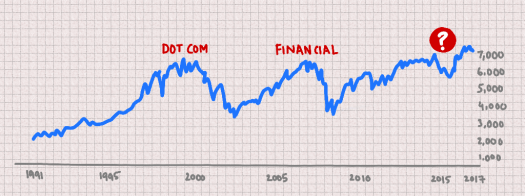
The FTSE, shown in the chart above, has risen from under 4,000 in 2009 to over 7,000 today, an increase of 75%.

But, as Santayana said, those who cannot remember the past are condemned to repeat it.

We live in a world where valuation and value are not the same thing.

The dot com crisis at the start of the millenium resulted from ascribing absurd valuations to companies that were little more than dreams and wishes.

The financial crisis in 2008 happened when complex contracts designed to spread risk turned toxic and concentrated it instead, corroding trust – the grease of modern economies – and bringing the whole financial system to a grinding halt.

And now we come to 2017.

Is the steady rise we have seen over the last seven years because of a real recovery or because of something else?

The internet has grown up after all – it’s now transforming how we live our lives and do things. So perhaps the new digital connected economy is helping economies change and grow?

An alternative explanation is that governments have pumped vast sums of money into the system to keep things working.

This money is injected through financial institutions and has to go somewhere – it has to be “invested”. So the money goes and accumulates in certain places – companies, commodities, bonds that promise returns.

The issue is that there is more money chasing these assets that have returns, and so people are willing to pay more for them, and as a result their valuation increases.

Since BREXIT, the UK index has risen because a weaker pound makes the largest businesses in the UK more competitive globally, increasing expectations that their profits will rise and pushing up their valuations.

Conversely, when the exchange rate drops, the valuation of these businesses falls as well – the FTSE 100 is inversely correlated with interest rates.

So, what should you do now? Should you sell everything and walk away from markets? Should you double down and buy some more?

As Blaise Pascal said (almost), all of humanity’s problems stem a person’s inability to sit quietly in a room alone.

The markets will go up and down. Given where they are, it makes sense to be prepared both psychologically and financially in case they fall once again.

The thing to remember is that percentage changes are not symmetric. A 75% rise only needs a 43% fall to wipe out all your gains.

At this point, it might make sense to invest with a mindset that is prepared to have your investment take over 10 years before it shows a profit.

Can you explain what you do to a rubber duck?

rubber-duck.png

Many people have the experience of being stuck on a problem, or finding that they have to explain what they know or have done to someone else.

You might face this when trying to create some software, work on a business process, repair a leaky pipe or when you’re trying to explain what you do during a sale.

So how can you make this easier to do?

One approach explained in the book “The Pragmatic Programmer: From Journeyman to Master”, by Andrew Hunt and David Thomas is rubber duck debugging.

The method is simple:

  1. Get a rubber duck.
  2. Tell the rubber duck that you need a minute of its time.
  3. Explain to the duck what you’re trying to achieve and then go over your code or problem in detail, line by line.

Somewhere during this process, you’ll realize that what you’re explaining to the duck is not what you are actually doing – and this leads you in the direction of a solution.

Alternatively, as you explain the problem to the duck, the solution will pop into your mind and you will know what to do next to resolve the situation.

It’s quite important, it seems, to talk out loud to the duck. It’s the process of explanation and thinking out loud that gets your mind to loosen up and allows solutions to tumble out.

Of course, you could ask someone else. The only thing is that if it’s someone who knows what they are doing and you haven’t taken the time to formulate your question well, you’ll look stupid and they’ll feel like you’re wasting their time.

You could also ask a co-worker, but the main advantage of a duck is that it sits there, doesn’t talk back to you or judge you or suggest that it has a better solution and is much smarter than you are.

If this approach seems a little silly to you, perhaps you need to consider what it actually makes you do and how it helps you do better work.

  1. Your brain has to stop and switch tracks – from doing something to explaining what you are doing.
  2. You need to slow down – you can’t assume the duck already knows what you know and cannot take things for granted.
  3. You have to go line by line through your program or process, focusing on the details that you might be tempted to otherwise overlook.
  4. It forces you to try and work through and answer your problem or situation yourself, engaging your brain, before asking someone else.

Of course, the duck’s powers are limited. If you have talked to the duck and are still stuck, you should go and talk to a colleague or someone who might know more than you about the problem.

The chances are that you will come up with a much better question for them this time around.

How to create intelligent systems

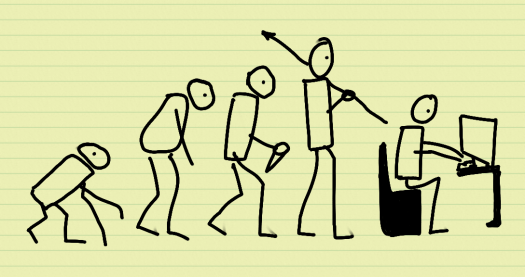
evolution.png

If you have a complex problem to solve, do you need to build an equally complex system to solve it?

Most people, when they think of systems, visualize technology – robots, artificial intelligence, connected machines and autonomous vehicles.

A more general definition of systems includes the people that use the technology and the processes they follow when using it.

Complex systems include things like governments, religions and companies.

How does a large, complicated company come into existence?

Well – it probably didn’t start out large. It started as a small company once doing something simple. For example, General Electric, one of the largest conglomerates in the world, can be traced back to Edison and his lightbulb.

This idea forms the basis of Gall’s law, a rule of thumb from the book “Systemantics: How systems really work and how they fail” which says “A complex system that works is invariably found to have evolved from a simple system that worked”.

The reverse also appears to happen. A complex system built from scratch never works and cannot be patched up to work. You need to start again with a simple system.

The main problem with building a complex system straight away is that a system is simply someone’s approach to solving a problem – the system itself doesn’t solve the problem.

A complex system built without constantly testing whether it is doing something useful can end up doing hardly anything useful at all.

This is why many modern approaches to programming are “agile”, solving simple problems first and putting out software that people can try out to see whether it is actually useful.

A related observation from the book is that very efficient systems are dangerous. Loose systems, systems that hang together with some slack tend to grow larger and work better. An example of this might be the growth of the world-wide web.

The book is a slightly tongue-in-cheek commentary on systems theory, which has moved from a “hard” systems approach where people believed every situation could be mathematically modelled and solved to “softer” approaches that take into account the reality that people doing what they think is right have the inherent capability to mess up any system designed by a technocrat.

Intelligent behaviour is not something you design into a system but something that emerges from the way in which the system is arranged.

The only approach that has been shown to produce intelligent behaviour so far is evolution, and so it makes sense to prefer it when creating a new system.