Use Generative Learning To Boost Generative AI

2025-12-05_gen-learning.png

We’re now familiar with gen AI but what is generative learning?

Generative learning theory suggests that people learn and remember more when they make relationships between what’s new to them and what they already know.

It’s a constructivist theory and says learning is about the work of actively constructing knowledge.

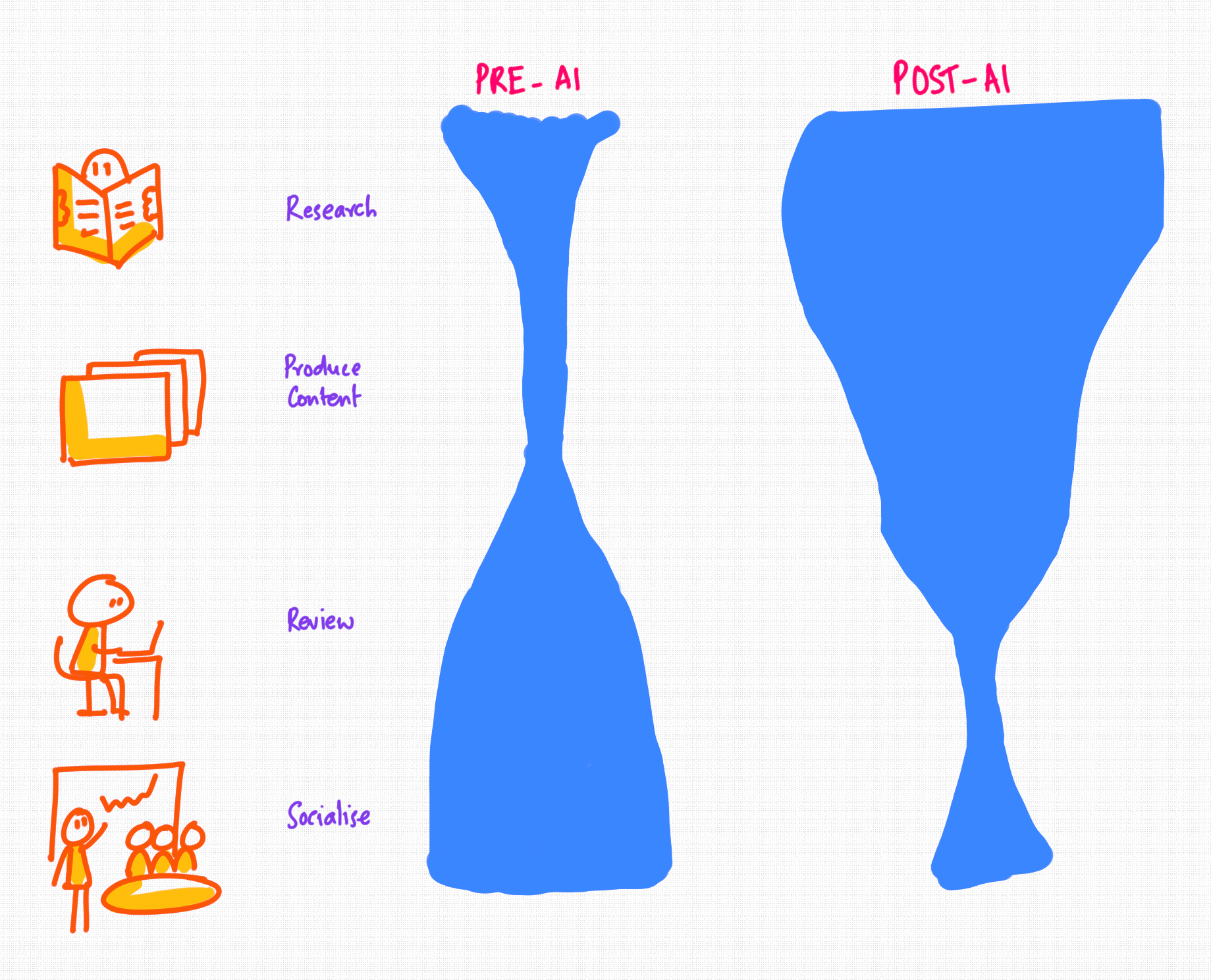
Gen AI tries to shortcut this.

I tried to make a thing yesterday. A tripod mount for an attachment. I drew a picture on paper, designed it in OpenScad, created a printable file in Slic3r and printed it on my 3d printer.

It’s a godawful design. I got it wrong twice. It only works becuse I didn’t realise that the tripod mount was helping the design stay rigid.

Any engineer that’s got shop experience would know a hundred different ways to make something better. But I don’t. I’ve given up on constructing that knowledge of making physical things. I’m at a competence level not far behind someone in high school.

We usually improve with age. Unless we stop trying.

Now imagine doing that with your mind. Stop trying to actively construct knowledge. Stop learning and remembering information. Stop trying to connect what’s new with what you already know.

In business, don’t bother talking to people. There’s no need to understand how the operation actually works. Want a strategy? Pick from a selection of ready made ones, all plausible and beautifully formatted.

If we stop and think for a minute, assuming we still can, what do we think that’s going to do to our ability to think?

Can we create the businesses and services and politics of the future if we let our ability to gain knowledge stagnate?

I’m not against using tools. They augment us. What we’ve got to do is remember that gaining knowledge requires active work – which is often hard work. You need knowledge so you can use tools better.

My prediction – the people who succeed will the ones who successfully couple generative learning with generative ai.

Writing A Thesis

2025-12-02_reading-writing.png

Tuesday, 6.45am

Sheffield, U.K.

I wrote my thesis on the benefits of war and very near got thrown out of college. But I can show you where the greatest advancement of mankind comes under stress and strain, not comfort. – Don Young

I need to get on and write the text of my thesis.

And, of course, rather than just getting on and doing the work, I’ve got to create a process that makes it easier first.

My thesis is going to be an extended version of a paper that I’ve worked on with colleagues for the last few years.

I jumped in and started writing – and quickly realised that I didn’t have enough material and hadn’t organised my thoughts – I needed to do some pre-work before I could get down to drafting.

One of the hardest things about doing research these days is just how much information is available.

It takes time to find and filter information and select the papers you think are relevant. Some are classics but the point is to be selective.

For example, I limited my search to papers published in the last three years on business. While there are probably great papers in history and psychology that might be relevant, that’s not the field I’m writing in.

Then there’s reading and note-taking.

Now, the topic of my thesis is actually about note-taking – something that is really quite under-researched given how foundational it is to learning.

I’ve been wrestling with the format in which to take notes.

I wanted three things from my notes.

1. Chronology

I like to know when I worked on something. Time and history are inextricably wound together. I years to come I would like to see what happened when.

2. Chunking by topic

I like the idea of index cards – with an idea to a card. It’s possible to move these around and put related cards next to each other.

This is hard to do in text. And I’m not the kind of person that buys SaaS or likes dedicated software.

So, I used a text editor and scripts to set up a process.

When I take a note, it adds date and time information so I can refer to it later, if I want to.

I have a way of formatting my text files so I can identify card-like sections. So for example, a section of text starting with .cd and ending with .. contains card information.

From that, it’s relatively trivial to write scripts that read all the text files in a folder and organise the cards by their topics.

What this lets me do is take notes on a paper, so I have a collection of notes related to a particular text, but then also see the notes organised by topic so I can pick out all the points that are related to a given idea.

3. Portability

I keep switching between text and odt – the LibreOffice format.

I spend most of my time in the console, so text is much much easier. And if you’re on different machines you can just ssh in or copy a text file across later. It’s much easier to slice and dice text files that odt. So, all my raw material is collected in text files.

I use odt when I need to write something that’s shared with others. If they also need to read and edit I need a Word-like way to share information.

But if it’s just me writing I like to format using groff. So then I get a ms style output and it is easy to format and publish.

The point is to publish

I think it’s easy to get sucked into tools and methods, but I have to remember that the point of all this is to get the thesis done.

But it’s also about developing a process that I can use for the next few decades. I see reading and writing as something I will continue to do for as long as I can.

So it’s worth spending a little time making sure I have a way that works for me.

Cheers,

Karthik Suresh

Go Deep AND Wide – The Essential Strategy For Succeeding In Business

2025-12-01_business.png

Monday, 8.40am

Sheffield, U.K.

Everyone has an invisible sign hanging from their neck saying, ‘Make me feel important.’ Never forget this message when working with people. – Mary Kay Ash

I’ve spent the last 20 years learning about business.

And there are two things I would advise myself to do ten years ago.

1. Build deep knowledge

Surface level knowledge is not enough.

Deep knowledge comes from working on an area of interest. Building craft skills, technical knowledge and muscle and brain memory.

We’re all good at different things.

I know people who would rather clean their cars than spend time with a book, while I’m the opposite – I do not like manual work but I’ll spend hours with words or numbers.

It’s the thing you do differently, almost obsessively, that you get good at.

And it’s that deep knowledge that lets you create new products and services.

2. Build wide relationships

We spend our careers looking down at our work but we need to also spend time looking around and seeing who else is out there.

Build your network early.

It takes time – and the one thing I wished I had done more is reach out and connect earlier in my career.

The more people out there that will take your call, the better your chances of reaching customers for your business.

Deep and Wide – That’s the secret

A good business creates value for a customer.

You create value through deep knowledge. And you create customers by drawing on wide connetions.

Get these two things right and it’s hard to fail.

Cheers,

Karthik Suresh

Are You In Control Of Your Route To Market Or Not?

2025-11-30_solid-ground.png

Sunday, 7.02am

Sheffield, U.K.

In real open source, you have the right to control your own destiny. – Linus Torvalds

If you start a business you need to be visible on social media – which is why I spent the last 140 days writing on LinkedIn.

Two things have happened.

First, I have been more visible. I’ve had people comment on how active I am. They’ve referred me to others. I’ve had a few good conversations start as a result.

Second, my engagement statistics are slowing down. I don’t know if that’s because readers aren’t interested in what I write or if the algorithm is throttling my output because it wants me to pay for reach.

The advice on LinkedIn is that if you want to get a following, focus on one topic.

My content fails this test.

I have a new business to promote, so I write about that.

But I’m also interested in AI, technology, politics, science, innovation, marketing, strategy.

What I see from people that are successful on LinkedIn is that they push out stuff in their niche that is one message repeated again and again in slightly different forms.

It’s advertising posing as communication, engagement, education or entertainment.

It’s just not very interesting after a while.

Another problem is that you are playing in someone else’s sandbox.

You can’t build a permanent home on shifting sands. Building a business that depends on the vagaries and algorithmic experiments run by big Tech seems risky.

You need solid foundations.

The bedrock on which you build your marketing strategy has to be under your control. Write first for your website, and have an outbound process – reach out to customers directly.

Email still has a place.

The problem with any technology is that either you control it or it controls you.

There isn’t an in-between – a good, win-win solution. Very smart people are trying to engineer situations where you work for them. And it’s increasingly hard in a world of SaaS and AI to even control your own computer – unless you’re familiar with Open Source and things like GNU/Linux.

If you take one thing away from this post it’s that you need to use systems other people own just enough so you can then move conversations into systems you own.

Cheers,

Karthik

Writing As a Process

2025-11-29_writing-process.png

Reading maketh a full man; conference a ready man; and writing an exact man. – Francis Bacon

Introduction

Do we still need to write in a world where machines can pump out pages of text in a few minutes?

I think so. And for one simple reason. For survival.

Prehistoric people didn’t have gyms because daily life was hard work that exercised their muscles.

We exercise to keep ourselves fit in a world that no longer requires us to lift heavy things or work hard for food. As a result, our muscles atrophy unless we put in extra work.

The same thing could happen to our brains if we delegate the work of thinking. But while we have machines to do the physical labour for us – do you really want to have to spend your days in the equivalent of a mental gym to stay occupied?

Writing work is thinking work. It takes effort to figure out what you know and explain that to someone else. It’s also hard to keep a reader’s interest. Every sentence needs to add value.

And that requires a process. One that lets you build a piece in a systematic way. This is the process that I’m trying out.

Start with Prewriting

I tend to leap straight into writing and that’s not a good thing.

The first few paragraphs of any writing are like getting rusty machinery moving. You need to oil the parts, complain about how rubbish everything is, and get the gears moving.

A good place to start is with freewriting – in a document that no one will see where you can drop in whatever is on your mind.

No one wants to read about writer angst. But it needs to get out of you to get your brain and fingers moving. So write it, and then move on. This isn’t going to be published.

Draw a Structure

The next practice I’ve found useful is to draw a diagram. Something that expresses what I’m trying to get across.

This blog is full of such diagrams. Making them helps me get a sense of what I’m trying to get across. Is it a process, a feeling, an observation, a structure?

There’s something that I’m trying to capture with a piece of writing – and drawing helps me unlock that before I try and get the words out.

Make an Outline

I know that outlining is a good thing but I’ve struggled with it all my life.

I think I’m the kind of person that has to go into the detail, struggle with the mess, before trying to frame it in some way.

I was in Copenhagen the other day and the person I was with marvelled at how the buildings were made without any scaffolding.

That wasn’t true, of course. Scaffolding has been used since prehistoric times. You can’t build a building without planning, diagrams and scaffolding. But at the end, you take everything away, and you’re left just with the finished structure.

An outline is just scaffolding for writing. It helps you stay on track and it makes it easier for the reader because it gives your piece structure.

I find it easier to keep the outline text at heading level, rather than trying to go deep into sections. It’s hard to get into a writing flow if you’re constantly interrupted by reminders.

Write the First Draft

Then it’s time for the first draft.

I go down the outline, and start to create sentences.

The point at this stage is to get words down – to create a messy first draft. No stopping, no going back, just moving forward and laying down words.

Write the Second Draft

The second draft is about editing.

Remove the scaffolding and read and edit each phrase and line.

Choose better words, polish paragraphs and sentences, make the sentences active.

See the shape of the piece. Add headlines, connect sentences.

Make the piece easy to skim read.

Write the Final Draft

And then we’re on to the final stretch.

Look at the piece from a reader’s point of view.

Is it easy to read? Does it flow? Does the order of ideas make sense?

Move sentences around. Move paragraphs up and down. The easier it is to follow, and the more sentences logically and naturally transition from one point to the next, the more useful it will be to a reader.

And readers only stick around if what they’re reading is useful.

Publish

And then it’s time to press the publish button and send your work into the world.

This is an ideal writing workflow – and not one that’s worth using for every piece of writing.

A quick blog or social media post doesn’t need all this work.

But longer pieces deserve it – because writing them is as much about you as it is about the reader.

It’s the ability to work through an piece from start to finish that makes you still relevant in a machine age.

Daily Practice – The Machines Are Coming For That Too

2025-11-28_daily-practice.png

Friday, 9.44pm

Sheffield, U.K.

It’s a philosophy of life. A practice. If you do this, something will change, what will change is that you will change, your life will change, and if you can change you, you can perhaps change the world.

– Vivienne Westwood

I have been writing on LinkedIn every day for the last 140 days, thinking that it might help as I take a new business to market.

I’m not sure it’s working.

Here’s the problem – what do you put your effort into every single day to develop your practice?

There’s a choice – write for your own blog – which is what I was doing. Or write in a platform, which someone else owns.

The way that works for me is a routine – a consistent approach that I commit to every day.

That means writing 7 days a week. No excuses, no interruptions. If you stop, everything stops. And when you stop, it takes time to come back and start again.

But it’s hard to do that on a blog and on LinkedIn – writing once a day is hard enough. Writing twice is perhaps asking too much. Especially if there is more writing to do – such as working on a thesis or papers.

So I decided to prioritize LinkedIn for a while because it felt like the place I could connect with prospects and partners.

But, I think consistency is now a problematic thing.

It’s hard to tell the difference between someone that puts in the effort every day and a bot.

If people are using AI tools to write and publish then what they do looks very similar to someone who does it through discipline.

Or, to reverse it, consistent discipline now looks like you’re using a robot to do your work.

And that’s problematic. I’ve seen views go down massively on LinkedIn. I don’t want to jump and blame the algorithm but it’s one of three things:

  1. It’s depressing reach so you reach for the boost button and pay more.
  2. There’s more AI content but the same number of eyeballs, so mathematically everything gets lower views.
  3. It thinks you’re a bot and so depresses your content.

There may be more options but I can’t think of any right now.

So, the logical thing to do is to change – stop being predictable to a machine that’s adjusting itself as it goes.

My primary writing space has to be this blog – it’s where I work out ideas and think through situations.

And I think LinkedIn has to be a more random thing. In fact, I’m thinking of having a random number generator, like between 1 and 7, and only posting on the days when it’s over 4 and over.

Will the algorithm reward such randomness as evidence of being human? I don’t know – but I do know that life is too short to try and work for an algorithm.

So if you’re subscribed, you will probably see more posts from me again.

Cheers,

Karthik Suresh

Get Computers To Work For You

2025-11-20_working-hard.png

Working hard in a world where you have computers seems like a failure of imagination to me.

I dropped out of my first PhD to join a startup.

While I was doing the PhD, however, I had plenty of time to get coffee with colleagues and talk about research.

And this was for one simple reason – my computer busy working for me.

I inherited a codebase in c of around 4,000 lines.

I cut it down to 100 lines in python.

And then I built a pipeline – the computer started with a model, did an initial pass to reduce compute time, and then worked through complex calculations on a computing cluster my colleague built. When the calculations were done, and the results were formatted and pulled together.

Yes, you could work hard at each of those steps and it would take days or weeks – or you could use a machine and get it done in three hours.

And this isn’t new stuff – we’ve had the tools for around 40 years now.

I’ve used the same approach again and again, and we do the same thing in our latest business.

Raw data is entered in spreadsheets. Computers do a series of tasks and clean and usable outputs pop out the other end.

Most systems on the market give you more work to do.

Our systems do the work for you.

Innovation Teams In An Age Of AI

2025-11-17_innovation-teams.png

How do you build innovation teams in a world of AI?

Pretty much the same way you built teams before AI.

There are four roles that are crucial but most firms only get three right.

You need a developer – someone who can make what you need.

You need an SME – someone who knows what do do.

And you need an architect – someone who knows how something should be made.

One person can deliver all three roles if they have the experience.

But what’s usually missing from the conversation is the voice of the user.

Maybe it’s because users introduce real world complexity and nuance – they bring context.

It’s messy and untidy and hard to solve.

But building for context is what results in success.

Keep Your Personalities Separate

2025-11-15_personalities.png

Saturday, 13.33pm

Sheffield, U.K.

Anything that is worth teaching can be presented in many different ways. These multiple ways can make use of our multiple intelligences. – Howard Gardner

I’ve been thinking of the difference between the tip of the spear and the person behind it.

“Word Craft” by Alex Frankel got me thinking about sales.

He points to Jean-Marie Dru who, in his book “Disruption”, suggested that communication is not something separate from your product – instead it’s an integral component of it.

In other words, your product IS your message.

As a consultant or business owner you are also a product – which means your message is hugely important.

For example, I use this blog as a thinking space. It’s where I can collect ideas and work on understanding them.

And one of the things I’ve been struggling with is separating me from my work.

To start with, I’m building a business that provides data management services to clients that need to disclose information under various regulatory and voluntary frameworks.

At the same time, I’m interested in a range of topics such as strategy and marketing.

And I’m also carrying out research into improving approaches to understanding and improving problematic situations – a field known as problem structuring – through using Rich Notes – a technique I’ve created.

So, who am I? What am?

The business builder?

The strategy consultant?

The academic?

I think what’s going on is that we are more than one thing.

But – if we’re trying to connect with other people we have to pick one personality and stick with it.

For example, I had someone mention that they had talked to a prospect about my strategy work but when the prospect checked me out on LinkedIn I came across as too energy focused.

So, I either lost a potential prospect because of my message or I filtered out a prospect that wasn’t the right fit for what I was offering.

It feels like you should put across everything about who you are – the richness that you have.

But you have to decide what you want people to think.

The kind of research I do is Action Research.

This is where you have a situation – like figuring out what to do about marketing yourself – and you try something.

Maybe rewrite your profile. Tweak your outgoing messages. Try and make it easier for prospects to work out if they need you or not.

The research comes from doing something and then reflecting on what you’ve done, looking for lessons to learn, principles to extract, steps to reuse.

That’s a messy, unpolished process that requires engagement in a situation followed by reflection and writing.

But this is necessary to work through your experience of taking action so that you can come up with theory – a way to explain what happens.

For example, here’s a five part theory

1. Your message is your product

How you describe yourself is what you are. Think about this carefully because it will determine how people respond to you.

2. If you have multiple personalities, let one out at a time

I don’t like simple frameworks. Yet they are essential – because what you’re trying to do is remove ambiguity – make it easier for people to understand what you’re trying to say.

The reason I use LinkedIn is to reach and connect with potential clients. So everything on there needs to be related to that objective.

I’m not doing a very good job of making it clear whether I’m a founder, an academic or a consultant at the moment, so that’s an improvement action I need to take.

Think of it like having more than one personality – having two operating at the same time is very confusing.

3. Cut and refine each message

Cut, cut cut. This post is too long. But that’s ok, because it’s a thinking post.

But your LinkedIn posts have to be tight. Your books, articles, promotional materials, training programmes – they’ve got to be trimmed until they fit exactly what a prospect needs.

4. Design for filtering

You are not aiming to sell to everyone. There is a subset of the market that is perfect for you. You need to find them.

If that market doesn’t exist you need to do something else.

Make sure your system is designed to filter out people who are not right for you and what you offer.

5. Test and learn

There is no right answer.

But there is the work.

Have an idea.

Try it out.

Reflect.

Learn lessons.

Try again.

And now it’s time for me to work on what the next personality has to do.

Cheers,

Karthik Suresh

Are You Describing Your Value In The Best Way?

2025-11-14_career-strategy.png

It’s a tough time for older job seekers.

We once interviewed an experienced, gray-haired candidate for a sales director role.

It was a no – not because of age but because their responses didn’t match the level of career maturity the role needed.

It got me thinking about how careers evolve, and what employers expect at different statges.

1. Early career: It’s a job

Your first roles are about learning, working hard and doing what you’re asked.

You build capability.

2. Mid-career: It’s about reliability

You’ve shown you deliver.

You’re a safe pair of hands.

The reward for good work is more work – and more importantly, responsibililty.

3. Experienced: It’s about knowing what you offer

Now you’re not just doing the work, you’re shaping how it’s done.

You sell ideas upwards.

You say, “Here’s what needs doing, and why.”

4. Senior: It’s about bringing about change

You recognize patterns – using knowledge and experience gained over decades.

You know what’s coming next, what needs to happen and what’s stopping us from getting better.

Your value is helping stakeholders in the organisation align, improve and move forward.

That salesperson we met?

We wanted level 4 vision – how they’d transform our go-to-market, upskill the team, build strategy.

What we got were Level 1 answers: “I’ll do anything you need me to do.”

I don’t think every rejection is about age.

Sometimes it’s because the way we describe the value we bring hasn’t matured as we have.