Two Of The Most Important Decisions I Have Ever Made

2025-07-13_weekly-review-reflection.png

This week marks perhaps the most important milestone in my life.

My youngest son will finish junior school.

If you know me, you will know that I have spent the last 20+ years obsessed with decision making.

And what I’ve learned comes down to the thing that my son’s teacher said she shouted while running after him.

“Make good choices”

If you have young children, pre-school, perhaps, here are two pieces of advice that I will never have cause to regret.

The first comes from a blog post I read by Tim Urban of WaitButWhy.

He wrote that people don’t realise that by the time we turn 18 and leave home for the next stage of our adult lives we’ve spent 93% of all the in-person time we’ll spend with our parents. It’s already the tail end of your time together.

If your kids are 3, that’s 15 more summers. 15 holidays if you go away somewhere with them once a year, before they pull away from you.

I am quite tight, but it was a simple decision to say we should at least do two experiences a year. More if possible. Double or triple our stock of memories with the kids.

Not expensive stuff. It’s not about money. It’s about having more time with your children.

The second thing is that if you put work first you’ll miss the first 10 years of your kids’ lives as well.

Leave at 7.30, come back at 7 and do that for long enough, and the years will go by. And you’ll miss really important stuff. You’ll miss them growing up.

I tried very hard to construct the kind of working life where I could move from commuting every day to being at home.

I’ve managed to have around 6 years of walking my kids to school. Six years of four minutes twice a day. Walking up and down, hand in hand.

One day, as comedian John Bishop said, one day they’ll let go of your hand and never hold it again.

And it ends this week.

But I was there for it.

These two decisions will be, as far as I am concerned, the best choices I ever made.

And if you are in that stage of life, with children that are still young, I would strongly advise that you consider making them too.
Are You Bringing a Digger Or A Spade To Work?

2025-07-07_digger.png

I was trying out the new Gemini cli coding assistant on the weekend and it feels like something truly new – worryingly so.

It could be the equivalent of bringing a digger to a spade fight.

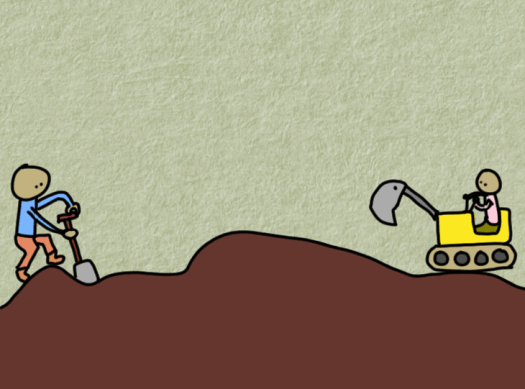
We needed our garden doing for years. The space was hard to access and the early quotes we got were astronomical because they involved a couple of folks with spades digging out all the soil for a few days.

So we waited until we were doing larger renovations, and got a digger around, which flattened everything in a few hours.

And that’s the sort of difference I see that working with a coding assistant in the command line can bring.

It’s foundational.

You can ask it to work out a plan for a an application, set out the folders in a modular way, and start creating the skeleton of the application.

It hurries along, setting things up, testing them, seeing there are errors and fixing them.

You get to the point where the workspace is flat and prepped and ready to go pretty quickly.

And that speeds up your ability to create tools that help – and figure out which ones work and which ones don’t.

I could build (or have the AI build for me) a couple of tools that just worked in the time it takes to go and make a cup of tea.

Another attempt at a more complex tool didn’t work out quite like I wanted but it reminded me that I had another approach that worked ok.

For a developer, speeding up the time between idea, code and execution is important.

The sooner you have working code, the sooner you can tell whether you’re on the right track with a solution or not.

I know there’s a massive debate about whether AI is simply doing things that artists should be doing by taking and remixing their work without permission.

But in software development this is starting to feel like an emergent phenomenon, a shift from a coding language to a natural language development pattern, something that is a throw back to the dreams of literate programming.

In this space, anyway, it feels like something new and important is happening.

What Kind Of Operation Are You Building?

2025-07-05_post-modern.png

There’s a model that I first came across ten years ago – that helped me make sense of the ten years before that.

And I now think it’s a helpful tool for anyone looking to position themselves for the next ten years by figuring out what kind of operation you’re running.

This is what I learned.

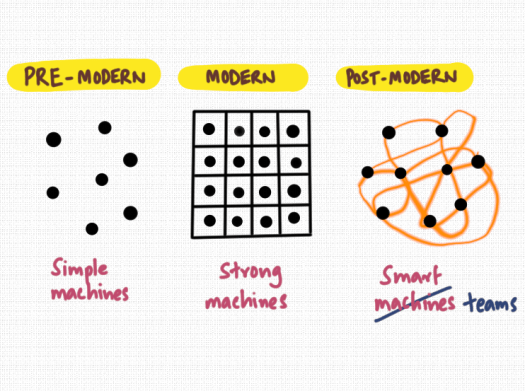
Once upon a time, there were butchers, bakers and candlestick makers.

In this pre-modern world you didn’t need to know about flour to operate a forge, or wax to make a loaf.

Individual professionals did their own thing with simple machines – hands, heat, hammers – and coexisted.

Then we had the industrial revolution and a step change in the way we made things.

Capital was deployed into factories and the modern world was born.

It was a world of strong machines, with workers that served the machines. The workers were ordered, structured, placed. They were interchangeable, replaceable, pieces on a board to be positioned and played by management.

Our modern hierarchy, command and control style operating structure comes from this world.

And then, sometime in the last century, the post-modern world came into existence.

This was a world of smart machines. An information age. Of networks and connections. Where the links between things mattered as much as the things themselves.

And there are obvious differences.

If I have a hammer and I give it to you, now you have a hammer and I have nothing.

If I know how to do something and I teach it to you, we both know this thing. I lose nothing.

So, what kind of business do you operate? Are you a lone genius that does your own thing? Do you have a job in a corporation? Or are you part of a network?

Knowing this gets even more important in this age of AI.

Now, the smart machines are everywhere. Anyone can have them.

Many people still think that they have to use modern methods to build organisations – using techniques to control and motivate people that are at least a hundred years old.

The observant ones will notice that it’s now about teams – small groups of people that want to work with each other and use smart machines to supercharge what they do.

What kind of operation makes this possible? Who’s doing this already? What does great look like?

That’s the change that’s coming. Ready or not.

Create The Conditions To Allow Yourself To Be Surprised

2025-07-03_charity-shop.png

I get concerned sometimes that the information I am exposed to is so highly curated that I learn nothing new at all.

We need to create conditions that allow us to be surprised.

There are three approaches that work for me.

The first is to frequent charity shops.

Books in a charity shop offer a glimpse of what others, who may be very different from you, find interesting.

For example, I came across Austin Kleon’s “Steal like an artist” in a charity shop, which then led me to Lynda Barry and Ivan Brunetti’s work on cartooning.

The second approach is to read the paper.

It’s much easier to go with free media but if you have library access and can get hold of titles like the Economist you get some really interesting perspectives.

The mix of stories in a newspaper are written without knowing you – so there’s a good chance there’s something in there that will be different and interesting.

The third approach is to get recommendations.

In a world where AI can help people pump out material designed for virality rather than substance personal recommendations get ever more important.

If you rely on just social media, then the algorithm seems to feed you what it thinks you would like – and the content seems to converge pretty quickly.

There are good posts but they can disappear as you scroll along, so I make a point of saving the good ones – so I can share them later.

And perhaps surprise someone else.

Sometimes You Don’t Need To Say Much To Get The Point

2025-07-02_efficiency-logic.png

If you hang around academics for a bit you notice that they use a kind of shorthand.

Take the way we normally talk about AI in businesses.

We look at the way in which we’re going to use it to speed up coding. How we can create documents more quickly. How we can summarise information. How we can make games more accessible quickly.

And we go on about the implications. At length.

And then you listen to a good researcher who says five words.

“The epistemology is efficiency logic”

I always have to look up the meaning of epistemology. Wikipedia is helpful for this but the article is a rabbit hole and one should probably stay away from it.

In a nutshell, however, it’s about the theory of knowledge. How we know what we know.

And in this case – when it comes to AI – we’re trying to think about what we think it can do.

And that’s to make us more efficient. More productive. Able to do more with the same resources.

Hence, efficiency logic.

And that’s really all you have to say about that. You can now move on to the next point, if there is one.

The great thing about a well written paper is that each sentence is worth reading. Each one adds knowledge rather than regurgitating what has already been said.

You know how some books are really one idea spread over 300 pages.

A good paper has a hundred good ideas – expressed clearly and efficiently.

It’s not something that can be summarised. It’s already as compact as it needs to be. Any less, and you lose something.

This post is not a good example of that. It’s exploratory, ruminative and far from distilled.

If you had to summarise what I’m trying to say in a phrase, it might be back to Strunk and White’s timeless advice.

“Omit needless words”

What To Do When Nothing Has Value

2025-06-28_karma-yogi.png

Saturday, 9.40pm

Sheffield, U.K.

The major value in life is not what you get. The major value in life is what you become. – Jim Rohn

I think we are living through a change in the global system, one that could have profound consequences.

Or it could fizzle out.

But while we’re waiting to see what happens let’s conduct a little thought experiment.

Let’s think about a world where there are fewer jobs to do because of these new technologies that make people with jobs so productive that companies don’t need to hire as many people as before.

New entrants to the labour market find there are fewer jobs to go after.

The well paid ones, the few that lead to money and status, are hoovered up by the rich and connected.

The rest struggle to get anything.

That’s one view.

Or, the technologies allow us to do more than ever before.

Every single person has the tools to create something great – they don’t need the resources of a corporation to create a new product, find a market, delight customers.

So yes, there are no jobs. But instead there is an explosion in businesses – where people create value.

I started this post by suggesting that a world could exist where nothing has value.

Perhaps I should examine my assumptions there.

If a machine can do something in seconds that would take an artist days or weeks, and do so for free – what happens to value?

The value of the machine generated product is nothing.

The value of the artists work is something – to a person that values the artist – and nothing if not.

The art in itself becomes less important than the way in which its produced.

There is a market for free. And there is a market for handcrafted. And each of us needs to decide how we go after the market that works for us.

The drawings I make for this blog are stuck at a 4th or 5th grade level.

Look at the picture above. It’s not art. It’s just someone doodling with a pen. It’s not worth anything.

Except to me.

Because it helps me in my process – in the writing that I do next.

And the writing isn’t brilliant either – it’s rambling, informal, grammatically questionable, unedited.

Nothing that would make it into the New Yorker.

Except, I’m not writing for the New Yorker,

I’m writing to get my thoughts in line, because it helps me in how I live my life.

Culturally, I was brought up in a tradition that values work, not the results of work.

I don’t know how well that translates to you reading this, but it comes down to saying do what you must do, do the thing that you’re working on with no thought of reward, no need for gratification.

Do it because it must be done.

But why, you might ask? What’s the point of that. You may point to Samuel Johnson who said “No man but a blockhead ever wrote, except for money”.

But if you live in a world where you cannot sell your writing, you cannot sell your art – because the machines do it instead – should you stop making art, stop writing?

Or are you now free – to do it because you want to not because you have to.

Because you value doing what you do.

And when that happens it doesn’t matter what happens in the rest of the world.

You just do you.

And figure out some other way to create value for others that brings in money.

Cheers,

Karthik Suresh

6 Levels Of Moral Development For Organisations

2025-06-28_6-levels.png

Rafe Esquith writes about Lawrence Kohlberg’s Six Levels of Moral Development in his book “Teach like your hair’s on fire” as a model for young people.

I think it could also help companies trying to figure out their culture and strategy.

Let’s take becoming more sustainable as an example – how would companies look at these different levels?

1. Stay out of trouble

Most organisations start here. They ask what the minimum compliance levels are and do what is needed to stay out of trouble.

2. Do things for rewards

Some organisations will get involved in programmes and schemes that offer a reward, such as grant funding for early adoption.

This can help unlock some projects that might otherwise not meet investment criteria.

3. Please someone else

We probably see companies start projects when customers ask them to make progress against the customer’s own objectives.

Questionnaires, rankings, and customer promotions may help make the case that an organisation should do more in a certain area.

4. Follow the rules

This might seem similar to 1, but the difference is that in this case it’s more like making a set of rules to follow rather than complying with someone else’s rules.

For example, you might set out rules on how to book travel – avoid meetings if possible, choose low-carbon options, and so on.

A collection of such rules then guides behaviour.

5. Be considerate

This level of operation is one that is empathetic – that considers others.

Perhaps the easiest way to see this is action is with the construction industry.

Is that development next door making noise at all times of day and night or are they considering the impact on the people around them.

In fact, there is a considerate constructors scheme that is just about this.

6. Have a personal code

This is the most difficult one to reach. It’s about having a code about what is the right thing to do and doing it regardless of what’s happening elsewhere.

You see this in action quite a lot. Companies sign up for a programme because it is good marketing, and then pull out when it’s too hard to reach, or if the political environment changes and certain views fall out of favour.

Do you carry on with those views, because you think they are right, or do you bend to power?

Esquith thinks that the 6 levels are an easy-to-understand set of building blocks that can help young people grow as students and people.

Perhaps they could help companies do the same.

A Roundup Of EURO 2025

2025-06-27_or-conference.png

I’ve returned from the EURO 25 conference with 30 pages of notes and a new appreciation for my own bed.

Like many practitioners I never realized that what I had been doing for over a decade was operational research – OR.

Many businesses get stuck trying to figure out what to do as things change around them.

Take sustainability, for example. What happens now? Should you invest in sustainable choices? Will everything just go back to fossil fuels? How do you make decisions in such complex environments?

Those are the kinds of questions OR helps with – it helps decision makers make better decisions.

And there are four things – at least – that I took away from the conference.

  1. Meetings are where things are decided

Many people hate meetings. They love the idea of sending their virtual note taker instead and just reading the summary.

That would be a mistake.

Meetings are where ideas are exchanged, consensus is formed, decisions are made, and resources are allocated.

You need to be in the room.

Soft OR and problem structuring talks about ways to hold better meetings.

Some great talks in this stream from Mike Yearworth, Chris Smith, Leroy White, and the UCL team with Ke (Koko) Zhou, Nici Zimmerman, Irene Pluchinotta and others.

  1. Models capture complexity

Just talking is rarely enough.

Models give people the power to hold more complex ideas in their heads and build more complete pictures of situations and resource flows.

Systems thinking is having a moment, we were told.

And as many equate ST with Systems Dynamics, David Lane’s talks were a must.

  1. Let’s get philosophical

Systems approaches have their roots, the founders tell us, in different philosophies.

It gets complicated very quickly.

Which is why it was helpful to have a session on the philosophical foundations of Systems Thinking by Graeme Forbes, along with an alternative history by Roger James.

  1. Reflecting on the field

As OR practitioners, we want to make a difference and improve how organisations work.

Mike Jackson talked about the way this has been done in the past, talking about Russ Ackoff’s vision of OR.

And, to learn more about how to study interventions in-depth, I had my first introduction to Behavioural OR with a workshop run by Martin Kunc and Alberto Franco.

I’ve missed many more great speakers from this list, and even more sessions I couldn’t attend – given there were 2,000 odd talks.

But there’s lots to think about.

I think the most important thing that came out was in David Lane’s session – with Blackett’s advice to OR practitioners trying to get things done:

  1. Use what you have
  2. Get access to senior people

At the EURO 2025 Conference Next Week

2025-06-21_euro-2025.png

Looking forward to listening to a range of speakers at EURO, the 34th European Conference on Operational Research next week.

I’ll be spending time mostly in the Soft OR and Problem Structuring streams.

Two items for your diary if you’re attending.

On the first session on Monday, Chris Smith will be talking about the Development of The Rich Notes Technique Through an Action Research Programme – on work we’ve been collaborating on with Giles Hindle.

In the afternoon, I will be talking about the History and Foundations of SSM.

Then its a job of looking through the list and selecting from the many options – the Systems Thinking stream looks interesting.

Graeme Forbes is on Tuesday at 14:30, talking about the Philosophical Foundations of Systems thinking in room Parkinson B11, and Christina Phillips is in room Maurice Keyworth 1.32 on Wednesday at 10.30 on Design Thinking for Impact in OR.

See you all there.

#EURO2025 #OperationalResearch #Leeds2025 #EURO50

The Leaner Your System, The More Flexible You Can Be

2025-06-20_pain-free.png

Every once in a while you come across a term that captures what you want to convey – and one that caught my eye recently was “pain-free progress”.

It was made in the context of physical pain but I think we should be able to use it when talking about software as well.

There’s a big disconnect in the way programmers see the world and the way managers see the world.

Programmers build what you want – give them a specification of what’s required and they’ll make something that does that.

The problem is that if you ask people what they want, you might end up with a long list of requirements.

But is it what they need?

This approach often results in programs that do what they’ve been asked to do but struggle if they’re presented with something outside what they’re designed for.

Managers, on the other hand, are usually just tired.

What they need is for the thing to work and make sense.

I’ve found that when you’re building or selecting software tools to help manage an aspect of operations the first version you create is the one that helps you learn what is really needed.

You’ve got two options from there.

One is to build on what you’ve made – add more functionality and features.

The other is to strip back – what is useful and what isn’t? How can you reduce the number of things that are going on so that what’s needed is done more simply and reliably?

The second approach, I think, is closer to my idea of pain-free progress.

Ironically, the leaner your system, the less it does, the more flexible and reliable it usually turns out to be.