How to design incentive systems

incentives.png

Many believe that if you create the right system of incentives people will perform better at what they are needed to do.

For example, with sales people you just need to get the commissions and bonuses right and that will result in people meeting and exceeding targets.

But is this really the case?

An increasing amount of research (and a helping of common sense) suggests that it isn’t.

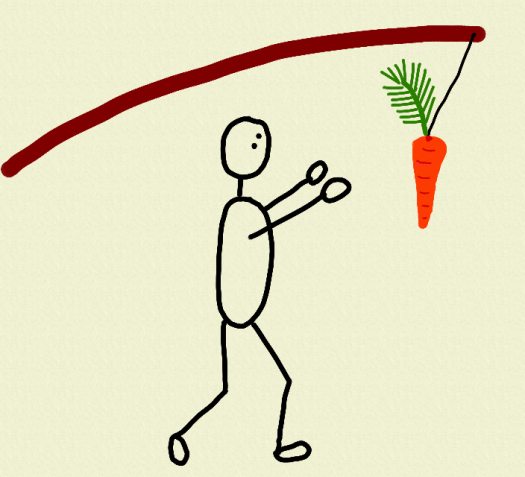
Linking a reward directly to behaviour has an unwelcome side effect – it tends to reduce how much you want to do it.

Ideally, you want behaviour to be intrinsically motivated: people do a good job because they want to, children eat greens because they want to, people turn off the lights when the leave a room because they want to.

In their book Intrinsic Motivation and Self-Determination in Human Behavior the authors, Edward Deci and Richard Ryan, write that “the research has consistently shown that any contingent payment system tends to undermine intrinsic motivation.”

Such payments can have a corrosive impact on organisational performance, especially when you are asking people to do complicated or interesting things.

People quickly learn just how much they need to do to get the payments, and no more.

Or they “game” the system – by making decisions that protect their own payments while ignoring the decisions that may provide a greater overall benefit.

It turns out that there are at least two things you can experiment with to break this cycle.

First, make rewards a surprise. If you can’t predict when you will be rewarded, you don’t link the reward to what you do, and that has less of an impact on your behaviour.

Second, it turns out that people are more motivated when given a choice between a bad task and a worse one.

Try this on your kids: see how much longer they do their homework when given an choice to do that, or clean the dishes versus being able to watch TV when they are done.

The silver bullet, however, is to aim for incentive systems that design in goal congruence.

Goal congruence simply means that individual goals are consistent with, or agree with the larger organisational goals.

It requires looking at more than just the person and their role but also consider how what they do interacts with and influences the larger organisational system.

This is easy to say, but not that easy to do.

But that is also why organisations that can pull this off should be able to show real improvements in organisational productivity and behaviour.
Are you as good as you think you are?

dunning-kruger-effect.png

There appear to be no shortcuts to becoming competent at something.

All skills, rather inconveniently, seem to take time and effort to master.

Why is it then that some people believe that they are outstanding performers at an activity when it is clear to others that they are not based on their performance?

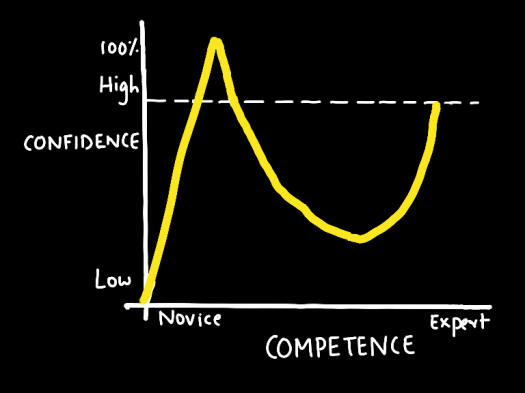
This appears to be because of a cognitive bias called the Dunning-Kruger effect, shown in the chart above.

When you are starting an activity, you may not be fully aware of what it means to be good at that activity.

As a result, you may be excessively confident of your ability and performance.

As you spend more time doing the activity and undergoing training, you become better at identifying what it means to be good.

As a result, your confidence in your ability to do the activity might also fall.

This can carry on until you reach a point where you can see that you are now doing better at the activity each time, and your confidence once again grows.

Once you are competent, perhaps even an expert, your confidence in being able to carry out the activity is now justified and is apparent to others through your results.

In essence, the way to avoid being trapped by the Dunning-Kruger effect is to become more self aware.

In her book Madness, Rack and Honey, the author Mary Ruefle writes about a remark made by the Vietnamese monk Thich Nhat Hanh on self awareness: “Before I began to practice, mountains were mountains and rivers were rivers. After I began to practice, mountains were no longer mountains and rivers were no longer rivers. Now, I have practiced for some time, and mountains are again mountains and rivers are again rivers.”

Or, as Confucius said succinctly: “Real knowledge is to know the extent of one’s ignorance.”

How to invest in yourself

you.png

For a long time people were thought of as “resources”, lumped together in a generic mass of labour that had an economic purpose.

Many organisations still think of people in this way – and it’s in the title they give the department that deals with this task – Human Resources.

Is this the right term to describe this activity now?

The Economist has an interesting article on Gary Becker, the Nobel prize winning economist, who in the 1950s began to articulate a theory of economics based on “human capital” – investments in things that raise your own value.

Becker explains that a form of capital like a physical asset is something that yields income and other useful benefits over time.

Less tangible investments such as education, health or habits can also yield income and other useful benefits – and this is what economists refer to as human capital.

The most important ways to create human capital are through investing in education, training and health.

Human capital is something that an organisation cannot separate from you.

You can’t be forced to give up your knowledge, skills or health in the same way that your house, car or bank savings can be taken from you.

This creates a quandry for organisations such as banks or employers.

A bank may be happy to lend you money for a house, knowing that they can always get the house if you fail to make repayments, but they may be less happy to lend you money for an education.

Employers may be happy to invest in job-related training that makes you more productive on their equipment or technology but less willing to invest in generic education that makes you more marketable.

This is why many investments in human capital have to be funded by people themselves, rather than relying on others to fund it for them.

One form of investment is “opportunity cost”, the earnings forgone by someone who goes on to complete advanced education. Many others rely on savings for later education.

It is also important to value the total returns from human capital accurately.

One form of return is income – more money – which seems all important because it is so visible.

But you also have other useful benefits – more interesting work, more choice, perhaps more opportunities, that arise as a consequence of increasing your human capital.

You need to take into account all these potential returns as you decide where and when to invest in yourself.

Why we should all use email less

your-brain-when-multitasking.png

There’s a lizard inside your brain.

This is the part of your brain that tries to keep you alive, and it does this by being aware of what is happening around you.

Your brain has a strong “novelty” bias. If something new turns up, you stop and figure out what this new thing means for you – is it dangerous or not?

And, because it’s such an important (or used to be important in the days when sabre-tooth tigers were around) brain function to have, it can cut through everything else you are doing to get your attention.

In other words, you can be easily distracted by something new in your environment.

And the tools we use for work and life now are designed to distract us, and as individuals and organisations, we should think hard about whether that is something we should allow.

Daniel Levitin describes how multi-tasking is bad for you in his book The organized mind.

Take email, for example. You can’t predict when the next email will come into your inbox.

When it does, you get anything from a little icon in the bottom right corner of your screen to a big ding sound if your speakers are on.

It is simply impossible for your brain not to notice that something has changed in the environment in front of you.

Your brain responds chemically, burning up brain fuel (oxygenated glucose), increasing the stress hormone cortisol and gets your body ready to fight or flee.

When this happens hundreds of times a day, it make you much less productive. Just knowing that you have an unread email in your inbox drops your IQ by 10 points.

It turns out that multi-tasking is worse for you than smoking pot.

One reason why email (and facebook and every other social communication tool) is exploding is that the marginal costs of sending a message are so low.

It costs someone nothing to send a new message.

As a result, everyone sends more of them – something they wouldn’t do if they had a limit on the number they could send, or paid a price when they sent each one.

So what we do if we want to be more productive?

There are two things to try out.

First try and limit your exposure to novelty. If you need to work on something and concentrate, turn off email and your phone for a while.

It’s hard, but you’ll get more done more quickly without interruptions and your brain will be happier at the end of that time.

Second, work in time-blocks. This simply means having set times when you work and a set time when you check email and communicate.

This is what Paul Graham of YCombinator calls Maker’s Schedule, Manager’s Schedule.

In most organisations, a recurring complaint from workers is the volume of email that comes in every day.

If you are in a position of influence to make your organisation more productive, perhaps the best way is to make it OK for people to check email once or twice a day rather than having it on all the time.

How many legs does a sheep have if you call its tail a leg?

how-many-legs-does-a-sheep-have.png

Four.

Because calling a tail a leg doesn’t make it one.

This riddle has been around for a few centuries and is often attributed to Lincoln, but actually goes back further.

It’s a useful thought to keep in mind, especially when you consider that governments often find it easier to redefine reality rather than do something about it.

At the same time, existing definitions may come under fire because they describe something as reality that people no longer think is the case.

An example is the definition of marriage.

You have a religious definition that is based on a relationship between a man and a woman.

And then you have a secular definition that is based on a relationship between two people.

Depending on how you have reached your own opinion on the matter, you may disagree with others as to which one should accurately represent reality.

In 2015, the government decided to redefine child poverty as based more around a lack of family morals rather than a lack of cash.

Campaigners for poverty reduction disagree.

In this TED talk by Rutger Bregman, he talks about how Margaret Thatcher called poverty a “personality defect”.

Bregman argues that if everyone had a basic income guarantee you would eradicate poverty and it would be much cheaper than all the programmes that try to remove it through education and helping the poor to help themselves.

The energy industry has suffered from this too.

In the period from 2006 – 2008, there was an effort by the government to redefine everything in terms of carbon rather than energy.

The focus became how to reduce carbon, rather than how to reduce energy.

When we look back at this period, it is possible that we will see that this has led to distortions in the market, and that change in definition has led to reducing efforts to invest in energy efficiency while increasing efforts to invest in green generation.

This means we use the same amount of energy – but use less carbon.

Not that making cleaner energy isn’t good for the planet.

It’s just that not using it at all in the first place is even better.

When should you use algorithms for decision making?

low-high-validity-environments.png

Many of us use algorithms every day for decision making.

We don’t always trust them, however, and tend to use them less if they have shown themselves to be imperfect in the past.

We tend to judge algorithms by how well they do at meeting a performance goal of some kind, rather than working out whether they will do better than the method we currently use.

This usually results in worse outcomes.

For example, if you drive, the chances are that you use a satellite navigation system often.

Whether it is a standalone system with built in maps or a connected system with traffic feedback like Google maps, how often have you decided to ignore the guidance and decided you know best?

The chances are that you will do better more often by following the guidance.

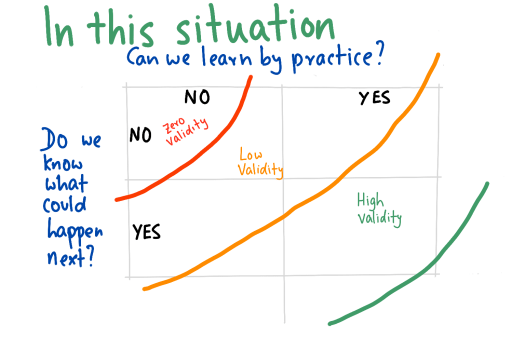
Algorithms work better in some situations than others.

Broadly, there are three kinds of situations or environments you could face.

In the image above these are categorised into learnable situations, where you can improve through practice, and the predictability of situations – whether you know what could happen next or not.

A zero validity situation is one where you can’t learn through practice and you don’t know what could happen next. A career path for a baby, for example, or the direction of world policy with Trump and Brexit.

A high validity situation is one where you can get better with practice and you can tell what is going to happen next.

Learning to play tennis for example, or learning to drive a car.

You know that a ball is going to arrive in your direction in the near future, or that you will need to drive in a straight line, or around a curve or slow down or speed up.

Between these two extremes is a wide range of low validity situations characterised by uncertainty and unpredictability.

The nobel prize winning economist Daniel Kahneman writes about how algorithms perform best in such low-validity environments.

These cover a wide range of situations including medicine, recruitment, finance, logistics and so on.

In study after study we find that simple rules outperform experts.

For example, a simple six point model outperformed doctors in judging the probability of cancers in a patient.

A stock market index fund that that simply follows the top 500 companies will outperform the vast majority of expert stock pickers.

Using a few measures to score applicants will select candidates who will perform better than those selected by “gut instinct”.

In fact, selecting applicants purely based on the information in CVs can produce a better result than selecting after an interview.

Algorithms don’t have to be complex. They can be based on simple rules based on existing statistics or common sense.

What algorithms do is help cut through the “noise” and focus on a few factors that can make a difference.

When used well, algorithms can help experts make much better decisions by helping them bypass their own cognitive biases.

We should all be using them much more in our work and lives.

When getting a cup of tea is a crucial decision

expectations-and-reality-over-time.png

In one of Austin Kleon’s talks, the writer and artist describes how the process of creative work unfolds.

It all starts with an idea.

It might be an idea for a new piece of art, a book or a charitable project.

It could be an idea for a new spreadsheet model, an asset purchase or a renewable investment.

Those count too – there is no reason why what we think of as “work” can’t be as creative as “art”.

The idea seems like the best thing in the world, especially if you have just come up with it in the shower.

Cue big, excited, smiley face.

Then you start work on that idea and begin to develop it and create packages of work to complete.

As you get deeper into doing that, you start to realise that this might be harder than it first seemed.

Once you get into the detail, various problems appear that you need to deal with as you move things along.

Cue pensive face.

At some point, you reach rock bottom. This is where nothing seems to work and you can’t see a way to fixing all the problems you have.

All you have done so far is in danger of being completely useless. You might just have wasted days/weeks/months/years on this project.

Cue sad face.

This is a crucial point in the process.

This is the time to go and get a cup of tea.

Or coffee. Or whatever that will give you a break and then let you get back to work.

It’s when you keep going and work through to the next stage in the process that things start to get better.

Just by spending time and working on the problems, you come up with ways to solve them and get things moving again.

It doesn’t seem that bad now.

Cue return of pensive face.

Then you’re starting to speed up again, and you enter the final stretch.

At this point, the work is done – whether it is art, writing, a spreadsheet or a construction project.

It’s perhaps not reached the lofty heights that you first imagined, but its a good piece of work and it is now done and you can be pleased about it.

Cue smiley face.

The message in Austin’s talk is that you should think “process not product”. Creating good work is as much about working on the process as on the product.

And a crucial part of that process is being able to recognise when you need to take a break and get a cup of tea, so that you can return to work and keep going after that.

Why change efforts fail

problem-solution-conflict.png

Organisations are constantly implementing new initiatives to improve the way in which they do things.

Why is it that so many of these efforts fail?

Robert Fritz describes an interesting way of analysing and showing these situations in his book Corporate tides.

He argues that the existing structure of an organisation undermines and frustrates efforts to change things.

Take, for example, a common problem in many organisations – a strained workload on people.

The solution to this problem is to add more people to help with the workload. So quite often managers will start recruiting.

Another problem is the need to maintain earnings and manage budgets.

Adding more people has an impact on budgets, and the solution to that problem is to limit hiring new people.

Limiting the number of people hired then has an impact on existing staff and their workloads.

The image above shows this, adapted from the method used by Fritz.

We have problems and associated solutions.

What is not immediately obvious to the people involved is that the solution to one problem can often make another problem worse.

This is because different managers are involved and don’t necessarily see the way everything interacts.

In large organisations, these dynamics can take years to play out.

A period of hiring by operational managers can lead to a clampdown in the following years by financial managers – leading to a constant oscillation between one bad situation and another.

We see this tension again and again in corporate situations. For example:

  • Between long-term investment and the need to report short-term results.
  • Between decentralised decision making and central control over the organisation.
  • Between employee responsibility and managerial control

This is why change efforts based entirely on dynamic energy and good intentions can make a difference for a while, but fail in the long run.

For example, you could bring in a manager that through sheer energy and momentum creates a new way of doing things.

As soon as that driving force is removed, the organisation resumes its normal pattern of doing things – its state of equilibrium.

What is “normal” is determined by the structure that is in place.

The structure might not be immediately obvious or visible, but it has a huge impact on whether change will succeed or fail.

The implication is that if you want real change, you can’t just fiddle with an inadequate existing structure.

You first need to establish a more suitable one – and that should be the primary focus of managers in strategic leadership positions.

The four principles for investment success

four-principles-for-investment-success.png

It sometimes seems that the process for investing money is made much harder than it should be.

Whether you are investing on behalf of yourself, putting your savings aside every month, or making decisions on behalf of a large corporate, there are four princples for investment that are worth keeping in mind.

These principles are set out in the investment philosophy followed by Vanguard, one of the world’s largest investment companies.

Vanguard was founded by John Bogle who created low cost funds designed to make investing simple.

Fans of Bogle are called Bogleheads and supporters include Warren Buffet who wrote that Bogle is the person who has done the most for investors by urging them to invest in ultra-low-cost index funds.

The four principles, however, apply beyond just personal investing and to a range of decisions we face.

1. Set clear goals

You need different approaches for short-term and long-term needs.

The same investment plan cannot be used to save for a house deposit, school fees or for retirement – you need a different approach for each one.

For short-term needs, you may better off with ways of saving money that are safer.

For long-term needs you may be happier with more fluctuation if you don’t need the money for a while, but much less comfortable with volatility if you are close to retirement.

2. Diversify asset allocation

You don’t know what is going to do better at any given period.

Quite often, something that does poorly one year can be the best performer next year.

Trying to pick winners usually results in you losing your stake.

The option that appears to work best is to keep a wide selection and pick from the entire market. The more you have in your collection, the less impact any one pick has on your results.

3. Minimise cost

Investors can’t control markets.

What they can do is control the costs of investing.

Every pound paid in fees or commissions reduces the returns to the investor.

Most managed funds do worse than an unmanaged index fund that tracks the market.

Worse, some managed funds are simply “closet” indexers, where they take large fees but simply follow the market.

Pick low-cost options wherever possible.

4. Be disciplined and think long-term.

Investing is a marathon, not a sprint.

The power of long-term investing lies in the ability of investments to compound over time.

With a long enough time-horizon small, regular investments can add up to a large return.

The mistake some people make is to react emotionally to short-term volatility and make quick, rash decisions.

Being discipled and following a long-term strategy is the best way to counter emotional responses.

Set your strategy, make your decisions and then get on with other, more important things.

The 1 kWh Energy Reduction Strategy

accumulation-of-marginal-gains.png

The business case for energy efficiency should be simple: the cheapest unit of energy is the one you do not use.

In spite of this, why is hard to get energy efficiency and energy reduction projects underway?

According to the International Energy Agency (IEA), energy efficiency is the only energy resource possessed by all countries.

Globally, we are making progress on energy intensity – it’s just that we aren’t making enough progress as fast as we need to do.

According to the IEA:

  • Global energy intensity improved by 1.8% in 2015 (2014 = 1.5%).
  • Emerging and developing countries reduced intensity by 2.5%, doing better than developed countries who managed 2%.
  • China is the best performer, with a reduction of 5.6%.

Although this is good, we need to have an annual improvement in energy intensity of 2.6% globally to meet our climate goals.

A 2.6% improvement doesn’t seem challenging. At an individual and organisational level, why is it that we can’t easily meet that target?

The problem is that globally is that more than 70% of energy usage is not covered by any form of energy efficiency performance requirement.

Two-thirds of buildings built do not have to comply with codes or standards.

In these situations, market forces determine what gets done, and people will quite often go for the cheapest option, which may not always be the most efficient.

For example, India is the third largest energy user in the world and installs a staggering amount of solar panels.

As it gets richer, however, it is also installing more air-conditioning, and so its energy demand is rising faster than the amount of new clean generation being installed.

Large projects face large challenges

Governments and policy makers want to meet climate change targets in the quickest and easiest way possible.

That is why they focus on large projects, such as the Hinkley C nuclear plant. The idea is that it will deliver both a substantial amount of secure energy and have a lower carbon impact, helping the UK government meet its targets faster.

The public debate and scrutiny, however, can be intense. It takes a long time to get such projects approved and underway.

In organisations, large energy efficiency projects that involve high capital costs, longer payback times than core business options, or the need to enter into long term agreements with third parties can face several hurdles.

You need to put together business cases, have them reviewed by panels, go through approvals processes before they are eventually accepted or denied.

Governments know this, and that is why much policy focuses on creating new infrastructure.

It is easier to get people to do something new from scratch than it is to have them fix an existing situation.

The solution may lie in a concept called ‘the aggregation of marginal gains’

Doing small things better regularly adds up over time.

This method can be traced back to the Austrian chess player Wilhelm Steinitz, who applied an ‘accumulation of small advantages’ to gain a positional advantage in his play and became the first official world chess champion in 1886.

The most current example of this approach is how Sir Dave Brailsford transformed British Cycling and the performance of Team GB in the Olympics.

His basic idea was that if you broke down all the activities involved in winning cycling races into their component parts and then made a 1% improvement in each of those components, then the gains would add up to a significant amount.

Another example is Mazda’s 1 gram strategy.

What they do is look for ways to save just 1 gram in weight from each component of the car.

The Mazda2 weighs a little over a tonne and this low weight means that Mazda can use less expensive transmission technology, making the car more affordable, more efficient and requiring less materials to build.

At the same time, the lighter car makes for a agile and nimble ride – keeping Mazda’s ‘zoom-zoom’.

Is a 1 kWh strategy the answer?

Instead of focusing mainly on large projects, perhaps applying a 1 kWh strategy is the way to get significant energy reductions in organisations.

In Europe, with two years to go before mandatory energy audit reports for large organisations have to be done for the second time, energy managers should look at the small changes they can make every day.

Look at every component of how your organisation uses energy, and see if you can shave just 1% off that.

There are 200 working days in a year. If you asked each person to work from home just 1% of that time – 2 days a year – what impact would that have on the fuel consumption associated with commuting?

If you have 5,000 lights that are on all the time, what would removing 1% of them, or 50 lamps, do to your operations?

What would a 0.5 degree change in your setpoint for heating or cooling do to your building’s need for electricity?

How would removing one printer in a hundred affect the way in which your business worked?

How would replacing one desktop in every hundred with a laptop impact your staff?

We ignore small wins too often because they don’t seem worth the effort.

The point, however, is that the “long tail” of small wins could get you to where you need to be in terms of energy efficiency without stumbling at all the hurdles that are associated with large projects.

The ‘aggregation of marginal gains’ strategy has worked in fields as diverse as sport, automotive manufacturing and healthcare.

There is no reason why it shouldn’t work across industry and business in general.