Some lessons from business and writing

writing-and-business.png

The writer Lee Child and businessman Sir Hugh Sykes were interviewed during the Off the Shelf Festival of Words in Sheffield.

They do two seemingly different things – one writes the Reacher novels, sitting down on the 1st of September and writing a book by March. He reads 300 books a year.

The other has bought 20-30 companies over the course of his career, which started by becoming the CFO of a FTSE 500 company in his 20s, and attributes his success to hard work and a good dose of luck.

Two things in particular stood out for me.

Hugh described how he learned to use money to build things. It was a simple process that he picked up from Jim Slater.

Buy a company. Improve it and add value. Float it on the stock market. Use the shares with increased value to buy another company. Rinse and repeat.

It’s simple, he said, but not easy.

This echoes a favourite saying of Warren Buffett. The principles of investing are simple, but that doesn’t mean it’s easy. Your worst enemy is yourself sometimes, and the emotions – the fear and greed that drives decision making.

Hugh also said that when you put your mind to it, it’s amazing what you can do and he found that very few problems were truly insuperable.

One final point – business planning once again is simple. Where do you want to go – what’s your objective? How are you going to get there? What do you need – what are the resources?

Answer those three questions and you are on your way.

Lee Child, on the other hand, got into writing after he lost his job in the TV industry doing something very specialised. The skills weren’t transferable, and he had to learn to write again.

He once had Reacher say “I tried it their way. Now I’m going to do it my way”. And that served as a guide for him as well.

When he started writing, he didn’t plan out the next 22 years and books. Instead, he started to explore through his writing and the character and story emerged.

An interesting observation he made was that sometimes people look down on mass-market fiction, thinking that somehow it is less literary and so less important or easier.

He pointed out, however, that only a few people buy Rolls Royces, so you can create a custom product for them, and someone will buy it.

A mass-market car has to appeal to many more people, and so is actually harder to put together in a way that is successful.

This has parallels in business – it’s easy to create a niche product that a specific group want, and often that’s the way to get started.

To build a big business with a wide market, however, is a much bigger challenge.

Easy reading requires hard writing.

Two lessons that I took:

  1. Niche is easy. Mass is hard.
  2. Simple does not mean easy.

Which moments matter? The Micro-Moments model.

micro-moments.png

The Internet has grown up.

We are now always on, always connected. And this means there are some interesting things that are changing about the way in which we connect.

Almost 90% of people have a phone close to them, day or night. Over two-thirds check their phones within 15 minutes of waking up. We spend nearly three hours on our phones a day.

But each session – the time between opening and closing the phone – lasts just over a minute.

So, what’s going on?

What’s happening is that there are hundreds of moments when we get our phone out and use it. From a quick text, dropping an email back, checking who that actor is during a programme, finding the closest petrol station, and so on.

We’re constantly getting our phones out, checking something and then moving on.

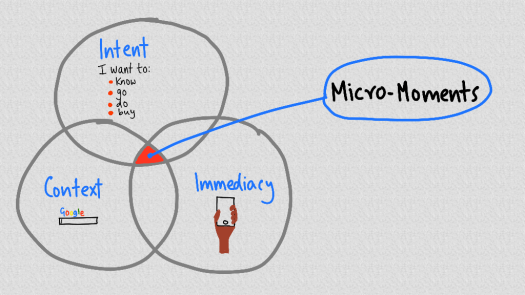
In 2015, Google came out with a name for these instances of time – calling them Micro-Moments.

They argued that interactions with customers are moving from “sessions to spurts” – hundreds of small, individual moments that lead up to making a decision.

They suggested that moments that matter – the key ones for anyone using the internet to interact with someone else – occur when three things intersect:

  1. Intent: The “I want to…” that triggers the impulse to act.
  2. Immediacy: What’s the quickest way – usually getting out the mobile phone.

3: Context: What am I searching for – and when might I do it?

Understanding which moments result at the intersection of these three things can guide you in creating resources that help.

As a marketer, the implications are obvious – you need to understand what someone wants or needs, and realize that they are going to open their phone and run a search. In addition, people usually want to know something, go somewhere, do something or buy something.

If you want to be in the game, you need to turn up in those search results, provide useful information and do it quickly – otherwise they will move on somewhere else.

This means that users are driven more by how relevant the information is that turns up than the brand or people providing related information.

This also matters, however, if you’re trying to organize knowledge and information across a business so you can work more effectively.

Where can you find the latest guidance on something? Where is the latest version of that model? Which presentation should you work from?

Organizations can now design internal information systems structured like the Internet does things. Instead of files in folders, you can have a collection of resources that people search when they need something.

You still need to be able to come up with useful and relevant material quickly that will help your teams function more effectively.

People act on information. How you give them that information will increasingly make the difference between succeeding and failing.

The business of keeping things cold

cold.png

Keeping buildings cool in the United States takes as much electricity as used in Africa for everything.

We can easily miss the amount of effort that goes into keeping things cool.

We use cooling systems to air-condition our homes and commercial buildings, keep food fresh and transport it across countries and use it in countless industrial processes – from medicines to preservation.

The internet couldn’t survive without the vast amounts of cooling that go into keeping the data centres that power the internet economy going.

Increasing urbanization, with the majority of the world’s population living in cities, will make the challenges and problems associated with cooling worse, not better.

For example, the United States uses more energy for air-conditioning than the rest of the world put together.

Many developing countries, however, are getting richer fast and are in hot parts of the world. If they were to use air-conditioning like the U.S, they would use around 50 times more – and half the world’s energy could go just on cooling.

This could happen quickly. In 2010, Chinese consumers bought 50 million new domestic a/c units and 95% of Chinese homes have a fridge, compared to 7% in 1995.

If India had the same proportion of refrigerated trucks as the UK, the fleet would rise from the tens of thousands to 1.5 million vehicles.

The problem is that keeping things cold is a very polluting activity. The technology being used is a hundred years old, relies on chemical refrigerants and has plodded on – generally ignored in the background.

As we move into a low-carbon economy – increasing cold using conventional methods is not going to help us reduce emissions or stay on target.

That means there are a number of opportunities out there.

For example, we could learn how to use and re-use cold energy more effectively. With better data collection – using the Internet of Things (IoT) approach, we can figure out how to be smart in the way in which we cool things.

Keeping things cold needs energy – so using free energy from renewables, being smarter about when energy is used based on supply and demand and moving to ways of storing and moving cold energy rather than creating it on demand using electricity are all ways to be more efficient.

The challenge, as always, is to make a business case for action.

Why can some people never agree?

worldview.png

The world is full of conflict.

The word conflict can be used to describe visible events – like war or a battle, an internal struggle – like one where someone is torn between principles, or the interplay and opposition between individuals.

But what causes this conflict in the first place? For example, why is it possible for two leaders in an organization to differ bitterly over what they should do and how they should work together?

The thing that is probably causing this is a mismatch between their worldviews.

A worldview is how someone sees things. It takes into account their knowledge, upbringing, language, philosophy, emotions and so on and fuses them into a lens through which a person sees and interprets what is happening around them.

The mistake many people make is thinking that they can change someone’s worldview.

To do so would require completely reprogramming them – starting with their language.

For example, you may have been at a party where someone from another culture said “Pass the salt”, instead of “Pass the salt, please”.

You might have been a little put out by the first statement and thought the person as a little rude.

The problem, however, is that some languages have respect baked in, while others, such as English, need you to add respect with an additional word like “please”.

Unless you interpret the sentence you are hearing using the language that the person who is speaking is most familiar with, you are likely to get it wrong.

So, if you can’t change their point of view, what can you do?

The answer (cutting out a long of theory) is that you have to come to an accommodation.

An accommodation is a compromise – something you can both live with. Not a situation where one wins and the other loses – but a situation that both of you can say is acceptable.

It also helps to make an effort to see why the other person has a particular worldview. Leo Apostel writes that there are six things that make up a worldview:

  1. Explanation: A worldview can explain what is happening around you now.
  2. Futurology: It can describe possible futures and what might happen.
  3. Values / Ethics: It gives you answers to the question “What should you do?”.
  4. Theory of action: It tells you how to act in order to reach your goals.
  5. Theory of knowledge: It helps you tell true from false.
  6. Origin theory: It tells you where it came from – how it was created.

It isn’t hard to look at some religious worldviews and see how conflict between religions can emerge from how its followers answer these six questions.

But this remains true for cultures, communities and businesses – worldviews are likely to be in play everywhere people interact.

One approach to creating harmony is by applying the Golden Rule: Do unto others as you would have them do unto you.

But there is an even better rule – The Platinum Rule.

The Platinum Rule says: Do unto others as they would have you do unto them.

The STARTegy Model: a strategy for getting started

Startegy-model.png

Modern business is usually pretty lean. Investment capital is scarce, costs need to come down all the time and the budget for innovation is minimal.

In this environment, how do you decide what to do – where to put your money and how to develop an opportunity?

A misspelling of the word strategy as startegy may provide an insight.

STARTegy as a word does not appear to be widely used, so it might be helpful to appropriate it to describe what we need to do when we get started on a new opportunity.

Most business opportunities, whether inside organisations or as a new start-up can be seen as projects. The objective of the project is to figure out a new source of revenue.

Most people are familiar with the Business Model canvas, proposed by Alexander Osterwalder. This is now almost a standard model to use when thinking through what your business is going to do and consists of 9 areas:

  1. Value proposition: In essence – what are you going to do or offer?
  2. Customer segments: What is your market segment and the kinds of customers you are going after?
  3. Key partners: Who are the people who can help you get to those customers?
  4. Customer relationships: Who, precisely, are you going to approach?
  5. Channels: How, precisely, are you going to get to talk to them?
  6. Key activities: What do you need to do in your business?
  7. Key resources: What things do you need – money, people, technology?
  8. Cost structure: What is it going to cost to deliver your product?
  9. Revenue streams: How are you going to make money?

This is a good start and helps you check that you have covered all the basic points needed for an internal or external project, especially if you need investment.

But, to put a STARTegy in place, you need more than just a business model.

A business model is a nice, neat, boxy thing that gives you an impression of precision and rationality.

But, the real world is messy and unpredictable.

The way in which we make sense of the real world is through story – through a narrative that helps us make sense of what we see in the world.

So, the next part of the STARTegy model is the story – the beginning, the middle and the end of a coherent narrative that helps people see what you see.

The story you tell will be told, retold, changed, bits taken away, bits added – and over time you will come up with one that is a good one.

But that still isn’t enough.

The capstone of the STARTegy model is making sure that what you have provides sustainable competitive advantage.

There is no point having a great idea for a business if an existing player can simply come along and do what you do pretty quickly and wipe out your market share.

You can avoid this by asking yourself four questions.

  1. Does what you do have value? Do you have something here that really makes a difference – increases revenue, cuts costs, saves time or saves effort?
  2. Is what you do rare? Is it hard to find an alternative to the product or service you provide?
  3. Is what you do inimitable? Is it difficult to copy or recreate what you do?
  4. Do you have an organisation? Do you have, or can you put in place, an organisational structure that can deliver your product or service?

If your answer to these four questions is yes, then you improve your chances of having something can compete and grow or take market share.

In conclusion, the STARTegy model suggests that you need three things to make an internal or external project successful:

  1. Have a clear business model.
  2. Tell a good story.
  3. Make sure you have a source of sustainable competitive advantage.

The anatomy of a thought leader

thought-leader.png

What exactly is a thought leader?

The term was used as early as 1887 and has since become very popular. But what does it mean?

Lauren Hockenson wrote that the editor of Booz & Company’s business magazine, Joel Kurtman, said a thought leader was someone worth talking to.

An alternative way to express that might be to say that person is someone worth listening to.

You might think that a natural source of thought leaders would be academia – that is where new ideas and thoughts are professionally generated after all.

The nature of modern academia, however, is a quest to find out more and more about less and less. It is hard to make it relevant to non-academics.

Some academics do make an effort, as do other professionals, to move beyond the confines and boundaries of their own disciplines to reach out to others and challenge existing norms.

You might call them a new intellectual class. The political scientist Daniel Drezner writes about the distinction between public intellectuals and thought leaders, saying the first are sceptical and analytic while the latter are evangelical and promote a particular point of view.

This is perhaps not a useful categorisation and the key measure should instead be the degree of critical thinking.

A point of view that draws on one’s narrow experience and successes and claims they are universally applicable is less critical than one that takes a number of points of view and generates a considered (critical) approach.

Thoughts and ideas are not much use if they are locked away. People that share and communicate what they do are more likely to find their ideas received by a larger audience. If they are lucky, they may go viral.

Someone that has something to say on a topic will probably have some expertise in that topic. At the same time, there is always more to learn.

There are a few observers that conflate cause and effect. For example, this definition suggests that thought leadership is very much about making money.

I doubt, however, that the profit motive alone is enough to sustain the work needed. Warren Buffett probably does not write his shareholder letters because they make him money but because he enjoys writing about investment principles.

So, how can you identify a thought leader? Perhaps the following checklist might help:

  • They are interesting – saying things worth listening to.
  • They challenge existing norms – helping you think more clearly.
  • They share their ideas – communicating freely and openly.
  • They care about their subject – they have taken the time to learn and continue to develop their knowledge.

How to ask a question

ask-a-question.png

Lawyers are taught never to ask a question to which they don’t already know the answer.

The smart ones also know that the right question to ask is the one that gets them the answer they want.

The issue with this approach is that one of the ways we try and make sense of situations and the world around us is by asking questions.

If the questions we ask lead to pre-planned answers then they don’t really help us gain an insight into the situation and look for alternative explanations.

A more insidious approach to questioning can literally re-write your memories.

The psychological scientist Elizabeth Loftus studies false memories. She found, for example, that showing people a situation – for example a car accident and then asking them a question like “How fast were the cars going when they smashed into each other” results in much higher estimates of speed than when the word smashed is replaced by hit.

In the same situation, if she asked them whether the blue car that drove past had something on its roof, people were more likely to say they had seen a blue car, even though the actual colour might have been green. The question in this form had distorted their memory.

Pollsters can use this approach to influence how you answer their polls. If they couch their question in the form of a idealogical position or in relation to a well known person, people are more likely to support it than when the question is posed in the form of a cost that they need to pay.

For example, the questions “Should we do whatever it takes to maintain the existing trading relationship with the EU” vs “Are you willing to pay X billions in order to maintain the existing trading relationship with the EU” may result in different and contradictory ratings of commitment.

If you are doing anything in business – trying to see if a new product has market demand, working on a culture change programme, or trying to transform operations – you probably want the questions you ask to give you useful and actionable information.

That means you need to try and ask questions that don’t have an inherent bias or lead the person in a particular direction.

For example, if you ask someone whether the government should force an outcome versus whether they should regulate it, many people will react viscerally and negatively to the word force and perhaps in a more nuanced way to the word regulate.

No one likes to be forced, but many will appreciate the need for regulation.

Finally – if you want to know whether there is demand for a product – there is a particular line of questioning that is very useful.

Don’t ask someone whether they want your product. Instead, ask them to describe how they currently approach the area of business that your product is designed to improve.

If they have a problem in that area, they will tell you what it means for them – and if your product really does solve that problem you may be on the right track.

How they currently do something is also the best indicator of how they are likely to do things in the future. If they are very conservative and risk-averse, you will not convince them to become innovative risk takers just because that is how you work.

If you really want to understand someone, ask them what they do or have done – not what they are going to do.

Why you should create lines, not dots

dots-vs-lines.png

It takes time for people to see what you can see.

You might have a brilliant idea: something that saves time, money, effort – or have a new approach or product that is going to bring huge benefits to someone else.

But, most people aren’t going to see it your way straight away.

Mark Suster, an entrepreneur, venture capitalist and blogger, introduced a great way of thinking about this. Thanks go to Dimitrios Kourtesis who shared this idea with me.

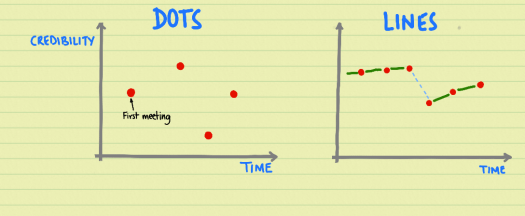
When you first meet someone, that creates a single data point – both for you and them. Your interaction creates a moment of credibility (Suster talks about performance).

The picture above shows this event (adapted from Suster’s original images).

In subsequent interactions you build up more data points. You learn more about each other, what you do and how do you it and so on.

Over time these interactions create more dots on the graph.

The key question is – are these dots connected or not?

If you have a set of random dots that don’t seem to have a clear relationship between them, people are going to struggle to connect them and understand what you are pitching.

People listening to you need to “connect the dots”, see the storyline that runs between them and helps them make sense of your proposition.

It doesn’t matter if there is a break or a change in the story. For example, in the second chart, you might have a particular set of dots connected by a line – and then something changes causing you to go in a different direction and you then have a new set of dots connected by a line.

The connection – the storyline – is what people buy into. It’s what allows them to see the pattern in what you are doing and start to trust that you have a plan and a destination in mind rather than just doing random activity based on what’s latest and loudest.

Suster recommends that you try and increase the number of data points with short, relevant updates when possible. Start well before you need something, and by the time you go for the “ask”, the people you are talking to can see the pattern in what you are doing and that reduces their perception of risk and increases their willingness to invest in you and your idea.

Reja Khadjavi of Shoelace has a good post on how regular, consistent updates to their investors helps them strengthen relationships and provides examples of what they actually send out.

It might seem basic, but sometimes we can get lost in the detail of what we do and forget that something that seems simple and obvious to us can be complex and opaque to someone else.

The way to get someone else to see what you see is to help them see the lines that connect what you do.

Creating a strategy with 3 circles

3-circles.png

How do you come up with a strategy for your business?

This can be an unexpectedly hard question to answer. We tend to think of things like USPs – the unique service propositions that differentiate us from others – but are we missing the bigger picture?

Joel E. Urbany and James H. Davis developed a simple tool to help work through this problem – the 3 Circles model.

An adapted form of the model is shown in the picture above. In essence, we need to consider 3 broad areas:

  1. What we do.
  2. What customers need.
  3. What competitors do.

If you draw a Venn diagram representing these three areas, you end up with seven sections, each of which are important to review and consider.

Urbany and Davis suggest that you carry out a thinking exercise. First, what do you think your customers want? Next, how well do you think your products overlap with their needs? Finally, how well do your competitors do it?

Then, work through the various sections of the Venn diagram.

In section 4, if you and your competitors both do something that doesn’t overlap with what your customer needs that’s obviously not much use. You need to find a different customer for those services or stop doing them.

Sections 7 and 5 are ones to think about carefully. You have an advantage in some areas and your competitors have an advantage in others. If neither of you can meet all your customer’s needs, then you need to figure out how to overcome your weaknesses in their eyes when it comes to what your competitor does.

Section 6, where all the circles overlap, is a bit like being in stalemate. You and your competitors produce something that your customer needs about as well as each other. It’s a 50:50 chance which one of you gets the job.

The amount to which there is a strategic fit between your products and your customer’s needs is important.

Urbany and Davis point out, however, that the green area – what you do better and what makes up your USP, is often much less important than you think to the customer.

The thing that comes across from working through the 3 circles model is that if you think about things only from your point of view, then you’ll end up being squished into a small space that you think is your sweet spot in section 7.

If you speak to your customer about what they need, you might discover a vast empty space in section 2. where neither you nor your competitors are yet providing a service and where you might be able to grow your offering.

Perhaps not surprisingly, if you want to grow your business, the best strategy is to try and see things from your customer’s point of view.

What kind of impact does a short-term strategy have?

sandbag-strategy.png

A short-term strategy is one that focuses on what is going to happen soon rather than what is going to happen over time and what you should do as a result.

In business, that might mean focusing on current stock prices, maximising near-term earnings or working out what you are going to say during the next quarterly earnings call with analysts.

It also means that if something is going wrong, you try and patch it up, fix it with something quickly.

Ari Wallach in his TED talk calls these sandbag strategies.

This is where you know there is bad weather on its way, the rivers are overflowing and the dam is broken, there has been no investment and so all you can do is put sandbags around your property.

And this strategy works. The sandbags protect you. The water goes down and everything is back to normal, after the cleanup and disruption. You can do this time after time.

According to Ari – “the insidious thing about this strategy” is that it works – it can help you make numbers, get elected and look like a hero.

In 2012, Francois Brochet, Maria Loumioti, and George Serafeim from the Harvard Business School tried to work out what impact a short-term strategy had on companies.

The hard thing is working out which companies have a short-term approach and which don’t. The team decided to take quarterly conference call transcripts and analyze them.

They coded the words used by senior managers and worked out a measure for short-termism based on a ratio of words that referred to the near-term (a year or less) and the words that referred to the long term.

After looking at over 70,000 transcripts they found that on average more companies focus on the short term rather than the long term.

At the same time, not as many companies are being managed for the short term as one might imagine – many firms are being run with a long-term mindset.

The interesting thing is that companies that are managed for the short-term tend to arract investors who also think of the short-term.

That creates pressures to perform and meet the numbers rather than build the business.

The researchers found that such an approach results in more volatility in stock prices and increases the risk and costs for investors.

As is often the case, a quote from Warren Buffett succinctly sums up the risks inherent in a short-term focus when it comes to business.

Charlie and I cringe when we hear analysts talk admiringly about managements who always “make the numbers.” In truth, business is too unpredictable for the numbers always to be met. Inevitably, surprises occur. When they do, a CEO whose focus is centered on Wall Street will be tempted to make up the numbers.