Humanity as a service: The future of work for us

robot-human-work.png

We work with computers now – that just seems natural.

Many people have jobs that involve using a computer at some point – it’s hard to think of many occupations that don’t.

Thirty years ago – that would have been unthinkable. Fifty years ago, people would still have scoffed at the idea of individuals owning computers.

The way in which we produce work and output in the future is inevitably going to involve technology.

Which means we should ask ourselves where we might fit in?

Robots – AI – all the tech we have – are still essentially logic circuits. They do things they are programmed to do.

If we could take the knowledge inside a doctor’s head, a lawyer’s head and turn it into a series of steps that could be done by a computer using a decision tree, then we’d be able to free up some of that professional’s time.

In many offices, there is someone given the task of comparing columns of figures and picking out the ones that don’t match.

If anyone is still doing that by eye – they need to get more skills – and quickly.

We’re not going to beat robots at tasks that involve calculation or large amounts of numbers.

We will be able to automate them to perform certain tasks – from doing our accounts to managing our heating.

Many systems come with this technology increasingly built in.

NEST can warm your building when it knows you’re coming home. Landrovers warm up your car in the morning ready to go to work.

So, what does that leave humans to do?

What’s left are essentially human tasks.

Things like being creative, using our judgement, having empathy and doing critical thinking.

Some of us will also be needed to clean and maintain the robots that do all the work.

But increasingly, we’ll spend our time doing work that comes up with new and better things and helps others – especially in ageing economies.

In other words – we need to shift to providing humanity as a service.

How to build something that is actually useful

lean-canvas-example.png

What should we do when we’re trying to start something new – whether it’s a new product line within an existing business or a startup dedicated to the idea?

All too often, we can come up with ideas for products and services and go quite far down the track of designing and creating them before finding out that the market isn’t that interested.

Alexander Osterwalder came up with the Business Model Canvas – a way to model a business using a one page framework.

This was much simpler than writing a 50-page business plan, and was enthusiastically adopted by the startup community.

A variant of the model by Ash Maurya is the Lean Canvas.

While the Business Model Canvas is designed to address all aspects of a business, the Lean Canvas focuses specifically on new product development.

The Lean Canvas retains five components of the Business Model Canvas:

  • Value proposition: What does the customer get?
  • Customer segments: Who is going to want this product?
  • Channels: How are we going to get to speak to them?
  • Revenue streams: What will they be willing to pay?
  • Cost structure: What will it cost us to deliver the product or service?

It adds four new components.

First – what is the problem we are trying to solve for a customer?

As Theodore Levitt said, People don’t want to buy a quarter-inch drill, they want a quarter-inch hole.

If the product doesn’t address a real problem that potential customers have then it’s hard to justify its purchase.

Then, what is the solution we are proposing?

The solutions needs to be simple – easy to understand. That doesn’t mean it has to be easy to do – or the customer could just do it themselves.

It must be possible, however, to see how the solution solves the problem.

We then need to look at two more components – metrics and unfair advantage.

Success or failure needs to be measured in an objective way and for that we need to select metrics.

Selecting a metric directly influences the activities we do in order to improve our score on that metric – so it’s important to select a few and important ones.

Finally, there isn’t much point spending time and money developing a solution if it can be easily copied or bought from someone else.

We have a competitive advantage only when it is hard for others to compete with us.

So, in summary, in order to build something useful, we need to start with a customer’s problems, come up with a solution, make sure we are doing the right things, and make sure that what we do is unique to us.

An easy list to write – but not a simple one to do.

How can our information systems help us be more productive?

delone-mclean-is-success-model.png

Productivity is defined as output per hour by workers – and it has flatlined in the UK over the last ten years.

Our output depends on the tools we work with – and information systems are a vital part of that toolkit.

There are some who argue that we have not invested enough in technology while others think that recent technological changes have less potential to transform productivity.

So – how can we select and implement information systems that will improve productivity?

William Delone and Ephraim McLean came up with a model to measure the success of information systems in 1993, which they they revised in 2003, called the D&M IS Success Model.

It remains one of the most influential theories in the field, cited in in thousands of papers, and is a useful one to keep in mind when looking at a new system.

The model has 6 dimensions that are linked together with process flows and feedback loops. They influence each other, and in turn some elements are influenced by others.

The model begins by looking at quality – and sees quality as having three dimensions: information quality, system quality and service quality.

Information quality is all about what the system stores, delivers to the user, and produces for the user.

System quality relates to how the system works – does it do what is needed quickly or not?

Service quality depends on the organisation behind the system – are they helpful and is there guidance that is easy to follow or not?

These dimensions need to be looked at independently to assess quality fully.

The next two dimensions are user based.

First there is the user and the system – and this needs to be looked at from two angles.

How does the user plan or intend to work with the system?

How does the system actually use the system.

The quality of the system directly affects these user choices – we may intend to use a system, but if it is of low quality or the information is not good enough, we probably won’t.

We can measure user satisfaction based on their experience of using the system and their feelings about quality.

The last dimension looks to measure net system benefits.

These need to be some combination of saving money, saving time, increasing productivity and increasing sales.

The D&M IS Success Model seems deceptively simple – but it is a “parsimonious framework” that organizes many of the success metrics from research.

If a system scores well on these six dimensions then it should help us be more productive.

How much will BREXIT cost the UK?

zopa.png

Is there a ZOPA between the EU and the UK when it comes to a divorce settlement?

A ZOPA stands for Zone of Possible Agreement – also called a bargaining range.

In any negotiation we end up with two roles – a seller and a buyer.

The seller has a high price they want to get and the seller has a low price they would like to get.

The amount wanted by the EU has been talked about as being in the range of €100 billion.

Brexiteers in the UK, on the other hand, want to pay nothing.

A ZOPA exists if there is an overlap between the minimum a seller will take and the maximum a buyer will offer.

Refining the numbers, it appears that liabilities for the UK may be in the region of €80 billion but offsetting claims could reduce the total to €60 billion.

Europe may now want around €50 billion euros of £44 billion while the UK might be offering around £20 billion.

Both sides are tight-lipped about the actual amount.

If the buyer’s maximum price is less than the seller’s minimum – £20 billion vs £44 billion, for example, a negative ZOPA exists.

It may be possible to overcome that with other incentives – for example agreement on worker rights, acceptance of EU laws and so on – all of which come with political and legal complexities.

In the end, however, if the two parties don’t reach an amount acceptable to both, there will be no ZOPA and both will have to walk away.

The negotiations continue…

Why you should trust your gut instinct

coin-toss.png

We’ve all probably been in a situation where we can’t decide between two options and someone has said to just flip a coin and let it decide.

It turns out that this may be a very good approach indeed – but not quite in the way we think.

For a long time we assumed that people were rational creatures, governed by a conscious mind that made decisions based on logic.

Relatively recent research found that we weren’t as logical as we though we were – behavioural economics showed that we acted in ways that weren’t consistent with logic.

Behavioural economics, in turn, is criticised by some because what happens in the laboratory does not always show up in the real world.

For example, altruism shows up more often than we expect in experiments, as people share when they have no need to do so – but at the same time do they only share because they are being watched in an experiment?

As we became increasingly aware of the vast number of things the brain does without any conscious intervention – useful things like breathing and digestion – some researchers also realised that our body seemed to know things before our minds caught up.

For example, if people played a card game with two sets of decks, one of which was rigged, they eventually worked out that something was wrong with one of the decks.

When researchers monitored players using methods like measuring galvanic skin response – how much they sweated – the found that their bodies seemed to figure out the wrong deck well in advance of their conscious minds catching up.

Somehow their bodies were taking in a lot more information through their senses and using all that to figure out what was going on – and reacting to their findings emotionally – raising heart rates and sweating more.

The work of Antonio Damasio, described in David Eagleman’s book Incognito: The secret lives of the brain, forms the foundation of much of this research.

Damasio, a neuroscientist, found that patients that had suffered damage to their brains and were no longer to process emotion and the kind of signals their bodies were giving them – so called somatic markers – were unable to make good choices.

In the card deck example above, they were unable to distinguish the bad decks, even after they had been told there was one.

In other words, our ability to make wise choices is fundamentally linked to the reaction our bodies have when confronted with the sensory data in front of us – and a completely rational Spock like approach will more than likely fail us.

What this means is that when we have to make a tough decision and flip a coin – instead of focusing on which side lands, we should be monitoring our body’s reaction.

If we have a sense of relief when a particular side lands or we get knotted up with tension – that is our body’s way of telling us which decision is the right one – through gut instinct.

Then, we should ignore the coin toss and go with our gut.

How to avoid being trapped in an echo chamber

echo-chamber.png

The giant corporations that we interact with on the internet are trying to understand what we like so that they can feed us a processed diet of stuff that is similar.

Amazon, for example, suggests other books we might like. Newsfeeds on the iPhone change based on what we click on. Google creates personalised search results based on our search histories.

Mainstream news channels pick stories with an eye to what other news channels are likely to talk about – creating an increasingly homogeneous mix of information and news.

Many people simply choose to ignore stuff they don’t like or don’t agree with on the internet – creating a system where what they see is more of what they already see.

The main danger with this is that we could get trapped in an echo chamber.

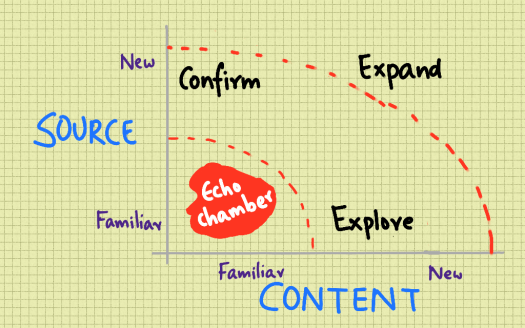
Colin Raney has a nice way to show this in a 2×2 matrix – shown in the picture above.

When we see familiar content from familiar sources – that’s the time to be wary.

If people and sources we know are repeating the same thing it could be true.

Then again, it might simply be an echo, as the same thing bounces off and is repeated and amplified by others in our network.

We may end up with a distorted version of what is happening.

When we see familiar content from new, independent sources that might help confirm a story.

The idea of independence is key. The content needs to have been gathered and checked independently.

If we see new information from familiar sources, especially ones we trust, that might be something to explore further.

We may learn something in these circumstances.

Finally, when we see new content from new sources, we expand our horizons and are exposed to novel concepts, ideas and stories.

The technology and media that surrounds us are trying to understand us better and deliver more tailored content.

Paradoxically, in doing that, they might make it too easy for us to settle into a situation where we believe that what we see is all there is.

Politicians know this.

The strategy all over the world now is to talk only at people that already believe in them or that might be on the fence. The opposition can safely be ignored.

Comfort leads to complacency – instead we might want to be curious, look for facts, be sceptical and look at things from multiple angles.

Do we all need to think like journalists now?

Why science can’t help us to understand ourselves

scientific-method.png

We think we are much better off these days than people that went before us.

And, using virtually every measure that matters, that is the case.

As Steven Levitt and Stephen Dubner write in Superfreakononics, whether it comes to “warfare, crime, income, education, transportation, worker safety, health”, many of us live in the most hospitable of times.

The reason for this is the scientific method and its rational approach to reasoned thought.

Our use of the scientific method has helped us create the modern world through a system of thinking.

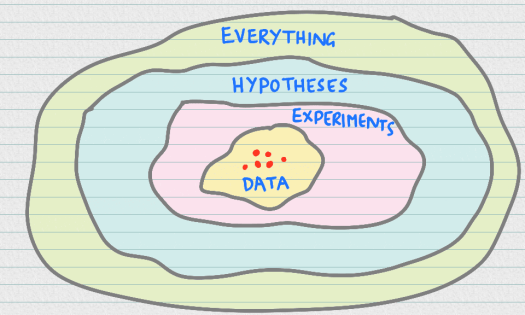
In essence, we look around us at everything and wonder why it is the way it is.

We look for explanations – create hypotheses – guesses at what might be going on.

Perhaps it rains when we do a dance, for example, or that the lines on our palms can tell what is going to happen to us.

Then, and this is the clever bit, we do something else.

We design an experiment to see if our hypothesis is right.

We collect real world data and see if what we predict will happen according to our hypothesis matches what happens in reality.

It seemed obvious for many years that a heavy object would fall faster than a light object when dropped from a height.

It took an experiment – dropping a heavy and light ball from a height and seeing when they hit the ground – to show that they fell at the same speed. Their weight made no difference to the outcome.

The experiment showed the hypothesis was false and so we needed another one.

The problem is that life quickly becomes more complicated from that point.

While the scientific method changed the course of human history and gave us cars, trains, planes, rockets and the rest of the modern world, it also created an illusion that it could explain everything.

And that’s wrong, it seems. The history of science shows that new hypotheses come along with irritating consistency to upend everything we know.

Simple Newtonian physics morphed into relativity and the simply incomprehensible world of quantum mechanics.

The logical end result of all this, as described in Pirsig’s Zen and the art of motorcycle maintenance, is that “The number of hypotheses that can explain any given phenomenon is infinite”.

What this means, in short, is that we think science will help us move towards the truth.

Where it matters, however, science simply increases the number of truths – what we believe to be true might not be true a few years from now.

Truth, rather than being fixed and unchanging, may be something we accept as true for the moment.

The point is that the scientific method has taken taken care of the material needs of many people – food, shelter, clothing.

The mistake we make is when we assume that because it explains so much, it explains everything.

The problem, again from Pirsig, is that the structure of reason based on rationality is “emotionally hollow, aesthetically meaningless and spiritually empty”.

We need to look elsewhere for meaning.

How to design a pilot

risk-reward.png

When we assume, Oscar Wilde wrote, we make an ass out of u and me.

Much of the time we’re not sure what option to take.

Whether its something simple, like changing the order in which we do things in the morning or a more complex situation, like deciding to move to a different country or go back to University for a graduate degree, we still don’t know how things will turn out.

With organisations – we face the same problems when trying to get a new customer to work with us, pick a supplier or decide in which projects we should invest company money.

So, how do we make a decision in these circumstances?

Some people decide, on the basis of their experience, that a particular course of action is appropriate. Then, they take things personally.

Questioning that approach is the same as questioning their competence or experience – which makes it difficult to have a discussion about the range of options.

This leads us down a binary decision path – either we do what is suggested or we don’t, and we might succeed or we might not.

The thing is that often the options are not really binary – there are more things we could do, if we were open to them.

Take the moving to a different country choice, for example. It’s different having a holiday in a country to moving there permanently.

It might be wise to try a longer holiday, see if there is a way to experience it for a three-month period, or spend some time asking people that have already done a similar move about their experiences.

These are pilots – experiments and research that try and test and validate our assumptions.

Ideally, pilots should be something quick, easy and cheap that we can try out and see whether an idea is worth doing and investing more time, effort and money in.

This happens all the time with new television programmes – a pilot episode is shot to test with audiences – and how they react may make the difference between getting funding to create a series or having to go back and start again.

Good pilots are designed, however, with one clear thing in mind.

They limit the downside, while leaving the upside uncapped.

This is what Nassim Taleb calls optionality in his book Antifragile.

Adherence to this principle, according to Monish Pabrai in The Dhandho Investor, is what has made a particular Indian community, the Gujaratis, so successful in the United States – owning tens of billions of dollars worth of assets.

Dhandho is a word that means “endeavours that create business” and it is based around a low risk-high return strategy that is all about “Heads I win; tails I don’t lose much”.

Taking a more well-known example – it’s what Richard Branson did when he set up his airline in 1984. He leased a single used Boeing 747-200 on condition he could hand it back after a year.

His downside was limited to a year of operating the plane and he knew that he could get money back for it if things went south.

Virgin Atlantic now operates 39 planes and turns over more than £2.5 billion a year with nearly 9,000 employees.

The opposite of an assumption, perhaps, is not a certainty but a pilot.

How can you get there faster?

sequencing.png

If you’ve ever been out with kids you will have experienced this.

Let say we set out on a walk someplace.

Everyone sets off at the same time from the same place. All is fine at this point.

Then, inevitably, the older kid starts to pull away from the group, walking faster, with one adult trying to keep up.

The younger one, along with the other adult, goes more slowly.

Within a short amount of time, a gap opens up between the members of the group.

In longer walks or hikes, this can become fairly substantial.

So, how long will it take for the group to reach its destination?

Some of us assume that with such a group, the time that it will take to get where we need to go will be based on the average speed of the individuals in the group.

So, as long as all of us try and keep up, we’ll get there.

This is why, all too often, one of the adults will turn back and shout to the other to keep up, or shout at the kid in front to slow down.

Eliyahu Goldratt in his book The Goal makes the point that averages don’t matter in this kind of situation.

The goal is to get everyone to the finish line. That only happens when the slowest member of the group makes it across.

The time for the group to reach the end, therefore, is the time it takes for the slowest member to reach.

This is something that we see all the time in work.

If there are a number of things that must be done in a sequence to produce a product and different teams do the work involved, the rate at which finished product is created is the same as the work rate of the team that takes the most time to complete its tasks.

Trying to speed up anyone else – or expediting – is a waste of time. Just like shouting in a group, it doesn’t do a single thing to actually improve the process.

The only place where any effort will make a difference is at the bit of the process that is the slowest – the bottleneck.

All too often, we think that if only we all did a better job, the company as a whole would be more productive.

Instead, it turns out, the company will become more productive only if we work on improving the performance of the activity that takes the most time to do.

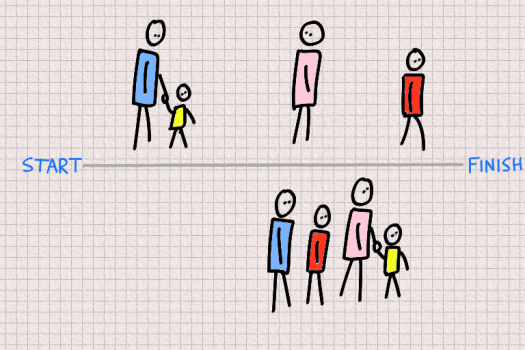
In the example in the picture, the fact is that we can’t increase how fast the smallest kid in the group can walk.

By putting that child in the front, however, the rest of the group will stay close as although they can move faster as individuals, they can’t move past the slowest person in front.

As a result, the group doesn’t spread out and there is no need to shout any more – it makes for a calmer walk, even if it’s no faster for the group as a whole.

Now, in order to improve, we have to improve the performance of the slowest part of the operation.

That’s why, on a family trip out, we end up carrying the youngest kid so often.

Why are some people inspirational?

why-how-what-sinek.png

Why do some people and companies inspire loyalty and dedication from employees and customers? What’s different about them?

Simon Sinek argues in a TED talk that has been watched over 35 million times that it’s because such companies have a pattern of thinking that is inside out.

Many of us can easily say what we do.

That’s our profession, our job, our position in a family – we might be doctors, consultants, accountants, husbands, wives, parents and so on.

In particular, when it comes to work – we can point to the roles we have as what we do.

We also usually know how we do things.

We may have some extent of control and autonomy over the work we do and so design how we work, or we operate in a way set out by someone else.

In either case, we still know how to do something.

Where many of us struggle is in explaining why we do something.

Why are we in this particular profession? Why are we in a particular relationship?

Are we there because it’s something we truly believe in or is it just something we have ended up doing?

Many people make the mistake of thinking that companies exist to make a profit.

That’s wrong – companies make a profit by creating value for customers – profits are a result of good work and not the motivation for good work.

Sinek argues that if we know why we do something – if we have a sense of purpose and belief and mission – then others are more likely to buy into that than there are to buy into any particular product that we try to sell.

Take Apple, for example. Apple was infused by a zen-like focus by Steve Jobs on creating products that could change the world.

Jobs said nearly 40 years ago that “We’re gambling on our vision, and we would rather do that than make “me too” products. Let some other companies do that. For us, it’s always the next dream.”

That vision turned Apple into one of the most uniquely successful companies in history.

Again, from Jobs “you can’t connect the dots looking forward; you can only connect them looking backwards. So you have to trust that the dots will somehow connect in your future. You have to trust in something — your gut, destiny, life, karma, whatever. Because believing that the dots will connect down the road will give you the confidence to follow your heart even when it leads you off the well-worn path and that will make all the difference.

Interestingly – the why is not something that we can logically justify – it’s something that we need to believe in.

It is a matter of faith and and trust – a feeling of having a higher purpose – and perhaps it’s not surprising that people that radiate a sense of purpose and mission inspire us more.