What would it look like if ESOS were easy?

energy-savings-opportunity-scheme-esos.png

ESOS is the Energy Savings Opportunity Scheme run by the Environment Agency to comply with the EU’s Energy Efficiency Directive.

It applies to businesses, charities and non-public sector organisations that are large enough to qualify.

Organisations qualify if, on the 31st of December 2018 (or the financial year just ended), they meet the ESOS definition of a large organisation – i.e, they employ more than 250 people or have a turnover of more than €50 million or a balance sheet of more €43 million during the year.

In a group company, if one part qualifies, then the whole qualifies and the highest UK parent company needs to be responsible for compliance – unless the responsibility is transferred to another group company.

The UK parts of overseas companies need to take part if any part of their group activities qualify in the UK.

So, the quick way to ESOS compliance is:

1. Work out your total energy consumption

This is simple if there are already systems in place that collect and process invoice data. If not, there is some data collection to carry out.

Most organisations will have quite good electricity and gas information. Other fuels and transport records are sometimes harder to find.

2. Identify areas of significant energy consumption

You need to identify at least 90% of usage and then figure out what existing assessments already cover these such as ISO 50001, DECs or GDAs.

The rest need to be covered with ESOS compliant audits.

The scope of the audits are decided by the lead auditor but the Association of Energy Engineers (AEE), for example, suggests than an ASHRAE Level 2 Audit which includes some measurement is appropriate.

Other schemes may have different requirements but they all will include a review of data, analysis of consumption and efficiency, identification of opportunities, site visits and a completed evidence pack that sets out the organisation’s approach to compliance.

3. Appoint a lead assessor

A lead assessor needs to do and oversee or review energy audits and overall assessment.

They (or their team) can either do the work, or work with you to review existing work – although they will be responsible for signing it off as compliant.

All lead assessors will be listed on their professional body registers.

4. Notify the Environment Agency

The Environment Agency must be notified using an online form by the 5th of December 2019.

5. Keep records

You need to keep an evidence pack of how you have carried out ESOS.

Then what?

Many ESOS reports the last time round were done and then left on a shelf to gather dust.

A significant issue is that many organisations are already quite energy efficient, especially when it comes to the large process tasks and pieces of kit that use the majority of industrial energy.

These pieces of kit can’t be quickly replaced and will have a upgrade and replacement cycle of their own.

As a result, a good ESOS assessment isn’t just an external audit at a point in time but a move towards an ongoing system of energy management and continuous improvement in energy efficiency.

Eventually, the activities being done could be formalised in an energy management system such as ISO50001.

Ideally – the output from the ESOS assessment will do two things:

  1. Come up with an action plan: Identify and rank projects that are doable – technically feasible – and have a payback that works for the company.
  2. Create a tender: Package up the rest of the projects for an Energy Services Company – so that the organisation can benefit from the savings while someone else takes on responsibility for implementation and financing.

Although the notification deadline is still some time away many of the activities can be carried out over the entire four-year period between deadlines, for example, the audits can be carried out on different parts of the portfolio during different years.

So… the place to start is with the data – and please do get in touch if you have any questions.
How to connect management, measurement and focus

management-systems-strategy.png

There are three questions that many businesses will need to address in 2018:

  1. How can we create business operations that have fewer emissions while creating more value?
  2. How can we protect the value we create – the intellectual capital – from pirates?
  3. How are we going to ethically use personal data?

These three questions are important because there are regulations and rules that need to be looked at now.

The Energy Savings Opportunities Scheme or ESOS requires large companies to audit their energy and transport use and look for savings.

The Cyber Essentials programme, run by the UK’s National Cyber Security Centre, aims to help all businesses and consumers become more secure.

And the General Data Protection Regulation or GDPR tells us how to manage personal data and keep it private.

So, what are the links between management, measurement and focus?

First, the standard approach to complying with requirements like these is to put in place a management system.

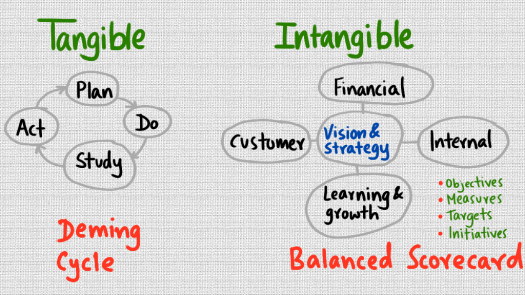
Most management systems, especially those that follow an ISO type standard, are based on the Deming Cycle – named after the engineer who helped transform Japanese manufacturing after the war into a lean powerhouse of quality.

The essential elements of the Deming Cycle are based on the principles of scientific enquiry and are:

  • Plan: Look at the situation and come up with an approach to manage it.
  • Do: Do the things in the plan
  • Study: Study what has happened and learn how to improve things. Some people use check instead of study – but Deming thought study was better as check is more about inspection, while study is about learning.
  • Act: Change the plan based on what has been learned and go through the cycle again.

This approach works well for tangible things such as reducing process waste or figuring out which items of kit to replace to reduce energy use.

But… things can get messy.

All too often a management system becomes an exercise in paperwork rather than a real effort to improve something – we do it to comply or pass the audit rather than actually becoming a better organisation.

And that’s because the technical element is only one part of an organisational system.

The intangible elements are just as important to get right.

The Balanced Scorecard is a method created by Robert Kaplan and David Norton that tries to look at the organisation as a whole.

Clearly, the way in which success is measured by an organisation is in the financial returns that come from doing a project.

Customers, on the other hand, focus on what they get out of the partnership.

In order to keep customers happy, the organisation needs to have the right internal capability to do the right things.

And that only comes when the people in the organisation are given the right learning and growth opportunities.

So, once again, how does all of this connect to management, measurement and focus?

It’s because it all starts with culture.

If the people in an organisation know and get with the vision and strategy – whether it’s becoming cleaner and greener, more secure or more ethical – then we’re starting with a firm base.

We can create a strategy using the Balanced Scorecard approach that works out what people need to know and helps them learn, puts the internal processes in place that are required, shows customers how this makes us better service providers and also gives us the financial returns needed to keep shareholders happy.

Our of the Balanced Scorecard comes a set of objectives, measures, targets and initiatives.

Otherwise called a plan.

We can implement the plan using the Deming Cycle and continuously improve our organisation – and that’s where quality comes from.

That’s sort of management and measurement covered, but where does focus come in?

Well, with all these kinds of things, there are two approaches we tend to take.

Either we look for the lowest cost compliance approach – because really none of these things are really that important and the existing financial pressures and priorities don’t leave any time for the hard work of business transformation.

Or we believe that we need to change to survive – and so the work involved in really becoming cleaner, safer and more ethical is worth doing.

And the results we will get in the next year will depend on which approach we focus on.

What does the UK’s clean growth strategy focus on?

clean-growth-strategy.png

The UK’s clean growth strategy, published in October 2017, sets out how the UK can grow while cutting greenhouse gas emissions.

The economic opportunity in clean business is huge.

Countries and companies need to invest around $13.5 trillion in the energy sector alone if we are to meet the Paris committments to keep the rise in global temperature below 2 degrees.

At the same time the UK wants to keep bills low – so the reduction in emissions needs to come from the cheapest technologies, processes and systems.

The UK plans to invest £2.5 billion from 2015 to 2021 in low carbon innovation.

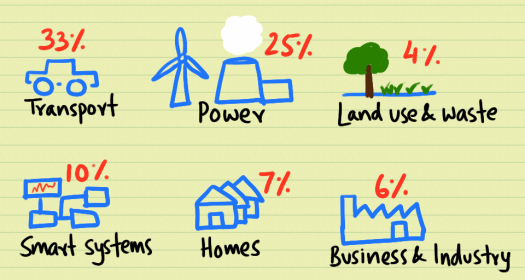
33% of this will go into transport, with petrol and diesel cars killed off by 2040, a shift to electric and ultra low emission vehicles (ULEVs), more cycling and walking and improved logistics.

25% will be spent on power with a focus on smart systems, nuclear, price controls and ongoing work in renewables.

4% will go towards land use and waste, with new support mechanisms after the UK leaves the EU, planting new forests, having zero avoidable waste by 2050 and investing in agri-tech, land use, greenhouse gas removal technology.

10% is targeted at smart systems including storage, demand response, nuclear and offshore wind.

Homes will get around 7% to upgrade home energy efficiency measures, smart meters, a roll out of low carbon heating and new requirements for control systems.

Business and industry will get 7% spent on them to develop a package of measures to support them in increasing “energy productivity” by 20% by 2030.

This includes minimum standards on energy efficiency, helping businesses identify where they can cut bills and industrial schemes to help large companies install energy efficiency measures and support heat recycling.

Innovation will also be supported through the ongoing Energy Entrepreneurs Fund.

The purpose of this document is to set out a framework for action.

It’s then time for businesses, investors and innovators to go after the economic opportunities out there…

How to predict the future

drucker-on-the-future.png

Peter Drucker, who died in 2005, was one of the most influential scholars of management theory – writing 39 books and his quotes and sayings litter the field.

He came up with the term knowledge worker in 1959 – well before the Internet turned us all into knowledge workers.

He also explained how he was able to predict the future. It’s easy – he said.

All we have to do look around, report what events we see happening and what we think that obviously means for the future.

Some people think that’s prediction, but it’s really just having our eyes open and taking the time to think.

So, how can we use what Drucker write about to come up with a clear strategy for the future.

First, we start by looking at the opportunities out there that we want to go after.

This is the world from our point of view – the things that we think are important and material and that should matter to everyone else.

Second, what are the opportunities that our organisation can deliver?

We need to be able to innovate – to create and deliver a product that matches the opportunity we select.

Without an organisational structure in place – with people, equipment and processes and a supply chain, we can’t deliver anything – or convince anyone else that we can.

Third, we need a customer.

Drucker said “The purpose of business is to create and keep a customer”.

Without a customer, who needs, wants and values the product that our organisation creates to address the opportunity – we’re simply setting ourselves up for failure.

And who wants that… especially when we’re starting a new year.

What are the trends to watch in 2018?

trends-watch-2018.png

Forecasts are usually a waste of time

At the start of the year, a number of predictions are made about what may disrupt life and business in the year ahead.

If we start, instead, by taking a look back, some of the biggest stories of 2017 came as a surprise.

Was anyone surprised by Trump’s policies?

The policies of the Trump administration are perhaps more of a series of road bumps to be endured rather than a revolution in how things are done.

Despite the US withdrawal from the Paris accord, it remains a leader in electric car technology and its technology companies still dominate global markets.

Attempts to support old industries will probably result in the money going to executives at large oil, gas and coal firms rather than actually helping people and communities with cleaner energy and new opportunities.

And the effect of the policies may well be to hand the Chinese a leadership position in the actual manufacturing of clean energy technology as well as increasing dominance over emerging markets.

The Brexit process was triggered

The UK will leave the European Union.

How and when and how much it will cost and who will win and lose are still being discussed.

The UK is not in a strong position.

It faces a juggernaut which is its main export and import partner and takes a long time to decide anything.

The EU can take its time – the UK needs decisions to be made soon.

And that pressure means the UK may have to settle for less than it hopes for.

Cyber-security and hacking are making headline news

2017 was full of news about Russian involvement in the US election and the extent to which foreign nations are carrying out cyber-warfare.

At the same time, criminals are targeting individuals and businesses.

Government and business are increasingly conscious of the risk of being hacked – but are still working out what to do in response.

The Grenfell fire caused 71 deaths and will result in changes to building regulations and fire safety

As more of us begin to live in cities and high-rises, the Grenfell Tower Fire has to spur action to improve safety in such buildings.

Better, more energy-effient infrastructure is needed to both prevent electrical fires from starting in the first place and stopping them quickly when something fails.

Electric cars may have reached a tipping point

Electric cars sales are still low, but their public perception as a viable alternative to petrol and diesel cars may have reached a crucial point.

Falling battery prices and increasing government support, including long-term targets to make electric cars the norm are helping the industry.

Bitcoin – bubble or not?

It’s probably one…

So, what could happen in 2018?

Security should be on our minds.

Recent news about hardware and software vulnerabilities should not be a surprise.

There are always bugs in systems.

The weakest point, however, is usually people.

Many organisations still need to really get to grips with digitisation and what it could do for them.

It’s not just doing things with computers the way they are done on paper.

And it’s not simply moving to the cloud – that is a particular type of solution – the point is what type of solution actually works for us in a particular situation.

Digitisation and security go hand in hand – we should use computers to do more, and we should be able to keep what we do on those computers confidential and secure from competitors and hackers.

The increasing complexity of everything, however, means that specialisation is now normal.

Advanced economies look at Everything as a Service, where we can find organisations and people to help with specific tasks.

It’s more about the specific solution OR the specific person that does something.

And, as no one wants to take the risk of paying up front for something they don’t understand and can’t use, paying to try things out and then use them if they work seems to be the model for the majority of products.

Unless you’re Apple, in which case you can deliberately slow down your old stuff to make people buy your new stuff…

So, for all those services, we really need to start looking at global/local partnerships.

For example, what’s stopping us from working with admin assistants in the Philippines, sysadmins in Brazil or developers in India?

Well, in 2017, nothing did…

The fact that countries are increasingly nationalistic and making it harder for people to cross boundaries, partly as a result of global terrorism, makes less and less difference in a world where everyone is connected by the Internet.

We should be looking for partners and services wherever they are – and select them based on what they do and how much they charge – and how much value we get.

Then there is the mail…

Many of us probably do the majority of our shopping online.

Vans are the fastest growing automotive segment because of all the deliveries being made.

We can order stuff from China or Taiwan on Ebay and have it here in a few weeks. If we pay more, we can have it tomorrow from the UK in the mail.

The mail order business is simply going to grow – shops are turning into places where we go and browse, like catalogs.

And then there will be all the things that no one predicted

As Donald Rumsfeld said in 2002:

Reports that say that something hasn’t happened are always interesting to me, because as we know, there are known knowns; there are things we know we know. We also know there are known unknowns; that is to say we know there are some things we do not know. But there are also unknown unknowns – the ones we don’t know we don’t know. And if one looks throughout the history of our country and other free countries, it is the latter category that tend to be the difficult ones.

In 2018 – the unknown unknowns will be the ones that get the biggest headlines.

How ethically are people likely to act?

10-40-40-10-rule-of-ethical-behaviour.png

What makes people act the way they do?

Is it the organisational culture around them? The people in their team? Their own values?

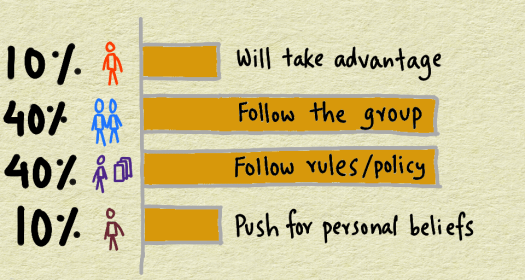
The 10/40/40/10 principle suggests that in any group 10% will take advantage if they see the risks as being low.

40% will go along with the group.

40% will try and figure out what the organisation is trying to achieve and do it.

10% will push for their personal beliefs and values.

This breakdown is apparently based on Lockheed Martin research, but it’s not clear whether there are any substantive studies that confirm this – it might just be a convenient rule of thumb that matches the 80/20 principle.

The point is that people are complicated – and the situation they are in will influence how they act.

For example, once we know that this is the expected breakdown, will we do the same as before?

Is it possible that awareness might cause us to change the decisions we take?

Or take a thought experiment.

Let’s say we’re in a ship that ran into trouble and everyone had to abandon ship and get into lifeboats.

We’re in the boat with six others and there is still one person in the water.

The leader says that as all of us are now in, and there is enough food and water for the group, the best option is to leave the last person in the water.

That way all of us can survive.

What would you do?

Perhaps we’d like to think that we’d stand up to the leader and insist on helping.

Or we might follow the group.

But many would be appalled at the idea of leaving one struggling person in the water.

But, when we take that principle up a few levels, to the question of a country and how it treats refugees, how do our thoughts and actions change?

What is clear is that as a species, humans are biologically and socially inclined to go with the group – for better or worse.

Which makes it all the more important for individuals to try and have a mind of their own.

How to expect the unexpected

unintended-consequences.png

History is littered with examples of when well intended action has resulted in unexpected outcomes.

Steven Levitt and Stephen Dubner in Superfreakononics write about the General Hospital in Vienna, where in the 1840s, women in labour where more than three times as likely to die in hospital than at home with a midwife.

It turned out that the doctors – who were trying to save their patients – were actually transferring germs to them because they were examining them without first washing their hands.

A simple fix – washing their hands – put an end to the deaths.

Politicians are forever coming up with programmes to incentivise changes in behaviour.

Often, however, things don’t go the way they expect.

For example, subsidies for wind power around the world have, quite literally, led to a windfall for landowners who have large tracts of property in windy areas.

People who are probably already relatively wealthy have been offered guaranteed subsidies for many years to site turbines on their land.

People who don’t have access to land or utility connections face relatively higher costs.

And the poorest, who have no way of reducing their costs or investing in their own generation systems face the prospect of increased bills to pay for the subsidies for the wealthy.

This happens again and again in different situations.

Levitt and Dubner put forward examples where laws aimed at preventing discrimination result in increasing it, or laws aimed at reducing waste result in more illegal waste dumping.

And, when it comes to things like tax codes, there are entire industries devoted to figuring out and working within loopholes.

So, how can we improve the way in which we plan actions and deal with outcomes?

The systems around us are complex and any intervention is likely to work through feedback loops rather than a simple cause and effect approach.

In addition to the intended result, we need to think about what we will do if the outcome results in a windfall, a detriment or a perverse result.

In essence, we need to make sure we model more than just one scenario.

What makes an innovation likely to succeed?

innovation-diffusion.png

When we try and create something new, whether for a new startup or as a new product line in an existing company, what questions should we ask ourselves to increase our chances of success?

Everett Rogers, an eminent sociologist, came up with the diffusion of innovations theory that tried to show how ideas and innovations spread through societies.

He argued that there were five characteristics that people looked for when considering a new product – in essence asking themselves five questions.

1. Relative Advantage

People start by looking for relative advantage.

Is it better in some way than what we are doing now?

Does it help us do something faster or make it easier to do a complex task?

2. Compatibility

Many innovations aren’t adopted simply because they aren’t compatible with existing systems and processes.

One of the reasons Software as a Service (SAAS) appeals to people is because all you need to get started is a web browser.

There is no need to get IT involved and get permission to install new software, or worry about which operating system or hardware drivers are needed.

3. Complexity

If something is seen as too complex or too hard to do, people will be put off.

When a product needs extensive training before it can be fully used, then the chances of widespread adoption start to fall.

These days, if something needs to ship with a manual it’s probably too complicated.

4. Observability

Are the pros and cons of the innovation clear to anyone looking?

Quite often, we still work through a list of positives and negatives when considering a purchase.

Decision makers want to be able to see clearly what return they will get on an investment – a fuzzy set of benefits will probably make them nervous and less willing to commit.

5. Trialability

Can we try before we buy?

This is almost a given for most organisations now.

Very few companies have the reputation and market dominance to simply put an innovation out there and expect customers to buy it.

Most need to provide a trial or pilot period where customers can test and use the innovation before signing up for a contract.

6. Social and legal considerations

A sixth point, and one that is increasingly important, is around the social and legal aspects of the innovation.

Socially responsible products and businesses are likely to be preferred by buyers that are looking for a long term partnership.

And modern technology creates new legal challenges – for example, it’s easier to take pictures but which ones are legally acceptable to share on social networks?

Summary

In summary, if we can say yes to these six questions, we should increase our changes of succeeding with a new idea, innovation or product.

Do you have what it takes to be a hacker?

hacking-characteristics.png

A hacker, in the eyes of many, is a criminal – someone who breaks into computer systems and steals information or worse.

Real hackers, however, don’t see things that way.

They call criminals “crackers”. Hacking is something much more creative.

Too many of us are bound by the rules, the way things are done and have always been done.

This is why we spend time entering data into mind-numbing spreadsheets, making cold calls, going into a physical office every day and following processes laid down by administrators.

That’s business as usual.

A hack is simply a cool new way to do something.

It’s that shortcut we figured out, a piece of code that can take something that takes 2 weeks to do at the moment and gets it done in 2 minutes, the one change in our daily routine that saves us an hour of effort.

The main characteristics of a hack are that it is simple – almost obvious in retrospect, and masterful – something that bubbled up from all the expertise and work we had already put in.

It is also illicit – it doesn’t follow the rules set out by the system.

Just because managers have said something should be done in this way doesn’t mean it’s the best way to do something.

If we all accepted the status quo all the time, there would be no innovation, nothing would change.

One of the greatest “hackers” of all time, Richard Stallman, would never have built his free software and associated free software license that went on to transform the world of computing, creating a real alternative to the corporate giants – Microsoft and Apple.

Sometimes, to do something better, we have to ignore imposed rules – and act illicitly.

The problem, of course, is when this turns into illegal activity – and that’s what worries the general public.

The idea of hacking – the good way – is behind sites such as lifehacker, that provides tips and tricks for getting things done, or the concept of growth hacking – unconventional ways to acquire customers and rapidly grow a company.

In today’s technology dominated economy – innovation comes from looking at things differently and coming up with simple and masterful ideas that transcends conventional wisdom and conventional rules.

The hackers in the machine are the ones doing innovative things and creating value – whether it’s in software, business systems, marketing or operations.

Being a hacker, in essence, can make what we do more interesting.

How to set up a knowledge work space

5S-method.png

The 5S method is a way to organise work spaces in manufacturing – and is a core part of the concept of lean.

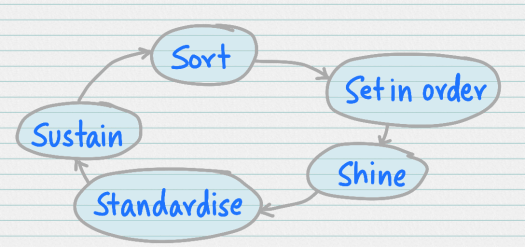
It uses 5 Japanese words: seiri, seiton, seiso, seiketsu and shitsuke. They can be translated as sort, set in order, shine, standardise and sustain.

It’s easy to see that having an organised workspace makes a difference in physical work.

But what about knowledge work? Can it be used there as well?

Bradley Staats, David Brunner and David Upton looked at whether lean principles could be embedded into a software company.

Staats and Upton write in the Harvard Business Review that lean projects don’t necessarily produce better quality work but do come in on time and under budget.

Knowledge work has specific aspects that make it different from manufacturing, such as uncertainty over the tasks that need doing, the fact that a lot of knowledge may be inside people’s heads as tacit understanding and that how things are done may change during the projects as requirements evolve.

In manufacturing, we usually know what we need to do, how to do it and in what order we should do it.

An assembly line designed to make cars doesn’t usually end up producing pizzas. But that seems to happen quite often in knowledge work.

So, how might we apply 5S in knowledge work?

Sort is all about removing obstacles. It means getting rid of piles of paper, books that we are never going to read and clutter that gets in the way.

The things that are in front of us or on our desks should be the things that we use every day. Everything else should either be discarded or be put somewhere where we can get them when we need them.

Set in order is then about arranging things in the way that makes it most efficient for us to use them.

For example, if you are right handed and your office phone is on your right side, the chances are that you’ll pick up the phone in your right hand, and then move it to your left to take a note.

When you put the phone down, it will probably introduce a kink into the cord – and that’s why so many office phones have such twisted wires.

Putting the phone on the left should sort this out.

Shine is about keeping our desks and workspaces clean.

Standardise is about doing things in a particular way – that’s crucial in manufacturing so that variation is minimised and everything comes out the same.

In knowledge work this is sometimes taken to mean that everything should be documented and made explicit so that people can follow a set of instructions and do things.

This is something I disagree with. If you can make something into a procedure then it should also be possible to automate it and remove the human element.

Instead, standardise in the context of knowledge work should be more about getting ourselves in the right frame of mind to do creative and innovative work.

We should aim to set ourselves up to get into flow with what we are doing, so standardisation should really mean things like checking email at set times, doing timed pieces of work, creating spaces for deep work without interruption and so on.

Finally sustain is about what we do every day.

Because knowledge work is so intangible, it’s easy to get bogged down in day-to-day firefighting and forget that we also need to innovate and create.

And that takes time and energy.

Which we might be able to create if we use the 5S method to address the things around us getting in the way and grabbing our attention.