How can we make more confident decisions?

confident-decisions.png

There are many situations when we are trying to work out what is best to do. Should we hire a marketing firm? Should we buy that building? Should we hire that person?

In all these cases we don’t know if we’re going to be successful. And, more importantly, we’re not confident that we’re making the right call.

Is there a way we can change this – be more sure of ourselves and the choices we make when we have to?

Three approaches – perhaps even formulae – may help.

First, make sure that it is actually important

Not all decisions are worth taking time over. As we get more to do, perfectionism gets in the way of progress.

Some people try and read everything, check everything. That’s laudable, but not smart.

The smart thing to do is focus on the things that matter – and the 80/20 rule or Pareto principle is one to follow here.

Of all the things on our lists, a few matter as much as the rest put together.

The key is figuring out what those are and choosing to put everything else on autopilot. The extreme example here is people who wear the same kind of clothes all the time so they don’t have to spend time choosing an outfit.

Then, look at the choice from multiple perspectives

A good rule for meeting requests is never to accept them.

Or at least only accept the ones that we are really happy with. But how do we know that?

A common issue is that we heavily discount the future. We are happy to book a meeting in a months time that we would not book in today, for example.

So, we need to apply the 10/10/10 rule.

Would we be happy with the outcome of that decision 10 minutes from now, 10 months from now and 10 years from now?

If yes, then we should go ahead. If not – then maybe we should pass on this one.

Very few choices or decisions are really once-in-a-lifetime ones. If we take the trouble to put ourselves in the path of opportunity, these decisions come along like buses.

By only choosing the right ones, we’ll probably get to where we want to end up much faster.

Finally – is the decision going to move the most important needle?

A concept behind many successful business models is the idea of one key metric.

A community in India, for example, called the Marwaris have an ancient system of accounting that totals their sales and expenses daily to keep an eye on daily profit.

If we have a market stall and use their technique, for example, and we’ve sold less than we wanted to during the day, then we might choose to defer an expense or part pay it so that we don’t incur a loss that day.

This simple technique means that we get better at managing our cashflow. Also, making a profit every day means that we’ll be in profit at the end of the month – and at the end of the year.

In other businesses, the Net Promoter Score, the difference between the customers you have that will recommend us to someone else and the ones that will not, can mean the difference between growing and winding up.

In summary decisions are hard – but we can make them easier by focusing on the important ones, looking at them from multiple perspectives and really asking ourselves if they will move the most important needle in our business.
3 things managers have to do if they are going to manage remote teams

managing-remote-teams.png

Imagine setting up a new business or expanding an existing team.

The first things many organisations do is think about adding people at an office. We need desks, computers, software, phones and all the other things that go with bringing that person online – and that takes time, effort and money.

Why do we do this?

In a world where most people we want to work with already have a desk, a computer and an internet connection that lets them get all the software and communications tech they need – why do we keep thinking working in an office is the way to go?

Or is that still the case? Research from Upwork, the freelancing website, says that two thirds of companies use remote workers. As talented specialists get harder to find, companies that are willing to offer remote working can choose from workers around the world.

Many organisations that have started up now have entirely virtual workplaces – with no central office at all.

So, what do our organisations and managers need to do to make virtual teams work well?

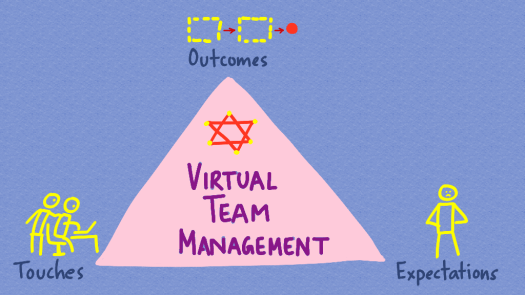
There are three things we need to get right.

1. Focus on outcomes, not process or how we would do it

Individuals now are developing increasingly individual ways of working – and that can be a challenge.

Take something as simple as taking notes – a fundamental part of work.

I’ve jumped from using a reporter’s notebook to a legal pad to One Note to text files to journalling software to Google spreadsheets to custom Excel files back to Moleskine notebooks.

In some businesses notes need to be recorded in a particular way for legal reasons. Reporters need to keep their notes in case they get sued. Policemen need to keep their pocket notebooks as evidence.

For most jobs, however, how people take notes doesn’t matter. What they do after that does matter.

For example, do they liberate the main points from their notes and share them with colleagues who need to know them? Does a sales person’s notes provide enough information for a service team member to take on the account?

With remote teams we need to focus on outcomes – the way things turn out – rather than the way in which they are done or the way in which we would do it.

2. Be clear on what you expect from others

I remember being on a train down to London and hearing a conversation a few years ago.

The speaker, who sounded like an entrepreneur, was quite loud and making no effort to speak quietly – but the gist of the talking was that a remote worker who was at home couldn’t be contacted on instant messaging – and that wasn’t acceptable.

Any sort of situation that makes us want to stand with our hands on our hips crossly is one where our expectations are not being met.

In this case, the entrepreneur’s expectation was that the remote worker needed to be available to contact during work hours on this system.

The worker may have had a perfectly good reason to be away from the desk at that time – or may have been in the park throwing snowballs. We don’t know – but that simple inability to contact the worker was enough to cause a work problem.

Some organisations recognise that instant messaging interruptions are as bad as actual interruptions, and set expectations that such contact is by arrangement and usual business is conducted by email.

The point is that much irritation can be avoided if expectations are clarified up front.

3. Make the effort to make contact and stay in touch

At the same time, workers will find managers much more relaxed if they make the effort to keep in touch.

Where there is little or no face to face contact, email updates, messages and phone calls can all help keep the lines of communication open.

Managers get nervous when they don’t hear anything for long periods of time. And – quite probably – when people don’t keep in touch it’s because things aren’t working and they are looking for, or working on, something else.

Lack of contact quite often leads to termination of appointments.

Interestingly – sharing personal updates before moving to business can help reinforce the feeling of being on the same team and help maintain a warmer relationship.

Summary

Many of us, if we don’t already, will experience remote working, virtual teams and more flexible ways of working.

For new starters, it will simply be the norm. For older workers, it is what they do as they move away from corporate jobs and focus on a more balanced life that looks after their health and family.

Whether we’re in offices together or on the phone – the things that make us human are what will cause us to succeed or fail.

Working towards a common outcome, being clear on what we expect from each other and taking the time to keep in touch and talk will help us manage this new world of work.

Why the best questions have to do with what is invisible

looking-for-what-isnt-there.png

Imagine having to ask the CEO of a company about their strategy or a prospective employee about his or her capability.

What they show and tell us will depend on the kind of questions we ask.

How do we know we are asking the right ones? The ones that will throw up opportunities and show us what is really happening?

There are lots of lists of questions we could ask. The important ones are about what is not there – and there are three important versions of these.

What is the unmet need?

The first comes from Jo Miller’s conversation with Ellie Pidot, VP of Strategy at Medtronic who asks What are your customer’s unmet needs?.

One way to think of this is like whitespace on a page.

What is left out helps us make more sense of what is there.

We can ask people what they do and what they want and we will be told a story, probably one that is logical and coherent.

They might tell us what they are doing – and the things identified as needs.

All too often, what they tell us and what they actually need can be different.

This happens quite a lot in IT, for example. There is often a gap between what software developers think people want and what they actually need.

The best programmers are able to bridge that gap and create the right kinds of tools to help us.

What would an outsider do?

The second question comes from Freek Vermeulen who asks what would other, external people do, if they found themselves in charge of this company?

This can be thought of like a blank page.

What would we do if we were starting from scratch? From a zero base – with no sunk costs or investments of time, effort and energy?

Bryan Tracy suggests asking – knowing what I now know, would I do things differently?

Are there things we would do more of, less of, start or stop?

It’s hard looking at the same things through the same eyes.

It might help if we try and look at them through the eyes of someone else, someone we respect. What would they say or do?

Then – do we have the courage to do that ourselves?

What would be least risky?

The third question is from Tim Ferriss’ interview with Joe Gebbia, the co-founder of Airbnb.

Many people think that to get ahead we need to take more risk. Higher risk equals higher returns.

That’s not really the case.

Take B2B sales, for example. Joe points out that B2B customers, given a choice between a low price and low risk, will take the lower risk option.

Entrepreneurs who have taken what seem to be huge risks often have carefully calculated the downside and decided that they can live with the odds.

The Dhandho approach follows this – Heads I win. Tails I don’t lose much.

Often the course of action that people will follow is not the one that gets them the most but the one that looks the safest.

So, in this case, its the absence of obstacles that matters.

Summary

There are more questions that we could ask than ever could be answered.

We need to ask the ones that show what isn’t there.

The whitespace, blank page, absence – that’s where the opportunities are hiding.

The 3 critical processes you must try and improve at your business

three-timelines.png

If we had to make sure that just three processes were working as efficiently as possible in our business, which ones should we choose?

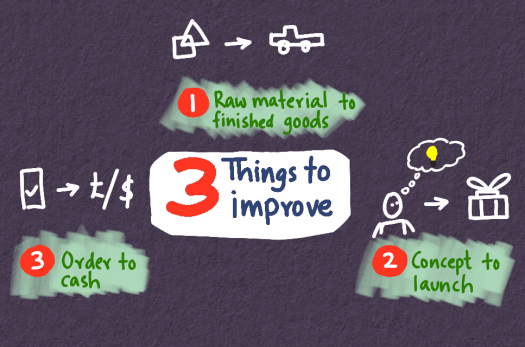
According to David Bovis three timelines developed by Toyota are enough:

  1. How we convert raw material into finished goods
  2. How we go from concept to launch
  3. How we go from order to cash

So, what are we trying to do when improving each of these?

Raw material to finished goods

The whole point of our business is that we add value to something. Whether its taking raw materials and turning out a physical finished product or providing a service that carries out some kind of knowledge work, we still need to work our way from a start point to an end point.

In a world with infinite digital storage space we end up keeping everything. Emails from ten years ago to every bad photo we ever took.

It takes real discipline to stop things piling up – whether in visible piles of stuff or paper or in ever growing digital folders.

So how can we improve this process? There are four things to look at:

  1. Maintain systems before they fail: From manufacturing systems to computer equipment, we need to look after our kit.
  2. Reduce the amount of parts and supplies: Do we need to have ten different types of notebooks in the supply cabinet or buy a year’s work of cleaning supplies?
  3. Keep things in the right place: We often can’t find stuff just because it’s not put back properly.
  4. Put stuff that needs to be thrown away in a set place: When things are ready to go, put them in an agreed place so they can be removed.

Concept to launch

This is an interesting one – especially if it’s taking a new product to market.

We need to create things that customers want more than they want the money in their wallets.

Just building it isn’t enough – it needs to be saleable – exchangeable for real money.

That means we have to work backwards from what customers really need (which isn’t the same as what they say they need) and build products to address their needs.

Everything that doesn’t do that is optional – perhaps even wasteful.

Another consideration – not always taken into account by product developers – is that customers, especially business-to-business ones – will choose an option with less risk over one that has a better price.

If something does what is needed and can be shown to be robust, it can often beat a competitor with more bells and whistles.

Order to cash

The final process to get right is the timeline from order to getting paid.

For many products, or services sold like products, we pay up front and receive the product later.

Service businesses, on the other hand, tend to invoice after the work is done.

Improving an order to cash process means looking all businesses, whether product or service, as product businesses where all or some of the payment is made earlier in the process.

Summary

For all three timelines, we’re trying to keep only what is needed – remove everything that adds waste and keep the things that add value.

It’s how we do that which matters.

How to set out a persuasive argument

minto-pyramid-principle.png

Consultants at the international strategy firm McKinsey are famous for their ability to take huge amounts of information and come up with clear and focused strategies for their clients.

That’s not something that we see all the time – how many meetings have we sat through that seem to have no point, presentations that meander all over the place and discussion or recommendation papers that are impossible to understand.

Is there a way to cut through all the noise and present information in a way that helps listeners understand their options and make decisions quickly?

Yes there is – and it’s called the Pyramid Principle.

Barbara Minto, the author of The Pyramid Principle: Logic in Writing and Thinking, came up with the principles in her book while working at McKinsey – and then implemented them in training programmes at the firm.

Her insight was to see that the order in which we present ideas is critical.

When we’re solving a problem, we need to start from the beginning and work through to the solution at the end.

When presenting a recommendation, however, we start with the solution and then expand on why we believe that is the right thing to do.

Why do it this way? Well, because people are busy and dying to get to the point.

If we can explain something more clearly with less information they can make decisions more quickly.

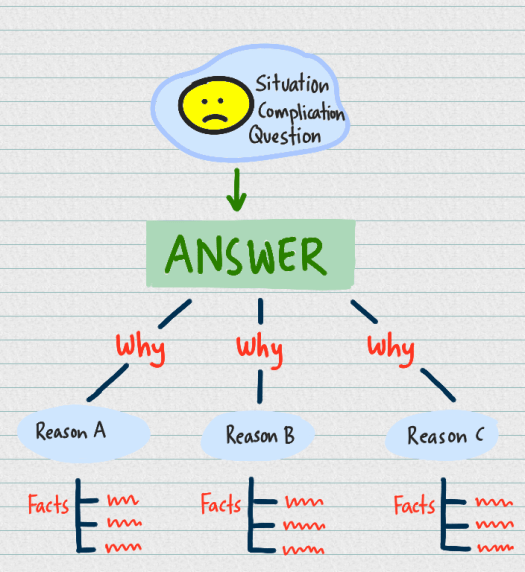
The Pyramid approach has three parts to it:

  1. Tell the audience a story leading to a key question – which we answer up front.
  2. We then set out the key reasons why we believe the answer is the right one.
  3. We put forward facts and evidence to support our beliefs.

In most cases requiring a solution, we start with a situation where there is a complication – something isn’t working the way it should.

Our starting point is to ask a question – how can we make things better?

The story we tell describes the situation and complication, poses the question and then presents the answer – up front.

The audience knows in the first few moments of engaging with us or our material what they are going to get from us.

So then we set out the key themes – essentially answering why we believe our answer is the right one.

Three themes is a common approach – but it could be more if all of them are mutually exclusive and completely exhaustive – the so called MECE approach. More than seven, however, will usually confuse things.

Then, for each theme, we set out more facts and evidence to support our position.

By following the pyramid principle, we are going to connect far more quickly with the people we are trying to persuade and get across the decision we want them to make and the reasons and evidence that supports why they should make that decision.

And that is much more persuasive than a rambling discussion that sends everyone to sleep.

How simple rules can help us become better at everything

simple-rules.png

Complex situations need equally complex solutions. Or do they?

This is the question explored in Simple Rules, a book by Donald Sull and Kathleen Eisenhardt.

Let’s be honest – how many times do we make something look really complicated so that we can come across as knowing more than everyone else or justify the fee we are charging.

But really, in many many areas, just using simple rules will give better results than complex ones.

So, what are simple rules and how can they help us?

Sull and Eisenhardt split simple rules into those that help us become more effective and those that help us become more effective.

Becoming Effective

Becoming more effective is squeezing more out of the time we have and that means saying yes to some things and no to others.

We can do these in three ways.

Boundary rules

First there are boundary rules. These are binary decisions of the yes/no variety.

What should we do and what shouldn’t we?

For example, when revising for exams for my first degree, I had two very simple rules.

I never worked after 12 in the afternoon and on weekends.

Working from 9 – 12 for four weeks before the exams was more than enough time to revise and prepare for them.

Prioritisation rules

The next kind of decisions revolve around what to do first.

The classic example of this is how medics triage patients during an accident.

Everyone is tagged based on the severity of their condition and how urgent it is that they are seen.

I remember being in an aircraft accident simulation as one of the volunteers to train the response teams where we were all labelled with the injuries we had supposedly sustained.

I had a broken foot and so was transported slowly by ambulance while enviously thinking of the helicopter ride being taken by the person with far more serious injuries.

Prioritisation can be a double edged sword, however, leading to unnecessary escalation and messing about unless the rules are clear and applied consistently.

Stopping rules

The last kind of effectiveness rule has to do with when to stop.

Enough needs to be enough. Cultures that have a rule that people should stop eating just before they are full have much lower obesity levels than others that stop eating when they are full.

Perfectionists sometimes don’t know when to stop. In most cases, it’s good to stop early – and that leaves us with the capacity to go longer on the things that matter.

Becoming Efficient

Where effective is about doing the right things, being efficient is about doing things right – and once again there are three types of rules.

How-to rules

How-to rules set out a pathway, a series of steps to follow.

The best example of this is the idea of mise-en-place – laying out everything that is needed and following an efficient sequence of operations to cook.

One thing I learned here was to put the pan on the fire before starting to get ingredients out. By the time I had everything, the pan was hot and I could get on with cooking.

Coordination rules

Coordination rules are about playing nicely with others – working as a team.

A nice example is when to use the words you and we.

When we talk to someone else and need to talk about a negative situation, say the person did something wrong, how should we phrase the sentence?

Is it You made a mistake or We made a mistake.

Using you will immediately result in the listener getting defensive and upset. With we, there is a recognition of collective ownership and a more likely move towards thinking of ways to stop the problem happening again.

Timing rules

The last set of rules are about timing – when to do things.

For example, many productive people believe that we should the things that are most important to us first thing in the morning.

When I started writing this blog, I did just that – the first thing I did every day was to write. And having that rule made it much easier to do the work needed

Many activities have cadences – a sequence that needs to be followed to get results. Getting the timing right on these is crucial.

Summary

Simple Rules is an easy-to-read book that sets out a clear map of what simple rules look like and how to come up with them.

So here is a simple rule – Read the book.

The three ways in which we think about systems

how-we-look-at-systems.png

Professor Peter Checkland has written a number of books about systems, and in 1981 published Systems Thinking, Systems Practice.

As one of the commentators on Amazon writes, the book elegantly describes the history of thought that led from early Greek logic displacing the religious and faith based approaches through to stunningly successful scientific reductionism and then to systems thinking.

The modern world is so much a result of reductive thinking – of breaking things into parts and understanding how they work – that we sometimes think that’s the only way to look at things.

The systems approach captures the idea of emergence – the fact that some things cannot be explained just by looking at its components – the idea that the whole is more – is something other – than the sum of its parts.

Many of us want to know the detail – how did something happen – what did someone else do, so that we can replicate or copy those tactics and apply them in our own lives and situations.

This works sometimes, and doesn’t at other times. Human beings and the way we function cannot be reduced to formulas.

If anything, human societies are constantly changing how we act in response to what we learn about what happens when we act the way we do.

So, when it comes to systems, Checkland suggests that there are three ways we tend to approach them.

First, a system could be looked at as a black box – with inputs, outputs and feedback. We look at what comes out of the box and adjust the inputs to get what we want.

This approach is mechanistic and assumes that the same input will always give the same output all else being equal.

Which it rarely is.

A stable system, however, that operates within a reasonable range, will give a set of outputs that are more or less regular, and we could use statistical methods to then figure out what might come out of the system.

Other people want to look inside the system, to figure out how it works.

That’s another approach – more reductionist – as we look at the workings of the system in detail and see what happens.

It’s like dissection – we can keep going through organs, cells, all the way down to atoms.

So, given that we can look at systems from the outside, or try to look inside them, Checkland writes that we tend to adopt three approaches.

The natural historian looks at the system and describes it. This is like an academic’s approach to social studies – we have no interest in changing what is there but we do want to try and capture what is happening.

A manager tries to organise things so that the system works well. This involves moving bits around and trying different approaches.

A designer tries to come up with a new system or modify an existing system so it does something better or differently.

All three look at the same system, but from different points of view. And this means that they have to work hard to understand what the other is doing.

A designer wants to change things around, and could be impatient with a manager that wants to do the most with what is there.

And the natural historian doesn’t want things to change, but does want to know what is going on.

The point is that we need all three – we can’t manage what we can’t describe, and we can’t design something when we don’t understand what we are trying to achieve.

Just like the starting point, trying to break things down into roles and pieces just doesn’t help when we’re trying to understand the entirety of something.

We’re trying to get at the whole thing – and that is what it means to take a holistic approach.

Why don’t more small businesses invest in information systems?

small-businesses-and-information-systems.png

Are the businesses around us as effective as they could be at using technology to improve how they do things – from serving customers to keeping costs low?

As we move into an increasingly digitized economy, what kinds of organisations are likely to take advantage of the new opportunities that emerge?

A paper from 1999 by James Y.L Thong may still have useful lessons for us nearly twenty years later.

The core systems that businesses require are more or less understood. Almost every business is probably going to have email, some kind of office software and a website.

But what happens after that… what about customer relationship management (CRM) systems, specialist analytics tools, marketing software and so on?

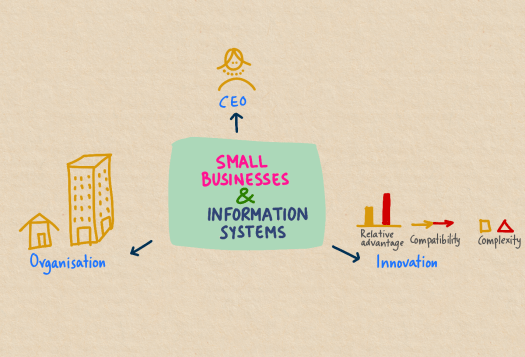
Thong’s paper argues that there are three key characteristics shown by businesses that adopt information systems (IS).

First, CEO’s matter a lot.

CEO’s that are innovative and open to trying new things are much more likely to put their weight behind an IS initiative than more conservative ones.

The amount of control held by CEOs over decisions in small firms means their approach is critical in making something happen or not.

In addition, their approach will also be influenced by how much they personally know and understand the technology being considered.

Someone who is unfamiliar with computers and suspicious of technology may be unwilling to engage and understand what is possible with modern systems.

This is not an age related thing – many older CEOs and Chairman have reached their positions by being ahead of the technology curve at every stage of their careers.

It’s an attitude thing instead.

Second – the innovation matters

People will only think about adopting something new when the benefits of doing so are clear.

We tend to use at least three rules of thumb to evaluate technological options.

  1. Is it better than what we have now – does it have relative advantage?
  2. Is it compatible with how we work now?
  3. Is it easy to use – or at least no more complex than how we do things now.

If an innovation passes these three tests, then there is a good chance we’ll consider it further.

The main thing is whether the organisation is at the right point in its lifecycle

An organisation that is too small is struggling to survive. It probably has owner managers and generalist staff.

The in-house technical people needed to properly evaluate and implement a new information system simply aren’t there.

In larger organisations with more defined roles it’s more likely there are a few people with the capability to take on the necessary jobs.

Larger businesses may also have more money to hire outside help with specialist skills.

The main difference between 1999 and now is the amount of capability aware as a service – the software as a service or SAAS model.

Email, documents, file storage, file sharing, email marketing, website design – all the capabilities that would have taken teams of people to create are now available over the internet with simple interfaces most people can use quickly.

The challenging area now is selecting and using specialist software that helps businesses do unique work.

Things haven’t changed over the decades. It’s not really about software.

It’s always about the business and the people in it.

Why we might be thinking about goals all wrong

types-of-goals.png

Goal setting theory has always bothered me – there’s something a little artificial about it – something not entirely natural.

Take the wording in this paper, for example. Edwin Locke and Gary Latham point out that some 400 studies carried out over 25 years show that specific goals lead to better task performance than easy or vague or abstract ones.

This inference hits the target but misses the point.

Before we look at why that is the case, it is useful to note that goals are then split into extrinsic and intrinsic ones.

We try and achieve extrinsic goals to show that we are capable of doing something, or to avoid showing that we are not capable.

We try and achieve intrinsic goals because they give us feelings of mastery and control and satisfaction.

The findings from more studies is that intrinsic goals lead to longer lasting performance.

There seems to be little appreciation, however, about the nature of goals themselves.

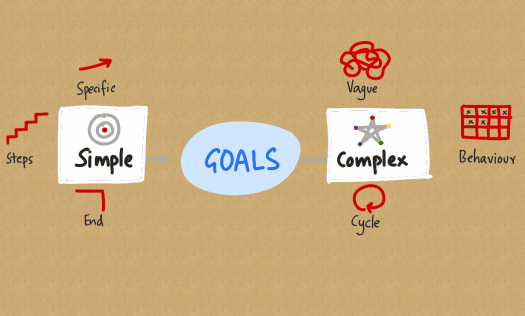
A more useful classification of goals, it seems to me, is to think of them as simple or complex.

A simple goal might be something like hit the bulls eye four our of five times on a shooting range. A complex goal might be create a sustainable level of income for a consulting business.

What happens all too often, especially when it comes to an activity like sales, is that we try and set simple goals and targets to achieve a complex outcome.

We’re then surprised and disappointed when the results don’t materialise and get cross and angry and change people.

Perhaps the mistake we’re making is in thinking that all goals are the same and all we need to do is make them SMART – the whole specific, measurable, achievable, realistic and time bound thing that is trotted out in courses.

Instead, we need to recognise the characteristics of the two types of goals and what we need to do to make progress towards them.

Take a simple goal, like getting better at hitting a target with a bow and arrow.

That is a specific goal and can be made SMART.

We can make progress towards the goal by improving how we carry out each step of the sequence of activities needed to achieve goal.

Elite athletes train until their muscles remember what to do and visualise every step they must carry out.

Finally, simple goals have an end point. We achieve them – and then that’s that. There is nothing else we need to do.

Complex goals, on the other hand are vague. They include things like living a good life, having peace of mind, and doing one’s best.

We make progress towards such goals not by following steps but by practising behaviours.

For example, we might try and learn something new every day, talk to a new person, take a different route, try new experiences.

When it comes to tasks like writing or sales, it is well known that having ridiculously low targets is a good way to actually make progress.

Finally, with complex goals there is no obvious end. When do you achieve being good? When is your business sustainable?

There is always change and we will need to adapt and discard less useful behaviours and adopt more useful ones.

Goal setting is a useful exercise. The problem is that we may be trying to adapt goals that are designed for success in fields like sport to life in general.

And life is more complex than that.

What Groucho Marx teaches us about win-win strategies

groucho-marx-strategy.png

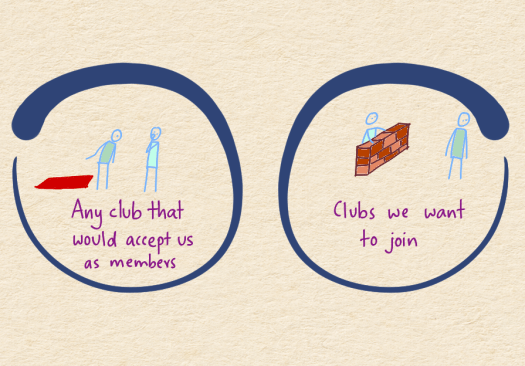
Groucho Marx, an American comedian, once wrote when resigning from a club that he didn’t want to belong to any club that would have him as a member.

Which, when we think about it, is often the way that we approach many situations.

Take selling or job hunting.

Many of us believe that if we make enough calls or apply to enough positions we’ll get somewhere – it’s a numbers game and we just need to make the numbers.

So we grind it out, spending day after day, and wondering why we aren’t getting anywhere fast.

That’s not a strategy – it’s a treadmill.

Terry Speed, Professor Emeritus at the University of California, Berkeley writing in the American Statistical Association membership magazine, suggests that a job hunter should instead make two lists.

  1. Where would I immediately accept a job offer?
  2. Which employers would be delighted to employ me?

It’s important that answers to both questions are unconditional – we accept and they offer without bargaining.

If we’re thinking like Groucho Marx, there is no win-win.

We want to work at places that may not want us. And we’re hesitant to consider the places that do.

According to Professor Speed, we’re in good shape and well calibrated if there is an overlap between the lists.

It’s worth spending the time to work out who really wants to – or will want to work with us because we can both benefit from collaborating.

That really means seeing if we’re aligned. No amount of external management or manipulation can overcome poor alignment of goals and expectations.

Conversely – sharing goals and aligning expectations means that we can spend less time on control and more time on execution.

Ideally then, we’d join clubs that we really wanted to be part of, and which would be delighted to have us as members.

But how do we know when this is the case – how do we know when we’re aligned?

There’s no easy answer to that question. It’s not something that can be assessed with a simple checklist.

We may just have to learn to look harder at what is in front of us until we can see.