How Should You Structure A Discussion For Maximum Effect?

get-to-the-point.png

Wednesday, 9.09pm

Sheffield, U.K.

Consultative selling is about making presentations – in person, in print, over the phone – in any other media you can think of.

You will need to try and get your point across.

More importantly, you will need to listen – and that’s something we can find hard to do.

Take the way many sales presentations are structured, for example.

You know everything about your company. So, it makes sense to you to start there. The marketing team is going to pull some stuff together about how big you are, what kind of clients you have, what awards you’ve won and whatever else you can come up with.

When you meet someone for an hour’s meeting, you’ll typically have an agenda that starts with introductions. Then you have a little presentation, where you go through the stuff about you. Then you give the other side a chance to talk a little about them.

By this time, forty minutes out of your allotted 60 minutes and you’re really nowhere. Perhaps you can feel good that you took the time to listen to them and get your message across.

In my experience, however, the other side spent the first bit simply staring at you glassy eyed and wondering whether they turned the lights off at home and the emails they forgot to send and just have to get round to before lunch.

During their bit of the session, they ran through a vague history of where they are and threw out some bits that they thought might fit with what you do.

The chances are, however, anything they talk about they already know how to do. That’s why they have enough to talk about. If they don’t know how to do it, then they’ll probably say that instead.

All that bland, corporate stuff is simply what John McPhee calls throat clearing. It’s all the stuff that is just in the way, the debris blocking your way to the real issue.

Think for a second about the purpose of all that introductory stuff you went through. The reason for putting it in there was to show you are good – to credentialize you.

But… the prospect hasn’t thought of buying from you at this point. They don’t know if you can help them in the first place. Why would they think about engaging you?

The thing to realise is that the point at which people check you out is after they come up with the idea that they need what you might be selling in the first place.

Think of the way you go about your life. Do you spend your time checking the history of all the things around you? Or do you first make a decision that you need something – a new car, toothpaste, a holiday – and then start looking into it in more detail?

The point about consultative sales is that it usually involves a problem that needs solving. The special thing about this problem is that it’s something the client can’t do themselves – either they don’t have the skills or know what needs to be done but don’t have the resources.

You’re either providing knowledge – the experience to help fix things – or a pair of hands to help out.

So, in your 60 minutes with your prospect, what you’ve got to do is spend as much time as possible on the issue. Get started there as soon as possible.

For many “trained” salespeople this can sound like heresy. What about all the rapport building you should be doing? Shouldn’t you be looking around the prospect’s office and trying to work out what hobbies they have? What teams they support?

Shouldn’t you be trying to become their friend at the start?

I think the answer is no. Perhaps it is in some cases – if you’re the kind of person that has the ability to have people give you business because they’re your friend.

In those cases, I’d suggest that the friend really has a conflict of interest. They shouldn’t be having that discussion with you at all. And you shouldn’t be having it with them. You just can’t provide honest, objective advice if things get that personal.

The way you become friends, in my view, is if you work together over time and build a relationship of trust based on delivering on your promises. That’s a more solid foundation for a long-term relationship.

Anyway… I digress.

The point is that you must get to the point. Quickly.

The most successful sales presentations I’ve seen are where the client has a problem and asks you to talk to them about it. You can leave all the guff about introductions and credentialization for later. At that point, you have them interested.

All you need to do is start talking about the issue. The problem. What their situation is, the shape and size and scope of the problem they’re facing, what it means for them and what approach you’ll take to solve it.

If your discussion is about a specific issue, in that form, then the follow on takes care of itself. Your proposal will simply put down in writing what you said you’ll do. You’ll get to a place where you have one discussion which leads to one proposal which leads to one sale.

As I write this, I’m thinking about a tender I’m working on. I’m trying to explain a technical approach to trading – I harp on about the history of this approach, how it has worked, how clever it is. Then I write about how I’m approaching the prospect’s situation and how we would advise them.

Tomorrow, I’m going to turn it around. I’m going to write first about them and what I’m suggesting they should do. Then, I’ll go back to why I’m saying that, why we developed our approach and why it works.

Then, I know that in the first few paragraphs I’ll be talking about their problem and getting across the main message – which is what I’ll do for them – and leaving the rest of it for them to absorb later.

In newspaper speak – what I’ve done in my current draft is bury the lead.

Instead, what you and I need to do to get the discussion going with maximum effect is to get to the point.

In the first paragraph.

Cheers,

Karthik Suresh

As a reminder, this is the seventh post in a series that I’m planning on eventually collecting into a book on Consultative Selling. If you are reading this and are interested in this topic, please let me have any feedback, good or bad, so I can make this as useful and easy to read for you as possible.

What Will Make Your Prospect Take Action?

take-action.png

Sunday, 9.35pm.

Sheffield, U.K.

When you think of successful people do you also think that the way they got successful was by taking risks?

Take your prospect, for example. That’s a person with a senior role in a large organisation, the kind of organisation that can afford to pay for your services.

They didn’t get there overnight. To be in a position where they can approve tens of thousands to pay for your time probably took a few years. Several years. Years where they worked carefully and conscientiously and were promoted for successes.

Do you think any of those involved taking a risk?

In a small number of cases the answer may be yes. It’s hard to think what the circumstances might be though.

In most cases, they got to where they were by not screwing up – or at least by not being seen to screw up. They got there by being risk-averse.

And that’s an important lesson for us to remember when trying to persuade someone to work with us.

It’s easy to fall into the trap of thinking that because we have a wonderful new product, everyone we talk to will think the same way.

Then, when we find they don’t, it’s just as easy to think what we have is rubbish and will never get anywhere in the market.

Both these are irrelevant ways of thinking. It really doesn’t matter what we think about our product. It also doesn’t really matter what most people think about it.

The only opinion that really matters is that of the person in a position to pay money for it.

And it’s a good idea to start imagining that person as standing in front of a wall. A wall built up of all their experiences, their preconceptions, their values. The things that make them think the way they do.

Let’s take an example. If you supply a service to the public sector, the chances are that there is government guidance out there that tells public sector bodies the best way to buy services.

What do you think are the chances that any one of those bodies follows a different way to the approved one?

Slim. If you try and persuade one of them to do things differently – to select you without going through a procurement exercise, for example – they’ll struggle with the idea.

If you know them well and they really want to work with you, then they’ll game the system – create a tender that only you can win.

In many cases, however, you’re dealing with someone that has a particular way of working and what you do needs to fit into that world, to be compatible. If it’s not, you’ll struggle from the start.

In other words, you’re not going to persuade anyone to take a risk. If your selling process is based on that you will fail.

What will make your prospect take action is to structure your pitch so that you avoid risk or eliminate it. That’s really what drives people.

It’s well known that most people look at wins and losses differently. You’d probably be much more upset at losing $1,000 than happy at winning the same amount.

Try this with your young kids. Tell them if they put their dishes in the sink, they’ll get a dollar. See how eager they are to take you up on the offer.

Then, give them a dollar. Then tell them that if they don’t put their dishes in the sink, they’ll need to give you back the dollar. See how they react this time.

If they’re like most kids, they’ll be less excited about earning something than losing something they already have. That’s why discipline for children often involves taking something away from them – that makes them much more likely to stop and listen to you.

So, what does this have to do with your prospect?

Well, to get them to take action, first you need to try and tear down as much of that wall as possible. That means making it safer for them to work with you – guarantees, warranties, try before you buy options.

The less risk they have, the more likely it is that they will consider what you’re offering.

Then, you need to go one step further. You need to frame your product in terms of what they will lose by not taking it, not what they will win.

For example, you could say that your product will save them $10,000. That’s what they could win. You could also mention that their competitor already has saved this $10,000 and what that means it that your prospect’s prices are going to be less competitive as a result. That’s what they could lose.

The way in which you put your point across will make the difference between them taking action or not.

Wherever possible, try and help them avoid losing something they have, and you might be surprised by how positive they are about working with you.

Cheers,

As a reminder, this is the sixth post in a series that I’m planning on eventually collecting into a book on Consultative Selling. If you are reading this and are interested in this topic, please let me have any feedback, good or bad, so I can make this as useful and easy to read for you as possible.
Karthik Suresh

How To Pick The Way That Works For You

three-roads.png

Friday, 9.24pm

Sheffield, U.K.

I like listening to motivational speakers. There’s a buzz that the good ones create, a feeling of energy and enthusiasm as they deliver their message.

Then it fades and real life starts happening again.

If only life were as simple as listening to someone else’s story and doing things the way they say we should.

Unfortunately, it’s not – and we all need to discover the ways that work for us ourselves. Fortunately, doing that will make us happier and more satisfied with ourselves.

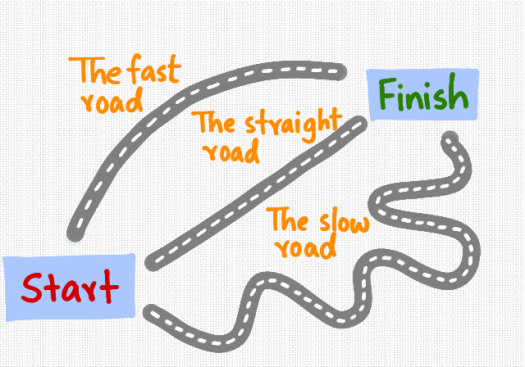
The point I’m trying to make is that there are different ways to get from one point to another, from start to finish. The thing to notice is that you have to go on a journey – and you might as well arrange things so you enjoy the trip.

Let’s put this idea in the context of consultative selling. You have a product or service. The start point is that a prospective customer doesn’t know you exist. The finish point is when they sign a contract.

The Fast Road – Get Introduced By Someone You Both Know And Trust

Human beings have evolved to be fearful. That’s how we survived. We react to anything new with fear.

That’s really what many “isms” are. Racism is fear of another race. Fundamentalism is fear of another religion.

If you have children you’ll know what happens when they’re surprised.

I was sat in the Park Guell in Barcelona, a place full of Gaudi’s creations, and one of my children was trying to fill a water bottle at the public fountain.

He was struggling to press the tap. A person stood with his kids noticed this and came over to help him.

The moment my child became aware of this strange person coming into his space he ran. Just picked up his water bottle and sprinted to me, running to safety, running out of fear.

Your prospect is grown up, but has exactly the same primal reaction mechanism built into him or her. They’re bigger and can control their fear a little more, but it’s still there.

So, just like you knew something was safe when your parents or a friend said it was, your prospect will accept that you’re worth talking to if you’re introduced by someone they know and trust.

It’s simply the best way. Period. Of course, you first need to earn that other person’s trust, and it can become an ever increasing chain of introductions.

If you’re lucky, you’re born with the right connections. Your parents know people. You went to the right schools. You’ve made the right connections at University and the people you know are now running businesses and institutions and know other people.

So, some of this is down to luck. Actually, when you think about it, the fast road is really mainly down to luck. If you’re lucky, make the most of it.

As someone said, if you want to have a good life, choose your parents carefully.

The Straight Road. Be A Battering Ram

This is the road to take if you weren’t born lucky, but aren’t afraid of hard work.

It’s simple on this road. Just keep going straight on. If there are obstacles, go over, under or around them. Or break them down. Obstacles will simply slow you down – they won’t stop you unless you decide to stop.

For example, I read on social media that someone called an organisation for a particular person and was told by the gatekeeper that they only allowed calls through from companies they already worked with.

So, if you’re a new firm looking to get business don’t call them. They’ll call you.

Which is really a polite way of saying the person you’re trying to talk to is too busy to bother with things like talking to potential suppliers, regardless of how much benefit you could bring them.

If you’re on the straight road, however, this isn’t going to stop you.

You’ll simply call back again a week later. Maybe there will be a different receptionist who will let you through.

You’ll call at a different time, either really early or really late, aiming to call while the receptionist is out and hoping your call goes straight through.

You’ll use social media to connect with your prospect, or figure out an email address, or contact another office.

Whatever happens, you’ll get through.

The thing with this approach is that it works. It works because you’ll eventually get meetings, simply from the law of averages. If you knock on enough doors, someone will eventually listen to you.

The problem is that it’s exhausting. You need abundant reserves of positive energy, a thick skin and the willingness to take rejection day after day in pursuit of your goal.

You have to want to win – to batter that door down and take your prospect by the scruff of his neck and make him listen to you.

The Slow Road. Show Your Work

The first two approaches will work for you at any stage of your career. This next one takes time.

It takes time because you’re not selling a product or a service. You’re selling yourself. You are taking the time to show what you do – where it can be seen.

The most obvious example of this these days is content marketing. The more time you spend opening up what you do to the world, the more likely it is that people who are interested will come across you. This is called being discoverable.

Making yourself discoverable takes time. You need to put things out there. You need to write and speak, do video and audio, meet people and network, go to conferences and be seen. It’s doing all the things that establish you as a voice, as a professional and as someone worth knowing.

This doesn’t come easy to some of us. For example, I like writing but I don’t like crowds. I don’t enjoy travelling long distances and mingling with people I don’t know.

I do like going places where I learn something and where I have the opportunity to have one-on-one conversations. That works for me.

The slow road really is about not worrying about the finish point so much and trying to enjoy the journey. Consultative selling is really about helping someone else with a problem.

Problems aren’t created overnight – not the kind that you’re probably helping with anyway. It takes time to change things, to find that processes that worked perfectly well when there were three people in a room work less well when there are twenty five. To realise that you need help and it’s time to call in the professionals.

If you just take the time to be professional – to be someone that is focused on building a reputation – then you’ll find that the slow road is the most rewarding one.

Surely it’s better than feeling you are where you are just because of what your parents did? And it must be more rewarding than spending every day being told not to call back?

The slow road, then, is about doing things that are right for you. Right because they make you feel good about how you spend your days. And, in spending your days doing work, you’ll build a reputation and people will find you.

You just have to trust the process. It won’t happen in a year. It will probably take ten. But then you’ll find that you’ve created something worth having. As the saying goes, people overestimate what they can achieve in a year and underestimate what they can do in ten.

In Summary

It’s probably clear where my preferences lie. Which road I think is best. But what I think doesn’t matter. What matters is that you pick the one that is right for you. They stick to that road – that approach.

You only get to the finish line by completing the journey, so whichever road you choose, stay on it till you’re done.

Cheers,

Karthik Suresh

As a reminder, this is the fifth post in a series that I’m planning on eventually collecting into a book on Consultative Selling. If you are reading this and are interested in this topic, please let me have any feedback, good or bad, so I can make this as useful and easy to read for you as possible.

What’s The First Thing You Should Do When Starting a New Sales Campaign?

cost-of-sales.png

Thursday, 9.04pm

Sheffield, U.K.

So, you’re in charge of a sales program – a consultative selling one. You’ve got targets, a resource plan, a budget. You’re ready to go. You just need to start prospecting.

Or do you?

Before you start doing anything you should ask yourself a question. Is what you’re about to do worth doing at all?

The reason for asking yourself this question is that the answer you give will decide how you spend your time. And the results you get will come from doing those things hour after hour, day after day.

You reach your goals as a result of all that work you put in over time. So, it makes sense to just check whether it’s the right work for you to be doing.

Let’s start with an example. You’ve just started a new sales role. What does your manager expect you to do?

You’re probably expected to do the modern day equivalent of knocking on doors. Pick up the phone, send emails, connect on social media. Be active. Be busy. More importantly, look busy.

You need to ask yourself whether that is the best use of your time. Let’s say that you’re not actually a professional salesperson. You’re a professional that has now been asked to get some sales in.

You’re actually good at doing something like accounting or law or working with technology. Now you need to go out and get business and the easiest, most obvious way is to “smile and dial”.

The thing that you miss by doing that is the cost of sales.

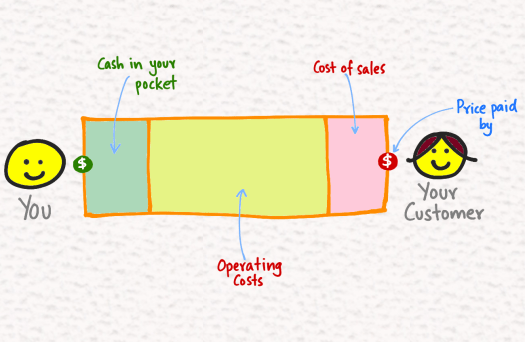
When your customer buys anything from you they pay a price. Let’s say that price is one hundred dollars. After you do everything you do in your business, you’ll end up (hopefully) with some cash in your pocket. Let’s say that’s 7 dollars.

Sounds good?

Not really. The stuff that eats up the money in the middle is operating costs – everything you need to do to actually deliver what you’ve promised the customer.

Then, at the front end is your cost of sales, the cost of actually getting to your customer and getting them to part with the money in their pocked for what you do.

Why does understanding the cost of sales matter? It matters because you can’t decide what activities are the best use of your time if you don’t price them correctly.

What are your options for bringing in business? Some of these might be on your list:

  1. Personal selling – you pick up the phone.
  2. Hire a salesperson
  3. Advertise
  4. Pay an introducer’s commission

Options 2, 3 and 4 have a defined cost associated with them. Option 1 seems free. It’s only free, however, if you value your time at zero. If you place any value on your time whatsoever, you need to decide whether it’s cheaper to go for one of the other options.

The problem is that in consultative sales, 2 and 3 have problems. You can’t easily advertise a product or service when you don’t even know what problem you’re going to solve. Perhaps you haven’t built the product yet.

Then, hiring a professional salesperson has the problems that come with an expensive resource that probably doesn’t have the deep domain knowledge you need to do a decent consultative sell. Your ideal consultative salesperson is someone who knows how to do the job as well, probably one of your operational folk.

These people, however, don’t want to pick up the phone and harass people. They aren’t good at playing the numbers game and just hammering on. They want to do good work and, if they can get in front of someone, they can explain what they do and probably get some business signed. It’s the getting in front of people that’s the problem.

Which leaves the last option – pay an introducer’s commission.

The chances are that there are people out there who spend all their time getting to know people. That’s their thing. If they’re confident that they can get you in front of the right people – and you’re confident that when you’re in front of the right people you can close a deal – then you’ve got a sweet thing going.

You should be happy to pay an introducer’s commission in this situation. You’ve saved hours of time that you can now spend on your business. The introducer makes some money and can carry on partying and meeting people. Everybody wins.

Unless someone gets greedy.

There’s an element of fairness involved. If you try and set your introducer commission too low, then you won’t get any takers. If they want too much or try and grab a slice of ongoing business, then you’re going to have to deal with that.

The best way is to have a number of introducers and negotiate a fair commission, say 20% of the first deal carried out as a result of an introduction. That will keep them bringing you new customers and you’ve got the opportunity to sell more to them later. Logically, you should be willing to pay the introducer whatever it takes – even if your profit on that first deal is zero – as long as you can make it up on the back end – the follow on sales.

It’s only when you decide that there is no way you can set up an arrangement where you pay for sales that you should do it yourself. That’s when you need to sit at your desk and start making calls and sending emails.

If you’re smart, however, you’ll spend your time finding people that can introduce you to the people you need to meet and get a commission agreement in place with them.

Then, you’re actually going to get some real traction in your sales campaign.

So, in summary, the first thing you should do when starting a new sales campaign is not to try and find prospects, but try and find people who can introduce you to prospects. Start building your referral network. That will free you up to focus on selling.

Cheers,

Karthik Suresh

As a reminder, this is the fourth post in a series that I’m planning on eventually collecting into a book on Consultative Selling. If you are reading this and are interested in this topic, please let me have any feedback, good or bad, so I can make this as useful and easy to read for you as possible.
How To Figure Out What Your Brand Is Doing For You

brand-halo.png

Wednesday, 9.27pm

Sheffield, U.K.

How is branding important in consultative sales and how can you make the best use of your brand?

Entire books have been written about brand – what they mean and how you get one. Some people think that it’s as simple as a logo, while others talk about the entire experience people have when they interact with you in any way.

Branding can be looked at very simply for our task of consultative selling. You just need to ask how your customers and prospects feel about you?

If they like, admire and trust you, that’s great. That’s the place you want to be.

That’s what many modern internet influencers have built a business on. They know that if you listen to their podcasts or read their blogs and find that what they tell you or show you is good then, when they eventually ask you to support them by buying something, you’ll be much more likely to want to reach into your wallet.

It’s very clear when people do something because they want to help you and when they do something because they want to help themselves.

Take the Tim Ferriss podcast, for example. It’s one of the most widely listened to business podcasts in the world.

Tim started it as a distraction when his previous book, which he’d worked on really intensely, failed to take off. Burned out, he started a podcast, interviewing successful people and trying to find out the routines and habits that helped them get where they were.

Now, if Tim mentions a product on his podcast, it sells out within days. That’s because he offers a trusted shortcut. He’s done all the work needed to find information, test it and bring the best bits to you. Now all you have to do is take those results and use them.

The best blogs and podcasts and companies make you feel a certain way about them. These days it’s increasingly not about what they say, but about what they show you.

That’s an area where companies that keep a tight rein on marketing struggle. They can’t make themselves more human and, let’s face it, no one is really interested in what a company does. They’re interested in what it means for them. And they’re nosy – they want to see what other people are up to.

So, an easy way to develop a brand is to be radically honest. Show it like it is. Show your work, show what you do, give people a peek behind the scenes.

This is vital in consultative sales, which happen only when people trust you. The more you show of yourself, the more information they have to judge whether you’re consistent, authentic and trustworthy or an opportunistic con artist.

So, if brand is how you make people feel, the products you offer are what you help them do. The product is the hammer you’re selling.

Take a site like Monevator, for example. That started as a finance blog about getting rich slowly. The authors have put a lot of work into making it easy to understand the options open to you.

If you want to start a pension or choose a collection of cheap index trackers, the site tells you how you can do it quickly and easily. You can save thousands by making a few simple decisions, starting with actually opening an account.

Once you use and trust a site like that then there is a good chance you’ll buy products that they recommend. In my case, it’s often books. It takes me seconds to decide to get a book if it’s recommended on a site I trust. That’s the power of its brand.

The biggest mistake people make about branding is thinking that brand is about the physical things in front of you – the logo, the fonts, the packaging. And it is that – but it’s more. It’s about what sort of feelings you evoke in the people you work with.

In consultative selling, this comes across in the way you act with a prospect. The biggest problem with selling something intangible is that people can’t judge whether you’re any good or not. You might just be good at talking. You might be showing work that someone else has done – but they’re not sure whether you can actually do it yourself.

If you insist on someone signing a contract before you’ll show them anything at all, you’ll find the task of selling to them much harder. The secret is having lots to talk about. Lots to show and tell about what you’ve done.

Here’s the thing. Advice is cheap to give. Ideas aren’t worth much. In a consultative sale, the money comes in because you are hired to execute – to deliver on a promise. To get hired, you have to show that you know your stuff, and that comes from good old show and tell.

The way in which you do your show and tell – in front of a customer and in the various media open to you – will set up and reinforce the brand you’re trying to create. Ideally, you want people to know you before you talk to them. If that isn’t possible, you want them to feel good about you quickly. The worst thing is to have people feel apathetic.

The approach to take in modern consultative sales is probably this. My advice is free or low cost. I give it away on my blog and in my books. My time is what you pay for – and paying for my time is well worth it because of the results I’ll deliver for you.

In other words, spend all your time creating your brand. The products you sell can come later in the process, when your prospects are comfortable with you – even if you’ve never met them in person.

Cheers,

Karthik Suresh

As a reminder, this is the third post in a series that I’m planning on eventually collecting into a book. If you are reading this and are interested in this topic, please let me have any feedback, good or bad, so I can make this as useful and easy to read for you as possible.

The One Thing To Understand About How Sales Works Now

sales-environment.png

Monday, 8.56pm

Sheffield, U.K.

I had my first real lesson in how sales works as I sat in the back of a lecture hall listening to Neil Rackham, the author of Spin Selling, talk about his research into the secrets of successful selling. I listened and took notes as Rackham took us through how organisations changed over the last few decades, morphing from lumbering, inefficient beasts to lean, hyper-competitive machines, operating in the age of the Internet.

The world of sales has changed too, as a result. The approaches and lessons of the past cannot be applied blindly today. We need to examine them critically, look at what works, what doesn’t work and what we need to do differently to be successful now.

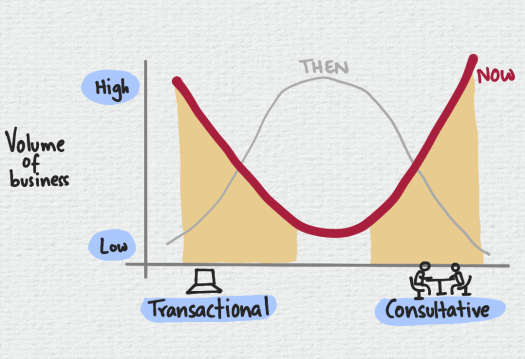
This starts with understanding the basic framework in which everything happens. Broadly, there are two extremes when it comes to something you can buy. At one end are Transactional products – simple and easy to compare. At the other end are Consultative products, a thing that you might not even realise you need but know you do when someone sits down and works through things with you.

Think of the last time you wanted to buy a book. A book is a good example of a transactional product. It’s the same product whether you buy it in a bookstore like Waterstones or a platform like Amazon. You don’t need someone to persuade you to pick one copy of the book over another. You can go off a recommendation, read a review and pick the place that is most convenient or cheap to get the book. You might even pay more in order to support your local bookstore. And the end, however, it’s a transaction and you simply exchange money for the book and get on with your life.

On the other hand, perhaps you’ve done a construction project, like a home extension. You didn’t just go out and buy and off the shelf extension. Instead, you talked to a few architects, selected one you liked, worked through a number of options, asked them for their opinion, looked at drawings and visualizations and eventually made up your mind. You couldn’t have done all that just by yourself – your architect was your consultant and advisor through the process and helped you make decisions by giving you the benefit of his or her information and expertise. This was a consultative sell.

Decades ago, before the Internet, things didn’t work quite like this. If you wanted a book, you walked into the local store and browsed the racks. Perhaps you spoke to the person behind the counter and asked for recommendations. You might have looked through the paper and read reviews of must-read books for this summer. In fact, there probably weren’t too many times you didn’t have to go into a store and ask someone’s advice, whether you were buying a new set of forks or a new car. The number of transactional sales were quite low then.

When you were in the store, you might be quite happy to pay a bit more if the service was good or if the next available store was several miles away. You’d pay for service, whether you were having your tyres changed or selecting furniture. You wouldn’t have known the options anyway – perhaps you went round three or four shops – but there was no guarantee that you couldn’t find the same thing at 20% off a few miles further on.

In this environment, the job of a salesperson was to help customers pick something. Many of the traditional selling approaches worked on the basis that the salesperson knew more than the customer and was going to spend their time together passing on their knowledge, working to “close” at the end. And that approach worked for a long time.

Then the Internet came along and changed everything. In less than ten years, many products became entirely transactional. Think of all the things you can buy online now without talking to a single person, from pencils and book and shaving cream to cars and televisions and insurance. All you have to do is do some research, compare your options and choose a product. If you know what you want, or are willing to find out by doing some research, you can then simply go on the best platform and buy it.

This has meant that that traditional rump in the middle – where you could go into a store and pay a little bit more for a little more advice has started to disappear. The relentless onslaught of the Internet is making product after product, market after market, more and more transactional. The traditional salesperson’s role is disappearing and being replaced by an online order form.

How about when you don’t know what you want? That’s the other end of the scale and it’s flourishing as well. In situations where you don’t have the expertise to evaluate your options yourself then you need some help. The individuals and organisations that do well here have the ability to help you when you don’t quite know what you need help with. For example, you might have an ache in your forearm, but you need the help of a doctor to tell whether it’s a simple muscle strain or the onset of rheumatism. If you need to carry out a major business transformation you might need to hire experienced consultants who can work with you to create and drive a process that works for your business. That needs a consultative approach.

All this means that different sales skills are needed for transactional and consultative selling. Transactional selling means you have to be great at optimising, at squeezing every last bit out of your systems and workflow and operations. Consultative selling means you have to be good with people, working with them, listening and coming up with creative and useful ideas and approaches. If what you do is repetitive and simple, it will be automated and become transactional. If what you do is human and creative, you’ve got some time still.

The first thing you have to do is figure out where you are and what you need to learn to sell in your business. You have to specialise in one end or the other – either be the best transactional salesperson out there or the best consultative. If you’re in the middle, you’re going to be squeezed out of business.

In this series of posts, I’ll start with consultative selling and then move onto transactional selling later – perhaps in another book.

As a reminder, this set of posts is part of a series that I’m planning on eventually collecting into a book. If you are reading this and are interested in this topic, please let me have any feedback, good or bad, so I can make this as useful and easy to read for you as possible.
Cheers,

Karthik Suresh

What Do You Need To Do To Get Extreme Success?

extreme-success.png

Saturday, 9.44pm

Sheffield, U.K.

Charlie Munger, the Vice-Chairman of Berkshire Hathaway, is well known for his views on the importance of mental models – concept that you can use to explain and understand why things happen the way they do.

Take extreme success, for example.

What is it that makes Walmart or Google so successful? And are these principles that can be used for smaller firms or even for ourselves as individuals?

Munger says extreme success is likely to happen when key factors combine in certain ways.

A. One or two factors – taken to extremes

When you think Walmart, you probably think cost. When you think Google, you think search.

These companies have taken a leadership position in a particular space – in their industry and in our minds.

If you want a prestige car, you’re going to think BMW and Mercedes first. Then there are the others.

Now, perhaps one doesn’t think of extreme success in the context of a local convenience store, but the factor that keeps them going is that they’re open late. Later than most others anyway.

So they thrive in their small niche, extremely successful in their own way.

B. Combining factors to get exponential results – the lollapalooza effect

This is the idea that 1 + 1 + 1 = 30, not 3.

Toyota have an ad out at the moment, showing a Hilux behind a glass panel and with the words in case of apocalypse, break glass.

You could argue that a Hilux gives you the ability to go anywhere and survive, has functionality that is world-class but is still something you can fix on the side of the road and is priced like a Toyota and not a Hummer.

It’s like the old joke comparing Land Rovers and Land Cruisers. If you want to go into the Australian outback, take a Land Rover. If you want to come back, take a Land Cruiser.

Scott Adams says that when he combined average skills at writing, drawing and knowledge of engineering the resulting comic, Dilbert, struck a chord with millions and took off.

It’s the combination that did it, not just any one factor.

C. Great performance over a number of factors

So here you need to look at organisations that get a lot of things right – and that’s not easy.

The more things you have to do, the more things that can go wrong.

Take Amazon, for example. It’s a company that does a ridiculous number of things – from providing a platform where you can buy almost anything to the support structures around your purchase, like recommendations and next day delivery.

Or take one of those survival watches. If you get one of them, you need to be confident that it will survive a plunge into freezing water, keep a signal going that can be picked up by satellite and looks good enough so you can wear it to an expensive fundraiser.

It’s hard to do a lot of things right. When you do, you’re going to get far.

D. Ride a wave

The final factor is that you’re lucky enough to be in the right place at the right time. Bill Gates was in the right place when IBM kickstarted the personal computer industry. Google came out with search algorithms just as the web reached the point where Yahoo’s listings couldn’t keep pace with the growth in pages.

The waves might be large, macroeconomic ones like the transition to renewable generation or the invention of the shipping container.

Or they might be small ones, like coming out with a diet that catches the eye of an influencer and spreads.

The thing with waves is that it’s hard to predict when they will turn up. You just need to get in position and, if you’re lucky, one will come along and lift you up.

So, do these apply to small businesses and individuals?

Well… as a model, perhaps we can use them and see. As George Box wrote all models are wrong, some are useful.

For example, can you be a leader in a particular factor? Cost, for example. While all your competitors do things manually, can you automate stuff so that you can be cheaper, but offer much more?

Can you put things together so that they have an exponential effect. For example, it’s incredibly hard to recruit people who can read, write and do arithmetic (to a high standard!). If you can… then there are many consulting jobs waiting for you with high salaries.

Are you a superb generalist – someone who can walk into an industry and fix everything from sales to operations to R&D. If so, perhaps that’s your edge.

And finally – have you qualified in a field whose time has come? Neuroscience, perhaps? Or big data?

What’s perhaps clear is that if you want to succeed, it’s not just about working hard.

You also need to know why you have an edge.

And then work on the things that sharpen your edge.

Cheers,

Karthik Suresh

Making Sense Of It All – Is It Even Possible?

sense-making.png

Thursday, 9.21pm

Sheffield, U.K.

Have you ever noticed that when you sit at your table and look at your glass – I mean really look at it – it turns out that it isn’t there at all?

Of course you haven’t, because glasses don’t act that way.

Electrons do.

You’ve probably heard of the Heisenberg Uncertainty Principle. It’s the idea that you can’t tell where something is and how fast it’s moving at the same time.

With an electron, if you try and look for it – that action will give it some energy, a boost, and it will end up speeding somewhere else. If you get its speed right, it will now be in a new place.

So you end up with this idea that an electron is everywhere at the same time, a sort of cloud rather than something precise.

And this is seems like a passable metaphor for society if we want to make sense of it all.

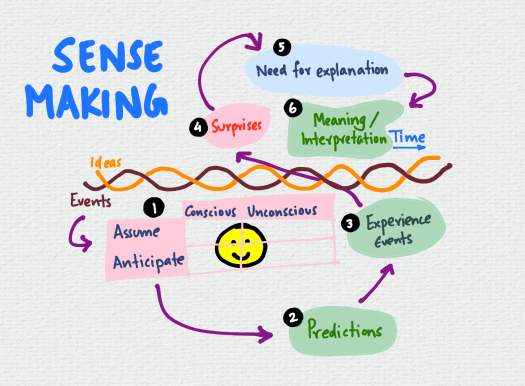
So we start with a flux of events and ideas, the braided rope of everyday life.

How do we make sense of what’s going on?

Take an approach that Meryl Louis set out in 1980.

She says that we the events we experience result in us making conscious and unconscious assumptions and anticipations.

What these let us do is make predictions.

Then… we experience events as they happen, as they unfold with time.

Some of them turn out like we predicted – but sometimes they don’t. We’re surprised.

That results in us needing to come up with an explanation – something that in turn helps us interpret and attribute meaning to the surprise we’ve just had.

Something that helps us make sense of it all.

So far so obvious – what’s the point of this all?

Well, one point is kind of screamingly obvious. All this happens in our minds. The actual flux of events and ideas doesn’t really care about any of this.

The second is that sense making is closely linked to surprise. We need to be jolted out of the everyday to see and discover something new.

Let’s say you do the same thing every day. You go to work, drive the same route, sit at the same desk, follow the same routine. How likely is it that you’ll experience something different?

Probably quite low.

It’s nice to have a simple life – one with routines. But if you’ve got too much of that, you need to get restless, a little worried, a little angsty about it all.

It’s very easy to assume that what you do is not very good, no one else will hire you, you’re not very marketable or sociable or attractive.

And if you’re in an environment (which you’ve constructed by the way with the decisions you’ve made over time) where your predictions about how things will happen come true all the time – then you’ve created a version of meaning, of sense as a result.

This can happen to individuals, to organisations, to families.

The antidote to the everyday is to get some surprise into your life.

And the thing is you don’t know where that will come from – you just need to create the opportunity for more surprises to enter your life, surprises that force you to re-examine your existing ideas and come up with new ones, ones that have a different kind of meaning.

Perhaps this needs an example. Perhaps not.

Here’s one. The fallacy of centrality.

This is the assumption that if something is important, then you’d know about it. And you don’t, so it’s not.

That leads to all kinds of problems.

Have you ever experienced a situation where someone new came in, promising to sort everything out. You put forward an idea for something that would make things better, but that person ignores you. They’ve never heard of this approach, so it clearly can’t work.

Except they then fail – and your approach works.

The problem is that the way in which they made sense of things failed when they experienced the events you did as well. Perhaps they were surprised, perhaps they learned from it. Perhaps not.

What this means for us is that the world is complex. For us to make sense of it all, we need to be alert to surprises, because that’s how we learn.

And if you’re not being surprised enough, you need to change something. Now.

Cheers,

Karthik Suresh

Why Succeeding Is More About Defeating Ourselves Than Others

beast.png

Wednesday, 9.04pm

Sheffield, U.K.

I was listening to Amy Porterfield’s podcast today and her guest, Brooke Castillo, said that the first time you do a webinar “your body literally thinks something is about to attack you and that you can die”.

Which made a picture jump into my mind – one that stayed there.

As human beings, we avoid pain. The pain of failure, the pain of rejection – any kind of pain.

In fact, we’re so fearful of pain that it can make us put things off – avoid doing things that will end up being good for us.

It’s a well known fact that we hate losing much more than we like winning. The ratio is something like five to one.

And this is a problem when we try and do anything new or different or better.

You know the old saying – if you’re so smart why aren’t you rich?

The problem, perhaps, is that if you’re smart enough to know all the ways in which things can go wrong, then you’ve got much more to be afraid of.

You create a monster in your mind, a monster that represents what failure looks like. Then, that monster sits in your way and stops you from doing things that you need to do.

And the problem is that this is a physical barrier, not just a mental one. Your body senses your brain’s fear and creates a mix of chemicals that physically cause you to want to run and hide.

To do anything but that horrible task of reaching out and making a cold call or connecting with someone new.

So, what are you going to do. What should one do when faced with a monster in one’s own mind.

Perhaps one could start with looking.

Many years ago, I was taught how to solve problems in engineering. I found analog circuit design hard, and a particular problem just wasn’t making sense to me.

My lecturer at the time just said look at the problem. Just look at it.

And so that’s what I did. For around three days.

All I did was look and think and look and think. And look and think about it. And think about what I could do about it.

And then suddenly, after three days, it felt like a rock had moved, something had shifted and suddenly I could see my way to an answer.

I can’t remember any circuit design now… but I do remember that feeling of being able to push through the fog and discomfort of a problem simply by staying put and looking at it.

And I think perhaps that’s how we can deal with monsters.

Because really, we only have a few choices open to us.

We can turn and walk away.

We can try and go around them… but we’ll probably find that they just move into the path we’re taking or we find new ones in our way.

Or we have a staredown. If we stand their long enough, they’ll get up, shake their heads and walk away.

Perhaps really that’s how we succeed.

Not by being the smartest or the wealthiest or the best connected.

Just by being the one that doesn’t back down.

Cheers,

Karthik Suresh

Why Do Some People Have All The Power?

power-structure.png

Tuesday, 6.54pm

Sheffield, U.K.

It’s easy to assume the world is the way it is and that’s how it’s going to stay.

It’s hard to imagine an alternative to the status quo. Can you imagine Google and Facebook not being as big and powerful as they are now? Doing a search on any other engine?

Logically – it’s possible, even likely. Societies change, regimes fall and companies disappear. All the time.

But, when you’re in the middle of a situation, whether personal, business or political, it’s hard to see where the change is going to come from.

Which is where power theory may help.

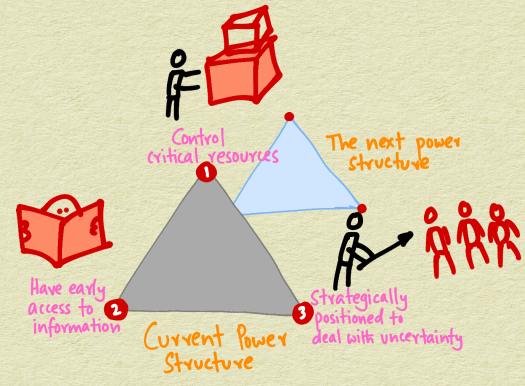
This paper by Oliver E. Williamson says that you need to have three things to grab power in an organisation:

  1. You need to control critical resources.
  2. You need to have early access to information.
  3. You need to be strategically positioned to deal with uncertainty.

Technically – he argues that the most critical part of the organisation will get these assigned to them. So, for example, if marketing is the bit of the organisation that makes the most difference, then it will be given these three things to do.

He also says that power theory is not great at explaining things – it’s a bit of a pied piper – because if you have control, why would you give it up? Why wouldn’t you stop power being taken away from you?

Now… I’m not sure I agree with his dismissal of the concept, because it seems to be useful in explaining both how things are and how they might change. Bear with me.

Let’s say you run a big car company in the US in fifties and sixties. The rest of the world has been devastated by war but the mainland US is unaffected and starts to churn out stuff for the rest of the world, supported by natural resources, a big population and abundant industrial expertise.

You’re in control. You make plenty of money. People buy your cars all around the world. Gas is cheap, so your cars are big and comfortable. You’ve got plenty of political support because of all the people you employ and the politicians you support.

You’ve also got all the statisticians and data analysts and government reports you need to see about the industry. Plenty of information on sales and resources and competitors. Nothing really gets past you.

You have a perfect power triangle – you’re in the strongest shape of your life – and it looks like nothing can ever challenge your dominance.

Until it does.

The Japanese car producers, who you’ve dismissed as makers of small, cheap, tinny cars that the American public will never buy, start to make better cars.

More importantly, however, there is a oil crisis. The Middle East creates a cartel and sends prices sky high. And suddenly all your big cars are hugely expensive to run, you don’t know how to make small economical cars and the Japanese have an opening – and people start to try their cars and like them.

Your problem is that you weren’t strategically positioned to deal with this kind of uncertainty.

And that’s because it’s really hard to predict such a dramatic shift in circumstances, especially when things are going so well.

Let’s take another example.

Microsoft was unchallenged in the PC operating system world. It ran most machines. The rest hardly made an impact.

The thing that they weren’t strategically positioned for was the Internet – and that let Google in.

What this shows us is that power is temporary – it’s a function of control, information and positioning.

At a point in time.

There’s no point in controlling critical resources if they become irrelevant. Just ask the coal industry as it wilts in the face of renewables.

There’s no point in having early access to information, for example through leaks from the government, when the Internet doesn’t give a hoot what politicians think and lets anyone talk to anyone else in the world.

And there’s no point being positioned behind a big wall if there’s a big tunnel forming right under it.

However fixed something seems to be, however powerful the current people in charge appear to be, there’s another power structure forming behind them, invisible to them – but getting ready to replace them.

Let’s hope it’s a better one.

Cheers,

Karthik