How To Make Something Interesting For Your Audience

interest-venn.png

Sunday, 9.26pm

Sheffield, U.K.

“Simple. I got very bored and depressed, so I went and plugged myself in to its external computer feed. I talked to the computer at great length and explained my view of the Universe to it,” said Marvin. “And what happened?” pressed Ford. “It committed suicide,” said Marvin and stalked off back to the Heart of Gold.” – Douglas Adams, The Hitchhiker’s Guide to the Galaxy

Why do you find one thing interesting and another completely boring?

I find, increasingly, that I have a low tolerance for boring stuff.

People who know me, on the other hand, would suggest that everything I do is catastrophically boring.

Including spending any time researching what makes something boring.

Anyway…

Paul J. Silva has done much of the hard work for us.

He says that coming across something you already know leaves you cold.

Not really that interested.

Sort of like listening to the safety briefing when you fly.

Cabin pressure. Masks. Yours first. Jacket under seat.

You know this stuff.

When you’re already familiar with the material being discussed you’ll simply tune out knowing you aren’t missing much.

Clearly what you know is a subset of the much larger set of things you don’t know.

And this is where things get interesting.

The first part of Silva’s argument is that new stuff is interesting.

So, if you want to make what you’re doing more interesting inject some “newness”.

If you look around a lot of activity is spent in trying to make things new.

Headlines that promise a new insight.

The entire phenomenon of 24-hour news.

A world filled with gossip on social media – fuelled by people wanting to be the first to know.

Some people have become famous mainly because they swear a lot in the stuff they put out and when they started that was new.

But then, new starts to get old.

When everyone’s swearing and copying things that were once new and interesting the magic disappears – it stops working as well.

The winners are the ones who captured the market first.

What’s the point here?

It’s that if you want to be the next Vaynerchuk or Ferris or Jenner you need something new and can’t just copy what they did.

The second part of Silva’s argument is that new is not enough.

It also needs to be understandable.

If you look around you’ll see lots of companies trying to create new ways to do old things.

Take customer relationship management software.

CRMs.

Businesses think they need them.

And others are trying to make new ones all the time – from Salesforce to Zoho.

What makes these interesting to people that want to buy CRMs is that they are understandable.

You get the idea of a web interface, the ability to add accounts and make notes and get reminders and share reports.

It might be new, but it’s understandable.

Now, let’s say I said to you that all you needed was a delimiter separated file and a simple script that let you manage it – the universe of people that will understand that starts to shrink quickly.

It’s new, but probably not understandable to people unfamiliar with the terminology.

Or maybe not – maybe anyone reading this gets it.

It’s hard to tell.

What isn’t hard to get is that if you want to get your message across you need make it new but you also need to deliver it in a way your audience understands.

And that goes back to very simple marketing concepts that most companies get completely wrong.

Like writing things in words your readers know rather than in jargon you do.

It’s not difficult really.

See the world through your audience’s eyes and point them to something new that they’ll understand and enjoy.

Cheers,

Karthik Suresh
How Companies Get Increasingly Desperate As They Grow

greiner-model.png

Saturday, 10.29pm

Sheffield, U.K.

It’s not the size of the dog in the fight, it’s the size of the fight in the dog. – Mark Twain

I discovered PechaKucha yesterday – a presentation format where you have 20 slides that advance every twenty seconds and you have to talk along to the images.

I selected one randomly and listened as Kal Barteski described her career as a polar bear artist.

In case you’re not sure what a polar bear artist is – she’s an artist who draws polar bears.

Over 500 of them so far, I think.

Yes. Really.

Anyway, however you look at this, it’s creative.

And distinctive. And focused. But, above all, creative.

Then, I watched Sir Ken Robinson on TED ask whether schools were places where the creativity was drained from people.

The arts, he said, were at the bottom of any hierarchy of subjects.

You were steered to everything else first because those subjects got you jobs.

I had this experience – I liked reading and writing but studied maths and physics and chemistry.

One could argue that what you study at school really doesn’t matter.

What matters is experience and you need that experience to make good art.

But, we digress.

The point is that at the centre of it all – a vocation, a business – is an act of creation.

You’re doing something different, bringing in something new.

And from then on it’s all downhill and gloom and despair.

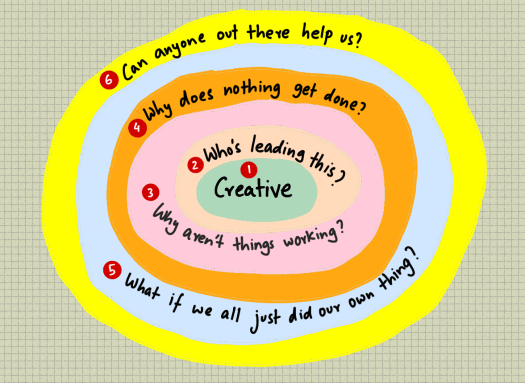
Which is captured in the Greiner Curve – five or maybe six stages that companies go through as they grow.

You’ll find examples of the curve everywhere so the picture above is an adaptation that tries to bring out the desperation under the quiet, academic tone of the model.

So, you start with a good idea. Maybe it’s just you or a few others.

You all work on the idea, long hours maybe, trying to get customers and build capability.

The team is small, talking is easy and you all get on.

Then you start getting some customers and suddenly there’s more to do.

You’re not sure who’s doing what and you ask Who’s leading this?

You give yourself roles or hire some staff and get on with the job.

But then it isn’t clear how to do things, training is patchy and customers aren’t happy. You’re asking Why aren’t things working?

The answer is that you need better systems and processes. Document everything, use forms and requests and plans.

Pretty soon, you’re drowning in paperwork and getting frustrated and asking Why does nothing ever get done?

So then it’s time to reorganise, maybe set up groups that do their own thing – lean teams that head off to conquer the world.

Except they don’t. Some things work, some things don’t.

So now it’s clear that you can’t fix it internally so you look around and ask Can anyone out there help us?

Sure… for a price.

But we can’t guarantee any results.

Is this too cynical?

I don’t think so – because it’s what happens a lot of the time.

Things generally degenerate – it’s the law of entropy.

Things, when left alone, will gradually decline into disorder.

It takes effort to stop that happening – effort and energy.

What’s clear to me from the Greiner Curve is that the only happy place is at the centre.

That centre where creative stuff happens.

After that, it’s all hassle and headaches.

When you’re working on something creative – that you’re passionate about and enjoy doing – the days go by quickly and you’re having fun.

You’ve got some fight in you.

Kal Barteski says polar bears have no natural predators – they’ve no reason to be scared of anything.

Some companies are so big that maybe that applies to them.

But for many the changes are they’re afraid a lot of the time.

If I were making that choice now about what to do in school I’d pick doing maths and writing and art. And random stuff.

Because the more skills and experience you have the more creative you can be.

Cheers.

Karthik Suresh

How Can You Find The Real Reason You Do Something?

asking-why.png

Friday, 9.48pm

Sheffield, U.K.

Thinking is the hardest work there is, which is the probable reason why so few engage in it. – Henry Ford

Many of us will face a situation where we have to come up with a one-sentence version of what we’re trying to say.

Our USP, mission statement or core value.

Something like that.

If you’ve tried doing this you know it’s not easy to do.

And that’s because we’re not always sure when we’ve reached where we should be.

For example, let’s say you want to strike out on your own as a consultant.

You’ve spent a number of years in different jobs and roles, you’ve managed people and are technically savvy and creative.

So, you’re in a position where you have some skills and some hunger and want to make your own way in life.

So, what do you say when people ask you “What do you do?”

If your answer is too broad they’ll look at you and ask more questions.

If your answer is too narrow they’ll squint at you and edge away nervously.

For example, if you say “I’m a management consultant”, they’ll ask what type of consultant you are.

Do you do process changes, analysis, restructuring?

They’ll try and come up with what they’ve seen consultants do and try to see if you do any of those things.

In other words, you’ve not answered the question so they’re trying to figure out the answer for themselves.

In a different situation you may say you’re an expert in Scandinavian lumber markets – perhaps something of vital consequence for everyone’s living room – but no one really gets why.

The thing is that you’re often going to be in situations where you need to try and explain something.

And the words you grasp for first rarely do the job.

What you realise is that you haven’t dug deeply enough yet.

So, you’re a management consultant.

Why do you do that?

Well, you solve business problems.

Why do you solve business problems?

Ideally, a business would have everything running perfectly – its operations would seamlessly work together – but that doesn’t happen in practice and so problems happen.

Why don’t business operations work seamlessly?

Operations are built over time, people come and go, knowledge is not evenly distributed. So often, someone creates something that works, and over time it is added to and modified and changed and stops working as well.

Why do things stop working over time?

Ways of doing things are just like material things – they get old and tired. Sometimes you can keep them going with maintenance and changes and sometimes you need to bring in a piece of kit.

Why do things change?

They just do – that’s one of the unchanging things about life.

So… if you stop digging at this point then you find that you’ve gone through several layers of rock.

You started by asking why you’re a management consultant and ended by knocking on the door of one of the ancient questions of life.

But perhaps you’re no closer to answering your question.

So, maybe you need to start again, go back up the chain of questions and try a different route.

No one said that the first place you dug would have all the answers.

All they said was you need to dig.

And maybe one day, if you’re lucky, you will.

Cheers,

Karthik Suresh

Why It Makes Sense To Reset Things To An Optimum Point

earth-heaven.png

Wednesday, 9.36pm

Sheffield, U.K.

People in Bali understand: in order to be happy you must always know where you are. Every moment. Right here is perfect balance. Right at meeting of Heaven and Earth. Not too much God, not too much selfish, otherwise, life too crazy. – Ketut in Eat Pray Love

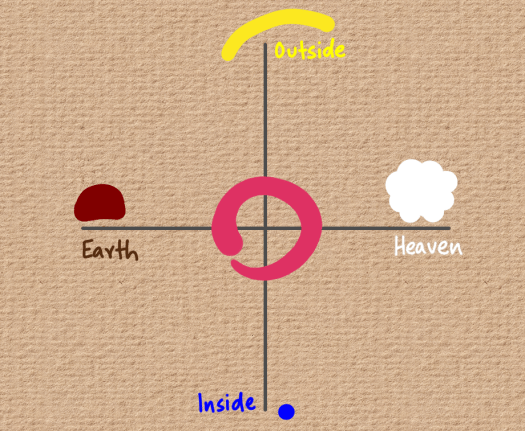
I watched Eat, Pray, Love today – because I had some time – and sat up at the point where Ketut, a medicine man, drew a picture of a cross with a circle in the middle and said the words quoted above.

The camera moved on quickly.

Was there more to the picture?

The Internet doesn’t say, so I’ve added bits to the picture and perhaps they’ll make sense.

This idea of balance is interesting.

There isn’t a perfect place you reach, where all is good.

Instead, you’re constantly balancing everything.

You’re balancing your need to find meaning and purpose with your need to eat and house your family.

How many stories have you heard of people achieving staggering wealth and losing their families on the way?

After all, if you walk along looking down at your feet or up at the skies you’re far more likely to get run over than if you’re looking straight ahead.

So, we have heaven and earth on one axis. What about the other?

Perhaps it has to do with what’s inside and what’s outside.

Some people take good care of what’s on the outside – their looks, their bodies, their environment but have doubts and uncertainty inside.

Others are the opposite – they spend so much time thinking about what’s inside that they miss what is all around them.

So, the aim is to navigate back to the centre, to that place where we’re in balance.

And that’s easier said than done.

You can, however, approach the issue from the side – creep up on it without being noticed.

Take good habits in the kitchen, for example.

The French idea of mise-en-place is about having the right things so you can use them in the right order.

The Japanese have Kichiri – the art of having things exactly, perfectly straight – with everything set out either parallel or at right angles to everything else.

Or take your computer desktop – when you’ve got everything closed except what you’re working on aren’t you much calmer than when there are tens of windows trying to get your attention?

Stress, anxiety, worry – in many cases your body must be telling you that you’re out of balance.

You need to do more of something and less of something else.

There is an argument that you get to balance by taking the average of extremes.

Today you break your back pushing your body to extremes.

Tomorrow you take the day off and don’t bother getting out of bed.

And maybe that’s true – it’s simply two points on the chart rather than a circle in the middle.

I heard someone say “The devil’s in the defaults”, which appears in The Four-Dimensional Human: Ways of Being in the Digital World by Laurence Scott.

So I guess where one should start is by working out where your defaults are set right now.

Do you spend all your time focused on what to do next and what your boss wants?

Or do you think about what you want to do?

Are you so lost in ideas and possibilities that you want to do that you forget to take action?

Or are you enraptured by a movement or ideology to the point of zealotry?

It’s only when you know where you are and how far away you are from the centre that you can start to think about shifting your position.

And that takes awareness – awareness of yourself and what’s around you.

Something many of us are too busy to spend time on.

Cheers,

Karthik Suresh

Why Opting For Safety Can Be The Riskiest Strategy Of All

bamboo.png

The three most harmful addictions are heroin, carbohydrates, and a monthly salary. – Nassim Nicholas Taleb

Many years ago, when I was around ten, we had an art class where we were introduced to Japanese painting.

We used a brush to make swift, sure strokes with dark, black ink on delicate, gossamer-thin rice paper.

Well – that was the idea, anyway.

My clumsy attempts to draw bamboo stalks would have won few prizes back then judging from my performance today in the picture above but it still serves to illustrate a point.

Would you rather have one leaf or many if you were a plant?

Do you ever wonder sometimes how you ended up where you are?

What choices led you to the precise place you now find yourself?

Perhaps you’re fortunate – you have all the things that society prizes.

Or perhaps you’re trapped, with all you want and nothing you need.

We often make decisions not to make the most of opportunities but to avoid risk.

And that makes sense because we’re hard-wired to dislike losing more than we like winning.

I remember reading somewhere that there’s no right way to look at this.

For example, the quote from Taleb derides an addiction to a monthly income.

That’s a bad thing – clearly.

Then again, recently I heard a wife talk about how her husband brought home a wage for forty years – and the stability and life that gave them.

You have stability – and the uncertainty that comes with it.

If you lose the one wage you lose a lot.

If you have lots of little streams of income coming in then you’re less reliant on any given one and if it stops flowing you still carry on.

The flip side to this is that if you don’t have enough then you’re always uncertain about where the next penny is going to come from.

It’s only an issue when you’re comparing bamboo, I suppose.

After all, there are things like cacti that seem to do very well with one very large equivalent of a leaf.

Is there a point to all this?

I suppose what it comes down to is that whether you have one leaf or several it’s nice to be in a position to make a choice about which one works for you.

And that choice is easier if you don’t depend on the leaves in the first place.

So, for example, if you have 12 months of living expenses stashed away you have more freedom than someone who needs next month’s pay packet to pay the bills.

Maybe it’s less to do with choosing safety or risk but being in a position where neither has an impact you can’t come back from.

Which I suppose starts with answering the question “What’s the worst that could happen?”

Cheers,

Karthik Suresh

What Is The One True Way To Do Something?

fishing.png

Monday, 10.40pm

Sheffield, U.K.

Wealth is not about having a lot of money; it’s about having a lot of options. – Chris Rock

I’ve only been fishing once in my life.

It didn’t go well.

The good thing was that I didn’t catch anything – if I had I’m not entirely sure what I would have done as I don’t really like fish.

I also got stuck.

I was by myself, at the edge of a small pond. I cast my line and it hooked onto the bushes on the other side of the pond.

So there I was, with a borrowed rod in my hands, deep water in front of me and a stuck line.

I resigned myself to having to wait for a few hours till someone who know what they were doing came and rescued me.

Then, after a while, I figured out that I could just put my rod down, walk around the pond and get my line free.

So then I was back to the casting and the failing to catch anything.

So, I am not a reliable source of fishing knowledge.

But, the idea of fishing is interesting when it comes to what you do with your life.

And it boils down to having options.

If you’re sat at the edge of the water with a single line then you’ll catch the occasional fish.

If, on the other hand, you’re like the French anglers we come across on vacation – the ones who park their caravan at the edge of the canal and set out a dozen rods – you’re going to catch more than your fair share.

One of them came across to us once and gave us a dozen fish – he just had too many for his family to have.

And that’s a good model – to have many lines in the water.

If you’re marketing your business you need to use all the channels you can – from cold calling, direct mail, referrals, advertising – everything that you can economically and competently do.

If you’re trying to get promoted you need to try your hand at different tasks, multiple areas of need – because doing more than just the one thing you’re paid to do is what results in a lucky break.

The point is that there is never really one true way to do something.

There are a multitude of possibilities and the more you can explore the better your chances of finding the one that works for you.

You can also put up with a lot more when you have options – it makes it much easier to deal with demanding situations and bosses when you know there is something else you’re also working on.

It’s a simple picture really – having one line versus having several.

We’ve just got to make sure we get on with getting them set up.

Cheers,

Karthik Suresh

What Is It You Really Want To Be To A Client?

trusted-advisor.png

Sunday, 8.52pm

Sheffield, U.K.

To profit from good advice requires more wisdom than to give it. – Wilson Mizner

The term “Trusted Advisor” has a thin, displeasingly metallic sound.

There’s nothing wrong with the term as such – it’s loved by professional services firms – and popularised by authors such as David H. Maister.

But you’d feel a little too self-promotional if you called yourelf one.

The idea behind it, however, is a good one and it does help you think about your business and how you want to come across to a client.

And Maister et.al have a model, adapted in the figure above, that is useful for this.

Think of the thing you’re good at – whether it’s boiler repair or software programming – you have built up expertise and can get a job done.

At that point, you’re available for hire.

You’re a consultant now. Even if you’re hired by a company full-time you’re still really a consultant to them.

But for any other firm you’re an expert that can come in and do a specific task for them.

From that point, the client needs to think not just about whether you can do the job but what else you’re bringing with you.

Do you work well with them? Can you collaborate? Do you get what they’re trying to do and how what you do fits in?

When you do, they’ll want to work with you on a regular basis.

You become a supplier – not just a consultant called in for one-off jobs.

Then what?

Do you put their interests ahead of your own?

Do you help them get what they need rather than what they say they want?

Do they see you as part of their team – on their side?

As the way you work with them moves from offering expertise to providing insight and as you go from getting a task done to collaborating with them you move from an expert for hire to an advisor they trust.

This model is nice because it shows you a pathway – what happens over time as you go from having your head down getting things done to looking up and doing the right things.

Then, I think, you may find yourself in a situation where you are trusted.

But I don’t think you should try and get trust – to try and force it or manipulate things so you appear trusted.

That’s false – and nothing ensures that trust is lost forever than a falsehood.

It may come down to this…

Start by doing things right.

Follow up by showing the client the right things to do.

Always do the right thing.

And trust, one day, will simply be there.

Cheers,

Karthik Suresh

Do You Act Like A Predator Or Like Prey?

prey-predator.png

Friday, 9.27pm

Sheffield, U.K.

This is an era of specialists, each of whom sees his own problem and is unaware of or intolerant of the larger frame into which it fits. – Rachel Carson

Why do I write this blog?

It forces me to ask questions – to consider approaches, options and alternatives – and choose one to do.

Yesterday, for example, I learned that it was important to create links – to try and distribute yourself widely.

So, I thought, maybe I should share these posts more widely on social media.

Today, I’m re-thinking that approach.

For a start, these posts are a first draft. I write them, proof read them, hope they’re ok and send them out into the world.

Some of you read them and a few of you give me feedback in the form of likes and comments.

Now, think of this blog like an organism.

Something that exists in an ecosystem – just out there trying to stay alive.

What could it do?

It could try and adapt – to camouflage itself and be like the others out there.

It could stand out, have bold colours, a loud cry and show itself off.

It could become huge and dominate its space lumbering through with little regard for anyone else.

Or it could be predatory, opportunistic and targeted, going after a target with precision and focus.

At the moment, however, it’s a bit like a petri dish full of uni-cellular organisms.

Each post is self contained, there are few links between them and the topics sort of bounce about based on whatever seems interesting right now.

Okay… you get the point.

Blog – like an organism – but not a big one.

More like jelly on a plate.

What next?

Well,the next bit is evolution.

Let’s take anything that’s at this stage – a blog, a new business, a new relationship.

Can you come along and shout at this thing to improve?

Can you create a business that has the gravitas of one that has been around for 130 years in the next twelve months?

Can you pack a 10 year relationship with this person you’ve just met into the next week?

Or do you have to evolve?

Do you have to go from being an employee to being a one-person business to hiring your first part-timer to your first full-time employee to two, to ten to five hundred?

Clearly not – as any advisor will say.

What you need to do is create explosive scale and growth.

And that comes from getting lots of money and lots of people and shouting very loudly and working very hard.

That sounds quite exhausting.

What does any of this have to do with the title of this post?

Well… it’s one way to think about where you are right now.

Are you uncertain, nervous, looking up all the time to see if you’re safe – in your job, career and relationship?

Or do you pad along, working on stuff you know is important and going after opportunities you want?

Whether you’re either of those or something different what’s happened is that you fit into your environment – there’s a niche shaped just like you.

For others, we’re still evolving – trying to being the parts together to become something bigger, something better fitted for its environment.

And at this stage it’s probably wrong to force it.

It’s better to have one reader that enjoys your writing than many that have somehow been persuaded to share it.

At these early stages staying organic seems a better way to survive.

But if you have a choice right now of choosing which direction you want to evolve in next – wouldn’t you rather be a predator?

Cheers,

Karthik Suresh

What Is The One Thing You Should Optimize For When Marketing A Message?

optimize-sharing.png

Your network is your net worth – Porter Gale

It’s very easy to confuse outcomes and goals.

If you want to lose weight, for example, it’s easy to set a goal to lose 20 pounds when what you want as an outcome is to look good when you’re going out.

Or, if you run a business, to set a financial goal of increasing business by $500,000 when the outcome you want is a promotion.

Now, if you’re anything like me, you’re questioning those last two statements.

Surely the two are obviously linked – you can’t just separate them.

If you lose 20 pounds, you’ll look better and if you add $500,000 in earnings you’ll be promoted.

But here’s the thing.

Neither of those goals are really goals – they’re outcomes as well.

You lose 20 pounds by doing something and add $500,000 by doing other things.

So… what are those things and are they the goals to go after?

Why does any of this matter? Surely you just need to decide on a goal and get on with it and stop worrying about all this stuff?

Well, it matters because of what Buzzfeed found when they looked at how things spread.

Life is not linear – it doesn’t proceed in a step by step way.

The future is a distribution – a thicket of possibilities.

So, if you want to get your message out there what should you do?

Is it the quality of copy that matters?

Can you post something great on your website and expect the traffic to pour in?

No, it turns out. What matters is putting that content out to more networks.

Then, it spreads, from network to network and back again.

From Pinterest to Facebook, from email to Twitter and back and forth and maybe to a completely new platform.

That’s how things really spread and, if you want to get your message out, you’ve got to spend the time working on those different networks.

Which brings us back to weight and revenue.

You could lose weight just cutting out everything but protein.

But, to keep it off, you’ll need a mix – exercise, diet, sleep, water.

With your business, you need email, personal networks, referrals, social networks, media, advertising.

The message is important – It’s got to be a good one.

But it appears that the distribution is even more important.

Which is why after several months I might start sharing these posts on social media again.

Cheers,

Karthik Suresh

What’s The Biggest Marketing Mistake You Can Make?

making-it-easy.png

I do uphill skiing; I don’t do downhill skiing. I think that’s for nerd amateurs. – Judah Friedlander

What is it that means some people struggle to sell their time at $10 an hour and others are fully booked at $10,000 an hour?

As you know platforms are the big thing now – you can get people from all over the word to bid for your work and get amazing results.

Or can you?

I’ve not seen that really. I’ve had some competent work and some pretty shoddy work. But because it was cheap it wasn’t really worth worrying about.

And that’s the thing about how you think about what you do.

If you’re cheap people will take a punt because they haven’t got much to lose but you’ll still be under the same pressure to perform as you would be if you were paid ten times as much.

In most professions it doesn’t take you any less time to service a small account than a big one.

That means it’s almost always a good idea to raise prices – to charge more than you think the market will bear.

But then, you’re asking, why would anyone pay that?

Let’s say you charge $300 a day at the moment. Why would anyone pay you $900 a day?

What is it you do that justifies that level of pay when others are doing the same job for $300?

If you’re asking that – then you’re asking the wrong question.

The point is that the value in what you do is not in the job you do.

It’s in what happens after the job is done.

If you think about your time as worth a fixed amount that’s thinking about it all wrong.

Your time is actually worth a share of what happens when you’ve spent it.

If you spend your time digging a hole you end up with a hole.

The value of that hole depends on whether you’re now going to chuck some rubbish in or whether there’s a vein of gold in there somewhere.

Boiling this down what this means is you’re on commission and whatever you’re paid is a percentage of the value you create.

If what you do saves someone $30 an hour then they’ll pay you $10.

If you save them $30,000 then you’ll get your $10,000.

But this is where the marketing problem comes into play.

If you say to someone “Give me $10,0000, and I’ll do some work that will make you three times that”, their first reaction will be “How can I be sure of that?”

And this is where you can go in one of two ways.

You can make it hard for them to be sure – create a road filled with potholes of uncertainty.

Or you can remove all the risk they can have.

For example, you might be very clear that you do everything at your own cost and risk and only get paid if you’re successful.

What if you’re too successful?

Maybe you cap the amount. Give the person a chance to buy you out.

But whatever you do you have to make it easy for them to buy.

And that’s harder than it looks unless you are totally clear that the customer getting the benefit they’ve been promised comes first – ahead of anything you get.

It’s very easy to make things hard – but what you’ve got to make sure you do is go the other way.

Cheers,

Karthik Suresh