How Different People Think About System Design

system-design.png

Thursday, 7.08pm

Sheffield, U.K.

Design is a funny word. Some people think design means how it looks. But of course, if you dig deeper, it’s really how it works. – Steve Jobs

I’ve spent a few days happily messing with data – not in Excel and fancy visual tools but on the command line – that place that existed from the beginning.

Now the thing with this other world of computing that most people don’t really know about is that people with names wrote the software I use now.

For example the Unix utilities cut and paste were written by David M. Ihnat, David MacKenzie, and Jim Meyering – names in the documentation that make it more real.

Talking about Unix, as I do every once in a while, I came across this paper by Donald A. Norman written in 1981 which damns the system as “a disaster for the casual user.”

Norman lists all the things that are wrong about the system and rails at how the simplest concessions to making things easy for people are not there.

It’s not consistent, he says, the functions are weird, it refuses to talk to you and it taxes your brain too much.

And then he has a pop at the venerable Unix utility cat – saying that it fails to do the simple task of showing you what’s in a file.

Now, if you are unaware of the history of these things and the views on the other side – we are treading on a battleground.

The Unix folk pointed out that people like Norman just didn’t get it.

The reasons why can wait for another day – because I doubt you’re really all that interested.

The point I want to come to is at the end of Norman’s paper.

He says that the three most important concepts for system design are to be consistent, have an explicit model for how to interact with the system and make it easy for the user – don’t tax their brains too much.

This kind of thinking inevitably comes up with a box.

It’s consistent.

You have a model for it – put stuff in the box and carry them around.

And it’s simple – it’s not too hard to work out how to use a box.

And then, by doing so you miss the point – a point that’s captured beautifully in the world of Calvin and Hobbes – the boy with his tiger.

A box, in his world, can be anything.

It can be a transmogrifier – you go into it and come out transformed into a dinosaur.

Children will show you what a box can be used for – not what it’s designed to be used for.

It’s a racecar, a spaceship, a den.

It can be anything you want it to be.

And that wasn’t designed into the model.

Systems like Unix that don’t tell you how to live your life help bigger things to emerge.

Like a tree.

No one designed a tree – but you can’t live without them.

They weren’t designed for you to climb – but you did that anyway.

The point about design – as Steve Jobs got – is not really about the control you have – but what it does for the user.

How it liberates them and empowers them.

And that is something a system like Unix – well – GNU/Linux now – does better than anything else out there.

Because it gives you your freedom back.

Cheers,

Karthik Suresh

How Healthy Is Your Business?

healthy-business.png

Wednesday, 7.58pm

Sheffield, U.K.

A man is as old as his arteries. – Thomas Sydenham

Some principles refuse to die – perhaps that’s why they became principles in the first case.

Winning companies, for example, tend to keep winning and eventually get so big that they tower over everyone else.

The Google and Apples and Microsofts of the world along with the GEs and Gazproms are huge, lumbering beasts – unstoppable and invincible.

And then you have everyone else.

The small businesses, the charities bigger businesses and the entire public sector.

The ones who employ everyone else and do everything else.

How can you tell whether they’re in good health or not?

I’ve been wondering whether how they use data could act as a measure.

It’s probably not an exaggeration to say that the flow of data through an organisation is like the flow of blood through an organism.

The thing that keeps the organisation going is that steady data flow, pumped out hourly, daily, monthly according to a cadence – a heartbeat.

What we do is pulled, pushed, driven by flows of data – emails in, emails out, spreadsheets, files, presentations, meetings – a never ending series of rolling waves of data that break on our desks.

And if you listen to the sound of that data flow – you’ll hear the wailing of anguished souls.

People don’t understand what to do.

They haven’t got the skills to clean and transform data.

The stuff they send out is incomplete and messy and plain wrong.

It’s always someone’s fault – if only they could just work harder and do a better job.

It’s going to take days to work through every line of this spreadsheet and check it off.

It feels to me like in such situations we have something clogging up the pipes that transport that data.

With the human heart and arteries it’s plaque that causes the damage – deposits of crud that narrow and constrict the vessels and stop the flow of blood.

With organisations the plaque is the people – as they try and deal with what’s in front of them but end up getting stuck and causing a blockage that eventually causes a failure of the whole system.

It’s not their fault just like heart disease is not the fault of the bacon you ate yesterday.

You can’t explain why the system behaves the way it does by pointing to the parts.

It’s the human making choices about what to eat that causes heart disease.

And it’s the organisation – the senior managers that make decisions – that are responsible for the deposits and blockage in their organisation.

And it doesn’t need to be that way.

It sometimes feels like technology solutions, especially those from the big vendors and anyone who tries to sell software as a service have the same effect as fast food on an organisation.

If you want to be healthy as a person you have to eat right and exercise – try and stay lean.

If you want to be healthy as an organisation – the same principles apply.

Looking to technology for the latest miracle cure or plaque busting pill will not help you get better.

Looking inside – looking at your behaviour and changing it – doing less of the bad stuff and more of the good stuff is the way to improve anything.

But again – do you know how to do this?

Sometimes, just like in real life, we need a doctor to help – someone who knows what to look for and what to prescribe.

The information is out there – in books, in open source software and in people who can help.

But you have to want to be healthy in the first place.

And then decide to do the hard work that’s involved in getting there.

Cheers,

Karthik Suresh

How To Market And Sell Professional Services

good-agency.png

Tuesday, 8.31pm

Sheffield, U.K.

Professional services industries like finance, consulting, and legal services are, by definition, meta-industries. That is, they serve to help large companies raise money, buy and sell each other, reorganize, implement new systems, conduct complex transactions, and so forth. – Andrew Yang

I’ve been thinking about the service sector and how to market it for the last few days.

Which is why the book How to advertise by Kenneth Roman and Jane Maas caught my eye.

Published in 1976, it’s a short book and the two authors worked at Ogilvy and Mather.

The book is a quick read and effectively a bunch of rules – but there are a few interesting things that still resonate with us now.

First – what does it take to be a good advertiser?

The answer, according to the authors is hard work, knowing the rules and creative brilliance.

When you start thinking of marketing your product the first thing you need is to understand how you are going to position your product

Where is it going to sit in the mind of the consumer?

That positioning decision sets your strategy – one part of which is the creative bit – the actual advertising.

And the book lists five questions it’s worth asking about your creative strategy.

  1. The Objective: What should the advertising do?
  2. The Audience: Who is your target consumer?
  3. Key Consumer Benefit: Why should they buy from you?
  4. Support: A reason to believe in that benefit
  5. Tone and Manner: What is the product’s “personality”?

Getting the strategy right needs work – you need to do your research, understand the facts, really get a good picture of what is going on so that the strategy you come up with is grounded in the data.

This paper, for example, sets out how I go about doing this.

And then they say something in the book that really fits how I see things working.

Getting the strategy done is half the work. The other half is the advertising itself – the execution.

Now, if you look back at the points above you’ll have a very quick overview of what you need to do delivering any kind of professional service.

Whether you’re an accountant, lawyer or management consultant the first part of your work is all about coming up with the right strategy.

The second part is executing – delivering on that strategy.

But why should someone trust you enough to hire you?

And that’s summed up in one tiny paragraph on page 149 – something that I think could easily be expanded into a whole paper or book all by itself – a message that’s laid out in the image that starts this post.

“Look for a business philosophy, stable management, a professional staff, technical expertise, and a past, present and future.”

Read that again and tell me it isn’t one of the most elegant and densely packed sentences you’ve seen.

And then tell me if you can honestly say that your agency ticks every one of those criteria?

And if it doesn’t – isn’t it obvious what you need to do?

Cheers,

Karthik Suresh

What Should You Design Into The Core Of Your Business?

plumbing.png

Monday, 8.59pm

Sheffield, U.K.

Acting is not an important job in the scheme of things. Plumbing is. – Spencer Tracy

It is not always clear what kind of relationship exists between the work one does and what one is paid.

I have a book upstairs about the wealth distribution in the UK and while I haven’t read it in a while, some of the points it makes are probably still relevant.

For example, a quarter of the fortunes made in this country are in property and another quarter in finance.

The change from a nationalised set of industries to deregulation and free enterprise created a host of well paid jobs – what the book calls “fat cat” jobs.

These are the ones heading major enterprises, industries, institutions that came out of public ownership and went into the private sector.

The way one decides how to pay people that run these organisations is by hiring advisers who look at what other organisations pay and suggest an equivalent salary – something that results in a ratcheting up of salaries.

Then there are the people in the professions – what the book calls the “professional poor”.

They’re several rungs down on the wealth scale.

Now, while we’d all like to be fat cats one needs to be careful about labels.

Arguably, one of the most important inventions of modern times is the invention of the joint stock company.

This is where people who don’t know each other put in money for a share in an enterprise and of its profits.

This replaced entrenched interests, family concerns and cartels with an institution – something that was its own legal entity and that was served by its Board of Directors.

So, in that situation you would expect them to be competent and pay them accordingly.

But say you aren’t at that level yet – you don’t have a business that’s listed on an exchange – you’re just starting out with something new.

What do you need to have at the core of your business?

Well, the single best thing is to have a monopoly – be in a business where the barriers to entry are so high that you have no competition.

If you can’t swing that then make sure that at the core of your business you fix something that’s broken.

Let me explain.

Lots of people will help you make money. Play the markets. Find you investments. Save you cash. Get you compensation.

Few, however, really fix problems.

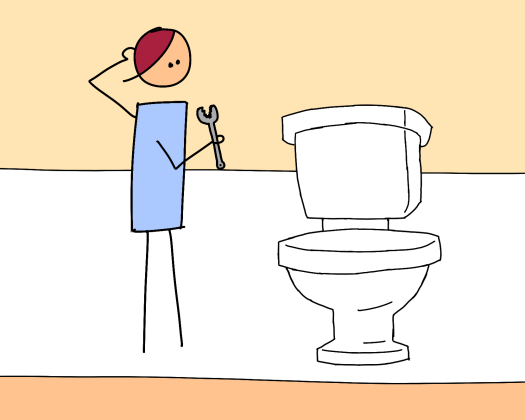
Take the job of a plumber, for example.

Most of the time you don’t really think about your plumbing at home – it works and there is hot water and something to drink.

But what happens when something goes wrong?

You’re willing to pay almost anything to get it fixed.

And that’s the point – you’re always more willing to pay money to fix a broken thing than pay money to avoid costs or make more money.

We’re very cautious – we don’t like to spend money if we’re not sure and we’re worried about losing money betting on the wrong thing.

In fact, we’re much more likely to hate the idea of losing money than the idea of making lots from a bet.

But when something is wrong – we’re a customer.

People look for you not because you’re nice or because you can help them – but because you can fix a smelly, dirty problem for them.

That’s the second best driver to bring in business – after being the only game in town.

Imagine listening to two pitches.

One says here’s a great way for you to make loads of money – you just need to hire me and I will do amazing things for you.

The other says you’ve got a smelly, dirty, messy problem in your house and your carpets are going mouldy – and I can fix that for you.

Which one are you going to hire first?

Cheers.

Karthik Suresh

What Must You Know In Order To Be An Entrepreneur?

business-creature.png

Sunday, 9.30pm

Sheffield, U.K.

Some people regard private enterprise as a predatory tiger to be shot. Others look on it as a cow they can milk. Not enough people see it as a healthy horse, pulling a sturdy wagon. Winston Churchill

Every once in a while you talk to a “real” business person and realise that they think in a different way about things.

Some of it is about culture and some of it is about history – but all of it is hard to compress into a formula.

Take, for example, a collection of essays titled The culture of entrepreneurship edited by Brigitte Berger.

The essays explore the way in which entrepreneurs operate around the world and argues for a better understanding of their importance.

This is important because, as the introduction points out, the living standards we enjoy are as a result of the productive forces unleashed by capitalism and embodied by entrepreneurs.

Entrepreneurs find ways to make the world work better – and in doing so seem to improve things for everyone else.

And that’s something many people still find hard to understand – they cling to the idea that people in business exist to exploit others – and that business itself must therefore be evil.

And that really comes from a place of fear – from a place of misunderstanding.

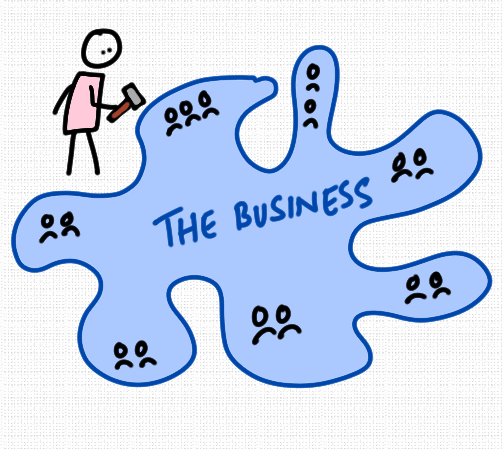
Imagine that a business is a creature – a strange thing with many arms and heads and a weird body.

Most people would be wary of such a strange animal – wondering what it’s going to do to them.

But that creature has probably evolved to fit a particular niche – and it is eminently suited to do what it is supposed to do.

That business can exist, grow, thrive until one of two things happens.

First, it can grow old and weak – and be devoured by something else.

Or its world can change around it and the niche it occupies disappear, leaving it defenceless and unprotected – and it simply goes extinct.

That’s just the way these things go.

But, while the business is alive – or even when it’s just a thought in the mind of an entrepreneur what is the most important thing that must be in place?

For this – we should think of one of the characteristics of a system as described by Russ Ackoff.

He said that you cannot explain a “why” in terms of its parts. A system cannot understand itself.

In a business you have many people doing jobs – think of them occupied in moving arms and legs – account and marketing and so on.

If you asked any one of them why the business exists you will probably get a partial point of view – perhaps articulated using the language and customs of the respondent’s profession.

In simpler terms they will tell you “how” the business works.

This is the business of analysis.

In order to know “why” the system works you must talk to the entrepreneur – the person who is outside the system – the person who is engaged in creating the business.

That is the only person that can tell you “why” the business exists because they were driven to create it.

This distinction is not easy to capture.

Does it mean knowing how to do every aspect of the business?

No – but it does mean knowing what each aspect needs to do – and making sure that’s done.

Within this basic structure there are a huge range of possibilities for how the entrepreneur functions.

Some people have grown up in business families while others have come to it with no background at all.

Some people see their businesses as families while others see theirs as a network of professionals held together by common values and desires.

The fact is that if you’re an entrepreneur the most important thing you have to be able to do is to see the creature you’re creating.

If you can’t then you’re going to struggle.

And it may be easier to stick with the day job.

Cheers,

Karthik Suresh

Why Trying To Make Something Happen May Not Be The Best Idea

forcing-effect.png

Saturday, 7.20pm

Sheffield, U.K.

The law that entropy always increases – the second law of thermodynamics – holds I think, the supreme position among the laws of Nature. If someone points out to you that your pet theory of the universe is in disagreement with Maxwell’s equations – then so much worse for Maxwell equations. If it is found to be contradicted by observation – well these experimentalists do bungle things sometimes. But if your theory is found to be against the second law of Thermodynamics, I can give you no hope; there is nothing for it but to collapse in deepest humiliation. – Sir Arthur Stanley Eddington, in The Nature of the Physical World.

I am, it has to be said, quite lazy.

I dislike effort – if something takes effort then it seems like something that should be looked at quite closely – well before you start to think about considering doing it.

This is not the standard advice from most people.

Most people are can-do optimists who believe that they can overcome any obstacles as long as they persevere, apply themselves and never ever give up.

And there is a problem with this kind of thinking and to see why let’s look at diets.

I was listening to a talk by Dr Michael Greger introducing his new book How not to diet where he discusses the evidence around healthy eating.

Somewhere in there he talks about diets – which we’ve all been on.

And he says something like you can make anything happen when you apply enough of a forcing effect.

That made my ears prick up.

It’s probably not an actual term but that idea of applying a forcing effect to make something go your way probably resonates with you as well.

If you go on a low sugar, low carb, high carb, low fat – whatever diet – what you’re doing is forcing yourself to stick with a particular programme.

And when you do this two things happen – depending on how long you carry on.

In the first instance you start to see weight loss as the changes you make start to have an effect – one that shows up in the scales.

Let’s leave the debate around whether it’s fat, water or protein being lost to others – the point is that you see a result.

But then, when you come off the diet, the weight quite often comes back on.

That’s one effect.

The other is that if you stay on the diet it starts working less well – you eventually plateau and further improvement stops.

So what’s going on here?

In the first instance when you remove the forcing effect the system returns to normal.

In the second instance when you maintain the forcing effect the system adapts to the new reality and stabilises at a new normal.

Now imagine that a new CEO comes in and shakes everything up in your business.

For a while, things change – but if that CEO moves on and the people still stay – then eventually the old (bad?) habits creep back in.

If the CEO stays then the people start to change – some old, good people leave because they can’t work with the new person.

New people come in and a new stable configuration results – usually bringing with it interesting new organisational conflicts, issues and problems.

The system will always have its revenge in the end.

The quote that starts this post is about entropy – about how everything tends to disorder – and that is the natural state of things.

Which is why it’s strange that we spend so much time fighting entropy.

For example, if you do any kind of work it’s almost certain that you will be reporting on some kind of metric.

For example, if you send out proposals you probably have a spreadsheet where you list all the proposals you’ve sent and their value.

This takes effort – going through your documents and collecting the information – and it’s more than likely that the spreadsheet lags behind the actual number and value of proposals.

But this is normal – every month people ask for this and people do the work.

If your sales team don’t send in the numbers you crack the whip, change things around.

An alternative – in my perfect text based, Unix driven universe, would be to have all proposals simply processed by a script that pulled out the relevant numbers and sends an email.

Or even better – focus on the clients and let the proposals simply emerge from the conversations you have.

Naturally.

The point is that you don’t have to create an effort based system – you can create an effortless one.

But that also takes effort.

Some people live their lives and work like they’re always at the gym, on a treadmill, or pumping weights.

And if you’re always stood there holding up those weights, when do you get the time to relax, look around, and appreciate what’s around you?

Maybe, when you really think about it, forcing something to happen doesn’t work for diets in particular and life in general.

Cheers,

Karthik Suresh

What Should You Do When You’re Under Pressure To Deliver A Project?

project-pressure.png

Friday, 6.22pm

Sheffield, U.K.

Observe that for the programmer, as for the chef, the urgency of the patron may govern the scheduled completion of the task, but it cannot govern the actual completion. – Frederick P. Brooks, The Mythical Man-Month

It’s time to think about a better way to get things done.

If you have worked on any project you’ve probably come to a point where there is too much to do.

You’re overwhelmed with the amount of things that needs to be done, there just isn’t enough time, the client is insisting on the finish date and stress levels are climbing.

So what do you do?

If you’re like most people you talk to your manager because it’s their job to help you out.

And they do try and help – usually by looking around to see who else has some capacity and can spend some time on your project.

Seems reasonable, right?

But this is probably the single worst thing you can do to yourself.

Adding people to a project, even experienced, skilled people is going to delay your project even more than it already is.

And Frederick Brooks explained why in The Mythical Man-Month.

Adding people only speeds thing up when those people don’t have to talk to each other.

If you’re picking rice then having more people picking rice will get the job done faster than having less people picking rice.

It doesn’t work that way with knowledge work.

And that’s because you need to get people up to speed with what needs doing – explain the data set, explain your design, train them in the stuff you’ve already done.

And by the time you do all that it’s past the deadline you’ve done less in the last two weeks than you did in the previous two when you were all by yourself.

So, say no to help.

The next thing your manager will suggest is whether there are any simple tasks you can hand over to an intern or a junior employee.

This again seems helpful and reasonable.

But it’s not.

Someone inexperienced working on something will suck up time and make mistakes – mistakes that you will need to fix in the now much less time you have available.

It’s far better to build a tool to get the task done – even if it takes you longer to build the tool and even if you have to throw it away.

This is wisdom from the Unix philosophy and it will help you immensely when you’re under pressure and the problem you have is a technical rather than human one.

One kind of problem you can solve – with the other, you can only hope.

The final thing your manager will insist on is that everything needs to get done – no cutting corners.

But then again if you’re up against it that’s what you need to do.

Not cut corners exactly but ruthlessly cut away at the scope of what you’re trying to do.

The point is that there will always be things that are more important and things that are less important.

Leave the less important ones for later – your client will be happier at getting core functionality that works than getting an incomplete product that doesn’t run at all.

Here’s the thing.

If you’re under pressure stay away from people – focus on the work.

Because that’s something you can actually do.

Cheers,

Karthik Suresh

Why Do We Overcomplicate Things?

simplicity.png

Thursday, 7.16pm

Sheffield, U.K.

While humans tend to be conservative, sticking with what they like, children are utterly conservative: they want things as they were last week, which is the way the world has always been. – Neil Gaiman

Ideas and concepts live in many places and it is time to turn back to TED for some inspiration.

Inspiration like this talk by George Whitesides, Professor of Chemistry.

Professor Whitesides tells us that while a lot of work goes into looking at complexity very little is done on simplicity.

Which is interesting – you can write papers and get very excited about complex things – but simple things are hard.

They’re hard because you can’t get away with fuzzy thinking – it’s simple to see when something is wrong.

Now, I was wondering about this in the context of innovation.

We often think that innovation is about something dramatically different, something entirely new, something radical.

But there it is often hard to tell whether something is new and wonderful or whether it is crazy and outlandish.

Which is why the quote that starts this post by Neil Gaiman is worth keeping in mind.

Imagine having to sell your child on the idea of vegetables.

There’s something hardwired in children to believe that brightly coloured thing are evil – vibrant greens and red are poisonous.

It probably has a perfectly sensible evolutionary history to it.

Kids are often quite happy eating the same thing over and over again, the same cereals, the same porridge and fruit combinations.

Try and surprise them with a vegetable curry for breakfast and see what happens.

The point really is that people don’t trust change, don’t trust your fancy new fangled ideas and really want you to just go away.

So, what should you do?

Well, you could ignore everyone and create the next generation of incredibly complex and world changing software and hardware technology.

As long as you realise that the odds of success are stacked against you.

But, if you follow Whiteside’s advice, you need to ask yourself if what you do has four characteristics.

First, is it reliable – can you predict what it’s going to do most of the time?

If something works then that’s a good start.

Next, is it cheap?

If something is cheap, Whitesides says, someone will find a use for it.

Then, do you get a lot of value for the cost – is it something that is actually very useful?

And finally is it a building block – can you stack it to make things?

Now, the image that comes to mind – the simplest, cheapest thing that exemplifies this is a brick – a literal brick.

It’s reliable – you know how it works.

It’s cheap.

You can stack it.

And you can build a cathedral with it.

In the world of computing the Unix philosophy is based on pretty much the same principles.

The thing is that nobody starts with something simple.

We start with a mess – and in our first attempts to understand or build something we make it complicated.

And then we learn and start stripping away – refactoring and redesigning – trying to make it simpler.

But that’s easier said than done.

Often it’s easier to throw everything away and start again.

But with the benefit of the learning you’ve gained along the way.

The answer, perhaps, to why we overcomplicate things is because that’s the easy thing to do.

Ironically, it takes thought and effort to keep things simple.

And that’s what makes it more valuable to us as humans.

Cheers,

Karthik Suresh

Are You Where You Should Be Mid-Career If You Are A Technologist?

mid-career.png

Wednesday, 9.50pm

Sheffield, U.K.

The biggest mistake that you can make is to believe that you are working for somebody else. Job security is gone. The driving force of a career must come from the individual. Remember: Jobs are owned by the company, you own your career! – Earl Nightingale

Do you ever wonder if you are at the right place in your career – whether you’ve made the right choices along the way?

If you have, you’re not alone.

People have wondered about this for a while.

Which is why Living with technology: Issues at mid-career by Lotte Bailyn is an interesting read.

It caught my eye because it had the name Edgar H. Schein associated with it who, you will remember, is sort of a granddaddy of organisational development.

It’s a study of the MIT graduates from 1951, 1955 and 1959, over 2,000 in all with 22 women – so it’s skewed in all kinds of ways.

But here’s what matters if you have a technical background.

Unless you’re an academic or working in a firm that highly values engineering you’re unlikely to be in a good place if you’re still working an engineering role.

That is, if you’re an employee in a firm.

If you’re independent then things look better for you.

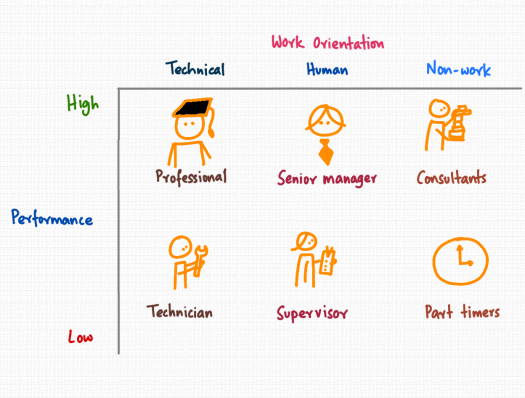
The image above shows how things tend to go for technical people working jobs by the time they reach mid career.

The first distinction is whether they are still technically focused or whether they have moved to more of a human focus – management in other words.

They might have also stopped trying to climb the career ladder and focus on other things that are important to them – like family.

The second distinction is whether they are high or low performers.

For high performers the route to follow if they want to stay technical is academia or professional engineering where their experience and doctorates will count for something.

In non-engineering companies they will not be recognised in the way they might want to be.

In those companies the high performers stop doing work and start ordering others around instead.

What matters is your place in the hierarchy – the higher up the better.

The corresponding roles for low performers is working as a technician or doing low level supervisory or line management roles.

That, then, is your unfortunate lot if you put work first.

If you don’t – then there are a couple more options.

If you’re good at what you do you could be kept on for your expertise – as a consultant to add value that isn’t in house.

If you’re less of a performer you might still be a useful pair of hands attached to a brain that can help out some of the time.

If you look at this image from an employees point of view it looks pretty depressing.

And actually, that’s the point.

As the quote that starts this post says you are in charge of your career – what you do at work is just a job.

If you aren’t recognised for what you do, or worse, you’re prevented from showing what you can do then you’re in trouble.

And need to spend some time thinking about what you could be doing.

The responsibility, however, also rests with employers.

The fact is that all the people in the various quadrants have something to contribute – but you have to be able to accommodate them.

And if you’re in a position where you make decisions about this kind of thing it’s worth remembering that the people this study is based on graduated sixty years ago.

This type of situation should be obsolete – but it’s still the norm.

Even that last quadrant – “part timers”, which to be clear is something that I put in and isn’t in the book, could be seen as dismissive and disrespectful of the work someone does.

I suppose if you were a good employer you would try and work with your people to help them figure out where they are, where they want to be and what would make them happy.

Or you could complain about how hard it is to get good staff.

Either way the world moves on.

Cheers,

Karthik Suresh

How To Share A Business Between Founders

founders.png

Wednesday, 7.25pm

Sheffield, U.K.

One goal of law – as we learn in law school from the first day of contracts – is to deter bad behavior. – Marvin Ammori

It takes skill to work well with other people.

I, for example, like having control over what I’m doing.

I like being able to write and publish this post without really having to involve anyone else.

And that’s fine – but as an old friend said “To go fast, go alone. To go far, go with company.”

And that is true, you will achieve more when you work with other people.

But which other people?

And under what conditions?

This is where a 2013 paper by Thomas Hellmann and Veikko Thiele called Contracting Among Founders may give us some insights.

It’s a fairly symbol heavy treatment of the topic and deals with founders that are equal – in terms of skills and resources – but it brings out some of the main points we need to consider when thinking about working with others.

Let’s start with a team thinking about working together – possible founders all.

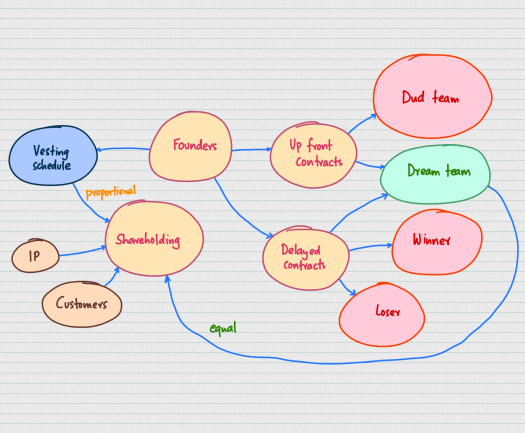
They can agree an up front contract where they set out in writing what each one’s shareholding is in the business.

Or they can wait and see how they work together before signing anything – a so called delayed contract.

The ideal situation is that either option results in a “dream team”, a group that works well together and where everyone contributes something essential.

The drawback of an up front contract is that you tie yourself to someone who they doesn’t do any work but is still entitled to a share of everything.

This results in a “dud team” and you have to figure out how to get out of it – which usually means buying the other person out with your money or money you borrow – and people usually don’t like lending you money to do that sort of thing: they want it to go into and grow the business.

The drawback of a delayed contract is that you put all the work in and your partner, who is savvier and more ruthless than you steals what’s there or walks away with the business leaving you with nothing.

In this case you have winners and losers and lots of angst and unhappiness.

Maybe some lawsuits.

Hellmann and Thiele point you to the story of The Social Network.

Now, if you have a dream team then you get an optimal situation – equal shareholdings where everyone is happy.

An alternative option, if you don’t know each other, is to tie the shares to a vesting schedule.

This is something where your share is released as you hit milestones or spend time in the business.

The advantage is that it’s in proportion to the value you bring.

The disadvantage is that the milestones or value cannot always be measured precisely.

After all, were you lucky or skillful when you made that enormous sale and hit all your targets?

The other thing we need to remember, which isn’t really touched on in the paper, is that your shareholding is really a claim on profits – and those profits come from customers.

And they come because you do something of value – these days mostly using your intellectual property or IP.

And the value that you’re trying to hold on to is the asset value of that IP and the cash flows from those customer contracts.

As models go this is probably a fairly good first pass at outlining the issues you will face working with other people.

You can see this working with entrepreneurial teams, intrapreneurial teams or plain office teams – the dynamics of work and reward play out roughly the same way.

One question is whether in a postmodern world where you work with networks some of this ownership angst can be managed through radical openness.

For example, if the first iteration of work you did created all IP under very permissive licenses such as the BSD licenses then you would have the option to split later and have each of the founders take the IP created so far and make what they could of it.

And that would probably help early customers as well.

Later on, when you know the team is working you can arrange a more tied in sort of contract.

These days it often makes sense to live together before getting married.

Then again, if you know, you know and you might as well tie the knot.

Or perhaps you should see lots of people before you settle down.

But the real point is who knows what’s going to work – there is no perfect answer.

It all depends on the situation and opportunity.

And you can’t reduce all that stuff to a formula.

Cheers,

Karthik Suresh