Will We Go Back From This Rapidly Reshaping Society?

existing-models.png

Wednesday, 9.00pm

Sheffield, U.K.

Society is always taken by surprise at any new example of common sense. – Ralph Waldo Emerson

There is a lot of stuff happening in the world right now – people are scared and fearful and worried about what’s going to happen to them, their families, their livelihoods.

And they’re talking about this – about the impact it’s having on them – millions of voices having their say.

And it feels like other people are listening.

When you think about the hard choices that governments are making – you get a sense that the response, in fairness, is on the right track – that there is method behind what is going on.

What people do for work seems to be recognised in terms how it can be done – rather than how a manager wants to do it.

Some services are ones that need people to be in certain places at certain times – healthcare, retail logistics, bin collections – and so we need to organise society to make sure they can get to work if they can.

Other work can be done from anywhere – and it makes no difference to these people whether they work at home or not.

In fact, all things considered, they might prefer to work from home but suffer through a commute because their boss comes from a generation that believes that work happens in the office.

And then you have work that’s affected by the policies that have been put in place to contain the spread of the virus – the entertainment industry, travel, hospitality, child care, construction – where work simply cannot be done.

Now, what’s going to happen is this.

People who need to be somewhere will be helped to get there.

People who can work from home will start doing so.

People who are in difficulty because of what is happening will be helped.

And, in several months, things will be back to normal.

And during that time, the damage will be covered by the state.

Hopefully.

Now, when we go back to normal – will we return to a world where a virus can stop everything functioning around the world in a matter of months?

Or will the new ways of working we put in place – ways of working that, one assumes, are more resilient in the event of this kind of threat – stay in place?

Will we see a wholesale shift from office based work to home based work?

Will that result in demand for different kinds of spaces?

Will the main reason we go out become because we want to socialise – and will the entertainment industry get a boost from that, while office space takes a hit?

There are lots of people who believe that working from home is the wrong thing to do – that people need the social and control structure of the office.

This assumption is about to be severely tested over the coming months.

The SAAS world will see a surge in interest in off-premise solutions.

Commutes, for those who have to, will become easier as the roads empty of non-essential traffic.

Carbon should go down.

This is a difficult situation for many – there is no doubt about that.

Some people will see this as judgement day, as doomsday, as something that is punishment for the way we live.

Others will be more optimistic – believing that society is better placed to weather this storm than we have ever been in the past.

I am in the optimistic camp.

And I would hope that once we go through this hard reset on our nineteenth century attitude to work – we make the choice not to go back.

Because the new way is better for us as individuals, as a society and for the planet.

Cheers,

Karthik Suresh

Why You Shouldn’t Be Afraid Of A Post-Industrial Future

connected-web.png

Tuesday, 7.42pm

Sheffield, U.K.

We must, indeed, all hang together or, most assuredly, we shall all hang separately. – Benjamin Franklin

Day 1 of self-isolation and it’s a window into a new world – is it one that we will embrace or is this the end of civilisation as we know it?

Times like this bring out the basic instincts in us.

We respond with fear and greed – and much of what you see on social media falls into these two buckets.

People are afraid, for their jobs, their industries, their future.

Others are looking for opportunities, pushing their services, angling for position working out new scams and profiteering.

So far, so natural.

And then you have behavioural responses – social, cultural ones.

These are empathetic acts – where you reach out to those who are afraid and reassure them.

Or more practically you organise into local support groups, helping those affected by restrictions on movement or those that are more vulnerable.

People rail against the selfishness of others – but also marvel at the unselfishness and community spirit of even more.

And then you have the responses of governments – and that’s a different kind of approach depending where you are and the kind of economics they believe in.

We’re seeing at least three kinds of responses then – instinctive, cultural and economic.

What should we make of all this?

The instinctive response is the one that has worked for many millions of years – find a safe place, keep a stockpile of stuff you need – depend on yourself and try to survive.

This is the world of the doomsday cults – the ones who believe that the world is going to end and that this is divine retribution.

Or, in a less extreme fashion, they’re conservative.

The kind of people who live within their income, have a decent savings pot and know they can ride out three to six months without an income.

But they’re probably in the minority, in developed economies anyway, because of the link between consumerism and economic growth.

Developed economies depend on people going out and spending money, keeping money circulating.

That stop in money circulation is devastating for individuals and industries.

It’s a connected web and while we all have a place to stand, things are ok – we keep bustling along and living our lives.

But what the people in charge know is that all this is built on a web of confidence – on the belief that we can live this way.

The social reaction to people in trouble is to reach out and help.

But not all the time – most of the time we ignore what’s going on.

The fact is that lots of people fall off our social web all the time – some were never on there in the first place.

We respond with social action – we raise money to help, there are charities that do what they can and philanthropists who spend money to solve the biggest problems.

But when we have a crisis, like the one we have now, the biggest thing a government has to do is maintain confidence.

And the way they do that is by not allowing anyone to fall – by helping them through this difficult time.

And you can see that happening – with loans and payment holidays and help of various kinds.

Help, you should note, that is given now but will need to be paid back later.

That way it’s not a handout but help to put people back on their feet – so they can carry on participating in the confidence game we call a modern economy.

What’s going on right now is a forced social experiment in creating a post-industrial society.

This is one where we work at home, get everything delivered and only go to a place of work when we have to be there because it’s critical for operations.

But we’re probably going to realise that there are few of those situations.

Most factories, docks, warehouses and places where things happen can be managed with a small staff – only a few of whom have to be on the premises.

A lot of things run themselves these days – and what we’re seeing at the moment is a good reason to make more things that way.

If you live in a modern economy it is probably a scary time, especially if you aren’t in a situation where you can survive on your own resources for very long.

And the thing people should realise is that it isn’t their fault – these kinds of shocks are a characteristic of the system they live in.

And it’s the people who are in charge of the system who need to make sure that a short-term shock does not result in a long-term impact on the people living in that system.

There are many reasons why this needs to happen – but the simplest reason is that people have long memories.

If you fire your staff now or make them take pay cuts when times are bad now – then when times get better you’ll find that they’ll get even by leaving.

Look after them now and they will repay you with loyalty in the future.

This is counter-intuitive behaviour for our basic instinct.

That just wants to run and hide, cut away the costs, pare to the bone, hunker down in order to survive.

Which is a little last century, perhaps even Jurassic.

What we now need to do is make sure no one falls off the web – by helping now.

Well – governments – the owners of the system need to do that.

Because this crisis will last a short time and then there will be a long period of growth and recovery.

That’s how these things work.

And why should governments act this way?

Once again – because people have memories.

A government that fails to act to support the system it manages will not stay in government very long.

So, there are two things we should remember.

There will be – there has to be – a safety net for people who are in trouble.

But you also need to help yourself – the changing economy will create new opportunities – for new products and services delivered remotely or by post.

The online economy will accelerate along with all its support services – see this post for the list.

Here’s what it comes down to.

You aren’t going to be allowed to fall – governments can’t afford for you to fall.

Not these days, with everyone watching them – urging them to do the right thing.

If you fall, we all fall.

So stop being afraid.

Take a helping hand, if you need to – and start thinking about what you’re going to do next to participate in the economic and social web we’re all clinging to.

Because that’s what matters now.

Cheers,

Karthik Suresh

Why Do We Think Competition Is The Only Way To Do Things?

community.png

Friday, 8.24pm

Sheffield, U.K.

The artist forges himself to the others, midway between the beauty he cannot do without and the community he cannot tear himself away from. That is why true artists scorn nothing: they are obliged to understand rather than to judge. – Albert Camus

How do you react when you first see something new – a new service or a product or an idea?

Do you react with cynicism, with scepticism – perhaps a view that it will never work.

Or do you eagerly try new things, knowing that if you don’t you won’t find those gems hiding among the stones?

Fear, uncertainty and doubt are our friends – they help keep us alive.

Our brains are wired to distrust the new, the unfamiliar until we’re sure it’s not going to eat or sting or poison us.

But we’re also social creatures, evolved to live together while constantly engaging in fractious tussles for turf and power.

And we’re not very different from our ancestors in that respect – monkeys have a strong sense of social hierarchy and status – and it governs much of what they do every day.

Now, what does that tell us about the way we work together – or more importantly, the way we should work together.

Let’s take any business, for example – probably one that’s based on an individual skill.

The other day I read a LinkedIn post where a provider of a particular service was called by a prospective customer asking for prices.

Later, when the provider researched the prospect it turned out that the prospect was actually a competitor – who then advertised the same service at a slightly lower cost.

You might argue that what the competitor was doing was smart market research, or you might feel that it was unprofessional behaviour.

Regardless, what it tells you is that the competitor saw the service they were providing as a commodity, something that was interchangeable with what someone else did.

And that leads to a problem.

If you’re selling something that is no different from what a number of other people are selling then the only difference is price.

In such markets the lowest cost operator will win.

You might be able to maintain margins for some of the time – but eventually many markets end up being dominated by a large commodity trade and a small luxury trade.

Take glasses, for example – the things that you wear.

You can pay a lot of money in a shop, even more if you’re buying a brand or treat it as an item of jewellery.

But you can also buy it for not very much through online services.

But the thing about being a commodity is that it’s as much about the way you see yourself as what’s actually happening out there.

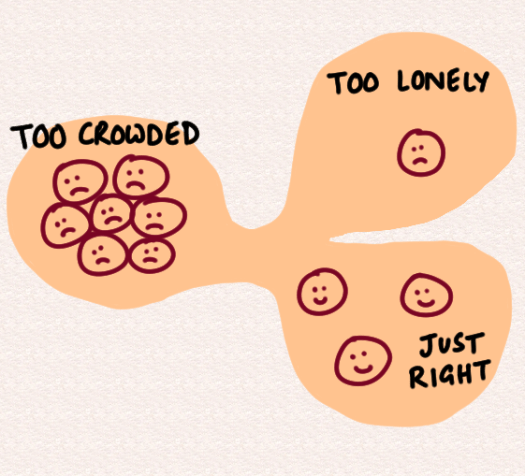
If you see yourself competing in a crowded, jostling market, selling things that anyone else could sell then you’re not going to have much fun running your business.

It will feel crowded and you’ll always be limited in what you can charge and how much you can grow.

At the other extreme you may have something unique but if it’s too different, too out of the ordinary, then you won’t have customers willing to take a chance on you.

That’s a lonely place – the kind where inventors who fall in love with their products go – when they stop listening to their markets.

A workable business, on the other hand, probably has principles of community at its core.

If you provide a service then you probably want to be in the company of other professionals who care about their subject enough to be expert at it.

More importantly, they need to have spent enough time on their craft to develop their own unique approach – one that doesn’t compete with your approach but that makes the whole field richer.

Take any industry, for example, say graphic design.

Graphic design is a field where a designer could have free rein to create amazing designs that delight customers.

Or they could turn out the same basic patterns again and again for different customers.

Or they could create pure art that no one really understands and therefore no one buys.

In that field you have people who experience business in all three ways: too crowded, too lonely and just right.

But it’s the same field.

What’s different is the approach and attitude they bring to their business.

All too often people blame the market for their lack of success.

Perhaps we should be asking ourselves what we bring to the market – what’s unique, rare, different about what we do?

Because the market, at its core, is the aggregation of lots of little decisions made by buyers and sellers.

Individual decisions.

Like the ones you make about whether to be a commodity or to be much much more.

To be part of a community.

Cheers,

Karthik Suresh

What Do You Need To Do Right As A Knowledge Worker?

knowledge-work.png

Wednesday, 9.43pm

Sheffield, U.K.

information is the primary basis of value in knowledge work, and it must flow to the right person in the right form at the right time at the lowest cost with the highest quality possible. – Matthew May

I’ve been thinking about the challenges we have as individuals and as managers in organisations when it comes to knowledge work.

Work based on knowledge has really only been a thing for a few decades or so.

And before that, you have to remember that work based on manual effort is also a relatively recent thing.

Yes, people toiled, in fields or for others or as soldiers, but modern manual work is a relatively recent thing in human history.

What makes this kind of work different is that it’s industrialised, professional and treats workers better than they were treated in the past.

That’s the kind of work a lot of people did after the Second World War, as the productivity of each worker increased massively.

Because the methods that made manual workers were so successful, they have seeped into our consciousness as the “right way” to do things.

And so we use the principles developed to do manual work better to try and manage knowledge work as well – and find that it just doesn’t seem to do the job.

Why is that and what should we be doing differently?

To answer that question a paper by Peter Drucker called Knowledge-Worker productivity: The biggest challenge is worth a read.

The first thing that’s interesting is that Drucker argues that there was a period Before Taylor and a period After Taylor.

Frederick Winslow Taylor was the guy who studied how work was done and broke it into a sequence of simple, repeatable steps and effectively put in place the foundations of all “developed” economies.

What’s slightly startling is that Drucker says that all methods since then including Deming’s work and the Toyota Production System build on the system of thinking – the principles – that Taylor put in place.

Taylor said that you should look at the task and break it down into its components.

Get rid of stuff that isn’t needed, reorder steps so that they are simple and easy to follow – create a job that can be done again and again – and then redesign your tools to make it even simpler and faster to do the job well.

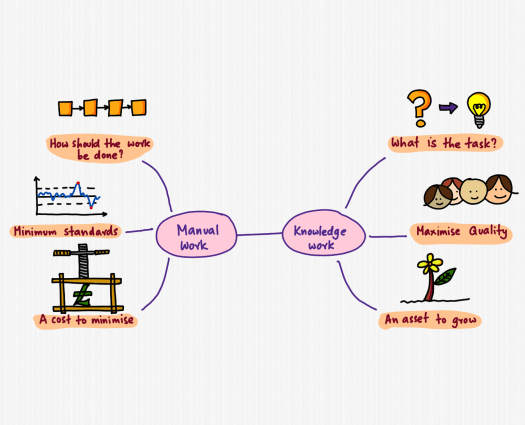
Manual work is all about how to do the job – and how to do it better and faster with less effort.

So, we apply this approach to knowledge work as well – we tell programmers how to set up their frameworks, we create processes for administrators to follow.

But in knowledge work the main issues is often figuring out what the task is in the first place.

And that requires a different set of skills – it’s more about listening and exploring than about doing and organising.

When it comes to actually doing the work, manual work is about meeting standards.

If you make a cup you want each cup you make to be about the same.

If you’re making steering wheels, every one that you make has to be within a certain tolerance if you want it to fit.

With knowledge work, on the other hand, you want the best quality you can get.

You don’t want an OK surgeon – you want someone who is very good at what they do.

The same goes for teachers and programmers and managers.

Quality in manufacturing can be measured while quality in knowledge work is often only seen through the experience of the customer.

Finally, when you’re looking at manual work you see it as a cost.

Ideally, you’d like to do three times the work, with half the people being paid twice as much – because people in this situation are costs that you need to reduce.

Knowledge workers, on the other hand, produce more the more they know, and are more valuable the better they get.

Having the best professors or the best surgeons on your team lets you raise your prices and get the best customers.

The thing with manual work is that an organisation has to take responsibility for developing its workers – managers have to work on the system to help them do their best work.

With knowledge work it’s perhaps more dependent on the worker to learn and develop – the company can give them projects and training but they have to really want to become the best they can be.

Companies that support this well become places knowledge workers want to work at – and that gives those companies a competitive advantage over those who think of them in the same way as they do manual workers.

When it comes down to it knowledge is about using information to create value.

And we’re all in the business of doing that these days.

Cheers,

Karthik Suresh

Why It’s Really Hard To Figure Out Winners And Losers These Days

cost-disease.png

Monday, 8.56pm

Sheffield, U.K.

Costs do not exist to be calculated. Costs exist to be reduced – Taiichi Ohno

I learned about something called Baumol’s cost disease recently and it got me thinking about how rare it for organisations to really understand the impact costs have on their customers.

Warren Buffet is famous for avoiding technology businesses – which is strange considering how technology businesses seem to dominate the world these days.

We are fooled, however, by thinking that because Apple, Microsoft, Google, Facebook, Amazon, Netflix appear to be doing so well that’s the way of all technology businesses.

Except these are the rarities – the ones that succeeded, for which the stars aligned.

For every one of these, thousands, perhaps tens of thousands of technology businesses have gone bust.

And that’s because they don’t understand a simple principle that Buffett articulated a long time back.

Most tech businesses come and tell you that they’re going to cut costs – they’re going to make you lean and quick and reduce the cost of doing business.

That’s almost always the sales pitch – if you use us you will save money and improve margins.

They’re right about the first part – you might save money.

But these tech businesses will sell their tech to you and to every one of your competitors – so you’ll all be able to save money.

And when you’ve got those margins someone will blink – and offer lower prices to customers – and then you’ll all have to follow suit or lose business.

So, the only people who benefit from your investment in technology are your customers – who get lower costs.

Now, it might seem like a vicious circle – one you can’t get away from.

After all, would you still be holding onto typewriters rather than buying computers for your staff?

But the important point is that the advantage of technology is actually not that much of an advantage – you don’t often lose if you want and buy later rather than being the first mover.

In fact, waiting can be an advantage, because you then buy cheaper, better tested product rather than new, untried stuff.

While tech businesses promise to cut costs other industries just seem to see costs increase without any corresponding increase in productivity.

People in public service are paid more for not doing much more than they were doing a decade ago, for example.

Salaries have to rise, apparently, to keep people who would otherwise move to better paid jobs in other sectors.

So, even though people aren’t producing more they’re paid more – which inevitably works its way through to lower margins for the business – because few industries can pass through all their increases in costs to customers without being asked some rather awkward questions.

Which means people in these roles get comfortable and happy without having to do much more.

Now, in the middle of a healthcare crisis, it’s probably wrong to question whether the public sector is doing all it can – but is it?

Is it systemically ready to do things without mistakes – to do them at the lowest cost?

It’s pretty unlikely, if only because you have a system full of highly paid, very experienced people who have spent their careers working in a system that is complex and almost certainly full of problems.

There is probably very little they can do to change things – and while they might do the best job they can – it’s probably not that different to what they were doing a decade or so ago.

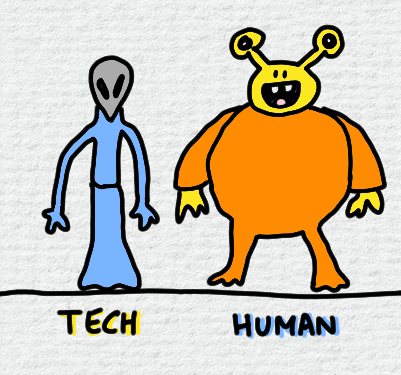
It does seem that tech by itself or people by themselves don’t really add much value.

But, I also learned recently, the combination of tech and human might actually be surprisingly effective.

In my experience most people struggle with the technology they have to use.

It’s not their friend.

The example I was given was how an AI program and a doctor are much more effective working together at diagnosis than either working alone.

But if you use a computer then you’re in a similar situation – do you rail at the software you have or do you enjoy working on your computer?

People who have to use proprietary programs probably have very different views to those who use a free system like GNU/Linux.

I certainly do.

If I had to write these posts using the WordPress tools or anything from Microsoft then I probably wouldn’t create anything.

I suppose the point I’m making is this.

It’s tempting to think that because your technology cuts costs or because you work really hard that you’re adding value and are a winner.

But there are too many businesses and too many jobs that are failing the employee and the market.

The goal is to do something that challenges you – something you enjoy.

And you win if someone is willing to pay you to do it.

And that’s enough for me.

Cheers,

Karthik Suresh

How To Do Customer Development For Complex Consultancy Businesses

customer-development-expanded.png

Sunday, 7.37pm

Sheffield, U.K.

Hell, there are no rules here – we’re trying to accomplish something. – Thomas A. Edison

I’ve started seeing more threads on Twitter these days and they’re making me think.

A typical thread has twenty or thirty points.

Some are effectively essays as the points build on and reinforce arguments the writer is making.

Others are nuggets of information, packaged together and delivered – held together by the thread.

And then you have lists – 25 of these and 30 of that.

One of these, for example, had to do with 25 facilitation methods – the kinds of things you might do to run meetings.

Now, when you look at a group of things like that what’s missing is really how you would use them in practice.

For example, if you were a Roman soldier, you would have a set of kit – a throwing spear, a thrusting spear, a short sword, a shield – and you’d use each of these in combat at the right point.

You’d be far more effective as a soldier if you knew how to use that set of kit than if you walked around carrying a whole lot of stuff pulled together at random.

So, I thought, if I were to describe how I currently think about the way in which sales works for me what would that look like?

My focus is usually on complex sales – the kind of thing where customers don’t quite know what they need yet and need to work through that before they are ready to buy.

It’s the opposite of transactional sales where the customer knows exactly what they want and the main thing they want to do is figure out who is offering the best deal.

A complex sale means that you need to understand a complex situation – one where there is a lot going on.

If you do this properly what you will end up doing is understanding what value means in customer terms – you’ll be able to define value in words the customer would have used.

But get to this point you have to do a few things first.

You have to start by studying the situation – building a picture of what is going on through interviews and going to where the work is done.

You’ll have to see what’s going on – trying to listen to the voice of the process.

For example, if you are working with an organisation that fixes things, then value probably has something to do with getting things fixed when the customer wants them fixed – and the measure that tells you what is going in is the number of days it takes for a fix to get done – which is the voice of the process.

Now, as you listen to people you’ll start to build a picture of how they see the world and when you put this down as a model it’s called a holon – a construct that describes their particular perspective.

These three things – listening to people, trying to look at things from their point of view and taking the trouble to look at measures that let you see what is going on helps you gain an understanding of the situation.

Once you have that you can start to shape an intervention – perhaps come up with a flowchart of how to do things differently.

And to explain to others why this process works you’ll come up with stories, with presentations that seek to explain and persuade.

But because your stories are founded on a deep understanding of the situation, you’ll be able to get people to listen more closely and focus on your points rather than trying to find holes in your argument.

I find that these tools are the ones I use most of the time in my process – and what they help me do is follow the platinum rule.

The golden rule, as you are aware, is to do to others the way you would have them do unto you.

The platinum rule says do unto others as they would have you do unto them.

Now, when I think about this approach – one that works for me – I don’t see it as an unconnected set of tools or tactics.

I see them as part of a systemic approach, one where the elements work together to create a better customer development process that is focused on understanding what value looks like before trying to deliver it.

And it seems to me that however you do your process it cannot but help if you give your customer the value that they want and need.

Cheers,

Karthik Suresh

What Do We Do When We Can No Longer Stand On The Shoulders Of Giants?

shoulders-of-giants.png

Saturday, 8.43pm

Sheffield, U.K.

If I have seen further than others, it is by standing upon the shoulders of giants. – Isaac Newton

For many Saturdays now I have taken a walk, doing a round of the charity shops close to me, accompanied by a small person and we both look for books.

Today, I stood and gazed at a shelf of books and wondered what I thought about them.

There was a selection of marketing textbooks – like a student had just dropped off four year’s worth of material.

A year ago I would have convinced myself to get pretty much everything on the shelf but today I was unconvinced – turning more to the children’s sections and books on drawing and doodling.

The reason for this, I think, is that I’m finding that theories about marketing and management are actually of very little use in day to day marketing and management.

Let me explain.

Isaac Newton’s saying that starts this post is one we all know – and clearly we have to learn from the lessons of the past if we are to avoid repeating them and if we want to build on them.

This approach works very well in the physical sciences – you don’t want to be in a position where you never learn that the earth is not flat, or the things that now are the basis of modern medicine.

But the same approach seems to run into problems when we approach the world of human society.

Science is very good at breaking down things and understanding the parts.

In doing that we come up with theories of why things are the way they are – and we use those theories to predict what else might be.

And science is so good at that it now seems that that way of thinking should be the basis of everything we do.

In marketing an early application of this way of thinking was Claude Hopkin’s famous book which was called, after all, “Scientific advertising”.

Anyone who wants to claim that their method works tries to use science – even if the scientific method has to be tortured a bit to make it seem like its producing valid results.

So you have a science of surveys and response analysis and statistics – all of which are used to come up with insights and theories such as those in the best-selling “Influence: The psychology of persuasion” by Robert Cialdini.

So, if you’re creating a new product or trying to connect with a market or sell something to a prospect – it makes sense to go out and pick up some books – the kind of books that I was looking at on that shelf perhaps.

But I’m realising that actually the scientific method is not everything – and it’s not really appropriate for everything that we do.

And actually, if we go back to before the scientific method there are ways of working we should not forget.

The first has to do with technology.

Technology is something that actually predates science – it comes before it.

We made tools and pottery and hot baths well before there was anything like a science of metals or minerals or state transition.

Nowadays technology is often based on scientific discoveries – which is why it might seem like it’s something that comes after.

But technology is fundamentally about tools used by people – and tools like the Internet and online commerce are really only a decade or a couple of decades old for much of humanity.

For example, I had to try and fix a leaking tap today – and constructing a new kitchen wasn’t really something that was a feasible option – even if it will happen in the long-term.

The tap is old, however.

But Ebay had one of the valves that I needed – and it’s on its way to me now.

And a YouTube video told me how to take the tap apart and how to search Ebay in the right way to find what I needed.

That’s technology to the rescue, not science.

Now, when you’re creating marketing for technology it seems to me that science will just get in the way.

That whole standing on the shoulders of giants things keeps you a little too far away from what matters.

What matters is what’s happening on the ground.

The people who succeed in online commerce are the ones who best understand what value looks like from the point of view of the customer.

The people who created a video that explained what I needed to do and the people who created an Ebay page where I could measure and check that what I was buying was what I needed were able to create the conditions where they delivered value and I paid a price.

And I don’t think that stack of books would have helped any of the people in that transaction do things better.

It might have even gotten in the way.

The more I think about this the more I am convinced that starting from the reality on the ground is the way when you’re trying to improve the way in which you carry out management or do marketing.

It’s coming up with approaches and strategies and tactics that are rooted in a clear understanding of the people you’re trying to serve and what value looks like from their point of view.

It’s grounded theory.

Which means, you have to get off those shoulders and get on the ground if you want to succeed here.

Which brings us to the second method.

Talk to your customers, listen to them and give them what they need.

And it might just be as simple as that.

Cheers,

Karthik Suresh

What’s The One Thing You Have To Do To Succeed?

close-the-loop.png

Thursday, 8.41pm

Sheffield, U.K.

String theory is an attempt at a deeper description of nature by thinking of an elementary particle not as a little point but as a little loop of vibrating string. – Edward Witten

I know nothing about string theory but this Witten quote makes perfect sense when it comes to the basic nature of everything we do.

Think of some of the people you’ve worked with, some of the people you know.

They might be old or young, experienced or new to the world of work, different genders, races, backgrounds.

Now, what kind of impression do you get about the way in which they seem to operate?

Some might be dots or spots – contained patches of ink that encapsulate what they are.

Perhaps they’re artists or lawyers or doctors or police or firefighters – defined roles that you see in children’s books of what jobs people have.

Perhaps they see themselves the same way, as people with a singular passion or focus – either one that really does fill them up or one that they have adopted because it works for their business.

If you do a search starting with the string “I’m passionate about” you get a bunch of results that tell you how to answer that question in the context of an interview.

And that’s because when you’re really passionate about something you don’t talk about it – you just do it and talk about it – and people see how passionate you are.

So, if passion is a dot what might a line be?

A line, I think, is someone that has a job – someone that does a certain task.

They might process things, file things, analyse thing – but generally they start at one point and traverse a line and end at another point.

And a lot of people see this as a thing – if you do process maps or flows this is the kind of way you represent what’s going on – starting here and ending there.

With spots and lines you’ve probably captured the ways in which most people think about work.

But, when they actually start doing work the lines no longer seem quite that straight.

Actually where you end up seems to be related to where you started – and so you find yourself turning back and heading to where you were at the start.

For example, if you are in charge of a project and you send an email requesting information then in the world of lines you’ve done your job.

If you don’t get a response, however, you’re starting to look back at that email you sent and wondering what to do next.

Many people think that they’ve done their job – they’ve sent that email and that’s it.

If they’re asked later why things went wrong they can always say, “Well, I did my part!”

That gap – that failure to close the loop between starting something and making sure it’s finished makes the difference between success and failure in most situations I’ve seen.

You go out and meet someone and fail to connect in some way so you can follow up your discussion.

That’s often my big problem.

A bigger one, though, has to do with all those tasks where you should really chase and follow up but you just don’t.

When people succeed it seems to be because they make the effort to close that gap, to make sure they close the loop and them move on.

Now you might not do this with everything but if you do it with the important stuff then you start to create little success circles – closed loops that mean stuff gets done.

And then, if you decide that string theory is for you – you can think of those success circles as the elements of business, the elements of what you do.

Instead of seeing them as static, once done and then forgotten things, you can see them as vibrating string loops – with the energy and passion you have emerging from that work you’re doing.

And really when you get the fundamental building blocks of reality on your side is there anything you can’t achieve?

Cheers,

Karthik Suresh

5 Things You Have To Get Right To Be Successful In E-Commerce

e-commerce.png

Monday, 9.15pm

Sheffield, U.K.

Retail is a customer business. You’re trying to take care of the customer – solve something for the customer. And there’s no way to learn that in the classroom or in the corner office, or away from the customer. You’ve got to be in front of the customer. – Erik Nordstrom, President, Nordstrom Direct

I was invited to go to the Retail Without Borders conference recently where I learned much that I didn’t know about the world of e-commerce.

Or, at least, I had my eyes opened to how hard it is to do the simple stuff well.

For example, the five points in the image above are a mix of points made by different speakers – and if you are in e-commerce it’s worth checking how many of these you get right.

First, you have to start with enriched content.

That means going beyond having basic listings with text – the more useful detail you put on there the more people trust what you are selling.

Pictures help, as do videos – the trick is making sure you have as many as needed.

Then you have to make sure how have the highest retail standards possible.

This means getting your stuff out to the customer as quickly as possible – promising three days and getting it there in two, for example.

If you’re big enough then same day delivery or next day delivery helps you stand out.

Before you do that, however, you have to get payment services that work for the customer.

That means giving them options to pay – using methods like Paypal and credit cards – but also others that work in the regions you’re service.

More on that in a bit.

Now, you’ve also got to make sure that you’ve got inventory under control.

There’s few things that make customers more unhappy than finding what they’ve ordered isn’t in stock or that they have to wait twice as long.

And while we’re talking about customers make sure you have an engagement plan for them – how you talk to them and build a community of customers.

Now, if you live in a developed economy – especially the UK or US – all this seems obvious to you.

These countries lead the way when it comes to digital commerce and the services are pretty slick on each of these points.

In fact, you’ll find it hard to compete if you don’t have all these things sorted for customers in these regions.

Take payments, for example.

If you offer Paypal and credit cards then you have 100% – that’s right – the entire target population pretty much covered.

But once you go further afield it gets more complicated.

People in many countries still prefer to pay cash on delivery – COD.

They don’t trust cards or aren’t allowed to make international payments with the cards they have.

The logistics of shipping to different countries can get frighteningly complex very quickly.

Your goods can be stopped or lost at customs and there’s no way of getting them back.

And if you’re looking at non-English speaking markets then you need to think hard about localisation issues.

Are you using the language that people use – are you using the right dialect.

You can lose a lot of sales if you use only one language.

To some extent this checklist is for product sales but it works pretty much the same way for services – with the exception perhaps that your logistics gets easier if you have no inventory and can email your product.

The basic principles still apply.

But all this is really just about hygiene – about getting the basics really really right.

The thing that really matters is whether you’re giving the customer something of value.

This list helps you deliver it better.

Cheers,

Karthik Suresh

Is Most Of What You Do At Work A Waste?

knowledge-waste.png

Wednesday, 9.02pm

Sheffield, U.K.

What is needed is a total management system in which human ability is drawn out fully to enhance the fruitfulness and utilize the facilities and machines well, performing the work with absolute elimination of waste. – Taiichi Ohno

I’ve been thinking about waste in recent days – especially when it comes to knowledge work.

But what really is waste, and how do you start to think about dealing with it?

Taiichi Ohno is well known for his work on the Toyota Production System and his concepts around eliminating waste.

What that means is getting what you need in the amount you need it when you need it.

Most of the world still operates on a “push” principle – you try and get people to buy what you are selling.

A “pull” method creates things when people want it and that’s actually a really hard thing to get your head around.

Think of the business you are in right now – how do you go about marketing and selling your services?

If you’re like most people you think about new sales – about the people you need to bring in to get your numbers up.

And it’s hard work selling to new people – it takes time and effort and money.

What would be a much better situation is if people pulled your services when they needed it – when they’re looking around for what you offer.

Now I know there are businesses who are very good at getting their marketing right, whether online or offline.

But for every one of those businesses there are hundreds of thousands, perhaps millions of others who struggle.

That’s partly because tactics only work as long as no one else knows how to use them – as they become more successful more people copy them and reduce the impact of the tactic.

There was a time when spam email worked – but for most of us that kind of approach is unlikely to cause us to respond.

If we do want to grow our businesses the thing we probably need to do is understand our existing customers better – and try and eliminate waste in the way we serve them.

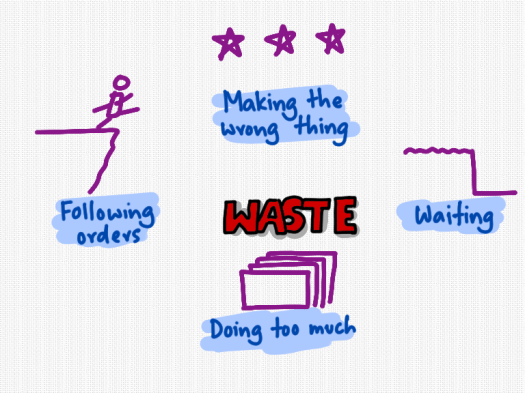
For example, how often do you end up making the wrong thing for a customer because you didn’t take the time to really understand what they needed.

All too often people try and guess what others need rather than taking the time to ask them and then write down what they say in their own words.

The minute you start to change the words they have uttered a game of “Chinese whispers” starts and you end up very quickly with something very different to what you started with.

Then there is the waste involved in waiting for something – you send an email and then because no one responds you don’t follow up.

After all, you’ve done your job so that’s ok right?

Equally wasteful is doing far too much for a customer – creating a ninety page powerpoint when a three page one would have done.

In knowledge work another kind of waste is the kind that happens when a leader issues orders.

A leader’s views will be implemented by subordinates no matter how wasteful they are – and they can be very wasteful indeed.

The thing that I’m starting to realise is just how much work is done by well meaning, driven and conscientious individuals that they do very well – but should not be done at all.

In an ideal world you would take the time to listen closely to your customer and build them exactly what they needed.

And by doing that, by eliminating the wasted activity that’s usually involved in businesses, you would give them the best product or service possible at the lowest possible price.

Because the thing about waste is that someone is paying for it.

Either you’re paying for it out of your profits or your customer is paying for it in their price.

Either way someone is losing.

And that’s a waste.

Cheers,

Karthik Suresh