What Is A Manager’s Real Job Anyway?

manager.png

Wednesday, 9.00pm

Sheffield, U.K.

Everybody wants to be a bodybuilder, but nobody wants to lift no heavy-ass weights. – Ronnie Coleman

When things aren’t working it’s easy to become frustrated – to get annoyed with what’s not happening the way it should.

So, who should you get annoyed with, who should you blame?

The correct answer, always, is those in power.

It’s easy to blame the workers – the ones doing the job.

After all, they’re the most visible and they are the ones doing the job.

But that’s making up your mind by just looking at the surface – the things you can see.

The usual approach if you think like that is to assume things would be better if people tried harder, put the hours in – just got on with delivering.

But, as Deming wrote, if everyone does their best 95% of problems will remain.

And that’s because he knew very clearly that if 95% of the variation in the performance of a system is caused by the system itself and only 5% is caused by the people.

In his words, “A bad system will beat a good person every time.”

But these insights, although they are now decades old, are still not understood – because we still see the jobs of managers as “managing” people – allocating people to jobs and monitoring their performance.

Which is a waste of time.

An utter, complete, futile waste of time.

So, what should managers be doing?

They’re in power – they should be changing the system.

How can they do that?

First, let’s start with the customer.

The customer gets two kinds of things from you.

One is what they need.

The other is what is wrong.

Let me explain.

The only person who seems to really be talking about this is John Seddon, who wrote Freedom from Command & Control: Rethinking Management for Lean Service, and came up with the terms value demand and failure demand to describe these two things that you give your customer.

Say you’re a graphic designer.

Value demand is a design that the customer likes and wants to use.

Failure demand is you reworking the design because the client expected something different.

Both kinds of demand result in work – time spent in front of your computer doing the design – and to many managers both kinds of work look the same.

But they’re not.

The fact is that any work you do that is being done because things weren’t properly understood or a mistake was made or you didn’t ask a question is work that is being done to meet failure demand.

Once you get this concept you’ll see failure demand everywhere.

It shows up in the powerpoint presentations that have charts with axes so small you can’t read the values.

It shows up in the analysis that focuses on a metric no one cares about.

It shows up in the program that solves a problem no one needs solving.

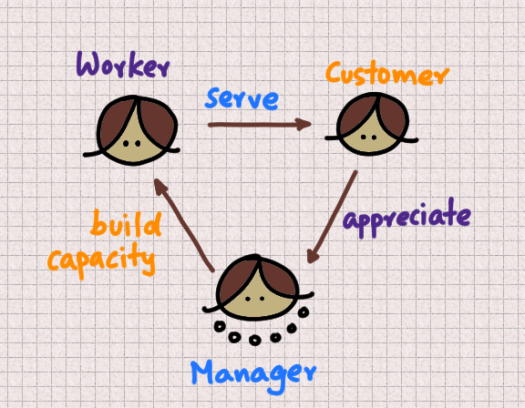
In the diagram above you’ll see the three main actors in any project – the customer, the worker and the manager.

What’s does your worker need to do?

They need to serve the customer.

If someone tells you they’re always busy there’s a good chance that 80% of their time is taken up dealing with failure demand.

That’s not “serving” the customer really, that’s sorting out everything that is going wrong.

If you’re serving a customer, then the customer ends up happy.

That’s the only thing that matters.

But, how does the worker know what the customer needs to make them happy.

They often don’t – they’re not experienced enough.

If they were, they’d be in management.

It’s the manager’s job to appreciate what the customer needs – to really know what should happen.

Not who is filling out what timecard.

If the manager really knows what the customer needs then they can spend their time building the worker’s capacity to serve the client.

This means focusing on reducing failure demand and freeing up the worker to spend time on value demand.

How does a manager do that?

By getting involved. By coaching and training and supporting. By studying and experimenting and learning.

None of which is part of the standard management curriculum or the way people think is “normal”.

But that’s where you have an advantage.

If you get this idea of value demand and failure demand and learn how to redesign your business so that most of what you do is work on value demand then you’ll be ahead of 99% of other businesses.

Because everyone would like to have a business that gives customers what they need.

Most don’t put in the work needed to do that.

You can.

Cheers,

Karthik Suresh

What Is The Real Way To Build Quality Into What You Do?

best-car.png

Saturday, 9.02pm

Sheffield, U.K.

If each part of a system, considered separately, is made to operate as efficiently as possible, the system as a whole will not operate as effectively as possible. – Russell Ackoff

You have probably heard the term “no-brainer” used to describe a situation every once in a while.

Some things are obviously the right thing to do.

For example, if you want to get from one city to another on the motorway the obvious thing to do is go as fast as you’re allowed to go – maybe a tiny bit over.

Not so much that you get in trouble but just enough so you get there earlier.

But is this actually the case? Will maximising one element of your journey give you the result you want?

It turns out that doesn’t really work.

The quote by Ackoff that starts this post tells us something that is often no longer intuitive.

What should you do if you want to increase sales leads?

That’s obvious – spend more time on the phone dialling numbers.

But is that really the case?

Might you be better off spending less time on the phone and more time doing research so you call the right people in the first place?

Ackoff says that the proof of his statement is long and complex but you can work it out for yourself with a simple thought experiment.

Let’s say you want to build the best car in the world.

Get a big warehouse and collect all the cars you think are already very good.

Now, pick the one with the best engine.

Find the one with the best braking system.

And the one with the best gearbox.

Keep doing this until you have the best component from every car.

Now put all those components together to create a brand new car.

This one is going to be better than all the others.

Right?

Clearly, it won’t. You’ll be lucky if it starts and moves because many of the components won’t fit together in the first place.

The point is that you won’t get the best performance by selecting the best parts individually.

But this is a mistake we make again and again in organisations.

We focus on one element of performance and look to maximise that.

The NHS, for example, tries to push down waiting times.

Websites try and maximise hits.

Influencers try and maximise followers.

But, you ask, what else can you do to improve a system other than to focus on the parts that make it up?

And that’s a reasonable question – but the answer is that you don’t need to optimise the parts but optimise the system and that might mean some of the parts are not run in an optimal way – but that’s ok.

This can seem complicated.

The thing with optimising a system is that you need to start not with what a system does but what it does for.

Does versus does for. What?

Let’s look at an example.

If you’re a company delivering a service to a customer what do you think constitutes quality?

Is it on-time delivery? Is it minimal packaging? Is it the length of the guarantee?

All these are parts of the company system – elements that can be measured and monitored and improved.

But none of them constitute quality.

Quality is, instead, something that emerges from the experience the customer has – when what you give them exceeds their expectations and delights them.

In other words, what determines quality is how the customer feels about you.

So, when you work backwards from the customer instead of outwards from you something interesting happens.

Take on-time delivery, for example.

You pride yourself on how on-time your delivery is. If you say it will come in seven days it comes in seven days.

Amazon, on the other hand, promises to deliver in five days and gets it to you in two.

They exceed your expectations, get your business and destroy the competition.

Now, that’s quality.

From one point of view anyway.

The larger you get the easier it is to manage by metrics because you can measure them and manipulate them.

But the only thing that matters – if you’re trying to deliver a quality service anyway – is how you make things better for your customer.

Cheers,

Karthik Suresh

What’s Stopping You From Getting Started And Making Things Happen?

when-to-start.png

Friday, 9.25pm

Sheffield, U.K.

If you have a dream, you can spend a lifetime studying, planning, and getting ready for it. What you should be doing is getting started. – Drew Houston

Children, you’ve probably noticed, are fearless.

If you ask a room full of young children to raise their hands if they’re good at singing or drawing, every hand will probably shoot up.

Up to the age of five or six, that is.

After that they start worrying what other people think.

By the ripe old ages of seven and eight they’ve learned about being embarrassed and not being good – they start to learn why they can’t do something.

And this is a problem that lasts, for many, the rest of their lives.

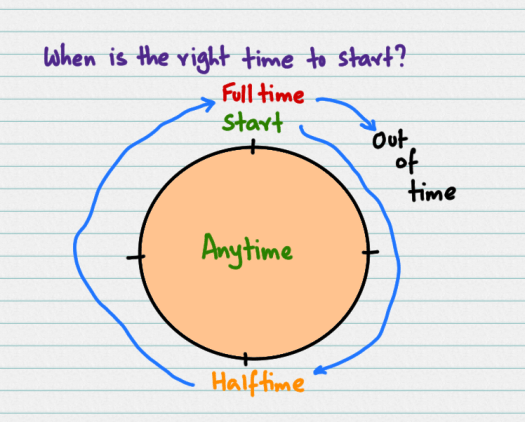
The picture above is adapted from something Robert Kiyosaki said about life being like a football game, which makes a point we would all do well to internalise.

While you’re on the field, even when you reach half-time, there’s lots of time left to go.

Even at three minutes to full time, you’ve still got a chance.

But when the game of life is over, that’s when you’re really out of time.

I’m still working my way through The four: The hidden DNA of Amazon, Apple, Facebook and Google and I’m not sure it works for me.

There must be points in there somewhere but they’re buried beneath unnecessarily coarse language and hyperbole.

Still, I’m trudging through it – well, skimming really – and in chapter 10 it starts to list success factors.

Factors like work hard, take ownership, look for equity.

A list that is rather banal – a term one of my marketing lecturers used to describe a paper I once turned in – and he was right.

Because really, if you want to be successful what you need to do is produce.

There’s a story somewhere about a pottery teacher who divided his class into two groups.

One group was told to make something every day – anything – as long as they made something for the term.

The other was told to work on their masterpiece – honing their best work for the same period of time.

At the end of the term all the pieces were collected and judged by independent experts.

The pieces that were judged the best all came from the first group – repeated practice over time had resulted in a better set of outputs.

Someone else wrote something interesting about investment.

In case you’ve noticed – I haven’t got the energy to go and research the source of these stories today…

They talked about the importance of the dividend in making your investing decisions.

Now, this is different from the way we normally think.

All too often we think about payback – how long will it be before we get our money back.

What’s more important is the payout you keep getting from that investment.

When you invest in yourself through an education you can get a lifetime of employment.

When you invest in your skills – developing and honing them by producing over time – they start paying you dividends.

As long as you keep producing you can’t help getting better over time.

And eventually the market catches up and values you fairly.

But the key to producing something is getting started – and what matters is not quality but quantity.

The things that hold us back are largely illusory, they disappear if you take a closer look.

There is only one thing that can really stop you.

And until that happens you’ve got all the time in the world.

Starting now.

Cheers,

Karthik Suresh

What Is The Right Way To Think About Growing Someone Else’s Business?

outsourcing.png

Thursday, 8.11pm

Sheffield, U.K.

When a person with money meets a person with experience, the person with the experience gets the money and the person with the money ends up with the experience – Various

You come across many businesses that offer a service to other businesses – so when should the latter take the former up on their offer, and under what terms?

For example, let’s say you are a marketing agency looking to grow your client base – why and how should someone work with you?

I was rummaging through my files and came across an adaptation of the Outsourcing Decision Matrix shown in the picture above.

This is from Maurice Greaver’s 1999 book Strategic outsourcing and in the introduction Greaver writes that “the essence of capitalism is the free flow of resources to those who can most effectively manage those resources.”

This is an interesting model because it gives you a way to think about what’s the best way to do something – but at the same time see how such ideas can conflict with the fears and hopes of the people involved.

Take our marketing company, for example.

How important, would you say, is marketing to an organisation?

In strategic terms, that is.

If you go with Peter Drucker’s perspective the only things that add value in a business are marketing and innovation – everything else is a cost.

So, looking at the matrix you’d rank marketing as having high strategic impact.

Looking at the other axis, what’s the operational impact of marketing?

From one point of view marketing exists on the periphery of the business – it’s only purpose being to drive “leads” to where they can be corralled and filtered and sorted and nagged until they press the button marked “buy”.

From another point of view marketing is everything the business does operationally – every contact a customer has with the business – every “touchpoint” is a marketing opportunity.

The way you’re treated by the people who serve you sets your view of the company – the view that marketing is trying to influence.

If you’re a business that thinks from the first point of view then it makes sense for you to partner with someone for whom marketing is the core of what they do.

If you think from the other point of view, then marketing has a high operational impact on your business and you should retain and enhance your in-house capability to do what is needed.

The point is that you may not have the skills and experience needed in-house and so you have to spend time and money recruiting and building a team and be willing to see low or no returns and ongoing costs until the team starts producing.

And people don’t like doing that in some businesses – they can’t get their heads around doing anything that doesn’t pay off immediately or meet their return on investment criteria.

Such businesses have a problem and should remember the saying, “If you’re sitting in the shade of a tree right now, it’s because someone else, a long time ago, planted a seed.”

If you don’t invest in your future it will probably end sooner than you expect.

Many organisations, because they don’t want to spend up-front money, go down the partnership route.

This can make a lot of sense, especially when there are good agreements in place but it will only work as long as the partners are roughly equal in power.

Otherwise you could end up in the embrace of an anaconda, as companies that trusted their marketing to Amazon and Google and Apple have found out.

Do you remember those connectors iPhones used to have – the big, flat ones?

They were made by a company that I can’t remember the name of, but I looked into its stock because the price had crashed off so much – and it turned out that was because Apple had decided to stop using those connectors and build these smaller ones instead.

That was the end of that business…

The thing to remember is that when you work with someone else you need to have a fundamentally sound model – because legals won’t protect you.

There are two other boxes in the matrix that we haven’t talked about.

At the bottom left are things that have low strategic value and have little impact operationally.

Stop doing them.

And at the bottom right you have things that have a high operational impact but low strategic value.

This category includes pretty much everything that is a support service – from buying stationery to buying energy and insurance.

Get someone else to do that for you and simply make sure you’re getting the most cost-effective advice.

Back to our marketing firm – so how should you sell to a company that should really do this themselves?

Why not try two things.

Either create an open-source version of what you do – tell your customer that they’ll get all the tools and methods and processes to do this themselves if they want to – but while they don’t they can pay you to do it for them.

And if you part company they’ve still got everything they need to go forward.

Or offer to partner with them using a structure that means they can buy you out.

You might build and recruit a team and capability dedicated to that organisation – one that you will set up for them and that they can buy off you at some point.

The thing with these two approaches is that you’re playing in the top half of the matrix – because you don’t really want to be in the bottom half.

Unless what you do doesn’t matter too much – and then it’s the right place to be.

Whatever you do stay away from the bottom left.

And keep your eye on what’s best for your customer.

Cheers,

Karthik Suresh

How To Structure A Presentation For Busy People

what-so-now.png

Tuesday, 9.16pm

Sheffield, U.K.

A good teacher, like a good entertainer first must hold his audience’s attention, then he can teach his lesson. – John Henrik Clarke

People in general, and busy people in particular, are only interested in one thing – what does this mean for me?

When you structure a presentation for such folk you need to focus on what they want and need to know – and expand from there.

This is quite different from the way most people plan their presentations.

We’re taught to think through stuff sequentially – first we did this and then we tried that and this is the result.

That’s ok if you’re explaining your reasoning to someone who is trying to see if you’re doing things right – but that’s not usually the kind of person in your audience.

This other, busy person wants to know what the result is that you reached in the end – not the details of the wrong turns you took on the way.

There are a few ways to construct a story that works – and one of them is shown in the picture above.

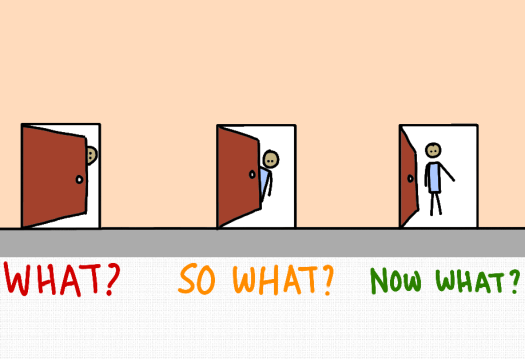
The What? So What? Now What? model is a useful way to think through your message.

For example, let’s say you’re looking at a client’s portfolio and have found a number of ways in which you can help them.

Are you going to start by talking about all the work you’ve done or by showing them the size of the opportunity you’ve uncovered?

The second point will get you more attention.

“I can save you a hundred thousand pounds” will get you more time than “we started by asking for all your paperwork”.

The first gets attention – the other causes people to start fiddling with their phones.

In examples like these the first two points almost run into each other.

We analysed your portfolio (what?) and found a big bunch of opportunities (so what?).

The third follows closely behind.

Now we’d like to implement them for you (now what?)

In other situations the three points stand out more distinctly.

  • The economy is slowing down (what?)
  • As a freight provider, you’re going to lose money (so what?)
  • We can help you cut costs and reduce the impact (now what?)

The smallest presentation you can have to communicate a complex message is probably four slides.

In the first one you tell them what matters to them – what result you’re going to provide.

We’ve found a way to save you a hundred thousand pounds.

That gets their attention.

And then you explain what’s going on, what it means for them and what happens next using the what, so what and now what model.

The point is that people are really not interested in all the background work you did.

They want to know what it means for them.

So, just tell them that.

Cheers,

Karthik Suresh

What’s The Alternative To Planning Every Step?

plan-vs-action.png

Saturday, 8.49pm

Sheffield, U.K.

To catch the ball, face up, look at all of my options and then pass. I was playing hot potato. I didn’t want to be the guy to stall the triangle. – Karl Malone

You probably have a preferred way of working – perhaps you carefully plan exactly what you’re going to do before starting work; Maybe you just get stuck in and see what happens.

Planning has never really worked for me.

It seems a good idea, in principle, but in practice it never quite delivers.

And I’m reminded of this approach because of a few projects that are on the go right now.

For example, I was wondering what it might take to start a podcast.

What kind of kit do you need? Should you script it all out or just go with basic points. What would you talk about?

Now, if you want answers to these questions all you have to do is head over to YouTube and you get a range of views and advice, all very helpful and interesting.

What would you do next?

For a start, one video explained that you should be aware that most podcasts don’t go past seven episodes.

The answer, they explained, was to make sure you really know what you’re going to talk about, who your audience is and have a plan for the structure of your episodes.

They started losing me around that point.

And I think part of the reason is that everyone defaults to a particular mode of thinking that they believe is the right one to have at this point.

Take starting a business, for example.

Everyone wants you to have a business plan – something in writing that sets out what you’re going to do, the size of the market growth projections, how you’re going to raise finance – and a whole bunch of other things to show that you’ve thought through what needs to happen.

Plans might be useless, as Eisenhower said, but planning is essential.

I wonder though if this way of thinking misses the point, perhaps two points.

The first is that at the start of a project you probably don’t know where you want to end up.

Maybe you have a vague idea or a very clear conviction – but things change.

And they usually change when you’re confronted by reality.

Reality that can come from inside or outside you.

The type that comes from inside is when you start a business or podcast or project and realise as you get going that it’s not really something that you’re passionate about and driven by.

Maybe you thought that it was something worth doing – perhaps you thought there was a market that hadn’t been exploited and you were the one that could do it.

In other words, you chased after an opportunity.

The type that comes from outside is when you don’t get the confirmation you expected from those around you or people in general.

This is when you don’t get enough followers, enough customers or enough recognition.

At this point, the lack of apparent traction puts you off – maybe to the point where you abandon the project altogether.

The underlying issue in these situations is that you are chasing something.

The way I look at this, borrowing a metaphor from value investing, is like a surfer.

I’ve never surfed but I’m reliably informed that surfers don’t paddle out into the sea, look for a big wave and head towards it, hoping to catch it.

Instead, they get in position and wait for a wave to come along and lift them up.

In other words, they don’t catch a wave; the wave catches them.

So, this is important for the internal challenge you face – if you’re doing something because you like doing it then you’ll probably keep doing it.

If you don’t then other things will seem more interesting soon and you won’t.

And, when you like what you’re doing you won’t mind waiting until the wave comes along.

I assume surfers sitting out there on their boards chatting to each other are having a good time.

I’d be thinking of sharks…

And they’re happy to wait till the opportunity comes along because they like being out there.

So the key thing is being ready to wait it out.

And you can’t plan for this because you don’t know anything about the future – you can’t predict when the opportunity will arise.

So that means you need to have the ability to keep going until it materialises – and that means thinking not about the long-term plan but about the next step and the immediate options you have.

The key is to preserve optionality – your ability to make the most of what comes along.

That means what you need to think about is not what the grand theme of your project might be but about what the next action is.

With enough action the grand theme will emerge.

I find, anyway.

Your mileage may vary.

The key, I have found over years of professional decision making, is often to leave the decision until the last minute.

When you’re not sure how things are going to go then keep options open.

Don’t quit your job, for example, until your side hustle is paying you more than you’re making now, or you have a contract offer for a new one.

Don’t make decisions about themes and equipment and things that will cost you time and money until you absolutely have to – because you may need to change your mind.

Start by taking action – and keep your options open.

People often achieve more by setting off than they do sitting down and making plans.

The counter to this is when you know the right thing to do.

In value investing that’s when you know something is under priced – and that’s when you commit – go hard on the dollar, as they say.

So, in a nutshell, the alternative to planning is to keep your options open most of the time and be ready to act.

Because on those rare occasions, the times when the wave comes along and lifts you up, you want to be ready to surf.

Cheers,

Karthik Suresh

The Difference Between Hard And Soft Systems Thinking

hard-soft.png

Wednesday, 9.02pm

Sheffield, U.K.

Remember, always, that everything you know, and everything everyone knows, is only a model. Get your model out there where it can be viewed. Invite others to challenge your assumptions and add their own. – Donella H. Meadows

It is worth asking, every once in a while, where the ideas and opinions we have come from.

Take the word system, for example.

It’s a word that is used all the time in all kinds of situations.

We think of collections of things as systems – like computer systems and gaming systems.

We think of big, complex things as systems such as the justice system, the economic system or the financial system.

And thinking of things in this way causes us to come to a very simple, and very wrong conclusion.

We think of systems as being “real” – as existing for real in the outside world.

As real as flowers and ponies and tigers.

But, the thing is that the “system” only exists in your mind and in the minds of the people that you’ve shared your idea of the system with – or vice versa.

So, why is this important?

Many approaches over the last century have focused on our ability to create things that we call systems – and human beings have been very successful at making lots of cool things as a result.

People have made railways and rockets and medicine that actually works.

Now, having used such a way of thinking very successfully in certain situations – we often make the assumption that it will work equally well in any situation.

Which is why you get technical people who believe that they can build a solution to any problem because they have built a solution to a particular problem.

It’s an engineering mindset – and one that sits behind a number of approaches to problem solving – including AI and machine learning.

But history is also littered with failures of an engineering approach – what might be called a ‘hard’ approach to deal with problems that are not in its natural domain.

Problems that involve issues of politics and culture and belief, for instance.

Problems where it’s possible to prove that you can’t prove everything which, if you believe Godel, is the case with any system of logic.

So if you find you’re in a situation where you can’t “engineer” a solution – like how to deal with a problem like Brexit, or what to do about an ageing problem – you have a couple of choices.

The first is to plough ahead with a technical solution anyway – create a committee, set up a negotiating team, create backup plans and so on.

In others words – put systems in place.

Or you could look at the problem for what it is – complex and complicated or even, as Peter Checkland writes, mysterious.

The picture above is adapted from Checkland’s drawing of the hard and soft system approaches – and the basic thing to take away is that when a problem is complex what you can do is be systemic in the way you think rather than trying to make the world systemic.

This is a hard thing to wrap your head around, so let’s try an example.

If you are a manager and have an employee who is not performing what are you going to do?

Speak to HR? Fire the person? Go through a disciplinary process?

You’ve probably got a system – one that’s written out in the manual, one that can be defended if you have to go to court.

This rarely ends well for either party.

This system is also what makes it hard for women with young children to fully participate in work, for people who would like flexible work to get enough and for people to make the most of their talents.

You could argue that the system is broken.

Or you could realise that you just don’t know enough yet.

You don’t know enough about the employee – and why they are not performing.

You don’t know enough about yourself – the way you’re training, coaching and supporting your staff.

What you know is that you have a system and by gosh you’re going to follow it.

A soft approach is not a weak one – just one that realises that real world problems are almost always more complex than you realise.

How scary is the thought that you might need to actually sit down and listen and engage with the employee to understand what’s holding them back and how you can help them?

The thing about such an approach is not that you will get a result – but that you will, in the end, know you’ve done the right thing.

Not just done things right – the way the system tells you to do things.

But done the right thing for the situation you’re faced with right now.

Cheers,

Karthik Suresh

Are You Doing These Things To Develop Your Business?

reality-check.png

Monday, 8.22pm

Sheffield, U.K.

Good luck is when opportunity meets preparation, while bad luck is when lack of preparation meets reality. – Eliyahu Goldratt

If you go to work every day and focus on what needs to be done then pretty soon you’ll start to lose track of what’s going on outside – what’s happening in the real world out there.

Guy Kawasaki’s book Reality check: The irreverent guide to outsmarting, outmanaging and outmarketing your competition is a collection of lists, Q&As and short pieces covering topics from starting up and raising money to making work less unpleasant.

At the end he has a reality checklist with ten points, out of which I’ve selected six (maybe seven) that are worth asking yourself regularly.

1. Do you make meaning with what you do?

I suppose this is a little like asking what value you provide?

It can be a slightly off-putting question – we probably all agree that teachers, police officers, first-responders and firefighters add value to society.

Every profession, in its own way will argue that it adds value.

Loan sharks, for example, make the argument that they provide credit where no one else will.

But it would be nice if it were possible to do more than that.

If you’re unsure about whether you make meaning right now, just think about it a bit more.

Maybe you just need to discover it for yourself.

2. What curve are you on?

A lot of people start things by looking at the competition – what else is out there?

That’s the red ocean strategy – the one you don’t want to follow.

It’s where there’s lots of competition and the sea is red with creatures fighting each other.

Where you want to be is the blue ocean where there is space and no competition.

Okay, not always.

If you sell a commodity product, you want to be where everyone else is so that people can compare and choose quickly.

This is the world of Amazon and Ebay.

If you do something a little more involved, then you should think hard about where you are on the innovation curve, and whether you can make the leap to an entirely new curve.

3. What’s your mantra?

Kawasaki asks if you have a three-word statement that sums up what you do.

I suppose it doesn’t have to make perfect sense – that’s the point of having time to elaborate on things.

Right now, if I were to have a mantra it would probably be Soft Systems Methodology – a useful approach to understanding and dealing with problematic situations.

4. Can you pitch or demo clearly and quickly?

The saying used to be publish or perish in the academic world.

It’s similar with marketing – you have to create content to explain what you do – with articles and white papers and presentations.

You still need to be able to pitch an idea – explain what you do in a way that people understand.

But even better is showing what you do – it’s now a demo or die world.

You’ll get a lot more enthusiasm if you show people stuff than if you tell them about the cool stuff you can do.

If you haven’t got a demo as part of your marketing package – build one.

5. Can you go to market with no budget?

In The Knack: How street smart entrepreneurs learn to handle whatever comes up Norm Brodsky writes about the business lessons he learned from his father.

Sell with a big markup, he explained. Make sure you can collect from your customer. Be fair – don’t take advantage.

And then the important one – “There’s a million dollars under your shoe; you just have to find it.”

Too many people wait until everything is right before looking for customers.

Start now – because it will take you time and you will be glad you did later.

6. Don’t ask people to do stuff you wouldn’t do

This is the basic rule of management – ask people to do only useful work.

Too many owners and managers ask people to do work that doesn’t create value for a customer.

Keeping timesheets, sending in status updates, form filling, follow processes – we need to ask which of these help with the central task of filling customer demand.

If the customer doesn’t need it doing then don’t do it.

If you own the business and wouldn’t do it yourself if you had a few minutes spare – then is it really worth doing at all?

Look around every once in a while

The point of this list, according to Kawasaki, is to act as a reality check – important points that will get you on the right path.

Because, as he quotes from Indiana Jones, “If you want to be a good archaeologist, you’ve gotta get out of the library!”

Cheers,

Karthik Suresh

Why Do Cathedrals Have The Same Basic Plan In Most Places?

cathedral.png

Sunday, 9.00pm

Sheffield, U.K.

The bearing of a child takes nine months, no matter how many women are assigned – Fred Brooks, The Mythical Man-Month

I have finally gotten around to reading this collection of essays by Fred Brooks – not all of it but what I have read so far is already illuminating.

Take for example, how many people you really need to get a job done.

Say you have a project and you put one programmer on the job.

The task starts looking too big – so you look at adding a person to help.

This will make things go faster, no?

No.

The first thing that Brooks points out is that you can only share out tasks between people when the tasks can be done without the people communicating with each other.

Picking cotton, sorting beads, moving pallets – all these tasks can be done in less time by fewer people.

Supermarkets, for example, get every employee in a store – from the top manager to the entry level clerk – to rumble the place – get every item on the shelf pointing the right way.

But, if you are doing a knowledge based project then communication is essential and communication causes two main problems.

The first problem is one of training. Say you add a person to help your programmer – the first thing the programmer has to do is train the person – and if that takes a week you’re another week behind schedule.

So, never get your existing programmers to train others unless you’re happy to fall behind even more.

Then, when people start to work together the increased need for communication scales exponentially with the number of people.

The more of them you have to talk to the less work gets done.

But you have to work with people – you need teams to get things done.

Here, Brooks points out that big teams with managers don’t work well.

Instead you need small teams and not just that – you need teams organised like surgical teams where you have a surgeon who does the work, an co-surgeon who is learning or can take over and support staff.

The way you work on a big project is by having lots of these surgical teams.

But the way you get them to work in a way that gets you moving in the same direction is to be very clear on the overall architecture.

A cathedral, for example, is pretty much the same wherever go in Europe because of the general design that Jean d’Orbais came up with.

Generations of builders can add their unique approaches and flourishes but within the overarching and coherent design that guides the development.

That approach – having a clear and coherent “what” allows experts to go ahead with the “how” in creative and inventive ways.

Just these three concepts – be wary of adding people to a project, organise yourself like a surgical team and work within an over architecture – alone can transform the way you manage knowledge work.

It goes beyond programming – and can be used pretty much across service industries that rely on using skilled people to deliver a benefit to a customer – it can even help you design a better sales process.

Because the whole point is to create a better experience for your user – your customer.

Wouldn’t it be nice if they looked at what you’d done for them with even a fraction of the wonder they have when they enter a cathedral?

Cheers,

Karthik Suresh

What Do You Do When You Can’t Be “Scientific” In Your Approach?

pearl-model.png

Thursday, 8.29pm

Sheffield, U.K.

It is the recoverability criterion, that is the crucial one in action research. If we imagine a spectrum of knowledge acquisition from experimental natural science at one end to story telling at the other, then along that spectrum will be very different criteria for judging the truth-value of the claims made. Traditional scientific experiments would be at one end and at the other, the weaker criterion that this (research) story is plausible. However, action researchers have to do better than simply settling for plausibility – Peter Checkland and Sue Holwell

I have a stack of books that fall into the genre of what Shawn Coyne calls “narrative non-fiction” and I’m starting to wonder whether they’re worth reading at all.

The problem is telling the difference between stuff that is true and stuff that just sounds true – the essential issue with anything that falls outside the remit of your basic set of physical sciences.

If you want to learn how people tick and how economies work what you need is carefully controlled experiments – from which you can figure out How Things Really Work.

The scientific method has been so successful at explaining the world around us that it now feels like the only way to create knowledge.

Except, a lot of time, there is a horrendous amount of noise in the situation you are trying to understand.

For example, let’s say you’re a consultant trying to come up with a marketing plan for a large organisation.

At one extreme everything you need to know is catalogued and figured out to two decimal places.

The Neilsen Norman group, for example, have identified 85 factors that go into making an About Us page to help your users.

It sounds very scientific – looking at over a hundred sites and observing 70 users – collecting data for the research that resulted eventually in this set of insights.

They write, with no trace of irony, that “Organizations that stood out from the crowd in favorable ways used tactics that helped them appear authentic and transparent.”

In other words – do these things and you will be able to fake being real.

Now, the point is not to have a go at the research – there’s nothing duller than trying to rubbish someone else’s work – but to understand how reliable this kind of research might be.

It’s likely that if someone else replicated the research they would end up with a different set of factors – none of the 85 on the list are going to be on the same level as, say, gravity.

The best you can hope for is that if you sat down and wrote a piece of copy that incorporated all the features it would outperform whatever was there already or “average copy”, whatever that is.

In a nutshell – it’s really hard to come up with an objective and neutral way of looking at things that involve people.

Systems that involve people are just plain messy.

So, when you read books that tell you how to solve problems that involve dealing with people you need to approach them with some scepticism.

And that’s because most of them make arguments that are plausible – but not much more.

What does that mean?

It means that if you want to write this kind of narrative non-fiction book what you do is collect a load of research, sift through it to come up with a Big Idea, search for stories that illustrate what is happening and put them all together in an engaging, conversational, easy to read package.

When you read these things the tips and tricks and hacks sound good – and you’re keen to try them out.

I try these out just as much as anyone else does – from David Allen’s GTD to Morning Routines from Tim Ferriss.

But these tips, while entertaining, do not help us move towards sustainable improvements in complex situations.

For those we need something a little more rigorous, something like action research – a process where we get involved in the situation as a participant AND researcher aiming to generate knowledge which is, if not repeatable, at least recoverable.

What this means, going back to our marketing example, way back when, is that the thinking and steps we follow to do what we do should be capable of being looked at and critiqued by someone else.

Which is a scary thing to allow – and so we don’t. Usually.

But, if you wanted to, just because it was the right thing to do what should you keep track of in the first place?

In a paper by Donna Champion and Frank Stowell called Validating action research studies: PEArL, they suggest that we should record five crucial elements to help us think about what we’ve created.

In the marketing project example – we might start with the participants. Are we satisfying the whims of the business owner or are we responding to a crucial change in the market?

Who is engaging with the project? Is it seen as something that is a one-off or do you have a team within the company that is interested and eager to make a difference?

What is the authority structure within the firm – is there someone who can make decisions or is this a project that is being done with no hope of taking action at the end?

What do the relationships look like? Are they collegial or based on power dynamics and politics?

Finally, is real learning being generated – not wishy washy marketing vaporware but real, reflective thinking that looks at things warts and all?

And a handy mnemonic for remembering these is PEArL – where the small r represents the importance of the soft relationships that exist within the group.

The chance are that if you look at the vast majority of commercial projects through the PEArL lens you will find all kinds of nasties and unmentionables hidden away.

Because in most organisations day-to-day life is about face and power and hierarchy and order – not about truth.

That’s the thing that “scientific” types need to understand about the real world.

It’s about people.

Cheers,

Karthik Suresh