You know that question you ask your cat when it drops a mouse at your feet?
“I can see you’re very proud of yourself, but what do you want me to do with this now?”
That’s how I feel when someone presents me with work they’ve made using AI.
Here’s an example. Let’s say you ask a junior consultant to generate market research and a go-to-market plan for one of your clients.
You get given 20 pages of output.
You ask the junior to talk you through the material.
Ideally, they’ve read the 20 pages, validated the information, sense-checked against prior knowledge, and can confidently articulate the situation and explain what needs to be done next.
All too often, you’ll get the same blank look the cat gave you when you asked it the question.
AI does not give you less work. In fact, you’ll probably end up with more.
Arthur Schopenhauer, as an old man, was asked what he thought about his life’s work on philosophy being ignored, and replied that he didn’t care at all. “They will find me”, he said.
This extract is at the end of a Peter Checkland (1992) paper I was reading, and so, of course, I looked up Schopenhauer.
I’ve recently been studying “explanation” as a sense-making device, in the context of strategy making by organisations.
In essence, this is the idea that structure is not something external to people but something that they construct based on how they explain the way in which they see the world.
In practical terms, this makes the difference between arguing for investing in sustainable technology or waiting, between starting a war or compromising to keep the peace. Explanations that make or break the future.
So what are we trying to explain?
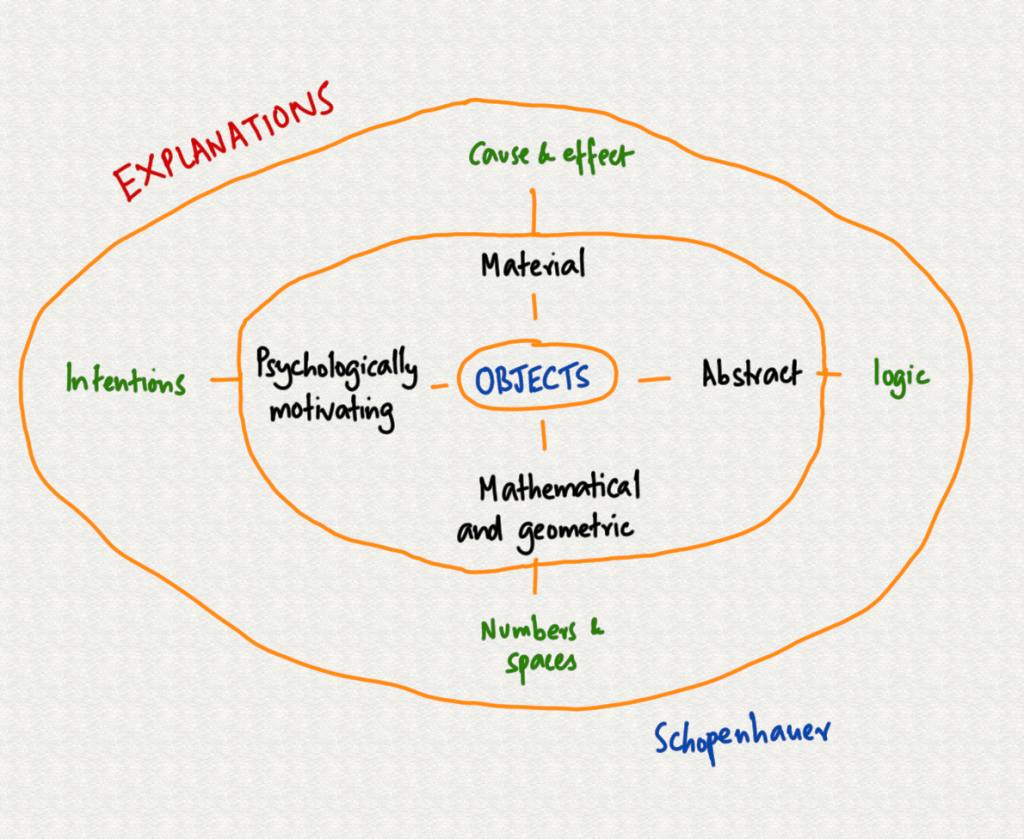
Schopenhaur argued that there are four kinds of objects and four corresponding types of explanations.
Material objects, explained with cause and effect reasoning
Abstract objects, explained with logic.
Mathematical and geometrical objects, explained with numbers and spaces.
Psychologically motivating objects, explained by motivation or moral reasoning.
Problems arise when we try and apply one style of explanation to a different type of object.
I see this problem all the time in my consulting practice.
Here’s an example. You have a leadership team that wants to build a decarbonized company. Should you therefore replace your gas boiler with an air-source heat pump?
The first problem is one of motivation. Do leadership believe in the case for decarbonisation? Are they forced to do it by supplier pressure? By regulation? What motivates them?
The second is a cause and effect problem. Will the ASHP meet heating demand in all situations? Are operating costs equivalent?
It’s when we mix modes of explanation that we end up with circular and stalled thinking.
Progress becomes easier when we use the right kind of explanation to match the problem we’re facing.
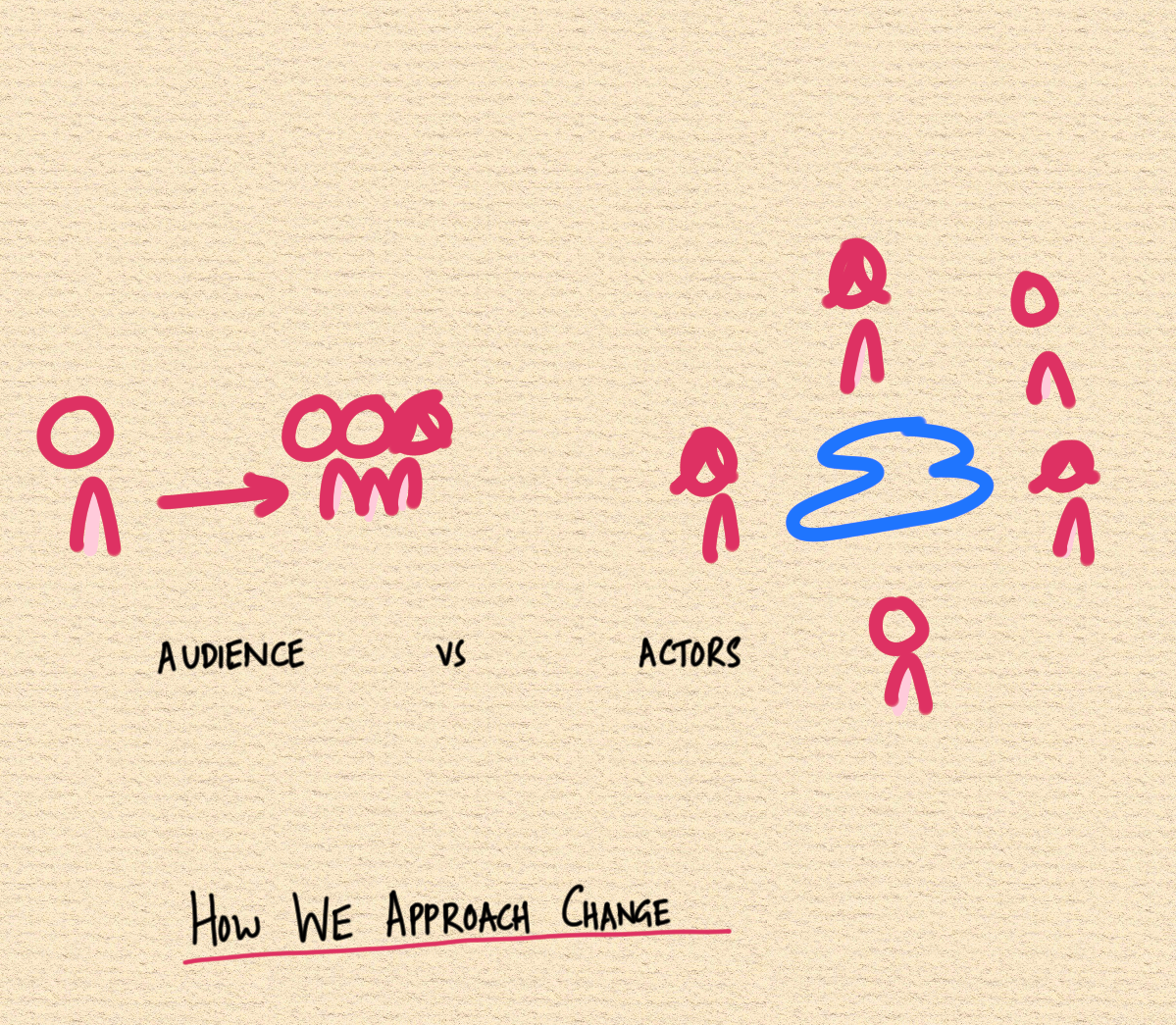
I come across two kinds of leaders tasked with driving change.
The first sees change as imposed. It’s a top-down, command-and-control process.
People are audiences – they are given a message and expected to act.
The second sees change as participatory and negotiated.
Stakeholders are actors with purpose and agency, and the ability to cooperate or resist change.
What matters here is building consensus and dealing with the messy reality everyone faces.
Which approach is better?
There is no right answer – it depends on the situation.
I love this quote by Poul Anderson – “I have yet to see any problem, however complicated, which, when you looked at it in the right way, did not become still more complicated”.
Change is not easy.
But it is a process.
Success or failure depends on how you design and run that process.
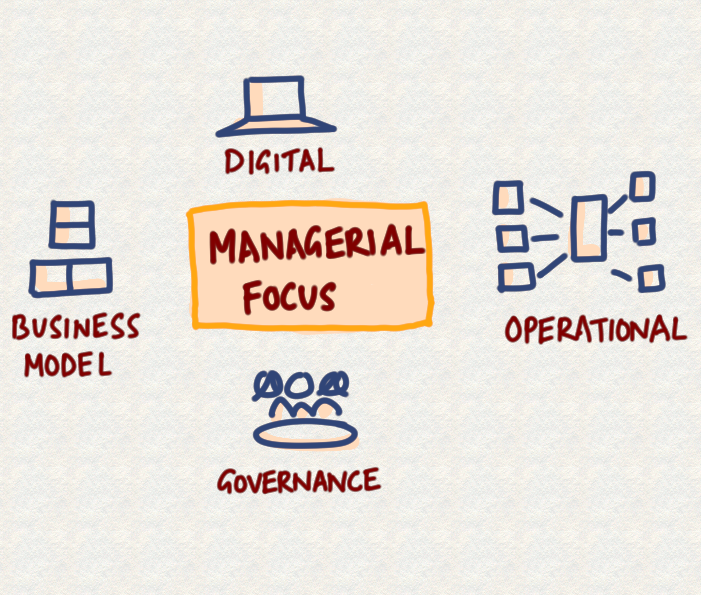
There are four topical challenges managers are addressing right now.
Digital effectiveness
Which integrated systems and processes do we need to manage information?
Operational effectiveness
How should we configure our internal and external value chains and build resilience?
Governance
What roles do leaders play and how do they make good decisions?
Business model development
What is the business and financial case for taking action?
Each department has variations on these themes to deal with – take sustainability as an example.
Digital: AI is pitched as a solution for dealing with overwhelming data confusion
Operations: New technologies have to be evaluated and assessed against like-for-like replacements
Governance: Leadership in sustainability requires regulatory fluency and agile political footwork.
Business Model: Financial models often don’t recognize the long term benefits of sustainability.
These are complex things to manage. It’s not surprising that some teams are feeling stuck – wanting to make progress but lacking budgets or resources.
A possible remedy? Nemawashi.
Nemawashi is a Japanese term for “digging around the roots” – and tells us to have informal discussions with stakeholders to prepare the foundations for change.
It’s a core element of the Toyota Production Process (TPS), and Japanese corporate culture.
Progress in organisations doesn’t happen quickly.
It happens when managers and teams take the time to engage widely, construct narratives, and build enough consensus to take action.
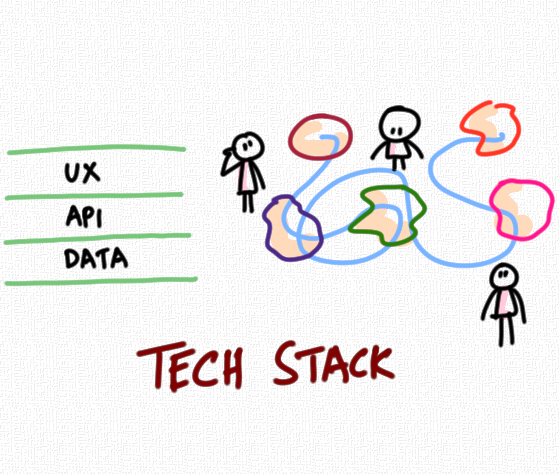
Imagine a technology-enabled enterprise. What comes to mind is often different from day-to-day reality.
Is there a clear technology stack? Data at the bottom? A user interface at the top? Clean efficient connections between data and insight?
Or do we have a mess of systems built and procured over time? People as an intrinsic part of the process. Software tweaked and customised over time to get the job done.
In such situations, change is a challenge.
Go down the RFP route, and you can end up getting a large, bloated system that no one uses.
Pick an innovative new platform – and navigate risks and issues raised by procurement, IT, legal, and finance – delaying the start of projects.
Change imposes costs. Real ones.
Right now, we’re being told that budgets are tight, costs must be controlled, and there’s no money to spare.
Buying a system doesn’t mean the work gets done. Sometimes it creates more work.
The pragmatic solution? Orchestration: start by getting the most out of the systems and capabilities we already have.



 Handcrafted insight