My Practice Of Consulting

2024-06-09_consulting.png

Sunday, 8.30pm

Sheffield, U.K.

Wherever I was in the world, at the beginning of every consulting project, one thing was certain: I would know less about the business at hand than the people I was supposed to be advising. – Matthew Stewart

Next month I’m presenting at a conference and this current series of posts is me working out my talk.

I’ve spent three days thinking about the question, “So what is it you do exactly?”

This is the heart of it – what is my practice?

Let’s start at the beginning. I’m a consultant.

Some people get into consultancy because they join a big firm that trains them to be a consultant.

I became a consultant because I couldn’t get a job. I ended up creating a job for myself, finding out what tasks needed doing and then doing those tasks in exchange for money.

This tiny distinction between figuring out what to do and being told what to do is the difference between being a consultant and having a job.

But let’s focus on a specific aspect of my consulting practice. I invite people to a web conference, we talk, I share my screen and take handwritten notes with a lot of words and some pictures and it seems to help the group with figuring out what to do.

For the last few years my collaborators and I have been trying to figure out what exactly is going on. Is there some magic here? Is it different? And I think I have an answer, helped by the magic of television.

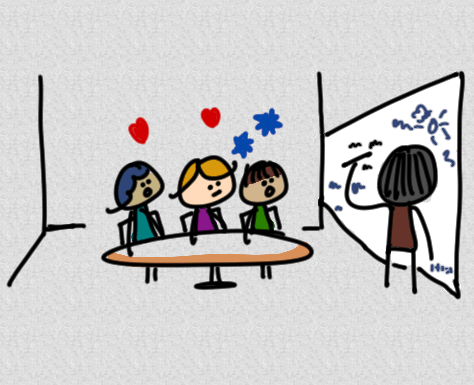
I recently saw a program on Disney Plus called “Reboot” which features a writer’s room. This is a room where all the writers go when they need to work on the story together and come up with a script. This activity seemed similar to the thing I do. I have a virtual room. I use the equivalent of a big whiteboard. We have a chat. I run the room. We don’t have a “workshop”, I don’t “facilitate”, but something happens in there – a collaborative exploration of a problem situation to get something done, like a shooting script or project.

Could this metaphor of a writing room explain what’s going on? I think we should find out. There are four things I think are relevant.

1. The room is where structuring work gets done

Writers come into the room to talk about the story, to pitch and build on ideas and agree what to work on. The idea is that the group mind is more powerful than the individual one, and when ideas are exposed to group discussion weaknesses will be seen and the group will build a consensus around strong ones.

The showrunner’s job is to run the room. That may be the role I take. The things that make a good room are:

  • The sense that it’s a safe space to talk
  • That it’s about valuing and getting excited about people’s ideas
  • That the culture is good, contributions are about making things better and negativity is discouraged
  • Criticism comes with a suggestion on how to fix the problem

The room (or virtual room) is the place where we work together to find ways to improve the situation.

2. There is a situation of concern

In a writer’s room everyone is working on a fictional situation. In a project room, everyone is working on a real situation. The trick is seeing the situation from the outside, seeing the participants as players rather than being stuck in the situation yourself.

The ability to step back and see the big picture what the room helps you do so that you can work out how to fix the fictional or real situation.

3. There is a whiteboard

It’s not enough to just sit around a table and talk. The ideas have to be captured and a whiteboard acts as external memory. Getting points on the board means that the group can concentrate on coming up with new ideas without worrying about losing the old ones.

My way of using a digital drawing tool like a whiteboard allows me to capture a lot of detail and the rhizomatic nature of the recording seems useful in remembering and connecting related ideas.

I am less convinced of the value of multiple inputs where everyone can add data at the same time because that seems like a way of working alone, together, rather than working together.

4. There is a product at the end of the process

The purpose of spending time in a writer’s room is to agree what to work on next and then get on with writing the script.

That’s the same thing that happens with my consulting room. Some consultants are all about producing a report or a recommendation but I’m interested in figuring out what to do next – discovering an opportunity or agreeing a project. It’s a practical, pragmatic approach – it’s about the work. It’s about the metaphorical pick and coal face. That’s where the real work is.

The specific aspect of my practice then is this virtual consulting room, where the purpose is to get people together and get them literally on the same page so that by the end we are ready to get on and do some work.

Cheers,

Karthik Suresh

What Are Rich Notes?

rich-note.png

Tuesday, 9.29pm

Sheffield, U.K.

The meeting of two personalities is like the contact of two chemical substances: if there is any reaction, both are transformed. – Carl Jung

19 November 2025 UPDATE – the post below is from 2024. If you are looking for an updated introduction to Rich Notes, this video may help.

Enjoy the rest of the post…

In 2018 I started to do a thing that changed the way I practiced consulting. I shared my screen in meetings and took handwritten notes using drawing software, writing on a graphics tablet with a stylus. This is what I am going to talk about at the EURO conference.

I call this thing Rich Notes and it describes nonlinear digital notes that I take during meetings to record and structure conversations. You can see an example in the picture and there are quite a few distinctive features that I won’t go into right now.

I have been obsessed with writing for as long as I can remember. I collected pens, pencils and paper. I tried different handwriting styles and experimented with calligraphy. I studied graphology. And I wrote, pages and pages. Study notes, journals, meeting notes. I kept logbooks, looseleaf notes, project notes. Writing has been the most useful method I’ve found to deal with life.

The act of getting words down has let me grapple with ideas. Stapling words to the page lets me chase other ideas down and wrestle them to the floor. Our brains are meant, as David Allen writes, for having ideas, not holding them. My philosophy for years has been that if it isn’t written down, it doesn’t exist.

Writing things down during meetings shows you’re paying attention. Or doodling. I once sat through a meeting where all I wrote down “I’m bored. So bored. I’m so bored.” in shorthand again and again. Luckily that doesn’t happen too often.

How we write is affected by the medium we use. I first wrote these words on an Amazon basics yellow legal pad with a Montblanc Mozart fountain pen using black ink, after passing over a Bic ballpoint and a Parker. Some people like such details. For others, it’s just strange. On the page my writing marches, like a line of drunk ants, to the right and down, line after line.

Taking digital notes is different. Writing on a computer screen with an infinite page is like throwing pasta at the wall and seeing where it sticks. It could go anywhere. Paper encourages linear writing, a wall encourages non-linear writing. The latter can hold many points of view while the former is better suited to one person working on their own. But that’s not a rule, you could do things the other way too – but it’s just easier to lean into whatever is easiest in the medium you’re working in. I focus on sharing my screen and taking notes to structure the conversation so we can have a productive discussion.

In this age of generative AI and SaaS why would writing by hand have any use? One reason is that it’s different – it’s still a uniquely human thing to do. The instrument being used is another human and I think we just connect instantly with handmade marks. When I pick my stylus and take notes on a digital screen I tap into thousands of years of human society, reaching back to a flickering fire in a Lascaux cave scratching a story on a wall with a burnt stick, or a Walbiri group in Australia scratching a story in the sand.

Rich Notes are an ancient art, as old as they come, and perhaps that’s why they work for me.

What I’m trying to do with my colleagues is understand more about them, what they are, and how they might work for others.

Cheers,

Karthik Suresh

What My Talk Is All About

2024-05-26_euro-talk-intro.png

Monday, 9.30pm

Sheffield, U.K.

The most powerful force ever known on this planet is human cooperation – a force for construction and destruction. – Jonathan Haidt

I’m spending a few posts working through the content of a paper I’m presenting at the EURO conference for Operational Researchers.

I’m making the argument that visible, shared, constructed Rich Notes lead to better meetings.

I’m not going to spend time comparing my approach with others. I saw a recent post by David Heinemeier Hansson where he talks about introducing Ruby on Rails and how it took off because he just showed what you could do with it. In the same vein I’m going to talk about what I do and the pros and cons, and you can do your own A/B comparisons and decide how this performs compared to what you do now or what else you could be doing.

Why a discussion needs to be visible

Meetings where people just talk are a waste of time.

We just aren’t designed to listen by default. Our brains hold a tiny amount of information so we zone out quickly and only focus when we’re surprised or entertained. Most meetings don’t do this.

I can often only stay interested if I take notes. For me, note taking is a way to listen closely. When you can see me taking notes I really have to stay focused. If I’m interrupted or distracted and stop taking notes you can see that happening. When the notes are visible people can see that their points have been noted – that I’m listening to what they’re saying and acknowledging their contributions.

The technology needs to allow for sharing

I make the discussion visible by sharing my screen when I’m taking notes. I take notes by hand using a digital drawing pad and stylus. This approach works best during a web conference call when everyone has joined and can see the screen. It does not work as well when some people join using a phone or if they’re in a room with a big screen and poor audio. It’s best when everyone is on the call, the audio and video works, and the screen can be shared easily – we can then get on and have a good discussion.

The notes have to be constructed in real time

Presentations are hard to follow because the thinking has been done in advance. The presenter is totally familiar with the content but the audience is trying to keep up, reacting to the small portion that we understand.

Building up notes from a blank page, filling in details by hand as people talk is very different. The notes build at a speed that is cognitively accessible – you can think and talk faster than I can write, so the process becomes slow enough to understand and rich enough to capture the complexity of the situation.

Being too prepared does not help. If I come into a meeting with preconceived ideas or frameworks then I talk too much. The point is to understand how the participants see the situation and starting with a blank page and asking them to talk about how they see things is more useful.

We all know people who sit in meetings waiting for others to stop so they can jump in and do their thing. I’ve seen this happen in online meetings as well when everyone can do stuff in a shared space – someone will always move around, dropping in content and waiting for a moment when they can tell others what they’ve done. That’s not listening – it’s just activity rather than understanding or really engaging with someone else’s ideas.

I keep it simple. Start with a blank page. Have a discussion. Take notes.

In my next few posts I will talk about three elements. What are rich notes? How do I use them in practice? And how do they help?

I didn’t create this approach for others. It emerged when others interests of mine worked well together – well enough to form a method that I could use. But does it have value more generally? Well, that depends on what another practitioner brings to it, so I’ll spend some time thinking about that.

Cheers,

Karthik Suresh

The Trouble With Meetings

2024-05-24_meetings.png

Friday, 8.56pm

Sheffield, U.K.

If you had to identify, in one word, the reason why the human race has not achieved, and never will achieve, its full potential, that word would be ‘meetings.’ – Dave Barry

I had an idea.

I have to give a presentation at a conference at the end of the month and it’s on using writing and drawing to think more clearly.

What better way to prepare than to work through a script over the next few posts with you?

So let’s begin with a question: why are meetings so dreadful?

I think it’s down to one simple reason – we’re not biologically designed to have them.

When we were frogs and fish decision making was simple: we either ate it, tried to have sex with it, or ran away from it.

When we became wolves and buffalo and lions we did those three things but we also added a fourth thing: let’s do what the others are doing.

We created group behaviour in social groups.

Most group behaviour deals with the same issues – shall we go there together or run away together? Or if everything’s ok, shall we stop and fight amongst ourselves?

Ok, but let’s focus specifically on that curious aspect of modern life – the meeting.

I think meetings don’t work because our brains can’t cope with the cognitive demands of the task when we try and run a meeting without the help of tools.

Think about the last meeting or call you had. Did you all have a conversation? Did you feel heard? Do you remember what everyone else said? Did you stay on track or drift? Did you make a decision? Were you happy?

Many meetings can be visualised as a period of time when people get together and let the air out of their lungs. And when they’re done talking nothing is left but the sound of silence.

This is because you can’t listen to someone else, listen to yourself working out what you’re going to say, listen to yourself creating a response to what you’re hearing, and remember what else was said earlier by someone else.

Your brain just can’t keep up. It simply drops the information.

“No problem”, you say. “I take notes.” And that’s great. That’s an answer. But that helps you. What about the group?

What we’ve done as a species is take things outside our bodies. There’s a technical term for this that I can’t remember but it basically means that we couldn’t survive on our own any more. We’ve externalised our digestive system, for example. We’ve got to cook food before we eat it in many cases.

It’s the same with our brains. If we want to use them effectively we need to get a lot of stuff out of there so we can function more effectively in information rich situations like a meeting. We invented writing to help with this and it’s an incredibly efficient way to hold on to more information than you can remember.

This is the essence of my argument for the presentation. If you take notes you remember more. If you take notes for everyone in a shared space that everyone can see then you transform the meeting experience for people. I call this approach “Rich Notes” and it’s a way of helping small groups grapple with complicated problems in a brain friendly way. It helps you load and unload data from everyone’s brain in real time to help you have better conversations, appreciate other people’s points of view and reach agreement on what to do next.

Sounds like magic?

But it’s not easy to do.

In the next post I’ll talk about what Rich Notes are, as I understand them at this point in time.

Cheers,

Karthik Suresh