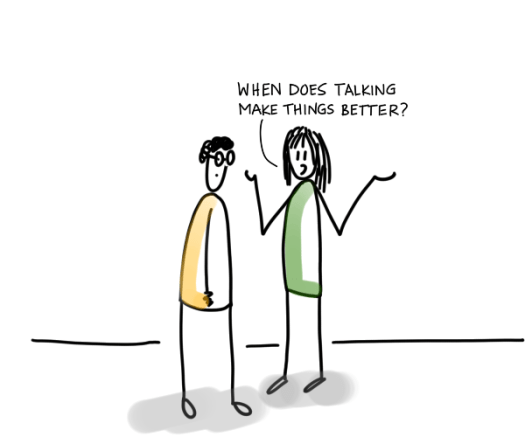
How Do You Make Something As Simple As It Needs To Be?

no-simpler.png

Monday, 7.17pm

Sheffield, U.K.

For every complex problem there is an answer that is clear, simple, and wrong. – H. L. Mencken

I have spent a lot of time doing customer interviews – the kind of thing where you are supposed to get out of the room and go and talk to real people. Fortunately, we can do this without leaving the room these days and that makes it a lot easier to get more of them done.

What I am always surprised by is how quickly a situation that appears simple on the surface turns out to be anything but as you unpack what’s going on and see all the links and connections and misunderstandings and wrong turns and hunches and insights and flashes of inspiration and brilliance. And this makes sense for one simple reason – there are few straight lines in nature.

The world around us is organic and complex and when you look at how it works there’s nothing planned and linear about it. We were in the woods the other day and I was struck by a particular arrangement of plants – something that started like a tree but which they wound itself around another, larger tree, like a vine. A strange combination but it happened in the way it did. You wouldn’t plan that – it just happened that way.

We are able to deal with the complexity and non-linearity of nature by taming it, by chopping down the disorder and building boxes in the spaces we’ve cleared. We don’t live in harmony with nature. Instead we live cocooned away from it with the only “natural” things we have consisting of carefully fashioned artifacts.

I’m less interested, however, in the outside world than the one inside our heads. That is a space where we construct a view of the world around us and we try and make sense of that world through the sense-making methods we learn over our lifetimes. And a lot of those tools are the same ones that were very successful at taming the natural world – putting things in boxes being one of the most important.

But our thoughts, like nature itself, are often organic and non-linear and rarely as simple as a box. They are complex shapes and we have to have mental tools that match the complexity of the situations we are thinking about. Things are as complex as they have to be. We can often make things more complicated but that doesn’t mean the same thing as dealing with a complex thing.

This is something that everyone has experience with. How often do you trust a complicated piece of analysis? If you can’t understand the reasoning you’re unlikely to place your trust in the results. This is why so much “analysis” is ignored by decision makers – they don’t know what it really means or if it’s riddled with errors so they ignore it and go with their guts.

But if the reasoning is transparent and clear and they can follow it then they are more likely to make the call you are recommending. But you have to do that by presenting the situation in its complexity – not making it simpler than it is. If you make the mistake of simplifying then you’ll be caught out and have to explain the things you ignored before a decision will be made by anyone.

Here’s the takeaway. When you talk to someone about their situation take the time to listen and then listen some more. And when you think you’re done, try and listen a little bit longer. That way you might get a chance of seeing what they’re facing in as much detail as possible and you can help them do the right thing next.

Cheers,

Karthik Suresh

Is Your First Thought On Seeing Something Negative Or Positive?

negative-reaction.png

Sunday, 8.26pm

Sheffield, U.K.

I don’t want to speak negativity into existence. – SZA

I was watching a TED talk today on a topic that I’ve been interested in for a while and when the speaker started talking someone else’s voice entered my head and I didn’t like it at all.

I’ve noticed a tendency for a certain group of people to attack others on this topic. Someone says something on social media and then you get a response – these comments and negativity pointing out that the person is wrong or doesn’t understand what they’re talking about.

I’m not a big fan of those voices and I need to stop myself becoming one of them. But it’s very easy, once you know something about something, to think you know all about it and everyone else must be wrong or stupid or incompetent or dumb. It’s like the people who come out and correct grammar and speling – quite often their responses contain errors of their own which sort of defeats the purpose. And yes, I do know how to spell spelling…

There’s also an age-stage thing going on with knowing things. Sometimes you aren’t ready for the more nuanced stuff until you’ve been through some time trying to make the obvious stuff work. I find myself thinking things like, “I went through that phase five years earlier.” And I need to remind myself that because I have had an experience and come to a conclusion doesn’t mean that others are at the same point. There’s this idea that life is like being on tracks and some people are coming up behind you and going through the stations you were at and that there are stations that you are heading towards that others have passed through before you. It can make your head hurt a bit when you think about it too much.

One of the best things you can do when faced with these situations is to look at the context – what is going on around the thing that you are looking at. When someone puts an approach forward for you to think about – a solution that they have come up with – what you need to remind yourself is to think of that solution in the context of the problem that it solves. It is very tempting to generalize a solution and feel like it should fit all circumstances. It sometimes can but you can often end up trying to put in a solution for a situation that doesn’t need that particular one.

Ernesto Sirolli has a story that helps to make this point. Imagine you go to a remote location to help a village and see that there is a very deep and fast flowing river that separates them from resources on the other side. They have to brave the water and ferry things across. What would you do to help them?

Sirolli says that everyone who goes there wonders why the villagers haven’t built a bridge. So, they apply for funding, get international donors to pitch in and start building their bridge. They do all the earthworks, drive in the pillars get everything built and get ready for the adulation of the villages. And then the rains come and the river changes course, running half a mile to the side leaving the bridge proudly spanning dry earth. And that’s why, the villagers tell them, we don’t build a bridge over this river.

What this should tell you is that you should probably be wary when someone gets up and promises to tell you how to fix all your problems. The problem is that what they tell you may have worked for them in their context but you need to figure out what will work for you in yours. Use other people’s solutions as a starting point to figure out what you need to do – not as a prescription to follow that will give you the results you want. At the same time you need to be careful not to discard what other people have done because they don’t do it like you do. You will still be able to learn something if you look at what they say critically – working to put it in context and seeing if that context has similarities to your context.

Of course, it does mean you find it harder to provide simple, easy, canned solutions and some people don’t have the patience to deal with all that complexity or, more charitably, they aren’t quite at that stage yet. And that’s ok. These things take time. What you don’t want to do is become such a know-it-all that you turn into a cantankerous grouch when you hear anyone say something that you don’t agree with.

Better, in those situations, to say nothing. Or smile and nod.

If it’s any good, it will still be around in ten years. If it’s not, it won’t. And you will have all that time to make up your own mind.

Cheers,

Karthik Suresh

What Is The Essence Of Planning?

plan.png

If you plan on being anything less than you are capable of being, you will probably be unhappy all the days of your life. – Abraham Maslow

Saturday, 7.37pm

Sheffield, U.K.

I am, on the one hand, quite resistant to planning, and on the other, rather fixated on time – and I wonder if those two things are related. For example, I find it hard to follow a recipe. But I also know how important it is to start cooking at the right time so food is ready when people are hungry.

That last point – about being ready when people are hungry is an idea that I don’t think everyone shares. Some people start to think about food when they are hungry – and then start looking for what they can make. And that’s a bad combination. Trying to make decisions when hungry rarely ends well.

Here’s the thing. You’re at home – so many of us are right now. It gets to 4pm. You want to work till five or six so what do you do? Do you keep working until you’re done and then make food? Or do you make food at four, feed the kids at five and then go back and do some more work if you have to?

I tell my kids all the time that early is on time and on time is late. If you get where you need to get to early you don’t need to plan how to get there on time. Planning starts to be unnecessary if you focus on time instead.

I’m sure there are problems with this line of argument but let’s just meander down a world where you decide what to do with time rather than plan what to do.

What are you going to do first? The most important thing? That would make sense, especially if you want to start and maintain a new habit. When I started writing, for example, I always wrote early in the morning, first thing. And then it started to become a habit and when I started writing in the evening it didn’t take much time to adjust. But I think the thing that made it work wasn’t that I planned to write – but that I wrote at the same time, more or less, each day.

Now, you might argue that planning is necessary when you’re working with others because otherwise how would you know what everyone needed to do? But again that comes down to time, doesn’t it. Coordination is about time, about getting things done so that you meet at the right time with the right things done. Right now, for example, I’m racing through these words trying to get them down before the kid’s bedtime as I hear their not so gentle thumps heading upstairs.

Many choices and decisions seem to come down to questions of how much time you’re going to spend on what. Time with the kids, time on your relationship, time at work, time on the side hustle, time on a hobby. Time is all we have and how you spend it is what becomes your life.

There is a systems thinking quote from Stafford Beer that says the purpose of a system is what it does. I think that works for people too. Your purpose is what you do.

Spend your time wisely.

Cheers,

Karthik Suresh

Are You What You Wanted To Be When You Grew Up?

perceptions.png

Thursday, 8.20pm

Sheffield, U.K.

There are only two tragedies in life: one is not getting what one wants, and the other is getting it. – Oscar Wilde

I’ve been thinking about models this week – so this could be a technical sort of post. Or be quite short, we’ll see.

Here’s the thing. How do you know what to do with your life? What kind of thought process do you go through as you work this out?

The thing most people are familiar with is the power of positive thinking. Believe in yourself and the universe will give you what you want. Write a list, focus on your goal and it will happen.

Now, this is a way of thinking but how do we capture it? How do we set it down in a way that can be analysed?

One way of doing that is to put down the logic – the arguments that are being made in order and look at them. Just look. So, if you did that, you might see something like this.

focus.png

Now that you have a model in front of you, that’s something that can be analysed. so, you ask yourself, is this really a question about a beginning and an end. If you wanted to be a train driver when you were a kid and you are now a painter and decorator – does that make you a failure? I suppose it sort of depends on how you see the world.

Right, so how could you see the world?

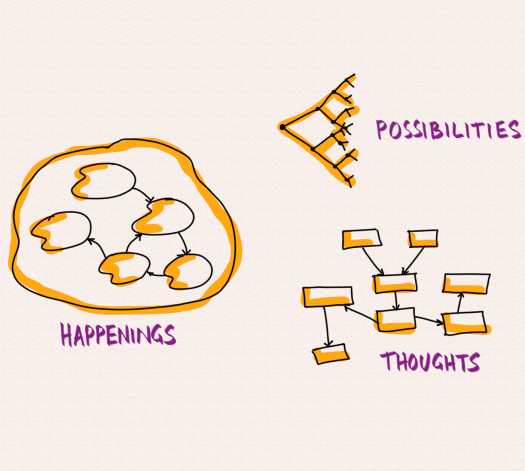
There’s a mathematical view which says there are lots of possibilities branching out in front of you and as you make decisions you travel along some branches and make other branches disappear. If you don’t take biology at school your chances of becoming a doctor start to fall as the branches leading to that career start to thin – until eventually you have no way to bridge the gap between where you are and that particular way of life.

If you were suggesting to your child what they should do in life you’d probably advise them to pick something that led to a safe and secure career. You’d have a number of thoughts that you’d arrange in order to make your point. These thoughts are what you believe and you’d try and get that across to your child – trying to help him or her make the “right” decision as you see it.

That might look something like this.

reality_simple.png

This pretty binary route is what seems to be the idea that most parents have in their heads as possible futures for their kids. And if you make decisions based on what you think – then you had better hope that you have the right thoughts in the first place. But how do you tell without living that life that you’ve thought about?

Well, most of us can probably relate to one of these branches but also know it’s not quite as simple as that. Reality is a little more messy and there are multiple routes that life could take. In a sense, there are happenings that result from the arrangement of our lives. In that sense what happens to us emerges from what is happening to us. And that doesn’t entirely make sense in words but it does when you think in terms of feedback loops. And that looks something like this.

reality.png

Now, I’ve thrown these models together in a few minutes and not really thought them through but that’s not the point. The point is that once the thinking is visible you can look at the arguments and see what might happen as a result of using any one of the thinking approaches that I’ve described – which loosely approximate making decisions based on a formula, a path of possibilities or based on thoughts, an argument for action or based on a systems model, a basis for emergence. These are a little technical, and you need some familiarity with the terminology to appreciate the differences, but the important point is that life is rather more complex than we sometimes make it out to be.

You are where you are because of all the choices you made over your lifetime and all the ideas you had, including the ideas about what you wanted to be when you grew up. If you aren’t happy with where you are – then you might benefit from thinking from all these vantage points. Is there a branching set of possibilities that could still give you what you want? Do you think there is a way to make it happen? Or could you arrange your life to have more of what you think is missing?

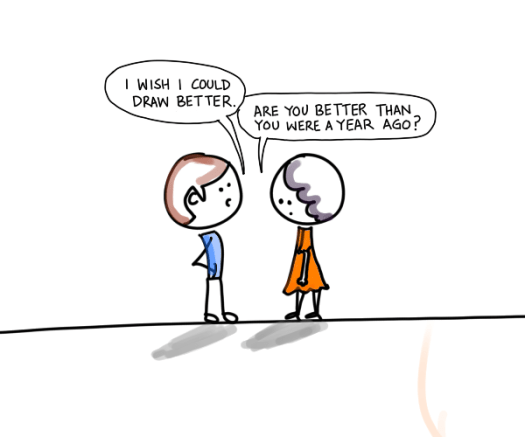
When I was young, I wanted to be a photographer and an artist. And I didn’t do those things for a career. But I draw a lot now, although not very well. And I think and write and do interesting work – and all in all – although I am not a National Geographic photographer – I have little to complain about.

Cheers,

And perhaps that is good too.

Karthik Suresh

How Does Your Model Of Reality Work?

bipolar-construct.png

Wednesday, 9.33pm

Sheffield, U.K.

We know from chaos theory that even if you had a perfect model of the world, you’d need infinite precision in order to predict future events. With sociopolitical or economic phenomena, we don’t have anything like that. – Nassim Nicholas Taleb

Do you know why you think the way you do? Why do you act the way you do? What is it that explains your thoughts and actions and behaviour?

Answers to those questions won’t fit on a postcard – we’re talking about the entire field of psychology here – but there’s one bit that I want to focus on called Personal Construct Theory (PCT). George Kelly developed PCT as a way to help people analyse the way they saw the world. He called this “way they saw the world” a personal construct and suggested it explained quite a lot about the way we dealt with the world.

Let’s start with a construct – that could be anything. How are you feeling, for example?

happy.png

If you say you feel happy – then that’s a construct, a way of seeing the world. But a construct by itself isn’t very helpful. What you often need is to put it in context so that you can make sense of it. So, when you say happy, what do you mean?

happy-sad.png

You could say that happy only makes sense when sad is also in the picture. If happy and sad are two extremes then you’re on one end or the other. Or you could be somewhere in between the two. This kind of duality – the idea that you can make sense of one thing only when you also have a sense of what its opposite happens to be is what Kelly called a “bipolar” construct. And because you need both elements to make sense you can crash them together in a sentence saying something like you feel “happy rather than sad”. And this bipolar construct is different from saying you feel happy rather than overjoyed.

happy-rather-than.png

This is an important distinction because if your choice is between happy and sad and happy and overjoyed you end up being in a different place when you choose happy. You’re happy that you won a game of pool is different from saying that you’re happy because you made it through the first mile of a marathon in good time. What your view is depends on what’s happening around you in addition to what you see through your own eyes.

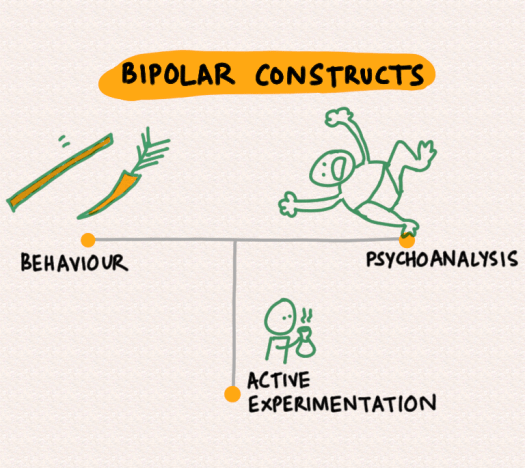
Kelly’s argument goes a little further and I think it can be understood by looking at the argument itself and its context. Typically psychologists seem to have looked at people as either being behaviourally driven – sticks and carrots – or as dealing with things that happened to them in childhood. If you think Pavlov’s dogs and Freud we’re talking about that kind of thing. Kelly says that there’s an alternative – perhaps people try things out, see if they work for them and then go with the things that work. So, in a bipolar construct sense you have two extremes – behaviour or psychoanalysis and many people fall somewhere between these two in contrast to Kelly’s approach of an actively experimental approach.

Using bipolar constructs is not a natural way to speak – it requires you to constantly question whether what you’re saying actually makes sense. For example, if you’re anti capitalist you could say something like “greedy capitalists” – and that sounds good. Boo hiss – all these people that just make money and keep it. But what is it that you’re saying? Are you saying “greedy capitalists rather than generous socialists?” Or are you saying “greedy capitalists rather than generous capitalists?” There are lots of capitalists that are generous and lots of socialists that aren’t.

If this sounds like hard work – constantly checking for poles – I think it well might be. But it sounds a bit like Jacobi’s saying, “Invert, always invert”. If you want to work through a chain of reasoning then perhaps this is a good idea. For example, does the image below help make the argument clearer?

reasoning.png

Now, this argument, captured in this way can be discussed and analysed. For example, I don’t agree that words should be used instead of pictures. I’d argue that you could use both to get a richer understanding. But the other points I’m ok with, mostly.

Now, when you use this approach to build up more complex strands of reasoning – that’s when it becomes useful or perhaps more confusing. Let’s look at applications of that in the next post.

Cheers,

Karthik Suresh