How To Draw Maps To Help You Improve Your Business

2024-11-04_mapping.png

Monday, 6.36am

Sheffield, U.K.

There’s no map for you to follow and take your journey. You are Lewis and Clark. You are the mapmaker. – Phillipa Soo

In my last post we looked at waste and how the next step to improve things is to use mapping techniques.

Let’s just take a step back and look at what “mapping” involves.

A map is traditionally a diagrammatic representation of an area of land or sea showing physical features such as roads and cities.

When you go somewhere new, the first thing you have to do is look at a map – or these days pull up the maps application on your phone.

On a short trip earlier this year I used up all my roaming data and couldn’t access my maps app. That was terrifying. I had to ask people for directions! They, in turn, pulled out their maps apps and I took a photo so I could start to figure out where I was.

We are blind to the bigger picture without maps.

In physical spaces, then, we start with a blank space in front of us, because we don’t know where things are, and we reach for a map someone else has drawn so we can figure out where we are in relation to where we want to be and plot a route between the two.

This mapping metaphor does not translate cleanly from the physical world into the mental world.

The terrain of our mental worlds are not static and unchanging – they are constantly shifting and rearranging.

But we still use the term “mapping” when we try and understand a situation, so the first thing we have to do is reframe how we approach mapping – rather than it being something you reach for, it’s something you construct.

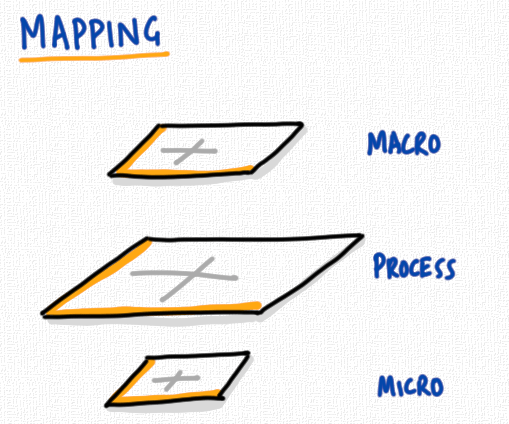
We have to learn to see the situation and map it at different levels.

The first level is the macro or systems level. This is where you look at the bigger picture and see how things fit together.

A technique for drawing a high level map is Rich Picturing from Peter Checkland’s Soft Systems Methodology.

There’s not enough space in this post to talk about Rich Pictures but have a look at this link and this one to get a sense of what’s required.

I created Rich Notes to help with this, but that’s also useful for mapping at the other levels.

At the macro level you’re looking at the landscape in front of you and identifying the mental equivalents of mountains and trees and streams and roads. The things that are in your way, the paths that already exist, the obstacles you need to ford.

Once you represent that situation on paper – in some kind of drawing that we call a map, you begin to see what sort of route you can take.

The most important thing with a journey is to see what the obstacles are and try to either avoid them or overcome them.

If you have a very high mountain in front of you, perhaps you need to find a way around it. If you have a river, can you build a bridge?

The obstacles you face lead you to decide the things you need to do – and now you can come down to the next level of mapping, which has to do with process.

In process mapping you look at the steps to follow.

As someone once said, “Life is one damn thing after another”.

A process map is about getting those damn things down on paper.

Start to finish, beginning to end, break down what is happening step by step.

A common technique is brown paper mapping, where you tape a long strip of brown paper to the wall and use post its and markers to step through the process.

These days it’s probably easier to use a spreadsheet or online tool.

Process mapping helps you see what is being done, or map out what should be done – and as you do this you’ll see areas of waste, where there is repetition or rework or delay.

And once you see waste, you can start to think about ways to remove that waste.

The bottom level of mapping is the micro level – which looks at the details of what needs to be done.

If you think of the macro level as the way things fit together and the reasoning behind what we’re doing, and the process level as the plan that we should follow, then the micro level is executing the plan, where action takes place.

And we need to lay that out, list the steps that need to be done and create tools to help us, like standard operating procedures, instructions, checklists and tests.

It does take some time to learn and practice mapping techniques at these levels, but one thing you should think about is who is doing the mapping.

Are you going to do it with your business – take hold of the pen and talk to people and map what they tell you?

This is what I do a lot of the time.

But you can also give them the pen and ask them to work through the situation in a group.

That gives your team the opportunity to get involved and think through what they do and what the bottlenecks and issues are with the process.

The thing to remember is that at the micro level your teams are often asked to follow the approaches imposed by management, whether they improve the customer experience or not.

If you are a manager you have the power to change the system – your workers don’t – and so once you see what the issues are it’s up to you to figure out how to make things better.

Hard work is not the answer, better systems are.

I came across a pointer to Miriam Suzanne’s post We don’t need a boss, we need a process, and that’s sort of the thing I’m going for here.

Think of mapping as a way of getting down what’s in your mind on paper – it’s just a representation, not reality.

It’s a tool to help you get what’s in your head and other people’s heads down on the page so that you can empty your mind and have the brainspace to focus on what to do next.

And that’s the point of a map, to help you on your way.

Cheers,

Karthik Suresh
How To Spot Waste In Your Business

2024-11-03_waste.png

Saturday, 7.53am

Sheffield, U.K.

Let him who would enjoy a good future waste none of his present. – Roger Babson

This is a continuing post series, the fifth one, as I read John Bicheno’s “The lean toolbox for service systems”.

Today we’re going to look at waste.

Bicheno says that we should approach this indirectly, not as a checklist for finding waste.

As always, we have to go and see what is happening for ourselves, trying to go from abstract ideas of what should be happening to specific things we can do to improve the way in which we serve our clients and customers.

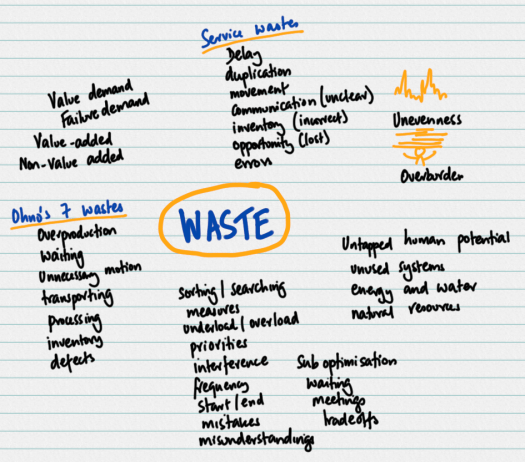
The picture above has a big list of wastes, some of which overlap – but let’s try and see what sort of things we might find.

Let’s start with the people you work with – are you benefiting from their full potential?

Working with others is challenging. We are social creatures and there are issues of hierarchy and control and relationships that have to be navigated.

How do you treat your employees or direct reports? Do you treat them like children – telling them what to do? Do you treat them like colleagues, working together? Do you trust them to do things right?

I have found that the hardest thing is to have a good working collaboration with others – it takes time. You cannot expect it to happen without effort, management tools and performance appraisals won’t make it happen, neither will silly bonding sessions or social occasions.

You need to spend time with the people you work with, talking about the work and figuring out how each person can contribute effectively.

People are often the biggest cost in a business and if they don’t bring their brains to work you’re missing out on the biggest return you can have.

Once your team is thinking together about what they’re doing and how they’re providing value you can start to dig a little deeper into the actual work that’s happening.

And the concept of value demand and failure demand come into play.

Value demand is when you work on what the customer wants.

Failure demand is having to fix the consequences of failure.

For example, if you’ve ever done a construction project you will find tradespeople will make choices to take shortcuts rather than do something in a more detailed way.

One example is whether they run cable in plastic sleeves they nail to the wall or if they chase the plaster and put the cables in the wall.

If they don’t do what you want and have to repeat the work because you don’t like the look of external wiring, that work is failure demand – you’re fixing something you’ve already done because it isn’t right.

A good percentage of service work can turn out to be failure demand – just not doing the job the customer needs.

These are two big sources of waste right there – not using your team effectively, and not taking the time to understand what the customer needs before doing the work.

I suspect, without evidence, that these two areas account for 80% of the waste in a service business.

The remaining 20% comes from stuff you can control but that people often just don’t do well.

Stuff like:

  • Not having a filing system for material that makes it easy to retrieve.
  • Underloading or overloading people or stages of your system
  • Moving things around too much, too many touches
  • Unnecessary processing

All these and more are issues to do with failing to create a flow of work, something that is even rather than uneven, and not distributing tasks well, loading different areas differently.

From a management perspective two things that don’t help are interruptions and meetings.

Interruptions kill work in progress, knowledge work in particular.

And meetings, in the standard sense, can be time sinks.

In my practice, I try and combine the two – by having regular meetings that are in the diary so I don’t need to interrupt someone in the middle of their work.

Ad-hoc calls are just not a thing anymore.

And meetings are used to go through and ideally do the work – they are working sessions where we collaborate rather than talking sessions where we talk about what needs to be done and then have to find more time to do it.

Online meetings can be hugely productive if you know what you’re doing but judging from my LinkedIn feed not many people know how to do them well.

That may be a post for another time.

Once you go to where the work is being done and start to get a sense of the waste in the system you can start to think about how you can improve it.

This starts with a mapping exercise, which is what the next chunk of the book is all about.

Having flipped through it, I don’t fully agree with some of the ideas – or, perhaps more accurately, I think they’re not enough to deal with the richness and complexity of real-world situations.

So we’ll dig into that next.

Cheers,

Karthik Suresh

The Principles Of Lean Thinking

2024-11-02_activities.png

Strive not to be a success, but rather to be of value. – Albert Einstein

In my last post I introduced Rich Notes, my approach to understanding a system.

Once you understand a situation, you can start to do something about improving it.

But what are you trying to do – what does improvement look like?

It’s worth taking a step back here and looking at what you do as a whole and what “better” might look like.

Let’s start with your customer – your purpose as a business is to improve her experience.

You do that by providing value.

The lean literature talks about value as being provided by a value stream.

I find this term hard to visualise but I think it’s very similar to what I would see as “activities” in Soft Systems Methodology.

A stream is a flowing thing, something that is linear and step by step.

Activities are a little fuzzier, sets of steps that follow on, but that also split and join in different ways.

This is a little pedantic, so as long as you see that value emerges from the value stream or the activities we do you get the picture.

The activities are where we spend most of our time.

For example, if you’re a consultancy one of the activities you will spend a lot of time on is writing proposals.

Early in my career we used to write huge proposals – 70-100 pages was not uncommon.

I think we thought that the more we put in front of the client the more impressed they would be.

Later, I worked with a law firm that sent me a simple 4 page proposal.

The first page was a letter, the second page was a list of bullet points of the work they would do, the third page was pricing, and the fourth page was a signature sheet.

You had some boilerplate terms and conditions at the back but the essence was in a page – what we’re going to do for you.

Adopting this process took proposal writing time from weeks to half an hour.

And, I think it provided more value. Clients want to know what you’re going to do for them and a rambling document makes them do more work and is really not as impressive as you might think.

Clarity and economy of thought is.

In the image above you’ll notice five elements – these are the five lean principles.

We’ve talked about value and the value stream.

Next comes flow – sequence what you do so that one step naturally flows into the other.

Don’t introduce non-value adding steps that slow you down or make the experience for the customer worse.

Do those in parallel, focus on keeping things moving.

Again, in service, a simple example is that once you’ve had the conversation get the proposal out the next day.

What’s important is that the client has an idea of what you can do.

If you wait for legal approval before issuing each proposal then that introduces a delay – you need to do that anyway so do it once the client indicates they are ready to go ahead.

The next principle is pull – do things once they are needed.

I cannot tell you the number of times we have done analysis and created material “just in case”.

This happens if you go into a meeting and the client asks for more information – you should always direct them to something you have done already.

Doing anything new, or spending time on stuff is work – and should be done if you are being compensated.

There are exceptions, of course, stuff that you would reuse, the first versions of things that you need.

But you shouldn’t do free work – and the client needs to see that value is being created when they ask for it – but only when there is a commercial relationship in place.

Now, once you have these four elements in place you will have a system that works better – for you and for your clients.

So now you can work on perfecting the system, making it better.

That involves identifying common weaknesses and starting to fix them.

Let’s look at that in the next post.

Cheers,

Karthik Suresh

Rich Notes – My Way Of Understanding A System

2024-10-29_empty-mind.png

He listens well who takes notes. – Dante Alighieri

Tuesday, 8.18pm

Sheffield, U.K.

This is the third post as I work through ideas in John Bicheno’s “The lean toolbox for service systems”.

And the idea in this post is a particularly big one.

What do you need to do when you first encounter a system?

You need to understand it.

Let’s unpack that.

My 1,708 page “Concise” Oxford dictionary defines “understand” as perceive the intended meaning of words / the significance, explanation or cause of.

“Perceive” is the important one there – and it in turn means to “become aware of or conscious of”.

You have to learn to see what is there, not what you think is there, or what you want to be there, but what is actually there.

You have to enter a situation with what the Zen folk call beginner’s mind.

Or perhaps even, empty mind.

The problem with knowing even a little about something is that you are tempted to go in with assumptions about what is wrong with the system and what needs to be done to fix it.

Watch people the next time something comes up that’s an issue – see how quickly they jump to offering solutions.

What they find hard to do is take the time to understand what is going on.

Bicheno refers to this as the “check” phase and points to John Seddon’s six stages of check as being vitally important.

These stages are:

  1. Understand the purpose of the system.
  2. Understand demand.
  3. Understand the capability of the system.
  4. Understand flow.
  5. Understand system conditions.
  6. Understand management thinking.

I want to focus on number 2 in this post.

Seddon says that you don’t ask for requirements, instead listen for demands that your clients place on the system.

This is a big shift in emphasis, in case you weren’t noticing.

Never ask someone what they want. Instead, listen for what they need.

There are a number of techniques out there which are supposed to help you understand how you find product market fit.

Most of them are based on asking – complete a survey, answer these questions, participate in a focus group.

Listening requires you to be open to the possibility that what you have to sell is not what the customer is interested in – and you’ll never find that out if you insist on bringing up what you do.

How do you listen better?

That’s a big topic in itself, but let me tell you how I do it.

I take Rich Notes.

What are those, you ask?

Well, hopefully in the next year or so I’ll be able to point you to a paper that introduces this to the world but for now, Rich Notes are digital notes that I take during conversations.

I start with a blank page – literally beginner’s mind – and we talk about the situation and I take notes.

The notes are non-linear and help me explore and understand the situation, seeing it from the points of view expressed by the participants in the meeting.

When we have finished talking I know more about the situation.

In fact, we all know more about the situation and are usually starting to converge – come to a consensus on what needs to be done to improve the situation.

That’s quite a good place to be – we understand what to do next.

We’ll pick up what that means in the next post.

Cheers,

Karthik Suresh

How To Think About Value In A Service Firm

2024-10-24_value.png

A satisfied customer is the best business strategy of all. – Michael LeBoeuf

In my last post we talked about “purpose” in a service firm and John Bicheno’s view that “the common purpose of everyone, top to bottom, is to improve the experience of the customer.”

Let’s start with this idea – that we are all working to improve the customer’s experience – how do we do that?

We improve their experience by delivering value.

But what does that mean?

I like Warren Buffett’s definition that “Price is what you pay, value is what you get.”

Value is a tricky thing to pin down – you know it when you see it and you know what it isn’t.

Value is an emergent property – it is created when you do things right. Things that the customer needs you to do.

As you know from the last post, this series is about reading the “The Lean Toolbox For Service Systems”.

One of the concepts in there is that of the value stream.

The value stream is where the customer gets value.

I find this hard to visualise – what is this stream? Is the customer dipping into it somehow? What are we trying to say here?

I think the reason we talk about streams is because the idea of flow is a big thing in lean – so I might come back to that.

But at this point, I think a more useful way to view how the customer gets value is thinking of value as emerging from carrying out a set of activities.

In other words, services are activities that provide value to a customer, rather than things that they get or use.

If I run a dry cleaning business, for example, value is created when the customer drops off dirty clothes and gets them back clean.

There are a certain number of activities we carry out in businesses.

  1. Manufacturing or construction.
  2. Field services or repair such a break-fix (the boiler is down, please fix it).
  3. Runner activities – the things we do every day.
  4. Repeater activities – regular or semi-regular tasks
  5. Stranger activities – things out of the ordinary, non-routine.
  6. Waste activities.

The ideas about customer experience, value, and activities are captured in the top part of the image above.

Let’s look briefly at the nature of the organisation that delivers this value.

In a service firm, the front line is closest to the customer.

When you buy a car, you’re unlikely to meet the person that finished your car door.

But you will have an interaction with the person that serves you your order at a takeaway counter.

People often think of the front line as being at the bottom of the pile – our lowest paid and most junior staff.

We should really invert this idea and see the front line as the most important people in the business when it comes to customer value.

However, it’s an inverted pyramid and their ability to serve the customer depends on how they are supported by management.

Ideally, everyone in the business will think about how to support the front line directly and indirectly.

They will be customer focused.

Often, the politics of work means that everyone is focused on what their bosses want, and end up looking away from the customer and inwards down the pyramid.

They are corporate focused.

It will not surprise you to learn that every service organisation, big and small, is bumbling its way towards figuring out how to make this structure work.

So, this is what’s happening. How can you make things better?

The first step is to understand what’s going in.

We’ll talk about how to do that in the next post.

Cheers,

Karthik Suresh

What Do We Owe To Each Other?

2024-10-19_purpose.png

Saturday, 7.36am

Sheffield, U.K.

I sit astride life like a bad rider on a horse. I only owe it to the horse’s good nature that I am not thrown off at this very moment. – Ludwig Wittgenstein

I realised recently that I need to do some more reading.

So I’m going to do a post series where I work through John Bicheno’s “The lean toolbox for service systems”.

I’m trying to understand the core elements that help us create better services for those we work with.

I’m also watching, for the nth time, “The Good Place”, which is where the title for the post comes from.

I want to explore this idea of service as something we do for others, something valuable rather than extractive.

What does good service look like?

In Bicheno’s book, we start with the big picture, zooming out and taking a systems level look at what is going on.

But what does that mean?

When trying to understand anything – an entity, a service, we start by asking “What is its purpose?”.

This is a surprisingly hard question to answer because it depends on who answers the question.

Let’s say you run a business offering consulting services, how might the members of your team answer this question?

With my technical head on, the purpose might be to carry out a series of complicated activities quickly and efficiently.

From my customer’s perspective, the purpose of the service might be to meet the requirements set out by the board.

From my boss’s perspective, the purpose might be to maintain a gross margin of 60%.

Narrow points of view lead to narrow definitions.

But what really matters in a service model is the customer.

Bicheno says that “the common purpose of everyone, top to bottom, is to improve the experience of the customer.”

That’s what the rest of the book is about.

See you in the next post.

Cheers,

Karthik Suresh

I’ve Just Discovered My Most Dedicated Reader

2024-09-24_dedicated-reader.png

Tuesday, 9.18pm

Sheffield, U.K.

Are you stalking me? Because that would be super. – Ryan Reynolds

Too many of my posts recently have been about generative AI.

I’m sorry, this is one more. It’s an important topic after all.

In my last post, I wrote about the future for human work, in particular about writing and knowledge.

My blog is not particularly widely read. I don’t actively promote it. It’s a place where I work on ideas by working on sentences. If someone reads a post and finds it useful that’s a bonus.

So, after I wrote my AI post, I thought, why not ask ChatGPT to write an article in my style?

Here’s what it started off with.

“Karthik Suresh’s writing style is characterized by a lucid, engaging tone that often mixes personal insights with a deep understanding of technology, business, and strategy. His pieces frequently strike a balance between being informative and approachable, with a hint of philosophical reflection.”

My first thought was, “Ok, well that’s nice”.

Followed by, “Sh*t, ChatGPT knows my work”.

Now how should I respond?

Let’s review the basic options. Fear. Flight. Fight. Food.

Actually, let’s go with the motivational triad: pain; pleasure; and sex.

The last one is not an option, so let’s consider the routes to pain or pleasure.

GenAI is going to take jobs. There is no doubt about that.

Transcribers. Translators. Voiceover artists. Visual creators. Writers.

A whole lot of jobs are going to change forever. That’s pain right there.

But is there pleasure?

I think that if you learn how to use these tools it will make you better at what you do.

I’ve worked on a couple of technical papers that I believe are stronger because I used these AI tools to help me learn quickly about concepts that are quite tricky.

I asked a person for help, one time, and was told I should join their class and it would take three months to learn.

Or….

I could get an AI to help me write some code, explain how things worked and figure it out from there.

I chose the easier option.

I asked ChatGPT to tell me how I could make my writing better.

It told me that my work lacked boldness. It wasn’t provocative. I’m too moderate in my views. And I don’t provide enough detail.

That’s good feedback. Points to consider and work on.

That’s pleasurable.

Here’s the thing. Options can be both good and bad at the same time.

The way you react to your options delivers good or bad results.

Me… the technology isn’t going away.

If a robot has peeked through the window and read everything I’ve written and knows more about how I write than I do myself – what should I do?

Throw stones at it and drive it away?

Or make friends with it?

What would you do?

Cheers,

Karthik Suresh

Statistics Are About The Past. Look To The Future.

2024-09-22_writing-as-thinking.png

Sunday, 7.54pm

Sheffield, UK.

I abhor averages. I like the individual case. A man may have six meals one day and none the next, making an average of three meals per day, but that is not a good way to live. – Louis D. Brandeis

I spent nearly three hours yesterday working and reworking a handful of sentences, trying to articulate what I had done between 2013 and 2017.

I wrote sentences. I wrote some more. I looked at them, shuffled them, reordered them. I put them aside. Later, I wrote new sentences on the same topic. Now I need to read, reorder and eventually type them into the computer.

What’s the point?

In five minutes between starting this post and writing the first paragraph ChatGPT wrote me a 1,759 word briefing note on logistics decarbonisation. It’s easy to read, contains what I need to know, and can be used virtually unaltered.

How can you be sure it’s correct? There are facts in there that I haven’t checked. But the weight of probability is on the side of the machines – literally – because it’s a statistical machine and the words are the most likely ones that would come up in that kind of writing. The last time I corrected the output from a generative AI, I introduced mistakes. It felt like a milestone, where I, the human, was the most fallible part of the system.

So where is the role for humanity in this? Do we just sit back and let the tide of AI generated material wash over us? How should we respond?

I think we do two things.

First, we recognise that knowledge is interesting and wrestling with data and information is part of the process of acquiring knowledge. If tools make it easy to do parts of the work then that simply means we can extend the edges of what we can learn about. When books first came out people complained that there were too many books being published to read in a lifetime. The Internet exploded our access to content. Now generative AI can spew out unlimited amounts of material.

In responds, many of us will pull down the barriers and restrict our reading to trusted material. How many news sites do you go to now? Our capacity for information processing has not increased with the technology for information creation. So we have to be selective – use our attention intentionally to gain the knowledge we are interested in and need.

Which takes us to the second point.

Statistics are good for showing what happens on average but not what happens to you in your particular situation. You can focus on your niche and figure out what you need to do to add value in a specific area. That area will be big enough to be interesting and valuable and too small to be able to be tackled with statistical methods. It will require human involvement, armed with tools like negotiation skills and constructive approaches – where you and others co-create the future.

In other words, where you look forward.

Statistics is about the past.

Human work is about what comes next.

Cheers,

Karthik Suresh

How To Think About Theory In Action Research

2024-09-19_theory.png

Thursday, 6.41am

Sheffield, U.K.

It is easier to act your way into a new way of thinking than to think your way into a new way of acting – anonymous

I’m grappling with the concept of “theory” in Action Research.

I’m not alone, many students and researchers avoid Action Research because of the need to come up with theory – it’s not clear what theory actually is or how to come up with it.

We have to start somewhere when unpicking a concept, so let’s start at a beginning.

You think. We all think.

A thought could be as simple as “If I listen carefully and take notes, I’ll learn about the situation my client is facing”.

It’s easier in the physical sciences – if I drop this rock it will fall down rather than go up.

We then take action based on what we think.

And we observe what happens.

This step of thinking to action is repeated countlessly.

Imagine a therapists office. The theory behind therapy might be that you listen to your patient and help them work out how to improve their situation.

That’s one way of thinking.

If you watch the Netflix documentary “Stutz” and read some of the commentary online you’ll find some criticism that the celebrity therapist the show is about “tells” his clients what to do rather than following an established process.

He thinks differently.

He does so because of what he has learned as a result of helping his patients – from the action he has taken.

But how do we learn from action?

We need time to reflect. To wonder about what happened, to write down what we remember, to make lists, to sort them, to categorise the ideas in them.

We need to articulate what we’ve learned.

This can be painstaking work.

It’s easy to take action – to do something.

When you do something a lot you start to forget how it’s done, how you learned to do it, what’s actually taking place.

Slowing down and analysing what you did is much harder than it seems.

You need tools for that.

Like slips of paper.

Once you start to see what has happened you can start to package your ideas into a framework.

This is the start of theory building.

I recently attended a conference where I was talking about my research to a colleague.

I used a lot of words to explain something I was doing.

He nodded and said, “Ah right, you mean…”

And then he said a word.

For example, I talked about how it took time to get good at using digital tools.

He said, “Ah right, you mean ability“.

That’s the next step, encapsulating a bunch of words and ideas in a single one, or a succinct phrase, and it gets you started with theorising.

You start to think about “truths” in this step.

I think that perhaps the difference between thinking and theory is that theory is thinking smartened up and put in a suit.

It’s a polished version of what you think, that’s ready to go out and meet the world and stand on it’s two feet.

It’s a grown up version of thinking.

It’s the rich flavour that’s left when you boil away all the excess liquid in a stock.

Of course, none of these descriptions really help with saying what a theory is – or how to write one.

We muddle our way towards creating theory by writing and having it reviewed and criticized and writing again.

Theories gain importance when they are used and found useful by others, especially when it comes to the social sciences and Action Research.

They are the way we make sense of our worlds.

Cheers,

Karthik Suresh

Why should you develop a reflective practice?

2024-09-05_appreciative-inquiry.png

Thursday, 5.32pm

Sheffield, U.K.

I feel like when you are really appreciative, it makes it easier to have a better outlook and perspective of life in general. – Miguel

A practitioner cycles between action and reflection; we do something and then we think about what we did, how it worked (or didn’t), and what we might do next or differently.

Sometimes it feels less like cycling between the two modes and more like vibrating, with acting and reflecting taking place constantly.

For example, any practitioner working with an organisation starts by asking “How can we understand what people in this organisation want or need to do?”

We need an answer to this question so that we can prepare an operational solution.

But what if people don’t know what they want?

In the 1980s, people used deficiency-based methods to address this problem, asking questions like “what’s wrong?”, “what’s your biggest problem?”, “what needs fixing?”, or asking about challenges, which is the the same type of question.

Such problem-solving approaches actually made it harder to improve some situations.

What if change really happens when people talk to each other, imagining and articulating what they think is possible and agreeing what to do next?

When people are passionate about something, you do not need to persuade, incentivise or coerce them into taking action.

How do you know what they are passionate about?

Well, you do this by talking to them using approaches such as Appreciative Inquiry.

There are five principles that underpin Appreciative Inquiry:

  1. Organizations are constructed by people who talk to each other about what they believe to be true.
  2. The questions people ask are not neutral — they reveal what they are passionate about.
  3. The story of the organization is constantly being told and re-told.
  4. What we do today is guided by what we think is going to happen tomorrow.
  5. The good kind of change is positive, grounded in hope, optimism, and open minds.

Designing a workshop or engagement approach that leans into these principles is impossible unless a practitioner is willing to try approaches, reflect on what happened and try to constantly improve.

It’s a reinforcing loop that’s needed to develop your practice.

After all, isn’t that what you’re passionate about?