Why Would You Want To Buy Greenland?

2025-01-04_arctic-contest.png

Saturday, 9.46pm

Sheffield, U.K.

I’m actually writing history. It isn’t what you’d call big history. I don’t write about presidents and generals… I write about the man who was ranching, the man who was mining, the man who was opening up the country. – Louis L’Amour

Did you hear Trump talk about buying Greenland from Denmark and merging with Canada and wonder what was going on?

I spent some time today away from social media.

A few months back I think I wrote about how I thought social media was a useful source of insight – how people looked for interesting things and shared them with you and the result was like having a team of researchers making sure you knew what was going on.

I’m less sure of that now.

There is probably some useful stuff but because the algorithm shows you what you’re interested in that means after a while you’re not seeing anything new.

That happened very quickly. It took around two months of writing and engaging before it was clear I was in an echo chamber.

So I stopped.

The problem is that once you cut off the information hosepipe you’ve been drinking from, how do you know what’s going on?

It’s a complicated world out there so how do you make informed decisions for yourself and your business?

I started by going back to the library.

UK cities have good library facilities for citizens and one of the benefits of paying a council tax is access to a good e-library which lets you borrow newspapers.

Like the Economist. I used to read the Economist every day. I had a subscription for a while. But then, as free sources of news came along, those habits slipped away.

But 2025 promises to be a year where shutting your eyes is not a good idea.

I borrowed a few papers and started reading. And, for the first time in a decade, started clipping articles out of the paper.

Well, using a snipping tool on the computer and saving them, that is.

It feels like an old fashioned thing to do – to clip an article.

I have a book in my library about the Mitrokhin Archives – about secret KGB operations between the 1930s and 1980s.

I picked it up in a second hand book store, mainly because within the pages the former owner had clipped and stored news stories about spies.

I clipped a story from the Economist about the economics of the Arctic, and learned that Greenland has the biggest deposits of rare earths, nickel and cobalt in the West.

Canada is also home to huge reserves of iron ore, has the largest coastline around, with access to the seas around the Arctic.

These materials are important to the West because the biggest reserves of minerals essential for batteries are in China.

And you know there are some tensions going on there.

Modern armies need technology, that technology needs these minerals.

As an aside, we also need them for green energy technologies.

So, wanting to control the places where these are found starts to make sense.

I think my resolution now, for 2025, is a simple one.

Try and be better informed.

Cheers,

Karthik Suresh
Do We Really Want To Live In Interesting Times?

2025-01-03_connections.png

Friday, 8.42pm

Sheffield, U.K.

We live in the mind, in ideas, in fragments. We no longer drink in the wild outer music of the streets – we remember only. – Henry Miller

Sometimes, technology doesn’t make things better.

The Jevons paradox is an example. Take a resource, coal for example. We develop technologies that use the resource more efficiently and, in doing so, reduce the cost of using that resource. The lower cost increases demand so that we end up using more overall. So, better technology leads to greater energy use.

Not using technology isn’t the answer either. We don’t really want stone tools or bullock carts.

When it comes to getting the balance right, between supply and demand, the market system seems to work pretty well.

When the market works.

But markets are influenced by policy makers who, in many countries, want to try and control how wealth is created rather than letting the market get on with the job.

And that creates a large set of risk factors.

For example, when I was younger, I read that there were only two reasons to buy property.

One, because it was cheaper to buy than rent, or two, because you really really wanted that house.

A home was a place to live, not an investment.

At some point, property has become an investment. It’s supported by the idea that they don’t make land any more, and people will always need a place to live.

And that’s been true for a while. Property prices have surged and many people have a lot of equity tied up in their homes.

But not because of supply and demand.

The increases since 2008 have been driven by very low interest rates. Interest rates that were put in place to avoid a market meltdown.

Being able to borrow more money more cheaply led to an increase in prices, as that extra money people could borrow went towards bigger bids on houses.

And now we have a ticking sound as those cheap mortgages expire and some people find that a repayment at 1% is very different from one at 6%.

China, in particular, acts as a uncertainty generator.

For the last 70 or so years the Chinese system has funneled money into industry after industry, creating capacity and driving down global prices.

That has been a good thing, as part of globalisation, but it’s also led to the shutdown of manufacturing in many countries.

In the last decade or so that’s lead to dissillusionment with globalisation and a retreat, more protectionism and more nationalist leaders on the world stage.

You can see this in the news now, as America responds to an increasingly powerful China, and both countries consider trade barriers, limiting access to technology and the materials that are needed for technology.

The result of all this is what the Economist terms “radical uncertainty”.

Or what the Chinese might refer to as “interesting times”.

I doubt many of us know what to think or what to do in these situations.

How would we even start analysing what’s going on?

I think we might need to go back to the history books, to see what happens when things get complicated.

But we also need ways to get a sense of what’s going on and make decisions in these complex and uncertain times.

That’s one place to focus on in 2025.

Cheers,

Karthik Suresh

Where Is The Value In Work Now?

2024-12-28_predictable-action.png

Saturday, 2.15pm

Sheffield, U.K.

Statistics are used much like a drunk uses a lamppost: for support, not illumination. – Vin Scully

It’s normal, I suppose, to come to the end of a year and look back to see what has happened and what has changed.

I’ve written more this year, around 60,000 words. Far short of the 280,000 I clocked in 2020, but a better showing than the last couple of years.

I also have this sense of being buried under material. Notebooks full of stuff, notes from everywhere, from stuff I’ve done, stuff I’ve read, journals that chronicle the mundane everydays.

How do writers make sense of all their material? How do they work through these ideas and get them into a form that says something useful?

My favourite author, Robert Pirsig, gives us a sense of this in a rare talk, as he describes writing his book Zen and the art of motorcycle maintenance. How the book was something he had to write. How he wrote a draft. Hated it. Put it away for a couple of years. Then wrote it again – and how this time, it came out exactly right.

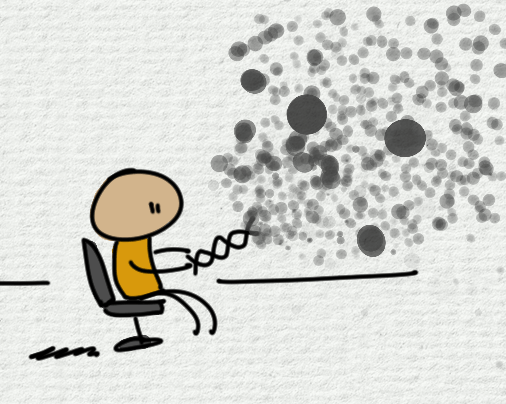
The sequence that one goes through, the germ of an idea, the flailing around in the darkness, the collecting of ideas and thoughts, trying to piece them together, failing, waiting, then starting again and making sense – that’s something that we go through as humans.

Will these new tools we have – the AI assistants – help us do this better or will they make us less capable of putting in the time and work needed to go through this process?

After all, if I can jot down some notes, or copy what others have written into a file, and get the AI to group and summarise what’s going on, isn’t that the same thing that I’ve spent all this time doing?

Probably.

I think that we’ll increasingly hand over stuff that isn’t worth doing to these tools.

Reading and summarising a whole canon of ideas – maybe that’s something we leave to the AI.

Although, we don’t really need it – that’s what encyclopedias have always done. Or the introduction and literature review of a decent paper. That’s going to have the same kind of material.

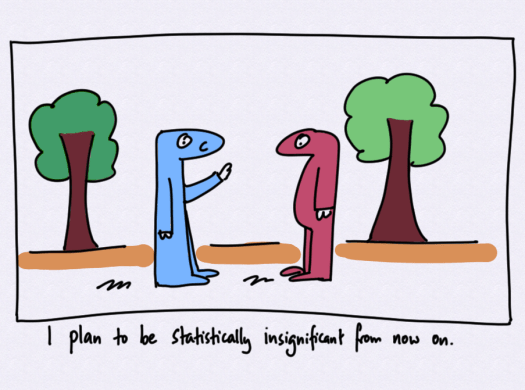
The work we’ve got to do is the stuff that hasn’t already been done, or that can’t be done because there isn’t enough data to build a statistical model that can fit the existing data and predict what comes next.

If what you do can be reduced to statistics then the machines will do those faster and better over time.

Maybe that’s helpful.

What they won’t do is the stuff that can’t be statistically modelled.

I learned a decade ago that sustainable competitive advantage comes from rare, valuable, inimitable capabilities that you have the organisational structure to deliver.

I think we might need to add unpredictable to this list.

VRIOU.

Cheers,

Karthik Suresh

What Kind Of AI Do You Need To Have In Your Life?

2024-12-10_ai-phase.png

I often tell my students not to be misled by the name ‘artificial intelligence’ – there is nothing artificial about it. AI is made by humans, intended to behave by humans, and, ultimately, to impact humans’ lives and human society. – Fei-Fei Li

A remarkable number of conversations that I have are now about AI. Whether it’s on my social media feed, or in a professional capacity, everyone is talking about AI and what it means for us.

I think AI has transformed our lives in two ways, one that we don’t notice and one that we do.

We rely on AI for our day to day activities far more than you might think. Google maps uses AI. So does Spotify. As does that scheduling thing that tries to work out a time when everyone is free to talk. There are lots of tasks that are being speeded up and because we’re using the tools without thinking about them we don’t realize that AI is embedded in more and more of what we do every day.

The second way is the visible one – the models you can talk to and which help you with intellectual work – as a sort of research assistant.

That’s again been immensely useful. Want to write a python script or do an analysis in R. Here you go. It gets you going, gives you a starting point, that often works. It sometimes needs fixing and won’t always follow what you want, but it’s certainly faster than reading the docs and starting from scratch.

It’s not human. Remember that. I once asked for a script that would go through some data and pick out numbers that looked odd. I meant odd in the sense of outliers or unexpected patterns. It thought I meant numbers that weren’t even.

Going from this step to engineering an AI workflow that does something more is a little harder. I have a decent workflow for document analysis, something that comes up fairly often.

But after that we’re in a bit of a gray area – between stuff that needs thinking to stuff that needs a lot of mathematics. New models like o1 are supposed to be better at thinking type jobs but we run into the issue of validation. When your maps app gives you a route you know it’s working if you end up where you wanted to go. When your AI tool sets out a strategy you have to follow it for it to work – and we run into the human problem. If you succeed, how do you know it was because of the strategy? And if you fail, how do you know if you did the strategy right?

When you’re managing people you try and train them as best you can. Then you let them get on with the work and you try and check in, make sure they’re on the right track. Some managers micromanage, look over their worker’s shoulders and tell them what to do, but that’s like a prison warden and prisoners. Both are in prison. A good manager should be able to go and read a book knowing that the team is doing the work and it will be done right. The point of checking in is to validate what’s going on.

I think that word – validate is an important one.

We need ways to validate what AI tells us, an ability to test its outputs and treat them with some scepticism until we see outcomes that suggest we’re doing the right thing. Validation is about having a mental model that tells us what to expect from the AI.

For a long time we’ve talked about digital twins – digital models of physical processes.

I wonder if it’s time for a new approach – an analog twin.

A brain tool that can help with talking about what we need from our AI assistants and validating if they’re doing the right thing.

Something that we can understand.

Such tools exist – they are mental models such as purposeful activity models from soft systems methodology (SSM).

They’re just not very well publicised.

Maybe their day will now come.

Cheers,

Karthik Suresh

What Are We Trying To Do At Work?

2024-12-09_pondering.png

Monday, 10.49pm

Sheffield, U.K.

When in doubt, mumble; when in trouble, delegate; when in charge, ponder. – James H. Boren

I’ve been thinking about James Thurber today, the American writer and cartoonist.

He had a drawing style that was loose and fluid, and captured the essence of a scene in a few scrawled lines.

One of his books is called “The last flower: A parable in pictures” apparently his favourite.

It’s a story about war. About how it happens, how people change, how it makes things worse, how people make things better, and how war comes around again.

We seem to be living through a time with more wars, with more parts of the world affected by conflict.

Operations Research, the field I’m interested, was born out of wartime work.

Early work was about working out things like the trajectories of shells.

Our modern high tech economy is arguably the result of the military-industrial complex, and it’s support for better spears to fight with.

It’s all a little depressing.

Human beings develop new technologies to stay ahead, to be better equipped than others to survive.

It’s an evolutionary trait.

Failing to participate is preparing to go extinct.

At an individual, organisational, or national level we need to organise ourselves for survival.

First survive, then climb the pyramid – see how far you can get to being an apex predator.

That’s what superpowers aim to be.

I guess an argument could be made that what we do at work is try and survive the day.

And we try to do that by figuring out what the boss wants.

Everyone has a boss. Someone you answer to, someone that needs what you provide.

Your customer is your boss too.

You’ve got to try and keep them happy.

But the trick to doing that is to ask a next level question – what does your boss’s boss want?

That’s the thing you need to figure out and deliver if you want to get your work done and go home.

Cheers,

Karthik Suresh

What Goes In A Soft OR Case Study?

2024-12-08_case-study.png

Sunday, 8.59pm

Sheffield, U.K.

You don’t lead by pointing and telling people some place to go. You lead by going to that place and making a case. – Ken Kesey

I’m going to have to focus on my thesis now for a bit – I need to make some progress there.

So please bear with me while I work through some stuff that may or may not be of interest.

My area of research is called Soft Operations Research, or Soft OR.

OR is a field that uses scientific methods, tools and techniques to solve problems related to how a system is operated and find optimal solutions.

Figuring out how much resource or material needed to get a particular task done efficiently is the kind of problem where you can bring out the OR toolkit.

It works really well when you need to think about how to get things working.

It’s not as effective when you want to get people working.

That’s where the “soft” part of Soft OR comes in – a different set of tools that we can use with people to structure decisions and problems so we can do something about them.

My thesis is about a tool I’ve come up with, called Rich Notes, and I’m trying to figure out how to write about it.

One of the ways of doing this is to discuss its use in practice with case studies.

So what does a soft OR case study look like?

I picked up Peter Checkland and Jim Scholes’ “Soft Systems Methodology in Action” to find out.

SSMA has a number of case studies and is probably a good model to follow.

Chapter 6 has two studies in a product marketing function, and seemed a good starting point for me.

There are two ways you can apply soft systems methodology or SSM. One is to use SSM to do a study, and the other is to do a study that uses SSM.

There is a difference. In the first I say I’m going to use SSM and plan a study that is designed to apply it. In the second I do my work and if I come across a situation where SSM could help, I use it.

The second approach is where a lot of ad-hoc managerial applications happen, for example when I talk to colleagues or long-standing clients.

The former is when I am trying to suggest that I consult with a new client – and propose that I use SSM.

Regardless, I’ve done something. What now, how do I describe it in my thesis in a useful way?

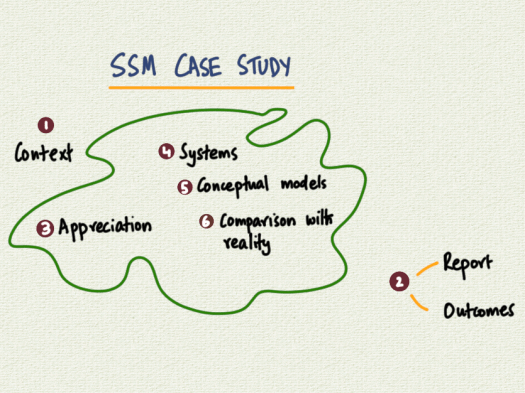
There are six things to consider, as I’ve gleaned from Chapter 6 of SSMA.

First, describe the context – what’s the background, what’s the situation, and how did you enter it?

The thing that people are most curious about is how it all began.

It’s like asking a couple, “How did you meet?”

It’s that context that helps us situate ourselves in the situation.

Second, from an SSM perspective, it’s worth understanding what’s going to be the end result.

Sometimes it’s a report. Sometimes it’s an outcome – some kind of change for the better.

Did you know at the start what sort of end result you were aiming for, or were you making it up as you went along?

Third, how did you gain an appreciation of the situation?

This is the important bit – seeing the situation from the points of view of the people involved.

It’s not about one side of the story but getting multiple perspectives and seeing what’s going on with fresh eyes.

How did you do that?

Then we come to the last three steps, which are a bit more technical.

Fourth, what systems did you conceptualise?

A system is about parts and connections – what are the bits and pieces that make up the situation you’re studying?

Fifth, what conceptual models did you build?

A conceptual model brings the system to life.

This is probably not going to make sense unless you already know a bit about this topic, but think of it like this.

A system is like the parts of a motorbike. The ignition, the gears, the handlebars, the fuel tank, the wheels, the frame, and how they are connected.

And don’t forget, the rider is also part of the system – maybe that’s you.

The conceptual model is how you start and ride the bike.

The first is static. The second is dynamic. Together, they get you going.

Sixth, you compare your models with reality and make changes.

What does your model say should happen, what is really happening, and what needs to be done to make things better?

In your case study, what did you do?

Bring these six pieces together and that’s how to write a soft OR case study. Should be good to fill a few pages.

Now I need to go and do a few of those.

Cheers,

Karthik Suresh

Plaiting Fog – The Thesis Writing Experience

2024-12-07_plaiting-fog.png

Saturday, 4.43pm

Sheffield, U.K.

In my Ph.D. thesis, written in 1989, I discussed the fact that when a civilization develops the technology to prevent catastrophic asteroid impacts, it marks a significant moment in the evolution of the planet. – David Grinspoon

August 2022.

That is the only month since June 2017 when I didn’t post a single article on this blog in a month.

It’s hard to remember what I’ve written in that time.

Reading old posts can be surprising, it’s like coming across a new writer for the first time.

And then you realise it’s you.

I’m feeling a bit like that as I tackle my PhD thesis again.

I had this idea that writing a thesis is a bit like plaiting fog, trying to get these ideas into some kind of order and make sense.

But it’s not really like that.

I don’t think there’s a right way to do this work.

Some fields have conventions they expect you to follow.

In the hard sciences you have a hypothesis and you test it and if your results support your hypothesis, when you’ve got something to talk about. If what you’ve discovered is sufficiently novel, then you’re good to go.

But outside that little bubble of “proper” science it all gets a little messy.

Actually, that’s not true either.

Whenever you write something you go through three phases.

First, you write a draft to discover what you think.

This is usually not very good.

Second, you rewrite your draft to get others to understand what you think.

This is much better.

Third, you rewrite your draft so it’s acceptable to the people in power.

This one is usually shit.

I mean, you have to play the game but this is why a good manager will hire a good sales writer and then use what they write without trying to make changes.

The writer is writing to sell off the page.

The manager is editing so that their manager will not be unhappy.

So they add extra words and clarifications and technical terms and generally ruin everything.

I think this happens with academic writing as well.

You write something.

Then you rewrite it to make the reviewers happy.

This is not a bad thing. The point of peer review is to make your paper stronger, and in many cases the feedback you get does make it stronger.

But, the nature of the academic publishing system means that you are probably going to have to pander to power to get your work published.

Everyone who publishes in academia is pretty open about that.

So, here’s my recipe for writing your next thesis.

First, write to understand.

Second, write to be understood.

Third, try not to screw it up.

Cheers,

Karthik Suresh

Why LLMs Are Like A Chainsaw For Your Mind

2024-11-30_chainsaw.png

Saturday, 8.24pm

Sheffield, U.K.

Supposedly, some writers work in rowdy coffee shops or compose whole novels to Megadeth, but when I write, I wear a pair of chainsaw operator’s earmuffs. – Anthony Doerr

I don’t know what you think about LLMs and this new breed of AI tools.

Some people that I follow on social media hate it. Viscerally. They see it as a large scale theft of intellectual property made in broad daylight. Piracy. Simple as that.

There is a specialised world where that is perhaps not quite as straightforward.

The world of Free/Libre/Open Source Software (FLOSS) has put code into the world for years, because of the stubborn belief of a few people that code was too important, something that mattered too much, to be locked away.

It deserved, it needed to be shared.

If you take this massive dataset of open, working code, and then develop the tools to generate new code is that ok?

Especially when many of those tools themselves are open source?

So, we’re not losing control, no one is taking over, we still have the ability to benefit from these models while having control because of the freedoms that come with the code.

Now, I’m not really arguing the legalities or opinions on the matter – I’m not really that interested in those.

I’m interested in the practical matter of what this means for you and me.

Many years ago I had a car, a Citroen ZX. I was doing a mechanics course at college as a evening thing – I wanted to learn how to fix cars. And I learned something about the brakes.

This was a long time ago, so I don’t remember much, but the essence of it was that you needed a seal to keep the brakes working properly.

I went into a garage and asked if they stocked a brake repair kit – the seals and things that were required.

The owner looked me up and down and told me that no one repaired brakes any more. It took too long and wasn’t worth the money. You just swapped them out and put a new unit in.

He said if I was ever looking for a job he’d be happy to take me on.

I guess being interested in the details of something like that was indicative of a worker that might be useful.

Instead, I spend a lot of time with computers getting them to do what I want them to do.

You can look at code in the same way as I looked at that brake repair job – we want to do everything from scratch and do the fix properly.

Coding was, until last year, one of the few hand crafts – something where every line was tapped out by a human.

Now, that isn’t the case anymore.

Last year I wrote something. I made a thing. And, I kept a little journal of how I got on.

It took me from the 23rd of November to the 13th of December to work out the kinks and get something working.

What’s that, 20 days?

Recently, I did this job again. Now, I knew what I wanted to do, but I was coding everything from scratch.

Or rather, I was getting an LLM to code what I wanted.

I was thinking about the structure of the code and then filling in the bits I needed using ChatGPT.

And I got this version working in 2 days.

And over the last 12 months I’ve used ChatGPT to help me create analysis work in R that would have probably taken me months to do if I was starting from scratch.

So, I’m starting to think of this as the shift from one level of coding, where it’s handcraft, to the next level, where it’s working at the level of blocks or units, and it’s not important to create every bit yourself.

You still need to know how to write it if you needed to, and understand what’s going on so you can debug it and all that.

But… you just don’t need to write every last line of code.

It’s like going from using a saw to a chainsaw.

A chainsaw for your mind.

I’m the kind of person that likes the idea of old tools, I’ve written about using dip pens, for heaven’s sake.

But an 18 day saving in time is something else too.

Now, where will this take us?

One thing is that we will not need as many people doing the jobs that are there now – you’ll need fewer coding jobs in these big firms because the coders will jobs will be more productive.

Of course, the world runs on code, so you probably need more people who can do that, so you might end up with many, many more coders and a huge increase in productivity, and the ability to use all this capability to transform our economies into lean, green ones.

That could happen too.

And some people will suffer.

If you know anything about India, you’ll have heard about Gandhi and his spinning wheel.

His idea was one of self-reliance, of making your own cloth rather than buying expensive, imported cloth.

If you use FLOSS software you’re using a spinning wheel, not going to a mall.

FLOSS software makes you self reliant, but only because so many others out there have put in the time and effort to make that possible.

So, if you have a spinning wheel, what can you do with it?

I think that if you’re a person that works in an industry affected by these models – coding for starter, but perhaps writing, or music, or design – if might be wise to consider what you’re competing against now.

I’ve heard sayings on the line of countries don’t fight, economies do. Or, companies don’t compete, supply chains do.

I think in our world it’s going to be people don’t create value, workflows do.

Something on those lines.

It’s less about you and a job and more about the workflow you manage and what the results are.

If you can get a set of tools together that creates an outcome that is valuable, quicker, cheaper and better than the competition, then you’ve got something to sell.

That’s not going to change.

These tools will change jobs, but they won’t change humanity, and the way we interact.

We just need to figure out how to go to work now.

Cheers,

Karthik Suresh

Why Rigid Specification Is Needed For Creativity And Flexibility

2024-11-08_toyota-four-rules

Friday, 6.22am

Toronto, Canada

Let’s say intelligence is your ability to compose poetry, symphonies, do art, math and science. Chimps can’t do any of that, yet we share 99 percent DNA. Everything that we are, that distinguishes us from chimps, emerges from that one-percent difference. – Neil deGrasse Tyson

A 1999 paper by Steven Spear and H. Kent Bowen set out to decode the DNA of the Toyota production system – and seek out what made it work so well and at the same time so hard to imitate.

They argued that there were four principles, four rules, that grew over time that even the workers themselves could not articulate – they were just built into their way of working.

Let’s have a look at what they are and how we might use them as we continue to consider Lean Service design.

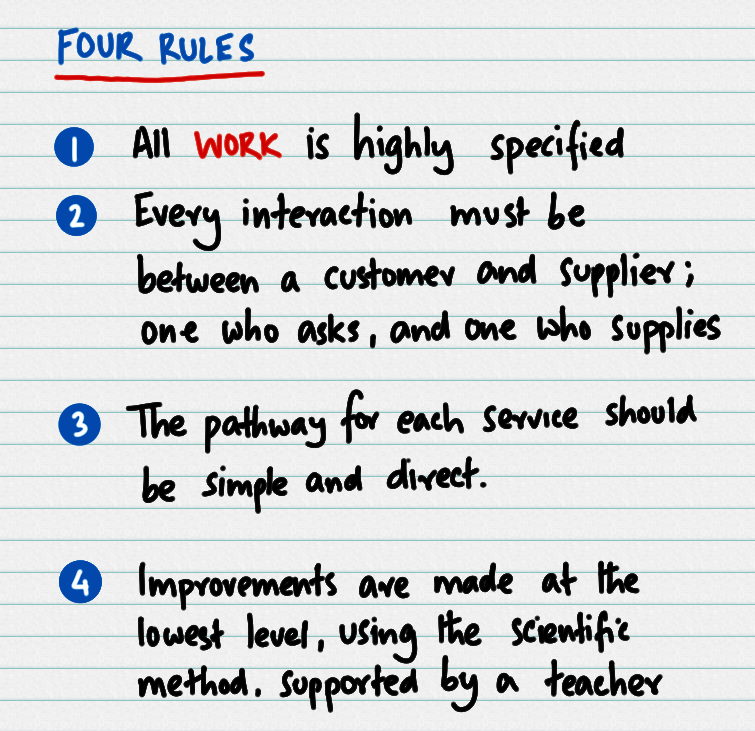
1. Specify work

Let’s start with what work and isn’t.

Certain things are not work.

I have a post about this somewhere and I can’t remember this exactly but I think the essence of it was that work is something you wouldn’t do if you weren’t compensated.

If you’d do it anyway, it’s not work.

Why would this definition be helpful?

Well, let’s limit it to the context of you’re a leader in a firm, someone who has a wide, creative role, who works with customers and develops services and enjoys the intellectual challenge of bringing something into the world.

You may be very well compensated for this.

But there is something that you don’t want to do. Something you need someone else to do. Something you are willing to pay someone else to do.

That’s work.

As you get closer and closer to the front line of where value meets the customer, figuring out what work is becomes easier and easier.

And this is when you must fully specify what the work is that you want someone to do.

What this means is systematically setting out, step by step. what needs to be done.

There are a number of approaches to do this, from Toyota’s own approaches to Crawford Slips, but they key is that there is a written specification of the work.

Now, when you ask for more resources and someone asks “for what work?”, you can provide your specification and say this is the work they need to do.

Most people will find this off putting, perhaps overwhelming, and file it in the too hard category.

2. Ask and you will get

The second principle is that every interaction is between a customer and supplier.

This is about a role, not about actual customers and suppliers.

In one case, your boss may be the customer and you the supplier.

In another instance, you may be the customer and the boss the supplier.

The point is that in each case, one person asks for something clear and unambiguous and the other provides something that is correct and complete.

This is about working on communication.

3. Follow the yellow brick road

The third principle is that of the path, each product or service should move along a simple or clear path.

First one thing happens, then the next and then the next.

Each action is a single piece of work that either does the work or puts it clean into flow so the next job can be done.

This is the service design work, working on getting each step working as well as possible.

4. Improvements done by the people doing the work

Train your teams and support them in making what they do better as they aim for continuous improvement.

All too often “improvements” are done elsewhere, in silos, and then imposed on people doing the work who then ignore it or find that it doesn’t do what they need it to do.

I have made this mistake and I need to learn when to recognize it – it’s hard to build something to make something easier for someone else.

You have to learn to see the world from their point of view and then start to work.

But if you’re the person doing the work you have an incentive to make it work better, more reliably, create less stress for you.

But you may not know how, so you need to pull support and guidance to get this done.

The takeaway

If you can’t do all this don’t be surprised.

The paper starts with noting that the approach is very hard to imitate.

It takes work to make the system work to do better work.

And Totyota has been working on this for decades.

One of the things you learn when you are exposed to critical thinking is that there are multiple ideas out there rather than one true idea.

Your job is to consider these ideas and weave together the ones that make sense to you.

Then you can apply what you’ve learned to your particular situation which is unique and different and requires careful thinking.

Or you can decide it’s all too hard and use some other form of management like command and control.

This approach was born in a factory and addresses products and services in that context of factory work.

There are other contexts like data work, or research work, or construction work, where you will need to develop approaches that are based on the principles and see how you do.

Now, I’m going to go and think about how to apply these principles in the work that I need to get done.

Cheers,

Karthik Suresh

Dealing With Conflict In The Real World

2024-11-06_conflict

Wednesday, 4.13am

Toronto, Canada

Peace is not the absence of conflict but the presence of creative alternatives for responding to conflict – alternatives to passive or aggressive responses, alternatives to violence. – Dorothy Thompson

As I consider the ideas associated with Lean Thinking I am struck by the bias towards a logical and machine-like approach which addresses but doesn’t embrace the complexities of real-world conditions.

I read somewhere that from the eighteenth century onwards the tech bro equivalents were lawyers – human society was becoming more complicated and brute power and hierarchy weren’t enough to manage evolving social dynamics.

The answer was contracting – agreeing between people what they would do – and putting a system in place that would enforce such agreements. Of course, that had been in place earlier. As Terry Pratchett observed, rich people found it was much easier to accumulate wealth and protect their hoard with the point of a pen rather than the point of a sword.

Most situations that have even a whiff of difficulty have social contracts at the heart of them, written or unwritten. The breakdown of an employee-employer relationship, for example, has as much to do with a breach of the implicit contract they have as any overtly agreed contract, which will always be subject to power imbalances.

Conflict is everywhere these days. Many countries are going through instability and pain, and responding with tribal reactions of fear and anger. Human beings cannot remove these instincts from themselves, and the inevitable result is conflict.

Unless we have tools to avoid a situation escalating to that point.

Coincidentally, there is something big taking place in a rather important country and CNN has some advice on conflict resolution, that we can apply to a range of other situations as well.

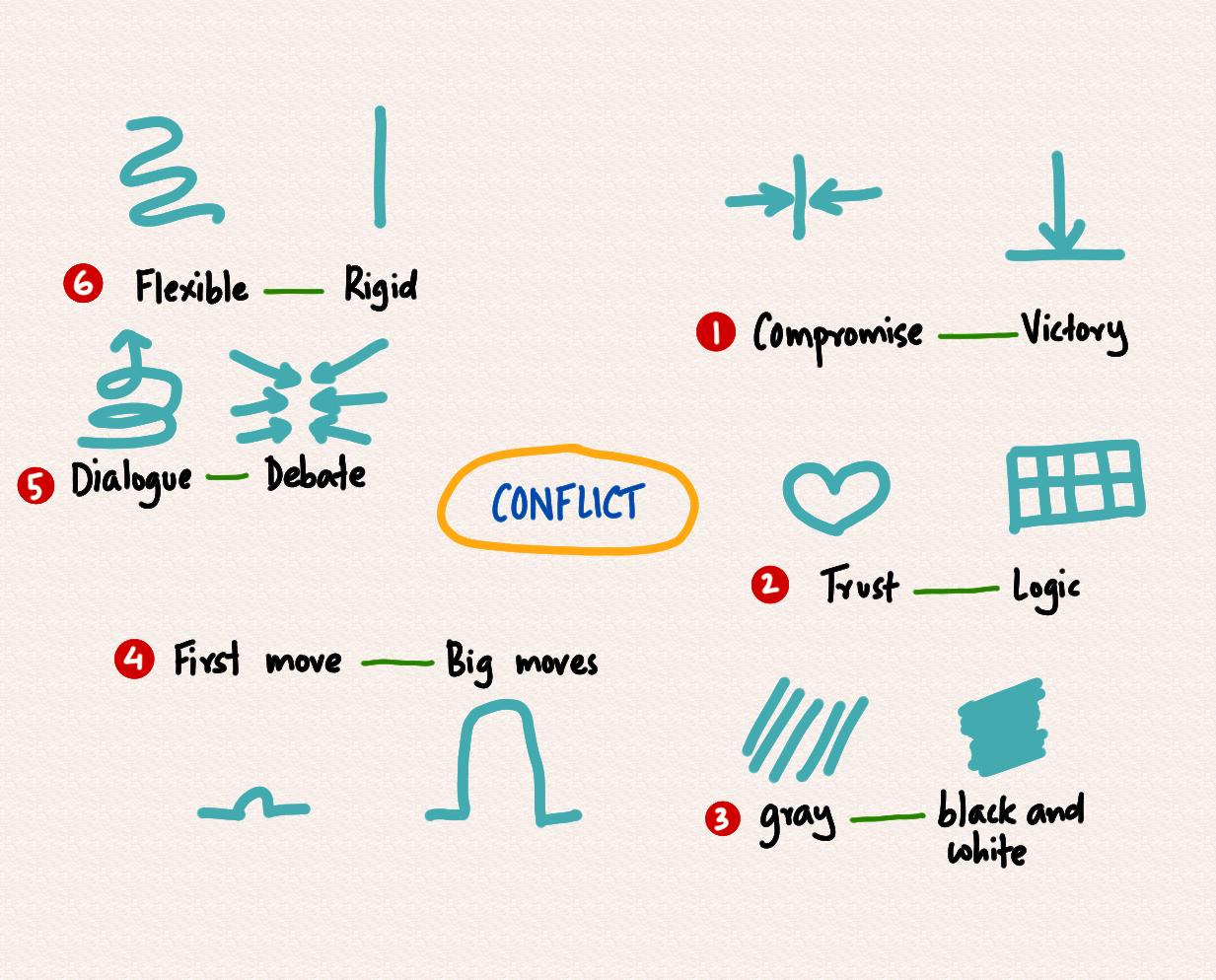
There are six points to consider.

1. Compromise or Victory?

Colin Eden’s SODA method is based on a two poles theory. Each thing you think about can be expressed in terms of two opposites. Articulating them this way helps you to see the range of what’s possible and try and see where you are on that line.

So the first thing you have to consider is whether you want victory rather than compromise. An all out push for victory is going to lead in one direction. All out compromise will lead to another. And there are plenty of examples of both leading to hubris.

The parties involved have to feel out where the situation is between these two extremes.

2. Trust or logic?

The potential for compromise can only exist if there is a chance of building trust. Logic does not work, few people are persuaded by logic. For example, you may subscribe to a philosophy that asserts that it is perfectly acceptable to act as if you are acting in a trustworthy way because the outcome you want is victory, and therefore lying is a logical approach to take if you have to in that situation. Get the other person to trust you and let down their guard and then go ahead and …

In turn, I logically know that regardless of how you act I cannot trust you.

We build trust over time, through conversation and trust-building actions. Again, it’s complicated. Sometimes you can see it in action, as when someone invades someone else’s territory. Sometimes it’s harder to spot, as when someone intrudes on someone else’s turf accidentally on purpose.

3. Gray or black and white?

Nothing is ever simple and clear and black and white.

I don’t need to go on about this, you know that when you look closely at anything it becomes more complicated and confusing.

There’s always something that led to something that led to where you are now.

And tracing it back can unearth generational trauma, passed on time after time.

Either you’re prepared to dig in and understand the layers or you’re not and want to just look at the surface level – and that decision will have an impact on how you approach the situation of conflict.

4. First move or big move?

Few things are better done fast, especially when it comes to important things. Everyone wants to move ahead quickly, and make a big change. But real change grinds slowly and you have to decide what you’re willing to do in the situation.

In the UK, for example, the Liberal Democrats, excited by their status as a junior partner in a Coalition government, naively reneged on their campaign promises and put up tuition fees for students.

A big move.

And they were nearly obliterated as a party when it came to the next election.

They should have stalled on that one – refused to budge without the support of their voting base.

Big moves require big agreement – and that takes time to build through a series of small moves.

The Paris Climate agreement in 2015, was the result of decades of slow, patient work building the science-based argument for action.

5. Dialogue or debate?

This one overlaps with some of the other points – dialogue is about exchanging ideas while debate is about winning, dialogue takes time while debate is about making your points and moving to a vote, dialogue is about consensus building, debate is about gaining power.

Which one do you think will make a situation better?

6. Flexible or rigid?

This one comes down to you and your personality. I’m flexible, perhaps too much so. I have friends who are rigid, perhaps too much so. And the potential for a good compromise is somewhere in the middle.

If I flex too much I will sign up to something that I will be unhappy with in the future, and I have to learn not to do that. If my friend is too rigid then no one will work with them and that’s not good either.

The takeaway

These points are thought-provoking and important and relevant whether you’re running a country or managing a home renovation, running a non-profit or a global business.

When two humans encounter each other there is the potential for conflict.

The fact that we have survived is because we have learned to manage it.

Cheers,

Karthik Suresh