What Is Good Work?

There is a remarkable amount of good television around these days. The huge investments that companies are making in streaming services seems to have led to smart, witty writing and engaging storylines that deal with important themes. As one of the characters in the series “Superstore” says, “We’re living in a golden age of TV.”

In the series “Space Force” the leading character, a four star general played by Steve Carell, talks about how “there are no small jobs.” What it says is that for the force to function what janitors do matters and what rocket scientists do matters – all these jobs need to be done to get things done.

That idea, that all jobs matter, has depth to it. Some people look at developing countries and thing that they need technology. They don’t. What they need are jobs, they need work that pays enough to live and school their children and change their fortunes over generations. Few people become rich in one lifetime. If they work at it, however, their grandchildren may have a very different life to the one they started off with.

Take the problem of dealing with insurgencies. We often think that the answer is to send in troops, to win a battle. You rarely hear about other approaches. I came across a story that described how troops in a region of India operated a program where people who surrendered their weapons were helped to set up businesses. They exchanged their guns and became business owners instead, starting things like small manufacturing firms. I don’t know if the story is true without spending some time verifying it – it’s social media after all – but the general principle is interesting. And one assumes it’s been tried in other places but perhaps successfully integrating rebels into an economy is not really news and so we don’t hear about it.

The idea that jobs matter is well understood in government. So you get targets to create more jobs – but what is the right kind of job? What is the right sort of work to do?

This is a hard question to answer because at one extreme any work is good when someone has little to offer other than labour. People around the world struggle to get an education for one reason or another, and that shouldn’t exclude them from being able to do meaningful work – or at least to get meaning out of work. Sometimes it’s may be wiser to forego a return to give people a chance.

Once you get beyond the struggle to survive, however, things don’t get much better. There appears to be a widening gap between the capability of the systems we have and the ability of people to produce using those systems. Cal Newport’s book A world without email suggests that we increasingly spend our time in a hyperactive hive mind allocating so much of our time to communicating that there is none left to do deep work. Doing work takes time – time when you need to get to your workspace and spend uninterrupted time on a project.

Another issue some face is that as they rise in their organisations they start doing less and managing more. A friend of mine who always has the perfect phrase to hand says, “first you’re paid for being the resource. Then at some point you start getting paid for allocating resource.” That second point, when you point to the work and get others to do it, is a disquieting time. There are people who are now better than you at doing things that you once did. I cope with it by having projects that still engage the technical and creative sides of me – this weekend was spent trying to program arduinos and figure out if the principles of junkbot robots can be used to design data collection devices.

One of the things I like about Action Research is this recognition of the interplay between theory and practice – between thinking and doing. Thinking deeply helps improve your practice and reflecting and learning from practice helps develop better theories.

Good work is the kind of work that helps you do both.

Cheers,

Karthik Suresh
How To Manage Diversity In Thinking

Saturday, 10.56pm

Sheffield, U.K.

I’m reading Matthew Syed’s The Power of Diverse Thinking and you will not be surprised to learn that the basic thesis is that people with different perspectives may make for better decision making.

Syed describes how a team that’s made up of very similar people often have a great time working together. If you like having a drink with mates and enjoy a regular round of golf and all the people around you like doing the same sorts of things work life can be fun – you get deals done in the pub and on the course.

This togetherness, this camaraderie, this homogeneity is great if you’re part of the in crowd but it makes it harder for others who are not. This often means that people who don’t fit in learn to fit in – they learn to talk and act in ways that will be accepted by dominant group. After all, conformity is rewarded while being seen as different is often a career-limiting strategy.

For example, I have little, no, actually no interest in sports. I like playing them, but not in watching others. But many interactions in the business world start with a conversation about sports, one that I find hard to participate in – and so I usually don’t. I have tried to take an interest, but it is just so boring.

People who don’t fit in find it hard to get ahead. Sometimes they find it impossible to get started at all. Imagine you’re forced to move to a new country and you encounter a different language, a different culture, a different religion. Do you hold on to what you had where you came from, or do you change to be more like the new place in which you find yourself. Some people can’t do it at all, their children are the ones that are the natives in the new world.

Now, of course, there are arguments on many sides. If you want to join a company, a country, you should be willing to accept the values of the place you’re trying to join. But too much consensus, too much of the same kind of thinking has historically resulted in people making very bad decisions.

Syed argues that diversity in thinking is good but you would need to be a special kind of person to get the balance right. First you have to make an effort to get people in a group that are very different from each other. Then, you have to have a conversation where you may have very different points of view and make sure that it leads to consensus rather than argument. Maybe the only way to get started is by having targets and quotas, no more male only panels, for example. A truer reflection of society in politics and the media. Making sure everyone has a voice.

That kind of thinking needs a mature, grown up society, a liberal one – one that is increasingly rare in a world where it’s much easier to be parochial, tribal and nationalist. It needs rules of procedure and engagement that are seen to be fair to all.

It shouldn’t really be this hard to do.

Cheers,

Karthik Suresh

When Are Thinking Tools Useful?

Thinking is hard work. We can only hold a certain number of ideas in working memory at one time. Any large, complex problem will have multiple, interrelated, and conflicting elements that have to be worked through. Some people can do this in their heads. The likelihood is that they will do it badly.

This is because we’re prone to bias. We cling to ideas that we think of first. Things that are recent, memorable or vivid seem more likely to happen again. As a result we’re often surprised when things turn out differently than we expected.

Formal thinking tools are a way to avoid these biases. We take notes, create models and carry out analysis so that we really understand what’s going on and, more importantly, avoid fooling ourselves.

Using tools brings its own risks. We can get so involved in models that we can forget they are simplifications of reality, not a model of reality. A model should be used to help you think rather than replace thinking.

But what is a thinking tool anyway? We’re surrounded by them – every textbook will show a model of one kind of another. Models show entities and relationships. A map is a model – a simplified representation of key geographical elements in relation to each other. A 2×2 matrix is a model, as is a spreadsheet with a budget.

Some things look like models but are not entirely quite. A list of questions, for example, is not a model unless there is some underlying connective logic that is visible to the questioner.

One of the challenges that we face is that some models are simplified to the point where they are plausible but not necessarily usable. For example, it’s often said that you can’t manage what you can’t measure. And you’re also told that not all that matters can be measured, and not all that can be measured matters. So which is it – is measuring something good or bad?

More often than not it turns out to be bad. Take waiting times or sales targets. They’re both very hard to hit and so managers end up gaming the system, managing the numbers rather than managing the business.

But really, what makes one thinking tool better than another? Why do some things work for some people and not others? Some people are motivated by targets while others hate them.

There is a sort of Godelian incompleteness to all this. Godel showed that within any system of logic there are things that cannot be proved using the tools within the system. In other words you have to take some things on faith, and treat them as axioms, a principle that is seen as true without proof.

The unhelpful, to some, conclusion is that the utility of any tool depends on you and how you feel when you use it. If target setting and goal-seeking work for you then great. It not, there are plenty of other methods that might suit you better.

Cheers,

Karthik Suresh

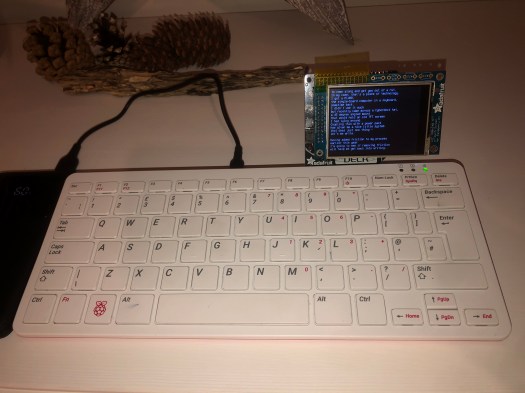
p.s. Posted from a Pi400

Going Back To Basics

cyberdeck-hat-pi400.jpg

Thursday, 8.03pm

Sheffield, U.K.

The secret of your future is hidden in your daily routine. – Mike Murdock

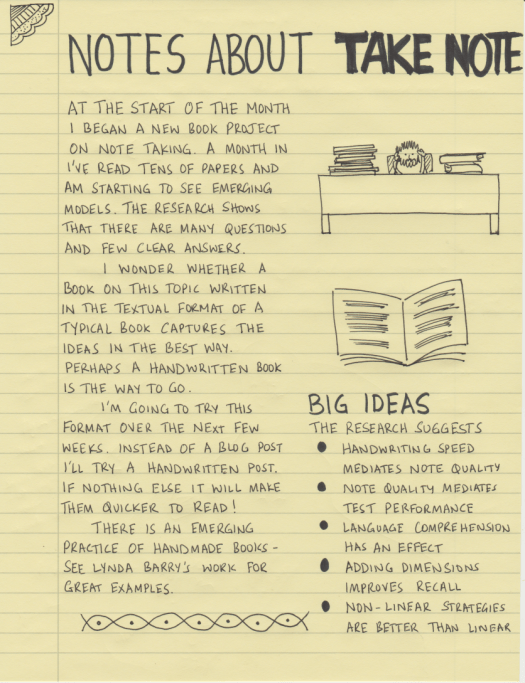
I haven’t written much this year and that’s because of a few reasons. The most important one, however, is that I changed my routine. At the start of the year I was researching different ways of organising notes and ideas using analogue methods. Basically, writing in notebooks.

Changing your routine, even slightly, has unpredictable impacts on output. Spending more time on paper means spending less time on the computer. It takes longer to write by hand but what you write has a different cadence and feel. It’s more physical because you literally carve words into paper but it’s harder to work with and share. Once you’re done with working on paper there’s less energy left over to do anything more on a computer.

Once you’ve reallocated time from one activity to another, the rest of the time isn’t enough to do everything you used to do. For example, I used to draw something, anything, to think through an idea and then I’d write it up. There isn’t enough time to do that now and so it’s easier not to write at all. Adding friction to your routine makes it harder to get started as easily as you used to before.

These two challenges – the limitations of time and the frictional costs of getting going can derail what you’ve worked towards. Five, maybe more years of activity, can come to a halt because you’ve changed something and not realised what that does to your process.

Sometimes you need something else to come along and get you out of a rut. In my case, that’s a piece of technology. I got a Pi400, the single-board computer in a keyboard, sometime back. I didn’t use it much but recently came across a Cyberdeck hat, a 45 degree angled mount that would hold an old TFT screen I had lying around. Coupling this with a power pack has given me a nice little system that does just one thing – it lets me write.

Having added friction to my process earlier this year I’m going to see if removing friction will help me get back into writing. So less of the drawing and more with words – although not too many of those either.

If you have been reading these posts I did mention that I was working on a notetaking book written by hand. I have done that – it’s very short and was probably a unnecessarily hard way to do something like that – but if you don’t try things out you don’t learn whether a way works or not. If you’re interested it’s here

On with the writing experiment then.

Cheers,

Karthik Suresh

The Long Process Of Making Sense Of Things

making-sense.png

Sunday, 8.26am

Sheffield, U.K.

The only way to make sense out of change is to plunge into it, move with it, and join the dance. – Alan Watts

I haven’t posted much this year because I’ve been trying to figure out what kind of research I’m doing and how to do it. There’s a tension between the production of material in different forms that’s slowing me down and I don’t know yet whether this is going to make things better or worse.

There are different ways to make sense of the world. Two approaches we’re familiar with are revealed truth and scientific truth. In the first you look to gods and their representatives and in the second you look to scientists and their experiments.

But there are things that neither of those two approaches can deal with well. One can tell you how to act but doesn’t explain why the world works the way it does. The other explains why the world works but leaves it up to you to decide how to act. The research area I’m interested in tries to bridge this gap – helping us make sense of the world around us and decide how to act to make things better.

The challenge we have is that there is so much out there, so much information that we cannot hope to make sense of it all. So we have to start with where we are and what we are involved in.

So, for background to this post there are two parallel things that I’m wrestling with. The first is how to read, take notes, take apart ideas and recombine them into new and interesting forms. That’s been one focus of the last few months – how to engage with material better.

The other is presenting the results of that work, the output from the act of engaging with content. How does one turn inputs into outputs that are useful?

A study of history is always useful when it comes to these kinds of questions and a few books I’ve read, and am reading, recently have been valuable. Index, a history of the by Dennis Duncan is a particularly engaging one about the history of scholarship. The challenges I’ve outlined are not new ones – people have documented their approaches for a thousand years. What’s new in recent years is our ability to work with computers to take some of the tedium out of the work. Although it does seem like what we’ve done so far is transfer the tedium from one media to another, from notes on paper to masses of data on systems. So what are the ways in which we can do this better?

I have no answers, as yet, and only tentative emerging theories. I’ll share more when I have more.

Cheers,

Karthik Suresh

Why Do We Want To Keep A Record At All?

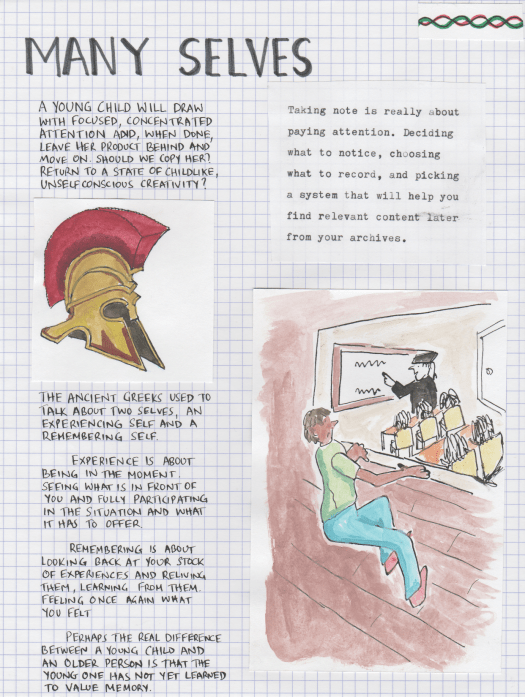
many-selves-scaled.png

Monday, 8.14pm

Sheffield, U.K.

In my last post I said I was going to try and write using a hand-made format. But why bother – what’s the point when you can just type it all out?

One reason why is that it’s a form of Action Research – a way of experimenting with an approach and seeing what effect it has on one’s practice – whatever that happens to be. It’s easy to type – easy to come up with text but it’s harder to compress ideas into a few words arranged on a page. You start to think in terms of elements, a headline, bits of text, illustrations and you’re not sure what medium to use or how it comes together but you start trying something and see what happens and eventually something will happen. It always does.

Cheers,

Karthik Suresh

What Does It Mean To Understand Something?

comprenension.png

Tuesday, 7.40pm

Sheffield, U.K.

Traditional education is based on facts and figures and passing tests – not on a comprehension of the material and its application to your life. – Will Smith

In my last post I looked at how we use note taking to support memory. In this post, I want to look at comprehension – do we understand what we’re recording – and work through the ideas in a few papers.

How can we tell if someone understands what is going on? How do we tell if we’re getting it? Comprehension is a measure of how much information is being transferred from one person to another, from a lecturer to a student or from a client to a consultant. Boyle (2013) looks at comprehension from the lens of an inclusive classroom and how students with learning disabilities can use strategies to increase their levels of comprehension and comes up with useful, generalizable principles.

In a student-teacher context it’s relatively straightforward to come up with an assessment of comprehension – you test the student. You can ask them what they remember straight after the lecture or you can give them a variety of tests designed to probe how much they understood. You have to watch out and control for certain things – the faster people write, for example, the better their performance on tests.

A typical lecture will contain a number of critical points and the lecturer will often emphasize these points – providing cues that suggest to the student that this material is worth noting. If you let students take notes any which way they want they typically capture around a quarter of the points that are made.

Using a strategic approach to note taking can push this up to around 40%. The main thing is to recognise that concepts are often clustered. You will probably hear four to six related things and if you capture these points and give them a label that frees you up – you can “forget” the six things, remember the label and focus on the next six things coming at you and their relationship with the existing labels on the page. Strategic note taking in Boyle (2013) formalises this approach, requiring students to take notes in a clustered form.

Such approaches result in an increase in both the quantity and quality of notes, which in turn help increase comprehension. The thing that’s important is that there is active engagement with the material – the act of noting down lecture points and then having to summarize them with a label forces the student to think about the points and consider them more deeply. These acts of engaging with the content seem crucial to really comprehending what’s going on. Study methods emphasize the importance of reviewing prior knowledge and reviewing material after lectures. The use of review periods and working with the material, paraphrasing it in your own words and wrestling with the ideas is what really helps make them your own.

You could type out every word or, easier still, get an AI embedded in your videoconferencing software to transcribe on the fly, but we know that reading and re-reading results in quite shallow learning – not the deep learning that’s needed to master the material (Morehead et al, 2019). We’ll come back to that in another post.

In the next one – more on production of notes and the impact on comprehension.

Cheers,

Karthik Suresh

References

Boyle, J.R. 2013, “Strategic Note-Taking for Inclusive Middle School Science Classrooms”, Remedial and special education, vol. 34, no. 2, pp. 78-90.

Morehead, K., Dunlosky, J., Rawson, K.A., Blasiman, R. & Hollis, R.B. 2019, “Note-taking habits of 21st Century college students: implications for student learning, memory, and achievement”, Memory (Hove), vol. 27, no. 6, pp. 807-819.

What Do We Use Our Memories For?

simple-theoretical-memory-model.png

Saturday, 8.34pm

Sheffield, U.K.

Without memory, there is no culture. Without memory, there would be no civilization, no society, no future. – Elie Wiesel

In my last post I looked at the components of note taking and the importance of working memory, note production and comprehension. In this post we’ll look at memory and how our need for it has changed over time.

The model above from Cowan, 1998 is a simple theoretical model of the way memory works that’s useful when you think about what you ask your memory to do.

First, you’re taking in information that’s coming at you from all directions. You can’t pay attention to everything. For example if you’re in a lecture hall and there is music playing in the corridor and two students having a whispered conversation behind you – you can’t listen to the lecturer, the music and eavesdrop all at the same time. You’re going to have to focus, tune out the music and conversation and listen to what the teacher has to say. However, this focused attention is capacity limited – which means you can only take in so much that you can remember as you go along. Once the teacher makes more than a few points you’re going to start losing track of what’s being talked about unless you are already familiar with the material.

Next, you have material that you can keep in active memory, but that is lost over time. For example, someone might have explained a process to you that you are able to follow. Let’s say it’s accessing a computer database and using different types of commands to do specialist searches. At the time you pick up that using special characters helps you do do certain things and that stays in your memory. If you were to come back and do the same task after a few weeks or months where you hadn’t practiced the approach you might find that you can’t quite remember – that you need a refresher.

And then you have long-term memory, the stuff that you’ve learned and rehearsed until it’s stuck in your head – the names of your family and friends, the songs you know word for word and everything else that you can access without having to look it up.

Before the widespread availability of writing technology if you had to remember something – you really had to memorise it. Stories of your ancestors, the myths and legends that made up your culture, the knowledge that your people believed in – they were lost unless they were remembered. In India, for example, sacred verses were memorised and passed down through generations. Very little was written down and so memorisation was the key to preserving any form of history. This was the same around the world and you can see this importance of memorisation in the Western history of the commonplace notebook – a place to keep extracts that you considered important. These were less about reference and more about an aid to memorisation – you could read and recall the material that was too important to forget, selected and curated from the mass of material that it was impossible to remember.

Yeo (2014) describes how the commonplace book as a tool was replaced by early modern scientists as their interest shifted from memorisation to data collection and recording. Notebooks became a place to collect data and record observations. You had writing technology that, for the first time, allowed you to forget and, in doing that, gave you the mental space to think.

Thinking happens in those other spaces – an area of interest where you focus on certain things. In many day to day situations we need to make sense of what is going on, taking in information, analysing what we’re collected and making choices about what to do next based on what we think. Our ability to take notes either helps or hinders in this activity

In the next post let’s look at the research on the production of notes and see if that helps.

Cheers,

Karthik Suresh

References

Cowan, N. 1998, “Visual and auditory working memory capacity”, Trends in cognitive sciences, vol. 2, no. 3, pp. 77-77.

Richard Yeo, Notebooks, English Virtuosi, and Early Modern Science. Chicago and London: The University of Chicago Press, 2014. Pp. xvii + 398. ISBN 978-0-226-10656-4.

What Do You Do When You Take Notes?

note-taking-processes.png

Wednesday, 7.22pm

Sheffield, U.K.

Neither comprehension nor learning can take place in an atmosphere of anxiety. – Rose Kennedy

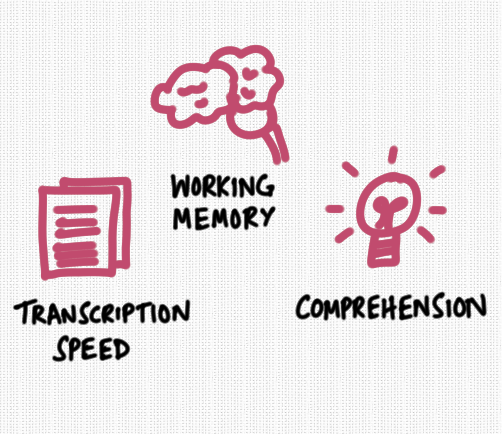
In my last post we looked at the how the task of taking notes is as hard as playing chess at an expert level – it’s a cognitively demanding task. But what do you actually do when you sit down to listen and take notes?

Imagine you’re just listening to a person talking, perhaps in a lecture. People speak around two to three words a second (Piolat et al, 2005). You’re not going to remember every word but the sentences and phrases they say will stick in your mind for a bit (Cowan, 1998). This is verbal working memory and it’s sometimes called short-term memory or immediate memory.

Now, think of what you do when you take notes. While spoken speech is around two to three words a second writing is closer to 0.2 to 0.3 words per second, which means we’re going to miss quite a lot of content. Our ability to produce notes depends on how fast we transcribe information. We can speed up how fast we transcribe by using contractions, abbreviations or even shorthand, although few people learn shorthand outside of professions like journalism. We can speed up transcription even more by typing notes and these days you have AI systems that will transcribe on the fly. We’re getting closer to the point where we can have a verbatim transcription of everything that is said.

Transcription speed comes, however, at the cost of comprehension. It appears that speeding up transcription by typing rather than writing, for example, results in a lower level of understanding (Mueller and Oppenheimer, 2016). The words pass through your ears and out through your fingers but little remains in your brain. Slowing down, paradoxically, means you have to engage more with the content. Rather than just writing everything you hear down you have to listen, pick out and remember what is important and write it down before you forget, while still listening to new material that’s coming in.

These three elements: working memory; production; and comprehension, seem to have an important role in the act of note taking. The context in which you’re taking notes, however, also makes a difference. In an academic environment, for example, the reason you take notes is to support your learning which is measured by how well you do on tests. Transcription fluency – how well you take down what is said in the lectures – seems to matter more than working memory – how much you remember (Peverley et al, 2007). But in other situations such as a company meeting you may need to keep track of several streams of thought and results may be different. Taking notes from a book or paper you’re reading poses different challenges yet again.

In the next few posts I need to go into these three elements in more detail – looking at working memory, production and comprehension and how that might inform approaches to developing our personal approach to note taking.

Cheers,

Karthik Suresh

References

Cowan, N. 1998, “Visual and auditory working memory capacity”, Trends in cognitive sciences, vol. 2, no. 3, pp. 77-77.

Mueller, P.A. & Oppenheimer, D.M. 2016, “Technology and note-taking in the classroom, boardroom, hospital room, and courtroom”, Trends in neuroscience and education, vol. 5, no. 3, pp. 139-145.

Peverly, S.T., Ramaswamy, V., Brown, C., Sumowski, J., Alidoost, M. & Garner, J. 2007, “What Predicts Skill in Lecture Note Taking?”, Journal of educational psychology, vol. 99, no. 1, pp. 167-180.

Piolat, A., Olive, T. & Kellogg, R.T. 2005, “Cognitive effort during note taking”, Applied cognitive psychology, vol. 19, no. 3, pp. 291-312.