What Is Needed To Make A Difference To The World Without?

why-help-the-poor.png

Saturday, 8.02pm

Sheffield, U.K.

I am for doing good to the poor, but I differ in opinion about the means. I think the best way of doing good to the poor is not making them easy in poverty, but leading or driving them out of it. – Benjamin Franklin

I watched a TED talk called The “bottom billion” by Paul Collier where he summarised a number of big ideas well.

The problem he talks about is that a billion people in poverty around the world live in failing states. Why is this, and what can be done about it?

Something has been done already. He praised a country for taking the lead on designing how to pull a region out of poverty. The country was America and the region was Europe after the second world war. Four tools were used: aid, trade, security and governance. Money to rebuild, access to markets, security agreements and international institutions. The approach worked and has resulted in the world we see now.

So what stops this from happening in other parts of the world? There is plenty of aid, there is even plenty of money. So what is stopping all these countries from getting better?

The thing that’s stopping them is called the “resource curse”. Countries that have resources, like oil and gas, do well in the short term. In the long term they often fail. Why is it that their riches don’t result in better living standards for all their people? Many of these places are democracies after all.

The answer has to do with governance. Not all democracies are equal and those that live in functioning democracies often don’t know why their countries actually function. There are two parts to democracy. The first is the one everyone knows about – the vote. But the second is as important – the existence of institutions that provide checks and balances on the untrammelled use of power. If you think about democracies blessed with natural resources that have the vote but not governance you can quickly see which ones work and which ones don’t. Norway and Russia both have gas reserves. Which one’s people are getting the benefits?

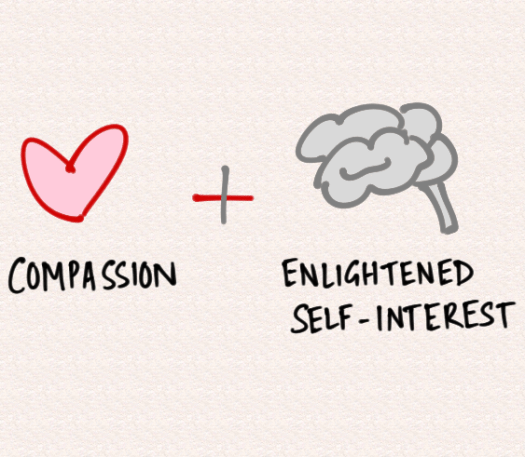
Collier’s argument is that those who have must do something for those who don’t – for two reasons. The first is compassion – because it’s the right thing to do. The second is in enlightened self-interest. What one has can be taken away. Billions of people who have nothing, whose lives are changed by war and climate change will not stay where they are – they will move looking for safety and opportunity and walls will not keep them out. America’s instinctive view is perhaps a memory of the words of Benjamin Franklin that the best thing that can be done for those in poverty is to help and guide them out of it.

This is easier said than done, of course, but one way to start is to insist that good governance is a condition of aid, trade and security. This applies to countries and to companies. Firms should not be allowed to invest and operate in countries with poor governance, or at least have restrictions on what they can do that are lifted as governance improves. You can see this happening in corporations already and those with good governance should help others, trade with them and offer long-term contracts as long as they show how they are, or trying to achieve better governance.

This may seem like a thing that doesn’t matter to individuals like you or me but it does. In our neighbourhoods we need good governance. The pandemic has led to an increase in poverty, which leads to a lack of opportunity, which leads to crime, which happens on your street. Poor governance affects us all – and we have to do something about it at every level, before it’s too late.

Cheers,

Karthik Suresh
How To Build On The Work Of Others

building-on-prior.png

Friday, 8.35pm

Sheffield, U.K.

Never become so much of an expert that you stop gaining expertise. View life as a continuous learning experience. – Denis Waitley

Many many years ago I picked up a textbook that had something to do with a social science – I think it was something like semiotics and I found it a disconcerting experience. The textbooks I was used to simply talked about facts, about known things, things you could observe and try and calculate and measure and weigh and program. They just were. A physics textbook didn’t talk about how different people viewed gravity – it was simply something you used in a calculation. Of course, we knew that once upon a time there was a guy whose path intersected with an apple and before that people thought there was something called an ether – but that was history – stories.

This other textbook, however, was full of things like Person A said this, and Person B said that and this is what another commentator said – and I found that very strange. Did they just not know? Why was there all this focus on who said what? Surely the facts were all that mattered?

It took several years before I realised that the complex areas are the ones that deal with people and social situations – the kind of areas that don’t lend themselves to a tidy equation. And you need a different sort of knowledge to deal with them.

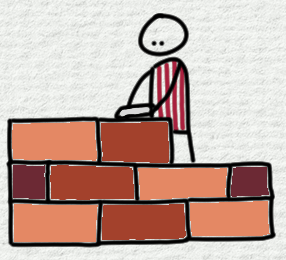
Now, you could come up with something new but the chances are that there are methods out there that people have tried before. Ackerman et al talk about how its hard to get people to build on prior work rather than constantly creating new approaches. If you keep placing a single brick on the ground you never create anything, but if you lay bricks on top of each other you can create a large structure.

But leads to a catch-22 situation; you have to invest the time to learn different approaches before you can tell if they’re worth learning. Just reading about it or doing a course isn’t enough too – you have to spend time applying what you learn to really get a feel for whether it will work for you or not.

Keys (2006) writes about this issue about gaining expertise – how someone new to a field has to learn how to use existing methods and tools, think about their experience, reflect on their use of the tools, and work out how to improve them. In doing so they adapt and customise the tools to work for them, potentially creating a unique approach that is the way they do things – their signature.

These challenges are like opposing forces, do you stick with the old or come up with something new, do you create something anyone can do or do you have to find something special that only you can do. There are no simple answers – if something is so easy that anyone can do it then it may not be worth you learning it too. If something is so hard that only you can do it people need to be able to recognise the value or you won’t get very far trying to sell your service.

It’s a hard circle to square, this one – but if you manage to do it you’ll probably have a competitive advantage others will struggle to match.

Cheers,

Karthik Suresh

References

Ackerman, F., Franco, L.A., Rouwete, E., White, L. (2014), “Problem structuring research and practice for the next decade: looing back to go forward”, EURO Journal of Decision Process, Vol 2, pp 165-172

P Keys (2006), On becoming expert in the use of problem structuring methods, Journal of the Operational Research Society, 57:7, 822-829

Pick A Field That You Can Stick To

pick-a-field.png

Thursday, 9.04pm

Sheffield, U.K.

The difference between involvement and commitment is like ham and eggs. The chicken is involved; the pig is committed. – Martina Navratilova

Some people are lucky enough to know what they want to do from a young age – and pursue their interests. The rest of us muddle along and try to figure out what works along the way.

An important barrier is having the freedom to do what you want – it’s much harder to pursue an interest when you’re under pressure to bring in money and meet basic needs. It’s no surprise that early modern scientists were often men of means – they had the time and space to work on what interested them, unlike the workers on their fields.

If you do have the freedom to study what you want then at some point you start being asked to choose what field you’re working in. Again, this starts early in school. Not doing biology rules out medicine. Not doing science rules out engineering. Yes you can catch up later, but it’s hard.

A sensible strategy, in the early days, is to preserve optionality – a fancy way to say keep your options open. It’s possible to study some subjects that are functional – that you may use to earn a living while keeping your interests going. Optionality, however, dilutes your chances of doing any particular thing. In essence, you sacrifice a win big/lose all bet for a set of possible outcomes having a 10-20% chance of coming off.

Making big bets may be easier when you’re young – there is less to lose, especially if you have a family safety net to fall back on. It gets harder to do later because you can’t walk away from 10-15 years of investment in a particular field.

This seems a little abstract but it does have to do with my research question. There’s a field called Systems Thinking, which has 20 or so methods and methodologies that range from quantitative, such as system dynamics, to cybernetic, such as the Viable system model. I entered the field through an exposure to Systems Thinking and then found a niche called Problem Structuring Methods, which is my area of research interest.

Now, the question that I need to answer is what field am I working in. Systems science overlaps with, but is different to problem structuring. That choice of one field or the other changes the way in which one looks at the literature – at the body of material that is considered relevant – given the conceptual ground you are ploughing.

Similar challenges will probably be found in other scientific disciplines. Arguably you have conceptual differences in the way you approach sales – from the numbers game of some proponents to the consultative approach of others. It’s like deciding which sport works for you – some like the speed of basketball, others go for the experience of cricket.

When it comes down to it there are only a few ways to decide whether one approach is going to work or not. You have to ask yourself whether you’re doing it because you’re intrinsically interested or if you’re attracted to the rewards. And then you need to look at people who are a few years or decades ahead of you and see how they live their lives and see if that’s a model that you want for yourself.

And then you make a decision – and stick to it.

Cheers,

Karthik Suresh

Why Being A Big Brain Is Not Enough

company.png

Tuesday, 7.4pm

Sheffield, U.K.

Genius is not perfected, it is deepened. It does not so much interpret the world as fertilize itself with it. – Andre Malraux

Hugo Mercier and Christophe Heintz in their 2013 paper “Scientists’ argumentative reasoning” write about how the classical view of science is that it is advanced by a lone genius – a big brain that works in isolation and emerges with monumental finished work.

The classical view is wrong.

Advancement happens as a result of connections. Matthew Syed, in his book “Rebel Ideas” says that the Neanderthals had bigger brains than modern humans but they lived in small social groups while humans lived in larger ones. The advantage of large groups is that ideas spread. It might take a big brain to first use a stick as a tool but once smaller brains learn about fire from each other, they’re more powerful as a group.

This is a hard thing for some of us to accept. We see ourselves as islands, independent entities that don’t need others to do what we do. But we do need others. Companies grow not because of the genius of their founders but because they recruit people – getting a motivated team together heading in the same direction is what you need for results in any field – science, entrepreneurship or sport, to name a few.

You have to make a case to convince others that all of you should head in a particular direction. That direction may be your company strategy or your plan to fight climate change – but success or failure comes down to two things. First, being able to argue your case and convince the audience that of your views. And the second is to evaluate other people’s arguments and see if they are reason to change yours or not.

If you come up with a better mousetrap you are going to have to be able to tell others about it – to sell it. And if someone does have a better mousetrap and you have a problem with mice, you’re going to need to be able to figure out whether it’s better or worse.

This may seem quite theoretical but it’s really of quite some practical importance. We’re faced with propositions these days that are really quite complicated. For example, how many people are really comfortable with the idea of cryptocurrencies or non fungible tokens (NFTs). I had a play with creating an NFT today and it’s pretty simple really – you need some bits and pieces but nothing seems particularly complicated.

Here is an example of a concept that’s new to people – and it doesn’t help that most explanations are bewilderingly technical. But advocates of decentralised technology keep talking about it – they keep putting forward “arguments” until some people try it out and then more and at some point it becomes something we all just do.

But the reason we try it out is because we’re evaluating the argument. An NFT is a way to prove ownership of a digital asset. Why would you want to do that – after all, if you create something you get copyright automatically. But to really understand the value of something that only exists digitally you just have to watch kids interacting with pretty much any game and getting excited about the artefacts they can collect or buy to realise that it’s very real for them – real enough to hand over money. And, of course, anything digital can be copied, so there’s some value in being able to say you own the thing – and being able to prove it.

The reason I had a look at NFTs is because of Twitter’s functionality where you can set an NFT as your profile picture. Accounts with NFTs show up as hexagons. And then you get this weirdness where people show you how you can use a graphic to mimic the same effect. And now you have people who have NFTs and people who are pretending to have NFTs. But here’s the point… only one set can actually prove it. So does that have value?

I think it might, at some point but I don’t know. But here’s the thing – over time things will get clearer as the group brain that is the Internet will help us figure it out. That is, perhaps, the real big brain out there now.

Cheers,

Karthik Suresh

Why It’s So Hard For One Person To Change Anything

tied-by-system.png

Monday, 8.36pm

Sheffield, U.K.

Life it is not just a series of calculations and a sum total of statistics, it’s about experience, it’s about participation, it is something more complex and more interesting than what is obvious. – Daniel Libeskind

I saw a post on LinkedIn today that quoted from the IPCC report “Climate change 2022: Impacts, adaptation and vulnerability” and highlighted the finding that 700 million people in Africa could be displaced by droughts by 2030.

That sounds like a problem – it sounds like you and I should be doing something about it.

I had a look at the IPCC report, which is subtitled “Summary for policymakers”. This summary runs to 3,676 pages. It has around 2.6 million words – five times the number I’ve written in the last five years. And they call this a “summary”!

I wrote a program some time back to pull out bigrams and trigrams from a text file. A bigram is two words, a trigram is three words. If we look for repeated bigrams and trigrams the selections we see are probably concepts that are important. I find that trigrams often describe larger concepts while bigrams elaborate on those concepts. Identifying these word patterns can give you an indication of what is important without having to read through all of the text.

The bigram that repeats the most in those 2.6 million words is, unsurprisingly, climate change. But rather than telling you about word counts, here’s what my code distilled from the text in 13 seconds.

Human induced climate change is causing increasing global warming. Higher global warming will lead to extreme weather events and climate related hazards, like vector borne diseases, and affect people that have climate sensitive livelihoods. The solution is climate resilient development, including ecosystem and community based adaptation, nature based solutions and advances in sustainable development.

What you notice when you look at this distillation is that these issues are much bigger than any one person. We are stuck within systems – tied in a web of restraints connected to the world in which we live and operate. Most individuals don’t have the power to dictate where their food is grown, how their clothes are made or what they buy in stores.

These decisions are made by managers – the people in charge. In government, of course, these are politicians. They are the ones with the power to change things and therefore the ones with the responsibility to change the system – and if they do that you can get on and do your part. You can’t buy zero carbon products unless the government makes them better value than high carbon alternatives.

The post I saw ends with a call to action – one that says we must put pressure on leaders to act. And that is the starting point – once the system is changed by those that have the power those of us that live in it will respond very quickly. And that’s the only way the impacts of climate change can be addressed.

Cheers,

Karthik Suresh

How To Use Circles To Model Social Relationship Structures

circles-as-social-models.png

Sunday, 8.12pm

Sheffield, U.K.

The whole universe is based on rhythms. Everything happens in circles, in spirals. – John Hartford

I’m still working through Rebel ideas by Matthew Syed and want to note an interesting way in which he uses circles to model the way social relationships operate.

Take two groups of people, reds and blues. Each one believes in different things. Each one is also convinced that the other is wrong. How can we model what might happen as a result?

The first model assumes that the groups don’t communicate – they have enough to talk about with people like themselves that there is no need to talk to others who are wrong.

This is the world of politics where what you say is meant to be heard by people who agree with you. Those who don’t won’t agree with anything you say away.

Now you would think that when these groups are in a situation where they can overlap with other groups that access to information that contradicts what they know would help them broaden their minds. But it doesn’t.

This is the second model, where the group is big enough to have diversity but somehow that doesn’t happen. The Internet is the widest grouping of humans there is and it’s full of little enclaves of people who think the same way and have found their “tribe”. Some of these groups are harmless, some nutty, some dangerous.

It turns out, that there is a Goldilocks zone for openness – when the group is big enough to have people with different views but small enough so that they overlap – they have to engage with each other. And that’s what changes minds, prolonged interaction with those others that you believed thought and acted in one way – but you really didn’t know.

While these ideas are interesting, what I’m musing about is the use of these circles for modelling ideas about organisations. Of course you have Venn diagrams, which are what these are. And then you have the idea of circles of competence – maybe it’s when you get a critical mass of people with overlapping circles of competence that startups reach a tipping point. If you’re too big, too much of a single circle with no connections, that’s a sign that you are heading for trouble.

Something to think about.

Cheers,

Karthik Suresh

Hierarchies And Networks And Which Are Better When

hierarchies.png

Thursday, 8.17pm

Sheffield, U.K.

Power is changing hands, from dying hierarchies to living networks. – Marilyn Ferguson

Matthew Syed’s book Rebel ideas: The power of diverse thinking reminded me of the work of Jordan Peterson, who popped up on the occasional YouTube video. Peterson is a “man’s man” sort of character – and what I caught from these brief videos was a sense of a “no punches pulled” character with strong opinions. It turns out that his views may be on the extreme side and perhaps wrong as well as dangerous, but let’s leave that aside and focus on one particular idea.

Peter suggests that dominance hierarchies are a feature of groups and go back hundreds of millions of years – lobster’s brains are wired in this way. I wrote about this previously here and we still examples of this in many aspects of our lives. The military is organized this way, some companies are too. Many public sector institutions have a hierarchy at their core.

Or do they?

It’s one thing looking at animals and saying the big, strong ones have all the fun – they get to lord over their territory and have their pick of mates. This idea of social structure leads to a “command and control” approach and is the sort of thing that comes to mind when we think of many social situations, and is not helped by stereotypes in the media and popular culture.

It’s also a particularly male point of view. Syed points out that when you really look at animal populations this idea of males being in charge starts to break down. Females have more choice than you think. Groups can be led by matriarchs rather than bulls. It turns out that things aren’t quite that simple.

Syed points to anthropological research that found that there is another kind of structure based on what he calls prestige. This is about connections, about the web of relationships one has.

A hierarchy works in many cases – when you have a clear objective, when you’re trying to fight a battle, when it’s important to get on with a task than argue about who gets to lead. But in a much larger number of cases we have to get on with daily life and sort out the things that need to get done.

It turns out that we can do this better when we harness the collective intelligence of groups. There’s a romantic notion that great ideas come from lone geniuses. In fact the vast majority of ideas come from teams that work in societies where they can share and access ideas.

There’s a special case of harnessing collective intelligence that has to do with day to day work. Every time you have a meeting, work on a project, get a team together – you have to make choices about who to include or exclude, who to talk to and who to ignore. They way in which you do this will determine whether you end up with a homogeneous group that has the same sort of ideas or a mixed group that can be creative and contribute something new.

But how do you get different people to get involved and participate – won’t it end up being lots of people arguing because they don’t really understand one another?

That’s where the concept of “procedural justice” plays an important role. You have to design a method of engagement that makes people feel like they have been included, allowed to speak and been listened to – been heard. This is when they will have trust that the process works for them.

Hierarchies are simple, but they may also be a thing of the past. The future needs us to understand one another, not dominate one another.

Cheers,

Karthik Suresh

Who Is The Audience For Your Work?

audience-for-work.png

Wednesday, 7.49pm

Sheffield, U.K.

I can think of nothing that an audience won’t understand. The only problem is to interest them; once they are interested, they understand anything in the world. – Orson Welles

One of the most valuable things you can do is get market-product fit. People often talk about this in reverse – they talk about product-market fit – you have a product, like a better mouse trap, and your job is to find the people who need it.

The other way is to start with the market, go talk to people who you think have a mouse problem – and as you talk to them you realize that their real problem has to do with bears – so you build a bear trap. That’s market-product fit.

Understanding the market is not an easy thing to do and there are few shortcuts. There is a lot of well-intentioned advice out there but it’s not clear what is relevant to your particular situation.

One way is to analyze data to understand what people want. An early example of this is in the 1928 book The first hundred million by E. Haldeman-Julius. This tells the story of the Little Blue Books, mass-produced copies of very low priced books that covered a range of topics. They sold in vast numbers and provided an unequalled “test of reading tastes and desires.” The statistics told you what people wanted.

This approach is clearly at the heart of the modern economy that gets what people want to them as fast as possible. This is a world of things and market-product fit literally means just that, a particular product that you make and sell.

The next market to consider is the one of goals, aspirations and experiences. People want to achieve something, reach somewhere – whether it’s to get an education, lose weight, or get better at a skill. What they’re looking for is guidance, modelling, training, encouragement and mentoring.

It was never that clear to me who the audience was for this blog – who is interested in this content? It’s not really a product, and it’s not self-improvement advice. I didn’t start writing it for an audience anyway – I wrote it to help myself learn about concepts in the management literature.

And it’s that literature that’s pointed out that the market for the content in this blog is probably other practicing managers – which includes people in all kinds of organisations that have to deal with issues relating to the operations of their firms. It’s not about leadership and vision and big picture direction. And it’s not about style and brand and emotional appeal. It comes down to how we deal with the issues that exist in the world as we experience it – and what we can do about them. This probably seems obvious to you, but it’s the first time I’ve realized that in the last five years of writing.

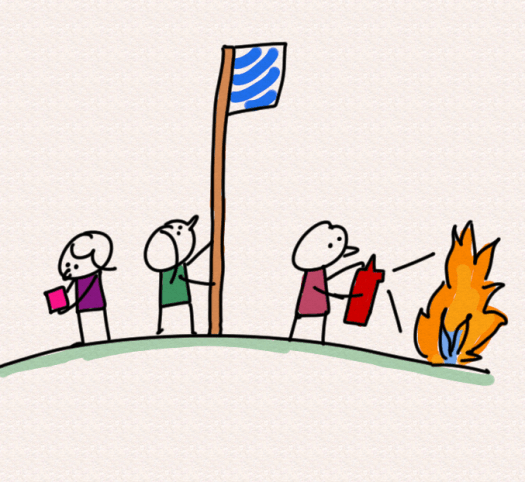
Management, by and large, is a task that involves putting out fires. It’s not something that comes naturally and it’s not something we’re taught to do. We have to seek out knowledge and avoid getting trapped in quick-fix approaches or stereotypical images of what management should be or look like. It’s an important activity that helps us deal with the complexity of the economic world around us. So it’s probably worth learning how to do better.

Cheers,

Karthik Suresh

How To Create A Rich Picture

edi-rich-picture.png

Tuesday, 7.32pm

Sheffield, U.K.

The history of the past is but one long struggle upward to equality. – Elizabeth Cady Stanton

In my last post I introduced the idea of facilitated modelling and suggested it was worth spending a little time exploring this. Facilitated modelling is a practice that helps to structure discussion through the use of a representation – a model of some kind that people can engage with.

Rich Pictures are a technique used in Soft Operations Research and particularly in Soft Systems Methodology (SSM). The idea is that getting people to draw a picture of a situation that matters to them is a useful way of getting at ideas and insights that are less easily expressed verbally or in written form.

I’m considering arguing that Rich Pictures should be treated as models – they have parts that can be related to make a whole. You can use the model to help you think and come up with observations and insights.

Take the concept of Equality, Diversity and Inclusion (EDI) – a subject that is getting increasing interest in the corporate and public sector worlds. Wolbring and Lillywhite (2021) have 35 pages of prose about EDI in Universities.

I’ve selected one section to demonstrate how one might start to build a Rich Picture. People who work in Universities such as academics have career ladder to climb. Their ability to climb it depends on other people – on how they are accepted, how visible they are, how much support they get and who mentors and pushes them. Academics that belong to under-represented groups or that have less privileged backgrounds experience challenges climbing the ladder. They also experience implicit biases, microaggression and need those with power to help change things. Change can’t happen soon enough – the earlier it starts the more likely it is that it will make a difference for people that are affected by inequality. They need access, opportunity and active promotion to develop their careers.

Hopefully you can see elements of these points in the image above. Imagine using a picture like this or one you’ve drawn yourself to talk through these ideas with someone else, exploring the various elements together. You might add your own ideas. The hope is that it helps us have a better discussion about the important points.

This post isn’t really about EDI but about how creating a picture to act as a model can help us have a discussion. It’s not a perfect solution – just a method that you can use if it’s something that works for you. We know that we can’t prove that one method works better than another when it comes to engaging in social situations like group problem structuring and problem solving. We can only try and have a high-quality discussion – one that makes us feel like we’ve said what we wanted to say, listened and been listened to and that the ideas that were expressed have been captured in a way that lets us take the next action.

One observation with modelling is that if you want to do it with others it needs to be as simple as possible. You can’t beat the experience of pen and paper or, in my case, stylus and screen. The more complicated your modelling process the more likely it is that you’ll need to do the work away from the group and come to the group to present and test your ideas. The takeaway is to keep it easy to follow along.

A picture creates issues of its own – should I draw race or gender more clearly? Will that lead to a different kind of bias because the picture is seen as unrepresentative? Should I draw a wheelchair or is it ok just having “keyhole” people? But just using text is also risky. Using the wrong words can offend others and we need to be careful to follow guidelines on inclusive language.

If you want to try this yourself the best thing to do is start by trying to express the problem that you’re considering as a picture – the actors, the elements, the relationships and talk about what they mean to you – aloud, to yourself, or in writing. See if this helps to bring clarity and organise your thoughts. And if it works, do it some more.

Cheers,

Karthik Suresh

References

Wolbring, G.; Lillywhite, A. 2021, “Equity/Equality, Diversity, and Inclusion (EDI) in Universities: The Case of Disabled People”. Societies, 11, 49.

Using Facilitated Modelling To Think About Marketing

causal-model.png

Business analytics or predictive modelling is a $100 billion industry, and $41 billion is spent on outsourced business analytics every year. I think that’s about twice the size of the movie industry – it’s really big. – Anthony Goldbloom

You’re probably familiar with the idea of facilitation – the art of getting people to talk about a situation of interest or concern to them. What’s less common is the idea of using a model to help with facilitation.

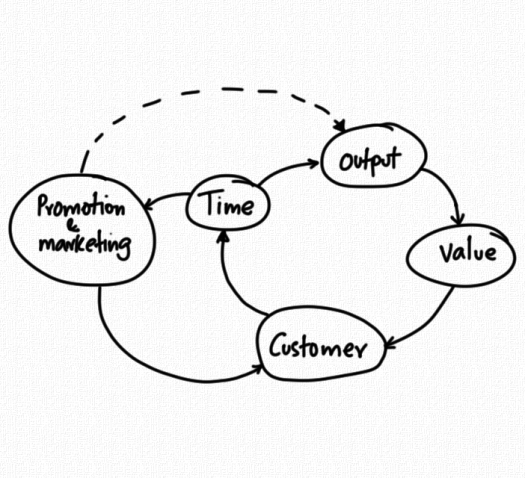
A model is a representation – some kind of thing that can be used to hold important ideas and talk about what’s going on without relying on remembering what people say. A model is different from a list of bullet points because it has elements and relationships – nodes and links. The picture above is an example of a causal loop model, something I’ve been trying to understand recently.

Causal loop models show cause and effect flows – plausible streams of activity that could explain what’s going on. They are simplifications that help us focus on important points and create a story, a narrative that explains what’s going on.

For example, if you run a business you can spend your time creating outputs that customers value. If they value what you do they will buy more time from you. That’s a positive loop – as you do more and better work you’ll get more customers.

If you spend time promoting and marketing yourself you’ll attract prospects some of whom will turn into customers. So that’s another positive loop.

The problem with spending your time marketing, however, is that it takes time and so you have less time to focus on output that customers find valuable. Spending all your time on marketing can end up reducing what you do, pulling down value for customers and causing them to spend less with you by going elsewhere.

This is a very simple causal loop that captures some of the considerations you need to look at when you’re coming up with a marketing strategy. You could assume that there is a limitless pool of customers out there and so losing some is ok as long as your promotion strategy brings in new ones. Or you could decide that your time is best spent creating your product and pay for promotion and marketing, either through advertising or by investing in a partner that does marketing for you.

Causal loops can be used to think through all kinds of issues – they’re the foundation of some of Peter Senge’s work on The Fifth Discipline about Systems Thinking. They are a subset of a wider group of graph models that show relationships between elements and help you deal with complexity.

Familiarity with facilitated modelling can help you deal with problems that are significant concerns to people and organisations – from business analytics to climate change. Al Gore, in a recent TED talk, described the sustainability revolution as all of the industrial revolution’s potential plus digital transformation.

The challenge practitioners face is that they have to be experts in facilitation and experts in the modelling process. This can be hard. Some modelling can be done in groups with people while other modelling needs to be done in the studio and then the results from the model shared and discussed with others.

This may be a topic that’s a little too niche for most people. But it’s a useful skill that could do with more attention. I might try and spend some time exploring the space in a few posts.

Cheers,

Karthik Suresh